
jedarden/duck-e
jedarden/duck-e has 56 GitHub stars and 10 forks. GitHot measured 0 stars in 24 hours. Last checked 2026-11-15 05:29 UTC. Last push 2026-11-13.
Measured star growth
- in 24h
- 0
- in 7 days
- Collecting history
- in 15 days
- Collecting history
- in 1 month
- Collecting history
Net star changes over overlapping periods, not daily totals. Missing measurements are left blank. Stars measure attention, not software quality.
About
Voice rubber-duck debugging assistant: a FastAPI backend bridges the browser (WebRTC) to the OpenAI Realtime API, with server-side tools for web search, URL fetch, weather, and per-user memory.
Developer ToolsREADME.md
OriginalDUCK-E
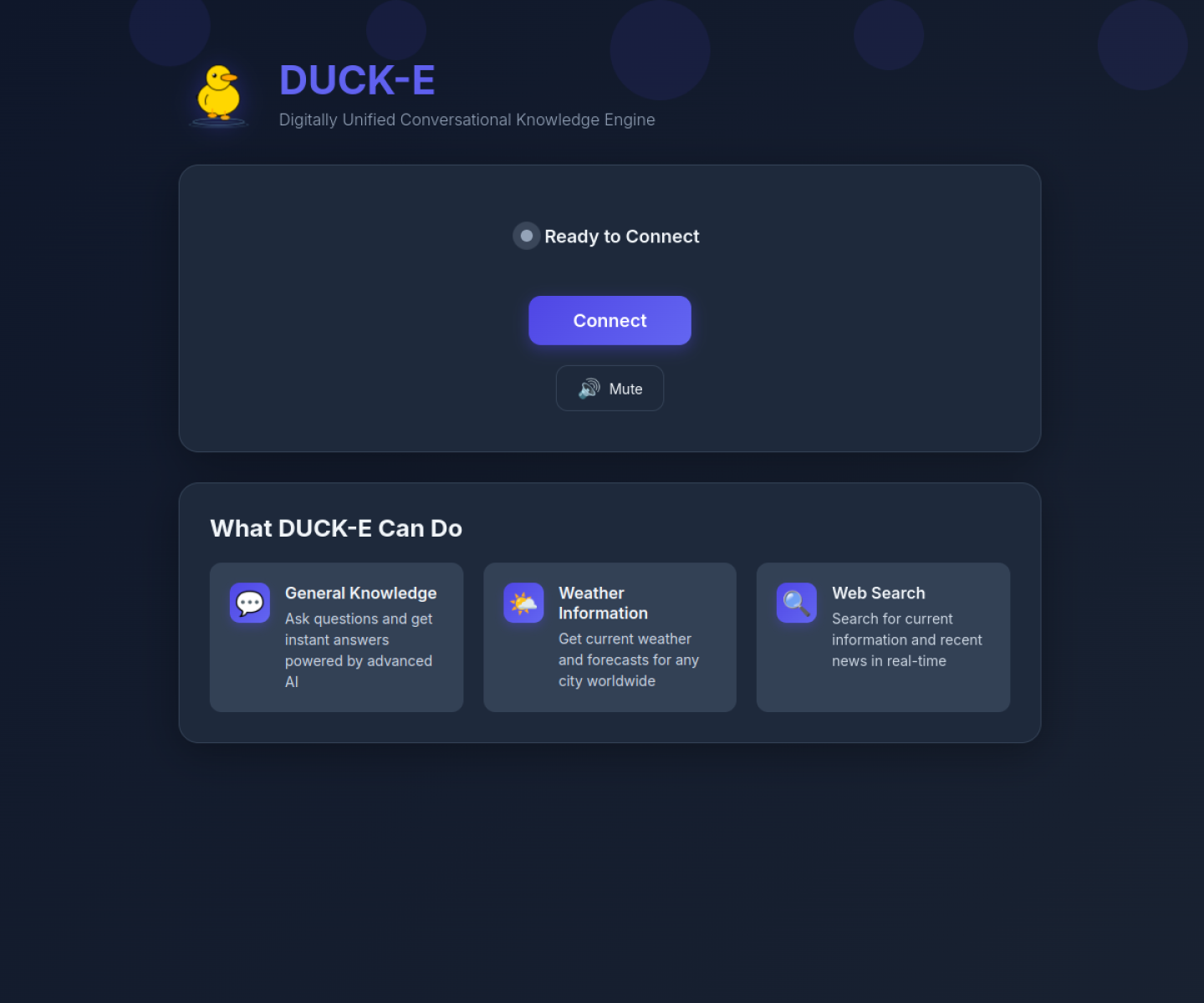
DUCK-E (Digitally Unified Conversational Knowledge Engine) is a browser-based voice assistant for rubber-duck debugging: you explain a problem out loud and it answers, asks questions, and can look things up. It is a FastAPI service that brokers a WebRTC session between the browser and the OpenAI Realtime API, plus a small set of server-side tools (weather, web search, URL fetch, per-user memory, voice switching). The backend is a custom RealtimeSession class; an earlier AG2/AutoGen dependency was removed and only the ag2.init client message name remains for compatibility.
Live demo: ducke-demo.ardenone.com
How it works
Browser (WebRTC) → WebSocket → FastAPI → OpenAI Realtime API
                                              (gpt-realtime-2)
- Your browser captures audio via the MediaDevices API and opens a WebRTC peer connection.
- The FastAPI backend requests an ephemeral key from OpenAI — your real API key never touches the browser.
- Speech is transcribed by OpenAI Whisper-1; the Realtime API handles both understanding and voice response natively.
- When DUCK-E needs external data (weather, web search), it calls the appropriate tool on the server and folds the result into its reply.
Features
Voice I/O
- Full-duplex voice conversation over WebRTC via the OpenAI Realtime API
- 11 voices (the Realtime API's set) — changeable mid-session via
session.update, no reconnect - Responses can be interrupted mid-sentence; the client finalizes the cut-off transcript
- Optional push-to-talk mode (hold a button or the spacebar) instead of an always-open microphone
Tools
| Tool | What it does |
|---|---|
get_current_weather |
Current conditions via Open-Meteo (free, no key required) |
get_weather_forecast |
Multi-day forecast via Open-Meteo |
web_search |
Live web search via OpenAI's gpt-4o-mini + web_search_preview |
web_fetch |
Fetches and parses a URL (SSRF-protected; blocks private IPs) |
save_memory / recall_memories |
Stores and retrieves facts about the user |
change_voice |
Switches voice mid-session |
Persistent memory
DUCK-E stores per-user facts with categories, confidence scores, and time decay, and surfaces them at the start of each session. Memory is keyed by user identity via:
- Validated JWTs (including Google OAuth): Signed identity claims take precedence and memory is keyed to the JWT email or subject
- Reverse proxy headers:
x-forwarded-emailthenx-forwarded-useris used only when the socket peer matches an IP or CIDR inTRUSTED_PROXY_SOURCES. The proxy must strip client-supplied identity headers before setting authenticated values.
Memory is silently disabled in local dev when neither authentication method is available.
Cost protection
- Per-session spend cap (default: $5)
- Hourly spend cap (default: $50)
- Circuit-breaker threshold (default: $100 — disables new sessions for 30 minutes)
- Maximum session duration (default: 30 minutes)
- Client-side live cost display derived from token counts in
response.doneevents
Security
- Ephemeral key flow — the real API key is never sent to the browser
- Per-IP rate limiting via slowapi
- SSRF protection on
web_fetch(resolves hostnames, rejects private/loopback ranges) - Input validation via Pydantic models (
LocationInput,SearchQuery,FetchUrl) - CORS origin whitelist
- Security headers middleware (HSTS, CSP, X-Frame-Options, etc.)
Before you start
- An
OPENAI_API_KEYwith Realtime API access. DUCK-E cannot hold a conversation without one. Voice sessions are billed by OpenAI; the per-session and per-hour cost caps described below are enforced server-side, but usage still costs real money. - Docker with the Compose plugin, or Python 3.12 if you prefer running directly on the host.
- A browser with a microphone (Chrome, Edge, or Firefox) and permission to use it. Microphone access is only granted on secure origins —
http://localhostcounts as one, so local use needs no TLS.
Quick start
Docker Compose (builds locally)
git clone https://github.com/jedarden/duck-e.git && cd duck-e
cp .env.example .env
# Add OPENAI_API_KEY to .env, then:
docker compose up --build -d
The compose file publishes host port 8000 by default; set DUCKE_PORT to override it (e.g. DUCKE_PORT=8080 docker compose up -d).
curl http://localhost:8000/status returns the running message and version.
curl http://localhost:8000/health/openai returns status: ok with a valid
key, or status: error without one.
Check that it came up:
curl http://localhost:8000/status
# {"message":"WebRTC DUCK-E Server is running!","version":"0.2.141"}

curl http://localhost:8000/health/openai
# {"status":"ok",...}  — your key works
# {"status":"error",...} — the key is missing or rejected; fix .env and restart
Then open http://localhost:8000, allow the microphone when the browser prompts, and start talking.
Local development
Requires Python 3.12.
git clone https://github.com/jedarden/duck-e.git && cd duck-e
python3.12 -m venv .venv
source .venv/bin/activate
pip install -r requirements.txt
cp .env.example .env
# Add OPENAI_API_KEY to .env, then (--env-file loads it):
uvicorn app.main:app --reload --host 0.0.0.0 --port 8000 --no-proxy-headers --env-file .env
Environment variables
| Variable | Required | Default | Description |
|---|---|---|---|
OPENAI_API_KEY |
Yes | — | Must have Realtime API access |
REALTIME_MODEL |
No | gpt-realtime-2 |
Override the realtime model |
REALTIME_VAD_EAGERNESS |
No | auto |
Semantic turn-detection eagerness: low, medium, high, auto; invalid values fall back to auto |
REALTIME_NOISE_REDUCTION |
No | near_field |
Input noise reduction: near_field, far_field, or off to disable; invalid values fall back to near_field |
REALTIME_TRANSCRIPTION_MODEL |
No | gpt-4o-transcribe |
Input transcription model (was whisper-1) |
GOOGLE_CLIENT_ID |
No | — | Google OAuth client ID (for user authentication) |
GOOGLE_CLIENT_SECRET |
No | — | Google OAuth client secret |
GOOGLE_REDIRECT_URI |
No | http://localhost:8000/auth/callback |
OAuth callback URL |
JWT_SECRET_KEY |
No | your-secret-key-here-change-in-production |
JWT signing secret |
JWT_ALGORITHM |
No | HS256 |
JWT algorithm |
JWT_EXPIRATION_MINUTES |
No | 120 |
JWT token expiration time |
TRUSTED_PROXY_SOURCES |
No | empty (trust none) | Comma-separated proxy IP addresses or CIDRs permitted to supply x-forwarded-user and x-forwarded-email |
RATE_LIMIT_ENABLED |
No | true |
Toggle per-IP rate limiting |
RATE_LIMIT_WEBSOCKET |
No | 5/minute |
Per-IP WebSocket connection rate |
COST_PROTECTION_ENABLED |
No | true |
Toggle cost protection |
COST_PROTECTION_MAX_SESSION_COST_USD |
No | 5.0 |
Per-session spend cap |
COST_PROTECTION_MAX_TOTAL_COST_PER_HOUR_USD |
No | 50.0 |
Hourly spend cap |
COST_PROTECTION_CIRCUIT_BREAKER_THRESHOLD_USD |
No | 100.0 |
Kill-switch threshold |
COST_PROTECTION_MAX_SESSION_DURATION_MINUTES |
No | 30 |
Maximum session length |
ALLOWED_ORIGINS |
No | — | CORS origin whitelist (comma-separated) |
GRAFANA_ADMIN_USER / GRAFANA_ADMIN_PASSWORD |
No | — | Required operator credentials for the monitoring Compose stacks |
API endpoints
| Method | Path | Description |
|---|---|---|
GET |
/ |
Main chat UI |
WS |
/session |
Real-time audio WebSocket |
GET |
/status |
Health check + version |
GET |
/health/openai |
Tests ephemeral key creation |
GET |
/metrics |
Prometheus metrics |
GET |
/auth/login |
Initiate Google OAuth flow |
GET |
/auth/callback |
OAuth callback handler |
GET |
/auth/config |
Check OAuth configuration |
GET |
/auth/me |
Validate JWT and get user info |
Voices
DUCK-E ships with 10 voices from the OpenAI Realtime API. Switch any time via the voice selector in the UI or by asking DUCK-E to change its voice mid-conversation:
alloy · ash · ballad · coral · echo · sage · shimmer · verse · marin · cedar
License
MIT — see LICENSE.
Part of jedarden.com · Read the write-up: jedarden.com/projects/ducke/
This GitHub repo is a read-only mirror of git.ardenone.com/jedarden/duck-e — issues and PRs are welcome here either way.