Projects View on GitHub
itsubaki/autograd
itsubaki/autograd has 27 GitHub stars and 4 forks. GitHot measured 0 stars in 24 hours and 0 in 7 days. Last checked 2026-11-15 03:34 UTC. Last push 2026-11-03.
Measured star growth
- in 24h
- 0
- in 7 days
- 0
- in 15 days
- Collecting history
- in 1 month
- Collecting history
Net star changes over overlapping periods, not daily totals. Missing measurements are left blank. Stars measure attention, not software quality.
About
Automatic differentiation library in Go
Machine LearningREADME.md
Originalautograd

An automatic differentiation library in Go.
Examples
Backward
import (
	"fmt"

	F "github.com/itsubaki/autograd/function"
	"github.com/itsubaki/autograd/variable"
)

func main() {
	x := variable.New(1.0)
	y := F.Sin(x)
	y.Backward()

	fmt.Println(y)
	fmt.Println(x.Grad)
}

// Output:
// variable(0.8414709)
// variable(0.5403023)
Composite function
matyas := func(x, y *variable.Variable) *variable.Variable {
	// 0.26(x^2 + y^2) - 0.48xy
	z0 := F.MulC(0.26, F.Add(F.Pow(2.0)(x), F.Pow(2.0)(y)))
	z1 := F.MulC(0.48, F.Mul(x, y))
	return F.Sub(z0, z1)
}

x := variable.New(1.0)
y := variable.New(1.0)
z := matyas(x, y)
z.Backward()

fmt.Println(x.Grad)
fmt.Println(y.Grad)

// Output:
// variable(0.03999999)
// variable(0.03999999)
Gradient descent
rosenbrock := func(x0, x1 *variable.Variable) *variable.Variable {
	// 100 * (x1 - x0^2)^2 + (x0 - 1)^2
	y0 := F.Pow(2.0)(F.Sub(x1, F.Pow(2.0)(x0)))
	y1 := F.Pow(2.0)(F.AddC(-1.0, x0))
	return F.Add(F.MulC(100, y0), y1)
}

update := func(lr float64, x ...*variable.Variable) {
	for _, v := range x {
		v.Data = tensor.F2(v.Data, v.Grad.Data, func(a, b float64) float64 {
			return a - lr*b
		})
	}
}

x0 := variable.New(0.0)
x1 := variable.New(2.0)

lr := 0.001
iters := 10000

for i := range iters + 1 {
	if i%1000 == 0 {
		fmt.Println(x0, x1)
	}

	x0.Cleargrad()
	x1.Cleargrad()
	y := rosenbrock(x0, x1)
	y.Backward()

	update(lr, x0, x1)
}

// Output:
// variable(0)         variable(2)
// variable(0.6837119) variable(0.4659528)
// variable(0.8263181) variable(0.6820318)
// variable(0.8947841) variable(0.8001903)
// variable(0.9334872) variable(0.8711214)
// variable(0.9569893) variable(0.9156519)
// variable(0.9718162) variable(0.9443121)
// variable(0.9813804) variable(0.9630323)
// variable(0.9876351) variable(0.9753732)
// variable(0.9917611) variable(0.9835568)
// variable(0.9944981) variable(0.9890044)
Deep Learning
dataset := NewCurve(N, noise, math.Sin)
dataloader := &DataLoader{
	BatchSize: batchSize,
	N:         dataset.N,
	Data:      dataset.Data,
	Label:     dataset.Label,
}

m := model.NewLSTM(hiddenSize, 1)
optim := &optimizer.SGD{
	LearningRate: 0.01,
}

for i := range epochs {
	m.ResetState()

	loss, count := variable.New(0), 0
	for x, t := dataloader.Seq2() {
		y := m.Forward(x)
		loss = F.Add(loss, F.MeanSquaredError(y, t))

		if count++; count%bpttLength == 0 || count == dataset.N {
			m.Cleargrads()
			loss.Backward()
			loss.UnchainBackward()
			optim.Update(m)
		}
	}
}
Double backpropagation
x := variable.New(1.0)
y := F.Sin(x)
y.Backward(variable.Opts{
	CreateGraph: true,
})

fmt.Println(y)
fmt.Println(x.Grad)

for range 5 {
	gx := x.Grad
	x.Cleargrad()
	gx.Backward(variable.Opts{
		CreateGraph: true,
	})

	fmt.Println(x.Grad)
}

// Output:
// variable(0.84147096)
// variable(0.5403023)
// variable(-0.84147096)
// variable(-0.5403023)
// variable(0.84147096)
// variable(0.5403023)
// variable(-0.84147096)
NoGrad and Test mode
func() {
	defer variable.Nograd().End()

	// No graphs are generated for gradient computation.
	for _, x := range xs {
		m.Forward(x)
	}
}()
func() {
	defer variable.TestMode().End()

	// DropoutSimple has no effect during test mode.
	// Take a look at the implementation of DropoutSimple as well.
	F.DropoutSimple(0.5)(x)
}()
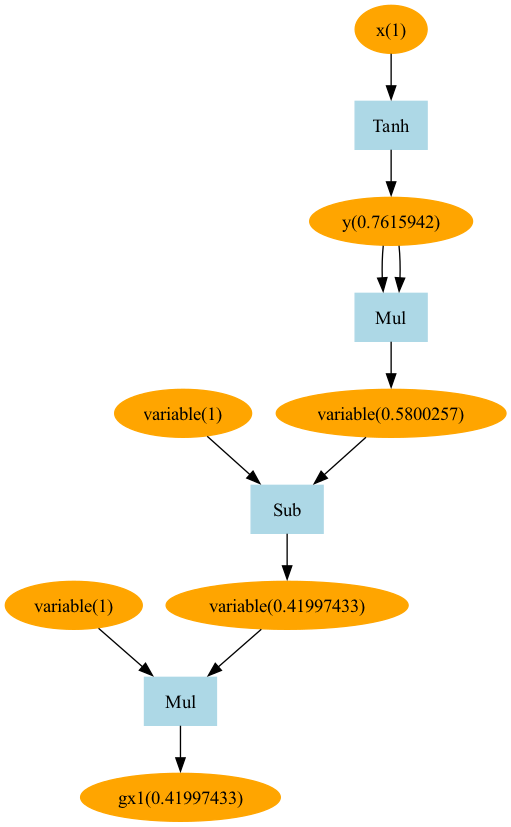
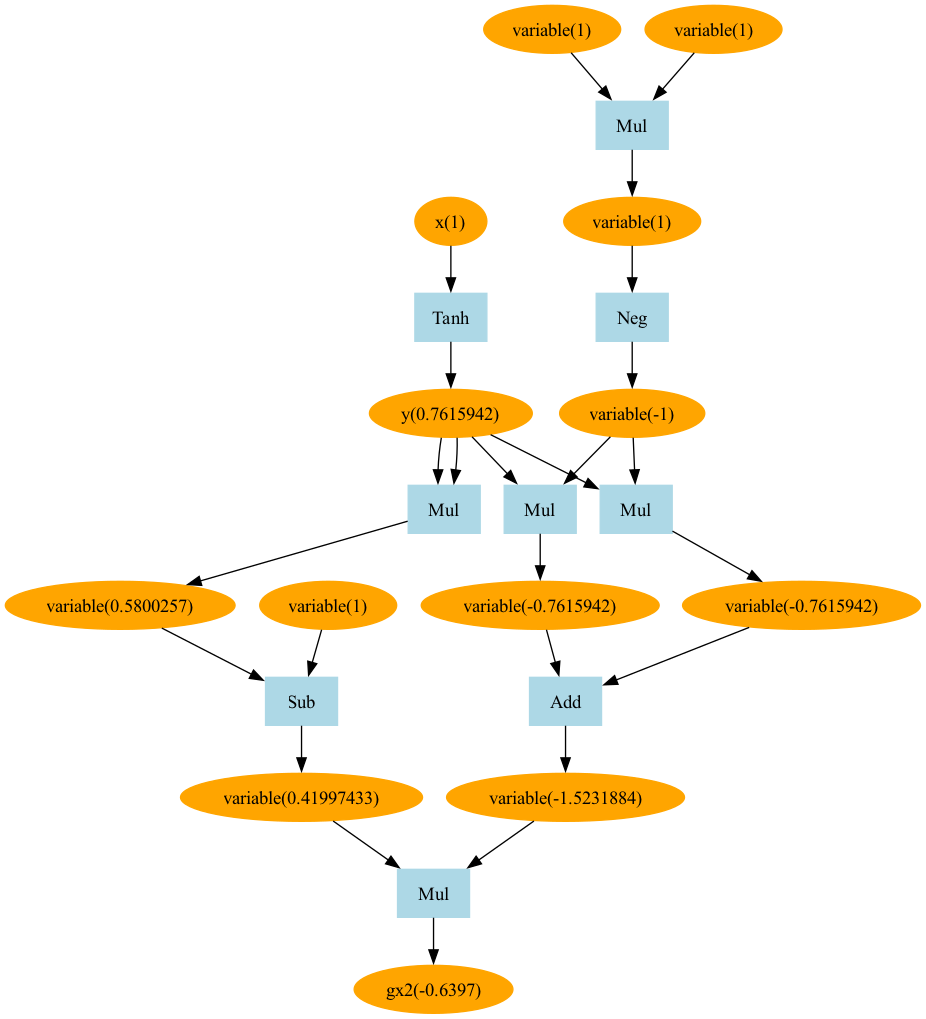
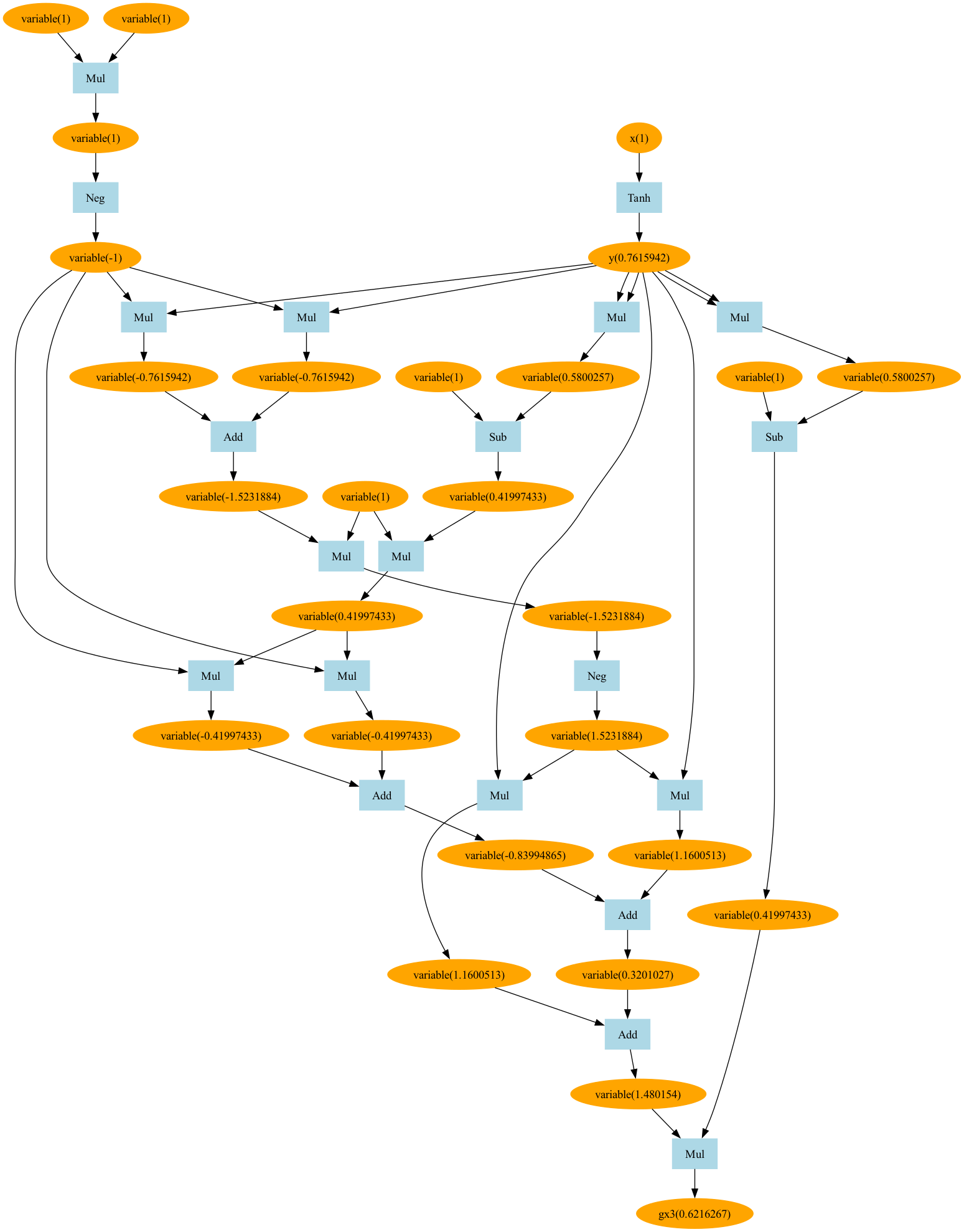
Dot graph
brew install graphviz
go run cmd/dot/main.go -func tanh -order 2 -verbose > sample.dot
dot sample.dot -T png -o sample.png