
ide-digital/nulltrace
ide-digital/nulltrace has 42 GitHub stars and 0 forks. GitHot measured 0 stars in 24 hours. Last checked 2026-11-11 17:49 UTC. Last push 2026-10-26.
Local-first privacy toolkit. Map yourself against 400+ data brokers, send CCPA/GDPR deletion mail, and check password dumps. The vault never leaves your machine.
Measured star growth
- in 24h
- 0
- in 7 days
- Collecting history
- in 15 days
- Collecting history
- in 1 month
- Collecting history
Net star changes over overlapping periods, not daily totals. Missing measurements are left blank. Stars measure attention, not software quality.
README.md
Original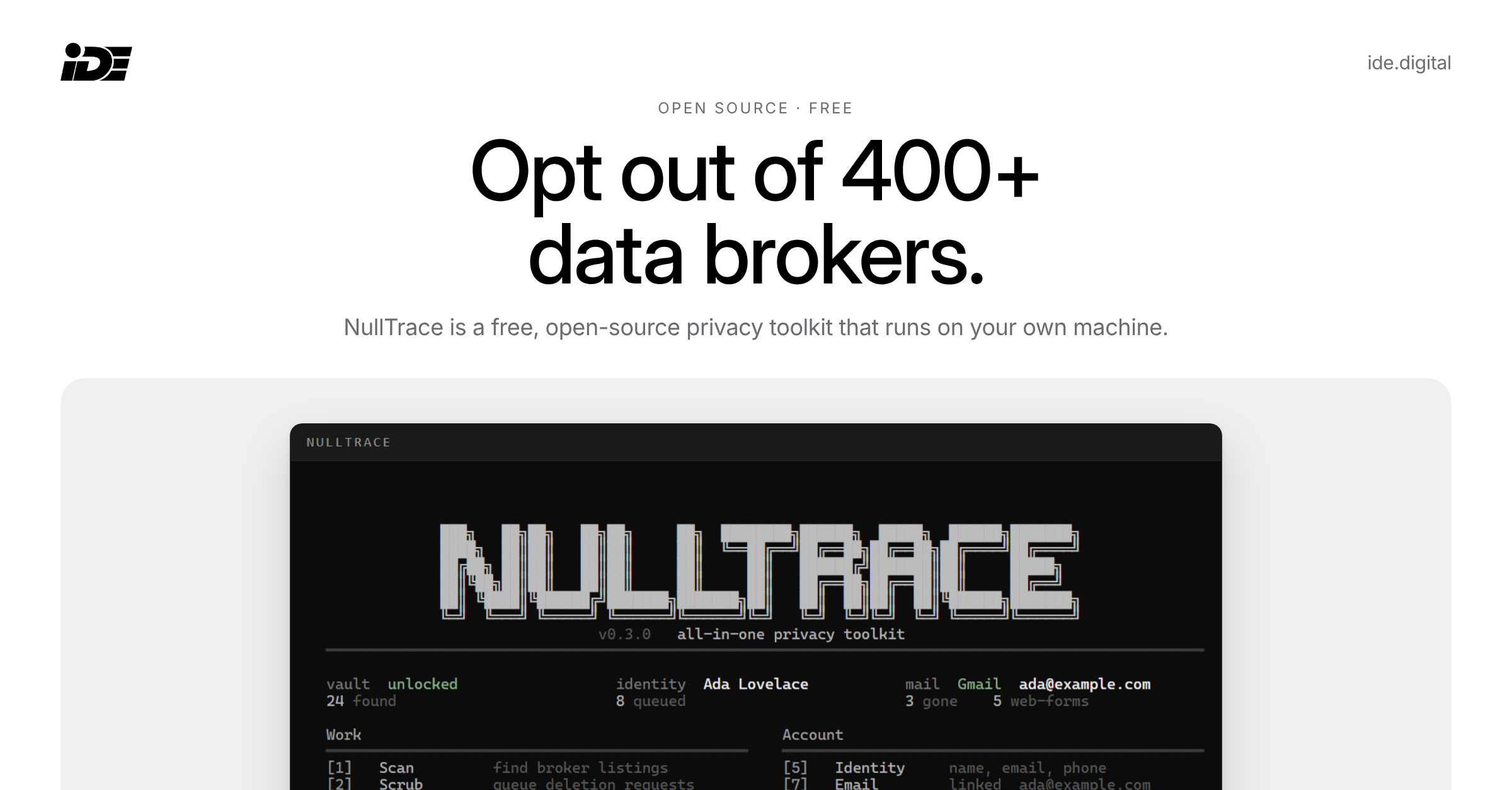
NullTrace
NullTrace matches the name, email and phone you give it against a catalog of people-search and marketing brokers, queues CCPA / GDPR deletion requests, sends them from a mailbox you already own, and checks your passwords against public breach dumps. Everything is stored in an encrypted vault on your computer. There is no NullTrace account and no NullTrace server.


Download · Quick start · What leaves your machine · Contributing
Why
Your address, phone number and relatives are probably listed on dozens of people-search sites. Getting removed means finding every broker, sending each one a legal deletion request, and tracking who actually complied. NullTrace does the tedious parts and keeps a record, without handing your identity to yet another company.
What it does
| Scan | Scores your identity against a maintained catalog of 400+ people-search sites, data brokers and ad-tech aggregators, and shows which ones are worth a request. |
| Scrub & Send | Builds CCPA / CPRA, GDPR and state-law deletion emails from local templates and sends them through your own Gmail, Outlook or Yahoo account. |
| Inbox | Optionally watches the same mailbox over IMAP for broker confirmations, so you can see who actually removed you. It only follows confirmation links that stay on that broker's own domain. |
| Playbooks | Step-by-step guides for brokers that only accept a web form. |
| Leaks | Scores password strength locally, checks a common-password list, and looks up breach dumps without sending the password. |
| Footprint | Looks up where a username is registered. |
| Vault | Mailbox passwords and API keys live in an encrypted local file (Argon2id + XChaCha20-Poly1305), never in plain config. |
What leaves your machine
By default, almost nothing.
- Scan is not a live crawl. It matches against the broker catalog bundled in this repo. It does not search the web for you.
- Password checks use k-anonymity. Only the first five hex characters of
SHA-1(password)are sent to the public Pwned Passwords range API. The full password and full hash stay local. NullTrace does not ask Have I Been Pwned which accounts were breached; that API needs a key. - Mail goes through your own mailbox. You paste in an App Password; SMTP is tested before it is saved. There is no OAuth app and no NullTrace inbox.
- Browser automation and CAPTCHA helpers ship disabled. By default it's just a catalog match and a templated email sent from your account.
Details and the threat model are in SECURITY.md.
Quick start
Download
Grab the build for your OS from the latest release.
Windows: unzip NullTrace-windows-amd64.zip, keep NullTrace.exe next to the app folder, and double-click. The exe isn't code-signed yet, so SmartScreen may ask first ("More info", then "Run anyway").
Linux:
tar -xzf nulltrace-linux-amd64.tar.gz    # or linux-arm64
./nulltrace-linux-amd64/nulltrace
macOS:
tar -xzf nulltrace-darwin-arm64.tar.gz   # darwin-amd64 on Intel Macs
cd nulltrace-darwin-arm64
xattr -d com.apple.quarantine nulltrace nulltraced   # not notarized yet
./nulltrace
Verify your download
Builds aren't signed with a paid certificate. This is how you confirm a download came from the public source.
Every file on the release page has a build attestation from GitHub Actions. With the GitHub CLI:
gh attestation verify nulltrace-linux-amd64.tar.gz --repo ide-digital/nulltrace
You can also check the SHA-256 against checksums.txt from the same release. The file lists every download, so pick out the line for yours.
Linux:
grep nulltrace-linux-amd64.tar.gz checksums.txt | sha256sum -c
macOS:
grep nulltrace-darwin-arm64.tar.gz checksums.txt | shasum -a 256 -c
Windows PowerShell:
(Get-FileHash .\NullTrace-windows-amd64.zip -Algorithm SHA256).Hash.ToLower()
Select-String NullTrace-windows-amd64.zip checksums.txt
The two hashes should match.
Build from source (Linux, macOS, Windows)
You need Go 1.23+ and make. On Windows, run it from Git Bash.
git clone https://github.com/ide-digital/nulltrace.git
cd nulltrace
make build
./bin/nulltrace
That builds bin/nulltrace and bin/nulltraced. On Windows it builds bin/NullTrace.exe and bin/app/ instead, the same layout as the zip. No C toolchain is needed.
First run
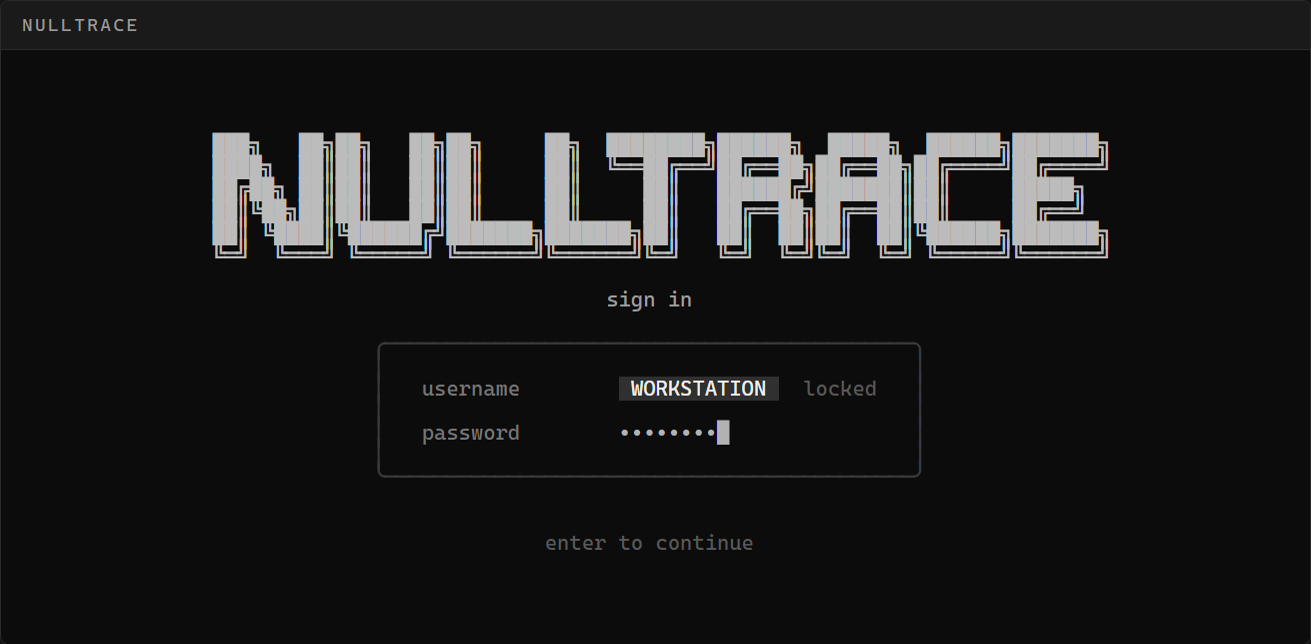
The first launch shows a loading bar, then asks you to create a login. The username is your computer name and is locked on purpose; the password is the key to your vault.
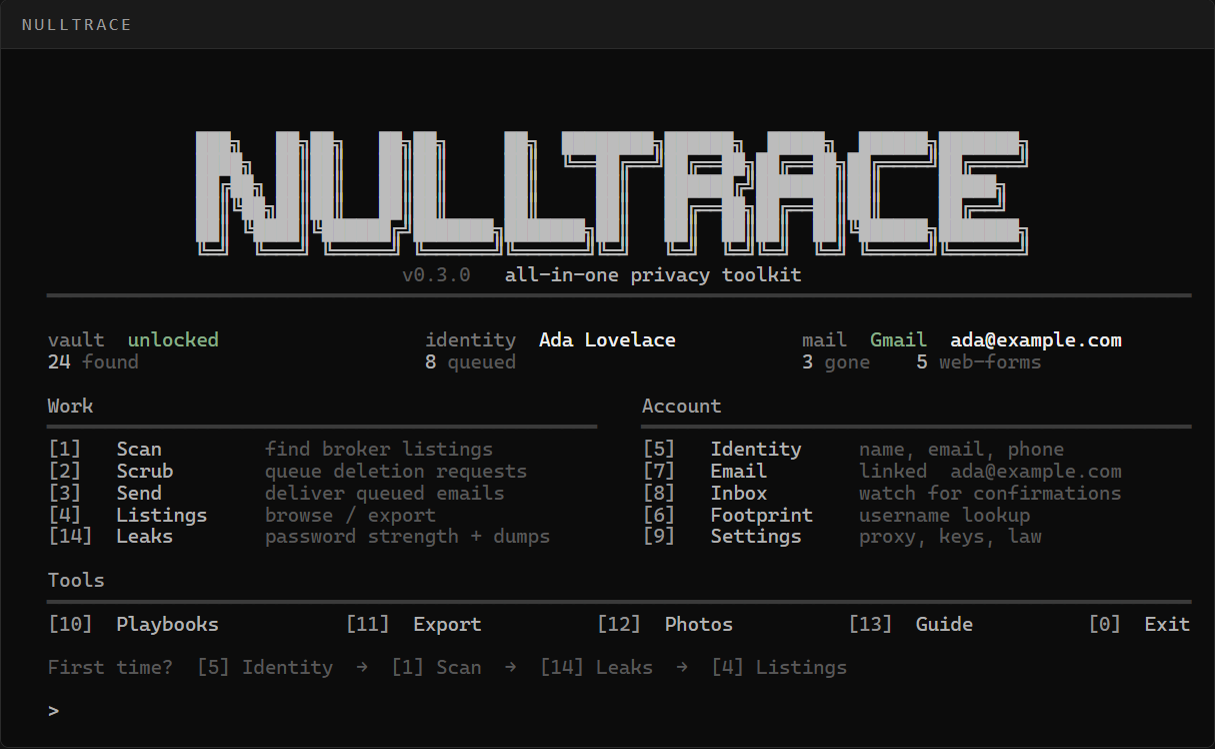
Then work through the home menu:
- [5] Identity: the name, email and phone people-search sites actually have on you
- [1] Scan: match that identity against the catalog
- [4] Listings: browse, search and export the matches
- [7] Email: link Gmail, Outlook or Yahoo with an App Password (your normal mailbox password will not work)
- [2] Scrub, then [3] Send: queue and deliver the deletion requests
- [10] Playbooks: handle brokers that only offer a web form
- [14] Leaks: optional password check
Nested screens use [0] back and [m] main menu. The identity form validates names, email, phone, date of birth and city; leave a field blank to skip it.
Running it as a service
nulltraced keeps the vault unlocked on a box while the CLI talks to it on 127.0.0.1:7738. See source/docker-compose.yml and source/scripts/systemd/nulltraced.service. source/scripts/install.sh (or make install) builds nulltrace and nulltraced into /usr/local/bin, using sudo only if it has to, and sets the daemon up as a systemd user service so it never runs as root. The daemon leaves queued mail alone until a mailbox is linked.
How the catalog stays current
Opt-out pages move and privacy addresses go dead. A GitHub Action checks every opt-out page and privacy address in the catalog once a week. Broken entries open an issue, and that same issue is updated each week until things are fixed.
A release only ships when the check passes. Entries we know are broken sit in known_issues.yaml for at most 60 days, so the list can't grow quietly.
If you fix an entry, send a pull request and include a source for the new URL or address. CONTRIBUTING.md shows how to run the check yourself.
Re-listing
Brokers sometimes add you back. While nulltraced is running, a watchdog checks once an hour:
- A removal you confirmed more than
scheduler.repopulation_daysago (45 by default) goes back to "re-check". - Each broker has a
repopulation_period_days(60 by default). Once that many days have passed since a completed request, the record is flagged again.
Nothing is re-sent automatically. Run Scrub again and it queues new requests for anything marked "re-check".
Where files live
| Windows | Linux / macOS | |
|---|---|---|
| Vault | %LocalAppData%\nulltrace |
$XDG_DATA_HOME/nulltrace (usually ~/.local/share/nulltrace) |
| Config | %AppData%\nulltrace |
$XDG_CONFIG_HOME/nulltrace (usually ~/.config/nulltrace) |
Config is YAML (source/config.example.yaml shows the default shape). Mailbox passwords, HIBP keys and CapSolver keys go in the vault with nulltrace secret set, not in the YAML. Deletion templates (CCPA, GDPR, state) live in source/internal/engine/mailer/templates/, and the jurisdiction is a setting.
Contributing
The broker catalog is YAML in source/internal/broker/data/. Opt-out pages change constantly, so a pull request that adds a broker or fixes a stale opt-out URL is the most useful contribution there is. Include a source for the URL or privacy address.
make test
On Windows the console is pinned to the window size rather than the 3000-row scrollback buffer, which used to smear the login field. If you touch source/internal/tui/login.go or source/cmd/nulltrace/console_windows.go, keep the login tests green.
Never commit a vault, daemon.token, .env, real identity data or screenshots of a live vault. See CONTRIBUTING.md.
Security
Found something that looks like a vault bypass or a crypto bug? Please report it privately through GitHub security advisories, not a public issue. See SECURITY.md.
License
Built and maintained by IDE Digital, development for agencies and founders.
Explore related projects
trimstray/the-book-of-secret-knowledge
A collection of inspiring lists, manuals, cheatsheets, blogs, hacks, one-liners, cli/web tools and more.
257,712 starsHack-with-Github/Awesome-Hacking
A collection of various awesome lists for hackers, pentesters and security researchers
125,254 starsswisskyrepo/PayloadsAllTheThings
A list of useful payloads and bypass for Web Application Security and Pentest/CTF
82,583 starscaddyserver/caddy
Fast and extensible multi-platform HTTP/1-2-3 web server with automatic HTTPS
78,959 stars