
iamNCJ/RenderFormer-Studio
iamNCJ/RenderFormer-Studio has 45 GitHub stars and 3 forks. GitHot measured 0 stars in 24 hours. Last checked 2026-11-14 22:59 UTC. Last push 2026-09-09.
Measured star growth
- in 24h
- 0
- in 7 days
- Collecting history
- in 15 days
- Collecting history
- in 1 month
- Collecting history
Net star changes over overlapping periods, not daily totals. Missing measurements are left blank. Stars measure attention, not software quality.
About
Official data, training, and inference code for RenderFormer (SIGGRAPH2025) and RenderFormer-V2 (ECCV2026)
Creative & MediaREADME.md
Original
RenderFormer Studio
Official, portable data-generation, training, and inference workflows for RenderFormer and RenderFormer-V2.
Agent-friendly by design: one CLI, stage-numbered recipes, and machine-readable receipts for reproducible data, training, and inference.
RenderFormer-V2 [ECCV 2026]: Chong Zeng · Yue Dong · Pieter Peers · Lvmin Zhang · Maneesh Agrawala
RenderFormer [SIGGRAPH 2025]: Chong Zeng · Yue Dong · Pieter Peers · Hongzhi Wu · Xin Tong
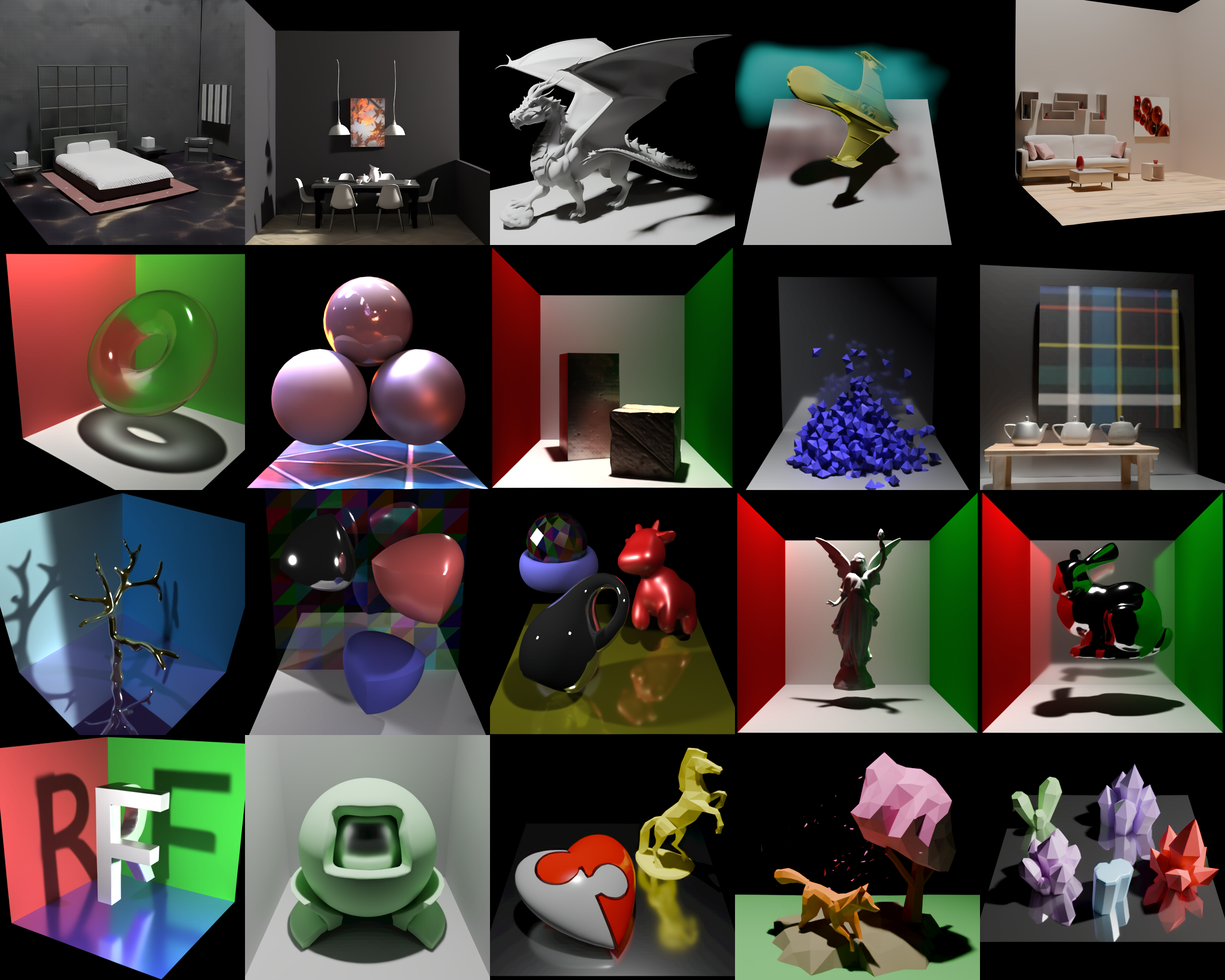
RenderFormer-V2 (top) and RenderFormer (bottom), rendered by the released inference pipelines. Scene credits: V2 · V1.
V1 Project | V2 Project | V1 Paper | V2 Paper | Models | Documentation
RenderFormer Studio unifies the maintained public implementation of both RenderFormer generations, including scene-data preparation, model definitions, training recipes, and inference pipelines.
V1 and V2 now share one model implementation. Training loads the trainable
RenderFormerModel component directly; inference uses
RenderFormerPipeline or RenderFormerV2Pipeline to assemble preprocessing,
auxiliary encoders, and rendering around that same component.
Use the documentation index to find the maintained guide, machine-readable source, and validation path for each workflow.
The distribution is named renderformer-studio; its Python package and only
console command are both named renderformer.
🤗 Published models
| Role | Hugging Face repository | Component subfolder | Link |
|---|---|---|---|
| V1 Base | microsoft/renderformer-v1-base |
repository root | Link |
| V1 Large | microsoft/renderformer-v1.1-swin-large |
repository root | Link |
| V2 native 512 | RenderFormer/renderformer-v2 |
transformer_512 |
Link |
| V2 native 2048 | RenderFormer/renderformer-v2 |
transformer_2048 |
Link |
| Material autoencoder | RenderFormer/renderformer-v2 |
material_autoencoder |
Link |
| Diffuse/specular mapper | RenderFormer/renderformer-v2 |
diffspec_mapper |
Link |
| Metallic mapper | RenderFormer/renderformer-v2 |
metallic_mapper |
Link |
| Metallic/transmission mapper | RenderFormer/renderformer-v2 |
metallic_transmission_mapper |
Link |
The V2 artifacts live in one componentized repository. A single repository
revision selects the two transformers, material autoencoder, and all three
mapper MLPs atomically. Authenticate with Hugging Face whenever the repository
is access-protected during release staging. Omit revision to follow the
bundle's default revision, or pass the same explicit branch, tag, or commit
when a reproducible component set is required. The package does not silently
replace it with a hard-coded commit hash.
🗂️ Repository layout
src/renderformer/
  pipelines/         RF1 and RF2 inference pipelines
  models/            shared transformer and material-model architectures
  data/              generation, conversion, H5 schemas, and loaders
  training/          RF1, RF2, and material-autoencoder training runners
  ops/               maintained CUDA/Triton operators
  cli/               unified command dispatcher and inference CLI
configs/
  model/{v1,v2,material}/  architecture-only YAML
  data/{v1,v2}/      stage-numbered data-generation YAML
  data/material/     material-autoencoder sphere-data YAML
scripts/data/        portable generation recipes and data utilities
scripts/train/       portable release-stage training launchers
examples/{rf1,rf2}/  runnable scene sources, launchers, and provenance
docker/              dependency-only runtime and data-generation images
environments/         Conda interpreter and compiled-system-package manifests
external/            contracts for separately acquired assets and models
licenses/            bundled third-party license texts
tools/blender_addon/  separate V1 and V2 Blender extension sources
docs/                environment, inference, and training guides
All wheel-installed runtime code lives in the single renderformer package.
The optional Blender integrations are two independent packages under
tools/blender_addon/: V1 exports RF1 H5 directly, while V2 exports the
prepared-frame intermediate consumed by the maintained data pipeline. They use
separate identifiers and can be installed together. The public release covers
maintained RF1/RF2 data preparation, training, inference
pipelines, and portable local launchers; deployment orchestration remains the
responsibility of the runtime environment. The RF1 composer's separately
documented legacy float16 material round-trip is input compatibility, not a
model-quantization backend.
⚙️ Installation
Core libraries, inference, and training support Python 3.10 or 3.11. The base installation contains lightweight schemas, H5 tools, and CPU-compatible data commands:
python -m pip install -e .
Verify the unified command surface after installation:
renderformer --help
renderformer infer --help
renderformer train --help
renderformer data --help
From an editable install, use the equivalent
python -m renderformer <command> ... module form. In an environment-only
container, PYTHONPATH=/workspace/renderformer/src enables the same command
without installing the project. No repository-root launcher wrappers are
required.
Each workflow declares its own optional dependencies. Install the optional
dependency groups you need, or combine several in one command such as
".[inference,geometry]":
python -m pip install -e ".[inference]" # inference pipelines and CLI
python -m pip install -e ".[training]"  # training entrypoints
python -m pip install -e ".[loaders]"   # PyTorch H5 loaders
python -m pip install -e ".[textures]"  # learned V2 texture/env encoders
python -m pip install -e ".[geometry]"  # remesh and local mesh utilities
python -m pip install -e ".[blender]"   # Blender/Cycles scene generation
The blender group covers surface-only scene generation. Volume scenes also
need the Python OpenVDB bindings, which are not a portable pip dependency; use
the Conda data-generation environment below for those.
For Blender generation, create the Python 3.11/OpenVDB 13 environment, then
install bpy==4.5.10 from PyPI and the shared datagen requirements:
conda env create -f environments/datagen.yml
conda activate renderformer-datagen
# Linux/NVIDIA only; use the CPU command in environments/README.md elsewhere.
python -m pip install \
  torch==2.7.1+cu126 torchvision==0.22.1+cu126 \
  --index-url https://download.pytorch.org/whl/cu126
python -m pip install bpy==4.5.10 --index-url https://pypi.org/simple
python -m pip install -r docker/requirements-datagen.txt
python -m pip install --no-deps -e .
Scene export from the Blender UI is also split by model generation. The repository publishes both extension source packages, not prebuilt ZIPs. If you want self-contained local installation archives, build the two platform-local, wheel-bearing packages in this environment. The builder uses the PyPI module and does not require an installed Blender.app:
PYTHON_BIN=python \
OUTPUT_DIR=/tmp/renderformer-blender-extensions \
bash tools/blender_addon/build.sh release
See the Blender extension guide for installation, dependencies, supported scene features, and the complete V2 prepared-frame to inference workflow.
For CUDA 12.6 training and inference, use the Python 3.10 Conda environment, then install the shared pinned requirements and FlashAttention:
conda env create -f environments/cuda.yml
conda activate renderformer-cuda
python -m pip install -r docker/requirements-cuda.txt
MAX_JOBS=4 python -m pip install \
  flash-attn==2.7.4.post1 --no-build-isolation --no-cache-dir
python -m pip install --no-deps -e .
See environments/README.md for both complete local environment receipts and CPU-only datagen guidance.
The datagen and CUDA environments are intentionally separate. Generate and
postprocess V2 scene H5 files under renderformer-datagen, then activate
renderformer-cuda for model inference or training; the public launchers do
not combine both dependency stacks in one process.
Packed-sequence V2 execution requires flash-attn. The pipeline fails early
with an actionable error if USE_SDPA=1 or ATTN_IMPL=sdpa conflicts with a
profile that enables packing. The default V2 release profile is deliberately
unpacked; the trainer-config checkpoint diagnostic may enable packing from
the serialized config.
🎨 Inference
Both the pipelines and the renderformer infer command consume a scene H5
file, so every workflow has two steps: prepare the H5, then render it.
1. Prepare a scene H5
An RF1 scene is composed from a JSON description with CPU mesh operations, and requires neither Blender nor a GPU:
renderformer data compose-rf1 examples/rf1/cbox.json --output scene.h5
renderformer data validate-h5 --input scene.h5 --format v1
An RF2 scene is generated with Blender/Cycles in the datagen environment and then postprocessed into the model-ready representation. The 12 curated RF2-only paper-scene definitions are bundled for the V2 200M architecture and run both stages through one launcher:
conda activate renderformer-datagen
bash examples/rf2/generate-paper-scene.sh \
  displacement-mapped-cornell-cube \
  /tmp/renderformer-rf2-displacement-mapped-cornell-cube
That writes the renderable file to
/tmp/renderformer-rf2-displacement-mapped-cornell-cube/processed/scene.h5.
For your own V2 scene, run the two stages explicitly:
renderformer data generate writes the raw H5, and renderformer data convert
applies the learned texture encoding, environment-map transforms, and volume
conversion. The optional
Blender extensions export from the Blender UI
instead: V1 writes RF1 H5 directly, and V2 writes the prepared-frame
intermediate that the maintained data pipeline consumes.
See the RF2 example guide for the paper-scene inventory, source generation launchers, H5 preparation, external asset requirements, provenance, and auxiliary-model requirements. The inference guide documents the complete V1 and V2 input-preparation receipts, including the exact RF1 H5 contract and the raw versus encoded V2 inputs.
2. Render the H5
Rendering needs only the inference environment, not the datagen stack. The CLI records the selected profile, resolved switches, input preprocessing, and auxiliary component provenance (source, requested revision, and dtype):
conda activate renderformer-cuda
renderformer infer \
  --input /tmp/renderformer-rf2-displacement-mapped-cornell-cube/processed/scene.h5 \
  --checkpoint RenderFormer/renderformer-v2 \
  --checkpoint-subfolder transformer_512 \
  --precision fp16 \
  --output-dir outputs
The same command renders an RF1 scene from the V1 checkpoint:
renderformer infer \
  --input scene.h5 \
  --checkpoint microsoft/renderformer-v1.1-swin-large \
  --precision fp16
The bundled paper scenes also have an inference launcher that selects the
official native-512 or native-2048 Hugging Face model from the scene
resolution; set CHECKPOINT only to override it. It does not invoke Blender or
generate data:
INPUT_H5=/tmp/renderformer-rf2-displacement-mapped-cornell-cube/processed/scene.h5 \
  bash examples/rf2/render-paper-scene.sh \
  displacement-mapped-cornell-cube
The Python API consumes the same H5 files. V1/RF1:
from renderformer import RenderFormerPipeline

pipeline = RenderFormerPipeline.from_pretrained(
    "microsoft/renderformer-v1.1-swin-large",
    device="cuda",
)
result = pipeline("scene.h5", precision="fp16")
hdr = result.hdr
V2 owns the environment and texture encoder specifications independently and loads the texture encoder only when a raw texture is supplied:
from renderformer import RenderFormerV2Pipeline

pipeline = RenderFormerV2Pipeline.from_pretrained(
    "RenderFormer/renderformer-v2",
    transformer_subfolder="transformer_512",
    resolution=512,
    device="cuda",
)
result = pipeline("scene.h5", precision="fp16")
V2 defaults to the validation-selected release profile: view-transformer
TF32 is enabled, packed sequences are disabled, absent environments are
encoded as black, absent volumes retain the checkpoint-sized padded and fully
masked representation, and geometry plus the environment encoder use render
precision. checkpoint is an explicit trainer-config diagnostic that reads
the view-transformer and packing switches serialized by training.
legacy_v2 and legacy_template_v2 preserve retired historical execution
receipts.
See the inference guide for the complete Python/CLI workflow, V1 padding guidance, execution profiles, output manifests, and model version selection. New examples use hyphenated options; the migrated path, batching, worker, tone-map, and video arguments also retain their documented legacy underscore aliases.
🧠 Training
Training never constructs an inference pipeline. A fresh run builds
RenderFormerModel(config); a cross-run warm start loads only model parameters:
from renderformer import RenderFormerModel

model = RenderFormerModel.from_pretrained(
    "/path/to/checkpoint",  # directory or model.safetensors
)

# Export only the reusable transformer component, without trainer state.
model.save_pretrained("/path/to/renderformer-model")
The wheel installs one public training command. Its first argument selects the RF1, RF2, or material-autoencoder runner, and every remaining argument is forwarded unchanged to that runner:
renderformer train --help
renderformer train rf1 --config_file configs/model/v1/200m_full_attention.yaml --help
renderformer train rf2 \
  --config_file configs/model/v2/200m_sliding_sink_summary.yaml \
  --help
renderformer train material --help
The module form invokes the same dispatcher:
python -m renderformer train rf2 \
  --config_file configs/model/v2/200m_sliding_sink_summary.yaml \
  --help
The runners remain separate internally because their data and optimization
loops differ. The shared command provides one stable launch surface without
combining those loops into one branch-heavy implementation. Material training
uses a strict EXR JSONL manifest and the explicit log10_1p preprocessing
contract:
MANIFEST=/datasets/material/exr-manifest.jsonl \
OUTPUT_DIR=/runs/material-autoencoder \
  scripts/train/material_autoencoder.sh --validate

MANIFEST=/datasets/material/exr-manifest.jsonl \
OUTPUT_DIR=/runs/material-autoencoder \
NPROC_PER_NODE=8 \
  scripts/train/material_autoencoder.sh
trainer_config.load_weights is this model-only initialization path.
trainer_config.load_ckpt is intentionally separate and restores the full
Accelerate state, including optimizer, scheduler, and recorded global step.
trainer_config.auto_resume explicitly selects the latest full state under the
same run directory; it defaults to false. Neither full-state mode can be
combined with model or optimizer component initialization. Model-component
loading also accepts a Hub revision, cache directory, offline mode, and
component subfolder through the matching trainer_config.load_weights_*
fields. load_weights_strict=true rejects every missing, unexpected, or
shape-mismatched model tensor.
The portable training curriculum has four explicit layers:
- a data YAML under
configs/data/defines one semantic generation stage; - the matching shell script under
scripts/data/recipes/launches that data recipe without cloud infrastructure; - one of three shared renderer model YAML files under
configs/model/defines model structure only; and - the same-named stage launcher under
scripts/train/recipes/binds data, model, loader, optimizer, schedule, and a date-free checkpoint edge.
V1 has two stages for Base and two for Large. V2 has eight stages and reuses
the final 200M sliding/sink/summary model config throughout. Training launchers
consume the matching data launcher's OUTPUT_DIR/paths.txt; they do not expose
historical dataset IDs or dated experiment names.
The fourth architecture YAML, configs/model/material/autoencoder.yaml, belongs
to the standalone manifest-driven material recipe above rather than to the
renderer curriculum. See the
full training receipt.
For example, generate and train V2 stage 1 without AML or Kubernetes:
export DATASET_ROOT=/datasets/renderformer
export OUTPUT_ROOT=/runs/renderformer
export WANDB_MODE=offline

OUTPUT_DIR="${DATASET_ROOT}/v2/stage_01_1k_no_env_no_volume" \
NUM_SAMPLES=1000 SEED=3407 ASSET_MANIFEST=/datasets/renderformer/assets.json \
  scripts/data/recipes/v2/stage_01_1k_no_env_no_volume.sh

scripts/train/recipes/v2/stage_01_1k_no_env_no_volume.sh --validate
NPROC_PER_NODE=8 \
  scripts/train/recipes/v2/stage_01_1k_no_env_no_volume.sh
See configs/README.md for config ownership, scripts/data/README.md for data generation, scripts/train/README.md for launching, and the training recipes for the complete stage/data/model matrix and known reproduction gaps. The documentation index provides task-oriented routes to the inference, training, data, environment, and provenance guides.
🧰 Data generation and utilities
One scene builder exports either model generation through a profile:
renderformer data generate \
  --template src/renderformer/data/templates/v1/250418_256_res/plane-no-object.jsonc \
  --background-topology-debias \
  --profile src/renderformer/data/profiles/v1_training_rf1.yaml \
  --output-dir /tmp/rf-data \
  --resolution 512 \
  --spp 4096 \
  --texture-size 32
V1/V2 PyTorch and DALI loaders live under renderformer.data.loaders.
Environment-map processing is shared, and UV/remesh operations are maintained
as optional geometry utilities and scripts. Batch tools consume explicit JSON
metadata manifests and use process-level parallelism.
Prepare the Objaverse object collection and its five metadata-derived runtime lists before scene generation:
INPUT_MANIFEST=/datasets/objaverse/sources.jsonl \
OUTPUT_DIR=/datasets/renderformer-assets/objaverse \
  scripts/data/prepare_objaverse.sh
The data receipt documents watertight reconstruction, 1188/3968-face QSlim tiers, UV generation, the explicit refraction-object selection, resume validation, and the boundary between the new portable collection and the unrecoverable historical split.
Material-autoencoder EXRs have their own seeded, explicitly sharded receipt:
renderformer data material-spheres \
  --recipe configs/data/material/material_spheres.yaml \
  --validate
See material-sphere data generation
for plan, shard, resume-verification, and manifest-finalization commands. It
runs directly under the pinned PyPI bpy==4.5.10 environment and never calls
an installed Blender application.
The curriculum data recipes preserve template weights, render/export settings, postprocessing settings, named output-list contracts, and the known V1 merge row counts. Historical sample budgets, complete random-seed streams, and exact list ordering/filtering were not recoverable. Regenerated training data is therefore distribution-compatible with the recorded curriculum, not a byte-exact reconstruction of the internal dataset.
The public V1 data curriculum contains exactly two scale stages:
stage_01_1k_256res for nominal
1k-token scenes at 256 resolution, then
stage_02_4k_512res for nominal
4k-token scenes at 512 resolution. The actual training padding lengths are
1572 and 4192. Both recipes apply the background-topology correction from stage
- The second stage retains the historical 250510 14-template, weight-42 distribution while reusing the retained 250428 template files; it is provenance within the 4k/512 stage, not a separate fix stage. Because the surviving historical candidate lineage introduced the correction later, the portable curriculum is a cleaned policy rather than a bitwise replay of an internal run.
See src/renderformer/data/README.md for schemas, profiles, external asset mapping, learned postprocessing, and loader behavior. Bundled example and template meshes have checksum-locked provenance manifests; their licenses and reuse restrictions are documented in examples/rf1/README.md.
🐳 Environment-only containers
The Docker images install dependencies only. They never copy this repository or bake application code into an image:
docker build -t renderformer-env .
docker build --platform linux/amd64 \
  -f docker/datagen.Dockerfile -t renderformer-datagen-env .
Mount an exported source tree read-only at runtime. The release does not ship AML or Kubernetes infrastructure; an external orchestrator should preserve the same source/image separation. See the environment setup guide for the complete container workflow.
📚 Citation
If you use RenderFormer Studio, please cite both RenderFormer papers. Machine-readable metadata is also available in CITATION.cff.
@inproceedings{zeng2025renderformer,
    title     = {RenderFormer: Transformer-based Neural Rendering of Triangle
                 Meshes with Global Illumination},
    author    = {Chong Zeng and Yue Dong and Pieter Peers and Hongzhi Wu and Xin Tong},
    booktitle = {ACM SIGGRAPH 2025 Conference Papers},
    year      = {2025},
    doi       = {10.1145/3721238.3730595}
}

@inproceedings{zeng2026renderformerv2,
    title     = {RenderFormer-V2: Neural Rendering with Heterogeneous Scene Primitives},
    author    = {Chong Zeng and Yue Dong and Pieter Peers and Lvmin Zhang and Maneesh Agrawala},
    booktitle = {European Conference on Computer Vision (ECCV)},
    year      = {2026}
}
⚖️ License
RenderFormer-authored code is released under the MIT License. Bundled third-party code retains the licenses and pinned-source notices listed in THIRD_PARTY_NOTICES.md. External models, datasets, and assets retain their own licenses and terms. Bundled RF1 meshes have a per-file provenance manifest and attribution notice; bundled data-template geometry has a separate manifest. Bundled RF2 scene sources, reference images, and credits are documented in the RF2 example guide and attribution notice.