
hora-search/hora has 2,656 GitHub stars and 77 forks. GitHot measured 0 stars in 24 hours and 0 in 7 days. Last checked 2026-11-06 11:35 UTC. Last push 2026-02-17.
🚀 efficient approximate nearest neighbor search algorithm collections library written in Rust 🦀 .
What you can do
- SIMD-Accelerated (packed_simd)
- Stable algorithm implementation
- Multiple threads design
- Can also be used as a service
Measured star growth
- in 24h
- 0
- in 7 days
- 0
- in 15 days
- Update delayed
- in 1 month
- Update delayed
Net star changes over overlapping periods, not daily totals. Missing measurements are left blank. Stars measure attention, not software quality.
README.md
Original
Hora
[Homepage] [Document] [Examples]
Hora Search Everywhere!
Hora is an approximate nearest neighbor search algorithm (wiki) library. We implement all code in Rust🦀 for reliability, high level abstraction and high speeds comparable to C++.
Hora, 「ほら」 in Japanese, sounds like [hōlə], and means Wow, You see! or Look at that!. The name is inspired by a famous Japanese song 「小さな恋のうた」.
Demos
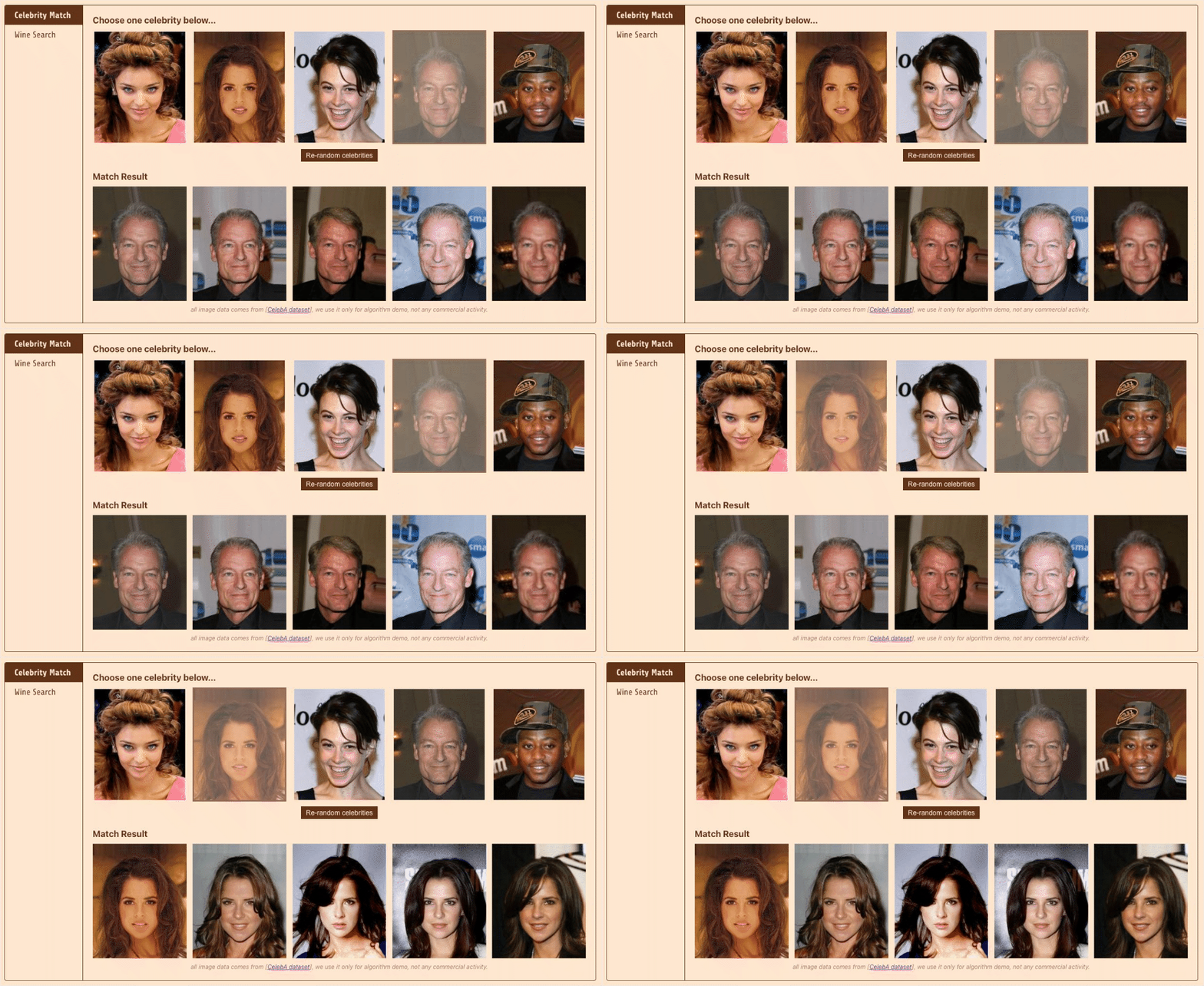
👩 Face-Match [online demo], have a try!
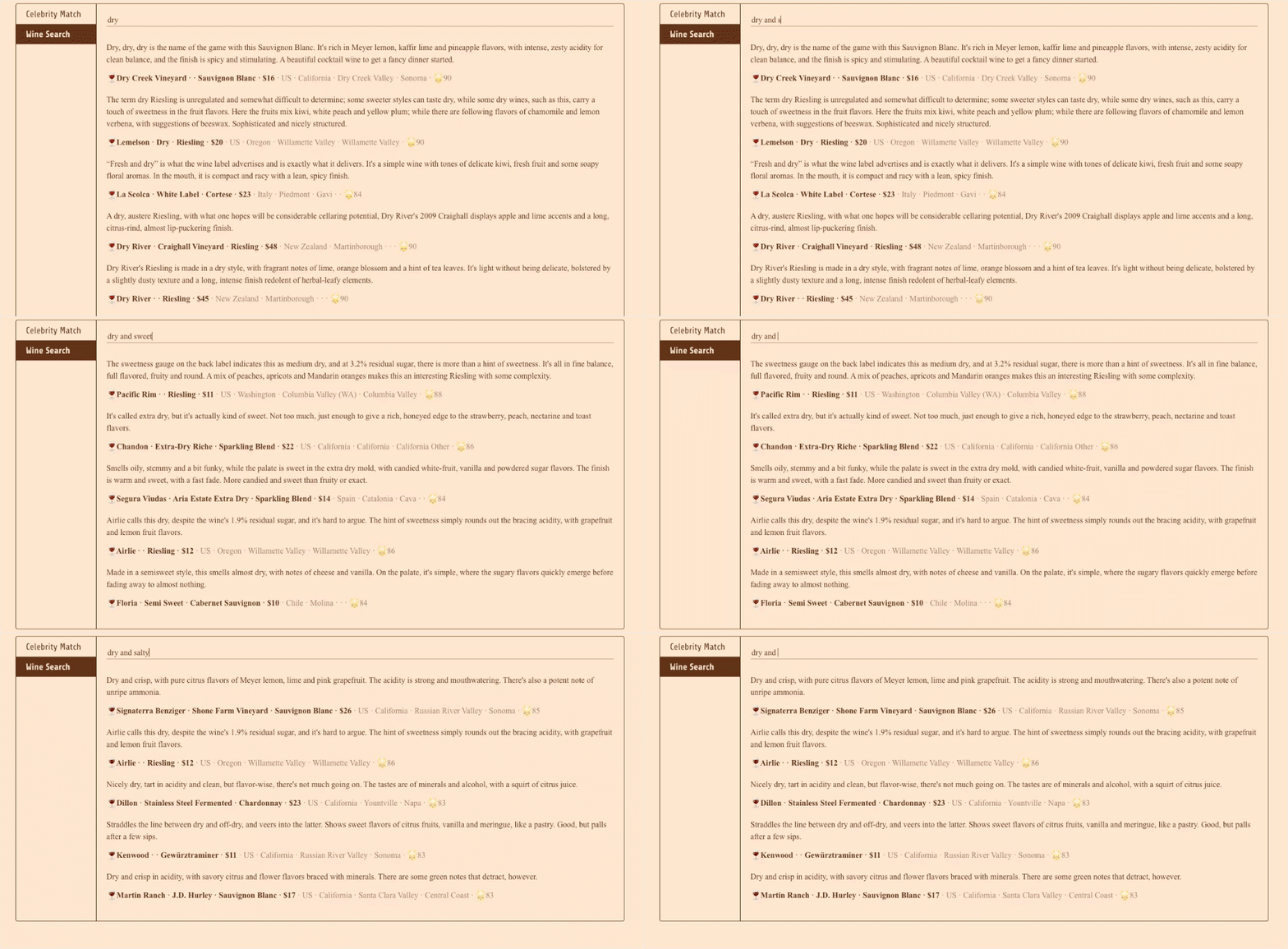
🍷 Dream wine comments search [online demo], have a try!
Features
Performant ⚡️
- SIMD-Accelerated (packed_simd)
- Stable algorithm implementation
- Multiple threads design
Supports Multiple Languages ☄️
PythonJavascriptJavaGo(WIP)Ruby(WIP)Swift(WIP)R(WIP)Julia(WIP)- Can also be used as a service
Supports Multiple Indexes 🚀
Portable 💼
- Supports
WebAssembly - Supports
Windows,LinuxandOS X - Supports
IOSandAndroid(WIP) - Supports
no_std(WIP, partial) - No heavy dependencies, such as
BLAS
- Supports
Reliability 🔒
Rustcompiler secures all code- Memory managed by
Rustfor all language libraries such asPython's - Broad testing coverage
Supports Multiple Distances 🧮
Dot Product DistanceEuclidean DistanceManhattan DistanceCosine Similarity
Productive ⭐
- Well documented
- Elegant, simple and easy to learn API
Installation
Rust
in Cargo.toml
[dependencies]
hora = "0.1.1"
Python
$ pip install horapy
Javascript (WebAssembly)
$ npm i horajs
Building from source
$ git clone https://github.com/hora-search/hora
$ cargo build
Benchmarks
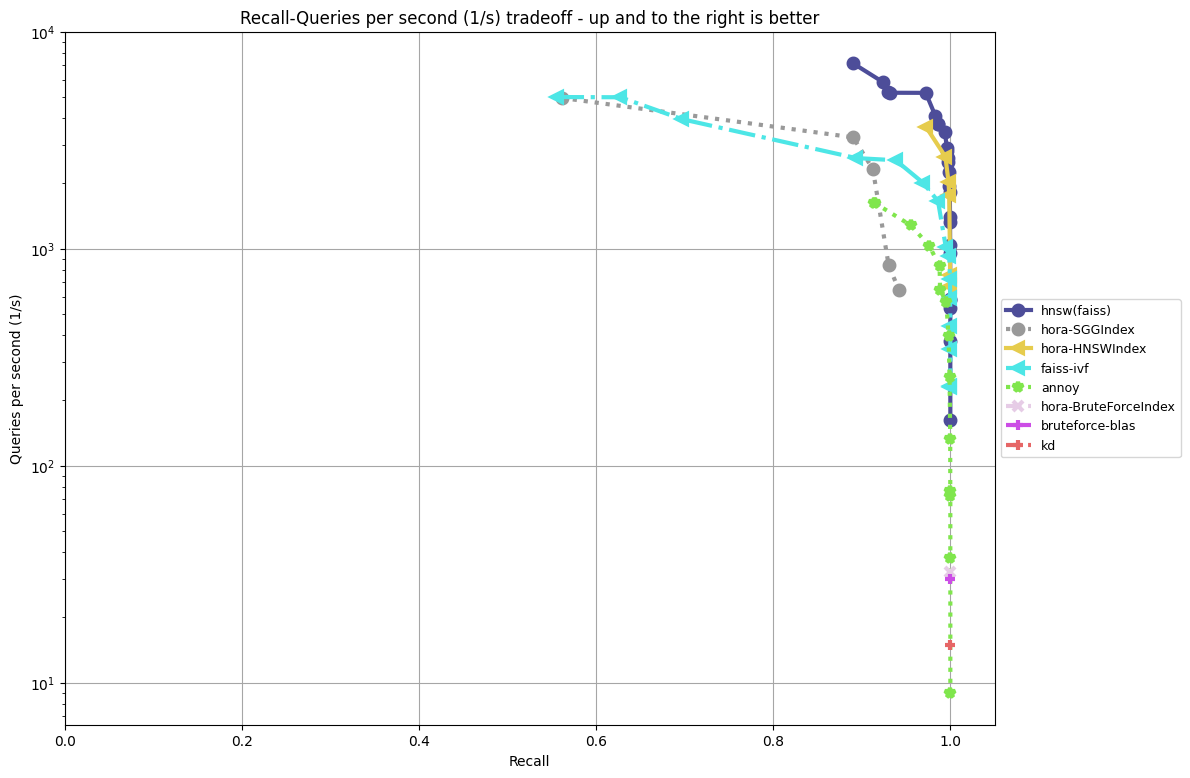
by aws t2.medium (CPU: Intel(R) Xeon(R) CPU E5-2686 v4 @ 2.30GHz) more information
Examples
Rust example [more info]
use hora::core::ann_index::ANNIndex;
use rand::{thread_rng, Rng};
use rand_distr::{Distribution, Normal};

pub fn demo() {
    let n = 1000;
    let dimension = 64;

    // make sample points
    let mut samples = Vec::with_capacity(n);
    let normal = Normal::new(0.0, 10.0).unwrap();
    for _i in 0..n {
        let mut sample = Vec::with_capacity(dimension);
        for _j in 0..dimension {
            sample.push(normal.sample(&mut rand::thread_rng()));
        }
        samples.push(sample);
    }

    // init index
    let mut index = hora::index::hnsw_idx::HNSWIndex::<f32, usize>::new(
        dimension,
        &hora::index::hnsw_params::HNSWParams::<f32>::default(),
    );
    for (i, sample) in samples.iter().enumerate().take(n) {
        // add point
        index.add(sample, i).unwrap();
    }
    index.build(hora::core::metrics::Metric::Euclidean).unwrap();

    let mut rng = thread_rng();
    let target: usize = rng.gen_range(0..n);
    // 523 has neighbors: [523, 762, 364, 268, 561, 231, 380, 817, 331, 246]
    println!(
        "{:?} has neighbors: {:?}",
        target,
        index.search(&samples[target], 10) // search for k nearest neighbors
    );
}
thank @vaaaaanquish for this complete pure Rust 🦀 image search example, For more information about this example, you can click Pure Rust な近似最近傍探索ライブラリ hora を用いた画像検索を実装する
Python example [more info]
import numpy as np
from horapy import HNSWIndex

dimension = 50
n = 1000

# init index instance
index = HNSWIndex(dimension, "usize")

samples = np.float32(np.random.rand(n, dimension))
for i in range(0, len(samples)):
    # add node
    index.add(np.float32(samples[i]), i)

index.build("euclidean")  # build index

target = np.random.randint(0, n)
# 410 in Hora ANNIndex <HNSWIndexUsize> (dimension: 50, dtype: usize, max_item: 1000000, n_neigh: 32, n_neigh0: 64, ef_build: 20, ef_search: 500, has_deletion: False)
# has neighbors: [410, 736, 65, 36, 631, 83, 111, 254, 990, 161]
print("{} in {} \nhas neighbors: {}".format(
    target, index, index.search(samples[target], 10)))  # search
JavaScript example [more info]
import * as horajs from "horajs";

const demo = () => {
    const dimension = 50;
    var bf_idx = horajs.BruteForceIndexUsize.new(dimension);
    // var hnsw_idx = horajs.HNSWIndexUsize.new(dimension, 1000000, 32, 64, 20, 500, 16, false);
    for (var i = 0; i < 1000; i++) {
        var feature = [];
        for (var j = 0; j < dimension; j++) {
            feature.push(Math.random());
        }
        bf_idx.add(feature, i); // add point
    }
    bf_idx.build("euclidean"); // build index
    var feature = [];
    for (var j = 0; j < dimension; j++) {
        feature.push(Math.random());
    }
    console.log("bf result", bf_idx.search(feature, 10)); //bf result Uint32Array(10) [704, 113, 358, 835, 408, 379, 117, 414, 808, 826]
}

(async () => {
    await horajs.default();
    await horajs.init_env();
    demo();
})();
Java example [more info]
public void demo() {
    final int dimension = 2;
    final float variance = 2.0f;
    Random fRandom = new Random();

    BruteForceIndex bruteforce_idx = new BruteForceIndex(dimension); // init index instance

    List<float[]> tmp = new ArrayList<>();
    for (int i = 0; i < 5; i++) {
        for (int p = 0; p < 10; p++) {
            float[] features = new float[dimension];
            for (int j = 0; j < dimension; j++) {
                features[j] = getGaussian(fRandom, (float) (i * 10), variance);
            }
            bruteforce_idx.add("bf", features, i * 10 + p); // add point
            tmp.add(features);
          }
    }
    bruteforce_idx.build("bf", "euclidean"); // build index

    int search_index = fRandom.nextInt(tmp.size());
    // nearest neighbor search
    int[] result = bruteforce_idx.search("bf", 10, tmp.get(search_index));
    // [main] INFO com.hora.app.ANNIndexTest  - demo bruteforce_idx[7, 8, 0, 5, 3, 9, 1, 6, 4, 2]
    log.info("demo bruteforce_idx" + Arrays.toString(result));
}

private static float getGaussian(Random fRandom, float aMean, float variance) {
    float r = (float) fRandom.nextGaussian();
    return aMean + r * variance;
}
Roadmap
- Full test coverage
- Implement EFANNA algorithm to achieve faster KNN graph building
- Swift support and iOS/macOS deployment example
- Support
R - support
mmap
Related Projects and Comparison
-
Hora's implementation is strongly inspired by these libraries.Faissfocuses more on the GPU scenerio, andHorais lighter than Faiss (no heavy dependencies).Horaexpects to support more languages, and everything related to performance will be implemented by Rust🦀.Annoyonly supports theLSH (Random Projection)algorithm.ScaNNandFaissare less user-friendly, (e.g. lack of documentation).- Hora is ALL IN RUST 🦀.
-
MilvusandValdalso support multiple languages, but serve as a service instead of a libraryMilvusis built upon some libraries such asFaiss, whileHorais a library with all the algorithms implemented itself
Contribute
We appreciate your participation!
We are glad to have you participate, any contributions are welcome, including documentations and tests.
You can create a Pull Request or Issue on GitHub, and we will review it as soon as possible.
We use GitHub issues for tracking suggestions and bugs.
Clone the repo
git clone https://github.com/hora-search/hora
Build
cargo build
Test
cargo test --lib
Try the changes
cd examples
cargo run
License
The entire repository is licensed under the Apache License.
Explore related projects
tensorflow/tensorflow
An Open Source Machine Learning Framework for Everyone
201,367 starshuggingface/transformers
🤗 Transformers: the model-definition framework for state-of-the-art machine learning models in text, vision, audio, and multimodal models, for both inference and training.
168,609 starsAUTOMATIC1111/stable-diffusion-webui
Stable Diffusion web UI
165,264 starsComfy-Org/ComfyUI
The most powerful and modular diffusion model GUI, api and backend with a graph/nodes interface. The fastest local inference engine in the world.
145,310 stars