
hexsyro/churn-boosting-showdown
hexsyro/churn-boosting-showdown has 30 GitHub stars and 0 forks. Star changes are not measured yet. Last checked 2026-11-15 14:49 UTC. Last push 2026-11-14.
Measured star growth
- in 24h
- Collecting history
- in 7 days
- Collecting history
- in 15 days
- Collecting history
- in 1 month
- Collecting history
Net star changes over overlapping periods, not daily totals. Missing measurements are left blank. Stars measure attention, not software quality.
About
Head-to-head comparison of XGBoost, LightGBM and CatBoost for customer churn prediction.
Machine LearningREADME.md
Original⚔️ The Churn Boosting Showdown
XGBoost vs LightGBM vs CatBoost: same churn-prediction task, same data, head to head.
This project uses the Telco customer churn dataset (7,043 customers; contract type, tenure, internet service, monthly charges, payment method, add-on services and other categorical-heavy fields) to predict which customers will cancel. About 26.5% of customers churn. The same task is trained on all three major boosting libraries so the comparison itself is the point, not three isolated tutorials.
🎯 Project Questions
- How does a single tree's errors get corrected by the next tree, and can you see that in a training loss curve?
- How much does tuning max_depth, learning_rate, and subsample actually move validation ROC-AUC?
- How much faster is LightGBM than XGBoost/CatBoost on this dataset, and does CatBoost's native categorical handling actually help accuracy?
- Where does early stopping kick in for each library, and what happens to validation loss if you ignore it?
Findings
- The three libraries land in the same place: test ROC-AUC is 0.8474 (XGBoost), 0.8376 (LightGBM) and 0.8477 (CatBoost). XGBoost and CatBoost are a tie, and LightGBM is about 0.01 lower. With a 1,409-row test set, differences this small should not be over-read.
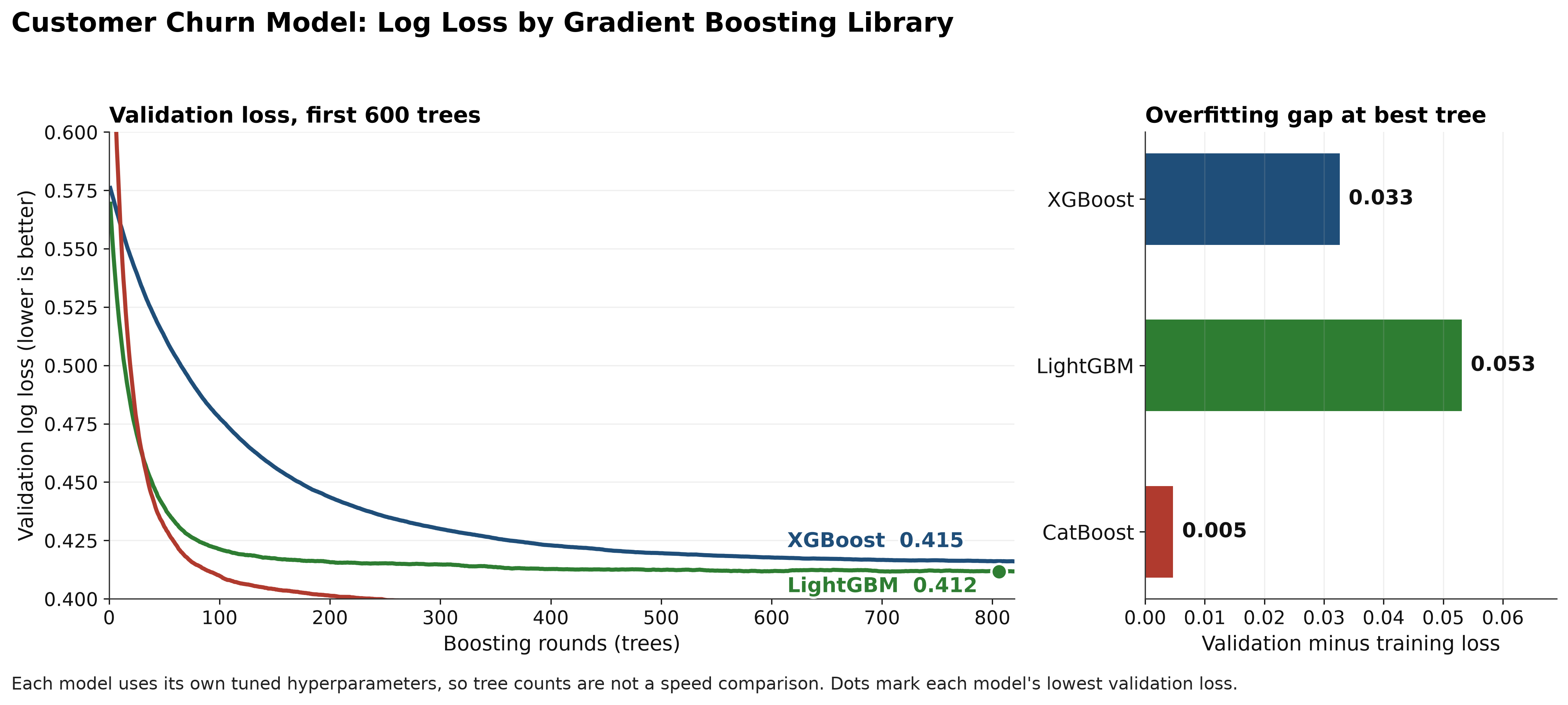
- Native categorical handling gave CatBoost no clear accuracy edge on the test set: it has the best accuracy (0.8062), precision (0.6747) and F1 (0.5882), but only slightly. Its benefit here is convenience: no manual one-hot encoding. It did reach the lowest validation log loss (0.418, against 0.446 for XGBoost and 0.442 for LightGBM).
- Speed: single-fit training times were 2.74 s for LightGBM, 4.14 s for XGBoost and 11.89 s for CatBoost. LightGBM was about 1.5x faster than XGBoost and about 4x faster than CatBoost. Each model uses its own settings, so this is a practical comparison, not a controlled benchmark.
- Shallow trees won the tuning: the best XGBoost model used
max_depth=3,learning_rate=0.03and 100 trees (validation AUC 0.8130). Very deep trees (depth 40 to 50) scored about 0.75 to 0.77. After roughly 1,900 more fits, a much larger grid ended at the same validation AUC (about 0.813), so this feature set has a ceiling that tuning alone does not lift. - Boosting curves flatten quickly: validation loss drops steeply over the first tens of trees, then levels off as each new tree fits smaller residuals. XGBoost's curve was nearly flat from about tree 400, and CatBoost's best validation loss came at tree 464.
- Ignoring early stopping means overfitting: LightGBM's training loss keeps falling (to about 0.33) while its validation loss stays flat near 0.44. The widening gap is memorization, not learning.
- Recall is the weak spot: at the default 0.5 threshold, every model catches only about half of the churners (recall 0.49 to 0.53). A real retention campaign would tune the threshold to the cost of missing a churner versus contacting a loyal customer.
| Library | Accuracy | Precision | Recall | F1 | ROC-AUC |
|---|---|---|---|---|---|
| XGBoost | 0.7991 | 0.6631 | 0.4947 | 0.5666 | 0.8474 |
| LightGBM | 0.8006 | 0.6545 | 0.5267 | 0.5837 | 0.8376 |
| CatBoost | 0.8062 | 0.6747 | 0.5214 | 0.5882 | 0.8477 |
Test-set metrics, scored once after all tuning decisions were made on the validation set.
📁 Repository Structure
churn-boosting-showdown/
├── data/
│   ├── raw/                   # Untouched source churn dataset
│   └── processed/             # Cleaned, encoded (where needed), train/val/test split
│
├── notebooks/                  # Step-by-step, one notebook per phase
│   ├── 01_load_explore.ipynb
│   ├── 02_boosting_theory_single_tree.ipynb
│   ├── 03_xgboost_tuning.ipynb
│   ├── 04_lightgbm_vs_catboost.ipynb
│   ├── 05_early_stopping_regularization.ipynb
│   └── 06_final_comparison.ipynb
│
├── src/                         # Reusable code, imported by notebooks/scripts (not copy-pasted)
│   ├── __init__.py
│   ├── data_load.py            # Load raw dataset, drop customerID, map Churn to 0/1
│   ├── preprocess.py            # Cleaning, stratified split, encoding (differs per library, see notes below)
│   ├── train_xgboost.py          # XGBoost training function
│   ├── train_lightgbm.py          # LightGBM training function (manual categorical encoding)
│   ├── train_catboost.py           # CatBoost training function (native categorical handling)
│   └── evaluate.py                  # Test metrics, training timing, and loss-curve comparison plot
│
├── tests/                       # Unit tests for src/ functions
│   ├── __init__.py
│   └── test_preprocess.py
│
├── models/                      # Saved trained models per library (.joblib), gitignored
│
├── outputs/
│   └── figures/                   # Overlaid train/val loss curves, comparison charts
│
├── .gitignore
├── requirements.txt
└── README.md
🛠️ Setup
git clone https://github.com/hexsyro/churn-boosting-showdown
cd churn-boosting-showdown
python -m venv venv
source venv/bin/activate       # Windows: venv\Scripts\activate
pip install -r requirements.txt
🚀 Usage
Add the raw dataset: download Telco Customer Churn and place it at
data/raw/Telco_customer_churn.csv. Keep the original file unchanged, since the pipeline reads it.Run the pipeline from the project root, in this order:
python -m src.data_load # drop customerID, map Churn to 0/1 python -m src.preprocess # stratified train/val/test split + encoding python -m src.train_xgboost python -m src.train_lightgbm python -m src.train_catboost python -m src.evaluate # test metrics + loss-curve figurepreprocesswrites two versions of each split: one-hot encoded for XGBoost/LightGBM, and the original categorical columns for CatBoost, which handles them natively.Explore in notebooks, in order, starting with
notebooks/01_load_explore.ipynbNotebook Open 01 Load and explore 
02 Boosting theory: single tree 03 XGBoost tuning 04 LightGBM vs CatBoost 05 Early stopping and regularization 06 Final comparison notebooks/06_final_comparison.ipynbproduces the final comparison table and overlaid loss-curve plot
📊 Skills Practiced
| Skill | Where |
|---|---|
| Boosting theory (sequential tree building) | notebooks/02 |
| XGBoost parameters and tuning basics | notebooks/03, src/train_xgboost.py |
| LightGBM vs. CatBoost tradeoffs (speed, categorical handling) | notebooks/04, src/train_lightgbm.py, src/train_catboost.py |
| Early stopping and regularization | notebooks/05, all src/train_*.py |
| Train/validation/test discipline (tune on validation, score test once) | src/preprocess.py, src/evaluate.py |
📈 Sample Finding
LightGBM trained about 1.5x faster than XGBoost and about 4x faster than CatBoost, but XGBoost and CatBoost tied on test ROC-AUC (0.847 vs 0.848) with LightGBM slightly behind (0.838). CatBoost, using native categorical handling with zero manual encoding, matched XGBoost's accuracy. The real tradeoff here was engineering convenience and training time, not accuracy.
📄 Data Sources
- Churn dataset: Telco Customer Churn
🔭 Possible Extensions
- Add SHAP values to compare which features each library considers most important
- Run a larger RandomizedSearchCV per library and see if the ranking changes with more tuning budget
- Tune the decision threshold (or use
scale_pos_weight) to raise churner recall, and compare libraries on precision-recall AUC, not only ROC-AUC - Test all three on a much larger synthetic version of the dataset to see if the speed gap widens or narrows