
hbofz/NeSLE
hbofz/NeSLE has 36 GitHub stars and 1 forks. GitHot measured 0 stars in 24 hours. Last checked 2026-11-09 23:23 UTC. Last push 2026-11-06.
GPU-native NES emulator + RL stack: thousands of parallel NES envs on one CUDA GPU. Train your agents faster.
What you can do
- GPU-resident PPO that keeps rollouts and training on device.
- Stable-Baselines3 compatible VecEnv, drops into existing code.
- Instant resets from bundled save states for all 8 worlds.
- On-GPU reward shaping and Mario RAM parsing.
Measured star growth
- in 24h
- 0
- in 7 days
- Collecting history
- in 15 days
- Collecting history
- in 1 month
- Collecting history
Net star changes over overlapping periods, not daily totals. Missing measurements are left blank. Stars measure attention, not software quality.
README.md
OriginalNeSLE
Thousands of NES consoles on one GPU, for reinforcement learning.
NeSLE runs the whole NES (6502 CPU, PPU, bus) inside a CUDA kernel, one thread per console. Observations never leave the GPU, so your RL loop stops waiting on the emulator.


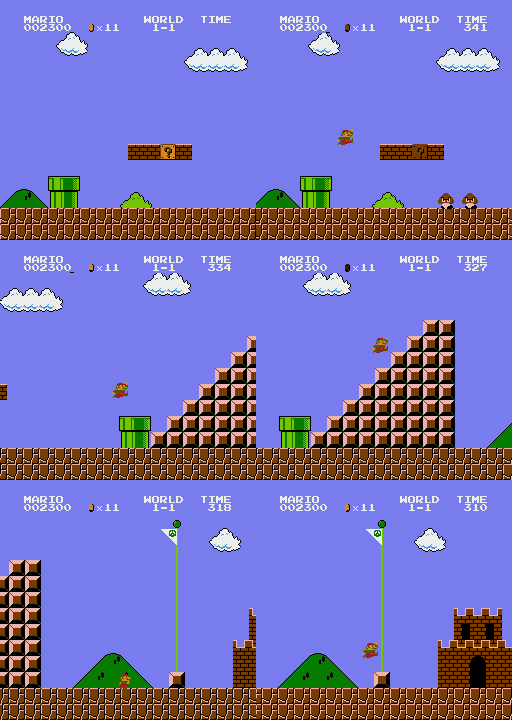
A PPO agent clearing World 1-1 after 2.5 hours of training on a GTX 1050 Ti.
Why
| Setup | Env-steps/s |
|---|---|
nes-py on all 12 CPU threads |
767 |
| NeSLE, GTX 1050 Ti, 4,096 envs | 177,401 |
| NeSLE, A100, 65,536 envs | 3,267,050 |
That's about 13 million NES frames per second on one A100. These numbers are best case (every env pressing the same button). With random per-env actions the 1050 Ti is about 6x slower, still 37x the CPU stack. Full benchmarks and method.
Features
- GPU-resident PPO that keeps rollouts and training on device.
- Stable-Baselines3 compatible
VecEnv, drops into existing code. - Instant resets from bundled save states for all 8 worlds.
- On-GPU reward shaping and Mario RAM parsing.
Quickstart
Needs a CUDA GPU, CUDA Toolkit 12.x, Python 3.10+, and a C++20 compiler.
git clone https://github.com/hbofz/NeSLE.git && cd NeSLE
python -m pip install -e '.[dev,rl]'
python -m pip install --force-reinstall torch --index-url https://download.pytorch.org/whl/cu126
Bring your own legally obtained Super Mario Bros. (World).nes. No ROMs are
included. Windows and Docker: docs/install.md.
import nesle

envs = nesle.make_vec(
    "Super Mario Bros. (World).nes",
    num_envs=2048,
    backend="cuda",
    observation_mode="ram",
    action_space="mario",
    reset_state_path="docs/data/smb_level1_1.state",
)
obs = envs.reset()
obs, rewards, dones, infos = envs.step([envs.action_space.sample() for _ in range(envs.num_envs)])
Train an agent:
python examples/native_ppo_train.py "Super Mario Bros. (World).nes" \
    --reset-state-path docs/data/smb_level1_1.state \
    --action-space mario --reward-mode smart \
    --num-envs 2048 --total-timesteps 25_000_000
All flags: docs/training.md.
Limitations
- Mappers 0, 2, 34 and 94 only (no MMC1/MMC3 yet). The RL tooling targets Super Mario Bros.
- Windows caps training near 3k env-steps/s. Linux is unaffected.
- Everything else.
Contributing
PRs welcome. Start with a good first issue, or take on the big one: MMC1/MMC3 mappers, which would unlock hundreds of games. See CONTRIBUTING.md.
More docs: architecture · design · GPU scaling
MIT licensed. Not affiliated with Nintendo.
Explore related projects
tensorflow/tensorflow
An Open Source Machine Learning Framework for Everyone
201,400 starshuggingface/transformers
🤗 Transformers: the model-definition framework for state-of-the-art machine learning models in text, vision, audio, and multimodal models, for both inference and training.
168,668 starsAUTOMATIC1111/stable-diffusion-webui
Stable Diffusion web UI
165,261 starsComfy-Org/ComfyUI
The most powerful and modular diffusion model GUI, api and backend with a graph/nodes interface. The fastest local inference engine in the world.
145,835 stars