
hasirciogluhq/xdatabase-proxy
hasirciogluhq/xdatabase-proxy has 38 GitHub stars and 4 forks. Star changes are not measured yet. Last checked 2026-11-09 16:32 UTC. Last push 2026-11-02.
A high-performance database proxy service built with Go, designed for Kubernetes environments. Provides secure and scalable database connection management with support for multiple database types.
Measured star growth
- in 24h
- Update delayed
- in 7 days
- Update delayed
- in 15 days
- Update delayed
- in 1 month
- Update delayed
Net star changes over overlapping periods, not daily totals. Missing measurements are left blank. Stars measure attention, not software quality.
README.md
OriginalXDatabase Proxy
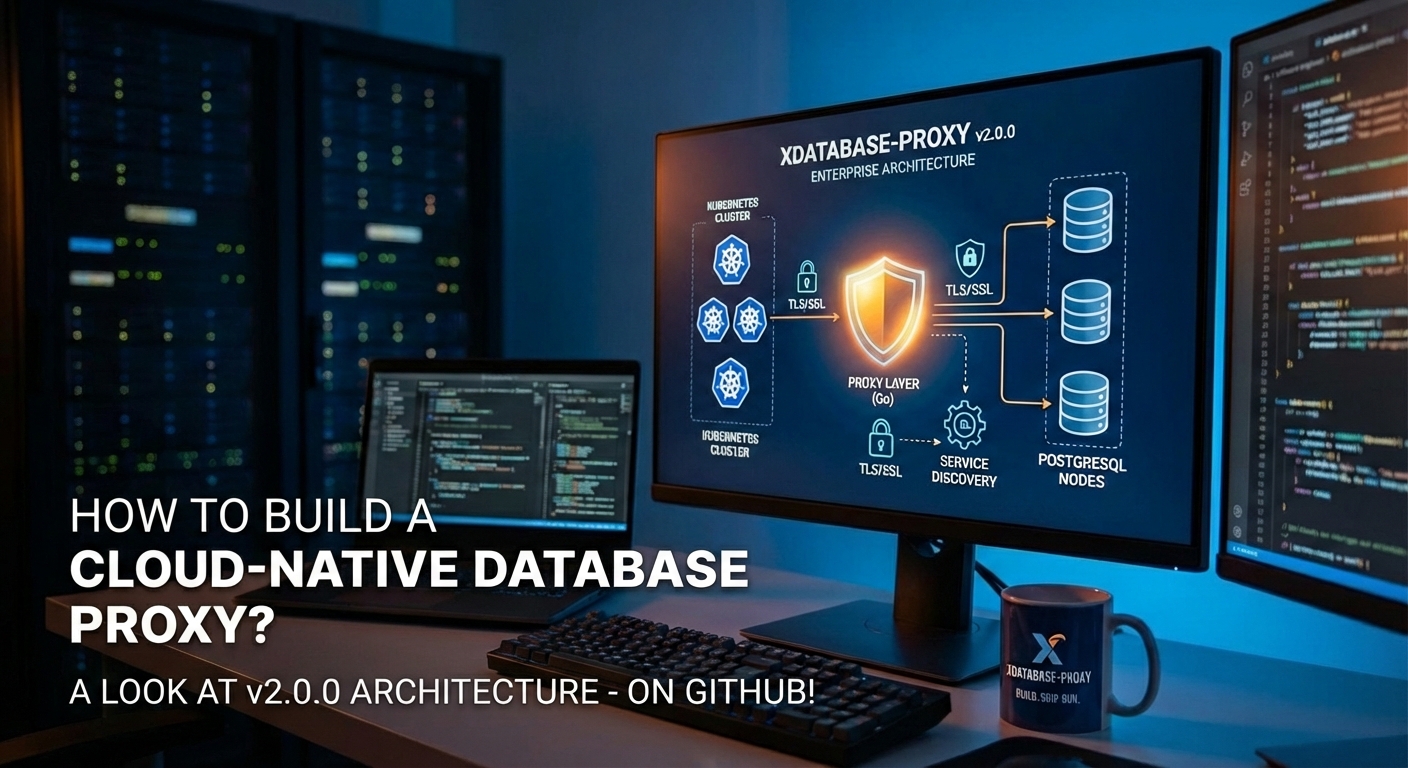
A small, dependency-light PostgreSQL connection router. Clients connect to one endpoint and the proxy picks the backend from the username, terminating TLS itself. It runs in Kubernetes, containers, VMs and bare metal.
postgresql://user.<deployment>[.pool]@proxy:5432/db
user.db-prod→ service of deploymentdb-prod(direct)user.db-prod.pool→ the pooled service (pgbouncer, odyssey, …) of the same deployment- Plain
userwith TLS hostdb-prod.pool.example.com→ the same pooled service, chosen by SNI (also works with PostgreSQL 17sslnegotiation=direct)
The proxy strips the routing suffix before forwarding, so the backend sees plain user. If database is empty or equals the full login (psql's default), it becomes postgres.
Full documentation: https://hasirciogluhq.github.io/xdatabase-proxy/ (sources in docs/).
Supported databases
| Database | DATABASE_TYPE |
Routing | Status |
|---|---|---|---|
| PostgreSQL | postgresql |
Login user.deployment[.pool], TLS terminated by the proxy |
✅ Supported |
| PostgreSQL-compatible: CockroachDB, YugabyteDB, TimescaleDB, Citus, Greenplum, QuestDB, CrateDB (Aurora/AlloyDB PostgreSQL need nothing special) | postgresql or the product name (cockroachdb, yugabytedb, timescaledb, citus, greenplum, questdb, cratedb) |
Same as PostgreSQL | ✅ Same code path. Wire handling is covered by tests; not yet run against the real products |
| Redis | redis |
Login user.deployment[.pool] in AUTH/HELLO … AUTH, and/or TLS SNI passthrough |
✅ Supported, e2e-tested with real Redis |
| ClickHouse (native protocol) | clickhouse |
Login in the Hello packet, and/or TLS SNI passthrough | ✅ Supported, tested with in-process fakes only |
| MongoDB, any TLS-first protocol | mongodb, tls |
TLS SNI deployment[.pool].your-domain, passed through to the backend |
✅ Supported, tested with a generic TLS backend |
| MySQL / MariaDB | – | The server speaks first and the password scramble is bound to the backend | 📋 Planned, hardest |
One proxy instance serves one DATABASE_TYPE. Which routing strategy (username or SNI) may reach a route is chosen by the cluster administrator with the Service label xdatabase-proxy-routing: username | sni | all; without it each type has a default. Details: Routing strategies.
TLS handling: PostgreSQL, and username routing for Redis and ClickHouse, terminate TLS at the proxy. SNI routes default to passthrough (the backend terminates TLS and the client sees the backend's certificate) and can terminate at the proxy with SNI_TLS_MODE=terminate (the backend may then be plain TCP).
MongoDB limits: routing needs the client to use TLS and send the server name (SNI); plaintext connections or clients without SNI are closed. Routing by username is not possible, because MongoDB sends the user only after the server answered hello. With passthrough the client must trust the backend's certificate (or use options like tlsAllowInvalidCertificates for a self-signed one); with SNI_TLS_MODE=terminate it sees the proxy's certificate.
Roadmap & a promise
As promised, XDatabase Proxy is no longer just a PostgreSQL router: Redis, ClickHouse, MongoDB and any TLS-first protocol are now in, along with SNI routing and TLS termination or passthrough.
And here is a new promise: if I make it, this will grow into a truly universal database proxy. Every top-tier database will get first-class support, and the goal is for it to become an indispensable tool for platforms.
Next up: MySQL / MariaDB (the hardest one, since the server speaks first and the password scramble is bound to the backend), then wider real-world testing of the PostgreSQL-compatible and ClickHouse paths. Ideas, bug reports and contributions are very welcome, see CONTRIBUTING.md.
How it is built
| Concern | Implementation |
|---|---|
| Wire protocol | pgx/pgproto3 |
| Kubernetes | client-go shared informer with a route index (no polling, O(1) lookup) |
| Logging | log/slog (JSON) |
| TLS | crypto/tls, self-signed ECDSA P-256 generated on demand, TLS ≥ 1.2 |
Layout: pkg/ holds reusable pieces (proxy TCP server/pipe, tlsutil); cmd/proxy/internal/ holds project-specific code (config, discovery, tlsstore, postgres, health).
Deployment
All manifests are Kustomize bases under kubernetes/:
| Path | What it deploys |
|---|---|
kubernetes/base |
Namespace, ServiceAccount, least-privilege RBAC (list/watch services, own TLS secret only) |
kubernetes/production/nodeport |
3-replica Deployment, NodePort Service (30432, externalTrafficPolicy: Local), PDB |
kubernetes/production/daemonset-hostport |
DaemonSet, one proxy per node on hostPort 5432, no Service hop |
kubernetes/development |
1 replica, debug logs, in-memory TLS, -development image |
kubernetes/test |
Throw-away PostgreSQL with the discovery labels |
kubectl apply -k kubernetes/production/nodeport          # or .../daemonset-hostport
kubectl apply -k kubernetes/development && kubectl apply -n xdatabase-proxy -f kubernetes/test/postgresql.yaml
Pin the image to a version tag or digest in production. Images are multi-arch, distroless, non-root, and published with SBOM and provenance attestations.
Container / VM (static routing, no Kubernetes needed):
docker run -p 5432:5432 -e STATIC_BACKENDS="db1=10.0.0.5:5432,db1.pool=10.0.0.5:6432" \
  ghcr.io/hasirciogluhq/xdatabase-proxy:latest
For Kubernetes discovery outside a cluster set KUBECONFIG (and optionally KUBE_CONTEXT).
Service discovery (Kubernetes)
Label a Service and it becomes routable:
| Label | Meaning |
|---|---|
xdatabase-proxy-enabled: "true" |
opt in |
xdatabase-proxy-database-type: postgresql |
protocol |
xdatabase-proxy-deployment-id: <id> |
routing key |
xdatabase-proxy-pooled: "true" |
pooled endpoint (default false) |
xdatabase-proxy-destination-port: <port or name> |
optional, defaults to the first port |
If several Services share a route, the one with the lowest namespace/name wins.
Configuration
| Variable | Default | Description |
|---|---|---|
PROXY_START_PORT |
5432 |
Listener port |
HEALTH_SERVER_PORT |
8080 |
/health (liveness), /ready (readiness) |
DEBUG |
false |
Debug logging |
MAX_CONNECTIONS |
10000 |
Concurrent client limit (0 = unlimited) |
DIAL_TIMEOUT_SECONDS |
5 |
Backend resolve + dial timeout |
DISCOVERY_MODE |
auto | static if STATIC_BACKENDS is set, else kubernetes |
STATIC_BACKENDS |
– | deployment[.pool]=host:port,… |
WATCH_NAMESPACE |
all | Restrict discovery to one namespace (then a Role is enough) |
CLUSTER_DOMAIN |
cluster.local |
Used to build service DNS names |
KUBECONFIG, KUBE_CONTEXT |
– | Kubernetes access outside a pod |
NAMESPACE |
pod namespace | Namespace of the TLS secret |
TLS_ENABLED |
true |
Offer TLS to clients (SSLRequest) |
TLS_MODE |
auto | file (if TLS_CERT_FILE), kubernetes (if TLS_SECRET_NAME), else memory |
TLS_CERT_FILE, TLS_KEY_FILE |
– | Certificate files |
TLS_SECRET_NAME |
– | kubernetes.io/tls Secret (created if missing) |
TLS_AUTO_GENERATE |
true |
Generate a self-signed cert when none exists |
TLS_RENEWAL_THRESHOLD_DAYS |
30 |
Re-issue our own self-signed cert this long before expiry; certificates you provide are never replaced |
Certificates are re-checked every 6 hours and hot-swapped, so cert-manager rotations need no restart.
Hardening
- Startup packets are size-limited by
pgproto3(10 kB), startup has a 10 s deadline, negotiation attempts are capped (no recursion). - Connection cap, graceful shutdown (drains for 25 s on SIGTERM), health goes unready first.
- Startup parameters and passwords are never logged.
- Minimal dependency set,
go mod verify,govulncheckand Trivy in CI, Dependabot for Go modules, actions and base image. - Pods run non-root with a read-only filesystem and all capabilities dropped.
CancelRequestis not routable (it carries no user); clients simply fall back to their own timeout.
Development
go test -race ./...
scripts/dev-run.sh          # proxy on :6432 → postgres on localhost:5432
scripts/local-deploy.sh     # build, load and deploy to a local cluster
CI (.github/workflows/ci.yaml): format, vet, race tests, govulncheck, manifest rendering, image build + scan, and an end-to-end psql run against a real PostgreSQL. Pushing a v* tag runs publish.yaml: multi-arch image, SBOM + provenance, GitHub release from CHANGELOG.md.
License
Licensed under the Apache License 2.0, free for any use including commercial; no fees or revenue limits. Contributing: CONTRIBUTING.md. Conduct: CODE_OF_CONDUCT.md. Security: SECURITY.md. Help: SUPPORT.md. Issues: https://github.com/hasirciogluhq/xdatabase-proxy/issues
Explore related projects
Asabeneh/30-Days-Of-Python
The 30 Days of Python programming challenge is a step-by-step guide to learn the Python programming language in 30 days. This challenge may take more than 100 days. Follow your own pace. These videos may help too: https://www.youtube.com/channel/UC7PNRuno1rzYPb1xLa4yktw
78,486 starsgrafana/grafana
The open and composable observability and data visualization platform. Visualize metrics, logs, and traces from multiple sources like Prometheus, Loki, Elasticsearch, InfluxDB, Postgres and many more.
77,790 starsredis/redis
For developers, who are building real-time data-driven applications, Redis is the preferred, fastest, and most feature-rich cache, data structure server, and document and vector query engine.
77,332 starsapache/superset
Apache Superset is a Data Visualization and Data Exploration Platform
75,455 stars