
gpillon/ignis
gpillon/ignis has 63 GitHub stars and 9 forks. GitHot measured 0 stars in 24 hours and +5 in 7 days. Last checked 2026-11-15 06:56 UTC. Last push 2026-11-05.
Measured star growth
- in 24h
- 0
- in 7 days
- +5
- in 15 days
- Collecting history
- in 1 month
- Collecting history
Net star changes over overlapping periods, not daily totals. Missing measurements are left blank. Stars measure attention, not software quality.
About
OpenAI-compatible inference server for Qwen3.8 on one RTX 5090 / RTX PRO 6000: the 27B at ~170 tok/s (peaks ~370), Flash-Next (125B MoE) at ~100 tok/s, built for local coding agents. Rust + CUDA, Windows and Linux.
AIREADME.md
Original

Ignis
A single-GPU inference engine for Qwen3.8 (the 27B and the 125B Flash-Next MoE) and Qwen-Image-2.1, built for the load an agent makes.
OpenAI-compatible HTTP API · Rust core · C++/CUDA kernel leaf · one RTX card









| ~170-370 tok/s one lane, free prose to coding prompts |
1,065 tok/s eight lanes, aggregate |
~9,700 tok/s cold prefill, 46K prompt |
~100 tok/s Flash-Next 125B MoE, one lane |
7.11x KV capacity of BF16 |
~36 ms a decision, zero tokens decoded |
896K context, with vision and DFlash2 |
~7.9 s a 2048² image, end to end |
Measured on one RTX 5090, 64 GB DDR4-3200 MT/s, PCIe 3.0. How, and against what: How fast.
📖 The documentation: gpillon.github.io/ignis
Quick start ·
Why ignis ·
The Playground, view by view ·
Every config field ·
Changelog
AI agents working for a user (asked what ignis is, whether it runs on this machine, to install it or to connect a client): the checks, the steps and the choices that are the user's are on the agent path (raw Markdown; every page of the guide as Markdown: llms.txt). Working on ignis itself: AGENTS.md. Working in a fork: what to send upstream, and how (raw Markdown).
https://github.com/user-attachments/assets/ed4eab53-6a9e-4f5b-b37c-226fcc0784a7
▶ Ignis in 90 seconds: a single-GPU inference engine built for coding agents. Also on YouTube.
Ignis is a deliberately specialized engine: one model family, NVIDIA RTX cards. It gives up generality and takes back speed. It loads an NVFP4 Qwen3.8-27B onto a single Blackwell card — an RTX 5090 or an RTX PRO 6000, both compute capability 12.0 (why not DGX Spark?) — serves streaming and non-streaming completions over the OpenAI v1 API, and is shaped around the workload a developer actually produces — one main agent plus a handful of subagents hitting the same card at once. Eight resident decode lanes run as one batch-wide round; the paged KV cache is budgeted in bytes rather than in sequences; conversation state survives the request that built it; a loop in the model's reasoning is caught while it streams and taken back; images are evidence, not an afterthought; and a decision can be answered without generating a single token. A Playground, a live Monitor and Prometheus metrics ship in the binary.
It also serves Qwen3.8-Flash-Next, the 125B MoE with 6B active, on the
same 32 GB card. Its 48 × 512 experts are re-quantized to a trellis code at 2.5
bits per weight on average (2 to 4 bits per expert, from calibration error); a
VRAM cache holds the hot ones and the rest stream from pinned host RAM, about
100 tok/s at one lane on a PCIe 3.0 board
(weights and numbers).
On a 96 GB RTX PRO 6000 every expert stays in VRAM with no copy in host RAM,
and the built-in rtxpro6000 profile drafts with the model's own MTP head:
about 258 tok/s at one lane on code and 427 tok/s across eight
(measured).
And it makes pictures: Qwen-Image-2.1-Turbo, on FP8 GEMM and 8-bit
attention kernels for the 5090, serves OpenAI's image generation and edit routes — a
2048x2048 image in about 7.9 s end to end, an edit from up to ten input images,
the prompt optionally rewritten first by the 27B
(Images made). Its weights are for
non-commercial use only.
What it runs on. The RTX 5090 and the RTX PRO 6000 run every model, and the 16 GB RTX 50 cards the 16 GB entries. The RTX 3090 and 3090 Ti are supported, on the 27B's 16 GB entries; the RTX 4090 and the 16 GB RTX 40 cards are expected to work, and reports are welcome. An RTX 30 or RTX 40 card needs release 0.10.0 or the development build: the 0.9 releases are built for Blackwell alone. The NVFP4 27B, Flash-Next and the image model load on Blackwell alone, on a card of 32 GB or more. The figures here are measured on an RTX 5090 (the guide's list).
The 27B also fits a 16 GB card (RTX 5060 Ti 16 GB, 5070 Ti, 5080), from a
second artifact: its body re-encoded in a trellis code at about 3 bits per
weight, 12.5 GiB on disk, with the same DFlash2 drafter. On such a card the
server picks the rtx-16gb profile and that artifact by itself, 262,144
tokens of context on two lanes, and the artifact passed four pre-registered
quality gates against the NVFP4 it stands in for: its KL divergence from BF16
is 0.77-0.82x the NVFP4's. It has not run on a 16 GB card yet. On the 5090 held
to 16 GiB it decodes 416 tok/s at one lane on coding prompts at 8K of
context; on a 5080 the estimate is 243-307
(the 27B on a 16 GB card).
The server switches between these models without a restart — a request that names another model is held and answered by it — and unloads an idle one after five minutes so the card is free for other work; the next request loads it again.
Rust owns everything above the step — scheduling, admission, KV accounting, serving. The forward pass and all GPU compute live in a C++/CUDA static library behind a flat, device-resident step-level C ABI. The engine is its own dogfood target, and partly there already: it serves some of the coding agents that build it, and the rest of that is what the remaining work is for.
TL;DR
Take a build from Releases — a
Windows .zip, a Linux .tar.gz, or the linux/amd64 container image on
ghcr.io/gpillon/ignis. Run it on an RTX 50, RTX PRO 6000 or RTX 30 card; the
releases from 0.10.0 are built for compute capabilities 8.6 and 12.0, the 0.9
ones for 12.0 alone. (Every push to main that
changes code also publishes a rolling development build, not a release: the image
ghcr.io/gpillon/ignis:develop and the develop prerelease.)
ignis-server --model-max-context 524288 \
  --spec-backend dflash2 --spec-draft-tokens 7 --vision-enabled
No model yet? It offers to fetch one. Those flags set the 512K context make
serves (YaRN x2, which the default auto rope scaling picks for it), DFlash2
speculative decoding and image input; the Prometheus
metrics the Playground's Monitor reads are on by default. A bare ignis-server
already gets DFlash2 and image input from the built-in rtx5090 profile, with
an 896K context (YaRN x3.5). On a 16 GB card, run a bare ignis-server
instead: it takes the rtx-16gb profile and offers to fetch the 27B's
16 GB artifact, while the flags above ask for a longer context than that card's KV
pool holds. Flash-Next is --model-id qwen3.8-flash-next; the flags make serves it with are on its
weights card.
The image model is ignis-image-2.1-turbo: once ignis-server model download ignis-image-2.1-turbo has fetched it, a request to /v1/images/generations
naming it switches the running server to it.
Then the OpenAI API is on http://127.0.0.1:8000/v1, the Playground and its Monitor on http://127.0.0.1:8000/ui/, and Prometheus on http://127.0.0.1:9464/metrics. The weights are on Hugging Face: the 27B in three flavours, the standard one, an uncensored one and the 16 GB card's, and Flash-Next: The weights. Everything else — the container, building from a checkout, every flag — is Quick start and the user guide.
How fast
Ignis on one RTX 5090 — Qwen3.8-27B NVFP4, hq-e8-2b KV, DFlash2 speculative
decoding with 7 draft tokens, greedy, short prompts. The served context is
512K tokens: the checkpoint's native 262,144 stretched by YaRN x2, as the
TL;DR flags and make set it. These runs used a 262,144-token maximum:
| load | throughput | source |
|---|---|---|
| one lane, eight coding prompts (write, edit, explain), geometric mean | 367 tok/s | upstream quick wins |
| one lane, predictable code / free prose | 491 / 167 tok/s | retained slots on the host |
| eight lanes at once, aggregate | 1,065 tok/s | upstream quick wins |
Other engines, same card, same model — single-stream decode as their authors published it:
| engine | weights and speculation | single-stream decode | source |
|---|---|---|---|
| SGLang v0.5.20 | NVFP4, MTP with 4 tokens | 152 tok/s (93 without speculation) | lucacadalora/sglang-rtx5090-mtp, 2026-09-23 |
| llama.cpp | NVFP4-MTP GGUF, q8_0 KV, MTP with 4 tokens | 122–142 tok/s | DataCamp, 2026-08-25 |
| llama.cpp | MTP | 70.5 tok/s | HF discussion #132 |
Those rows are other people's runs: their prompts, their drafters, their context lengths. They are not a same-session benchmark, so read them as an order of magnitude, not a ratio. Prefill was where ignis trailed; 0.7.3 made it 30-53% faster on long prompts.
- ignis, measured cold: 9,717 tok/s on a 46K prompt, 7,865 on a 105K one. The prefill attention now reads the compressed KV directly, instead of expanding it into BF16 planes first: +30% at 46K and +53% at 105K against 0.7.2's kernels in one A/B session (no prompt planes). A 2,048-token prefill chunk adds 2% more (the 2,048 chunk). Decode is unchanged, and the KL divergence from BF16 is lower.
- One same-session bench, someone else's
(mkyt/qwen3-27b-5090, a 5090 at a
400 W limit, 2026-10-11), cold 73K prompt:
- NInfer 7,000;
- that engine 8,800 (its attention runs on FP4/FP8 tensor cores).
The one same-session comparison is against NInfer, the engine whose kernels ignis started from: same artifact, same card, one session, two process launches per side, before ignis had speculative decoding. ignis is 1.06x the reference at one lane and 3.07x at four, and 3% behind it on inter-token latency p95 (hq vs BF16 live/live).
What sets it apart
Every number below is a measurement on a 5090. Each topic is told in full, with how it works, how to see it and where its numbers come from, in the guide's Why ignis section.
The decode round
- One batch-wide round for all eight lanes, replayed from per-width CUDA graphs (widths 1..8), not one launch sequence per sequence.
- At one lane with DFlash2, the round is 1,166 graph nodes and 15.81 ms of device time that is weight streaming at the card's bandwidth — the backbone GEMM at 100% of roofline (a fit good to about ±10%), the output head at 86%. Graph submission costs 2.2% of it, and the whole remaining headroom is the 4.8% the device spends idle. At eight lanes the round is 32.18 ms.
- Prefill and decode take turns a chunk at a time, so a long prompt holds
the lanes already generating for one chunk, not for the whole prompt;
model.decode_sharesets the share of the card they keep meanwhile.
Speculative decoding (DFlash2)
- The served artifact carries a grafted DFlash2 drafter;
--spec-backend dflash2 --spec-draft-tokens 7runs draft-and-verify rounds against it. - The drafter's vendored top-k gave one warp to each of seven columns over a 248k vocabulary and spent 3,145 µs — 16.4% of decode kernel time — to move 2.0 µs of memory. Our row-split replacement does it in 44 µs at a bit-identical answer: 17.6% of a decode round, +21% decode throughput at one lane. A vendored kernel measured as the bottleneck may be replaced — an exemption to verbatim vendoring.
KV that costs bytes, not sequences
- hq-e8-2b is the serving KV format: a sequence-token costs 9,216 bytes against BF16's 65,536 — 7.11x the capacity, so eight lanes at a 40,960 context need ~3.02 GB instead of 20 GiB. The capacity has a measured price: against BF16 KV, hq-e8-2b adds 0.018 KLD at 32K and 0.022 at 64K, half as much again as the weights' own, and about a point of top-1 (KLD against BF16).
- BF16 is retained, not deprecated: it is the format every correctness oracle runs against.
- The GQA workspace zeroing is dead work under hq — every byte the next launch reads it writes itself — and removing it is worth 2.12% of GQA layer device time on a 70K prefill.
State that outlives its request
- Cross-request reuse: a prompt checkpoint captured at the generation opener, a retained prefix shared between siblings, and a lazy spill into a pinned KV-RAM host tier with unified eviction.
- A device-to-device prefix clone is 0.25 ms for 148 MiB — 96x cheaper than a PCIe round trip and ~8,000x cheaper than re-prefilling the head; a full-context snapshot/restore round trip is ~90 ms, about 100x cheaper than the re-prefill it replaces.
- The retained checkpoints and prefixes live in pinned host memory, not in VRAM, so the KV pool gets that room: 475K -> ~680K tokens at level throughput, measured on the 262,144-token default load of 2026-09-29 (the 5090 profile's pool is now 944,832 tokens at a 917,504 context) (retained slots on the host).
- Below KV-RAM, a KV-disk tier takes the state of an evicted sequence and gives it back where it stopped: a ~1 GB spill takes ~0.63 s beside two decoding Flash-Next lanes, costing their inter-token p50 3-8% (KV-disk contention; on by default for Flash-Next).
- What a request resumed is reported, not guessed:
cached_tokenson the usage, and the done line names the tier and the kind of reuse it came from.
A VRAM plan, decided at load
- Every byte the process will hold is reserved and laid out before the first request, and the plan is printed: weights, workspaces, lane state, decode and drafter graphs, retained slots, media embeddings, and whatever is left becomes the KV pool. The Monitor shows that plan beside what is in use — see it.
- The load that used to grow the process 2,734 MiB in 14 minutes now grows it 6 MiB in 24.5, and the printed plan matches what the OS reports to within 16 MiB. No paging, no surprise at minute forty.
- In 0.7.3 the 27B handed up to 2.4 GB of VRAM back to the KV pool. The prefill attention no longer holds prompt planes (up to 1.02 GB, ~0.6 GB with image input on), and the 1.35 GB token embedding lives in pinned host memory, at ~1 µs per prompt token. On the 5090 the built-in profile's context went from 786,432 to 917,504 tokens, with image input and DFlash2 still on (embedding in host memory).
Lanes that know who is asking
- A request states its own lane tag —
interactiveoragent— through theclassextension field or an@<lane>suffix on the model name. The tag drives protection, backfill priority and eviction order, so a burst of subagents fills the lanes a foreground conversation is not using instead of evicting it. - Admission is a full state machine: protection, backfill class, temporal credit, frontier distance.
The Responses API, over a WebSocket
/v1/responsesis OpenAI's Responses API — the wire Codex CLI, the OpenAI SDKs and the Agents SDK speak: streaming events, function tools,tool_choice(requiredand a named function force the call), reasoning items passed back and forth.- WebSocket mode on
GET /v1/responses: one connection per agent,previous_response_idplus only the new items on each turn instead of the whole history, agenerate: falseprewarm that really prefills and keeps the prompt state, and several streams multiplexed on one socket. - A full engine queues the request on the socket, in one first-in
first-out order across every connection, where HTTP would answer
503and leave the retry to the client. Closing the socket cancels what it had running. - The Playground talks to the server over that socket, so parallel agents are not held to the browser's six connections per host.
Reasoning that finishes
- A loop in the reasoning is taken back while it streams. About a third of
first turns on a long enumeration loop, at the model card's sampling — on
NInfer with the same weights too, so the loop is the model's
(reasoning loops).
The guard scores the reasoning as it is written; once a loop persists, it
cuts back to the last clean window, puts a nudge in the model's own words,
and the generation goes on in the same response. The client sees a tag where
the loop was and
rewound_tokensin the usage; the reasoning sent back on the next turn is repaired to what the model saw. - Scored on recorded runs of the prompt its thresholds were tuned on, it catches 25 of 25 harmful loops, and 6 of 7 on 40 fresh seeds; it never fires on the recorded opencode and qwen-code sessions it was also tuned against. On 79K- and 138K-token agent contexts a rewind restores the prompt in 0.08-0.10 s (a loop persists, the guard).
- An end of turn drawn inside the reasoning closes it — it becomes
</think>, and the model goes on to the answer or the tool call it was writing instead of returning reasoning and nothing else. - A thinking budget whose close answers: past the budget the reasoning is closed with a sentence that tells the model to answer from what it has, without one more tool call — the deferral that kept two agent sessions looping for 15 and 32 turns (a close that answers).
System One decisions, answered without generating (/v1/systemone, /v1/decide)
- The System One API, on a local model: the typed-decision API the Jev
model is served under, with the same route (
POST /v1/systemone), body and error statuses, also served asPOST /v1/decide. - A classification is not a completion. The endpoint prefills the evidence once and reads the answer out of the logits at a single position.
- Seven primitives:
noul(yes/no),choiceandscore; one constrained digit per step,number,pointandbox; andlocate, which finds a line in a log or a passage in a text from the attention heads and a labelled choice, generating nothing. - On 144 authored decisions the declared options hold a median 99.8% of the model's distribution, and the readout costs ~36.5 ms and zero decoded tokens at 0.934 balanced accuracy on the layout first measured; moving the evidence into the system block takes it to 0.963, a difference of 4 of the 144 rows.
pointlands inside the target on four pre-registered sets of screenshots through the served endpoint: 236 of 240, 240 of 240, 120 of 120 and 60 of 60 (the sub-cell reading).locatefinds the line on fresh cluster logs of 100K to 1M tokens 21 times out of 23, median 2.6 s, with no long prefill and no token decoded (zero-decode locate).- A System One client reaches this engine by changing its base URL;
modelis left out or names the model ignis serves.
Images as evidence
--vision-enabledloads the tower and reserves its workspace; images arrive inline as data URIs or as URLs the server fetches, prepares and caches.- The encoder output is kept past its request, keyed by content digest and grid: four questions over one 4096x4096 screenshot go from 27.92 s to 13.24 s on one encode instead of four, and 9.49 s when the picture was already seen.
- The tower's quadratic curve is the checkpoint's own scheme, not a bug: 88.2% of a 16,384-column encode is the attention kernel, holding 164.7 TFLOP/s with 0.1% device idle, so 3.67 s is the worst case per image — and the only lever is sending a smaller one.
Images made, on the same card
- Qwen-Image-2.1-Turbo (
ignis-image-2.1-turbo) is served on OpenAI's routes,POST /v1/images/generationsandPOST /v1/images/edits: the checkpoint's seven presets (2048x2048 to 2752x1536) and 1024x1024, 1 to 10 input images per edit, transparent backgrounds, progress streamed as server-sent events. - The 8-step denoising loop is 1.20 s at 1024x1024 and 6.11 s at 2048x2048, its FP8 GEMM at 67-73% of the published bar for the card and its 8-bit attention at 88-93% (the image leaf). Served end to end, a 2048x2048 generation is 7.87 s and a two-image edit 9.48 s (spec 05, live run).
prompt_enhancementhas the 27B rewrite the prompt with Qwen's own system prompts before the image model reads it; with the 27B loaded, the rewrite runs first and the server switches once.- In the Playground, the Image view keeps image sessions — every step,
marks drawn on a picture or sent as a mask, "change only the marked area" —
and the chat has a
make_imagetool: the page switches to the image model, makes the pictures, and switches back. - The weights are under the Qwen Research License, non-commercial use only: do not serve the image model in a commercial product.
Speech to text, on the CPU, beside the card
- Qwen3-ASR is served on OpenAI's route,
POST /v1/audio/transcriptions, on the CPU: it never takes VRAM from the model on the card, and runs while that model switches or is unloaded. It is loaded by the first request and unloaded afterspeech.idle_unloadseconds without one. It is off until its files are on disk (ignis-server model download qwen3-asr-1.7b); nothing downloads by itself, andGET /v1/modelscarries aspeechobject saying whether it can serve and, if not, why. - OpenAI's clients work unchanged.
modelmay be absent, the speech model's id, or one ofspeech.compat_names(whisper-1,gpt-4o-transcribe,gpt-4o-mini-transcribe, ...): Aider works withOPENAI_API_BASEpointed here and its hard-codedwhisper-1. The answers arejson,textandverbose_json, or Server-Sent Events withstream;promptandkeywords[]give the model context,languageforces the language. A field the server does not do (srt, word timestamps, diarization,temperatureother than 0) is a400naming it. - Live dictation goes over OpenAI's Realtime transcription session,
GET /v1/realtime?intent=transcription: PCM16 appends at 24 kHz (16 kHz, the model's own rate, as an extension),server_vadby default (Silero VAD, ported to Rust, finds each utterance and commits it after its silence, at OpenAI's 0.5 / 300 ms / 500 ms) or a manual commit withturn_detection: null, and the text as it settles.deltaevents carry stable text only, so they join to the transcriptcompletedcarries; a session that opts in withsession.ignis.provisional_tailalso gets the tail the model may still revise. The audio is encoded while it arrives, so a commit leaves only the last seconds to decode. Up to four sessions (speech.max_sessions), served ahead of the queued clips. See live transcription. - Requirements. A CPU with AVX2 (Haswell, 2013, or later) and 1.4 to
3.1 GB of RAM while the model is in use. WAV, FLAC, MP3 and AAC are decoded,
and the Ogg and Matroska/WebM containers when they carry FLAC; Opus is not
decoded yet. A clip may be 20 minutes long, and is never split: the wait is
proportional to the audio, a few times faster than real time on a desktop CPU
and slower on a 4-core one; one clip runs at a time, and up to four wait
(
speech.max_queue), then503withRetry-After. - Forcing
languageItalianises English jargon: the model hears a sentence in Italian with English terms best left to detect the language on its own; force it only when it guesses wrong. - Dictation in the Playground. A mic beside Send, in the Image studio and on Decide's prose fields, or Ctrl+Shift+Space (held, push-to-talk): the words show as they settle, and the text lands at the cursor, never sent by itself (dictating a prompt).
Models that come and go
- One card, one model at a time, no restart.
POST /v1/models/switchmoves the server between the 27B, Flash-Next and the image model; a request whosemodelnames another known model triggers the same switch and is held until that model serves — no retry loop in the client. On the 5090 the 27B to the image model is 10.0 s, and back 11.3 s. - Idle unload: after five minutes with no request the model is unloaded
— VRAM, pinned host memory and KV-RAM all freed for other programs — and the
server stays up; the next request loads it again and is answered.
Polling
/v1/modelsor/metricsneither keeps it loaded nor loads it. GET /v1/modelslists what a request can be served by. The loaded model comes first, then every model whose weights are on disk, so a client's model picker shows them all. A model whose weights are gone is a 404 and never tears the loaded one down.- A catalog it fetches from:
ignis-server model download <id>, every file pinned at a revision and its size and SHA-256 checked before use; an operator catalog file and a mirror endpoint for private or air-gapped machines.
The 27B on a 16 GB card
- A second body for the same model. The 16 GB entry,
qwen3.8-27b-16g, is the 27B with its linear layers in a trellis code at about 3 bits per weight (a repack of a public 3.0 bpw EXL3 quantization), read by dense kernels of ignis's own, beside the NVFP4 artifact's token embedding and DFlash2 drafter: 12.5 GiB on disk against 18.1 GiB. - Chosen by the card. Under
--profile autoa card under 20 GiB takesrtx-16gb(262,144 tokens of context, two lanes, DFlash2 with 7 drafts, no image input), and the default idqwen3.8-27bresolves to the 16 GB entry. On a 5090 held to a 16 GiB budget the load fits with nothing adapted, and at 15 GiB too; at 13 GiB it lowers its context to 65,536 instead of refusing, andGET /v1/modelssays what it adapted. On a real card the budget is its free memory less the profile's 1,200 MiB headroom. - Four quality gates, registered before the run, all passed, against the NVFP4 the 27B serves on 32 GB or against BF16: KL divergence from BF16 0.77x the NVFP4's at the same prefill chunk (0.82x against the NVFP4 at its served chunk); MMLU-Pro 65.84% against BF16's 67.97% (exact McNemar p 0.31, not significantly lower); DFlash2 commits 0.996x the NVFP4's tokens a round; reasoning loops on 9 of 32 turns against 14 of 32.
- Speed, not yet measured on a 16 GB card. On the 5090 held to 16 GiB, one lane decodes 416 tok/s on coding prompts at 8K of context and 216 at 253K, two lanes 684 together at 8K. Agent turns accept fewer drafts a round, which would scale these by about 0.58. Estimated from those for one lane at 8K: 5080 243-307, 5070 Ti 204-270, 5060 Ti 16 GB 103-153 tok/s. Prefill is the gap: 2.5x slower than the NVFP4's at 130K on the 5090.
ignis-bench small-cardwrites one record of a 16 GB card's load and speed to paste into an issue: the guide's the 27B on a 16 GB card has the sources.
A context you can rescale
autoby default: both models are trained to 262,144 positions, and rope scaling follows each model's context — no scaling up to 262,144, then YaRN atmax_context / 262,144(3.5 for the 27B's 917,504 on the 5090, 4 at 1,048,576; factor up to 64).--model-rope-scaling yarn:Fornoneoverrides it. What a long-context probe must ask is a question about relative position — a literal needle at 320K is recalled with YaRN and without it. No probe so far separates the two tables, soautois the principled default, not a measured gain in long-context recall.
Batteries in the binary
- The Playground at
/ui/— chat with tools and subagents, parallel sessions, image input, dictation, an Image studio, a Decide tab, a live Monitor and a Server view that downloads, loads and removes models and edits the running configuration. Built into the server, not a separate service. - One declaration per setting: every option is a flag, an
IGNIS_*variable and a key in a YAML or JSON config file, with per-model values and a built-in profile chosen by the card's memory by default (--profile auto: the measuredrtx5090,rtxpro6000for the 96 GB card and the derivedrtx-16gbfor the 16 GB cards andrtx-24gbfor the 24 GB cards);GET/PATCH /v1/configreads and changes the running server, reloading the model only for a field that needs it. POST /v1/tokenizecounts a chat body's prompt exactly as it would be served — template, tools, thinking controls — without serving it.- Prometheus on its own loopback listener, on by default (
--server-metrics falseturns it off), with the VRAM plan, retained state, KV pool occupancy, decision counters and request lifecycle. - It fetches its own model. Started with no artifact, a GPU build asks, then downloads and verifies it.
--server-api-keyand--server-expose— a keyed public URL through a quick Cloudflare tunnel, key always required.- Linux and Windows, a
linux/amd64container image onghcr.io, and release archives cut from the same build.
The Playground
Every view and every control, with what it asks the server: the Playground, view by view.
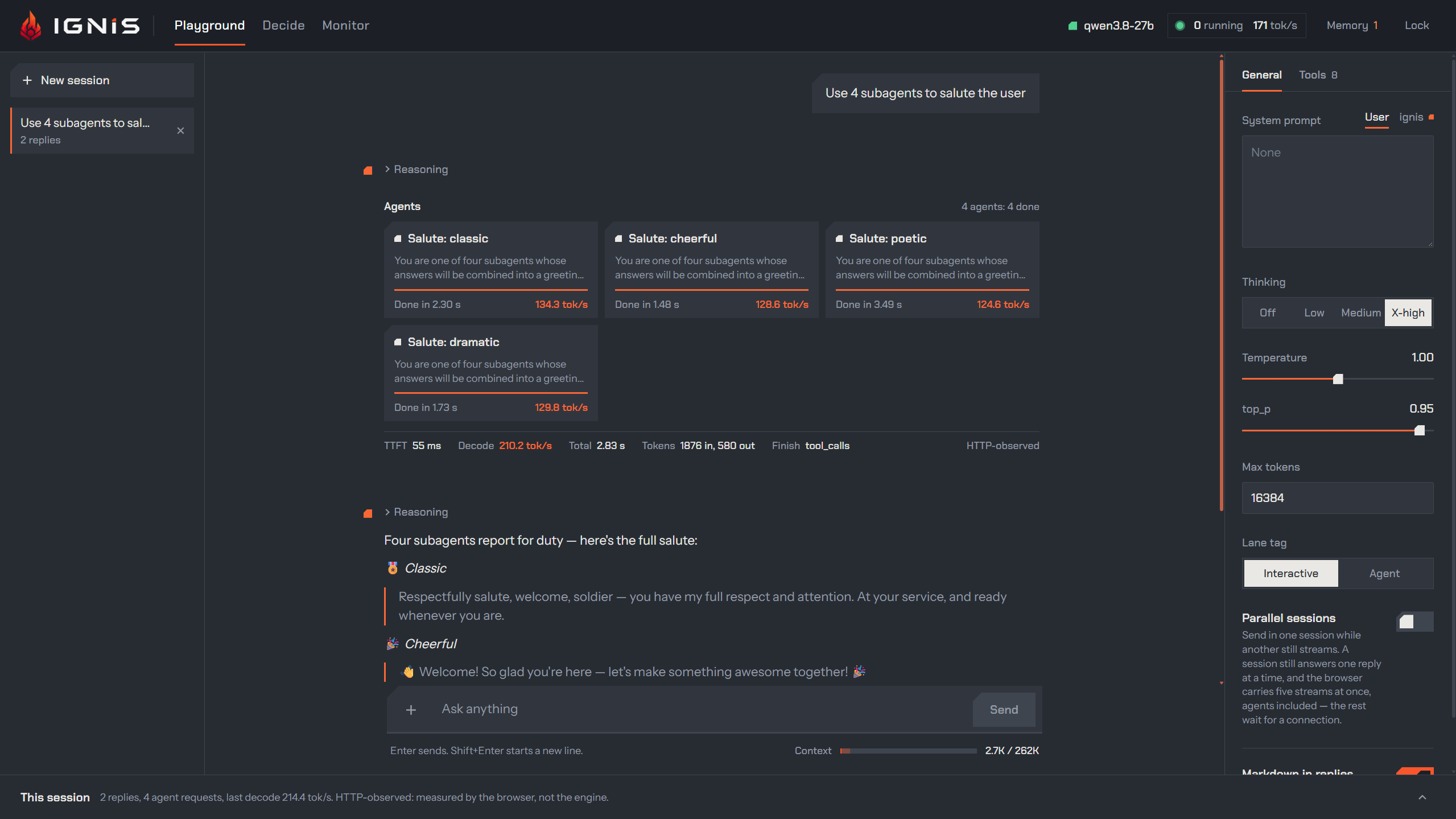
Agents running in parallel, each on its own lane, with the engine's own timings beside every reply:
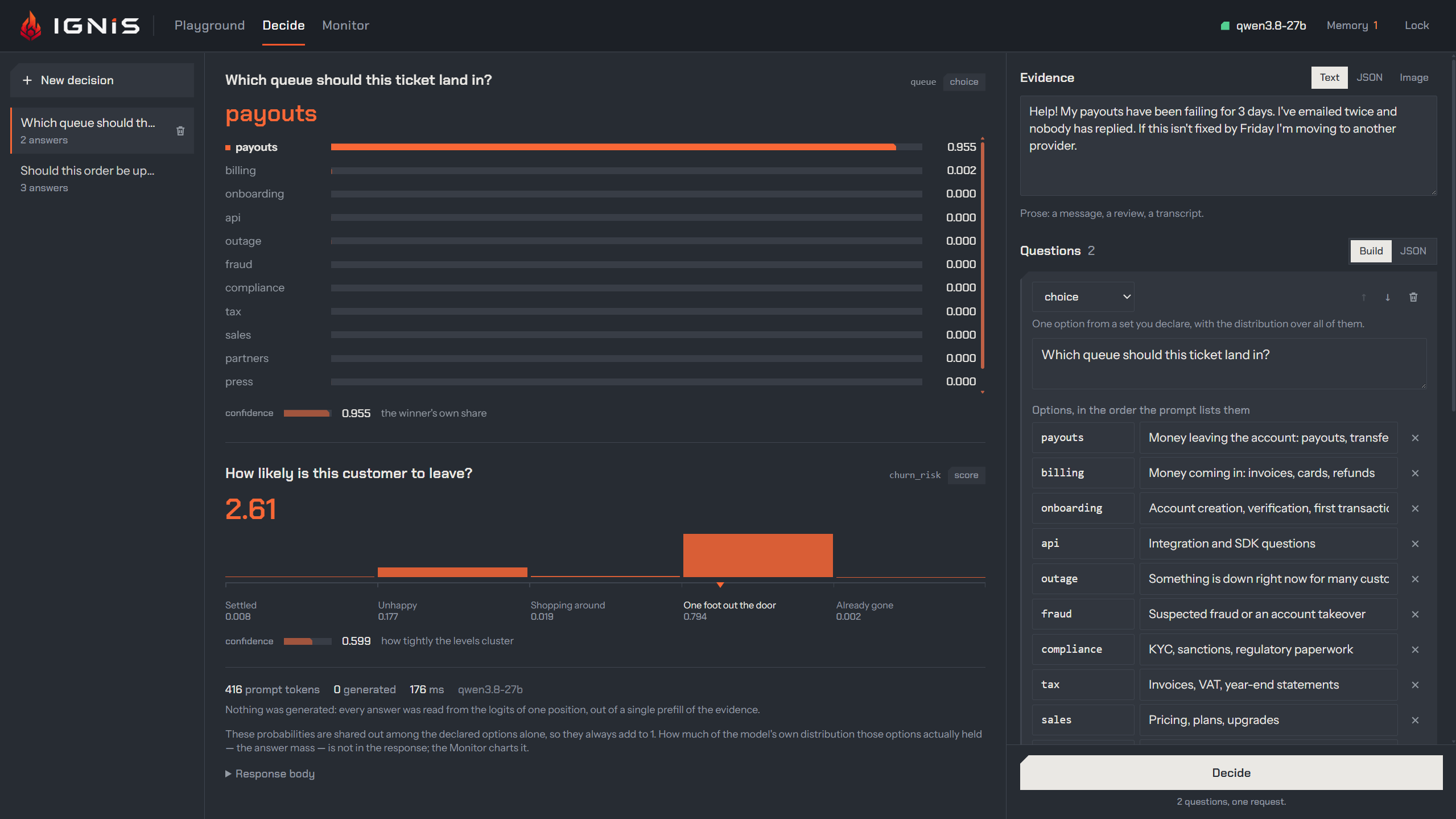
A decision over prose — the winner, the whole distribution, and a score read as levels — answered out of one prefill with nothing generated:
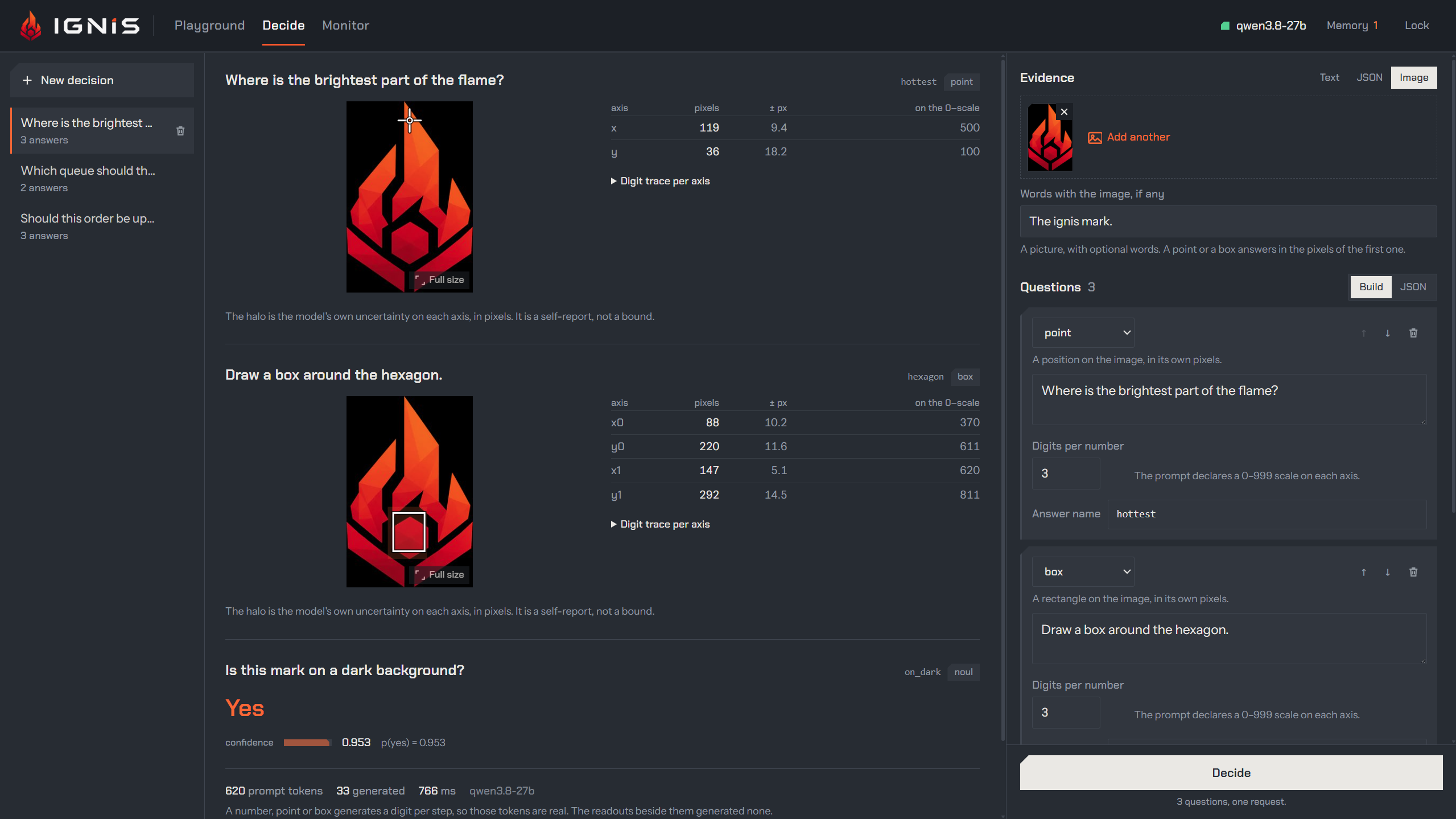
The same endpoint over an image: a point, a box, and a yes/no, each a digit at a time, with the model's self-reported uncertainty on every axis:
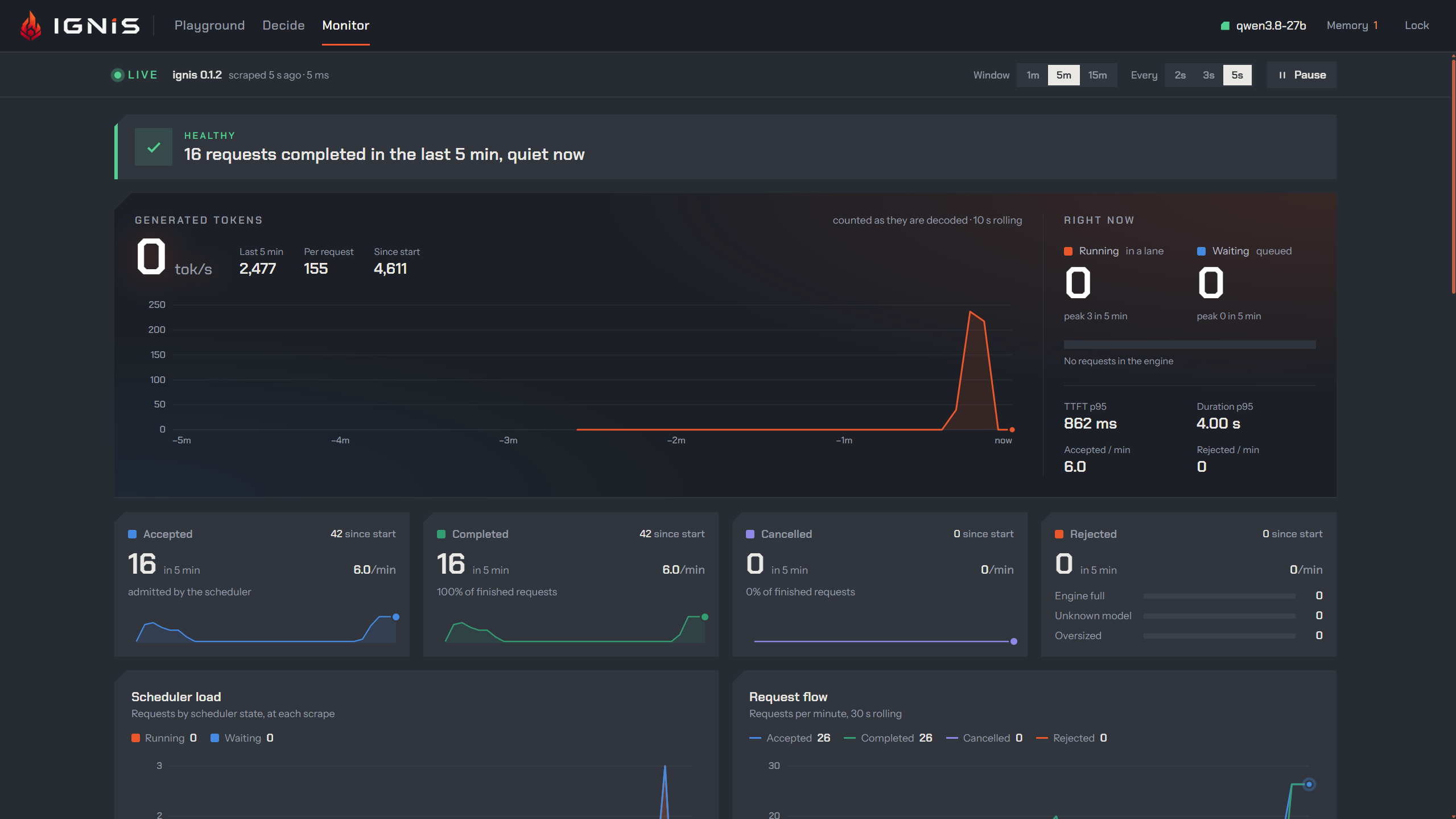
The Monitor scrapes the engine's own metrics: throughput, lane occupancy, latency quantiles:
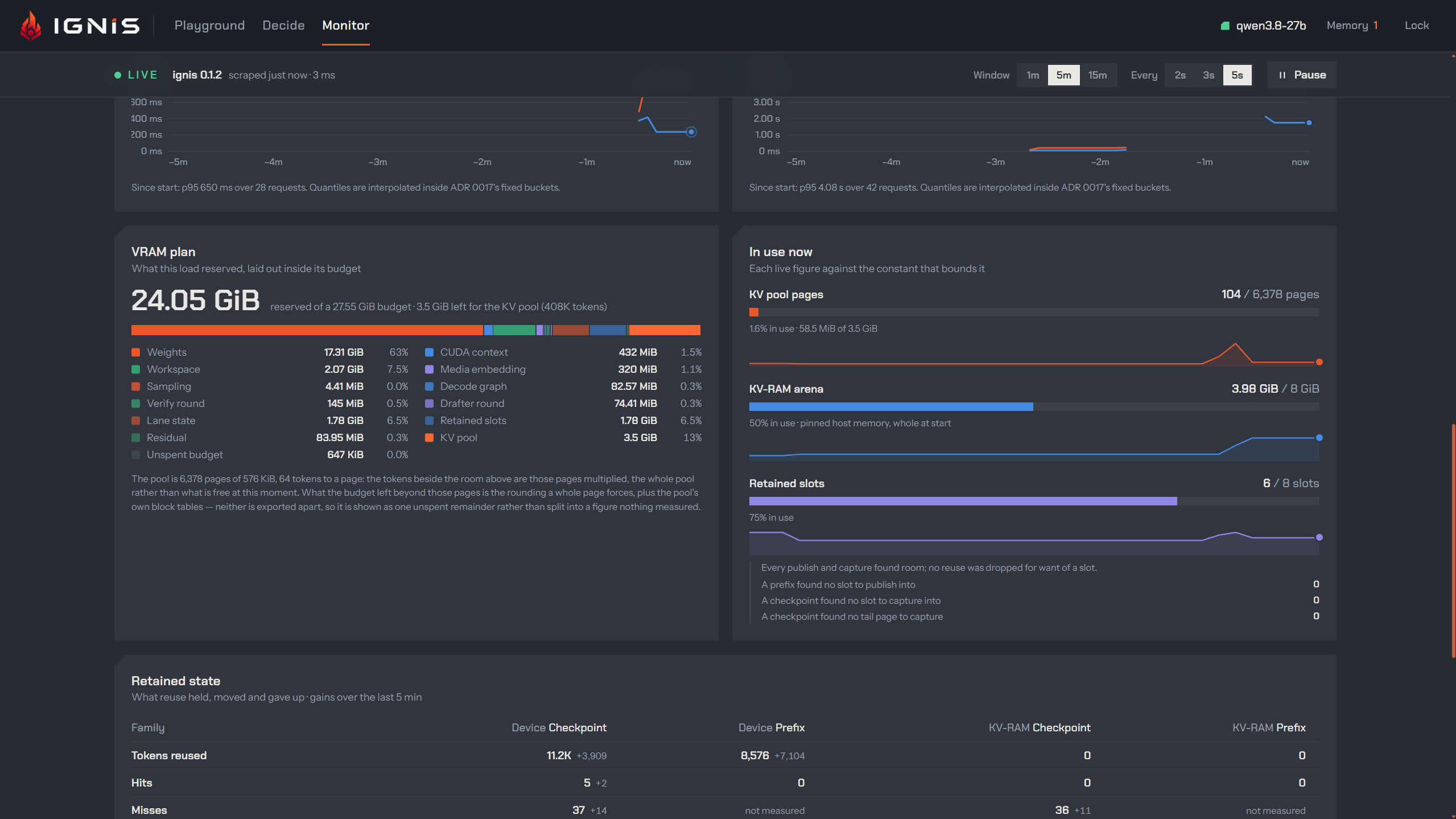
...and what the load actually reserved, against the constants that bound it:
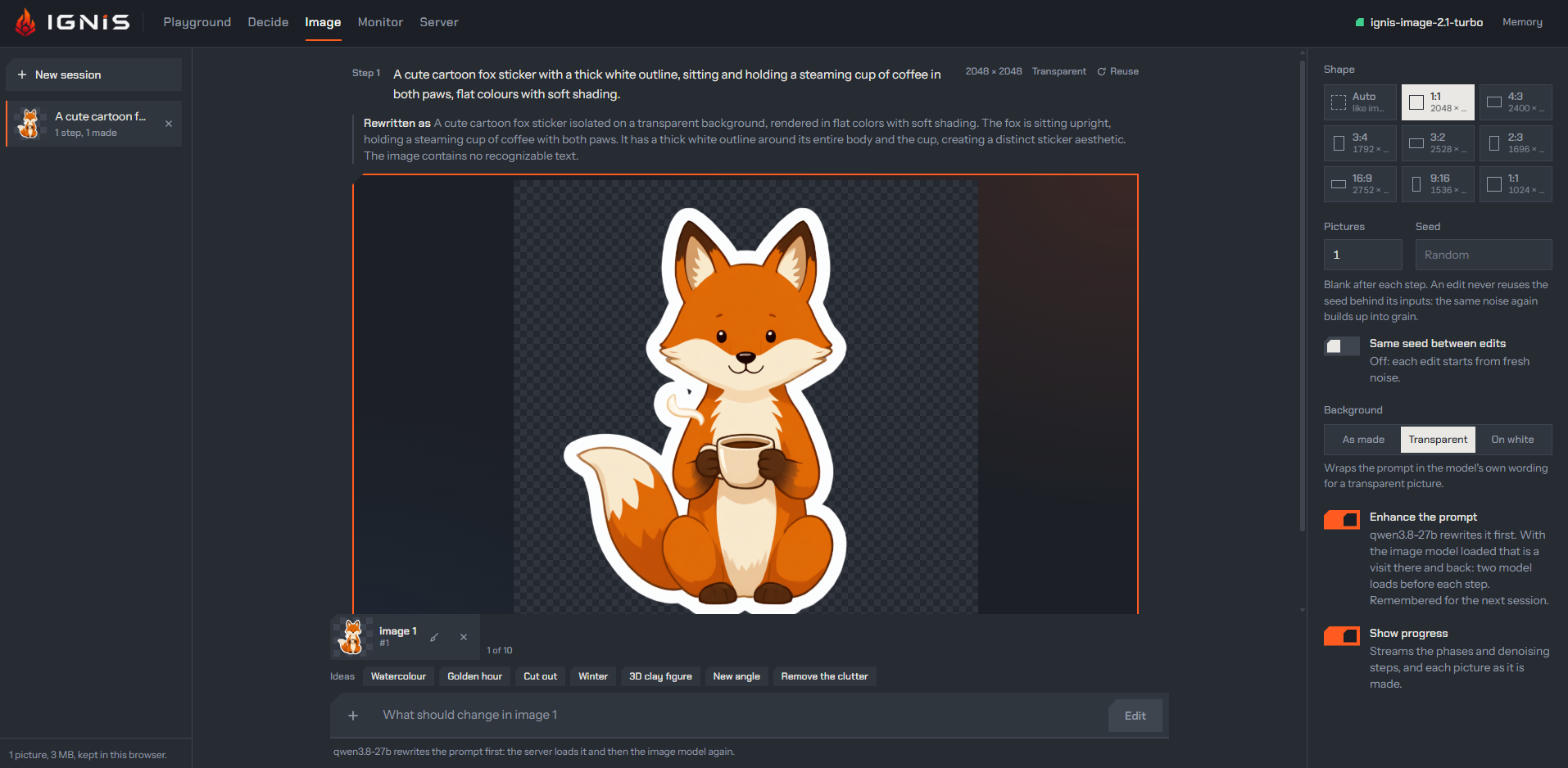
The Image view, a studio of image sessions: the prompt as the 27B rewrote it, a transparent 2048x2048 picture, and the next step's edit already pointed at it. Every step is kept in the browser, and a picture can be marked before it is edited again:
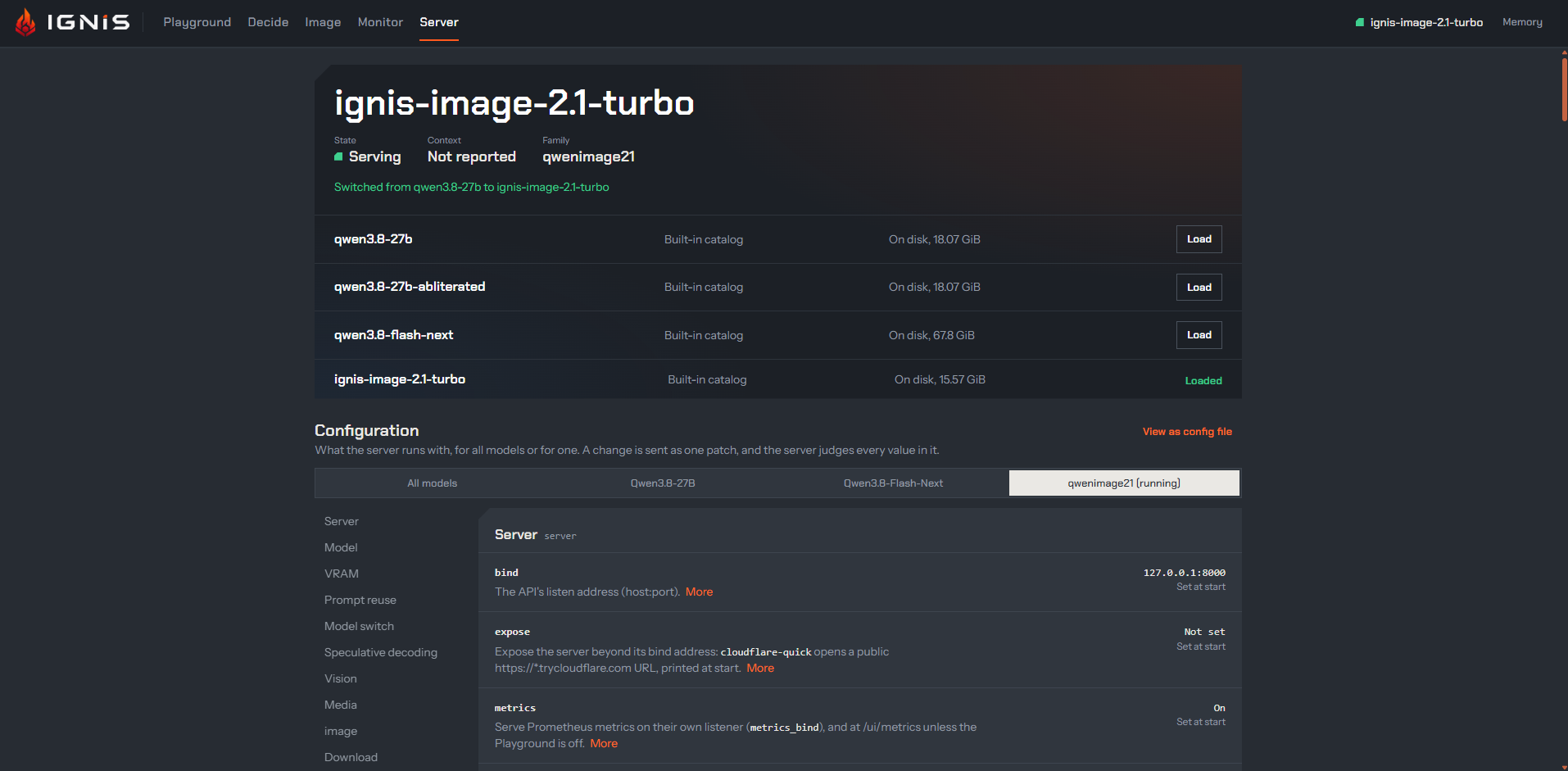
The Server view: the model serving and the switch that brought it, every model the catalog knows with what is on disk and a Download or Load button, and the running configuration, for all models or one family, field by field with where each value comes from (the Playground):
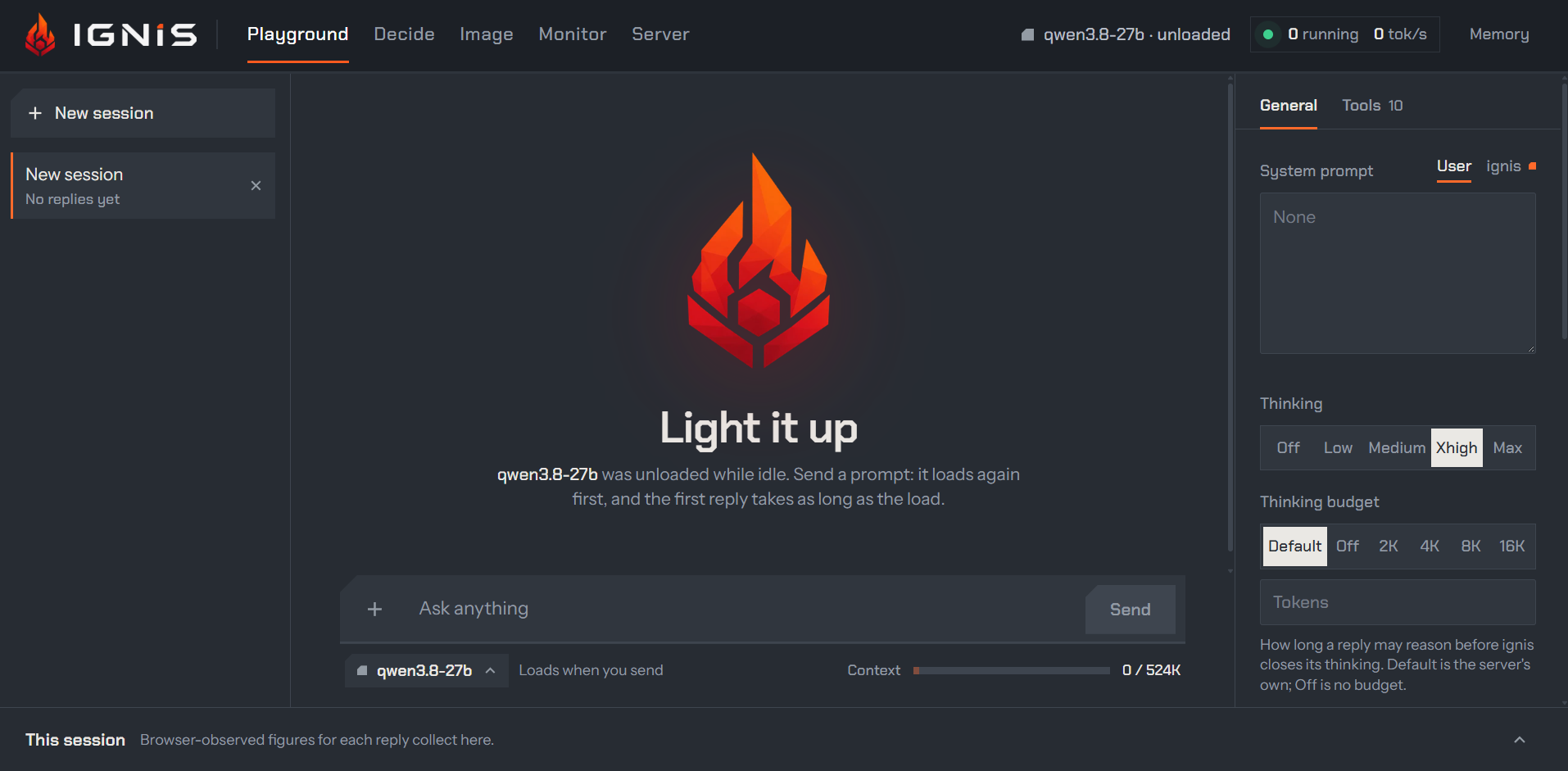
A model the idle clock unloaded is not an error: the header says so, and the next message loads it again before it is answered. The picker under the prompt box says what sending will do first:
Quick start
The weights
Eight artifacts on Hugging Face: six of the 27B, all carrying the DFlash2 drafter (the three NVFP4 ones 18.07-18.08 GiB, the three for 16 GB cards 12.46 GiB), Flash-Next, and the image model:
| Hugging Face | file | |
|---|---|---|
| Standard | gpillon/Qwen3.8-27B-nvfp4full-dflash2-NInfer |
qwen3_8_27b_nvfp4full-v2.ninfer |
| Uncensored | gpillon/Qwen3.8-27B-nvfp4full-dflash2-abliterated-NInfer |
qwen3_8_27b_nvfp4full-v2-huihui-abliterated.ninfer |
| 16 GB card (trellis body, about 3 bits per weight) | gpillon/Qwen3.8-27B-trellis-3bpw-ignis |
qwen3_8_27b_trellis_sc30-v2.ninfer |
| Uncensored, 16 GB card | gpillon/Qwen3.8-27B-trellis-3bpw-abliterated-ignis |
qwen3_8_27b_trellis_sc30-v2-huihui-abliterated.ninfer |
| Swift 1.5 (a fine-tune of the 27B; commercial use above the license's US$1M revenue threshold is not licensed) | gpillon/Swift-1.5-Qwen3.8-27B-nvfp4-ignis |
qwen3_8_27b_nvfp4full-v2-ukisai-swift-1.5.ninfer |
| Swift 1.5, 16 GB card | gpillon/Swift-1.5-Qwen3.8-27B-trellis-3bpw-ignis |
qwen3_8_27b_trellis_sc30-v2-ukisai-swift-1.5.ninfer |
| Flash-Next (125B MoE, 67.8 GiB with its MTP companion) | gpillon/Qwen3.8-Flash-Next-trellis-a25-ignis |
qwen3_8_flash_next_trellis_a25-v2.ninfer |
| Image (Qwen-Image-2.1-Turbo, 15.57 GiB, non-commercial use only) | gpillon/ignis-image-2.1-turbo |
ignis_image_2_1_turbo-v2.ninfer |
The server fetches the standard one by itself the first time it starts without
a model (on a 16 GB card, the 16 GB one), and checks every file's size and SHA-256 before using it. To download
any of them ahead of time — no GPU needed, --out <dir> for a machine with no
network:
ignis-server model download qwen3.8-27b
ignis-server model download qwen3.8-27b-abliterated
ignis-server model download qwen3.8-27b-16g
ignis-server model download qwen3.8-27b-abliterated-16g
ignis-server model download swift-1.5-27b
ignis-server model download swift-1.5-27b-16g
ignis-server model download qwen3.8-flash-next
ignis-server model download ignis-image-2.1-turbo
The uncensored artifact is the standard one with the
huihui-ai abliteration
applied: 1,255 of its 1,325 objects are byte-identical, and only the 70 matrices
the abliteration changed are re-encoded. Start it with --model-id qwen3.8-27b-abliterated (fetched like the standard one when it is not on disk),
or make dev UNCENSORED=1 from a checkout; it is served under that id, so a
client can tell the two apart. On a 16 GB card the same id fetches and serves
the 16 GB one, qwen3.8-27b-abliterated-16g: the 16 GB card's artifact with
the same 70 matrices re-quantized from the abliterated weights, about as
faithful to them as the 16 GB artifact is to the standard ones
(the uncensored variant).
It does not refuse, so put the guardrails in the application or tool layer
and do not expose it to untrusted users.
Swift 1.5 is UkisAI's post-training of the 27B, served as swift-1.5-27b, and
on a 16 GB card by swift-1.5-27b-16g, which answers to that id there. Its
weights are under the Swift Open License v1.0, not Apache-2.0: commercial use
by an organization whose gross revenue, with its affiliates, was US$1,000,000
or more in its last fiscal year needs UkisAI's Swift Enterprise License.
model download prints the license before it fetches
(fine-tunes).
Container
podman run --rm --device nvidia.com/gpu=all -p 8000:8000 \
  -v /path/to/models:/models \
  ghcr.io/gpillon/ignis:latest --download-path /models
(docker: --gpus all in place of --device.) With no model in that
directory the server fetches one and verifies it. The Playground is then at
http://127.0.0.1:8000/ui/.
From a checkout
make doctor          # toolchain, rust target, artifact, web deps
make dev             # build web + kernel + GPU server, then run it
make dev VISION=1    # the same, with the vision tower loaded for image input
make dev UNCENSORED=1  # the same, on the uncensored (abliterated) weights
make mock            # the same with no GPU, no kernel, no artifact
make alone lists every target; make config prints the exact server command a
run will use.
A request
curl http://127.0.0.1:8000/v1/chat/completions \
  -H 'Content-Type: application/json' \
  -d '{"model":"qwen3.8-27b","messages":[{"role":"user","content":"Hello"}],"max_tokens":256}'
Full flag table, API surface, model handling, container and release detail:
the user guide (its source:
docs/user/).
Every field of the OpenAI request bodies is honoured, accepted as inert (a
value asking for what the server already does, like n: 1 or store: false),
or refused with a 400 naming it in param — never dropped in silence. The
table is in the API reference at /v1/docs/.
What it does not serve
Choices, not gaps — so nobody goes looking for them:
- Embeddings, or a generic reranker. Either is a second model on the card;
the VRAM plan gives the card to one. A classification is
/v1/decide, read off the loaded model's own readout. /v1/completions. A raw prompt skips the chat template the model was tuned on, and the turn boundaries reuse is keyed on; chat completions and responses cover it./v1/batches. An offline queue is a storage service, and this server holds no request past its connection: send the requests at once, and the scheduler batches them.- Audio out, and
/v1/audio/translations. Nothing here speaks, and the speech model transcribes the language it hears; it does not translate. - LoRA adapters. They are trained against BF16 weights, and the checkpoint is NVFP4: merge the adapter and re-export the checkpoint instead.
- A second model on the card. The VRAM plan is decided at load, for one: the server switches between models by a full reload instead. The one exception is the speech model, which runs on the CPU and never holds VRAM.
Building it
Two parts, in this order: the C++/CUDA kernel leaf, then the Rust workspace that links it.
- Toolchain — Rust; MSVC C++ build tools (Windows) or GCC (Linux); the CUDA
Toolkit (
nvcc, targetSM120a); CMake + Ninja; Node.js for the Playground. - Kernel leaf —
kernel/build.ps1on Windows,kernel/build.shon Linux. Both configure and build intokernel/build/, whichcrates/*/build.rslink. - Workspace —
cargo build --release -p ignis-server --features cudafor the real engine; without--features cuda(or without an artifact) the server runs a deterministic CPU-only mock, which is how protocol and scheduler work gets done with no card.
The repo
| Path | What lives there |
|---|---|
crates/core/ |
Scheduler, admission, paged KV accounting, request state, host tier. |
crates/artifact/ |
The .ninfer reader: reader, binder, materializer. |
crates/runtime/ |
Safe wrapper over the step ABI (CudaLeaf, decode graphs). |
crates/server/ |
HTTP, OpenAI schemas, decisions, metrics, telemetry. |
crates/logging/ |
Structured logging: tracing layers, hotpath lint, trace context. |
crates/bench/ |
Trace-replay harness, gate and canary runner. |
crates/vendor/ |
The vendoring tool: manifest, hashes, patch records. |
kernel/ |
The C++/CUDA leaf: the program and the vendored ops (CMake + nvcc). |
web/ |
The Playground: React + Vite, embedded into the server at build time. |
make wraps all of it. Tests: cargo test is workspace-wide, CPU-only and
never touches the GPU; GPU work is checked by a separate explicit profile that
fails rather than skips when the card is busy. The 5090 fits one run at a
time — check make gpu-status before starting anything on it.
Documentation
| User guide | Running it, tuning it, calling it, working on it: install, models, every config field, the API, the Playground, telemetry, troubleshooting, contributing. Its source is docs/user/. |
| The agent path | For an AI agent working for a user: what ignis is, the checks before installing it, the user's choices, starting it, connecting a client. The site's llms.txt lists every page of the guide as Markdown. |
CONTRIBUTING.md |
How to report a bug and how a change ships. |
docs/adr/ |
Every architectural decision, and why it was taken. |
docs/findings/ |
Durable, evidence-backed measurements. |
docs/agents/ |
Conventions for agents working in this repo. |
GLOSSARY.md |
The glossary. One vocabulary, one meaning per term. |
The OpenAPI description of the HTTP surface is served at /v1/openapi.json,
with a browsable reference at /v1/docs/.
Lineage
Ignis started as a branch of NInfer,
in the fork gpillon/ninfer, where its
first features were built on top of NInfer's engine. That branch soon showed
its limits. Parts of NInfer did not fit the tool it was meant to become, and
much of what that tool needed was not native to NInfer but lived in other
forks, to be cherry-picked one by one. The branch was becoming more
cherry-picks than work of its own. So rather than keep carrying it, Ignis was
rewritten from scratch, around everything NInfer was missing: its own forward
pass, sequence state, step ABI, scheduler and serving layer, with those
features native instead of picked.
To have a working engine from the start, the rewrite brought NInfer's CUDA
kernels in as they were: the kernel leaf vendors them verbatim under a
manifest that pins the reference commit and every file's content hash — a
claim you can diff. The pinned reference is
gpillon/ninfer, itself downstream of
cometkim/ninfer (kernel-perf,
hyperquant KV, NVFP4-full, the original DFlash2 port) →
natpate/ninfer-windows (the
Windows port) → Neroued/ninfer (the
original engine). The .ninfer model artifact is still NInfer's format.
The vendored kernels are a starting point, not a destination: one at a time,
where measurement shows one is the bottleneck, it is rewritten. The latest is
the 27B's prefill attention, which no longer expands the compressed KV history
into BF16 planes before attending: up to 1.02 GB of device memory freed and
cold prefill up to 53% faster. The kernels added for Flash-Next and the image
model, which have no NInfer reference, are our own, or adapted or vendored from
a named, permissively licensed source recorded in kernel/NOTICE.
Ignis is not a fork or a port of NInfer. It is a rewrite that started from NInfer's kernels, and is rewriting them in turn.
For the same reason, ignis asks its own forks to send upstream what is not about their setup, a fix, a feature or a card's figures: Working in a fork.
Credits
With thanks to the NInfer project and its contributors:
- cometkim — kernel-perf integration (PDL decode chain, split-K prefill, per-request error boundary), the DFlash2 base port, the hyperquant KV cache, the 1M-context envelope, the NVFP4-full target.
- Mirko Covizzi — RTX 5090 Laptop compatibility, MTP adaptive verification-width tuning.
- mr-september — warmup/readiness decoupling, frontend streaming fixes.
- dylan (dylanbrodiefafard) — the RAM KV cache concept, LRU lane eviction, the decode CPU-spin fix.
- Neroued — the original NInfer engine.
License
Apache License 2.0.