
getbeton/inspector
getbeton/inspector has 40 GitHub stars and 2 forks. GitHot measured 0 stars in 24 hours. Last checked 2026-11-16 04:29 UTC. Last push 2026-11-09.
What you can do
- 20+ Signal Detectors — Trial intent, power users, feature adoption, engagement drops, and more
- Account Scoring — Health, expansion potential, and churn risk on a 0–100 scale (concrete grades: M100, M75, M50, M25, M10)
- PostHog Integration — Reads events, persons, and group data from your PostHog data warehouse
- CRM Sync — Routes scored accounts and signals to Attio, HubSpot, Pipedrive, or Zoho with full context
Measured star growth
- in 24h
- 0
- in 7 days
- Collecting history
- in 15 days
- Collecting history
- in 1 month
- Collecting history
Net star changes over overlapping periods, not daily totals. Missing measurements are left blank. Stars measure attention, not software quality.
About
Open-source revenue intelligence (not in active development): find buying signals in PostHog data, score accounts and route them to your CRM. Alternative to Pocus and Common Room.
Self-hostedREADME.md
OriginalBeton Inspector
Open-source revenue intelligence for product-led growth.
Turn your PostHog product data into buying signals, score every account, and route the warmest leads to your CRM — no data engineering required.
The open-source alternative to Pocus and Common Room.


Self-host · Architecture · All Beton repos
Why it exists
Your product already knows which accounts are about to buy, expand, or churn — the signals are sitting in PostHog. But they never reach the people who act on them: by the time usage data becomes a dashboard, the moment has passed, and sales is still working off gut feel and lead forms. Commercial tools that close this gap (Pocus, Common Room) are closed-source, expensive, and want to own your data. Beton Inspector is the open-source alternative: run it yourself, point it at your own PostHog and CRM, and own the whole pipeline.
What is Beton Inspector?
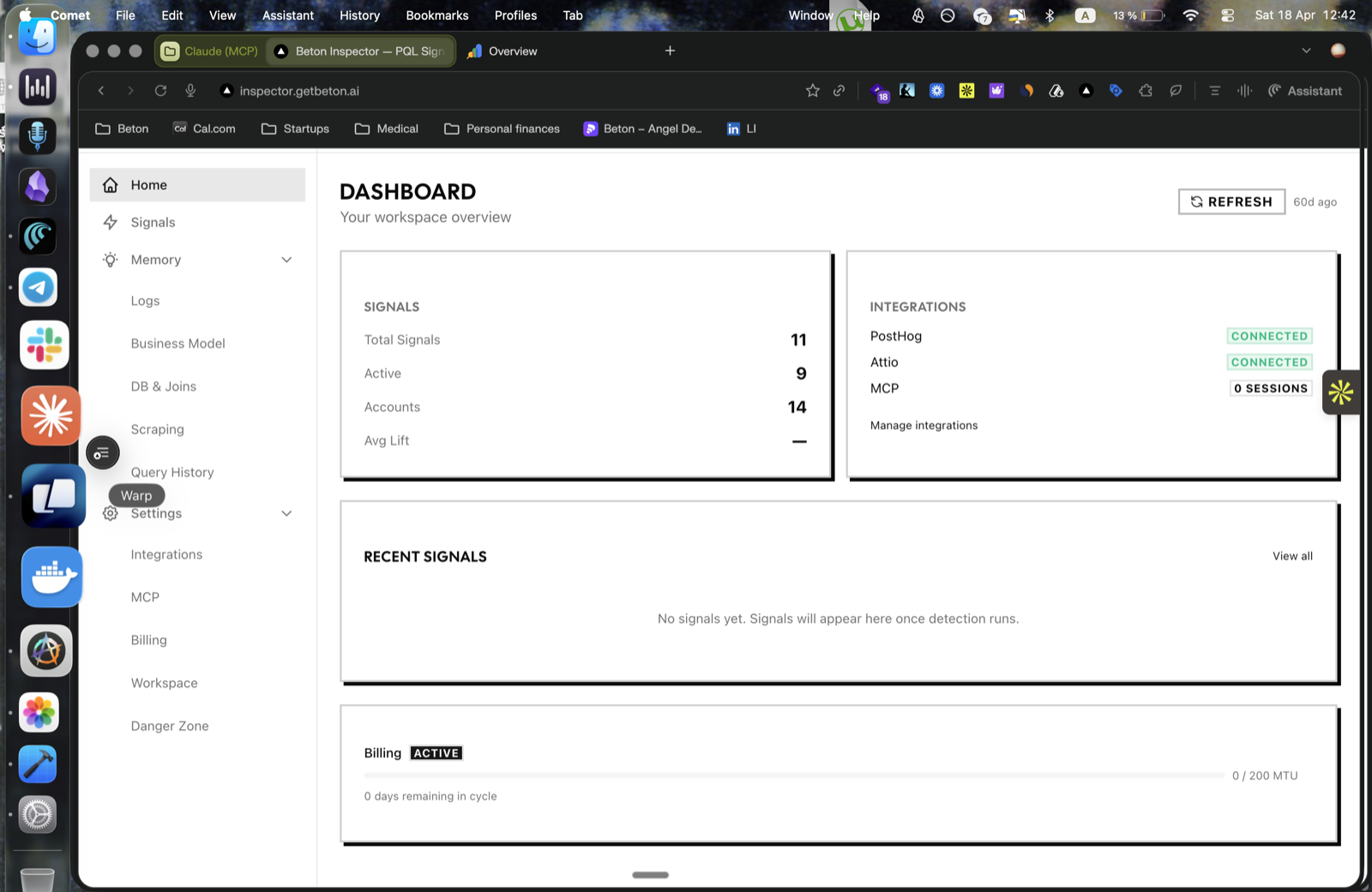
Beton Inspector connects to your product analytics (PostHog) and turns raw usage data into actionable revenue signals. Instead of guessing which accounts are ready to buy, expand, or churn, Beton detects concrete behavioral patterns — trial conversion intent, power user emergence, feature adoption velocity — and scores each account automatically.
The signals and scores flow into your CRM (Attio, HubSpot, Pipedrive, Zoho), giving your sales team a prioritized list of accounts with context on why they should reach out and when.
Key value: Your product data already contains the buying signals. Beton Inspector surfaces them without requiring data engineering or custom dashboards.
Features
- 20+ Signal Detectors — Trial intent, power users, feature adoption, engagement drops, and more
- Account Scoring — Health, expansion potential, and churn risk on a 0–100 scale (concrete grades: M100, M75, M50, M25, M10)
- PostHog Integration — Reads events, persons, and group data from your PostHog data warehouse
- CRM Sync — Routes scored accounts and signals to Attio, HubSpot, Pipedrive, or Zoho with full context
- Webhooks & n8n — Route signals to custom destinations via webhooks or n8n workflows
- Multi-tenant — Workspace-based isolation with Supabase Row Level Security
- Metered Billing — Optional Stripe integration for SaaS billing (can be disabled for self-hosting)
- Agent System — AI-powered data exploration that learns your schema and business model
Self-Hosting Quick Start
Beton Inspector is fully self-hostable under AGPL-3.0. Leave DEPLOYMENT_MODE=self-hosted
(the default) and all billing/Stripe features are disabled — unlimited use, no payment dependency.
Prerequisites
- Docker + Docker Compose (recommended), or Node.js 20+ for local dev
- PostgreSQL — via Supabase (recommended) or any PostgreSQL instance
- PostHog account with API access
Configure environment
git clone https://github.com/getbeton/inspector.git
cd inspector

cp .env.example .env
# Edit .env and set at minimum:
#   NEXT_PUBLIC_SUPABASE_URL        your Supabase project URL
#   NEXT_PUBLIC_SUPABASE_ANON_KEY   Supabase anon key
#   ENCRYPTION_KEY                  64-char hex (generate below)
#   AGENT_SECRET                    64-char hex (generate below)
#   DEPLOYMENT_MODE=self-hosted

# Generate the two secrets:
node -e "console.log(require('crypto').randomBytes(32).toString('hex'))"
Option A — Docker (recommended)
# Reads .env, starts the app on :3000 (and an optional local Postgres on :5432)
docker compose up
# → http://localhost:3000
Option B — Local (npm)
npm install
npm run dev   # next dev loads your .env
# → http://localhost:3000
Connect your data
- Sign in and create a workspace.
- Add your PostHog credentials in Settings → Integrations.
- Pick a CRM destination (Attio, HubSpot, Pipedrive, or Zoho) — optional.
- Signals and 0–100 account scores (grades M100–M10) populate as events sync.
Self-Hosted Mode
When self-hosting, set DEPLOYMENT_MODE=self-hosted (or leave it unset). This disables all billing features, giving you unlimited access with no Stripe dependency.
Architecture
| Component | Technology | Details |
|---|---|---|
| Application | Next.js (TypeScript) | Full-stack — pages + API routes |
| Database | PostgreSQL (Supabase) | RLS-secured, multi-tenant |
| Auth | Supabase OAuth (PKCE) | Session cookies, workspace context |
| State | Zustand + React Query | Client state + server cache |
All code lives in src/. There is no separate backend — business logic runs as Next.js API routes.
src/
├── app/
│   ├── (auth)/              # Login, OAuth callback
│   ├── (dashboard)/         # Protected pages (signals, identities, memory, settings)
│   └── api/                 # ~40 API route handlers
├── components/
│   ├── ui/                  # Base UI primitives (base-ui + CVA)
│   ├── layout/              # Sidebar, header, navigation
│   ├── signals/             # Signal-specific components
│   └── billing/             # Billing UI (optional)
└── lib/
    ├── heuristics/          # Signal detection & scoring engine
    │   └── signals/detectors/  # 20+ signal detectors
    ├── integrations/        # PostHog, Attio, Stripe clients
    ├── supabase/            # Client helpers + auto-generated types
    └── email/               # Notification emails (Resend)
Development
npm run dev          # Start dev server
npm run build        # Production build (must pass before committing)
npm run lint         # ESLint
npm run typecheck    # TypeScript check
Contributing
Beton is not in active development, so the team does not review new pull requests. You can fork the repo under the AGPL-3.0 license. CONTRIBUTORS.md lists the people who built it.
License
Beton Inspector is licensed under the GNU Affero General Public License v3.0.
This means you can freely use, modify, and distribute the software, but any modifications must also be made available under the same license, including when running a modified version as a network service.
Security
To report a security problem, see SECURITY.md.
More from Beton
Beton was open-source revenue intelligence. Inspector was the main product. Other Beton repos:
- dryfit: synthetic analytics data and hidden benchmark truth for agent tests
- oss-pricing-data: open-source pricing dataset, 20 tools, 2023 vs 2026
- beton-main-site: the Beton website, with the blog and the pricing teardowns