
flyingriverhorse/Kayra has 48 GitHub stars and 8 forks. GitHot measured +1 stars in 24 hours. Last checked 2026-11-09 14:59 UTC. Last push 2026-11-06.
Visual MLOps you host yourself: canvas or Python pipelines, training, registry, serving and drift monitoring. Export models as standalone APIs, or run them on Databricks with MLflow.
What you can do
- Data - Ingest CSV, Excel, JSON, Parquet or S3 (AWS, MinIO). Metadata starts in SQLite with zero config and scales to PostgreSQL.
- Exploratory analysis - One-click profiling with interactive charts, statistical alerts, correlations, outliers, segmentation, decision-tree rule extraction, time-series, geospatial views and causal discovery (DAGs).
- Visual pipeline canvas - Drag-and-drop nodes for cleaning, imputation, encoding, scaling, outlier handling, feature generation, text vectorizers and feature selection. Multi-branch canvases run as parallel jobs.
- Training & tuning - 34 model types: scikit-learn classifiers, regressors and clustering, plus XGBoost and LightGBM. Grid, random and successive-halving search built in, Optuna optional. Voting and stacking ensembles. Jobs run in the background (Celery + Redis, or threads).
Measured star growth
- in 24h
- +1
- in 7 days
- Update delayed
- in 15 days
- Update delayed
- in 1 month
- Update delayed
Net star changes over overlapping periods, not daily totals. Missing measurements are left blank. Stars measure attention, not software quality.
README.md
OriginalSkyulf

Kayra — the self-hosted visual MLOps builder, by Skyulf.
From a raw file to a trained, served and monitored model, without leaving one workspace.



🟢 live demo, no signup required




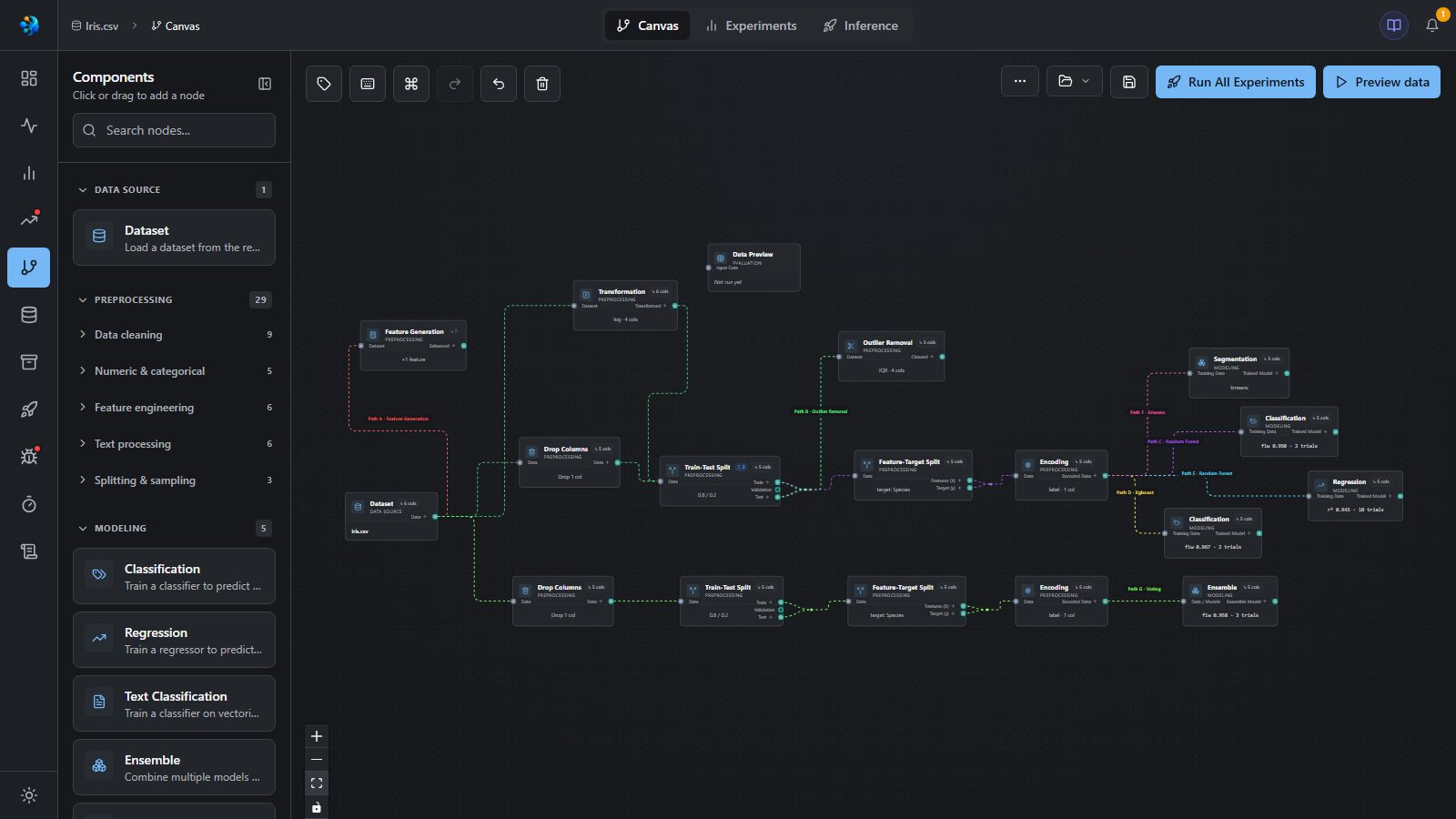
Skyulf has two parts that share one engine:
- Kayra — a self-hosted web application. Upload data, explore it, build a pipeline on a node-based canvas, train and tune models in the background, compare runs, serve the best one and watch it for drift. Your data stays on your machine or server.
skyulf-core— the standalone Python library behind Kayra (Apache 2.0, on PyPI). Use the same pipelines, EDA and models from your own scripts and notebooks.
A model you train does not have to stay inside Skyulf: export it as a standalone API and batch project, or run the whole lifecycle directly on Databricks with MLflow.
Contents
- Features
- Quick Start
- Take a model anywhere: project export
- Run ML on Databricks with MLflow
- Use skyulf-core as a library
- Screenshots
- Documentation
- Development
- Contributing
- License
Features
| Area | What you get |
|---|---|
| Data | Ingest CSV, Excel, JSON, Parquet or S3 (AWS, MinIO). Metadata starts in SQLite with zero config and scales to PostgreSQL. |
| Exploratory analysis | One-click profiling with interactive charts, statistical alerts, correlations, outliers, segmentation, decision-tree rule extraction, time-series, geospatial views and causal discovery (DAGs). |
| Visual pipeline canvas | Drag-and-drop nodes for cleaning, imputation, encoding, scaling, outlier handling, feature generation, text vectorizers and feature selection. Multi-branch canvases run as parallel jobs. |
| Training & tuning | 34 model types: scikit-learn classifiers, regressors and clustering, plus XGBoost and LightGBM. Grid, random and successive-halving search built in, Optuna optional. Voting and stacking ensembles. Jobs run in the background (Celery + Redis, or threads). |
| Experiments | Compare runs side by side with metrics, confusion matrices and ROC curves; tune decision thresholds; optional SHAP explanations. |
| Registry & serving | Versioned model registry. Promote a version and it is served behind a REST endpoint; the full deployment history is kept. |
| Project export | Download any completed version as a standalone project: a FastAPI service and CSV/Parquet batch scoring that run without Kayra. More below. |
| Notebook export | Turn any canvas pipeline into a self-contained Jupyter notebook, in full (one cell per node) or compact mode, including tuning. |
| Monitoring | Data and model drift reports, error log, slow-node profiling and an audit log of every pipeline change. |
| Databricks & MLflow | Databricks Asset Bundle template for training, approval, batch and Spark scoring, Model Serving and monitoring; MLflow tracking and registry. More below. |
| Performance | FastAPI + Polars for ETL; Arrow-based conversion to NumPy for model nodes via SklearnBridge. |
Quick Start
Prerequisites: Python 3.12 (or Docker).
1. One command
- Windows: double-click
start.bat - macOS / Linux:
./start.sh(orbash start.sh)
The script creates a virtual environment, installs dependencies, writes a .env with safe defaults
(SQLite, no Redis) and starts the server. Open http://127.0.0.1:8000 when it is ready.
2. Docker Compose
docker compose up --pull=always --build
This starts the FastAPI backend (port 8000), Redis (port 6379) and a Celery worker. Check http://127.0.0.1:8000/health; in development mode the API docs are at http://127.0.0.1:8000/docs.
3. Manual setup
pip or uv, step by step
Using uv (faster):
uv venv
# Windows: .\.venv\Scripts\Activate.ps1   macOS/Linux: source .venv/bin/activate
uv pip install -r requirements.txt
python run_skyulf.py
Using pip:
python -m venv .venv
# Windows: .\.venv\Scripts\Activate.ps1   macOS/Linux: source .venv/bin/activate
pip install --upgrade pip
pip install -r requirements.txt
python run_skyulf.py
run_skyulf.py starts the FastAPI server.
Optional: run without Celery and Redis
By default Kayra uses Celery and Redis for background jobs. For simple local use, or where you
cannot run Redis, add this to .env:
USE_CELERY=false
Training and ingestion then run in background threads inside the main process.
Optional: S3 storage
To use S3 for data and artifacts, add these to .env:
AWS_ACCESS_KEY_ID=your_key
AWS_SECRET_ACCESS_KEY=your_secret
AWS_DEFAULT_REGION=us-east-1
AWS_BUCKET_NAME=your-bucket
# Optional: upload local training artifacts to S3
UPLOAD_TO_S3_FOR_LOCAL_FILES=true
# Optional: force local storage even for S3 data
SAVE_S3_ARTIFACTS_LOCALLY=false
AWS_BUCKET_NAME is the canonical default data-bucket setting and is read from .env or the
process environment. The legacy S3_BUCKET_NAME name is also accepted. Environment values
override .env; when both names are set in the same source, AWS_BUCKET_NAME takes precedence.
For a guided first pipeline, see QUICKSTART.md.
Take a model anywhere: project export
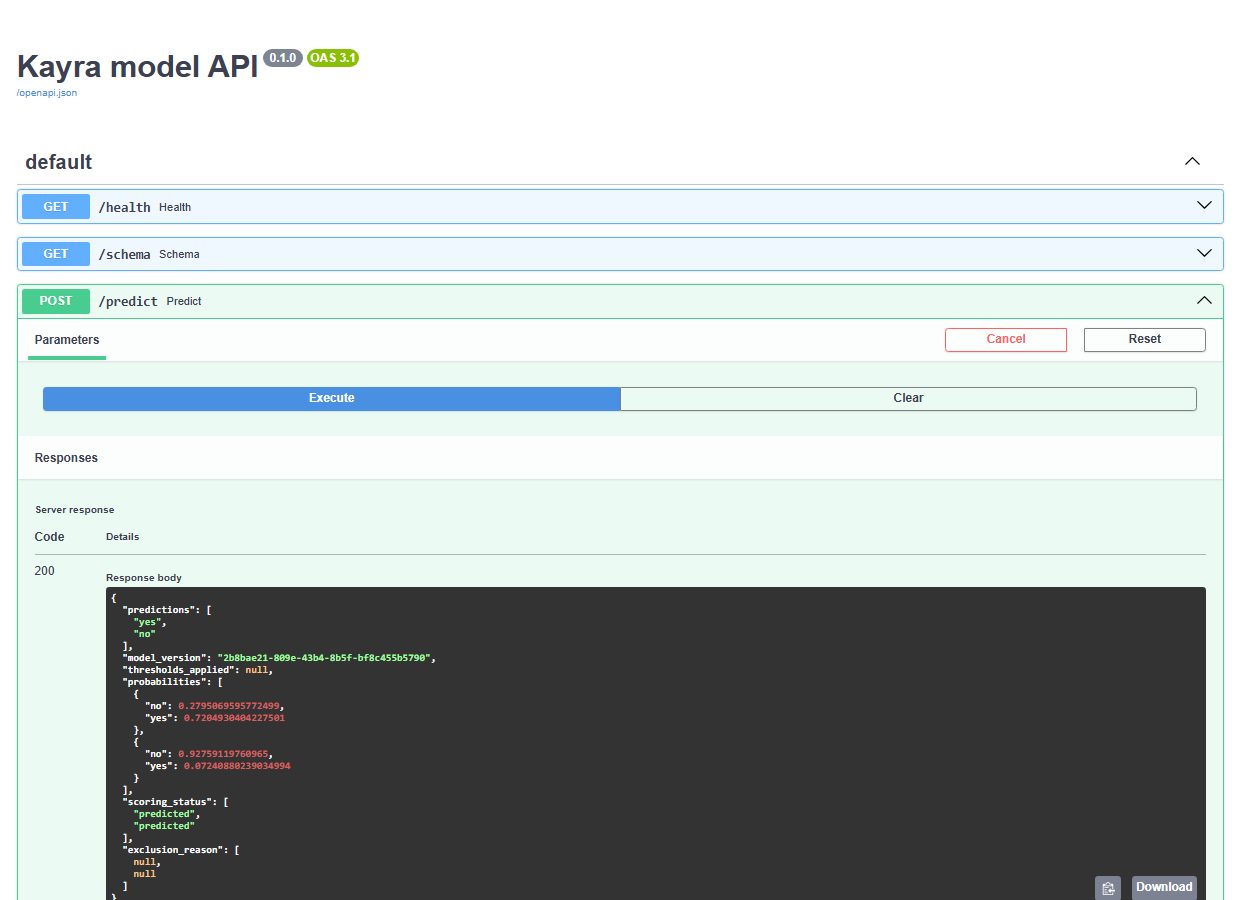
In Model Registry, pick a completed version and click Export project. You get a ZIP that runs on any machine with Python, without Kayra, a database or a scheduler:
model.pkl          fitted model + fitted preprocessing (imputers, encoders, scalers, outlier filters)
scoring.py         one prediction path shared by the API and batch
app.py             FastAPI service: /predict, /health, /schema, /docs with typed inputs
batch.py           CSV/Parquet scoring in chunks, original rows and columns kept
wheels/            the matching skyulf-core wheel, so installation never depends on PyPI
requirements.txt   pinned versions · Dockerfile · smoke_test.py · README.md
uv venv && uv pip install -r requirements.txt

# HTTP API, docs at http://127.0.0.1:8000/docs
uv run --no-project uvicorn app:app --port 8000

# batch scoring of a file
uv run --no-project python batch.py --input data.parquet --output scored.parquet
Send raw columns as they were in your training data; the saved preprocessing runs before the
model. Classifiers return labels and class probabilities. Rows rejected by a fitted outlier
filter are kept in place and marked excluded instead of silently disappearing. See the
project export quickstart for the full
flow and what can and cannot be exported.
Run ML on Databricks with MLflow
Skyulf ships a Databricks Asset Bundle template, so the same preprocessing and models run as Databricks jobs on your own workspace, with MLflow and Unity Catalog as the model registry:
databricks bundle init skyulf-core/templates/databricks --output-dir ./generated
The generated project covers the full lifecycle, configured in YAML instead of notebooks:
- Train one model, a competition of 2-8 candidate algorithms, or a multi-target model set, with grid, random, halving or Optuna search and holdout quality gates.
- Register and approve versions in MLflow / Unity Catalog with champion and challenger aliases and rollback.
- Score on a schedule into Delta tables, on a single node or on Spark workers for large tables.
- Serve through a Model Serving REST endpoint, call it from SQL with
ai_query, or look up online features by key. - Monitor drift, performance and serving health with Databricks dashboards.
MLflow also works without Databricks: track runs, package models and manage a local registry. Start with the integrations index or follow the end-to-end Databricks walkthrough.
Use skyulf-core as a library
pip install skyulf-core                  # base
pip install "skyulf-core[eda,viz]"       # profiling and charts
pip install "skyulf-core[eda,viz,tuning,preprocessing-imbalanced,modeling-xgboost]"   # full set
# or with uv: uv add "skyulf-core[eda,viz]"
Train, save and reuse a pipeline
import polars as pl
from skyulf import SkyulfPipeline

df = pl.DataFrame({
    "age": [43, 38, None, 52, 61, 29, 47, 55],
    "income": [52000, 61000, 48000, None, 73000, 41000, 58000, 66000],
    "city": ["NY", "LDN", "LDN", "PAR", "NY", "PAR", "NY", "LDN"],
    "purchased": [1, 0, 0, 1, 1, 0, 0, 1],
})

pipeline = SkyulfPipeline({
    "preprocessing": [
        {"name": "split", "transformer": "TrainTestSplitter",
         "params": {"target_column": "purchased", "test_size": 0.25, "random_state": 42}},
        {"name": "impute", "transformer": "SimpleImputer",
         "params": {"columns": ["age", "income"], "strategy": "median"}},
        {"name": "encode", "transformer": "OneHotEncoder",
         "params": {"columns": ["city"], "handle_unknown": "ignore"}},
    ],
    "modeling": {"type": "random_forest_classifier", "params": {"random_state": 42}},
})

metrics = pipeline.fit(df, target_column="purchased")
pipeline.save("model.pkl")
predictions = SkyulfPipeline.load("model.pkl").predict(df.drop("purchased"))
Imputation, encoding and the model are fitted on the training split only, so the test split stays
untouched. See skyulf-core/README.md and the
quickstart notebook.
Automated EDA
import polars as pl
from skyulf import EDAAnalyzer, EDAVisualizer

df = pl.read_csv("your_dataset.csv")
profile = EDAAnalyzer(df).analyze(
    target_col="target",
    task_type="Classification",  # optional: "Classification" or "Regression"
    date_col="timestamp",        # optional, if auto-detection fails
)

viz = EDAVisualizer(profile, df)
viz.summary()  # rich terminal dashboard
viz.plot()     # matplotlib charts
Time-series, geospatial and causal examples are in the EDA guide.
Screenshots
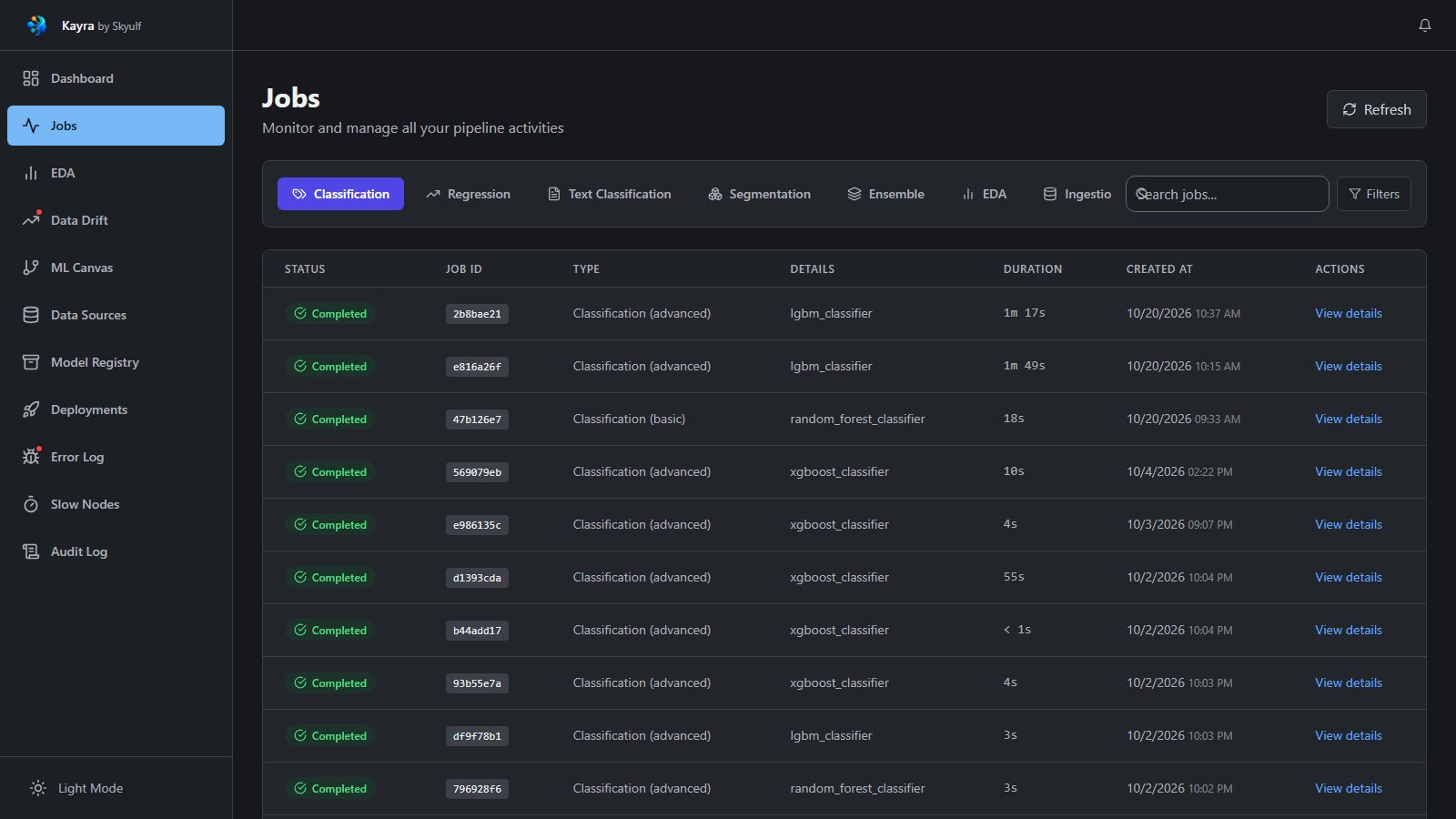 Background training and tuning |
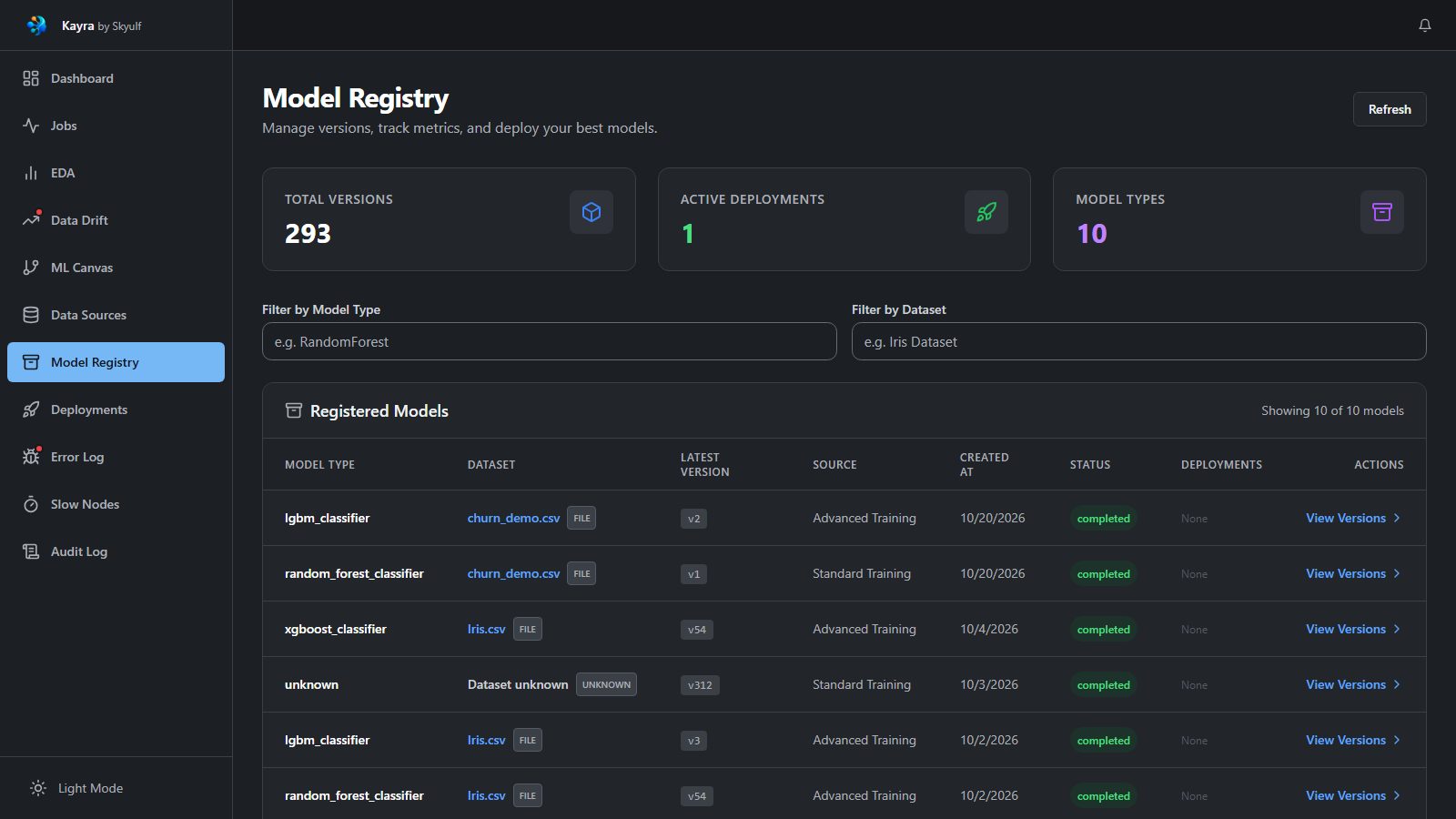 Versioned model registry |
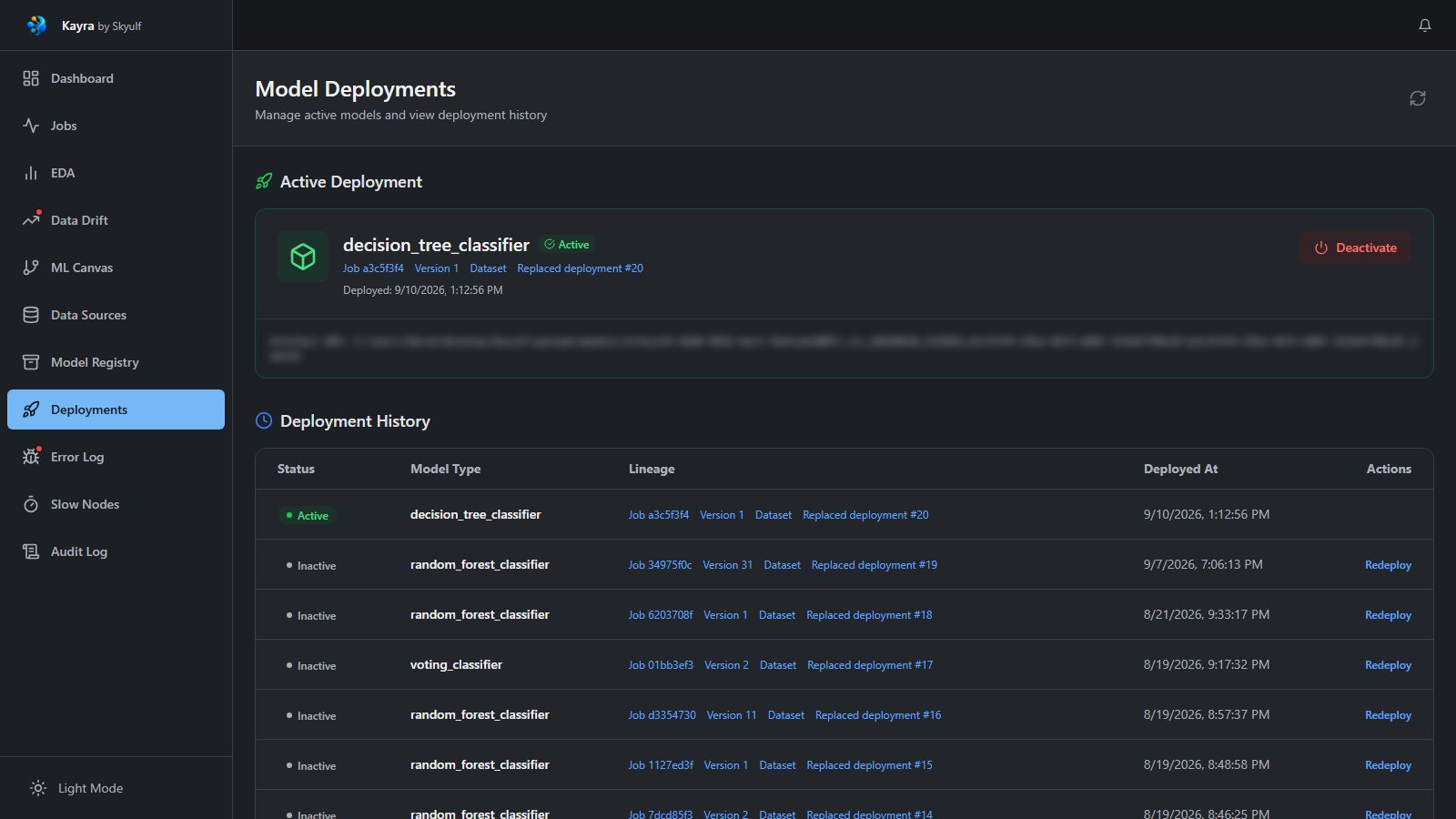 One-click deployment with history |
 Standalone exported model API |
Documentation
The full manual is at kayra.skyulf.com/manual. Good starting points:
| Topic | Guide |
|---|---|
| First pipeline in Kayra | QUICKSTART.md |
| EDA and profiling | EDA guide |
| Text and NLP nodes | Text & NLP |
| Drift monitoring | Drift monitoring |
| Standalone model projects | Project export quickstart |
| SHAP explanations | SHAP |
| MLflow and Databricks | Integrations |
| What changed | CHANGELOG.md and changelog/ |
Development
- Configuration lives in the
backend/config/package (domain mixins: SQLite, dev CORS, Celery, S3). - Lifespan hooks initialize the async database engine automatically.
- Tests:
tests/(backend and integration) andskyulf-core/tests/(library). skyulf-commands.mdcollects the common dev, quality-check (Ruff +ty), test, build and release commands.RELEASING.mdexplains the app release (GitHub Release) and theskyulf-corerelease (PyPI).
Contributing
Contributions are welcome. See CONTRIBUTING.md for setup and workflow, and read the Code of Conduct. Bug reports, feature ideas and documentation fixes all help.
License
Skyulf uses a split licensing model to balance open standards with sustainable development:
- Backend (FastAPI / API server): GNU AGPLv3 (Copyleft) - If you run this as a network service you must release your full stack's source code, or obtain a commercial license.
- Frontend (ML Canvas): GNU AGPLv3 (Copyleft) - Same network-service copyleft requirement.
- Core Library (
skyulf-core): Apache 2.0 (Permissive) - Use freely in any project, open or commercial.
Commercial Use:
If you want to run the backend or frontend as part of a proprietary product or SaaS without open-sourcing your stack, you need a commercial license exception.
See COMMERCIAL-LICENSE.md for partnership options.
Existing versions: Releases v0.5.15 and earlier were published under Apache 2.0. Those versions remain under their original license. AGPLv3 applies from v0.5.16 onwards.
If you'd like to contribute, sponsor, or request a commercial license, please star the repo, open a Discussion or issue, or see .github/FUNDING.yml for sponsorship options.
About the name
Sky is the open space above Earth, where the sun, moon, stars and clouds live. Ulf means "wolf", with Nordic roots, and the wolf is also a strong symbol in Turkic tradition. Together it fits the project: independent and built for the community.
🤝 Join the Journey
I'm building this because I love it, but I can't do it alone forever.
- Try it out: clone the repo, run it, break it.
- Give feedback: tell me what sucks and what you love.
- Contribute: even a typo fix in the README helps.
Let's build the simplest, most powerful MLOps hub together.
"Not all those who wander are lost." — J.R.R. Tolkien

© 2025–2026 Murat Unsal — Skyulf Project SPDX-License-Identifier: AGPL-3.0-or-later (backend/frontend) AND Apache-2.0 (skyulf-core)
Explore related projects
tensorflow/tensorflow
An Open Source Machine Learning Framework for Everyone
201,427 starshuggingface/transformers
🤗 Transformers: the model-definition framework for state-of-the-art machine learning models in text, vision, audio, and multimodal models, for both inference and training.
168,711 starsAUTOMATIC1111/stable-diffusion-webui
Stable Diffusion web UI
165,274 starsComfy-Org/ComfyUI
The most powerful and modular diffusion model GUI, api and backend with a graph/nodes interface. The fastest local inference engine in the world.
146,024 stars