
florinel-chis/GopherCRM
florinel-chis/GopherCRM has 26 GitHub stars and 11 forks. GitHot measured 0 stars in 24 hours. Last checked 2026-11-15 23:29 UTC. Last push 2026-11-14.
What you can do
- 🔐 Authentication: JWT tokens and HMAC-SHA256 API Keys with role-based access control
- 🛡️ Security: Account lockout, password complexity, sort-column allowlists against SQL injection, rate limiting with trusted-proxy handling
- 🧹 Right to Erasure: Deleting a person overwrites their personal data before the row is soft-deleted (GDPR Art. 17)
- 👥 Lead Management: Lead tracking with conversion to customers
Measured star growth
- in 24h
- 0
- in 7 days
- Update delayed
- in 15 days
- Update delayed
- in 1 month
- Update delayed
Net star changes over overlapping periods, not daily totals. Missing measurements are left blank. Stars measure attention, not software quality.
About
Open-source, self-hosted CRM: leads, deals, tickets, tasks and lead-capture forms. Go + React, SQLite or MySQL.
Self-hostedREADME.md
OriginalGopherCRM
A self-hosted CRM for small teams: sales and support in one app, with lead-capture forms built in. Go backend, React UI, SQLite or MySQL.


Who it's for: small sales and support teams that want leads, deals and tickets in one place, on a server they control, without per-seat licence fees.
- A complete CRM. Leads that convert into customers, companies, deals on a five-stage pipeline with a full stage history, support tickets, tasks with labels, and four roles (admin, sales, support, customer).
- Lead capture built in. Build forms in the CRM and embed them on any website with one script tag. Submissions become leads, behind layered spam protection (time trap, origin allowlist, honeypot, rate limits, optional reCAPTCHA v3) and an optional double opt-in.
- Easy to run. A single Go API binary and a static React UI. SQLite needs no database server; MySQL 8 and MariaDB 10.11 are tested in CI. Docker Compose files ship for both.
- AI-visibility reports (AEO). See whether Anthropic, OpenAI, Gemini, Kimi, Perplexity or any OpenAI-compatible endpoint mentions your brand when buyers ask.
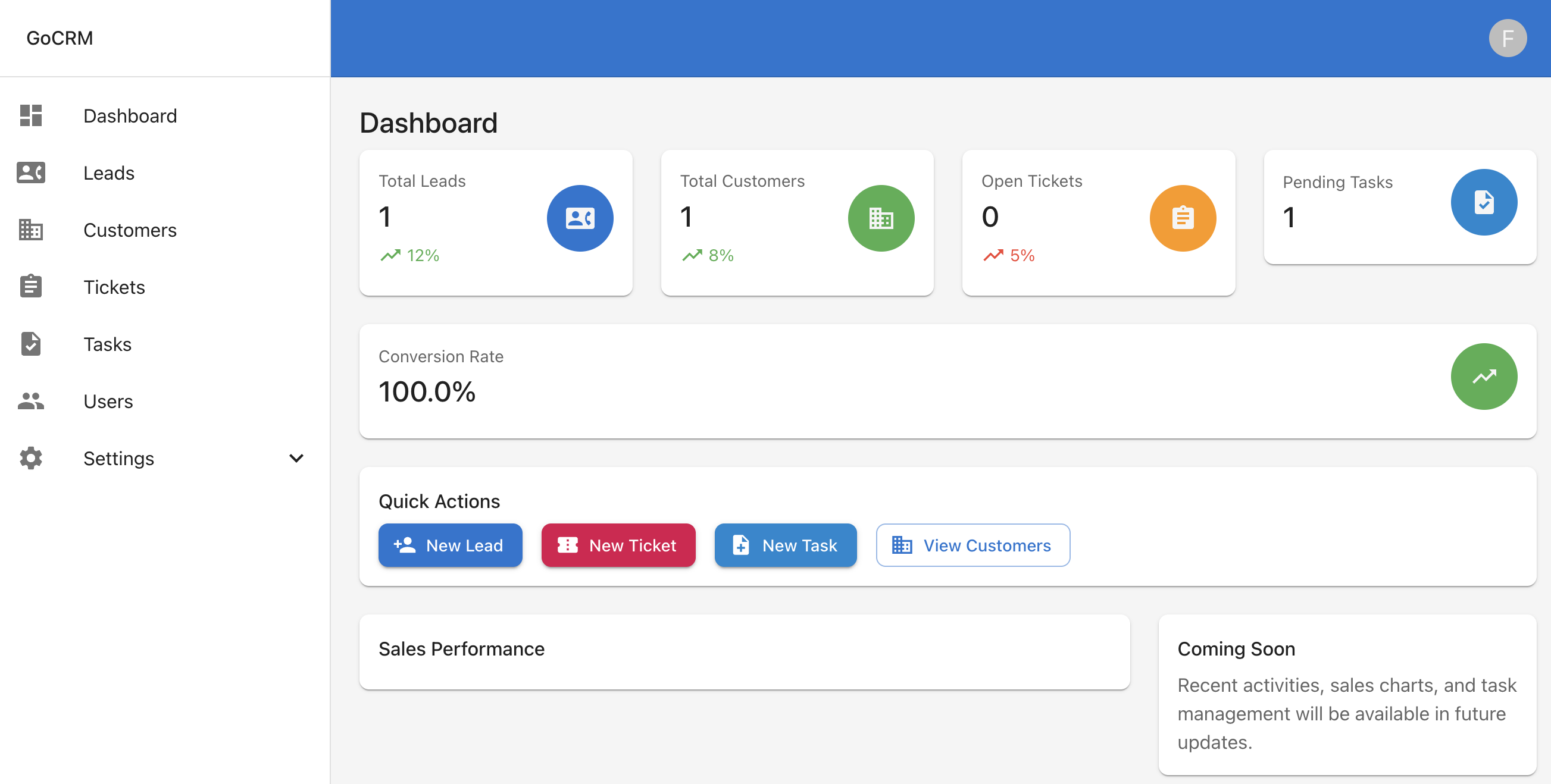
Quick start (SQLite, no database server)
Needs Docker with Compose and free ports 3000 and 8080.
git clone https://github.com/florinel-chis/GopherCRM.git
cd GopherCRM
export JWT_SECRET="$(openssl rand -base64 32)"
docker compose -f docker-compose.sqlite.yml up -d --build
docker compose -f docker-compose.sqlite.yml exec backend create-admin -non-interactive \
  -email [email protected] -name "Admin" -password 'ChangeMe!2345'
Open http://localhost:3000 and sign in as [email protected] / ChangeMe!2345, then change the
password under Settings > Profile. Port 3000 taken? Put UI_PORT=3001 in front of the up
command and open http://localhost:3001 instead.
Docs: Docker · Setup · Features · Developer guide · Data model · Screenshots · API reference (spec) · Roadmap · Changelog · Releases · Validation and release workflow · Documentation maintenance
If it's useful, a star helps others find it.
Fork it
GopherCRM is meant to be forked and adapted. A fork starts with the modules listed under Features,
four roles (admin, sales, support, customer), and the machinery that keeps them working: 990
top-level Go test functions, 22 Playwright specs, 12 MySQL migration pairs checked against
MySQL 8 and MariaDB 10.11, and 5 CI workflows (measured on 4dfe404; commands in
FORKING.md).
- docs/FORKING.md — first run, rebranding, configuration, deployment, CI and staying in sync with upstream.
- docs/SERVER_PROVISIONING.md — preparing a fresh systemd/nginx server (MySQL or MariaDB) for the release-tarball deploy path.
- docs/USE_CASES.md — worked recipes for concrete deployments, with their gaps.
- docs/EXTENDING.md — adding or removing entities, routes, migrations and modules.
Three things catch most first runs from source (cp .env.example .env, then go run ./cmd or
make run):
- Replace the example
JWT_SECRET. The placeholder is refused at startup, so a copied.env.exampledoes not start until the secret is replaced (internal/config/config.go:270-280). - Set
CORS_ALLOWED_ORIGINSfor any cross-origin UI other than localhost on 5173, 3000 or 8080 (internal/middleware/cors.go:14-20). An unlisted origin looks like a failed login. - Public registration ships off (
internal/models/configuration.go:323-330). Create the first admin withmake build-tools && make create-admin.
Features
The full feature list
- 🔐 Authentication: JWT tokens and HMAC-SHA256 API Keys with role-based access control
- 🛡️ Security: Account lockout, password complexity, sort-column allowlists against SQL injection, rate limiting with trusted-proxy handling
- 🧹 Right to Erasure: Deleting a person overwrites their personal data before the row is soft-deleted (GDPR Art. 17)
- 👥 Lead Management: Lead tracking with conversion to customers
- 🏢 Customer Management: Complete customer lifecycle management
- 🏭 Companies: Organisation records that leads and customers link to, with domain de-duplication and per-company customer and lead views
- 💼 Deals: Sales opportunities with a five-stage pipeline, integer money per currency, per-stage probabilities and an append-only stage history
- 🧾 Products & Quotes: A product catalogue and quotes on deals and customers, with lines that copy the catalogue price, server-computed totals, a draft → sent → accepted/rejected/expired lifecycle with history, and a plaintext quote email; the UI has the products list and admin form, the quotes list and detail with draft-only line editing and status actions, an email confirmation, a print page and a Quotes section on each deal
- ⏱️ Follow-up Automation: Admin-defined rules that start on lead, deal or ticket events, or on a daily UTC schedule, and run ordered steps — wait, condition, create task, assign owner, staff email, in-app notification — as persisted runs that survive a restart, with a dry run that writes, sends and notifies nothing; the UI has the admin rule list and form with a dry-run dialog, the run list and detail (admin and sales, with an admin cancel), Automation sections on lead and deal pages, and a notification bell and page for staff (screenshots)
- 🎫 Ticket System: Support ticket management with assignments
- ✅ Task Management: Task tracking and assignment
- ⚙️ Configuration Management: System-wide settings with admin interface
- 🔎 Answer Engine Optimization (AEO): Track how often LLM answer engines mention your brand — daily runs across Anthropic, OpenAI, Gemini, Kimi, Perplexity and any OpenAI-compatible endpoint, with visibility, share-of-voice and citation reporting
- 📝 Forms: Build contact, quote-request and lead-capture forms in the CRM and embed them on any website with one script tag — submissions land in the CRM, create leads, and can require double opt-in email confirmation before delivering gated content; layered spam protection (honeypot, time trap, rate limits, optional invisible reCAPTCHA v3)
- 🎨 Modern UI: React TypeScript frontend with Material-UI
- 📊 Dashboard: Analytics and activity overview
- 👤 Role-Based Access: Admin, Sales, Support, and Customer roles
- 🔌 RESTful API: Clean architecture with comprehensive endpoints
Running with Docker (MySQL)
The whole stack (MySQL, API, UI) can run in containers, with database data persisted in a named volume across restarts:
export JWT_SECRET="$(openssl rand -base64 32)"   # or put it in .env
docker compose up -d --build
docker compose exec backend create-admin          # first admin account
UI at http://localhost:3000, API at http://localhost:8080/api/v1. See docs/DOCKER.md for configuration and persistence details.
To run the same stack without a database server, use the SQLite flavor instead —
docker compose -f docker-compose.sqlite.yml up -d --build starts two containers
with the database in a file on a named volume (docs/DOCKER.md).
Prerequisites
Backend
- Go 1.25 or higher
- MySQL 8.0 or higher — or nothing at all, if you run on SQLite
(
DB_DRIVER=sqlite, see Choosing a database) - Make (optional, for using Makefile commands)
Frontend
- Node.js 20 or newer (React Router 7 requires Node >= 20) and npm
- Modern web browser
Setup Instructions
1. Clone the Repository
git clone https://github.com/florinel-chis/gophercrm.git
cd gophercrm
2. Backend Setup
Choosing a database
DB_DRIVER selects the backend. It defaults to mysql, which is the production
dialect and the one the SQL files in migrations/ are written for.
DB_DRIVER=mysql          # default: DB_HOST/DB_PORT/DB_NAME/DB_USER/DB_PASSWORD apply
DB_DRIVER=sqlite         # single file, no server
DB_PATH=gophercrm.db     # only read when DB_DRIVER=sqlite; relative to the working directory
On SQLite the server-connection settings — DB_HOST, DB_PORT, DB_NAME,
DB_USER, DB_PASSWORD — are ignored.
SQLite needs no server and no make create-db — the file is created on first
start. It suits development, demos, CI and small single-instance deployments.
Things to know before relying on it:
- Everything serializes on one connection. SQLite takes a database-wide
write lock, so the pool is deliberately capped at a single connection: within
the backend process reads queue behind writes exactly as writes do, and there
is no read concurrency to be had. What WAL mode buys here is that a separate
reader — the
VACUUM INTOsnapshot below, or asqlite3shell — is not blocked by the backend's writes. Run only one backend process against one file. - The file must live on a local filesystem. WAL mode relies on shared-memory locking that NFS, SMB and similar network shares do not implement reliably; putting the database on one risks corruption.
- The database is three files.
gophercrm.dbplus the-waland-shmsiblings. A graceful shutdown checkpoints the WAL back into the main file; a process killed outright leaves it in place, which is normal and recovers on the next open. - Never copy a live database file. To back it up, either stop the backend and
copy all three files, or take an online snapshot with
sqlite3 gophercrm.db "VACUUM INTO 'backup.db'". A barecpofgophercrm.dbon a running system produces a stale or torn copy. - Back up before upgrading. On SQLite the schema advances only through the
auto-migration that runs at startup — the
migrations/SQL is MySQL-only — and auto-migration is not reversible. Take the offline copy or theVACUUM INTOsnapshot above first. Upgrading from v1.2.0 rewritesleadsandcustomersin place (the driver drops and copies each table to add the company link). The two rebuilds run one after the other, each in its own transaction, so the first start needs free disk for a full copy of one table at a time, while the WAL accumulates both rebuilds until the next checkpoint. Auto-migration runs with foreign-key enforcement off, as SQLite prescribes for table rebuilds, checks every foreign key afterwards and refuses to start if the check finds a dangling reference. A refused start has already committed the schema change; only the data violation is left. Restore the backup, or fix the offending rows (the message names the tables aschild -> parent), and start again. The v1.2.0 binary still opens the upgraded file — it ignores the extra tables and columns — so the binary can be rolled back even though the schema is not. The deals release adds thedealsanddeal_stage_changestables only: it rebuilds no existing table, and the previous binary still opens the file. The quotes release does the same withproducts,quotes,quote_linesandquote_status_changes: four new tables, no existing table touched. The task-to-deal link release rebuildstasks(drop and copy) to addfk_tasks_deal, so its first start needs free disk for a full copy of that table; every existing task keepsdeal_idNULL, and the previous binary still opens the file, ignoring the extra column. DB_PATHmust not contain?; the connector appends its own pragma query string, so startup rejects a path that already carries one.
Docker users get this prewired in docker-compose.sqlite.yml; see
docs/DOCKER.md.
Create the Database
MySQL only — skip this on SQLite, where the file is created on first start.
# Using Make (recommended)
make create-db

# Or manually with MySQL
mysql -u root < scripts/create_database.sql
Configure Environment
# Create environment file
cp .env.example .env

# Edit .env file with your database credentials
# JWT_SECRET is required; the placeholder must be replaced with the output of openssl rand -base64 32
Install Go Dependencies
go mod download
Run Backend Server
# Using Make (recommended)
make run

# Or directly with Go
go run ./cmd
The backend server will start on http://localhost:8080. Schema auto-migration runs at startup.
Create the First Admin
Self-service registration always creates a customer account, so the first administrator has to be
created out of band:
make build-tools
make create-admin
create-admin also accepts --non-interactive --email ... --name ... --password ... for scripted
provisioning; that is how the E2E suite seeds its admin (gocrm-ui/e2e/global-setup.ts).
3. Frontend Setup
Navigate to Frontend Directory
cd gocrm-ui
Install Dependencies
npm install
Configure the API Base URL (optional)
cp .env.example .env
# VITE_API_BASE_URL defaults to http://localhost:8080/api/v1
Start Development Server
npm run dev
The frontend will start on http://localhost:5173
Usage
Default Access
- Open your browser to
http://localhost:5173(the dev server), orhttp://localhost:3000on the Docker stacks - Sign in with the admin account you created with
create-admin
Public sign-up ships disabled: the login page offers no registration link until an admin turns
on security.allow_public_registration under Settings > Configuration (Security tab). When it
is on, self-service registration always creates a customer account.
Elevated roles (admin, sales, support) are assignable only by an admin through POST /users, or by
the create-admin CLI. The registration endpoint ignores any role supplied by the client.
Tokens are stored in sessionStorage and expire with the browser tab unless you tick Remember
me at login, which moves them to localStorage.
Admin Features
Admin users have access to additional features:
- User management
- System configuration
- All data access across the system
Configuration Management
GopherCRM includes a powerful configuration management system that allows administrators to customize system behavior through a web interface.
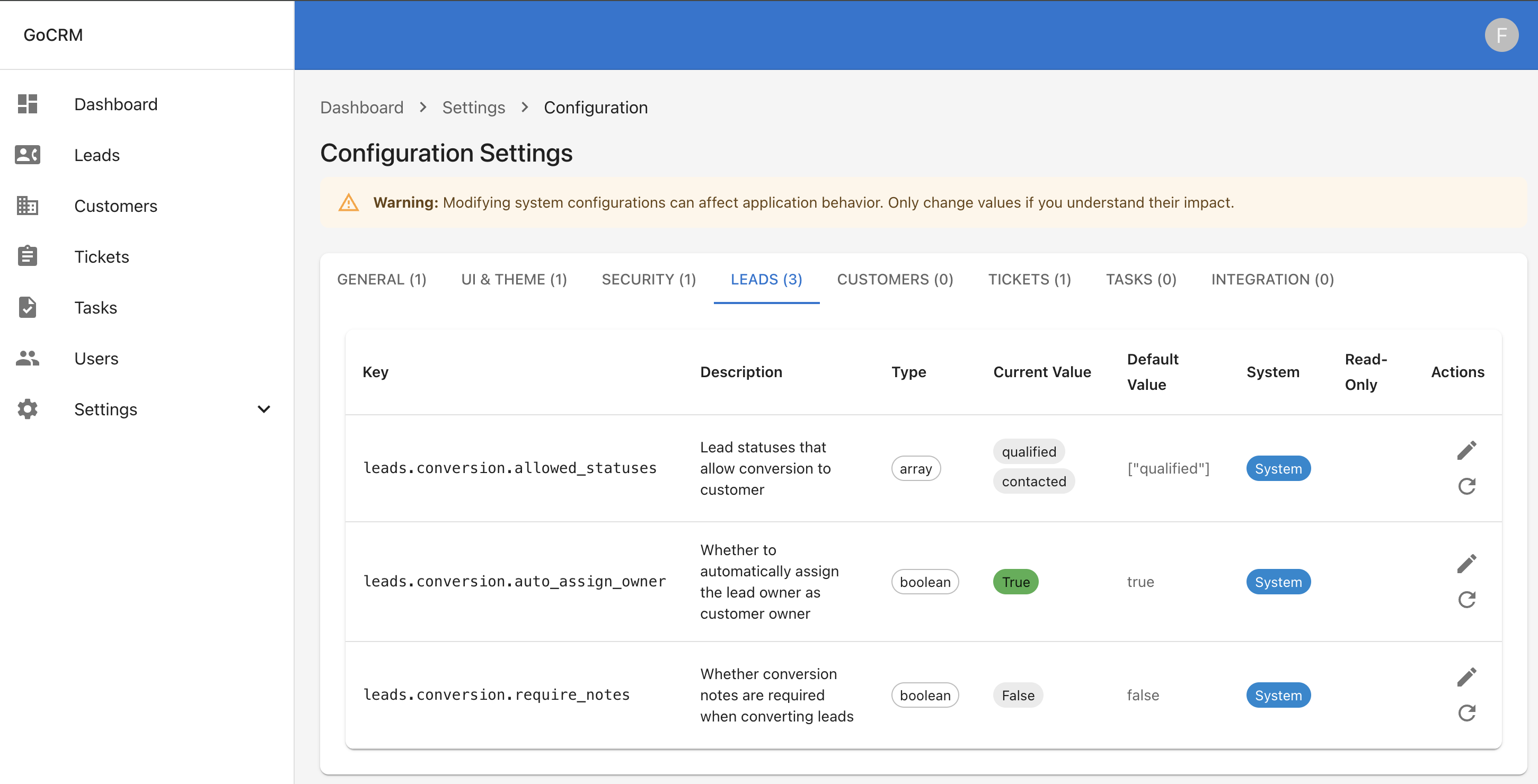
Accessing Configuration Settings
- Login as an admin user
- Navigate to Settings > Configuration
- Browse settings by category tabs:
- General: Company information and basic settings
- UI & Theme: User interface customization
- Security: Security-related settings
- Leads: Lead management behavior
- Customers: Customer management settings
- Tickets: Support ticket configuration
- Tasks: Task management settings
- Integration: Third-party integrations
Configuration Features
- Type-Safe Editing: Different input types based on configuration type (boolean, string, array, etc.)
- Validation: Built-in validation for configuration values
- System Protection: System configurations are protected from deletion
- Read-Only Settings: Some critical settings are read-only
- Default Values: Easy reset to default values
- Real-Time Updates: Changes take effect immediately
Lead Conversion Settings
The configuration system includes specific settings for lead conversion, enforced by the server on
every POST /leads/:id/convert before anything is written (a refusal is 400 VALIDATION_ERROR):
leads.conversion.allowed_statuses: Which lead statuses allow conversion to customer (any ofnew,contacted,qualified,unqualified; seeded asqualifiedandcontacted)leads.conversion.require_notes: Whether non-blank conversion notes are requiredleads.conversion.auto_assign_owner: Make the lead's owner the customer's assigned user
If the leads.conversion.allowed_statuses row is missing (seeding never ran), conversion falls back
to qualified only, the entry's default value, rather than the seeded qualified, contacted; the
next start re-seeds the row. A lead reaches converted only through the convert endpoint: lead
create/update and the bulk status endpoint refuse it. The lead's company link is carried over to
the customer as well. GET /configurations/ui exposes
the three settings read-only, and the web UI follows them: Convert to Customer is offered on the
allowed statuses, the conversion dialog requires notes when they are required and says when the
lead's owner becomes the customer's assigned user.
Answer Engine Optimization (AEO)
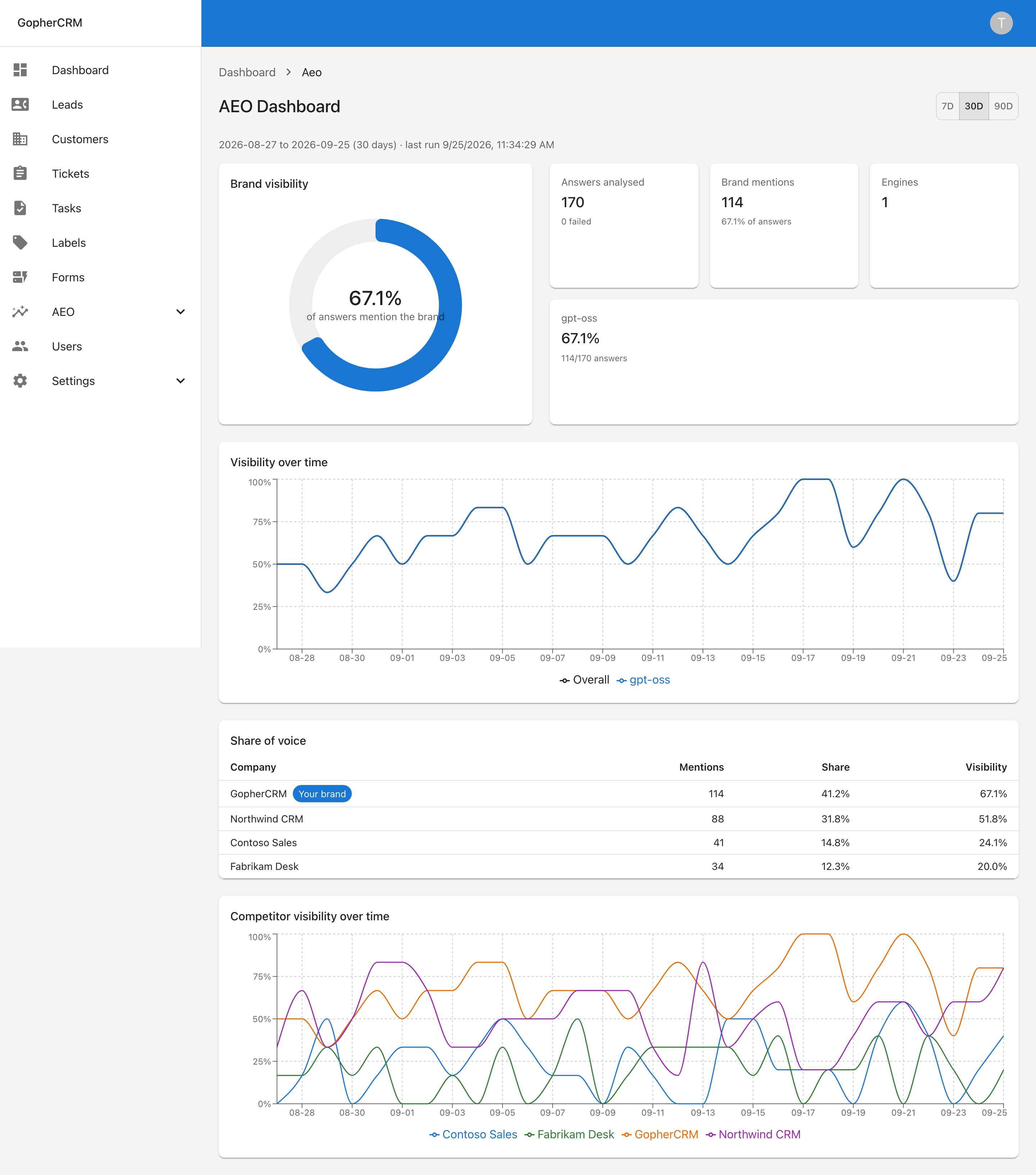
AEO tracks how visible your brand is in the answers large language models give to buyer questions. You describe the brand and its competitors once, track a list of prompts, and a daily run asks every configured answer engine each prompt and records what came back: whether the brand was mentioned, how early, which competitors appeared alongside it, and which sources were cited.
Available to admin, sales and support under AEO in the sidebar; customer cannot
reach it. Saving the profile, managing prompts and starting a run need admin or sales; deleting a
prompt needs admin.
- Settings (
/aeo/settings) — brand name, aliases, owned domains and competitors, the provider API keys (admin only; stored encrypted and never echoed back, so a chip per engine reports only whether a key is present) and which engine prompt generation runs on. Save the profile before anything else: a run has nothing to detect without it. - Prompts (
/aeo/prompts) — the questions to track (up to 100 active). Add them by hand or ask the configured generation engine to suggest some. Each row shows the visibility percentage over the selected window; opening a row shows the recorded answers with every brand mention highlighted. - Dashboard (
/aeo) — overall visibility, a per-engine timeline, share of voice against the competitors and their trend, over 7, 30 or 90 days. - Citations (
/aeo/citations) — how often each company's domains are cited, and how often a citation coincides with a brand mention.
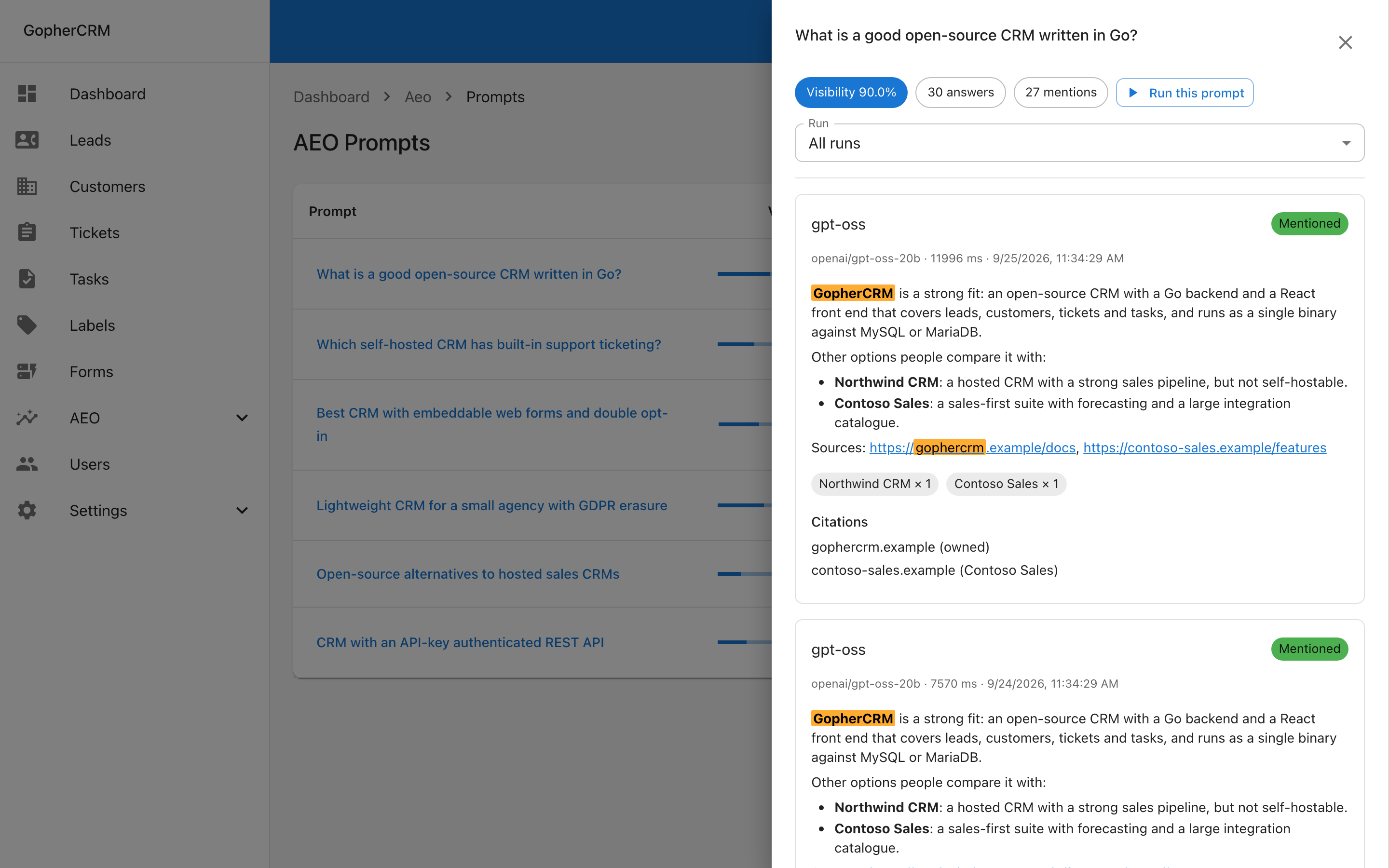
Every recorded answer is kept verbatim — the drawer above shows one engine's answer with the brand mentions highlighted and a selector to walk earlier runs. The full screen-by-screen tour lives in docs/SCREENSHOTS.md.
Provider keys come from Settings (/aeo/settings) first and fall back to the environment
variables below when no key is stored, so a key entered in the UI takes effect from the next run
without restarting the process. An engine with no key from either source is simply skipped.
Admins can also override each hosted engine's model and base URL in Models and endpoints;
blank values restore environment/default behavior. These settings apply to both tracking runs and
prompt generation. The custom engine, schedule and egress policy remain environment-only, so a
stored base URL selects an endpoint but cannot make an untrusted one reachable.
Where your data goes. CRM records and stored prompt sets are kept on your server. Each tracking run sends every active prompt to every configured engine. Queries stay on your network only when all configured endpoints are local; in that setup, tracking measures those local models. Queries to hosted endpoints leave your network. Prompt generation is separate: it sends your brand name, description and competitor names to the selected generation provider. That request also leaves your network if the provider's endpoint is hosted.
| Engine | Key | Model override |
|---|---|---|
| Anthropic | ANTHROPIC_API_KEY |
AEO_ANTHROPIC_MODEL |
| OpenAI | OPENAI_API_KEY |
AEO_OPENAI_MODEL |
| Gemini | GEMINI_API_KEY |
AEO_GEMINI_MODEL |
| Kimi (Moonshot) | MOONSHOT_API_KEY |
AEO_KIMI_MODEL |
| Perplexity | PERPLEXITY_API_KEY |
AEO_PERPLEXITY_MODEL |
| Any OpenAI-compatible server (e.g. LM Studio) | AEO_CUSTOM_BASE_URL (+ optional AEO_CUSTOM_API_KEY) |
AEO_CUSTOM_MODEL, AEO_CUSTOM_NAME |
Each hosted engine also accepts AEO_<PROVIDER>_BASE_URL (for example,
AEO_GEMINI_BASE_URL=https://generativelanguage.googleapis.com/v1beta/openai/). Use the
OpenAI-compatible base for Gemini/OpenAI/Kimi/Perplexity, and the Messages API root for Anthropic.
Do not include credentials, query parameters, or the final /chat/completions or /v1/messages
path. A provider's 503 may mean temporary overload.
Egress policy. Each engine may send its key only to its official HTTPS origin. Any other
endpoint must be trusted explicitly in the environment. This applies to a gateway or regional
host, a stored Settings override, and every custom engine. Use AEO_EGRESS_ALLOWED_ORIGINS for
public HTTPS origins and AEO_EGRESS_LOCAL_ORIGINS for narrowly scoped loopback/LAN servers, for
example AEO_EGRESS_LOCAL_ORIGINS=custom=http://10.0.1.21:1234. An untrusted endpoint fails with
endpoint_not_permitted before any request. Destinations are checked again at connection time;
redirects are never followed and HTTP(S)_PROXY is ignored. Failed answers record only a bounded
category and the numeric HTTP status, never the provider's response text. See
docs/AEO_SECURITY.md for the syntax and the migration checklist.
AEO_SCHEDULE_ENABLED (default true) and AEO_SCHEDULE_HOUR (default 6, server local time)
control the daily run. The scheduler is armed whenever it is enabled, with or without a key at
boot: engines are resolved when the hour arrives, so a key saved in Settings is used by the next
scheduled run without a restart. With no key set at all the module still boots; starting a run
then returns 503 instead of recording a run that could never produce an answer, and a scheduled
tick that finds no profile, key or active prompt is logged once and skipped until the next day.
Shutdown. On SIGINT/SIGTERM the process stops admitting runs (a run requested while draining
answers 503 SHUTTING_DOWN), cancels the scheduler and every run in flight, waits for them to
finalize, and only then closes the database. An interrupted run ends failed, or partial when
some answers were already recorded; queries cut short count as failed and are not stored as
answers. A failed finalizing write leaves its row for startup reconciliation even if the
work drains successfully. The AEO drain waits at most 15 seconds. If a provider call or database write still has not
released by then, the process exits without closing the database and the run row left in
running is failed by the next start's reconciliation, exactly as after a crash.
Prompt generation (POST /aeo/prompts/generate) deliberately runs on one named engine rather than
whatever happens to be configured, so its output keeps a consistent shape. Anthropic is the default;
the Settings page selects any of Anthropic, OpenAI, Gemini, Kimi or Perplexity instead. If the
selected engine has no key, generation answers 503 naming that engine rather than silently falling
back to another one.
Cost. One run is active prompts × configured engines API calls — 25 prompts across 5 engines is 125 calls a day. The 100-prompt cap exists for this reason. Only one run may be in flight at a time; a second request is refused with 409.
scripts/aeo_live_smoke.sh walks the whole module against real providers for manual verification.
It spends real credit, so it is never part of CI. Test cases: docs/testing/11-aeo.md.
Privacy: deleting a person erases their data
Deleting a user, customer or lead is an erasure under GDPR Art. 17, not a recoverable soft
delete. Every personal field on the row is overwritten in place — the email address is replaced
with a random, non-routable placeholder in the reserved .invalid domain — and the row is only then
soft-deleted, all in a single transaction. API keys, refresh tokens and password-reset tokens
belonging to the account are purged with it. The row itself is deliberately kept so foreign keys
from tickets and tasks still resolve: business records survive, the person does not.
Erasure follows the person, not the table: a lead, the customer it was converted into and that
customer's own customer-role login are erased together whichever of them you delete. Staff
accounts are never erased that way, and only an admin may delete a converted lead. Erasures made
before this rule existed are not repaired automatically: docs/DEVELOPMENT.md lists the queries
that find the ones with a live row left, and the supervised way to finish them; graphs whose rows
are all soft-deleted have no supported path yet.
Deals and quotes of the erased customers and leads are kept with their links, stages, amounts,
statuses, totals and history, but the text staff typed into them can name the client, so the same
transaction overwrites it: deal titles become [redacted] and their notes and lost reasons are
emptied, quote titles become [redacted] and their notes are emptied whatever the quote status,
quote line descriptions are reset to the product names, and notifications about those deals are
deleted (#245). Ticket and task text is kept; see docs/DEVELOPMENT.md for the ticket redaction
procedure.
Two consequences:
- Erasure cannot be undone. The only way to get the data back is to restore a database backup.
To suspend access reversibly, deactivate the account instead (
is_active = false); deactivation never touches personal data. - The email address becomes reusable, because the original no longer exists in the table.
Tickets and tasks are unaffected — deleting one is still an ordinary soft delete.
Rows soft-deleted before this behaviour existed still hold personal data;
scripts/anonymize_legacy_deleted_pii.sql remediates them. It is manual, irreversible, and
deliberately not wired into auto-migration.
Full rationale, the cascade rules for converted leads, and the operational caveats are in docs/DEVELOPMENT.md.
Development
Backend Development
Building
make build
Running Tests
# Run all tests
make test

# Run specific tests
go test -run TestName ./path/to/package

# Run integration tests (in-memory SQLite, no MySQL needed)
go test ./test/integration/ ./tests/

# Race detector
go test -race ./internal/... ./test/... ./tests/...
Database Operations
# Create database
make create-db
Frontend Development
Available Scripts
# Start development server
npm run dev

# Build for production (runs tsc -b first)
npm run build

# Preview production build
npm run preview

# Run unit tests
npm run test

# Run end-to-end tests (requires the backend and frontend running)
npm run test:e2e

# Run linting
npm run lint
Development Tools
- Hot Reload: Automatic browser refresh on code changes
- TypeScript: Full type checking and IntelliSense
- ESLint: Code linting
- Prettier: Code formatting
API Documentation
All application routes are mounted under /api/v1 (configurable via API_PREFIX). Every endpoint
returns the unified envelope { success, data, error, meta }.
The complete reference, with every operation's roles, parameters, error codes and schemas, is
generated into api/: open api/index.html in a browser (a static page that works offline,
straight from the checkout), or feed api/swagger.json / api/swagger.yaml (Swagger 2.0) to a
client generator. The list below is the overview.
GET /health is served outside the API prefix and needs no authentication.
Authentication (public)
POST /api/v1/auth/register- Register a new user. Gated by thesecurity.allow_public_registrationconfiguration, which ships disabled — while off, the endpoint answers403and the login page offers no sign-up (an administrator can turn it on under Settings > Configuration). Always creates acustomer; a client-supplied role is ignored. Password policy: min 10 chars with upper, lower, digit and special character. A duplicate email returns409.GET /api/v1/auth/registration- Report whether public registration is currently open ({"enabled": bool}), for the login/register screens; no authentication required.POST /api/v1/auth/login- User login. Returns an access token and a rotating refresh token.POST /api/v1/auth/refresh- Exchange a refresh token for a new token pair. Rotation is strict: the presented token is revoked, replaying it returns401. The revocation is a single-use claim inside the transaction that stores the successor and signs the access token, so a presented token yields at most one successor even under concurrent requests, and a failed rotation leaves it usable instead of stranding the session. An invalid token is the generic401; an operational failure (database, signing) is a retryable503 SESSION_REFRESH_UNAVAILABLE, and a failure before the commit leaves the token usable (a failed COMMIT is ambiguous). The web client shares one refresh among all requests that hit a401, settles every one of them (success, failure, or a 15 s timeout), replays each request at most once and only under the session it was sent with.POST /api/v1/auth/password-reset- Request a password-reset email. Always answers200whether or not the account exists (anti-enumeration). Delivery goes through SMTP whenSMTP_HOSTis configured, otherwise a logging fallback.POST /api/v1/auth/password-reset/confirm- Redeem a single-use reset token (1 h expiry) and set a new password. The token claim, the password update, the lockout reset and the revocation of all refresh tokens are one transaction: a failed or rejected confirmation leaves the link usable, and competing confirmations succeed exactly once.
All of the above sit behind the strict rate-limit tier (10/min). Two more auth endpoints require authentication and live on the moderate tier:
POST /api/v1/auth/logout- Revoke the caller's refresh tokens (all of them, or just the one in the optional{refresh_token}body) and end every access token issued to the caller before the logout, in one transaction:users.token_versionis incremented, and an older JWT then answers401 Invalid credentialslike an expired one. This holds for Bearer and API-key callers, with or without a body; API keys themselves keep working.POST /api/v1/auth/change-password- Verify the current password and set a new one (same complexity policy) in one transaction with the revocation of the user's refresh tokens; a failure before the commit leaves the password and every session unchanged (a failed COMMIT is ambiguous and answered 500). A bearer session that sends its currentrefresh_tokenis renewed: the response carries a replacementtoken,refresh_tokenanduser, and every other session loses renewal. Arefresh_tokenthat is not a live session of the caller is409 SESSION_STALEwith nothing changed. Without one, and always for API-key requests, every refresh token is revoked and no credentials are returned. The change also ends every access token issued before it, the caller's own included; the renewedtokenis signed after the change and keeps working. A confirmed password reset (POST /auth/password-reset/confirm) ends earlier access tokens the same way.
Users
GET /api/v1/users- List all users (admin)POST /api/v1/users- Create a user with any role (admin)GET /api/v1/users/me- Get current user profilePUT /api/v1/users/me- Update current user profileGET /api/v1/users/:id- Get specific user (self or admin)PUT /api/v1/users/:id- Update user (self or admin; only admins may changeroleoris_active)DELETE /api/v1/users/:id- Erase user (admin; cannot delete yourself; a customer-role user takes its customer records along)
Leads (entire group requires admin or sales)
GET /api/v1/leads- List leads (page,limit,search,sort_by,sort_order,classification;external_idreturns the leads with that exact external id the caller may see, overriding the others; hidden leads are left out rather than refused)POST /api/v1/leads- Create new lead (the owner must be an active admin or sales user)GET /api/v1/leads/export- Download the leads the caller may list as CSV (admin: every lead, with the list's search, classification and sort; sales: only its own leads, in id order)GET /api/v1/leads/:id- Get specific leadPUT /api/v1/leads/:id- Update lead (a changed owner must be an active admin or sales user; admin only)DELETE /api/v1/leads/:id- Erase lead (cascades to the customer it was converted into and its login; converted leads admin-only)POST /api/v1/leads/:id/convert- Convert lead to customerPOST /api/v1/leads/:id/assign- Assign lead to an active admin or sales user (sales may only hand over leads they own)POST /api/v1/leads/bulk/status- Set the status of up to 100 leads at once, all-or-nothing (sales may only touch leads they own)
Customers
GET /api/v1/customers- List customers (admin, sales, support); withsource,scopeandexternal_idit is an exact external-id lookup answering at most one live customerPOST /api/v1/customers- Create new customer (admin, sales)GET /api/v1/customers/:id- Get specific customer (admin, sales, support)PUT /api/v1/customers/:id- Update customer (admin, sales)DELETE /api/v1/customers/:id- Erase customer (admin; cascades to the lead it came from and its customer-role login)GET /api/v1/customers/:id/tickets- List that customer's tickets (a customer-role user may only read their own)GET /api/v1/customers/export- Download all matching customers as CSV (admin only — mass PII egress; supportssearch,sort_by,sort_order)POST /api/v1/customers/:id/assign- Assign the customer to an active admin or sales user (admin, sales)POST /api/v1/customers/:id/external-ids- Map an external(source, scope, external_id)identity to the customer; the triple is unique and case-sensitive, 409 when already mapped (admin, sales)DELETE /api/v1/customers/:id/external-ids/:mappingId- Delete one of the customer's mappings (admin, sales)
Companies (read: admin, sales, support; write: admin, sales; delete: admin)
GET /api/v1/companies- List companies (page,limit,searchover name/domain/industry/city,sort_byinid, name, domain, industry, created_at, updated_at— anything else is 400,sort_order);datais the array,metathe paginationPOST /api/v1/companies- Create a company (domain normalised and unique among live companies → 409;owner_idmust be a live user → 400INVALID_REFERENCE; sales may only own it themselves)GET /api/v1/companies/:id- Get a company with its owner and livecustomer_count/lead_countPUT /api/v1/companies/:id- Replace a company's fields (absent text fields are cleared;owner_idabsent keeps,0clears — admin only)DELETE /api/v1/companies/:id- Soft-delete a company and clearcompany_idon its leads and customers in one transaction (not an erasure: companies hold no personal data)GET /api/v1/companies/:id/customers- The company's customers, paginatedGET /api/v1/companies/:id/leads- The company's leads, paginated (admin and sales; sales sees only its own)- Leads and customers accept
company_idon create and update (unknown → 400INVALID_REFERENCE; on update0clears, absent keeps) and returncompany_recordon their detail endpoints. The free-textcompanyfield is independent of the link. - Companies also report a live
deal_count, andGET /api/v1/companies/:id/dealslists their deals (admin and sales; sales sees only its own)
Deals (admin and sales; sales sees and edits its own deals; delete: admin)
GET /api/v1/deals- List deals (page,limit,searchover title/notes,stage,open=true,company_id,customer_id,owner_id— admin only, sales is always narrowed to itself —sort_byinid, title, stage, amount_cents, probability, expected_close_date, closed_at, created_at, updated_at, anything else is 400,sort_order);datais the array,metathe paginationPOST /api/v1/deals- Create a deal (stage defaults toqualification, probability to the stage's 10/40/70/100/0, currency to thedeals.default_currencysetting; every link must be a live row → 400INVALID_REFERENCE;owner_iddefaults to the caller and sales may only own it themselves; the first history row is written in the same transaction)GET /api/v1/deals/pipeline- The live deals per stage: all five stages in pipeline order, each withcountandtotalsper currency (amount_cents,weighted_cents= round half up of Σ amount × probability / 100, rounded once per stage and currency);owner_id(admin only; sales is always narrowed to itself) andcompany_idfiltersGET /api/v1/deals/:id- Get a deal with its owner, company, customer and leadPUT /api/v1/deals/:id- Replace a deal's fields (links: absent keeps,0clears; a stage change goes through the same rules as the stage endpoint and records history)POST /api/v1/deals/:id/stage- Move a deal to a stage{stage, probability?, lost_reason?}(won is always 100 and lost 0;closed_atset on won/lost and cleared on leaving them;lost_reasonkept only on lost; the same stage again is a 200 that writes nothing)GET /api/v1/deals/:id/history- The stage changes, oldest first, with the user who made eachDELETE /api/v1/deals/:id- Soft-delete a deal; its history stays (admin)GET /api/v1/customers/:id/deals- The customer's deals, paginated (admin and sales; sales sees only its own)
Products (admin and sales read; create, update and delete: admin; support and customer get 403)
GET /api/v1/products- List the catalogue (page/offset/limitthrough the shared parser —limit=0is 20, the cap is 100 —searchover name and SKU,is_active,currency,sort_byinid, name, sku, unit_price_cents, currency, is_active, created_at, updated_at, anything else is 400,sort_order); soft-deleted products never appear. Withsource,scopeorexternal_idpresent (even empty) it is an exact external-id lookup instead: the three values are validated (400VALIDATION_ERROR), the other list parameters are ignored, anddataholds at most one live product, inactive products included (admin, sales)POST /api/v1/products- Create a product{name, sku?, description?, unit_price_cents, currency?, is_active?}(the price is an integer in minor units, 0 to 10^12; currency defaults todeals.default_currency; active by default)GET /api/v1/products/:id- Get a productPUT /api/v1/products/:id- Partial update (existing quote lines keep the name and price they copied)DELETE /api/v1/products/:id- Soft-delete a product (its quote lines keep their copied values; its external-id mappings are hard-deleted in the same transaction, so their triples can be mapped again)POST /api/v1/products/:id/external-ids- Map an external(source, scope, external_id)identity to the product; the triple is unique and case-sensitive, 409 when already mapped (to this or another product), 404 for a missing or deleted product (admin)DELETE /api/v1/products/:id/external-ids/:mappingId- Delete one of the product's mappings (admin; 404 for another product's mapping)
Quotes (admin and sales; sales sees and edits its own quotes only; support and customer get 403)
GET /api/v1/quotes- List quotes without their lines (status,deal_id,customer_id,owner_id— admin only, sales is always narrowed to itself inside the query, someta.totalcounts only its quotes —sort_byinid, title, status, total_cents, currency, valid_until, sent_at, created_at, updated_at,sort_order, pagination)POST /api/v1/quotes- Create a draft{title, deal_id?, customer_id?, currency?, valid_until?, notes?, owner_id?}(at least one ofdeal_idandcustomer_id; with only the deal the customer is taken from it; a customer that is not the deal's is 400; an unknown deal, customer or owner is 400INVALID_REFERENCE; a won or lost deal is 409; sales may only quote its own deals and own the quote itself; the first history row is written in the same transaction; the JSON addsnumber, e.g.Q-000042)GET /api/v1/quotes/:id- Get a quote with its lines (by position), its totals and summaries of its customer, deal and ownerPUT /api/v1/quotes/:id- Partial update of a draft (currencyonly while it has no lines;valid_until: nullclears; 409CONFLICTwhen the quote is not a draft)DELETE /api/v1/quotes/:id- Soft-delete (sales: its own drafts only, 409 on a non-draft; admin: any quote; lines and history stay)POST /api/v1/quotes/:id/lines- Add a line{product_id, quantity, discount_bp?, unit_price_cents?, description?}(copies the product's name and price unless overridden;quantity1–1,000,000,discount_bp0–10000, the line's gross and the quote total at most 10^12, at most 100 lines; another currency is 400; an inactive or deleted product is 400INVALID_REFERENCE; returns the quote with its recomputed totals; 409 when not a draft)PUT /api/v1/quotes/:id/lines/:lineId- Edit a line (same bounds; a line of another quote is 404)DELETE /api/v1/quotes/:id/lines/:lineId- Remove a line and recompute the totalsPOST /api/v1/quotes/:id/status- Move the quote{status}(draft→sent, sent→accepted, sent→rejected, sent→expired, sent→draft; anything else or a lost race is 400INVALID_STATUS_TRANSITION; sending without lines or accepting aftervalid_untilis 409; one history row per move; accepting does not change the deal)GET /api/v1/quotes/:id/history- The status changes, oldest first, with the acting userPOST /api/v1/quotes/:id/email- Email a sent or accepted quote as plaintext to the linked customer's current address (subjectQuote Q-000042 from <name>, the configuredgeneral.company_nameorGopherCRMwhen it is blank; 409 without a live customer or when the quote was revised during the send; 502MAIL_DELIVERY_FAILEDwhen the mailer fails;last_emailed_atis set on success. WithoutSMTP_HOSTthe same logging fallback as the password reset applies: the mail is logged, not delivered, and the call still answers 200 and stampslast_emailed_at)GET /api/v1/deals/:id/quotes- The deal's quotes, paginated (sales: its own deals and its own quotes only)GET /api/v1/customers/:id/quotes- The customer's quotes, paginated (sales sees only its own)
Tickets
GET /api/v1/tickets- List tickets (customers cannot list all tickets)POST /api/v1/tickets- Create new ticket (admin, support)GET /api/v1/tickets/my- Get current user's ticketsGET /api/v1/tickets/:id- Get specific ticketPUT /api/v1/tickets/:id- Update ticket (admin any; support only their own assignments; sales is read-only; recordsticket_updated, plusticket_status_changedwhen the status changes, in the update's transaction, #242)DELETE /api/v1/tickets/:id- Delete ticket (admin; soft delete; in the same transaction its comment mail delivery records and the notifications about it are hard-deleted and its pending, waiting and running automation runs are cancelled withrecord_deleted)GET /api/v1/tickets/:id/comments- List a ticket's comments (customers never see internal notes)POST /api/v1/tickets/:id/comments- Add a comment or internal note (admin; support on their own assignments). Withemail_customer: true(not on an internal note, which is 400) the comment is also emailed once to the ticket customer's current address after it is saved, and the201carries the outcome asdelivery(sent,failed,log_onlyorskipped); there is no retry and no read returns itPOST /api/v1/tickets/bulk/status- Set the status of up to 100 tickets, all-or-nothing (admin any; support only their assignments; a closed ticket cannot be reopened; records the tickets' automation events, originbulk, in the batch transaction)
Tasks
GET /api/v1/tasks- List tasks (non-admins see their own)POST /api/v1/tasks- Create new task (admin, support, sales; non-admins may only assign to themselves)GET /api/v1/tasks/my- Get current user's tasksGET /api/v1/tasks/upcoming- Tasks due withindays(1-90, default 7) (non-admins see their own assignments)GET /api/v1/tasks/:id- Get specific taskPUT /api/v1/tasks/:id- Update task (only admins may reassign)DELETE /api/v1/tasks/:id- Delete task (admin; ordinary soft delete)GET /api/v1/deals/:id/tasks- The deal's live tasks, paginated (admin all of them; the sales owner only those assigned to it; 403 for anybody else)POST /api/v1/tasks/bulk/status- Set the status of up to 100 tasks, all-or-nothing (non-admins only their own assignments; completed tasks cannot change status)
API Keys (always scoped to the caller's own keys — no admin override)
GET /api/v1/api-keys- List user's API keysPOST /api/v1/api-keys- Create new API key (optional RFC3339expires_at; the plaintext key is returned only in this response)GET /api/v1/api-keys/:id- Get one keyPUT /api/v1/api-keys/:id- Rename, deactivate or reactivate a keyDELETE /api/v1/api-keys/:id- Revoke API key (marks inactive; the row is kept)
Keys authenticate via Authorization: ApiKey gcrm_xxx. A key is rejected if it is inactive or
expired, or if its owner has been deactivated or erased.
Configuration
GET /api/v1/configurations/ui- Get UI-safe configurations (any authenticated user)GET /api/v1/configurations- List all configurations (admin)GET /api/v1/configurations/category/:category- Get configurations by category (admin)GET /api/v1/configurations/:key- Get specific configuration (admin)PUT /api/v1/configurations/:key- Update configuration value (admin)POST /api/v1/configurations/:key/reset- Reset configuration to default (admin)
Dashboard (entire group requires admin, sales or support)
GET /api/v1/dashboard/stats- Aggregate counts (total leads, customers, open tickets, pending tasks, conversion rate)GET /api/v1/dashboard/leads-by-status/tickets-by-priority/tasks-by-status- Grouped counts in a chart-friendly{labels, datasets}shapeGET /api/v1/dashboard/sales-performance?period=week|month|quarter|year- Lead conversions over time, bucketed per periodGET /api/v1/dashboard/activities- Recent activity feed synthesized from lead/ticket/task eventsGET /api/v1/dashboard/upcoming-tasks- Due-soonest tasks, including overdue (non-admins see their own)GET /api/v1/dashboard/recent-tickets- Newest ticketsGET /api/v1/dashboard/new-leads- Newest leads (sales sees only their own; support gets an empty list)GET /api/v1/dashboard/pipeline- The deal pipeline per stage (asGET /deals/pipeline) pluswon_this_month(count and amounts per currency of the deals won in the current calendar month, UTC) (admin sees all deals, sales its own; support and customer get 403 — no deal access)
Automation (rules and dry run: admin; runs: admin and sales, sales narrowed to the leads and deals it owns; support and customer get 403)
GET /api/v1/automation/rules- List rules with their steps (entity_type,enabled,sort_byinid, name, entity_type, trigger_type, enabled, version, created_at, updated_at, anything else is 400; pagination through the shared parser —limit=0is 20, the cap is 100)POST /api/v1/automation/rules- Create a rule{name, description?, entity_type, trigger_type, trigger, enabled?, steps[]}(returns 201 with the steps numbered 1..n;trigger_typeislead_created,lead_updated,lead_status_changed,lead_form_submitted(lead rules only: a finalised submission of acreate_leadform linked to the lead, new or repeat),deal_created,deal_updated,deal_stage_changed,ticket_created,ticket_updated,ticket_status_changed(ticket rules,entity_type: ticket, #242) orschedule;triggercarriesfrom/tofor a status, stage or ticket status change,form_id(optional,lead_form_submittedonly; 0 or omitted means every form,not_applicableon any other trigger) andhour_utc,filters {status|stage|ticket_status}andstale_daysfor a schedule; a ticket rule's owner is the ticket's assignee, its conditions teststatus,priority,owner_idandcustomer_id, its placeholders areticket.id,ticket.number,ticket.status,ticket.priority(plusowner.*outside tasks), its task is linked to the ticket's customer, and itsassign_owneruser must be support or admin; a step is{step_type, config}withwait(duration_minutes),condition(field,operator,value,currencyforamount_cents,elsestop|jump,else_position; alead_form_submittedrule may also test the string fieldsutm_source,utm_medium,utm_campaign,utm_term,utm_contentandreferrer_hostof the submission that started the run — empty in a dry run,not_applicableon any other rule),create_task(title,description?,priority?,due_in_days,recipientowner|user,user_id),assign_owner(user_id),send_email(subject,body, recipient) andnotify(title,body?, recipient); an invalid trigger or step, more than 20 steps, more than 90 days of waits, a backward or out-of-rangeelse_positionor an unknown{{placeholder}}is 400INVALID_INPUTand writes nothing; acreate_tasktitle or description accepts only the placeholderslead.id,lead.status,lead.sourceor thedeal.*fields — never a lead's name, email, phone, company or owner — because a task survives the erasure of its lead; note thatdeal.titleis staff-typed and may name the client: the erasure redacts the deal (#245), but a task already rendered from{{deal.title}}keeps that text (accepted limitation); an unknown, inactive or non-staff user is 400INVALID_REFERENCE; every refused field is listed inerror.details.fieldsas{field, code, message}—fielda path into the body such asname,trigger.hour_utcorsteps[2].config.title(steps counted from zero) — whileerror.messageanderror.codeare those of the first refusal)GET /api/v1/automation/rules/:id- Get a rule with its stepsPUT /api/v1/automation/rules/:id- Replace a rule (one transaction: version + 1, steps replaced, the rule's pending, waiting and running runs cancelled withrule_changed; the same 400 answers anderror.details.fieldsas the create)POST /api/v1/automation/rules/:id/enable/disable- Switch a rule (disabling cancels its active runs withrule_disabled)DELETE /api/v1/automation/rules/:id- Soft-delete a rule (its active runs are cancelled withrule_deleted; runs and their logs stay)POST /api/v1/automation/rules/:id/dry-run- Simulate the rule{entity_type, entity_id}and get a per-step report (outcome, simulated time, resolved user ids, task due date and link, owner from/to, branch taken; waits advance a simulated clock; nothing is written, sent or notified; the wrong entity type is 400INVALID_INPUT, a missing rule or record 404)POST /api/v1/automation/rules/dry-run- Simulate an unsaved rule body{rule: {...the create body...}, entity_type, entity_id}(the rule editor's current values, for a new rule or unsaved edits; the same validation and 400 answers as the create, then the same report withdraft: trueandrule_id/rule_version0; nothing is saved, no transaction is started and nothing is written, sent or notified)GET /api/v1/automation/runs- List runs (status,rule_id,entity_typelead|deal|ticket,entity_id,sort_byinid, created_at, updated_at, status, resume_at; the role scope is applied inside the query, someta.totalcounts only what the caller may see; every run carriesrule_name, the rule's current name — also for a deleted rule, then withrule_deleted: true— and never the rule's trigger or steps, so sales users see the names of the rules that ran on their records)GET /api/v1/automation/runs/:id- A run with its step log,rule_nameandrule_deleted(a sales user asking for a run on somebody else's record gets 404)POST /api/v1/automation/runs/:id/cancel- Cancel a pending, waiting or running run withcancel_reasonmanual(admin; a finished run is 409INVALID_STATUS_TRANSITION)
Notifications (admin, sales and support see their own; customers get 403)
GET /api/v1/notifications- The caller's notifications, newest first, paginated (unread=truenarrows to the unread ones)GET /api/v1/notifications/unread-count-{unread}for the callerPOST /api/v1/notifications/:id/read- Mark one of the caller's notifications read (anyone else's is 404)POST /api/v1/notifications/read-all- Mark every unread notification of the caller read; returns{marked}
Bulk operations
The only bulk endpoints are the entity-specific bulk/status routes listed above. There is no
generic bulk create, update, delete or action API.
The reference in api/ (swagger.json, swagger.yaml and the HTML page index.html) is built
from the swag annotations on the handlers, their request/response types and the general block in
cmd/main.go. Regenerate it with make swagger after changing a handler, a documented type or a
route; make verify-api-docs (part of make verify and CI) fails when the committed files are
stale, a route has no operation, a parameter or body the registered handler reads is undocumented
(or documented with the wrong type), a status its route middleware can return (401, 403, 429) is
missing, an operation's security alternatives are wrong, or a description is missing. Nothing is served by the
application; internal/handler/routes.go remains the routing source of truth.
Project Structure
gophercrm/
├── cmd/
│   ├── main.go                  # Application entry point and DI wiring
│   ├── create-admin/            # CLI that provisions an admin account
│   └── migrate/                 # Migration runner
├── internal/
│   ├── config/                  # Environment configuration
│   ├── models/                  # Domain models and database schemas
│   ├── repository/              # Data access layer (incl. erasure.go, erasure_cascade.go)
│   ├── service/                 # Business logic layer
│   ├── handler/                 # HTTP handlers and routing
│   ├── middleware/              # Auth, logging, CORS, rate limiting, recovery
│   ├── errors/                  # Sentinel error types
│   ├── mocks/                   # Generated test doubles
│   └── utils/                   # Utility functions and helpers
├── test/integration/            # Integration tests (SQLite in-memory)
├── tests/                       # Further integration tests
├── scripts/                     # create_database.sql, anonymize_legacy_deleted_pii.sql
├── migrations/                  # SQL migrations
├── api/                         # Generated Swagger 2.0 spec + static HTML reference — make swagger
├── docs/                        # Project documentation (developer guide, setup, features, roadmap)
├── gocrm-ui/                    # React TypeScript frontend
│   ├── src/
│   │   ├── components/          # Reusable UI components
│   │   ├── pages/               # Application pages
│   │   ├── api/                 # API client and endpoints
│   │   ├── hooks/               # Custom React hooks
│   │   ├── contexts/            # React contexts (auth, config, snackbar)
│   │   ├── layouts/             # Shell layouts
│   │   ├── routes/              # Route table
│   │   ├── types/               # TypeScript type definitions
│   │   ├── test/                # Vitest setup and helpers
│   │   └── theme/               # Material-UI theme configuration
│   ├── e2e/                     # Playwright suites, page objects and global setup
│   └── public/                  # Static assets
├── Makefile                     # Build and development commands
├── go.mod                       # Go module definition
├── go.sum                       # Go module checksums
└── README.md                    # This file
Tech Stack
Backend
- Go 1.25+ - Main backend language
- Gin 1.10 - HTTP web framework
- GORM 1.30 - ORM for database operations
- MySQL 8.0+ - Default database; SQLite is a supported alternative via
DB_DRIVER(pure-Go driver, no cgo) and is what the test suite runs on - JWT (
golang-jwt/jwt/v5) - Authentication tokens - Logrus - Structured logging
- Testify - Unit and integration test suites
Frontend
- React 19 - UI framework
- TypeScript 5.8 - Type safety
- Material-UI (MUI) v7 - Component library
- React Router 7 - Client-side routing
- TanStack Query 5 - Data fetching and caching
- React Hook Form + Zod - Forms and validation
- Axios - HTTP client
- Recharts - Dashboard charts
- Vite 6 - Build tool and dev server
- Vitest 3 + Playwright - Unit and end-to-end tests
Documentation
| Document | Contents |
|---|---|
| docs/DEVELOPMENT.md | Developer guide: commands, architecture layers, key patterns, configuration, deletion semantics |
| docs/SETUP.md | Backend and frontend setup walkthrough |
| docs/FEATURES.md | Feature and test-coverage matrix with known issues |
| docs/datamodel.md | Entity model and relationships |
| docs/ADMIN_TESTING.md | Admin E2E page objects and fixtures |
| docs/ROADMAP.md | Ideas that are not implemented yet |
| CHANGELOG.md | Notable changes |
Known Limitations
- Access tokens end early only on logout, password change and password reset. These three
increment the account's
users.token_version, which every JWT carries, so every access token issued before them is refused at once (deactivation and erasure reject it too). Refresh rotation does not: the access token it replaces stays valid untilJWT_EXPIRY_HOURSelapses, and so does every token of an account whose role changes. There is no per-token denylist. - Session handling has known gaps. Browser tabs sharing a remembered session coordinate their refreshes through the Web Locks API (#184), which browsers offer only in secure contexts: served over plain HTTP (the bundled nginx without TLS) each tab locks on its own, and two tabs refreshing at the same moment can still sign each other out when the losing tab's rejection arrives before the winner stored the successor. Other open tabs learn about a sign-in or sign-out only on their next request. A login that verified the old password a moment before a password change commits can still be issued a session afterwards, and login is not yet serialised against erasure under the owner lock (#183).
- Outbound email needs SMTP configuration. Without
SMTP_HOSTset, every mail — the password-reset link (redacted), the forms mail, the quote email and thesend_emailstep of an automation rule — goes to the application log instead of a mailbox, and the sending code cannot tell:POST /api/v1/quotes/:id/emailstill answers200and stampslast_emailed_at, and an automation email step is logged assucceeded, although nothing was delivered. Form mail and ticket comment mail (email_customer) are the exception: each delivery is recordedlog_only, notsent. Fine for development, useless in production. - Form mail is retried by hand only. Every form mail (confirmation, follow-up, one notification
per address) is recorded and shown on the submission and in
GET /api/v1/forms/deliveries; admin and sales retry a failed, log-only or stuck one withPOST /api/v1/forms/deliveries/{id}/retry. Nothing retries automatically, andsentmeans the relay accepted the message: bounces are not tracked. - The automation worker assumes a single API replica. Runs are claimed by conditional updates
and recovered only at boot of the worker process (
AUTOMATION_ENABLED, see.env.example); there is no lease timeout, so a run leftrunningby a crashed worker is handed back only when that process restarts. Enable the worker on exactly one instance: a replica started withAUTOMATION_ENABLED=falseserves the API and records events but neither executes runs nor reconciles them at boot, so it leaves the worker replica's runs alone. Processed events and finished runs are kept; there is no retention pruning yet. - CSRF middleware is not wired.
internal/middleware/csrf.goimplements HMAC-SHA256 tokens with a 24h expiry and is unit-tested, butcmd/main.gonever installs it, so no route currently requires a CSRF token. - Rate limiting does not distinguish reads from writes on authenticated routes.
RateLimitModerate(120/min, burst 30) is applied once to the whole protected group insetupDependencies(cmd/main.go) and covers reads and writes alike.RateLimitStrict(10/min, burst 5) guards the/authgroup and, viaSetupFormPublicRoutes, the public form submit and confirm routes;RateLimitGenerous(240/min, burst 40) is applied only to the public form reads (embed.js, the definition and the hosted view).DISABLE_RATE_LIMIT=truebypasses the strict tier alone — the check lives insideRateLimitStrict— so the moderate tier still applies to test traffic. - Rate limits are per process and per middleware instance. Each instance tracks at most 10,000
client IPs; when it is full, previously unseen IPs get the ordinary 429 until idle records are
reclaimed (after five idle minutes, and only once the bucket has refilled). Limits are not shared
between replicas, and behind a proxy they depend on
TRUSTED_PROXIES. See DEVELOPMENT.md for details. - Bulk operations are status-only. Only
POST /leads|tickets|tasks/bulk/statusexist (see Bulk operations above); there is no bulk create, update or delete. - Spam and unconfirmed form submissions are kept until you set a retention. With
FORM_RETENTION_DAYSset (3 days at least, off by default), those with no linked lead are removed permanently at that age, at boot and then every 24 hours, so the first boot removes the existing backlog. Until a separate frontend task merges, the form-delete dialogs still say "Collected submissions are retained", which is wrong for those rows. - Erasure does not reach logs or issued tokens. Service logs omit email, name, title and search fields; shared helpers omit argument/result/response payloads, and HTTP logs omit query strings. Quoted values in logged errors are redacted, and SMTP errors retain only the protocol code. Other raw diagnostics, request IDs, client IPs, Origin/User-Agent headers and mailer recipient metadata can still carry personal data. Older logs and issued JWTs that embed email also remain outside database erasure, so log and token retention need their own policy.
Contributing
Read docs/DEVELOPMENT.md first — it documents the layering and the patterns the codebase enforces (unified response envelope, sentinel errors, sort allowlists, role assignment rules, erasure-on-delete). Then:
- Fork the repository
- Create a feature branch (
git checkout -b feature/amazing-feature) - Commit your changes (
git commit -m 'Add some amazing feature') - Push to the branch (
git push origin feature/amazing-feature) - Open a Pull Request
License
GopherCRM is released under the MIT License. See LICENSE.
Support
For support and questions:
- Create an issue in the GitHub repository
- Check the documentation in the
docs/directory - Review the configuration settings for system behavior customization