
eternityspring/shuohao-skills
eternityspring/shuohao-skills has 6,459 GitHub stars and 913 forks. GitHot measured +77 stars in 24 hours and +457 in 7 days. Last checked 2026-11-11 11:48 UTC. Last push 2026-10-26.
A collection of skills for AI short-drama production: character bibles, adaptation outlines, art bibles, screenplays, and storyboards. Runs in Claude Code and codex.
Measured star growth
- in 24h
- +77
- in 7 days
- +457
- in 15 days
- Collecting history
- in 1 month
- Collecting history
Net star changes over overlapping periods, not daily totals. Missing measurements are left blank. Stars measure attention, not software quality.
skills/novel-outline/README.en.md
Original


novel-outline
Feed it a novel plus target parameters, and get a five-piece short-drama adaptation outline:
- Adaptation notes — one-line core, keep/cut/merge tables, risk plans, and decision conclusions (
cutNote"this means…" /mergeNotelead-roster rationale), with key decisions backed by verbatim quotes from the source - Cast table — tiered by asset weight: leads ≤ 5, named supporting ≤ 10, functional roles ≤ 10 (a face, not a name — labelled by function), each carrying a ← change record (who they map to in the book, who got merged in)
- Beat table — major/minor beats pinned to episodes, gaps ≤ 3 episodes, no dead zones
- Per-episode synopses — three mandatory fields per episode: synopsis + hook + suspense; narrative prose only, quoted dialogue counts as out of scope
- Asset list — computed by script, never hand-written by the model: scene/character usage, reuse plans for one-off scenes, production-risk warnings
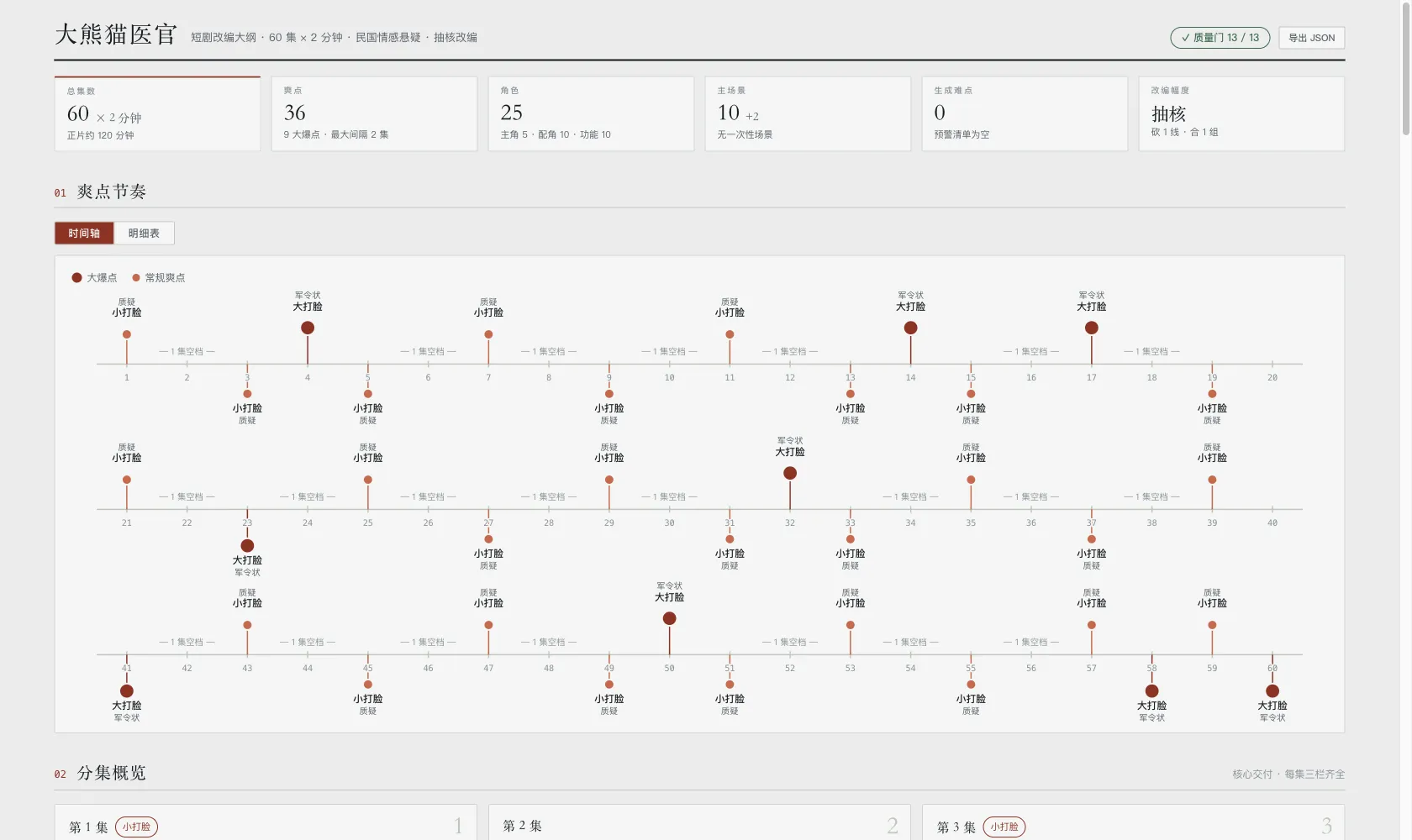
Outputs outline.json, a Markdown report, and a self-contained outline-report.html:
The quality gates are code
The core stance of this skill: a checklist the model grades itself on is worthless. All 14 gates are deterministic checks in validate, not prose for the model to read — per-tier cast caps (leads 1–5, supporting ≤ 10, functional ≤ 10), a narrative-prop cap (≤ 8; props is optional and the gate says so when absent), a primary-scene cap that scales with episode count (4 + ⌈episodes/10⌉ clamped to 5–15 — tuned for AI production, where scenes are generated and the cap guards consistency assets rather than set-building money), reuse plans for one-off scenes, beat gaps, episode-1 hook, major-beat timing, three-fields-per-episode, crowd-scene plans, risk keywords flagged, reference integrity (no jobless characters, no unused scenes, no unused props, no dangling IDs), and no quoted dialogue in synopses.
Why tiers instead of one flat cap: a flat cap conflates who the audience must remember with how many consistent faces production must maintain. The lead cap guards screen time and memory; the support/functional caps guard AI character-asset cost — and the asset list converts tiers into workload automatically (leads → full model sheets, supporting → bust references, functional → prompt-only). Unnamed extras stay off the table entirely. Functional roles legitimately have no arc — the doctor is there to stitch a wound.
Thresholds are parameters (params.thresholds), not constants — different platforms want different beat cadences. The selftest defeats every single gate on purpose to prove each one actually blocks.
The most valuable rule in the flow
The skeleton (cut lines / merge characters / place beats) ships as a quick draft for sign-off first — which lines died, who got merged, which episode carries the big payoff. Only after the user nods does episode writing begin, and that's enforced as a stage gate (validate --stage beats), not a promise. Episodes are then written in batches of ≤ 10; writing 60 in one go always collapses in the back half.
The report
Reports render with a Chinese UI by default; pass --lang en for a fully English report (or set a top-level lang field in outline.json — the flag wins). The UI and the quality-gate labels are translated; data content — beat types, synopses, names — stays exactly as authored, and so do the detail strings of a failing gate. In English mode the quality-gate labels are translated too (thresholds kept as computed); failing-gate details and all data stay as authored.
node scripts/novel-outline.mjs render outline.json --html --lang en > outline-report.html
A single-page, 1600px-wide review document — everything laid flat and Cmd+F-able:
- KPI band: episodes, beats, tiered cast, primary scenes, production risks, adaptation mode — six stat tiles up front
- Beat rhythm: chart/table tabs — the story timeline by default (filled majors, lighter minors, dead gaps annotated right on the axis, rust-red past the threshold, wrapping every 20 episodes), one click to the detail table
- Per-episode cards in three columns, first three shown by default with a fade-out and an expand button; each card carries beat capsules, hook/suspense fields, and scene/cast/risk tags
- Scene overview: one card per scene — ghost episode numbers top-right, a presence strip, beats carried, cast seen or the reuse plan
- Key decisions: the three sign-off items on paper — which lines were cut (with a "this means…" conclusion), who got merged (cast-slot counts and the lead roster are computed), and where the major beats land (auto-listed from the beat table, first/final tagged)
- Dispatch matrix: characters and scenes on one grid — read a column top-to-bottom and you have that episode's requirements
- Asset conversion: cast tiers, scene environments, and production risks converted into prep workload — all computed
- Quality gates: header badge, a failure banner when anything fails, and the full ✓/✗ list at the end — baked in by the script
- Export JSON downloads
outline.jsonverbatim — edit and feed it straight back intorender/validate - Built-in Chinese and English UI — Chinese by default,
--lang enfor English - All graphics are inline SVG/CSS with a validator-checked palette; zero external resources, opens offline
Checkup mode
Have an outline already and just want a diagnosis?
node scripts/novel-outline.mjs checkup outline.json
node scripts/novel-outline.mjs render outline.json --html > outline-report.html
Failing gates don't block rendering — showing the problems is the point.
Long texts
An 800k-character novel doesn't fit in context. chunk splits by chapter headings into volumes (15 chapters each by default), each volume summarised concurrently, then merged. Caps at 60 volumes and reports truncated explicitly — it never drops the tail silently. Key decisions must point back at the source (keep[].evidence, verbatim) — no inventing content from the title.
Relationship to novel-characters
novel-outline owns adaptation structure (cutting, merging, beat placement, episodes); novel-characters owns character design (profiles, image/voice prompts, model sheets).
The outline sits upstream of the character bible: the characters block already settles who is in, who is out, and who leads, so the character pass works from that roster instead of re-deciding it. The reverse also works — if you already have a cast.json, feed it in as character raw material instead of re-reading the source. This skill writes no dialogue, no storyboards, no generation prompts.
Selftest
node scripts/selftest.mjs
249 assertions — chunking, validation, gate-defeating cases, asset aggregation, rendering (both UI languages), export. No model calls, runs in about a second.
Only tested on macOS + Node 24.
Explore related projects
codecrafters-io/build-your-own-x
Master programming by recreating your favorite technologies from scratch.
561,871 starspublic-apis/public-apis
A collective list of free APIs
498,229 starsmorluto/rea
Reverse engineer anything with agents, from app behavior down to native binaries.
452,625 starsopenclaw/openclaw
The AI that really does things. Any OS. Any Platform. The lobster way. 🦞
394,365 stars