
eshaangulati123/perfectclone
eshaangulati123/perfectclone has 47 GitHub stars and 4 forks. GitHot measured +2 stars in 24 hours. Last checked 2026-11-15 06:18 UTC. Last push 2026-11-04.
Measured star growth
- in 24h
- +2
- in 7 days
- Collecting history
- in 15 days
- Collecting history
- in 1 month
- Collecting history
Net star changes over overlapping periods, not daily totals. Missing measurements are left blank. Stars measure attention, not software quality.
About
yoink any website. Clone any website 1:1 and get its real frontend files, not an AI-regenerated copy. Rebrand it, keep Next.js working, and deploy it as your own instantly
Web & AppsREADME.md
Originalperfectclone: website cloner that copies the real site, 1:1
Pull the real frontend of any public site in ~15 seconds. No AI, no tokens.
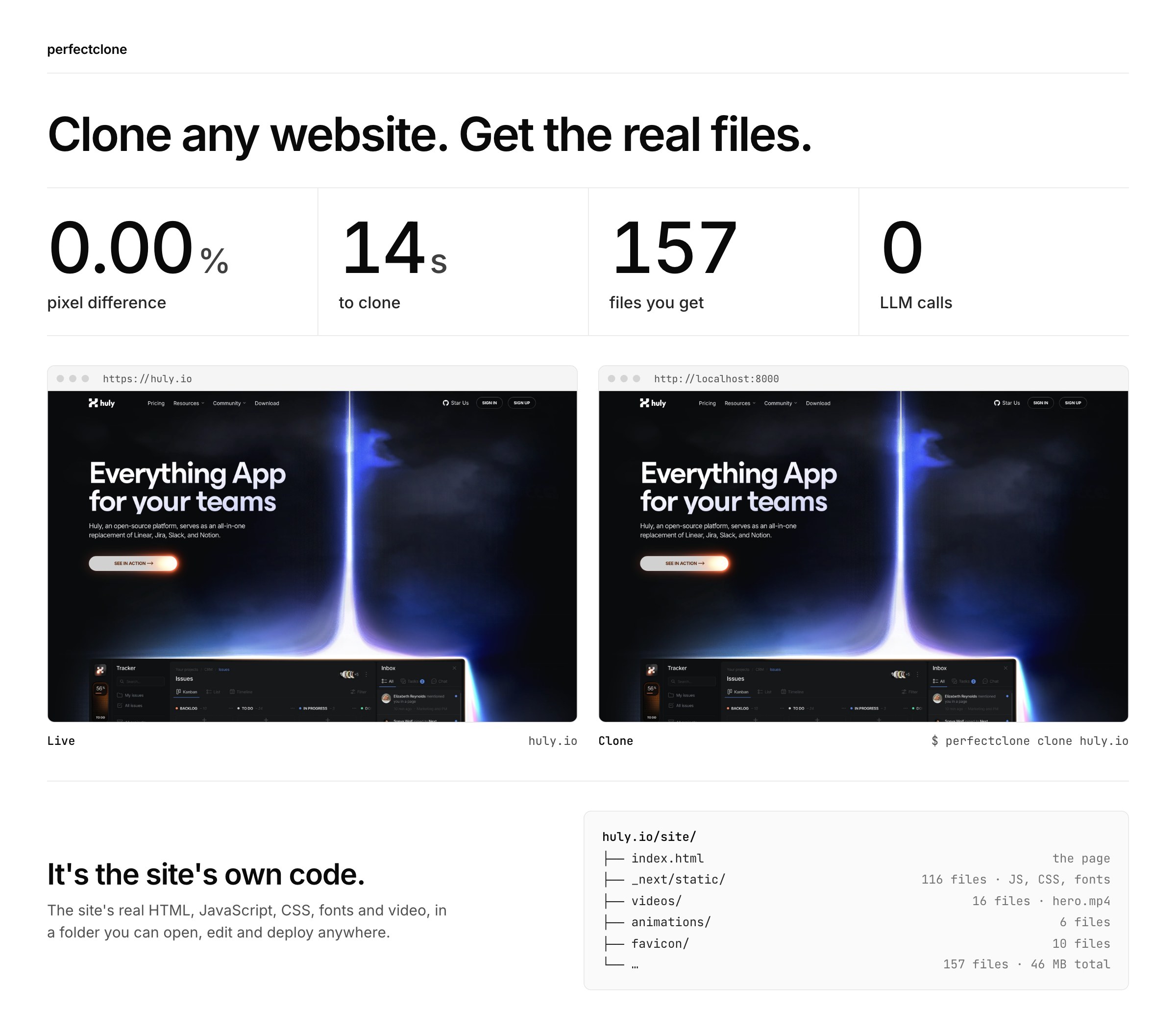
perfectclone clones any website 1:1. It crawls the site with a real browser (Playwright), downloads the site's own HTML, JavaScript, CSS, fonts and images, and gives you a folder you can serve, edit and deploy. Then it lets you rebrand it, rehost it and strip the original owner's trackers without breaking it, including Next.js sites that hydrate on load.
pip install perfectclone

perfectclone clone example.com
perfectclone serve example.com             # → http://localhost:8000
That's it. Chromium is downloaded automatically the first time you clone. Requires Python 3.10+.
Or try it without installing anything, using uv:
uvx perfectclone clone example.com
Why not an AI cloner?
Most "clone any website" tools today regenerate the site: an AI agent looks at screenshots or scraped markup, writes a new React/Next.js app, and compares the result against the original with a visual-similarity score until it's close enough. That gets you a lookalike. The code is new, the behaviour is approximate, and there are always gaps.
perfectclone doesn't regenerate anything. It mirrors the bytes the site actually serves, so the clone is the site: same markup, same bundles, same animations, same JavaScript running. Sometimes the real solution is the simple one.
| AI cloners | wget / HTTrack | perfectclone | |
|---|---|---|---|
| Copies the site's real files | ❌ | ✅ | ✅ |
| Pixel-identical on modern JS sites | ❌ | ❌ | ✅ |
| Catches lazy-loaded JS, fonts, images | — | ❌ | ✅ |
| React / Next.js sites still run | — | ❌ | ✅ |
| Rebrand without breaking the site | ✅ | ⚠️ | ✅ |
| Strips the original site's trackers | — | ❌ | ✅ |
| Works without an LLM or API key | ❌ | ✅ | ✅ |
Tested on real sites
Each card is one site split down the middle: the live site on the left, the clone on the right.
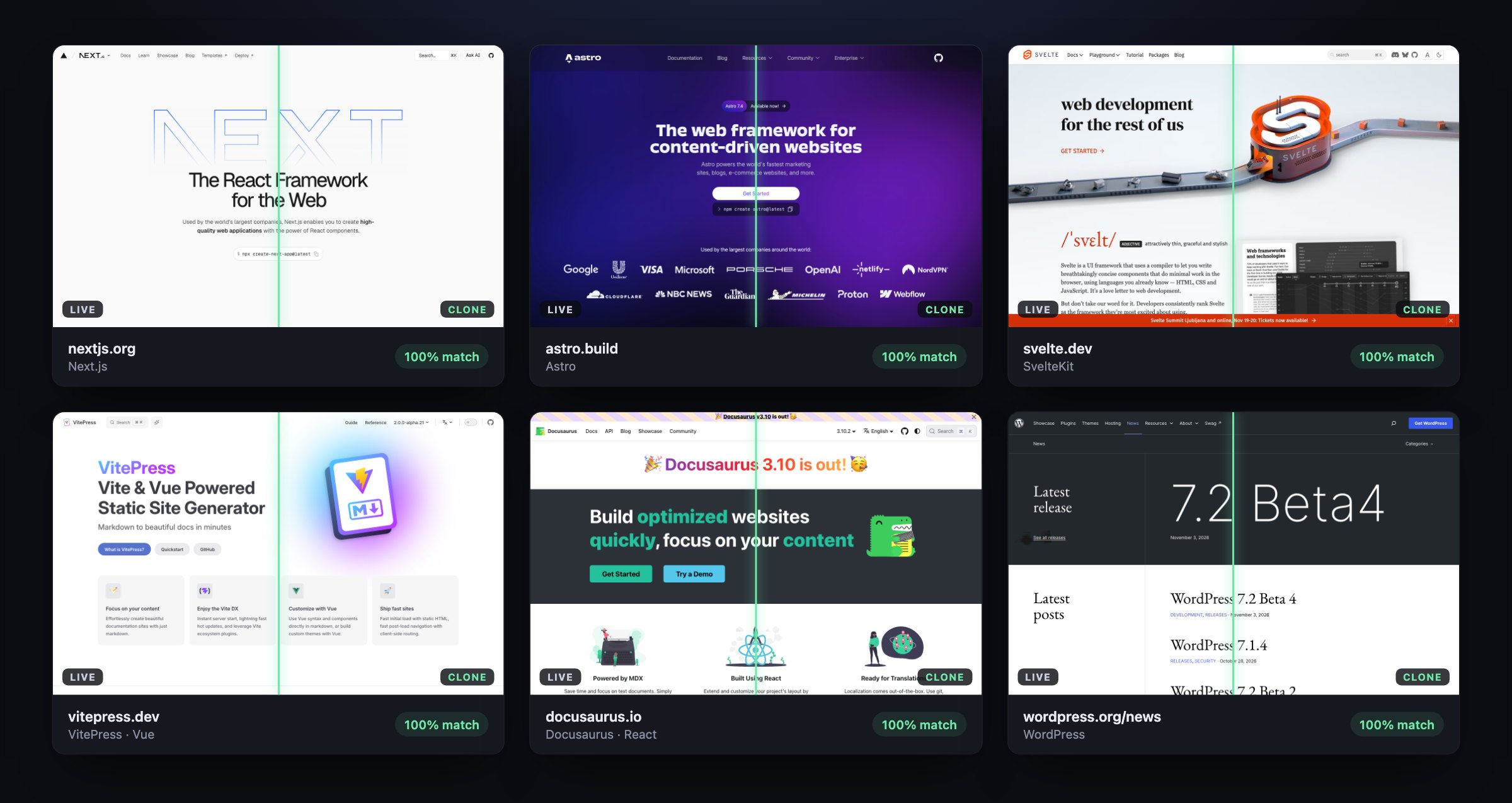
scripts/compat.py clones each site, serves the copy, and compares its home page with the live
one at 1440×900, with animations and videos paused on the same frame:
| Site | Built with | Pixel match | Hydration errors | Notes |
|---|---|---|---|---|
| huly.io | Next.js | 100% | 0 | |
| nextjs.org | Next.js | 100% | 0 | |
| astro.build | Astro | 100% | 0 | |
| svelte.dev | SvelteKit | 100% | 0 | |
| vitepress.dev | VitePress (Vue) | 100% | 0 | |
| docusaurus.io | Docusaurus (React) | 100% | 0 | |
| wordpress.org/news | WordPress | 100% | 0 | |
| paulgraham.com | Hand-written HTML | 100% | 0 | |
| example.com | Static HTML | 100% | 0 | |
| framer.com | Framer | 96% | 0 | Cookie banner needs Framer's backend |
| webflow.com | Webflow | 93% | 0 | Cookie banner won't run on localhost; carousel caught mid-scroll |
Every clone loaded with zero requests to trackers. Run it yourself with
python scripts/compat.py, and please open an issue for any site that doesn't come out right.
Commands
perfectclone clone <url> [-o out] [--max-pages 200] [--extract] [--keep-trackers] [--ignore-robots]
perfectclone serve <site> [-p 8000]
perfectclone replace <site> <old> <new> [--exact-case] [--substring]
perfectclone rehost <site> <old-origin> <new-origin>
perfectclone strip-trackers <site>
- clone writes
out/site/(the working copy) andout/manifest.json(pages, failures, third-party hosts the site uses).--extractalso saves each page's text, metadata (headings, links, images, forms, JSON-LD) and a full-page screenshot toout/extract/. Trackers are stripped by default. - replace renames text everywhere: HTML, JS, CSS, JSON, SVG. It also handles the UPPER, lower and Capitalized variants, and leaves URLs and asset paths alone so nothing 404s.
- rehost points canonical, Open Graph, JSON-LD and sitemap URLs at your domain.
- serve works like a static host: clean URLs (
/about→/about/index.html), and/_next/imagerequests are served from the mirrored originals.
Rebrand a clone and put it online:
perfectclone clone acme.com -o acme
perfectclone replace acme "Acme" "Globex"
perfectclone rehost  acme https://acme.com https://globex.com
npx netlify-cli deploy --dir acme/site --prod      # or any static host
How it works
- Crawl with a real browser. Each page is rendered in Chromium and scrolled to the bottom,
and every response is recorded. That catches what static mirrors miss: code-split JS chunks,
fonts requested from CSS, images behind lazy loading. Links are followed breadth-first,
seeded from the sitemap. robots.txt is respected unless you pass
--ignore-robots. - Mirror the server's bytes. Pages are saved as the HTML the server sends, not the
rendered DOM, because that's what the site's JavaScript expects to hydrate. Assets keep
their URL paths, and CSS/JS are scanned for further references (
url(),srcset, chunk paths) until nothing new turns up. - Edit without breaking hydration. A Next.js App Router page ships its HTML and a
serialized copy of the React tree in
self.__next_f.push(...)script chunks. Change one and not the other, and React throws a hydration error and re-renders from the payload, undoing your edit. perfectclone decodes the payload stream, edits it row by row, recomputes the UTF-8 byte lengths of length-prefixed text rows (<id>:T<hex>,…), rejoins rows that span chunks, and writes it back next to the matching HTML edit. - Strip trackers. Google Analytics/Tag Manager, the Meta pixel, LinkedIn Insight, Hotjar,
Clarity, Segment, PostHog, HubSpot, TikTok, Reddit, X, Cloudflare Web Analytics, RB2B and
more. They're removed from
<script>/<noscript>tags, from preload hints, and from Next.jsnext/scriptelements that only exist in the payload.
Limits
- No backend. Forms, logins, search and API calls still go to the original servers (or fail). perfectclone copies the front end.
- Next.js client-side navigation needs each page's RSC payload answered for
?_rsc=requests. perfectclone mirrors them andperfectclone serveroutes them. On a plain static host, internal links fall back to full page loads: everything still works, just without the instant transitions. - Chunks that are only requested after a click (say, a modal's code) are captured if the crawl triggered them or a bundle names them as a string. A bundle can also assemble a chunk URL at runtime, and that one may be missed.
- Bot protection (CAPTCHAs, aggressive Cloudflare rules) can block the crawl. perfectclone does not try to get around it.
- Embeds (YouTube, Cal.com, maps) and third-party CDNs keep loading from their own hosts.
Roadmap
Clone apps behind a login, like dashboards. Today perfectclone sees what an anonymous visitor sees, and data that loads from APIs after the page renders isn't kept. The plan, for apps you have an account on:
- Crawl as you. Sign in once in a browser window; perfectclone saves the session and crawls with it.
- Record API responses. Keep every JSON response the app fetches during the crawl and have
perfectclone servereplay them, so charts, tables and lists show real data offline. - Explore by clicking. Click through navigation, tabs and menus to reach views that only exist in client-side routing.
The result is a clickable snapshot of the UI and its data at capture time. Saving, server-side filtering and live updates still need the real backend.
Other ideas: hydration-aware editing for Nuxt, SvelteKit and Remix payloads, and a deploy
helper that writes _redirects / vercel.json rules so ?_rsc= and /_next/image work on
static hosts. Contributions welcome.
Contributing
perfectclone is open source under the MIT License. Issues and pull requests are welcome, especially reports of sites that don't clone cleanly. See CONTRIBUTING.md, and please follow the Code of Conduct. Report security issues privately as described in SECURITY.md.