
erezsh/Preql
erezsh/Preql has 630 GitHub stars and 13 forks. GitHot measured 0 stars in 24 hours and 0 in 7 days. Last checked 2026-11-09 04:13 UTC. Last push 2022-08-17.
An interpreted relational query language that compiles to SQL.
Measured star growth
- in 24h
- 0
- in 7 days
- 0
- in 15 days
- Update delayed
- in 1 month
- Update delayed
Net star changes over overlapping periods, not daily totals. Missing measurements are left blank. Stars measure attention, not software quality.
README.md
Original
Preql is an interpreted, relational programming language, that specializes in database queries.
It is designed for use by data engineers, analysts and data scientists.
Preql's main objective is to provide an alternative to SQL, in the form of a high-level programming language, with first-class functions, modules, strict typing, and Python integration.
How does it work?
Preql code is interpreted and gets compiled to SQL at runtime. This way, Preql gains the performance and abilities of SQL, but can also operate as a normal scripting language.
Currently supported dialects are:
- Postgres
- MySQL
- Sqlite
- BigQuery
- More... (planned)
For features that are database-specific, or aren't implemented in Preql, there is a SQL() function that provides a convenient escape hatch to write raw SQL code.
Main Features
- Modern syntax and semantics
- Interpreted, everything is an object
- Strong type system with gradual type validation and duck-typing
- Compiles to SQL
- Python and Pandas integration
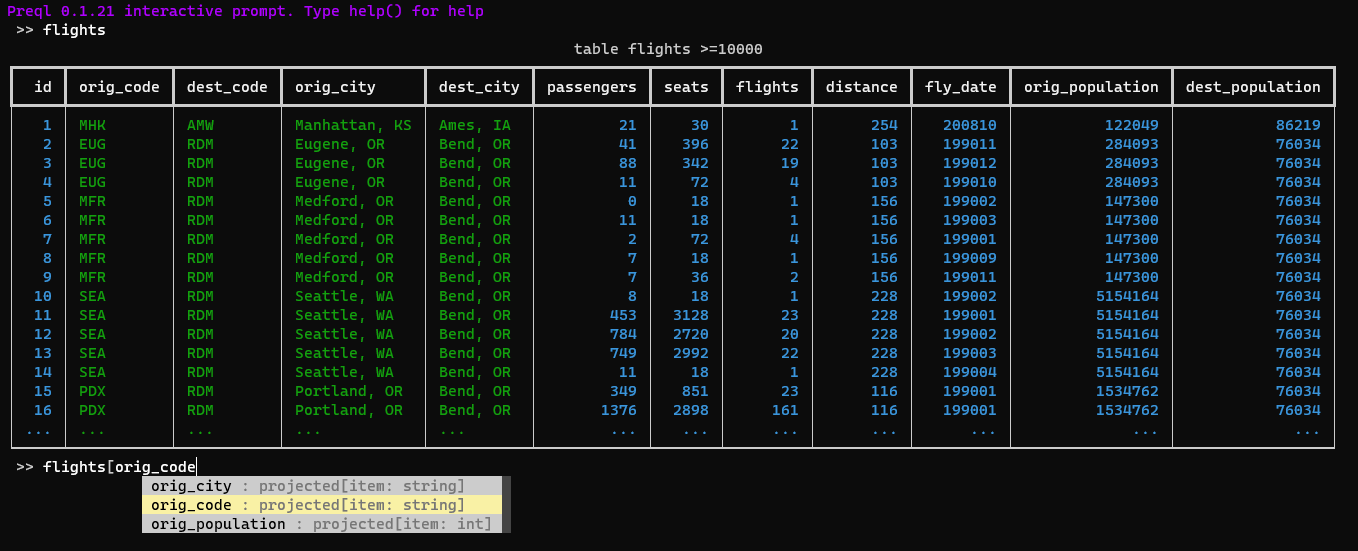
- Interactive shell (REPL) with auto-completion
- Runs on Jupyter Notebook
Note: Preql is still work in progress, and isn't yet recommended for use in production.

Learn More
Check out the online demo:

Get started
Simply install via pip:
pip install -U preql
Then just run the interpreter:
preql
Requires Python 3.6+
Quick Example
// Declare a new table
table Continent {
    name: string
    area: int       // km²
    population: int
}

// Initialize the table, by inserting rows
new Continent("Africa", 30370000, 1287920000)
new Continent("Antarctica", 14000000, 4490)
new Continent("Asia", 44579000, 4545133000)
new Continent("Europe", 10180000, 742648000)
new Continent("North America", 24709000, 587615000)
new Continent("South America", 17840000, 428240000)
new Continent("Australia", 8600000, 41261000)

// Print the continents, ordered by density
print Continent {
    ...                         // Include existing fields
    density: population / area  // Create new a field

} order{^density}

// Print the total land area
print "Total land area:", sum(Continent{area}), "km²"

//  ========================= Output ==========================

                              table  =7
┏━━━━┳━━━━━━━━━━━━━━━┳━━━━━━━━━━┳━━━━━━━━━━━━┳━━━━━━━━━━━━━━━━━━━━━━━┓
┃ id ┃ name          ┃     area ┃ population ┃               density ┃
┡━━━━╇━━━━━━━━━━━━━━━╇━━━━━━━━━━╇━━━━━━━━━━━━╇━━━━━━━━━━━━━━━━━━━━━━━┩
│  3 │ Asia          │ 44579000 │ 4545133000 │     101.9568182328002 │
│  4 │ Europe        │ 10180000 │  742648000 │      72.9516699410609 │
│  1 │ Africa        │ 30370000 │ 1287920000 │     42.40763911755021 │
│  6 │ South America │ 17840000 │  428240000 │    24.004484304932735 │
│  5 │ North America │ 24709000 │  587615000 │    23.781415678497712 │
│  7 │ Australia     │  8600000 │   41261000 │     4.797790697674419 │
│  2 │ Antarctica    │ 14000000 │       4490 │ 0.0003207142857142857 │
└────┴───────────────┴──────────┴────────────┴───────────────────────┘

Total land area: 150278000 km²
In the background, this table was generated by executing the following compiled SQL code (reformatted):
-- Continent {..., density: population / area} order{ ^density }
WITH subq_1(id, name, area, population, density) AS (
    SELECT id, name, area, population, (CAST(population AS float) / area) AS density
    FROM Continent
    ORDER BY density DESC)
SELECT * FROM subq_1
See more examples in the examples folder.
Interactive Environment
License
Preql uses an “Interface-Protection Clause” on top of the MIT license.
See: LICENSE
In simple words, it's free for personal use. Also, it can be used for any commercial or non-commercial purpose, as long as your product doesn't base its value on exposing the Preql language itself to your users. Read more
Explore related projects
Asabeneh/30-Days-Of-Python
The 30 Days of Python programming challenge is a step-by-step guide to learn the Python programming language in 30 days. This challenge may take more than 100 days. Follow your own pace. These videos may help too: https://www.youtube.com/channel/UC7PNRuno1rzYPb1xLa4yktw
78,423 starsgrafana/grafana
The open and composable observability and data visualization platform. Visualize metrics, logs, and traces from multiple sources like Prometheus, Loki, Elasticsearch, InfluxDB, Postgres and many more.
77,790 starsredis/redis
For developers, who are building real-time data-driven applications, Redis is the preferred, fastest, and most feature-rich cache, data structure server, and document and vector query engine.
77,309 starsapache/superset
Apache Superset is a Data Visualization and Data Exploration Platform
75,455 stars