
emanuele-em/kanzo has 1,138 GitHub stars and 86 forks. GitHot measured +17 stars in 24 hours. Last checked 2026-11-10 02:29 UTC. Last push 2026-11-05.
Self-hosted, sharable kanban for humans and agents. One 4.5 MB binary, 4.5 MB of RAM, 10 to 60 tokens per agent reply, starts in 2 ms, zero setup.
Measured star growth
- in 24h
- +17
- in 7 days
- Collecting history
- in 15 days
- Collecting history
- in 1 month
- Collecting history
Net star changes over overlapping periods, not daily totals. Missing measurements are left blank. Stars measure attention, not software quality.
README.md
Original



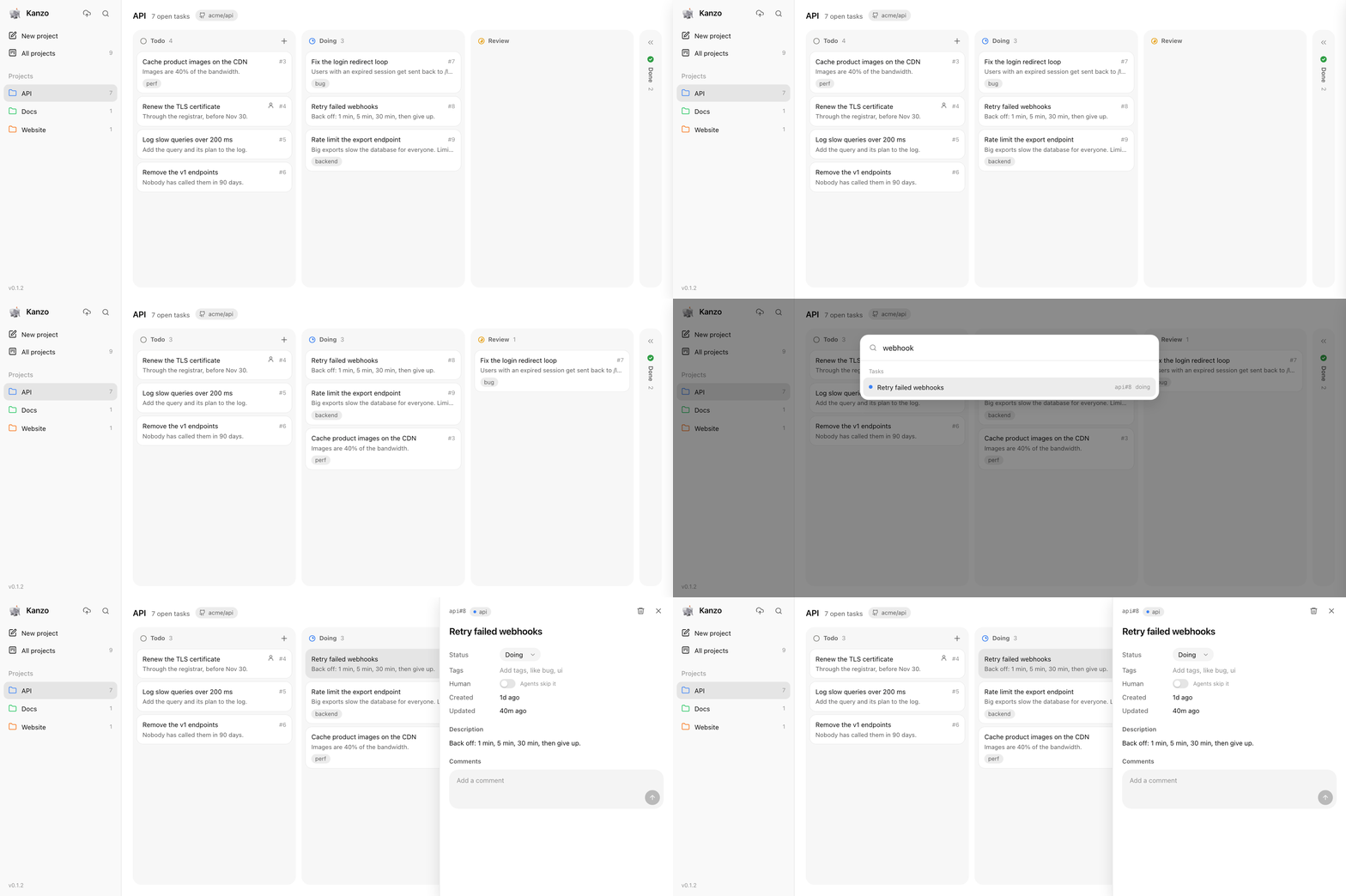
Kanzo is a kanban board in your browser and an MCP server in one 4.5 MB program, so you and your coding agents work on the same tasks: on one computer, or on one board shared by all of them. No account, no server, no setup: run kanzo and it works.
You never edit a file. Everything is done in one of three places:
- the board, in your browser, for you;
- MCP, for your agents: they take tasks, move cards and comment;
- the
kanzocommand, for the terminal and scripts.
Install
[!TIP] Just ask your agent: "install Kanzo from github.com/emanuele-em/kanzo."
curl -LsSf https://github.com/emanuele-em/kanzo/releases/latest/download/kanzo-installer.sh | sh
For macOS and Linux, including every Raspberry Pi. On Windows, in PowerShell:
powershell -ExecutionPolicy Bypass -c "irm https://github.com/emanuele-em/kanzo/releases/latest/download/kanzo-installer.ps1 | iex"
Or download the Windows zip from the latest release and put kanzo.exe in a folder named bin on your PATH, like %USERPROFILE%\.cargo\bin: the board updates itself only there.
Every release is signed by GitHub: check a download with gh attestation verify <file> --repo emanuele-em/kanzo. Or with Cargo:
cargo install kanzo
Start
[!TIP] Just ask your agent: "start Kanzo and keep it running at login."
kanzo
The board opens at http://localhost:4242. That's all the setup there is: the first run creates ~/kanzo, and the whole board lives in it.
n adds a task, / or ⌘K searches every project, f filters the board and ↵ keeps the filter, Tab moves to the description, ⌘↵ saves and closes, Esc cancels. Mark a task Human and agents leave it to you; the person icon shows only those. Paste or drop an image into a task or a comment to attach it. Give a task a URL, like its pull request on any site, and click the link on its card to open it; agents set it with url. When a new version is out, the sidebar offers it: one click installs it.
Connect your agents
[!TIP] Just ask your agent: "add Kanzo as your MCP server," then restart it.
claude mcp add kanzo --scope user -- kanzo mcp   # Claude Code
codex mcp add kanzo -- kanzo mcp                 # Codex
Other MCP clients: run kanzo mcp (apps like Raycast need the full path, from which kanzo), or use the running board at http://localhost:4242/mcp.
Then ask: "take the next task from kanzo and do it." The agent moves the card to doing and comments as it works. It finds the right project from the git remote of the repo it works in; link more repos to a project from its ⋯ menu.
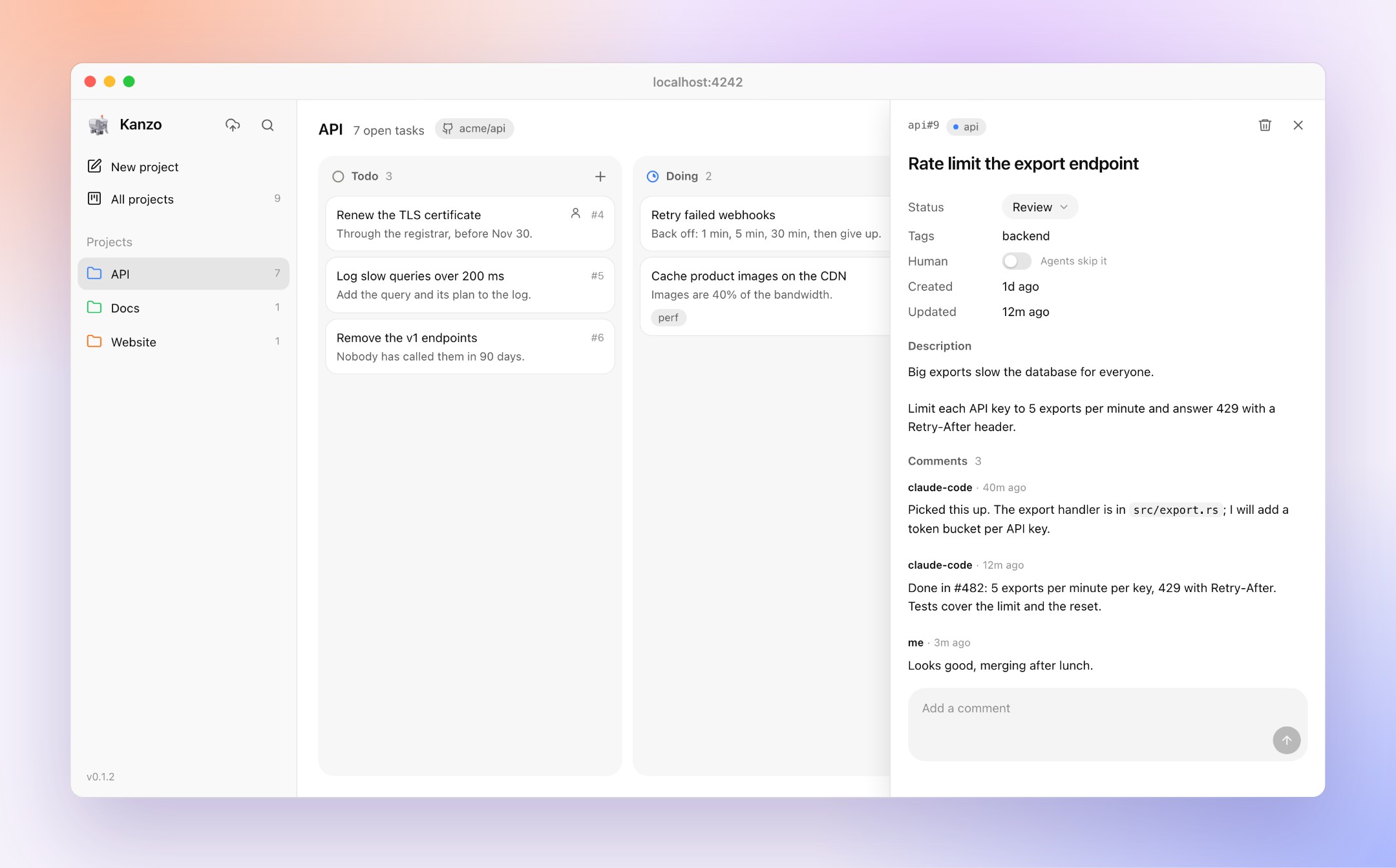
Park ideas in a backlog
Turn on Backlog in Settings for a column agents leave alone, until you move its tasks to todo.
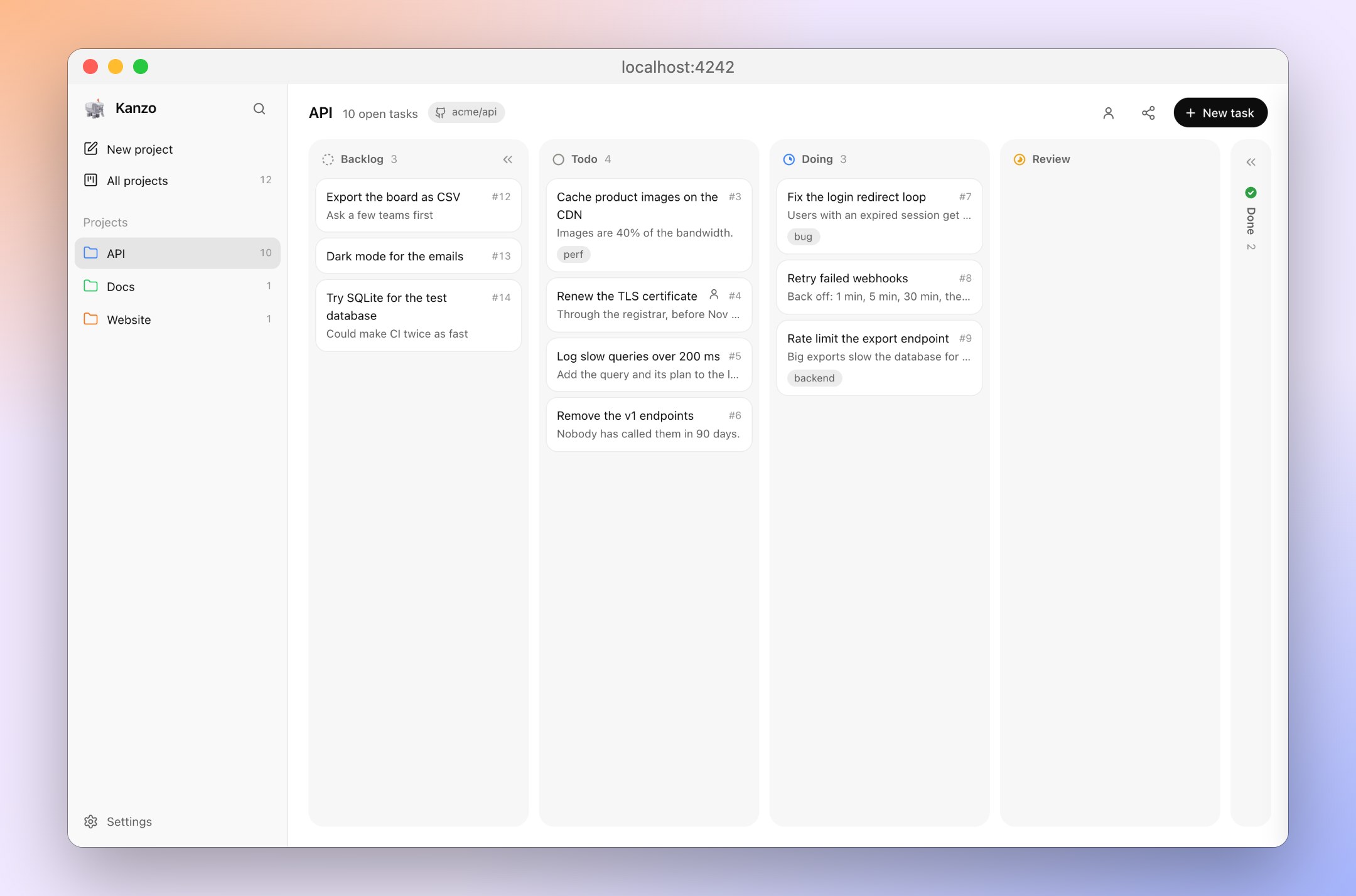
Filter and search
[!TIP] Just ask your agent: "take the next kanzo task tagged billing," or "list what's left in kanzo with tag:billing."
The board's filter (f), search (/) and the filter of list_tasks and next_task all understand the same words, like on GitHub. Every part must match, and - before a qualifier negates it: tag:billing -status:done. Qualifiers turn blue as you type them, so you can see what will filter.
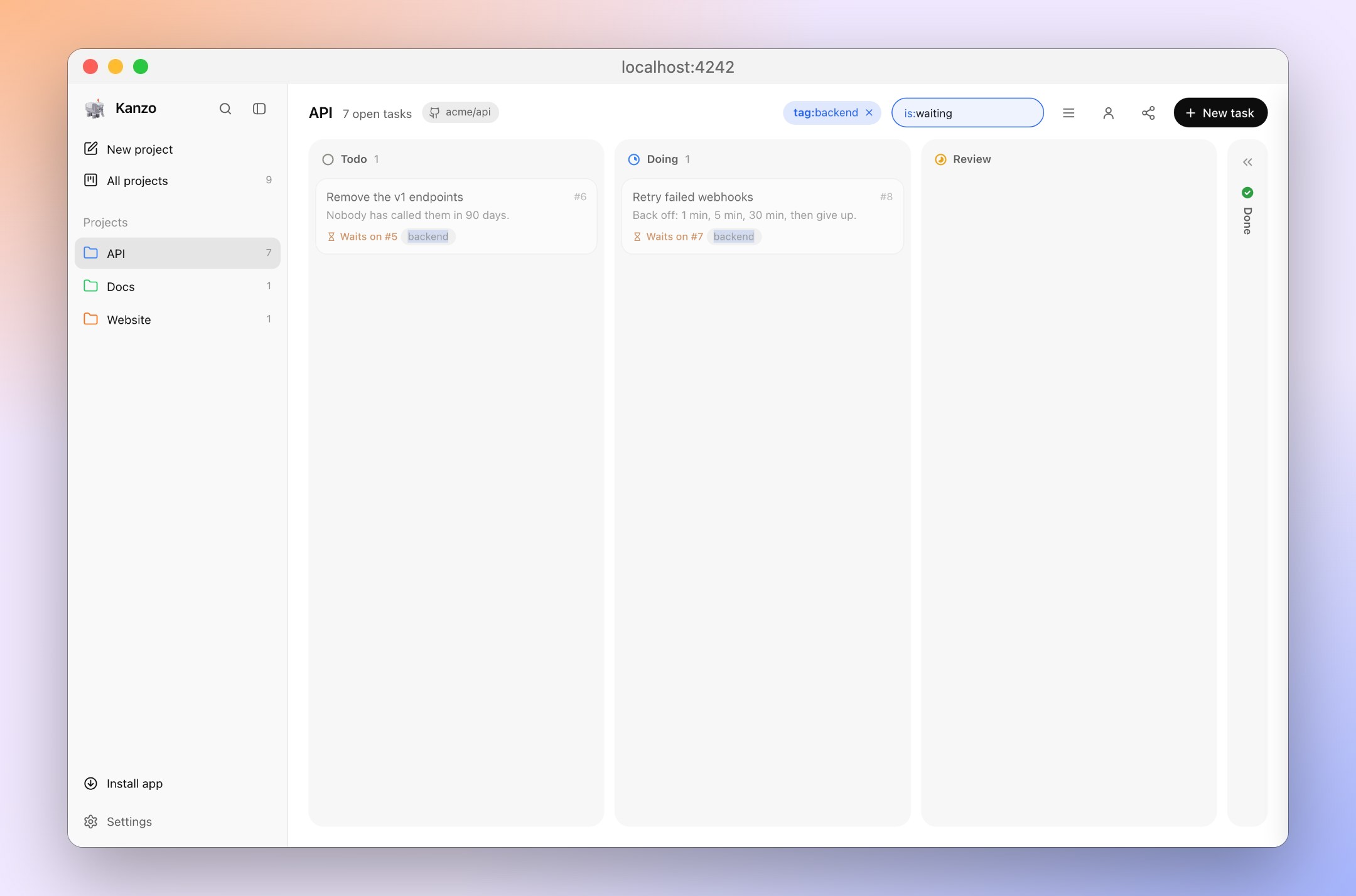
| Qualifier | Finds | Example |
|---|---|---|
tag: |
that exact tag | tag:bug, tag:"needs review" |
status: |
a column | status:doing |
project: |
a project | project:api |
title:, description:, url:, comment: |
text in that field | title:login, comment:"on hold" |
id:, comments:, images: |
a number, or a range | id:12, comments:>2, images:1..3 |
created:, updated: |
a date, or a range | created:2026-11-05, updated:<2026-01-31 |
is:human |
tasks for you, not agents | -is:human |
has:, no: |
description, tags, url, comments or images |
has:url, no:tags |
Anything else is plain text. Use quotes for a phrase, "on hold", or to look for text that reads like a qualifier, "tag:bug". Agents can't filter through a property you've hidden in Settings.
Use it on several computers
Two ways, neither with any setup: share one board live, or sync it between machines.
Share it live
[!TIP] Just ask your agent: "share my Kanzo board" on one computer, and "join the Kanzo board at 192.168.1.20" on the others.
Several computers, one board, at the same time: everyone sees the same tasks, and every agent works on them.
- On the computer with the board, click the share icon next to New task and turn on Share this board. Copy an address it shows.
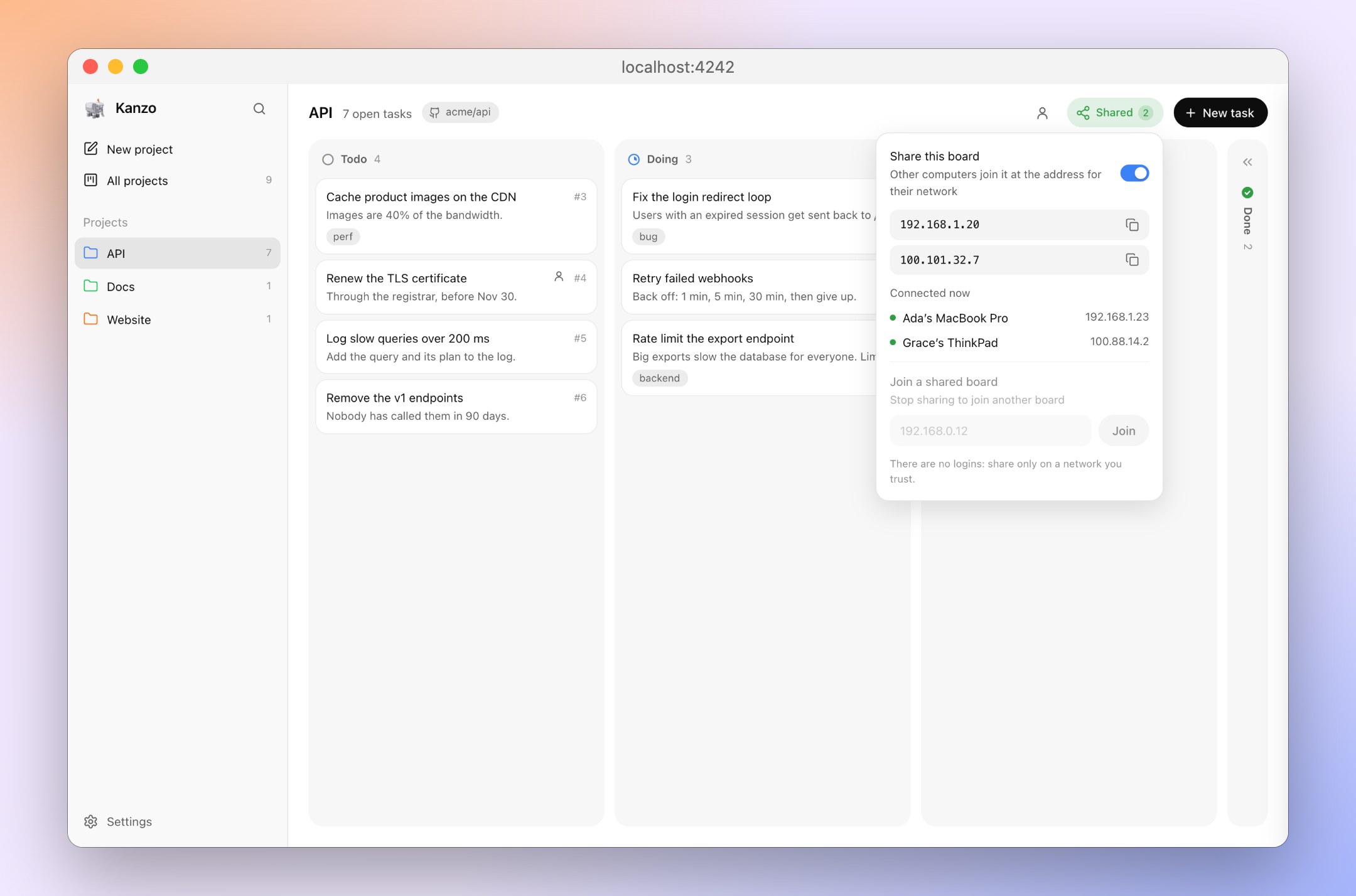
- On each other computer, click the share icon, paste the address and click Join.
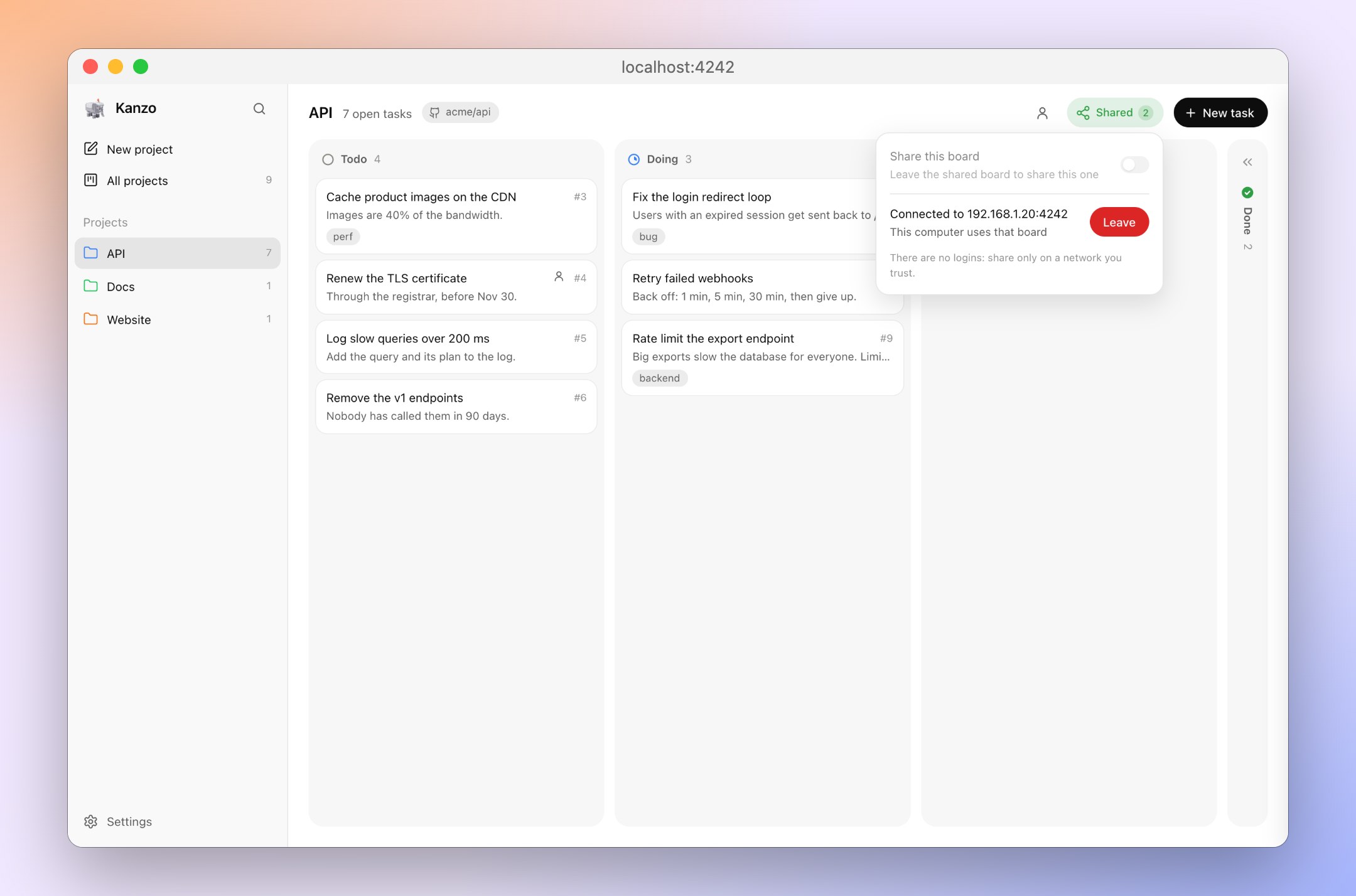
Nothing restarts and nothing needs configuring. Their board shows the shared one, and their agents use it through the same kanzo mcp, still finding the project from the repo they work in. Turn sharing off, or click Leave, at any time.
From a terminal, or for an agent, it's kanzo share on and kanzo join <address>, then kanzo share off and kanzo leave.
The same two commands work wherever the board lives; only the address changes:
Your computer shares its board. Others join it from theirs, on the same network.
flowchart LR
  B["💻 Laptop B<br><code>kanzo#nbsp;join#nbsp;192.168.1.20</code>"] -- home network --> A["💻 Laptop A<br><i>192.168.1.20</i><br><code>kanzo#nbsp;share#nbsp;on</code>"]
A Raspberry Pi keeps the board. Every computer joins it, and none has to stay on.
flowchart LR
  A["💻 Laptop A<br><code>kanzo#nbsp;join#nbsp;192.168.1.50</code>"] -- home network --> pi["🍓 Raspberry Pi<br><i>192.168.1.50</i><br><code>kanzo#nbsp;share#nbsp;on</code>"]
  B["💻 Laptop B<br><code>kanzo#nbsp;join#nbsp;192.168.1.50</code>"] -- home network --> pi
The Raspberry Pi is somewhere else, over the internet. Put a VPN on the Pi and on each computer, like Tailscale, NetBird or WireGuard: kanzo share on then shows the Pi's VPN address too.
flowchart LR
  A["💻 Laptop A<br><code>kanzo#nbsp;join#nbsp;100.101.32.7</code>"] -- VPN --> net(("🌐 Internet"))
  B["💻 Laptop B<br><code>kanzo#nbsp;join#nbsp;100.101.32.7</code>"] -- VPN --> net
  net -- VPN --> pi["🍓 Raspberry Pi<br><i>100.101.32.7</i><br><code>kanzo#nbsp;share#nbsp;on</code>"]
On a Pi, kanzo service install keeps the board running after a restart. There are no logins: share only on a network you trust.
Sync it between machines
[!TIP] Just ask your agent: "sync my Kanzo board," or the first time, "set up Kanzo sync with github.com/you/kanzo-data."
To carry the board between machines you use one at a time, a private git repo you own keeps it in step.
- Create an empty private repo on GitHub, or anywhere git can push.
- Click Settings at the bottom of the sidebar, choose Sync and paste its URL. Kanzo makes
~/kanzoa git repo and pushes the board. - On each other machine, do the same with the same URL: Kanzo offers to use the board that's already there.
From then on, choose Sync, or run kanzo sync, when you switch machines. It commits the board and pulls or pushes it, and it's safe while the board and your agents are running. If both machines changed the board, Kanzo asks which one to keep. To move to another repo, change it in Settings, under Sync.
Commands
| Command | Does |
|---|---|
kanzo |
Starts the board at http://localhost:4242 and opens it; --port for another port, --no-open to not open it |
kanzo service install |
Keeps the board running and starts it at login; uninstall removes it |
kanzo mcp |
The MCP server for agents: they start it, not you |
kanzo share on |
Shares the board with the other computers on your network; off stops, while the board keeps running |
kanzo join <ip> |
Uses the board another computer shares, from this one's board and agents; kanzo leave goes back |
kanzo sync |
Commits the board and pulls or pushes it; --repo <url> sets the repo, --keep-local or --keep-remote when both sides changed |
kanzo export |
Prints the board as Markdown; -f json for JSON, -p <project> for one project, -o <file> to save it |
kanzo update |
Installs the latest release and restarts the board's service; the board offers new versions too |
kanzo init |
Creates the data folder; the first run does this too |
kanzo --version |
Prints the version |
Every command takes --home <dir> to use another data folder.
Settings
[!TIP] Just ask your agent: "run Kanzo on port 4300."
Everything lives in ~/kanzo: the board in kanzo.db, settings in config.toml. You never need to open either; use another folder with --home or KANZO_HOME.
port = 4242
listen = "127.0.0.1"   # sharing opens the board to your network; "0.0.0.0" keeps it open
mcp_http = true        # MCP at /mcp
Settings on the board lists each task's properties, like tags or comments. Turn one off to hide it there and leave it out of what agents get; nothing is deleted.
Small and fast
| Program | 4.5 MB, SQLite included |
| Memory | 4.5 MB idle, 8 MB with 3,000 tasks |
| Start | 2 ms |
| Board of 3,000 tasks | 17 ms to load in the browser |
| Agents' tool list | about 1,000 tokens, once per session |
| Agents' replies | 10 to 60 tokens of plain text |
Measured on an Apple M4.
License
AGPL-3.0: use it, change it and share it; if you offer a changed version over a network, share its source too. To help, see CONTRIBUTING.
mcp-name: io.github.emanuele-em/kanzo
Explore related projects
n8n-io/n8n
Fair-code workflow automation platform with native AI capabilities. Combine visual building with custom code, self-host or cloud, 400+ integrations.
209,959 starslanggenius/dify
Build Agentic workflows, RAG pipelines, with rich AI model and tool support on one collaborative workspace. Deploy on cloud, VPC, or self-hosted, so teams move from prototype to production without rebuilding the stack.
160,773 starsmicrosoft/PowerToys
Microsoft PowerToys is a collection of utilities that supercharge productivity and customization on Windows
140,755 starsstablyai/orca
Orca is the place for working with a fleet of agents (e.g. Grok Bot, Claude Code). Run any coding agent with your own subscription. Available on desktop, mobile and remote runtime.
120,604 stars