
dsh-plugin-lab/dsh-workbuddy-bridge
dsh-plugin-lab/dsh-workbuddy-bridge has 39 GitHub stars and 7 forks. GitHot measured +1 stars in 24 hours. Last checked 2026-11-15 02:07 UTC. Last push 2026-11-13.
Measured star growth
- in 24h
- +1
- in 7 days
- Collecting history
- in 15 days
- Collecting history
- in 1 month
- Collecting history
Net star changes over overlapping periods, not daily totals. Missing measurements are left blank. Stars measure attention, not software quality.
About
DSH 插件:把 WorkBuddy 桌面 App 里的模型接入 DeepSeek Harness,零配置直接用。(原生嵌入"插件-插件配置页")
AIREADME_en.md
Original

dsh-workbuddy-bridge
WorkBuddy desktop models in DeepSeek Harness
把 WorkBuddy 桌面 App 的模型接进 DSH 对话窗口



Per-version changes → Releases (one-to-one with npm versions)
[!NOTE] Credentials never leave this machine: sign-in state is read from the WorkBuddy desktop app's own credential file and kept as one encrypted local copy; the browser half never sees a token, and none ever appears in the UI.
The CN WorkBuddy and the international WorkBuddy AI coexist: install one app and its model group appears; install both and the two groups sit side by side, each with its own account and credit. The models appear directly in the DSH model picker — no separate provider to configure.
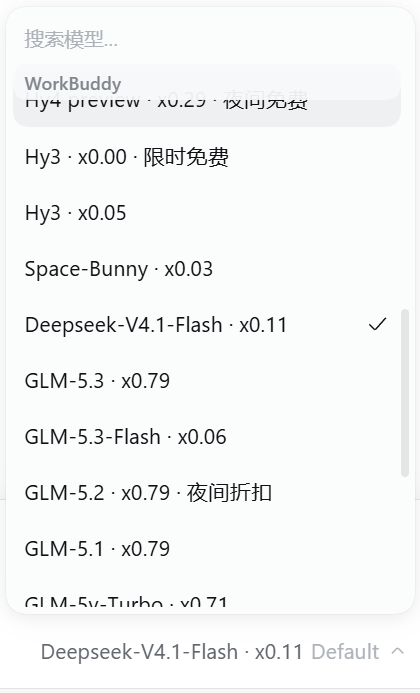
Chinese UI screenshot: The CN version forms its own group in the model picker, each model carrying its credit rate and promo
badge; installing the international version adds a "WorkBuddy AI" group the same way.
Capabilities
- Zero configuration — install, enable, and the model group appears by itself.
- Two isolated versions — "WorkBuddy" (CN) and "WorkBuddy AI" (international) each form their own group; models, accounts and credit never mix, and each follows only its own app's sign-in.
- Reasoning levels — models that declare levels expose them directly; the rest can be checked manually
on the plugin page. The bulb means "this model can switch levels"; a declared model shows it too, it just
has nothing to detect. A switchable model also carries a default level (the upstream's own declaration
when it has one, otherwise
high), so the picker no longer offers "Default". Off means "send no level parameter": neither endpoint accepts that literal, so the plugin never puts it on the wire — whether thinking is then actually disabled is up to the upstream, and the plugin makes no claim. - Credit in view — each reply shows what it consumed, and remaining credit sits beside the model picker. Nothing renders when a figure is unavailable.
- Model visibility — tick which models appear in the picker on the card's "Models" tab, saved per signed-in account.
- Image input — most models accept pasted or dropped images; text-only models say so explicitly.
- Three surfaces — Web, Desktop and TUI; only the TUI lacks manual detection.

Chinese UI screenshot: The everyday view in the conversation window: the coin and its balance, the reasoning-level bulb, then the
model name — one row, left to right.
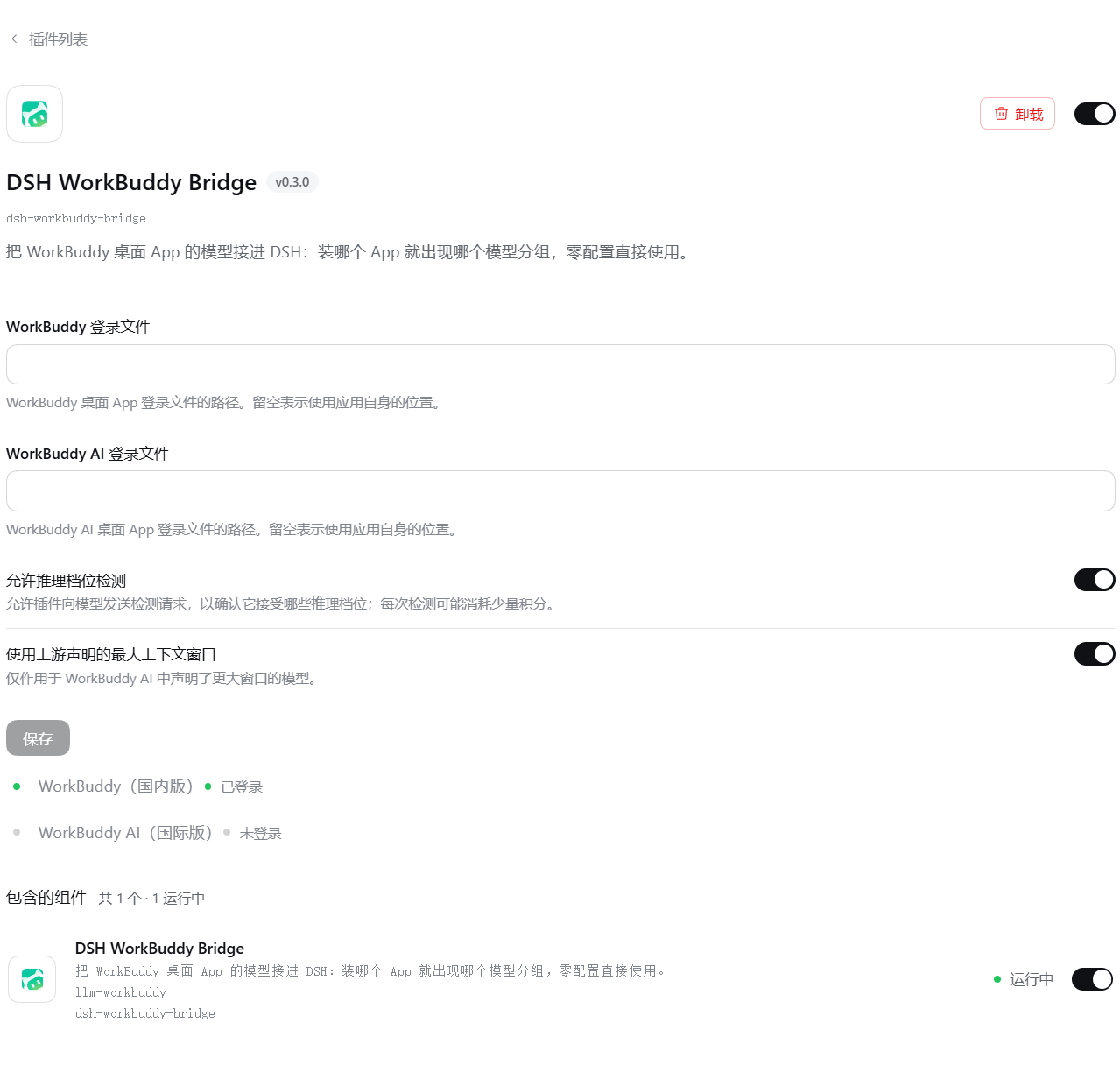
Chinese UI screenshot: The plugin page: the configuration form on top, two cards below, each following its own app's sign-in.
Install
One prerequisite: the WorkBuddy desktop app is installed and signed in (WorkBuddy AI for the international version) — the plugin reuses the app's sign-in state.
dsh plugin --profile web add dsh-workbuddy-bridge
dsh web
For Desktop and TUI swap --profile web for desktop / dsh-tui (the TUI needs a recent version of
the terminal plugin @deepseek-harness-tui/dsh-tui — see its docs).
Or from source:
git clone https://github.com/dsh-plugin-lab/dsh-workbuddy-bridge.git
cd dsh-workbuddy-bridge
pnpm install && pnpm build
dsh plugin --profile web add "$PWD"
⚠️ The pnpm install above is not optional: under a path install the repository has to supply
its own dependencies (see local development setup) — skip it and the
plugin shows as "not running" (ERR_MODULE_NOT_FOUND).
The plugin page
Sidebar Plugins → installed → click DSH WorkBuddy Bridge. The configuration area sits right under the description and takes effect on save:
- Sign-in file paths (CN / international) — leave blank to use the app's own location.
- Allow reasoning-level detection and use the largest declared context window — two switches.
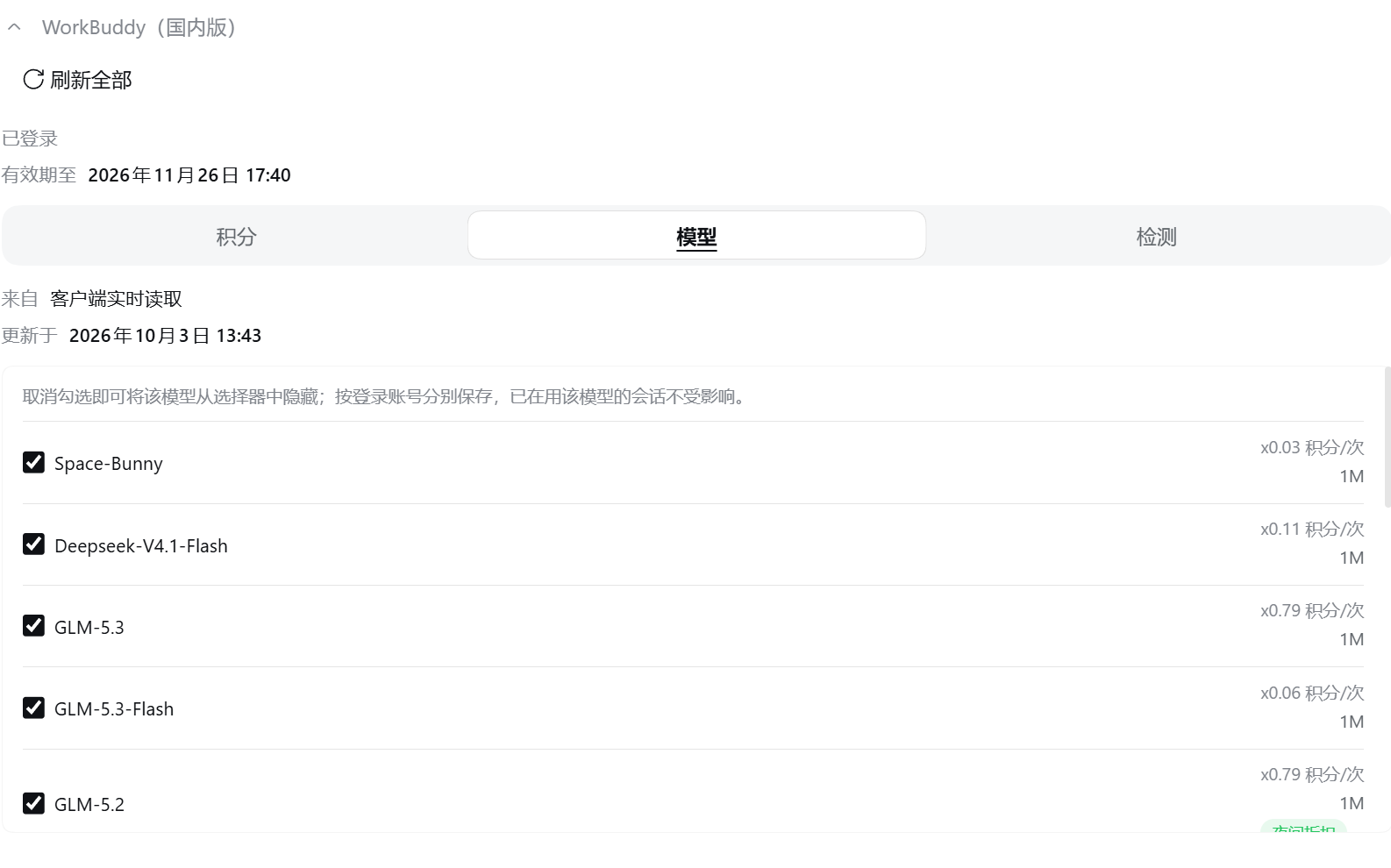
Chinese UI screenshot: The Models tab: tick which models appear in the picker, and read each one's window and rate.
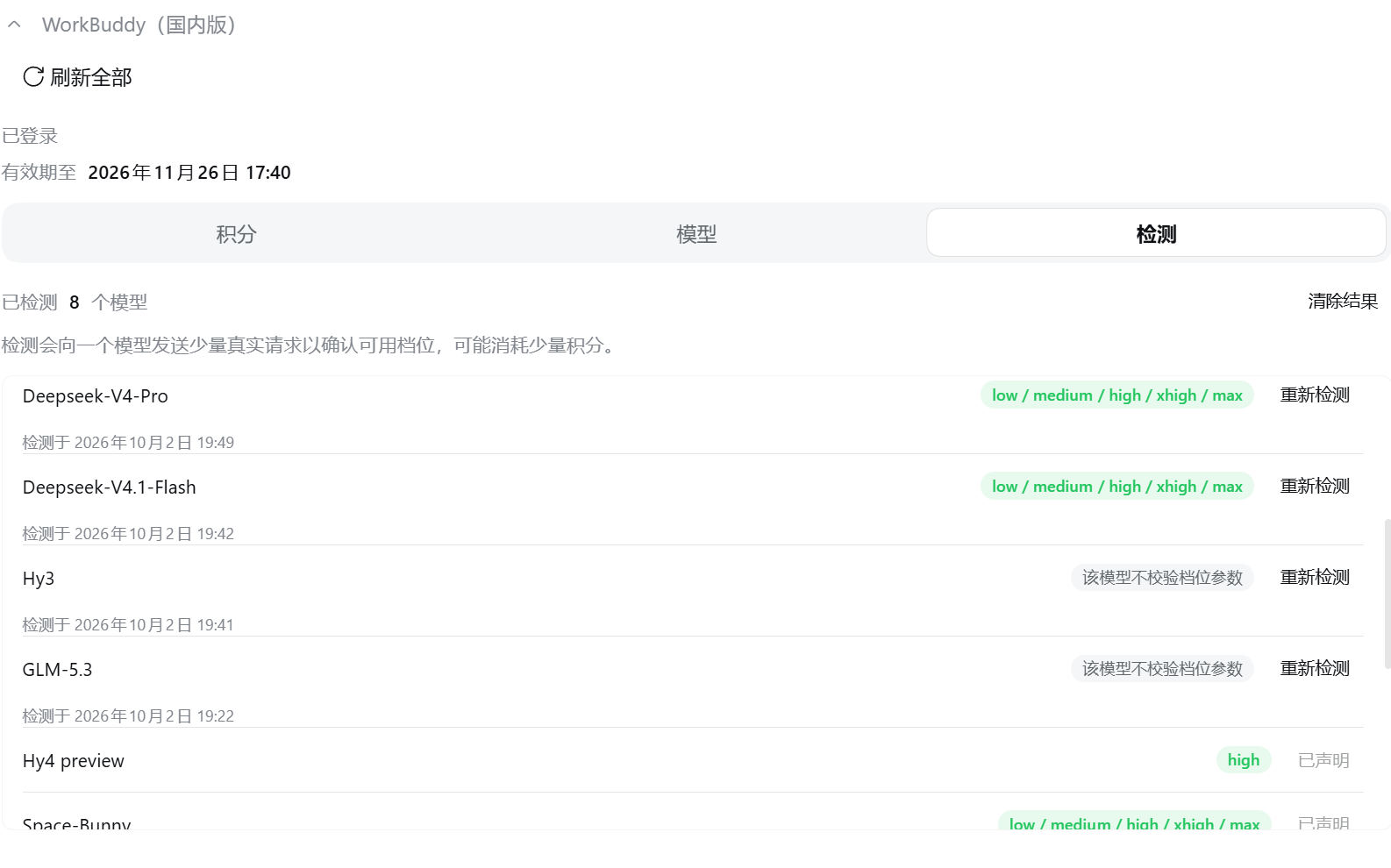
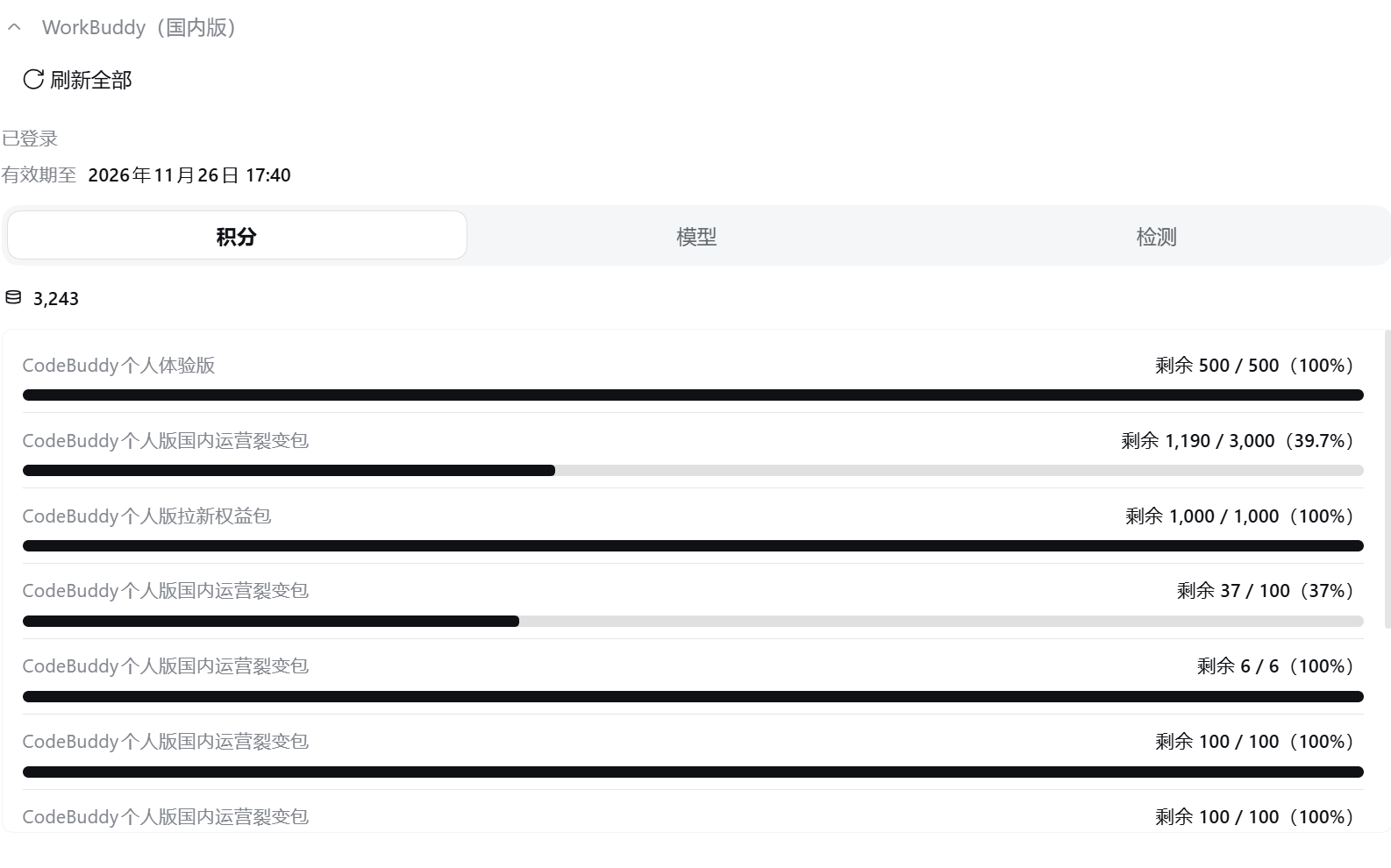
Chinese UI screenshots: Left, "Detection": one row per reasoning model — press the button to confirm which reasoning levels it
accepts. Right, "Credits": the total balance, each package's allowance as a row below.
Why detection is manual
The WorkBuddy API does not guarantee that level information is reliable — some models were observed to
accept reasoning_effort while silently ignoring unknown values. So the plugin does not guess: it
confirms one model at a time with a few real requests on demand, and a result only means the upstream
currently accepts that level — it does not promise any change in behaviour. Models that declare their
levels skip this step and use the declared set directly.
Mechanism and trade-offs in docs/ARCHITECTURE.md.
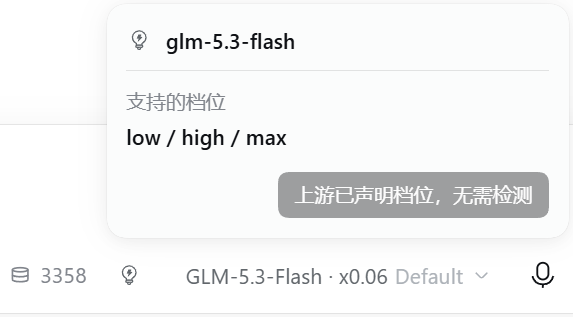
Chinese UI screenshot: A model with declared levels: the bulb is lit, the levels are directly selectable, and detection is disabled.
Compatibility and limits
A group without credentials does not appear. The host version floor, platform support, where the model catalog comes from and known gaps → docs/COMPATIBILITY.md.
Design notes → docs/ARCHITECTURE.md; release process → docs/PUBLISHING.md; maintainer map → AGENTS.md.
Disclaimer
- This project is for personal study and research only; it drives your own WorkBuddy account on your own machine. Do not use it commercially.
- You must comply with WorkBuddy's terms of service; any consequences are your own responsibility.
- Not affiliated with, nor endorsed by, Tencent, WorkBuddy, or DeepSeek; names appear only to describe compatibility, and trademarks belong to their owners.
Acknowledgements
- Sliverkiss/workbuddy2api (MIT) — reference for the WorkBuddy upstream protocol.
- franksong2702/dsh-codex-connect (Apache-2.0) — reference for DSH plugin structure and provider registration.
License
MIT.
Contributing
Bugs and requests go to the repo Issues.