
dogsinatas29/SYNAPSE
dogsinatas29/SYNAPSE has 38 GitHub stars and 1 forks. GitHot measured 0 stars in 24 hours. Last checked 2026-11-20 04:03 UTC. Last push 2026-11-17.
What you can do
- 🧠 Real-time Graph Visualization: Live network mapping of your project.
- 🚫 Hybrid Blacklist System: Intelligent exclusion of noise (node_modules, dist) with O(1) path matching.
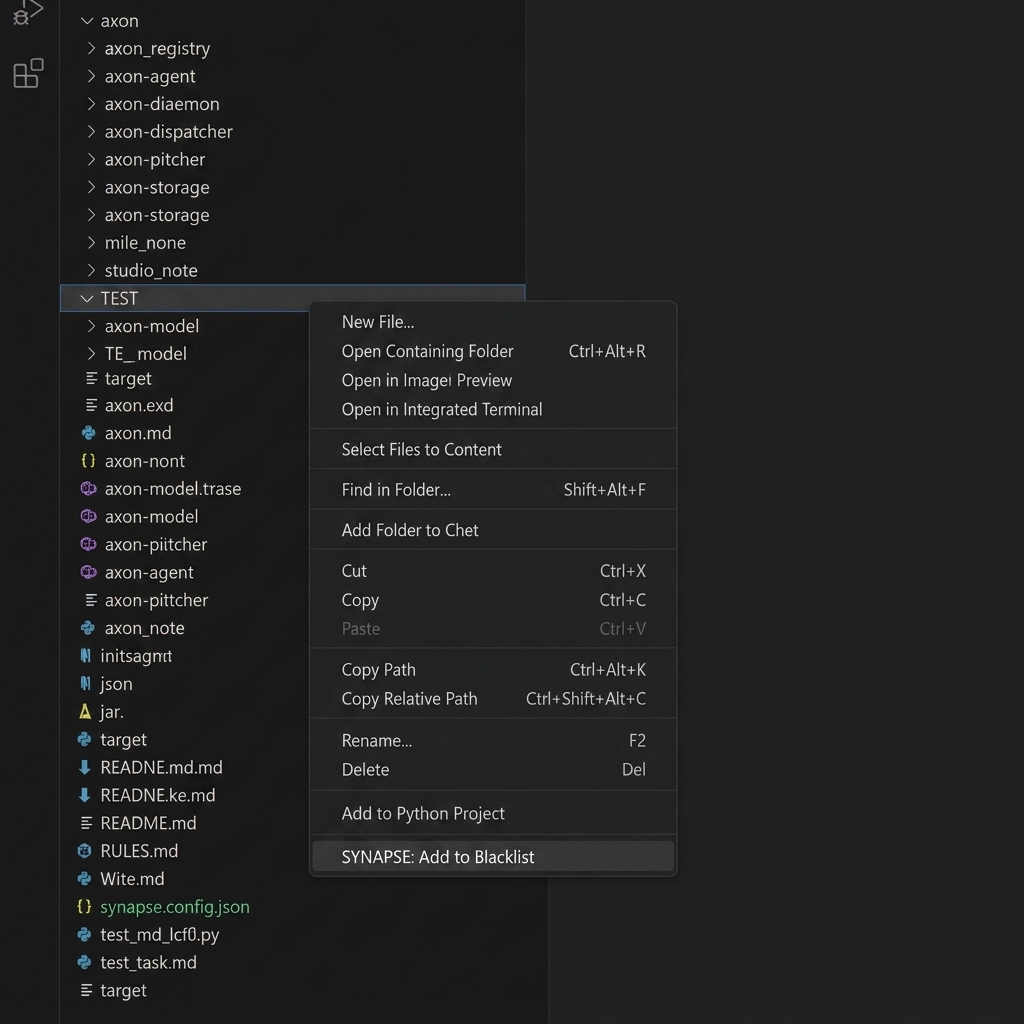
- 🖱️ Explorer Context Integration: Right-click any file/folder to instantly add to blacklist and refresh the graph.
- 🔍 N-hop Focus View: Automated identification of critical core nodes.
Measured star growth
- in 24h
- 0
- in 7 days
- Collecting history
- in 15 days
- Collecting history
- in 1 month
- Collecting history
Net star changes over overlapping periods, not daily totals. Missing measurements are left blank. Stars measure attention, not software quality.
About
Architecture Visibility Platform for Large Software Systems
Developer ToolsREADME.md
Original SYNAPSE
Visual Architecture Engine for LLM Systems
Don't read the code. See the architecture.
Software is not hard because of code.
Software is hard because of invisible relationships.
SYNAPSE transforms source code into an explorable architecture map, allowing engineers to visualize dependencies, execution flow, bottlenecks, and system-wide interactions across large software systems.


SYNAPSE helps you understand systems.
From hundreds of files and thousands of dependencies, to the handful of nodes that actually matter.
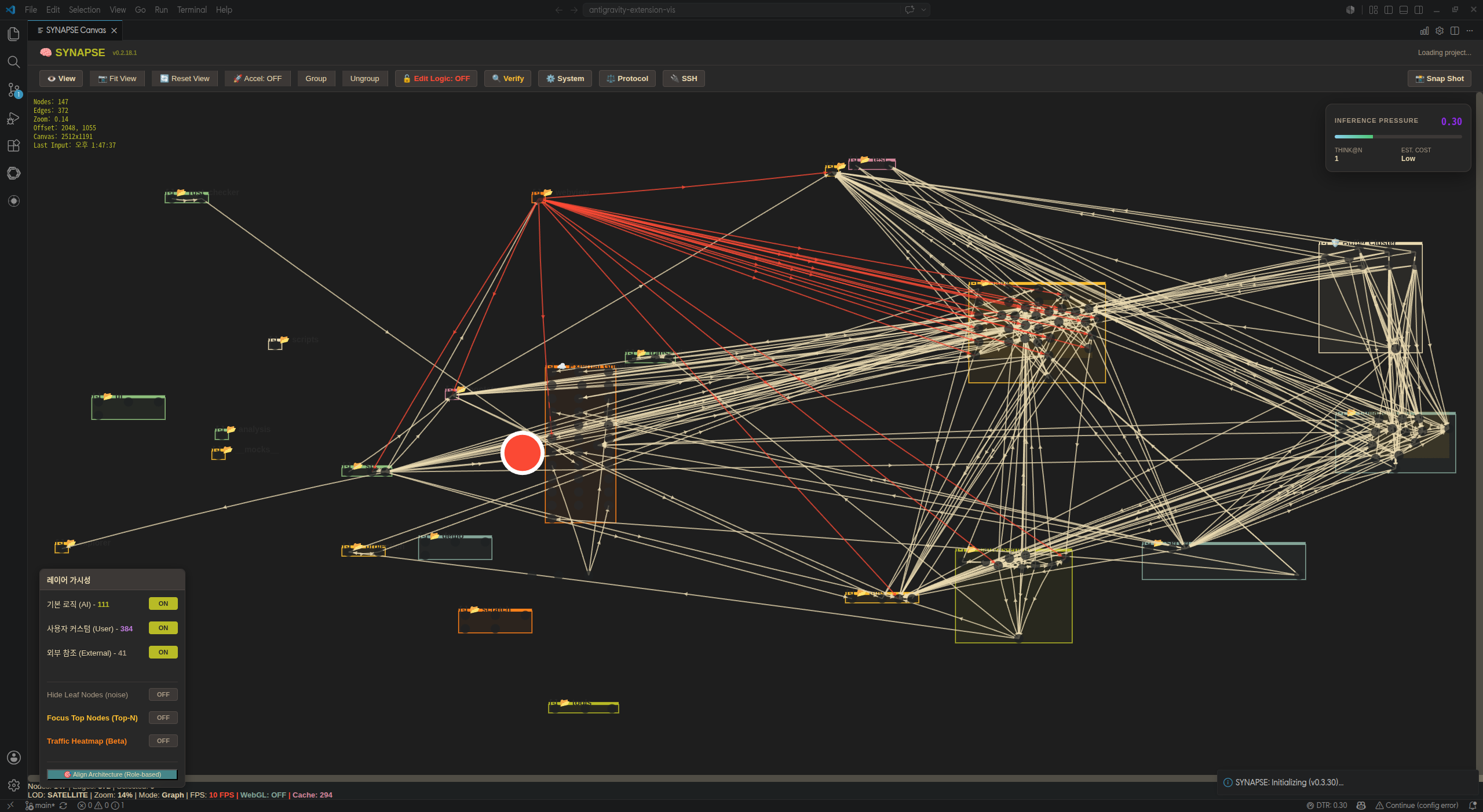
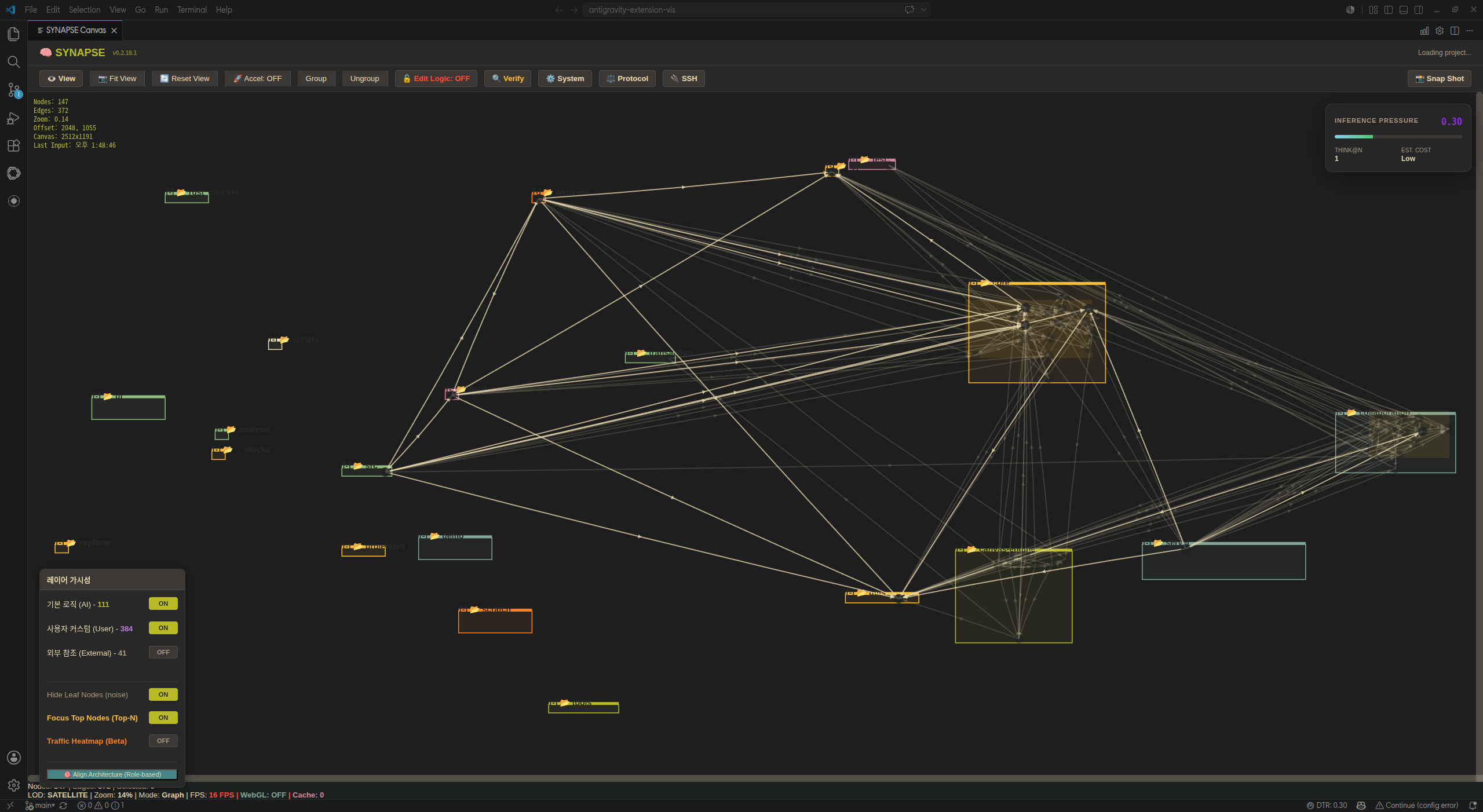
How SYNAPSE Understands System Architecture
| 1. Global Dependency Map | 2. Filter Noise |
|---|---|
 |
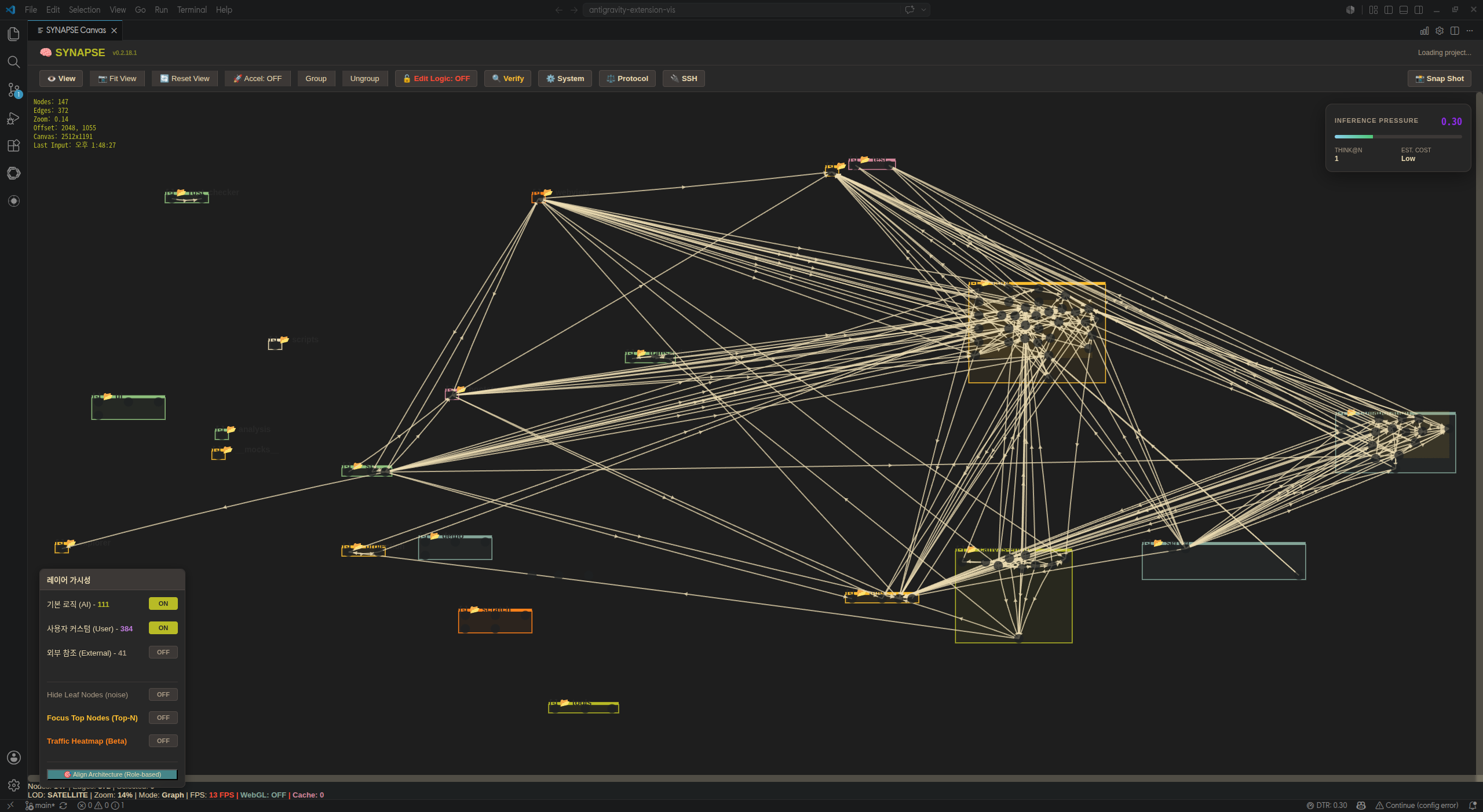 |
| "This is what real projects look like" | "Removes the noise" |
| 3. Focus on Core Nodes | 4. Traffic Heatmap |
 |
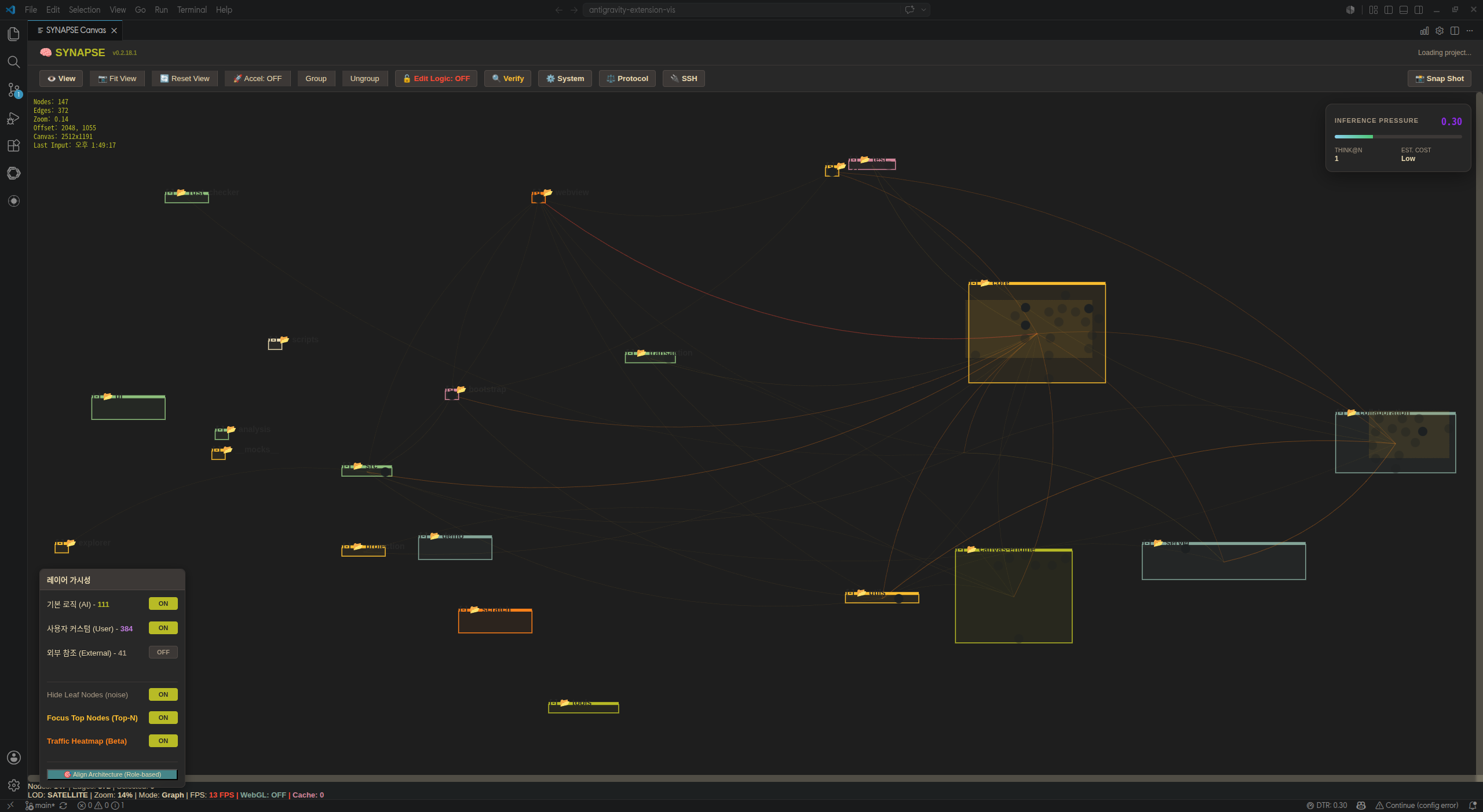 |
| "Tells you where to look" | "Shows you what matters most" |
Why SYNAPSE?
Modern software is no longer written by one person.
The problem is not writing code.
The problem is understanding how thousands of files, multiple developers, and distributed systems interact as a whole.
SYNAPSE turns source code into a visual architecture map.
It allows architects and senior engineers to:
- Identify architectural bottlenecks
- Trace dependency chains
- Visualize project-wide logic structures
- Collect remote team outputs through Harvest
- Review large codebases without manually traversing files
SYNAPSE focuses on visibility first.
Not synchronization. Not issue tracking. Not source control.
Visibility.
Who Is It For?
Architecture Review
- Tech Leads
- Staff Engineers
- CTOs
For those who need to grasp the structure of massive projects and trace dependencies.
Distributed Development Teams
- Remote work teams
- VM-based development environments
- Multi-OS environments
For teams that need to visualize outputs created by multiple people in one unified space.
Legacy & Brownfield Projects
- Old codebases
- Undocumented projects
- Systems with hard-to-understand structures
For those who want to see the architecture before reading the code.
📸 Demo
 Zoom, Layer Visibility, and Traffic Heatmap demonstration.
 Deep Zoom detail showing icons, badges, and tooltips.
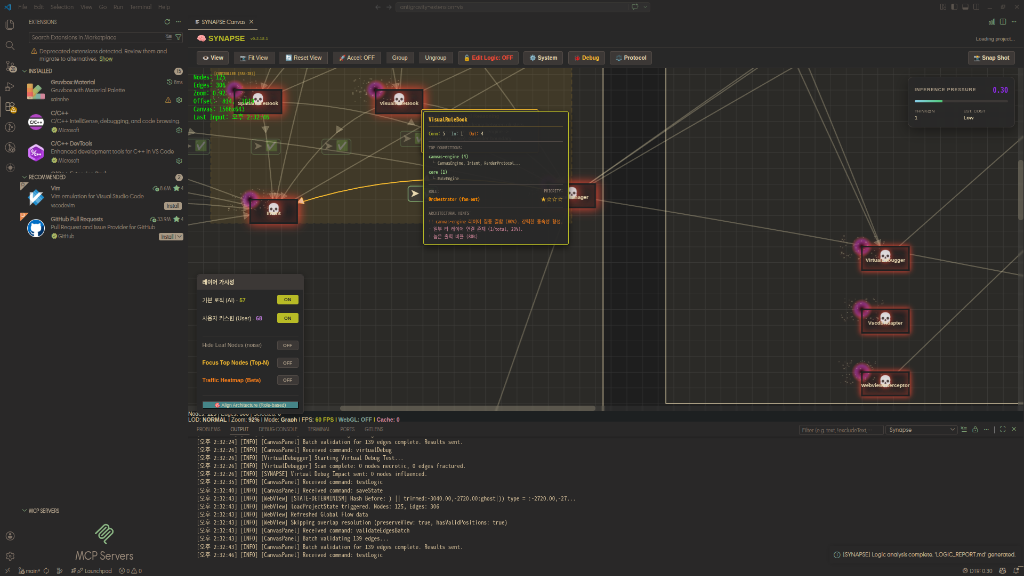 SYNAPSE uses a rich visual vocabulary to communicate the nature and health of your architecture.
1. 📄 Entity Types (Identity Icons)
Defines the physical nature or architectural role of the node.
| Icon | Type | Meaning | Visual Style |
|---|---|---|---|
| 📄 | Active Source | A physical source file (Logic, Config, etc.). | Solid border, base color |
| ⚡ | Atomic Logic | Core logic or Entry Point (contains Atomic signature). | Purple glow (DTR) |
| 📁 | Folder | A directory structure cluster. | Folder cluster container |
| ☁️ | External API | External library (os, fs) or API call dependency. | Cloud-like UI |
| 📚 | Doc Shelf | Milestone, release note, architecture document. | Hidden by default on canvas |
| 🧪 | Test Case | Unit tests and validation scripts (.test.ts). | Orange border |
| 🧩 | Component | Modular UI or logical component unit. | Blue-green border |
| ⚙️ | Processor | Data transformation or computational engine. | Purple-grey border |
| 🤝 | Service | Shared logic or infrastructure service layer. | Blue border |
| ⛩️ | Gate | Security, authentication, or traffic controller. | Thick yellow border |
| 📋 | Data Record | DB schema, JSON model, or pure data definition. | Thick border, dark background |
| 👻 | Ghost Source | Referenced internal source missing physical file. | Dashed border |
2. 🎨 Node Status & Glow
Defines the current reasoning state and visual prominence of the node.
| Status | Visual Hint | Color | Meaning |
|---|---|---|---|
| Active | solid border | #83a598 |
Verified and currently active in the codebase. |
| High DTR | purple glow | #8a2be2 |
High reasoning density; critical logic point. |
| Ghost | dashed border | #928374 |
Proposed architectural node (not yet materialized). |
| Deleted | grayed out | #282828 |
Safely commented out/decommissioned node. |
| Warning | red pulse | #fb4934 |
Logic error, circular dependency, or dead-end detected. |
| Necrosis | 💀 | #1d2021 |
Fatal logic failure; broken build or severe physical defect. |
| Tombstone | 🪦 | #1d2021 |
Irrecoverable deterministic failure; recommended for deletion. |
3. ➡️ Logic & Flow Markers
Markers that occur on nodes or edges depending on the Zoom level (LOD).
| Icon | Type | Meaning |
|---|---|---|
| ↻ | Loop | Iterative logic (for, while, map). |
| ◈ | Decision | Branching logic (if, switch, validation). |
| 🖨️ | Output | Terminal logging, printing, or side-effect output. |
| 📡 | Signal | Network request or remote procedure call (RPC). |
| 📊 | Payload | High-bandwidth data movement or stream. |
| 🕒 | Async | Asynchronous processing or wait states. |
4. ⚠️ Hazard & Purification Markers
Visual indicators of system purity and architectural health.
| Icon | Type | Meaning | Visual Style |
|---|---|---|---|
| 💀 | Necrosis | Architectural failure (circular dependency, etc.). | Dark background + noise |
| 🪦 | Tombstone | Persistent deterministic violation record. | Tombstone marker |
| 💣 | Mine | High-hazard point (breaking changes detected). | Red-out warning |
| ⚠️ | Logic Fault | Specific code-level error or sync failure. | Red pulse / Warning icon |
| 🔴 | Dirty Dot | Local changes that require synchronization/push. | Top-right red dot |
5. ✅ Interaction & Approval Badges
Intelligent badges representing synchronization and user command status.
| Badge | Status | Meaning |
|---|---|---|
| ✅ | Confirmed | Manually approved by the Commander. |
| 🤖 | AI Validated | Automatically verified against the codebase. |
| ❓ | Pending | Proposed design awaiting verification (Draft). |
| ❌ | Purge | Marked for physical removal or deletion. |
| 🔒 | Locked | Immutable state; protected from modification. |
🔗 Edge & Line Conventions
SYNAPSE uses distinct colors and styles to represent different types of logical connections and data flows between nodes.
| Edge Type | Color | Style & Thickness | Meaning |
|---|---|---|---|
| Dependency | #ebdbb2 |
solid 2px | Standard module dependency or import. |
| Data Flow | #83a598 |
solid 3px | Heavy data transfer or payload movement. |
| Event | #fe8019 |
solid 2px | Event triggers or asynchronous callbacks. |
| Conditional | #d3869b |
solid 1px | Conditional branches like if/else or match. |
| Origin | #d65d0e |
solid 1.5px | Prompt origin links for AI logic tracking. |
| API Call | #8ec07c |
dashed 2px | External API or cross-service network calls. |
| DB Query | #d3869b |
solid 3px | Database queries, mutations, or transactions. |
| Loop / Back | #fe8019 |
dotted 2px | Loop-backs (while/for) or reverse logic flow. |
| Highlighted | #fabd2f |
pulse 5px | Active execution path (Hovered/Selected). |
🚀 Quick Start
Launch your visual architecture journey in seconds.
1. Install Extension
Download the latest .vsix from Releases and run:
code --install-extension synapse-visual-architecture-v0.3.33.1_fix2.vsix
2. Launch Canvas
Click the 🧠 Canvas icon in the editor title bar or Sidebar.
3. Instant Analysis
Select "Lite Bootstrap" to automatically discover your project architecture.
✨ Key Features
- 🧠 Real-time Graph Visualization: Live network mapping of your project.
- 🚫 Hybrid Blacklist System: Intelligent exclusion of noise (node_modules, dist) with O(1) path matching.
- 🖱️ Explorer Context Integration: Right-click any file/folder to instantly add to blacklist and refresh the graph.
- 🔍 N-hop Focus View: Automated identification of critical core nodes.
- ⚠️ Diagnostic Intelligence: Real-time architectural analysis (R1-R5).
- 🧩 AI Scan Integration: Unified scanning engine for Python, Rust, C++, and TS.
- Semantic Zoom (LOD): Navigate thousands of nodes with performance optimization.
🔍 Semantic Analysis & Layer Visibility
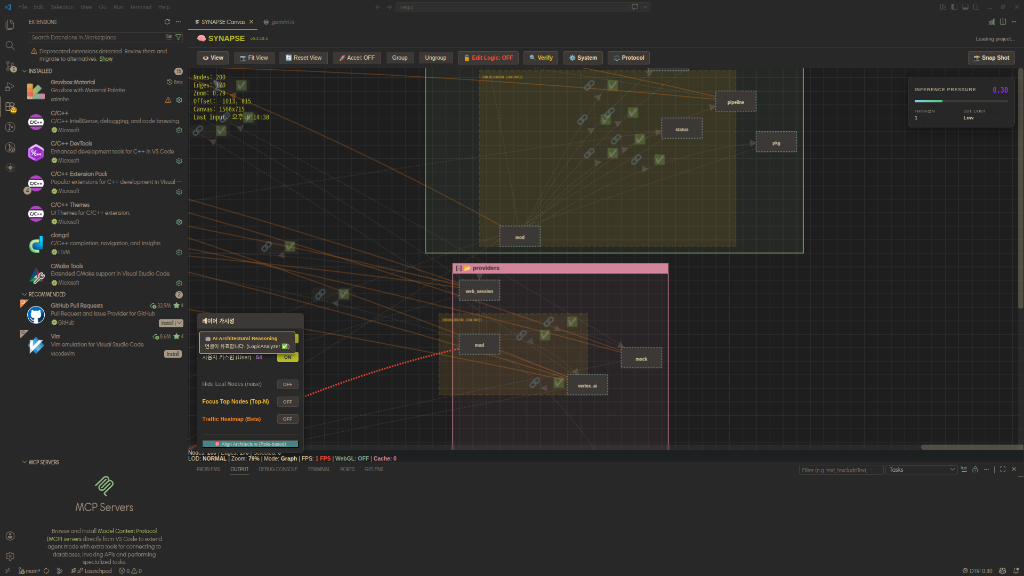
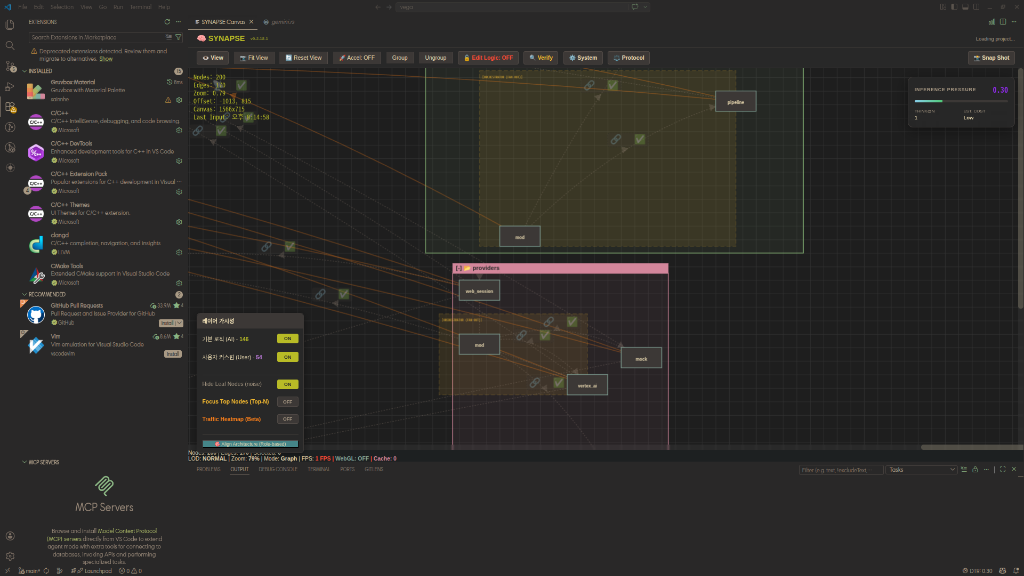
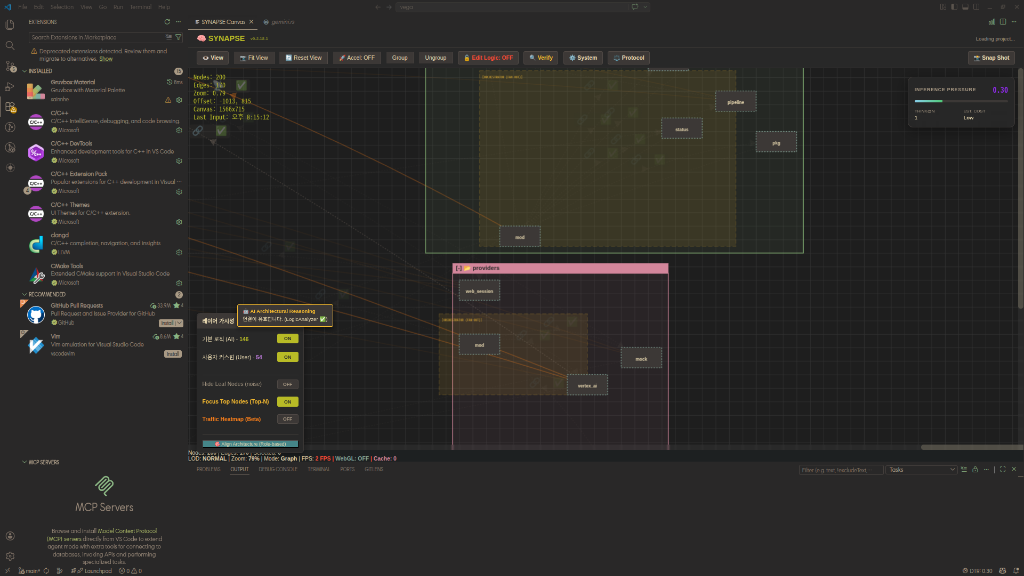
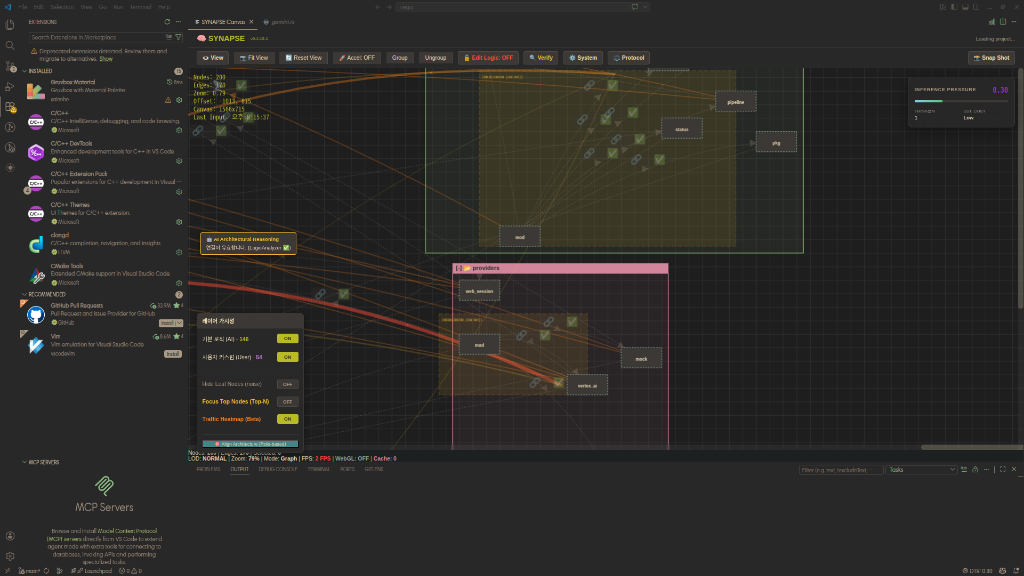
SYNAPSE provides powerful semantic filters to analyze massive graphs by controlling layer visibility and isolating critical logic paths.
| 1. Default View | 2. Hide Lead (Noise Reduction) |
|---|---|
 |
 |
| 3. Focus Top Nodes (N-hop) | 4. Traffic Heatmap (Beta) |
 |
 |
Example
Full Graph:
A ─ B ─ C ─ D ─ E
│   │
F   G ─ H ─ I
Focus View (N = 1, Center = C):
B ─ C ─ D
    │
    G
Focus View (N = 2, Center = C):
A ─ B ─ C ─ D ─ E
│       │
F       G ─ H
Why it matters
- Instant Scope Reduction: Narrow down debugging range in massive graphs.
- Path Tracing: Rapidly trace specific execution flows.
- Local Anomaly Detection: Identify structural defects within a localized area.
📂 Cluster Visibility
SYNAPSE provides a Cluster Visibility Panel to effectively manage massive architectures. It offers a file-explorer-like hierarchical view to grasp and control complex folder (cluster) structures at a glance.
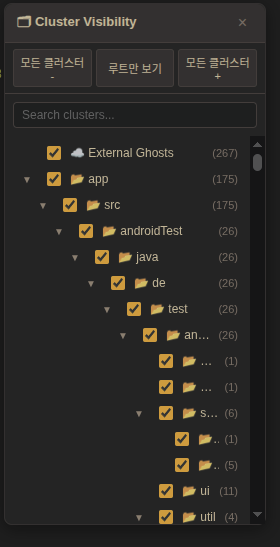
Quick Actions
- 모든 클러스터 - (Collapse All): Collapses all clusters in the tree, showing only the highest-level groupings.
- 루트만 보기 (Roots Only): Expands only the root clusters while keeping deeper levels collapsed.
- 모든 클러스터 + (Expand All): Expands all clusters in the tree to show their full contents.
1. Intuitive Hierarchy & Recursive Counting
The visibility panel reflects your project's actual folder structure. The number next to a folder indicates the accumulated total of all nodes (files) contained within it and all its subfolders. You can instantly know how many components are inside a module just by looking at the top-level folder.
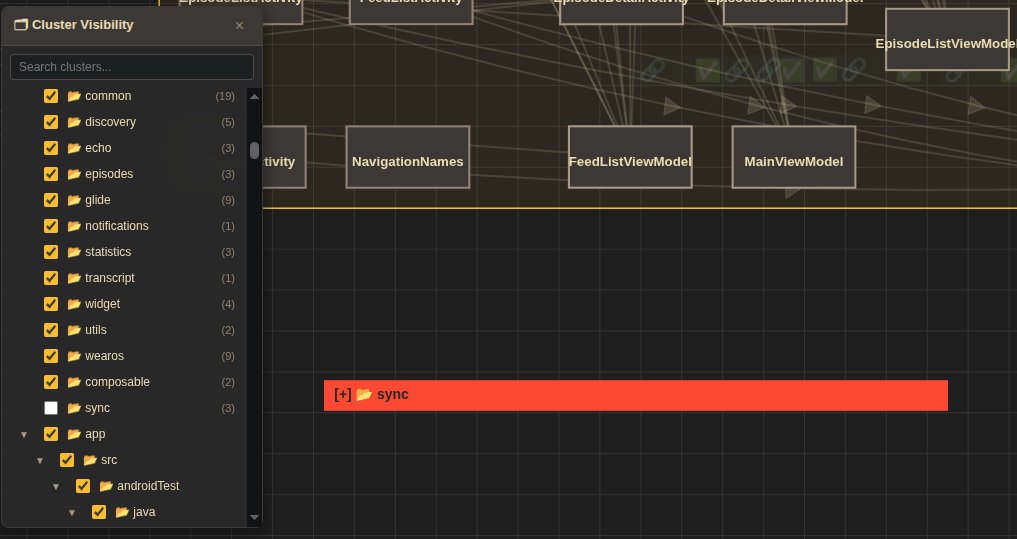
2. Cascade Visibility Toggling
You can toggle the visibility of specific folders using the checkboxes. When you toggle a parent folder, the visibility state automatically cascades to all its descendant folders. This allows you to hide or reveal massive modules containing hundreds of nodes with a single click.
3. Real-time REVEAL Navigation
Clicking the → (REVEAL) button next to a folder smoothly navigates the canvas camera directly to where its nodes are clustered. Even if you have manually dragged nodes around, it tracks the real-time physics coordinates and centers them perfectly on your screen.
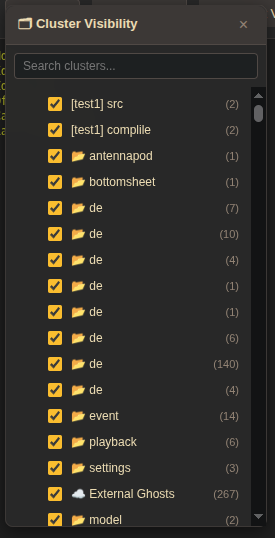
4. Network Attached Client Identification
Clusters created by clients connected to the network are clearly distinguished in the visibility panel. The system automatically prepends the client's account name (e.g., [username]) to their cluster names, keeping remote namespaces perfectly isolated and easily identifiable.
🌾 Harvest
Harvest is a snapshot-based collection system where the Architect (Server) safely collects the work results of collaboration participants.

Harvest does not aim for general bi-directional synchronization. The traditional Client ↔ Server ↔ Client architecture can cause ownership conflicts and state inconsistencies, leading to undefined behaviors.
To prevent this, Harvest adopts an Architect-centric uni-directional collection model.
Client → Snapshot → Server → Archive
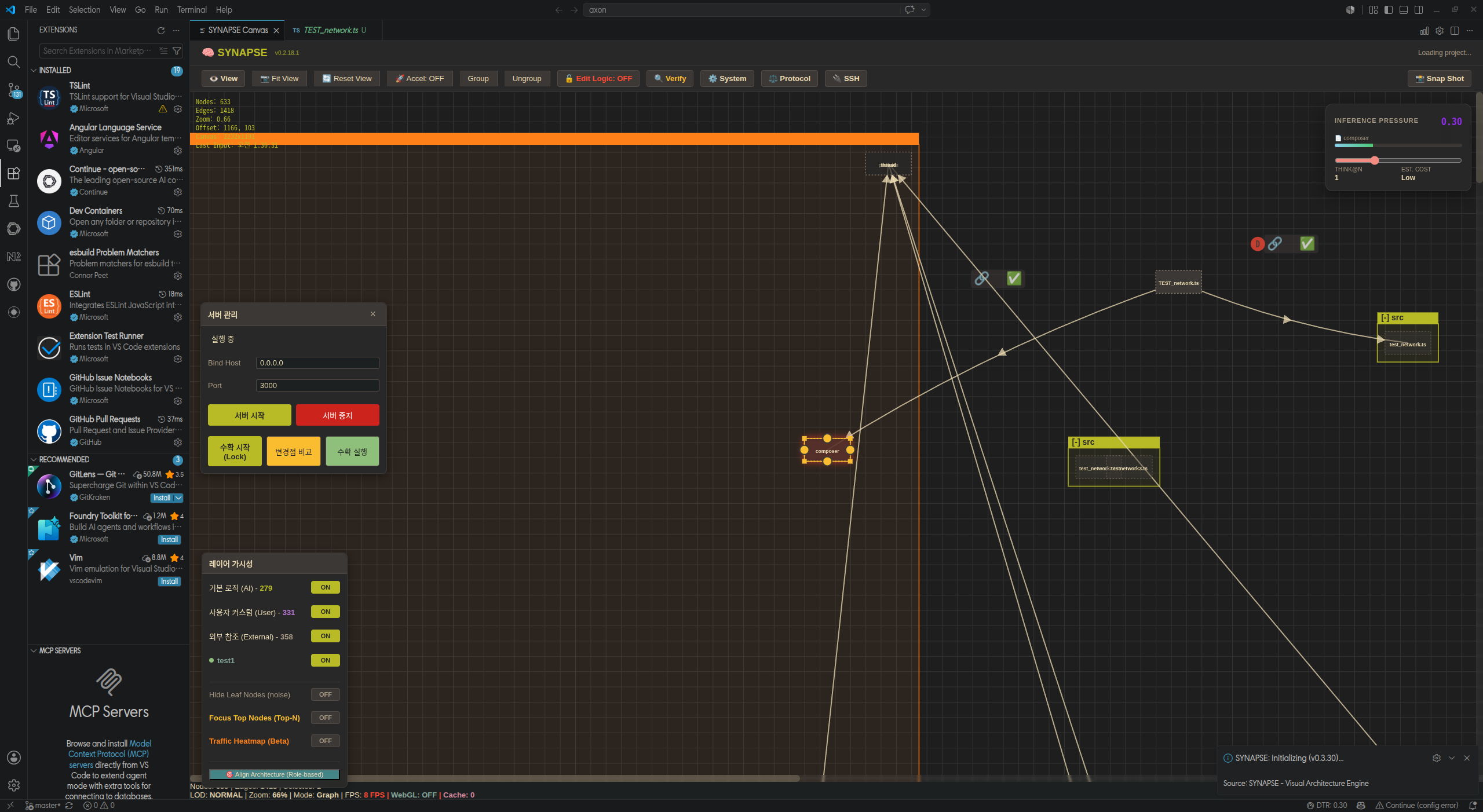 Files from clients connected to the network are displayed directly on the Synapse screen, enabling logic verification.
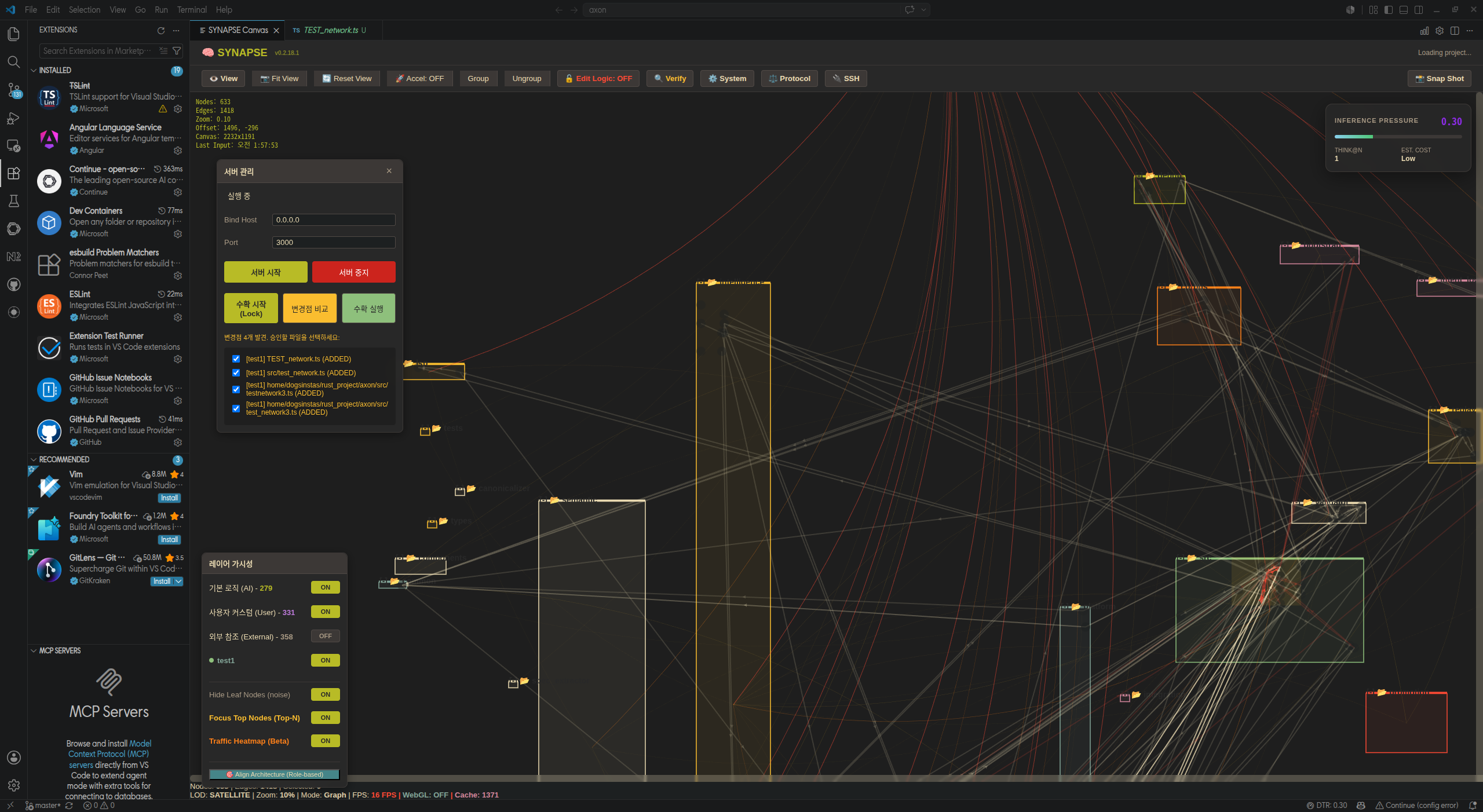 Among the files from connected clients, only verified files can be "harvested" and saved to the server.
The goal of Harvest is not code integration, but safe collection and preservation.
How It Works
Visibility-Based Harvest
Harvest does not collect the entire project indiscriminately.
The Architect selectively collects only from client layers with active visibility on the canvas, and can manually select files to copy via the UI.
This minimizes unnecessary data influx and repository pollution.
Client Isolation
Collected files are not merged into a single shared folder.
Each client is assigned an independent User Root, and their harvest results are kept in isolated user-specific Harvest spaces.
.synapse/
└─ clients/
   ├─ userA/
   │  └─ harvest/
   └─ userB/
      └─ harvest/
This structure guarantees:
- Traceable ownership
- Safe diffing
- Independent deletion
- Prevention of overwrite collisions
Harvest Lock
While Harvest is in progress, a LOCK state is applied to the target clients.
A warning overlay appears on the clients' screens indicating that Harvest is underway, minimizing potential state changes during the collection.
Harvest Lock is a safeguard to support data integrity, aiming to maintain a deterministic state during the collection process.
Directory Layout
.synapse/
└─ clients/
   ├─ {username}/
   │  ├─ harvest/
   │  ├─ metadata.json
   │  ├─ snapshots/
   │  └─ cache/
   └─ ...
harvest/
Stores the actually collected source code while maintaining its original structure.
metadata.json
Stores session information, client identifiers, and collaboration metadata.
snapshots/
A history and backup layer intended for future versions.
cache/
Buffer space for remote file viewing and temporary data processing.
Safety Guarantees
File Collision Protection
Even if files share the same name, they will not conflict or overwrite each other because each user's storage space is isolated.
Path Traversal Protection
Attempts to escape paths, such as parent directory access (../), are blocked on the server side.
Type-Safe Result Processing
Harvest result data is processed through explicit type structures, preventing data loss caused by runtime key mismatches.
Harvest Is Not Sync
Harvest is a feature for collecting and preserving data.
It does not perform auto-merging, auto-overwriting, or conflict resolution.
Code integration is executed manually through the Architect's review and judgment; automated synchronization is beyond the scope of Harvest.
🔍 Verify (Architecture Logic Report)
Verify is the Architect's real-time diagnostic system for inspecting the health of the architecture graph — including all currently connected remote clients.
⚠️ Scope: Verify analyzes not only the Architect's local project graph, but also the architecture graphs pushed by connected collaboration clients. Any client whose layer is visible on the canvas is included in the diagnostic scope.
Verify Menu Items
Evidence-Backed Report Generation
SYNAPSE reports are built from structural observations and traceable evidence, not from unsupported architectural assumptions.
The report pipeline follows an explicit evidence contract:
Question → Required Vocabulary → Allowed Evidence → Supporting Pattern → Supporting Metric → Claim
Each stage has a defined responsibility:
- Question: Defines the architectural question being investigated.
- Required Vocabulary: Defines the concepts needed to express the observation.
- Allowed Evidence: Restricts the evidence that may support the result.
- Supporting Pattern: Defines the structural pattern being evaluated.
- Supporting Metric: Provides measurable support for the pattern result.
- Claim: Presents only the conclusion supported by the available evidence.
A detected structure is not automatically an architectural defect. High connectivity, centrality, or dependency concentration alone does not establish that a component is incorrectly designed.
SYNAPSE distinguishes observed structure from interpretation. When evidence is insufficient, the report should preserve that limitation rather than infer intent or prescribe a corrective action.
Report Responsibilities
- Virtual Debug: Trace structural observations, validation results, and their supporting evidence.
- Architect: Help experienced engineers understand system structure, important nodes, boundaries, and dependency relationships.
- Onboarding: Help new contributors navigate entry points and major structural areas, subject to the evidence available.
Reports present validated results from the analysis pipeline. Detailed evidence should remain available for inspection so that readers can trace a reported conclusion back to its supporting observations and metrics.
📝 Report Samples (v0.3.34.73)
| Project | Architect Report | Onboarding Report | Simulation Debug | Evidence Viewer |
|---|---|---|---|---|
| Godot | Link | Link | Link | Link |
| AntennaPod | Link | Link | Link | Link |
| VSCode | Link | Link | Link | Link |
🧹 Clear Debug
Removes all debug visual states from the canvas and resets nodes to their default rendering state. Does not affect actual graph data.
💎 Det Bootstrap (v0.2.28: Determinism Bootstrap)
Runs the Determinism Bootstrap sequence. Resets internal state checksums and re-establishes a deterministic baseline for the current architecture snapshot. Used to eliminate accumulated non-determinism from repeated edits.
🔄 Deep Re-Scan
Performs a complete re-scan of the entire project directory from scratch. All previously cached graph data is discarded, and the full file-to-node pipeline is re-executed. Use when the graph has drifted from the actual file system state.
Inference Pressure
The Verify system calculates Inference Pressure as a baseline structural metric:
Pressure = criticalIssues / totalAnalyzedNodes × 100
ℹ️ Verification Scope: Currently validated on specific open-source architectures (VSCode, Godot, AntennaPod, Linux Kernel) up to 70k nodes. Inference Pressure serves as a relative calculation index within this validated scope, not a universal or scale-invariant health guarantee for all ecosystems.
🏗️ Architecture
SYNAPSE consists of the following layers:
- Scanner: Deep semantic multi-lang analyzer.
- Graph Engine: Deterministic, immutable state machine.
- Visualization Layer: Hybrid 2D Canvas & 3D WebGL accelerated rendering.
- AI Merge Logic: Intelligent resolution of ghost references and active files.
⚠️ Troubleshooting: Canvas Blank / Nodes Disappearing on
Accel ON
If nodes and edges disappear when WebGL Acceleration is enabled, your environment may be restricting GPU context creation.
Fix: Open your IDE'sargv.json(e.g.,~/.antigravity-ide/argv.jsonor VSCode equivalent), set"disable-hardware-acceleration": false,and restart the IDE.
🧠 Philosophy
"What you see is the logic of LLM"
SYNAPSE was created to overcome the limitations of code-centric development. It bridges the gap between Large Language Model (LLM) reasoning and physical code architecture, transforming abstract logic into an interactive, high-performance node-edge network.
📜 Revision History
| Version | Release Date | Description |
|---|---|---|
| v0.3.34.74 | 2026-11-11 | Build Asset Isolation, Rust Crate Resolution & Report Quality Refinements: Enforced strict build & packaging asset isolation ($V_{\text{build}} \cap V_{\text{app}} = \varnothing$) in NodeBuilder, eliminating build-script leakage into runtime graphs. Added native Rust workspace/local crate reference resolution in ReferenceResolver, reducing false ghosts across multi-crate Rust projects. Refined architecture reports (O2/A1/E2): eliminated redundant O2 file extensions in section titles, applied dynamic P90 ceiling cutoff (ceil(0.1 * N)) to A1 & E2 rankings, removed non-deterministic rank-slice descriptions in favor of factual criteria, and enforced 3-decimal float precision in Markdown tables. Resolved virtual-node identity mismatch (Node.id === Node.filePath).Known Report Limitations: (1) Root-level test directories without leading slashes (e.g., tests/...) bypass the test component filter in NodeBuilder; (2) Third-party and vendored code lacking an explicit scope boundary declaration still surface in top-level candidates; (3) In C/C++ projects, O2 entry-point detection can invert ranking because actual root files (main.cpp) receive internal call edges (inDegree > 0), whereas leaf implementation files retain inDegree = 0. |
| v0.3.34.73.fix1 | 2026-10-10 | Infinite Bootstrap Fix & UX Expansion: Resolved EROFS infinite loop during mock node creation. Added .inc, .inl, .hh scanner support properly restoring 593 ghosts. Increased cluster dragging hit-box padding proportional to camera zoom. |
| v0.3.34.73 | 2026-10-09 | Resolver Trace Instrumentation: Implemented P1 trace generation feature that records the entire internal reference resolution process by success/failure facts (targetPathExists, targetNodeExists, resolverMatched, edgeCreated). |
| v0.3.34.72 | 2026-10-09 | Interpretability & Onboarding Quality Upgrade: Executed product pivot including the removal of Executive reports and the completion of core values (O2, A2) to achieve the goal of 'Evidence-backed structural exploration'. |
| v0.3.34.41 | 2026-09-07 | Validation Engine Completion & Provenance Tracking: Upgraded from static analysis to a Level 3.5 Validation Engine that simulates structural collapse. Completely separated Claim and Study ownership by introducing supportingStudyIds to ValidationClaim. Rebuilt the Executive Report to only render mathematically proven SUPPORTED claims rather than guessing based on rules. Established the "Validation Engine proves, Report Builder renders" architecture philosophy. Deferred the Level 4 Decision Engine (P4) to address critical cross-project replication flaws (VSCode over-fitting) and prioritize testing against NestJS, AntennaPod, and Linux Kernel architectures. |
| v0.3.34.40 | 2026-08-30 | Separation of Complexity & Control Rankings: Split the architecture analysis into Report A (Complexity) and Report B (Control). Advanced the InsightEngine to calculate dependency centralization (Fan-In / inboundEdges) to uncover system dominators (arch/arm, drivers/acpi, block) vs mere complex hubs (i915). Solidified boundary promotion thresholds by auditing candidate rejections. |
| v0.3.34.31 | 2026-08-24 | Semantic Hub Recognition & Wrapper Resurrection Fix: Advanced the Semantic Engine to properly distinguish between high fan-out structural defects and intended architectural hubs. Massive core modules (e.g., src/vs in VSCode, core/scene/servers/rendering in Godot) are now correctly classified as [INFO] INTENDED_HUB instead of [CRITICAL] STRUCTURAL_DEFECT. Fixed the "Wrapper Resurrection" bug where RootCauseAggregator artificially recreated wrapper hubs (like extensions/copilot) that were intentionally split by BoundaryGraphBuilder. Added splitWrappers tracking, EvidenceType.WRAPPER_NODE emission, and dynamic depth drill-down (up to depth 5) to ensure aggregator groupings respect semantic boundaries. Validated successfully against VSCode and Godot architectures. |
| v0.3.34.24 | 2026-08-20 | Architecture State Model — Graph → State Graph: Redefined UNKNOWN from a classification failure to a State Machine Completeness problem (UNKNOWN = Transition Missing). Introduced a complete FSM-based state model: LifecycleState (DISCOVERED→CLASSIFIED, one-way), HealthState (UNCLUSTERED / UNCLASSIFIED / CORRUPTED), ViewState (VISIBLE / OUT_OF_SCOPE, view-scope only, not node state), ReferenceState (RESOLVED / GHOST, edge-scoped), FSMCompleteness (KNOWN / INCOMPLETE / INVALID, separated from NodeState as a validation result). NodeState aggregates three axes as a single object. Implemented AnomalyCollector — a pure state classifier with no architecture pattern inference. Injected into ValidationEngine.analyzeState() (try/catch, non-breaking). Added Section 8 Architecture State Report to every ASR output with FSM Completeness table and Health/View/Reference anomaly breakdown. UNCLASSIFIED designated as Soft Anomaly (role ontology gap, not FSM violation). Verified on AntennaPod (839 nodes), VSCode Main (12,373 nodes), Linux Kernel 7.2-rc3 (70,089 nodes): FSM ✅ PASS, AGGREGATE_unknown = 0 on all three. First milestone on the roadmap: Static Graph → State Graph → Transition Record → Simulation Engine. |
| v0.3.34.23 | 2026-08-19 | Architecture IR Builder — Q4 Extension Point Engine: Established a multi-stage Candidate → Evidence → Promotion pipeline to discover structural extension axes from IMPLEMENTS/EXTENDS edges. Rewrote JavaScanner and KotlinScanner regex to handle multi-line mixed inheritance declarations, recovering EXTENDS: 174 and IMPLEMENTS: 98 edges on AntennaPod. Fixed a critical Webpack class-mangling bug in ScannerRegistry (switched dedup from name-string to constructor-reference equality), preventing all scanners after the first from being silently rejected. Added FileScanner auto-registration to permanently block legacy parseJava() fallback. Fixed answer.findings → answer.items field mismatch that caused Q4 to always output empty results. Added isFrameworkType() to filter Android/Java SDK noise from extension point candidates. Validated full pipeline on AntennaPod: PodcastSearcher, Playable, SwipeAction confirmed as extension points. Traced AGGREGATE_unknown root cause: nodeFound: false = View Scope mismatch, not a classification bug — introduces AGGREGATE_out_of_scope distinction, laying groundwork for v0.3.34.24 Node Lifecycle FSM. |
| v0.3.34.19b | 2026-08-13 | Subgraph Isolation Fix: Fixed evidence/impact pipeline contamination when analyzing a selected cluster. AGGREGATE_* nodes (VirtualDebugger's collapsed-external-cluster placeholders) were passing through intentEdges into impactMap, consumers, ghostEvidence, and boundaryEvidence, causing external paths (extensions/*, cli/*) to pollute workbench-scoped reports. Added a single startsWith('AGGREGATE_') guard at 4 sites in ValidationEngine.ts. After fix: coupling breakdown shows vs (43.9%) > extensions (42%) instead of mirroring global stats — confirming true subgraph isolation. |
| v0.3.34.19a | 2026-08-12 | Cost Projection Root Cause Fix & Collapse State Model: Fixed the root cause of Files Affected = 100 — ValidationEngine never populated the consumers field on candidate objects, causing the reporter to always fall back to the Top N cutoff (100). Added ?? 0 null guards to prevent raw undefined output. Replaced the broken _preCollapseState hotfix with a clean collapsed / forcedCollapsed two-field model so ancestor collapse no longer overwrites user-intent fold state, and parent expand no longer force-opens grandchild clusters. |
| v0.3.34.19 | 2026-08-12 | Auditor Verification Layer & Report Reliability: Physically verified TEST_ARTIFACT penalty pipeline via RAW Top 20 dump log — vscode-test-resolver dropped from #14 raw to outside Top 10. Fixed Top50==Top100 aggregation bug by dynamically scaling bfsLimit to 200. Added UI_COMPONENT and DOMAIN_SERVICE classification rules, eliminating mass UNKNOWN labels. Fixed Cost Projection always returning 0/0/0/0 for healthy codebases by falling back to topImpactFiles. Fixed Auditor execution order so TEST_ARTIFACT penalty runs before sort. |
| v0.3.34.17 | 2026-08-09 | ASR 3.0 (Architecture Scan Report) Stabilization & Data Reliability: Transitioned from subjective "Diagnosis Reasoner" to fact-based MRI scans (Scan > Diagnosis). Overhauled layout into a 6-stage logical flow. Fixed critical Impact Files slicing flaw to correctly aggregate all external edges. Restored isGhost metadata reliability. Replaced absolute file path dependencies for Webview URIs. |
| v0.3.33.1_fix2 | 2026-07-20 | Layout Engine Sovereignity & Extreme Scale Profiling: Completely decoupled the Layout Engine from the Visibility State by removing cluster.collapsed constraints from the physics packer, preventing massive bounding box overlaps. Eliminated O(N*C) bottlenecks in drawClusters and aggregateEdges, reducing rendering preparation time from 1,830ms to 5ms (366x faster). Successfully tested against extreme mono-repo scales including VSCODE-main and Linux Kernel 72 rc3. |
| v0.3.33.1_fix | 2026-07-16 | Render Virtualization & Pipeline Repair: Removed the hardcoded edge limit (50k) that silently aborted the rendering pipeline for massive mono-repos like VSCode-main. Restored the 'LINES (No Badges)' edge visibility mode. Integrated precise telemetry probes into the WebGL/Canvas2D pipeline to trace culling and LOD bottlenecks. Resolved Cluster Bloating issues by excising padding from empty directories and properly propagating collapsed state bounds logic to the BottomUp packer. |
| v0.3.33.1 | 2026-07-15 | Aesthetics & LOD Optimization: Fixed "Roots Only" cluster visibility bug to properly identify depth-1 Continents as roots, allowing them to be expanded correctly so their contents are visible rather than collapsing into missing blocks. Implemented 3-level Edge LOD (FULL/CLUSTER/NONE) to eliminate premature edge-culling on massive mono-repos. Refactored trackpad zoom logic with non-linear DeltaY sensitivity to fix hypersensitive "microscope" scrolling. |
| v0.3.33 | 2026-07-14 | Cluster Hierarchy & Dragging Overhaul: Completely refactored cluster interactions and visibility control. Replaced isolated node-dragging with a unified cluster-dragging model that recursively moves all child clusters and their nodes. Upgraded Cluster Visibility panel with 3 new quick-action buttons (Collapse All, Roots Only, Expand All) for rapid LOD management. Implemented depth-based priority for hit detection (getClusterHeaderAt) to ensure reliable parent cluster selection, even in deeply nested paths. |
| v0.3.32.4 | 2026-07-05 | UX & Visibility Improvements: Added recursive node counting and cascade toggling to the Cluster Visibility panel. Fixed real-time coordinate tracking for the REVEAL feature, completely isolated remote client namespaces with 👤 [username] labels, and patched a major memory leak during State Reset. |
| v0.3.32.1 | 2026-06-27 | Cross-Network Trace & Semantic Flowchart: Improved flowchart rendering quality (single-pass Barycenter ordering, red dotted back-edges). Implemented [SYNAPSE_NETWORK_LINK] macro for cross-project dependency parsing bypassing language syntax limits. Fixed IFF logic for remote client nodes and proved distributed DAG merging via Harvest. |
| v0.3.32.2 | 2026-06-29 | File Deletion Sync & Architecture Physics Fixes: Fixed manual node deletion sync bug, safely handling absolute vs relative paths. Expanded EXTERNAL_PACKAGES to recognize 100+ standard frameworks across 7 languages, eliminating false ghost nodes. Enhanced regex to properly resolve [SYNAPSE_NETWORK_LINK] cross-workspace dependencies and cluster remote ghosts into cluster_ghost_network_remote. Fixed root-level files infinite layout collapse by injecting a dynamic 📁 Root cluster to force global physics packing. Resolved false-positive JSON serialization errors for workspace states. |
| v0.3.32.1 | 2026-06-27 | Cross-Project Trace & Semantic Flow Layout: Upgraded Flow View to Semantic Flow Layout with single-pass Barycenter Ordering, drastically reducing edge crossings. Visualized back-edges in red dashed lines. Introduced [SYNAPSE_NETWORK_LINK] for universal language-agnostic cross-network dependency parsing. Fixed client node mirroring (IFF logic) to distinguish local vs remote client nodes. Proved distributed architecture collaboration via Harvest DAG merge within Flow View. |
| v0.3.32 | 2026-06-26 | Collaboration Flow Visibility: Fixed ghost filter collision that made 100% of client-contributed nodes invisible in Flow View. Client nodes now bypass !isGhost filter, controlled by _isClientLayerVisible() toggle. Fixed reasons ReferenceError that silently crashed buildFlow() when client nodes were present. Unified client node detection filters across debug/survival/flow logic. Contribution Entity Graph Phase 0 validated: (filePath, userId) confirmed as canonical identity. |
| v0.3.31 | 2026-06-25 | Diagnostics Stabilization & Observability: Fixed false-positive Necrosis from doc/file/folder nodes. Normalized Pressure calculation to criticalIssues / totalNodes. Excluded Ghost Cluster (cluster_ghosts, doc_shelf) from dependency hints. Added clientTimestamp-based Stale opacity visualization (Active/Stale/Offline). Tooltip now shows "[username] Updated Xm ago". Soft Disconnect with 15-minute cache retention for post-crash debugging. |
| v0.3.30.2 | 2026-06-25 | Security Hardening & Harvest Stabilization: Verified 6 critical attack vectors (Path Traversal, Auth Bypass, SSE Contamination, Lock Bypass, Sandbox Escape, Client Spoofing). Fixed port binding conflict & 403 Auth error on Admin UI. Implemented backward compatibility for legacy array-formatted accounts.json and synapse_history.json to prevent unshift crash during Harvest. |
| v0.3.30 | 2026-06-22 | Harvest-Based Collaboration Model: Major architecture upgrade introducing session management, secure SSH transport, and remote projection layers. Full integration of Harvest Engine and Identity permissions. |
| v0.3.29 | 2026-06-06 | Cluster Overlap Resolution & External Layer Fix: Implemented Initial Spread (circular layout via FNV-1a hash) + Cluster Push-Apart engine (Mass-weighted AABB push-apart) to resolve cluster/node overlapping. Fixed External Ghosts cluster box not showing when External layer is ON. Reduced Align Architecture cluster expansion by 50% (roleOffsets halved). |
| v0.3.27 | 2026-05-28 | Data Sync Resilience & Layer Sovereignty: Resolved critical data synchronization bugs causing phantom edge disappearances (Edges: 0). Ensured UI layer separation logic properly isolates scanned folders and custom groupings without structural damage. |
| v0.3.26 | 2026-05-26 | 2D Edge Validation Patch: Fixed a bug where solid edges would silently fail to render in 2D mode due to invalid dash array fallback [0, 0] not supported by HTML5 Canvas API context. |
| v0.3.25 | 2026-05-25 | Cluster-Aware Local Alignment: Refactored the layout alignment physics so that nodes align cleanly relative to their specific cluster's gravity center, preventing global coordinate collapses when arranging architecture. |
| v0.3.24 | 2026-05-24 | RULES.md Embedding & Bootstrap Hardening: Embedded standard DTR (Dynamic Thought Routing) & Forced File Projection Rules deeply into the Bootstrap Engine, establishing security and design constraints by default upon initialization. |
| v0.3.23 | 2026-05-02 | Hybrid Blacklist & Intelligent Onboarding: Implemented O(1) path-matching blacklist system. Added Explorer context menu for instant exclusion. Fixed webview layout collapse issues. |
| v0.3.22.11 | 2026-04-22 | Interaction Stability & Coordinate Sovereignty: Resolved node dragging jitter via Timestamp Guards and Position Persistence. Unified absolute coordinate system across SSoT layers. |
| v0.3.22.10 | 2026-04-20 | Rendering Parity & Identity Binding (SSoT): Full 2D/3D visual synchronization, and SSoT-based tooltip identity binding for 100% data consistency. |
| v0.3.21 | 2026-04-18 | Visual Consistency & Edge Bundling: Full convention synchronization, Bezier flow consolidation, and Amnesia Guard for snapshot integrity. |
| v0.3.20 | 2026-04-17 | Rust Persistence & Engine Hardening: Path-based IDs for Rust support, Velocity clamping for physics stability. |
| v0.3.18 | 2026-04-17 | Diagnostic Hint Engine: Real-time architectural analysis (R1-R5), Zero-Unknown semantic labeling. |
📜 License & Author
Licensed under the GNU General Public License v3.0.
Created with 🧠 by dogsinatas29