
didilili/ai-agents-from-zero
didilili/ai-agents-from-zero has 5,866 GitHub stars and 811 forks. GitHot measured +10 stars in 24 hours. Last checked 2026-11-07 13:18 UTC. Last push 2026-10-14.
🚀 2026 最系统的 AI Agent 速成指南|智能体实战教程 · 完整学习路径 + 实战项目 + 面试题库 · 对标大模型应用开发工程师岗位 · 覆盖LangChain / LangGraph / Coze / Dify / MCP / skills / LLM / RAG / 提示词 · 企业级部署与微调 · 从0到企业级落地 + 从学习到上线项目 + 面试准备一体化
Measured star growth
- in 24h
- +10
- in 7 days
- Collecting history
- in 15 days
- Collecting history
- in 1 month
- Collecting history
Net star changes over overlapping periods, not daily totals. Missing measurements are left blank. Stars measure attention, not software quality.
translations/en/README.md
Original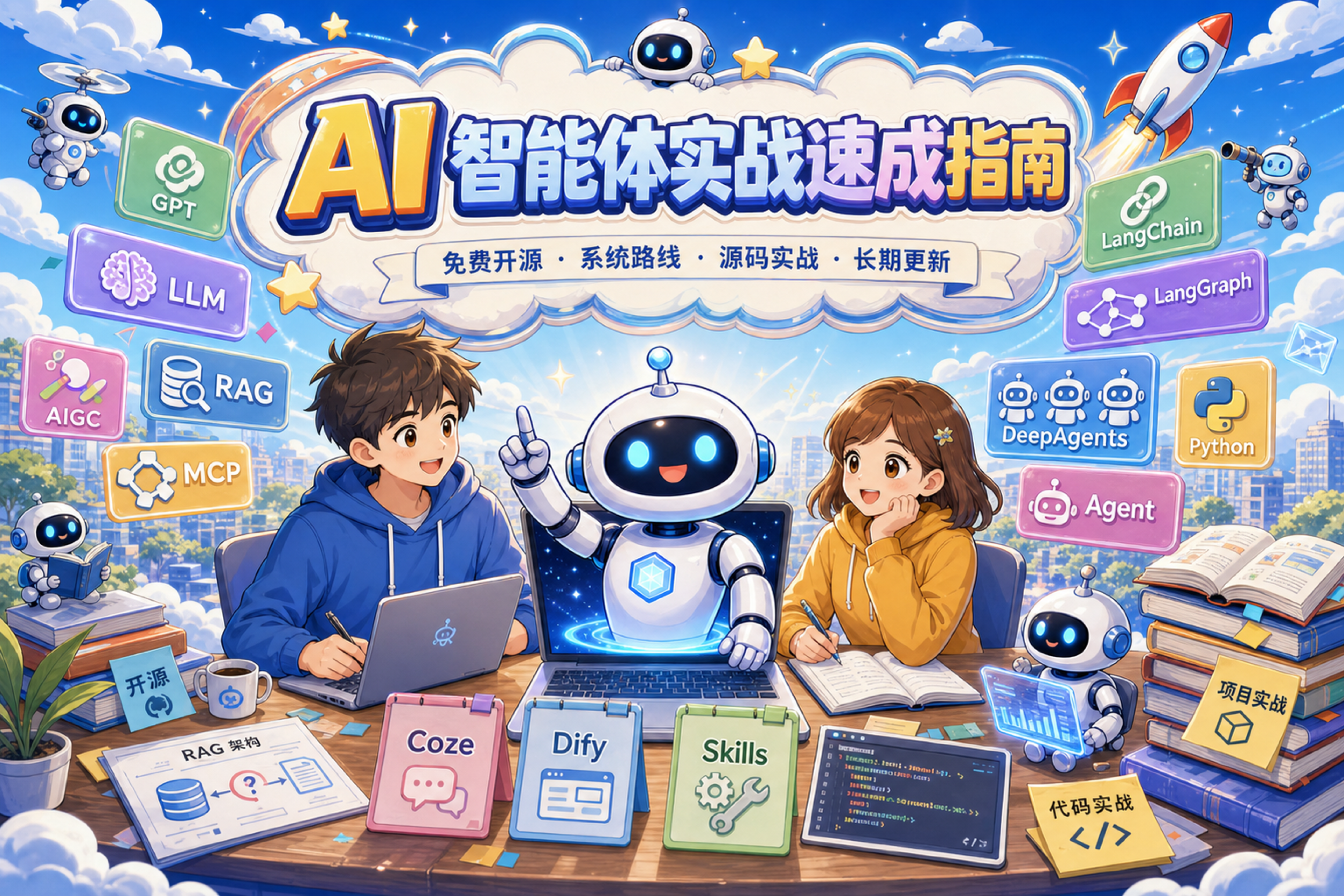
🚀 The Most Systematic AI Agent Hands-on Crash Guide on the Web (From Zero to Enterprise Deployment)
ai-agents-from-zero
Continuously updated through 2026 · Aiming to build the "strongest on Earth" AI Agent tutorial —— systematic tutorials + runnable source code + interview question bank + enterprise-level hands-on projects + long-term tech stack updates, fully aligned with the training curriculum and job descriptions for "AI Agent / LLM Application Development Engineer" as a one-stop learning path
简体中文 · English





Quick Start • Tutorial Outline • Changelog • Online Question Bank • Join the Community
📢 Update Notes: AI never stops, and neither do the updates. This repository will continue to evolve alongside the AI LLM tech stack, staying committed to being open source, systematic, and continuously updated. Models, frameworks, agents, and hands-on projects will all be continuously refined and upgraded as the ecosystem changes. It's not just here to get you started—it grows with you, from zero foundation all the way to real-world deployment.
Currently, the Concepts section has been fully updated, and two complete hands-on projects have also been completed: the NL2SQL + LangGraph hands-on project Shopkeeper Data Q&A (source repository) was finished on May 3. The DeepAgents multi-agent hands-on project Deep Research (source repository) was finished on May 17. You can check the Changelog for the latest repository updates.
There is a lot of content about LLM application development out there, but most of it consists of fragmented posts or paid bootcamps. This repository lets you systematically enter LLM application development without first spending thousands or even tens of thousands. If you find it helpful, please give it a Star ⭐~
🎯 MianStack | The Ultimate Programmer Interview Question Bank
Real interview experiences, great answers. Before the interview, visit MianStack first. Building the most valuable programmer interview question bank on the web!
- Real interview questions, focus on high-frequency ones: Browse real question formats by company and role, and focus on the questions interviewers ask repeatedly.
- Great solutions, explained thoroughly: Combining principles, code, diagrams, and follow-up questions to help you handle "elaborate further" requests.
- Project interview confidence: Break down architecture, review technology choices, read source code, with resume examples and scenario-based answer approaches.
👉 Practice Online · GitHub Open Source Repository, Star Welcome ⭐
🤝 Project Sponsorship
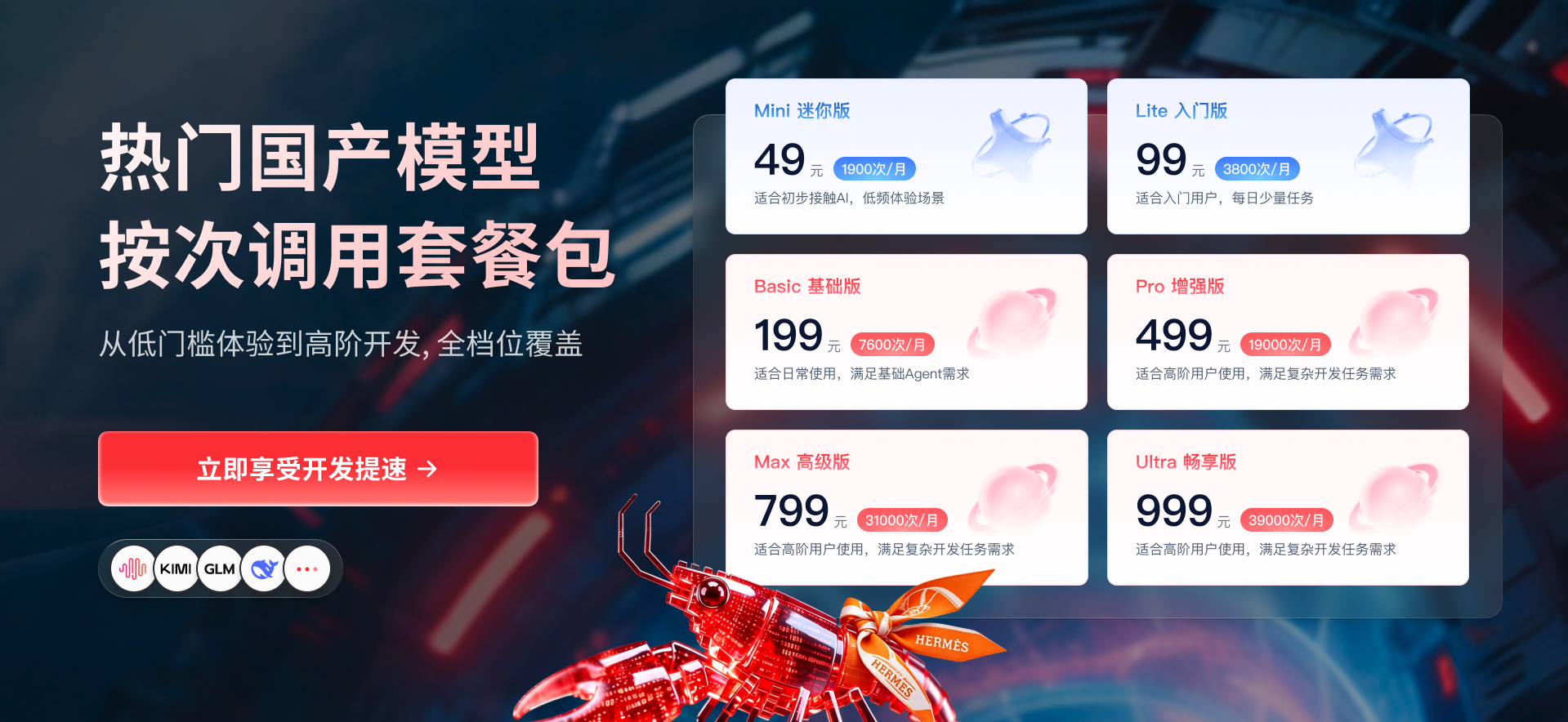
High-value Agent Plan Preferred Choice |
Thanks to Compshare for sponsoring this project! Compshare is an AI cloud platform under UCloud. It mainly offers monthly subscription and pay-per-use, high-value domestic model Agent Plan packages starting as low as ¥49/month. It also provides officially relayed stable overseas models, supports integration with Claude Code, Codex, and API calls, and offers enterprises high concurrency, 7*24 technical support, and self-service invoicing. 🎁 Users who register through this link will receive a free ¥5 platform trial credit. |
✨ Tutorial Highlights
- 🌱 The web's first systematic open-source AI Agent tutorial: This is a long-term maintained LLM application development roadmap. There is no shortage of scattered posts or paid bootcamps, but truly systematic, continuously updated AI LLM application tutorials that cover tutorials + source code + hands-on projects + interview question banks are extremely rare. What this repository aims to do is make this path public, deep, and complete, growing with you from beginner to advanced to real project practice.
- 🧭 One path through the full LLM application stack: From LLMs and prompts, to low-code platforms (Coze/Dify) and code frameworks (LangChain/LangGraph), to enterprise-level RAG/Agent, fine-tuning, and engineering standards—organized uniformly by knowledge system, forming a complete end-to-end closed loop, suitable for systematic mastery rather than fragmented bookmarking.
- 🐍 Focused on the Python ecosystem, targeting Agent engineering directly: Many courses revolve around Spring AI and langchain4j, leaning more toward the Java tech stack. This tutorial focuses on Python + LangChain + LangGraph, directly aligning with the most common engineering path for AI Agent / LLM application development today.
- 📘 Beginners can enter, engineers can dig deeper: The entire tutorial is arranged from shallow to deep, first thoroughly explaining core concepts like LLMs, Agents, RAG, MCP, and Tool Calling, then moving into source code, frameworks, deployment, and project design. Less jargon, more "why it's designed this way, how the code runs, and how the project gets deployed."
- 💼 Enterprise-level practice, targeting "able to deliver": Using Shopkeeper Data Q&A, Deep Research, Shopkeeper Knowledge Base, and E-commerce Assistant as the main threads, connecting intent parsing, multi-source knowledge, human handoff, review, and monitoring; putting multi-route retrieval, evaluation, observability, cost, and guardrails into real-world contexts for practice. Writing resumes and presenting projects becomes grounded rather than vague.
- ✅ Every case is measured by "it can actually run": Not just explaining concepts or pasting pseudo-code, but providing runnable cases, source code, environment instructions, and common troubleshooting wherever possible. All case content has been organized based on actually verified runs, helping you avoid pitfalls and get up to speed quickly.
- 📚 Tutorials, source code, and interviews—a three-in-one that actually works: Not just "finished reading," but also "can run it" and even "can answer it"—runnable cases and source code, prompt templates, and deployment approaches, refusing to "only talk concepts." The interview question bank breaks down questions by common competency domains from training programs and JDs, with a significant portion organized from real interview questions at major companies, public interview experiences, and high-frequency follow-up scenarios, suitable for career changers and new graduates to review intensively.
- 🚀 Facing 2026, continuously evolving and hardcore: The tech stack and high-frequency question patterns will iterate with the ecosystem, aligning with the dimensions of ten-thousand-yuan-level training curricula for "AI Application Development Engineers"; it's not just telling you "what to learn," but also "how to do projects, how to present projects, how to answer interviews." If useful, a Star is a tip ⭐.
🛠 Tech Stack Overview
| Category | Technology/Platform | Description |
|---|---|---|
| LLMs & Fundamentals | LLM, Transformer, MoE, Self-Attention | LLaMA/Qwen/GPT, multimodal, pre-training/fine-tuning/inference |
| Prompting & Orchestration | Prompt Engineering, Tool Calling, Skills | Multi-turn dialogue, message templates, structured output, tool invocation, skill-based capability accumulation |
| Low-Code Platforms | Coze, Dify | Workflows, Agents, knowledge bases, plugins, Python invocation, and localized deployment |
| Development Frameworks | LangChain, LangGraph, DeepAgents | Model I/O, Runnable / LCEL, Memory, Tools, Agents, graph-based workflows, multi-agent |
| Protocols & Communication | MCP (Model Context Protocol), A2A | Function Calling, service decoupling, external tool integration, cross-Agent collaboration |
| RAG & Retrieval | Vector databases, sparse retrieval, hybrid retrieval, BGE-Rerank | Multi-route retrieval, reranking, knowledge graphs, RAGAS evaluation, advanced RAG optimization |
| Documents & Multimodal | MinerU, OCR | Mixed text-image PDF parsing, device manuals and after-sales guides |
| Deployment & Operations | Docker, Ollama, Xinference, vLLM | Tencent Cloud/Alibaba Cloud, AutoDL, Coze local deployment |
| Fine-tuning & Training | PEFT, LoRA, QLoRA, DeepSpeed, Llama-Factory | Alpaca/ShareGPT data formats, Safetensors, keyword-based evaluation |
| Programming & Tools | Python; Codex, Cursor | Primary language is Python; covers AI programming tools, Agent Skills, multi-model APIs, MCP integration and debugging |
| Job Seeking & Interviews | Interview question bank | Organized by role competency domains with questions + answers; aligned with similar online training completion capabilities and high-frequency JD exam points |
🎯 What Will You Gain After Completing This?
- Deployable project capability, able to independently deliver AI Agent applications (from environment to deployment), progressing from "just calling APIs" to real-world engineering practice.
- Systematic architectural expression, able to clearly explain RAG, Agent, MCP designs and trade-offs, able to withstand follow-up questions in interviews and resumes.
- Interview and JD alignment, with an independent interview question bank cross-linked with question numbers in the main text, organized by role competency domains with question formats and answer approaches, suitable for new graduates and career changers to organize their talking points.
- Engineering and resume material, with enterprise-oriented cases and expressions around multi-route retrieval, observability, and cost—projects that can be demonstrated and written into resumes.
- A searchable knowledge map, with a systematic table of contents + case source code, aligned with common "Agent / application development" curriculum dimensions, making it easy to cross-check and fill gaps, avoiding the pitfall of "only read articles but never ran anything."
- Clear role alignment, qualifying you for roles such as AI Application Development Engineer, AI Agent Engineer, AI Automation Process Developer, and AI Product Technical Lead; especially suitable for those with frontend / backend / product backgrounds transitioning into AI and agent development.
📚 Tutorial Outline (Excerpt)
For the full navigation, see the Tutorial Table of Contents and online documentation.
This outline is not a fixed table of contents. It will continue to evolve alongside the AI tech stack, with new core knowledge points, new frameworks, and new project practices continuing to be incorporated into this path.
01 Building Core Large Language Model Capabilities
| Chapter Name | Content Overview |
|---|---|
| Understanding LLMs and Environment Setup | Origins and development, relationship with AGI, mainstream model features and use cases, pre-training/fine-tuning/inference |
| LLM Architecture Principles | Transformer, MoE, self-attention, LLaMA/Qwen/GPT, multimodal |
| LLM Scheduling Platforms | Ollama, private LLM invocation, cloud/on-premises deployment (AWS, Alibaba Cloud, etc.) |
| Prompt Engineering | Core principles and structure, chain-of-thought and few-shot, multi-turn dialogue and memory, applications in Agent and tool calling |
02 Enterprise Low-Code Platform Development and Project Practice
| Chapter Name | Content Overview |
|---|---|
| Coze Platform | Interface and features, plugins/knowledge bases/workflows/agents, Python workflow invocation |
| Project 1: Merchant Operations Assistant | Industry research PPT, viral video reproduction, marketing posters, selling point extraction, comment analysis |
| Dify AI Platform | Workflows/Agents/knowledge bases, multiple cases (complaint classification, research reports, customer service analysis, comment analysis), Python invocation |
| Containerization Technology | Docker core concepts, installation and common commands |
| Enterprise-Level LLM Deployment | Tencent Cloud/Alibaba Cloud, Docker, Dify, AutoDL, Ollama, Xinference, Coze on-premises deployment |
| AI Coding Tool - Trae AI | Installation and usage, multi-model API, MCP integration |
| AI Coding Tool - Qoder | Usage and debugging, project development |
03 Core LLM Development Frameworks
| Chapter Name | Content Overview |
|---|---|
| LangChain Framework Principles and Applications | Model I/O, Prompt, Parser, Runnable / LCEL, Memory, Tools, Retrieval, Agent |
| LangGraph Framework Principles and Applications | Graph-based thinking, State/Node/Edge, persistent memory, streaming output, multi-agent and A2A |
| MCP: From Principles to Practice | Comparison with Function Calling, communication mechanism, workflow, Server deployment and custom development |
| Cross-Agent Communication: A2A Protocol | Relationship with MCP, messages and authentication, typical scenarios |
04 Enterprise-Level RAG / Agent Project Practice
| Chapter Name | Content Overview |
|---|---|
| Shopkeeper Knowledge Base | LangGraph RAG workflow, MinerU/OCR, vector + sparse + Neo4j multi-route retrieval, HyDE/BGE-Rerank, RAGAS evaluation |
| E-commerce Assistant | Intent parsing, multi-source knowledge bases, streaming responses, human handoff mechanism, conversation review, multi-channel and monitoring |
| Shopkeeper Data Q&A | Centered on natural language data querying, fully connecting MySQL data warehouse, metadata knowledge base, Qdrant vector retrieval, Elasticsearch field value retrieval, LangGraph workflow, SQL generation, validation and execution, FastAPI SSE, and frontend-backend integration |
| Deep Research | Building a multi-agent research system based on DeepAgents, connecting web search, MySQL queries, RAGFlow knowledge base, file reading and generation, FastAPI APIs, and WebSocket real-time progress reporting |
| Market Compass | Scenario-based task decomposition, design and development from 0 to 1, stage goals and progress control, code review and achievement presentation |
Recommended completed practical projects:
- Shopkeeper Data Q&A(Source repository):Not a simple SQL generation demo, but integrates knowledge points such as
MySQL,LangGraph,Qdrant,Elasticsearch,FastAPIinto a single runnable intelligent data query pipeline.- Deep Research(Source repository):Not an ordinary chat box, but centered on open research tasks, building a complete closed loop with main agent orchestration, sub-agent division of labor, multi-source material retrieval, file generation and delivery, and frontend-backend real-time interaction.
05 LLM Fine-Tuning Practice
| Chapter | Content Overview |
|---|---|
| 28 Fine-Tuning Overview | Problem diagnosis, model types, baseline and keyword project workflow |
| 29 Data and Templates | Real JSONL, sample quality, cleaning and splitting, dialogue templates |
| 30 Training and Efficient Fine-Tuning | Training parameters, GPU memory examples, LoRA and QLoRA |
| 31 LLaMA-Factory Fine-Tuning Practice | AutoDL single GPU / FP16, cleaned training, logs and backup |
| 32 Fine-Tuning Evaluation and Model Deployment | Single-sample validation, 200-sample dual-group prediction and scoring, export and standalone loading; vLLM optional |
| 33 Fine-Tuning Memory Optimization and Multi-GPU Training | Single-GPU memory troubleshooting, parallel division of labor, ZeRO and short-run log analysis |
06 Big Tech Development Standards
| Chapter Name | Content Overview |
|---|---|
| Enterprise LLM R&D Process | Technical research, solution and framework design, RAG and pipeline, evaluation and roles, project initiation and requirements documents |
| Current LLM Hot Topics | Agent/RAG mainstream technologies, frontier and trend tracking |
🏗️ Agent Project Architecture and Technical Architecture

🚀 Quick Start
Learn together with the online documentation. Want to run a case immediately? Follow the steps below. For more detailed environment instructions, API applications, and common error handling, see Getting Started and FAQ.
Clone the repository and enter the project directory
git clone https://github.com/didilili/ai-agents-from-zero.git
cd ai-agents-from-zero
Prepare the environment (Python 3.10 recommended, supports 3.10–3.13)
python3.10 -m venv .venv
source .venv/bin/activate          # macOS/Linux
# .venv\Scripts\activate           # Windows CMD
pip install -r requirements.txt
Configure API Key
- Copy
.env-examplefrom the root directory to.env - Fill in your API Key in
.env(such as Qwen/Alibaba Bailian, DeepSeek, etc.). The variable names must match the code (such asaliQwen-api,QWEN_API_KEY,deepseek-api) - For how to apply for keys on each platform, see Getting Started and FAQ - How to Apply for Keys on Various API Platforms
- Copy
Run the first case in the project root directory
python 案例与源码-2-LangChain框架/01-helloworld/StandardDesc.pySuggestion: Run
pythonin the project root directory for unified management of the virtual environment, dependencies, and output files.load_dotenv()in regular scripts usually automatically searches upward for.env; if you are using an IDE, REPL, or debugger and cannot read the Key, check its working directory configuration. If you do not want to use cloud APIs, you can use the Ollama local model (no Key required).
If you encounter ModuleNotFoundError, API Key errors, cannot find .env, etc., see Getting Started and FAQ - Common Problems and Solutions.
💬 Join the Community
Want to chat with more friends about AI programming, Vibe Coding, interview experience, and also shoot the breeze and vent about your boss? Welcome to the "Most Loving AI Agent Exchange Group in the Universe — Whimsical Ideas Research Institute"! 🎉
👉 Click here! Apply to join: Leave a comment on the application post and add WeChat as described in the post.
May we have a little less anxiety and a little more inspiration here; a little less going it alone and a little more whimsical thinking together~
📖 About This Repository
- Goal: To create a truly beginner-friendly, systematic, and long-term updated AI Agent practical crash course, explaining concepts clearly while getting cases running, so you can go from 0 to independently building RAG / Agent / Multi-Agent projects and clearly explain your solutions and projects in engineering terms.
- Technical Positioning: Focus on the Python Agent development path, with emphasis on LangChain / LangGraph and related engineering practices. It does not follow the Java path of Spring AI / langchain4j, making it more suitable for those who want to directly enter Python LLM application development.
- Tutorial Source: References course materials such as Shangguigu's "LLM Agent Crash Course", and on that basis, combined with public documentation, community practices, and project experience, it is continuously restructured, supplemented, and maintained, gradually organized into a systematic learning resource for Python Agent application development.
- Interview Question Source: A considerable portion of the question bank is compiled from real interview questions from major companies, public interview experiences, and high-frequency follow-up scenarios, and has been engineering-restructured around the chapter主线 of this repository, making it more suitable for review from a project and system design perspective.
- Content Composition: Systematic chapter notes + Runnable case source code + Interview Question Bank (benchmarked against similar online training and social/campus recruitment JDs).
⭐ Star History
Repository English Name: ai-agents-from-zero · Repository Chinese Name: 《AI Agent Practical Crash Guide: From Zero to Enterprise-Level Deployment》
Explore related projects
affaan-m/ECC
The agent harness performance optimization system. Skills, instincts, memory, security, and research-first development for Claude Code, Codex, Opencode, Cursor and beyond.
299,018 starsNousResearch/hermes-agent
The agent that grows with you
261,430 starsmultica-ai/andrej-karpathy-skills
A single CLAUDE.md file to improve Claude Code behavior, derived from Andrej Karpathy's observations on LLM coding pitfalls.
230,545 starsfirecrawl/firecrawl
Supercharge your AI agents with data from the web and beyond. Building the library for superintelligence. 🔥
199,303 stars