
dformoso/machine-learning-mindmap
dformoso/machine-learning-mindmap has 6,267 GitHub stars and 1,004 forks. GitHot measured -1 stars in 24 hours. Last checked 2026-11-06 13:58 UTC. Last push 2020-05-30.
A mindmap summarising Machine Learning concepts, from Data Analysis to Deep Learning.
Measured star growth
- in 24h
- -1
- in 7 days
- Collecting history
- in 15 days
- Collecting history
- in 1 month
- Collecting history
Net star changes over overlapping periods, not daily totals. Missing measurements are left blank. Stars measure attention, not software quality.
README.md
OriginalMachine Learning Mindmap / Cheatsheet
A Mindmap summarising Machine Learning concepts, from Data Analysis to Deep Learning.
Overview
Machine Learning is a subfield of computer science that gives computers the ability to learn without being explicitly programmed. It explores the study and construction of algorithms that can learn from and make predictions on data.
Machine Learning is as fascinating as it is broad in scope. It spans over multiple fields in Mathematics, Computer Science, and Neuroscience. This is an attempt to summarize this enormous field in one .PDF file.
Download
Download the PDF here:
https://github.com/dformoso/machine-learning-mindmap/blob/master/Machine%20Learning.pdf
Same, but with a white background:
I've built the mindmap with MindNode for Mac. https://mindnode.com
Companion Notebook
This Mindmap/Cheatsheet has a companion Jupyter Notebook that runs through most of the Data Science steps that can be found at the following link:
Mindmap on Deep Learning
Here's another mindmap which focuses only on Deep Learning
1. Process
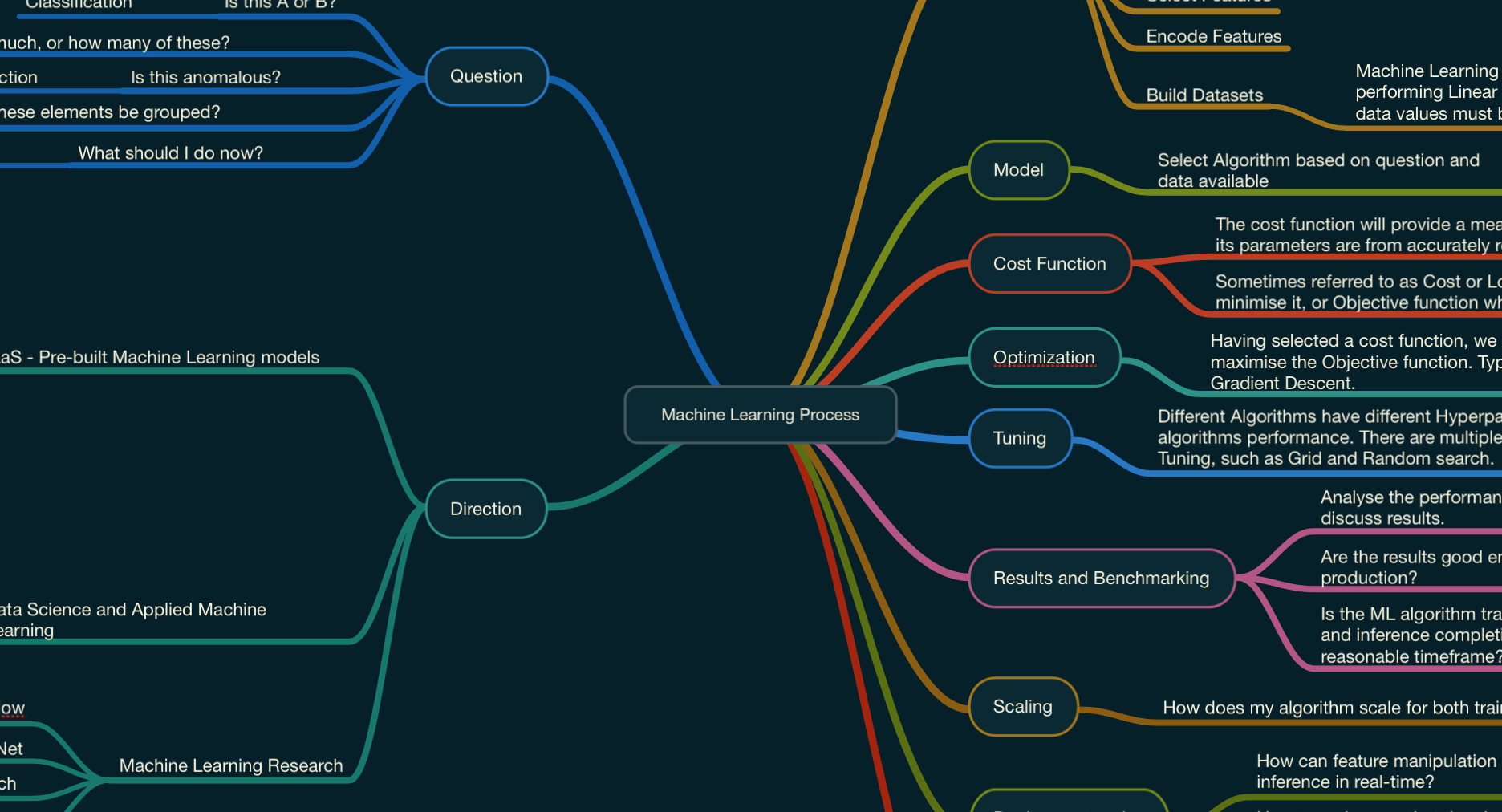
The Data Science it's not a set-and-forget effort, but a process that requires design, implementation and maintenance. The PDF contains a quick overview of what's involved. Here's a quick screenshot.
2. Data Processing
First, we'll need some data. We must find it, collect it, clean it, and about 5 other steps. Here's a sample of what's required.

3. Mathematics
Machine Learning is a house built on Math bricks. Browse through the most common components, and send your feedback if you see something missing.

4. Concepts
A partial list of the types, categories, approaches, libraries, and methodology.

5. Models
A sampling of the most popular models. Send your comments to add more.

References
I'm planning to build a more complete list of references in the future. For now, these are some of the sources I've used to create this Mindmap.
 Stanford and Oxford Lectures. CS20SI, CS224d.
> Books:
  > Deep Learning - Goodfellow.
  > Pattern Recognition and Machine Learning - Bishop.
  > The Elements of Statistical Learning - Hastie.
- Colah's Blog. http://colah.github.io
- Kaggle Notebooks.
- Tensorflow Documentation pages.
- Google Cloud Data Engineer certification materials.
- Multiple Wikipedia articles.
About Me
Twitter:
Linkedin:
Email:
Explore related projects
tensorflow/tensorflow
An Open Source Machine Learning Framework for Everyone
201,311 starshuggingface/transformers
🤗 Transformers: the model-definition framework for state-of-the-art machine learning models in text, vision, audio, and multimodal models, for both inference and training.
168,576 starsAUTOMATIC1111/stable-diffusion-webui
Stable Diffusion web UI
165,264 starsComfy-Org/ComfyUI
The most powerful and modular diffusion model GUI, api and backend with a graph/nodes interface. The fastest local inference engine in the world.
145,310 stars