
deepseek-ai/profile-data
deepseek-ai/profile-data has 1,204 GitHub stars and 158 forks. GitHot measured +1 stars in 24 hours. Last checked 2026-11-09 08:28 UTC. Last push 2025-03-21.
Analyze computation-communication overlap in V3/R1.
Measured star growth
- in 24h
- +1
- in 7 days
- Update delayed
- in 15 days
- Update delayed
- in 1 month
- Update delayed
Net star changes over overlapping periods, not daily totals. Missing measurements are left blank. Stars measure attention, not software quality.
README.md
OriginalProfiling Data in DeepSeek Infra
Here, we publicly share profiling data from our training and inference framework to help the community better understand the communication-computation overlap strategies and low-level implementation details. The profiling data was captured using the PyTorch Profiler. After downloading, you can visualize it directly by navigating to chrome://tracing in the Chrome browser (or edge://tracing in the Edge browser). Notice that we simulate an absolutely balanced MoE routing strategy for profiling.
Training

The training profile data demonstrates our overlapping strategy for a pair of individual forward and backward chunks in DualPipe. Each chunk contains 4 MoE (Mixture of Experts) layers. The parallel configuration aligns with DeepSeek-V3 pretraining settings: EP64, TP1 with 4K sequence length. And the PP communication is not included during profiling for simplicity.
Inference
Prefilling
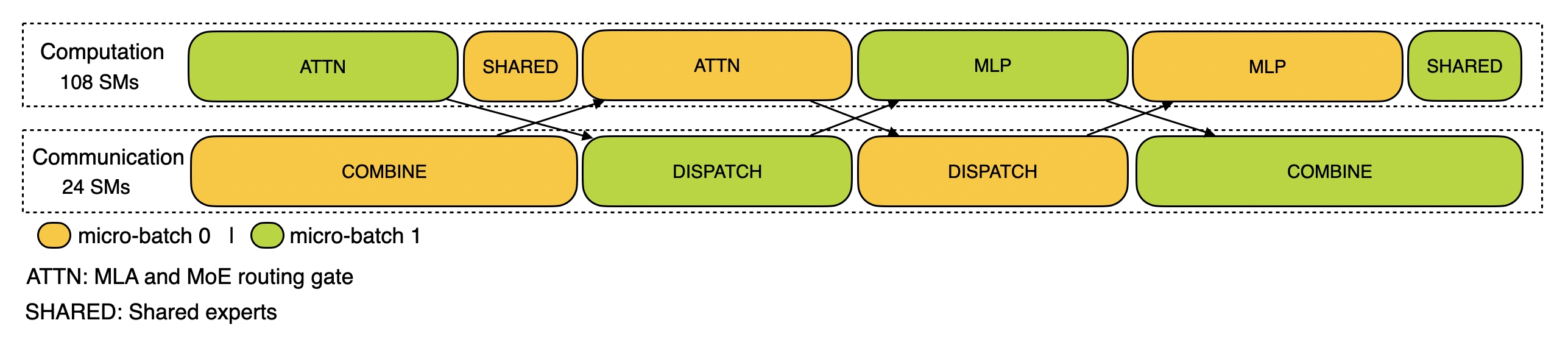
For prefilling, the profile employs EP32 and TP1 (in line with DeepSeek V3/R1 ’s actual online deployment), with a prompt length set to 4K and a batch size of 16K tokens per GPU. In our prefilling stage, we utilize two micro-batches to overlap computation and all-to-all communication, while ensuring that the attention computation load is balanced across the two micro-batches — meaning that the same prompt may be split between them.
Decoding
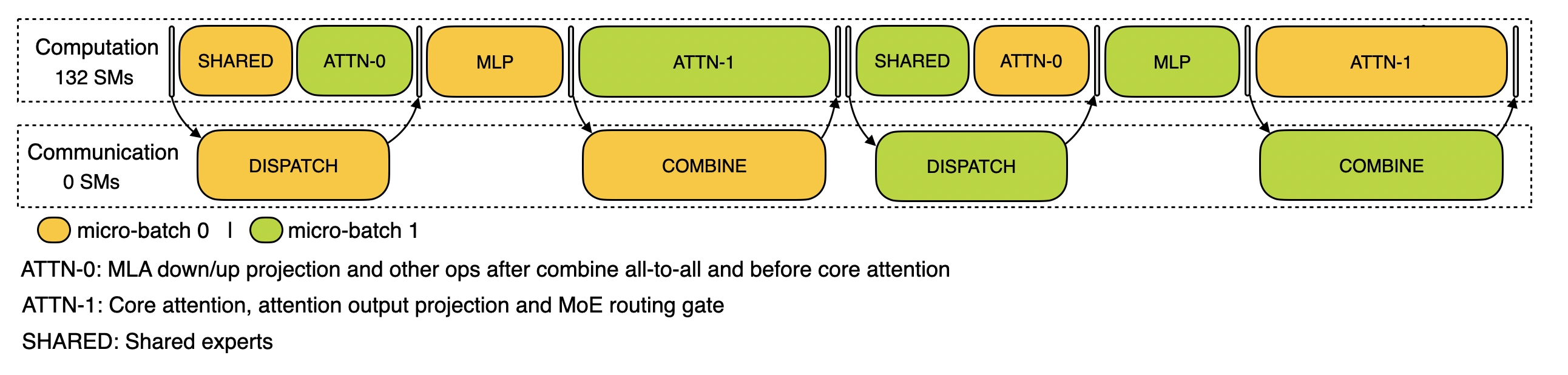
For decoding, the profile employs EP128, TP1, and a prompt length of 4K (closely matching the actual online deployment configuration), with a batch size of 128 requests per GPU. Similar to prefilling, decoding also leverages two micro-batches for overlapping computation and all-to-all communication. However, unlike in prefilling, the all-to-all communication during decoding does not occupy GPU SMs: after RDMA messages are issued, all GPU SMs are freed, and the system waits for the all-to-all communication to complete after the computation has finished. For more information about the all-to-all implementation, please refer to DeepEP.
Explore related projects
codecrafters-io/build-your-own-x
Master programming by recreating your favorite technologies from scratch.
561,363 starspublic-apis/public-apis
A collective list of free APIs
497,621 starsmorluto/rea
Reverse engineer anything with agents, from app behavior down to native binaries.
447,042 starsopenclaw/openclaw
The AI that really does things. Any OS. Any Platform. The lobster way. 🦞
394,259 stars