
darkhanakh/pg-kazsearch
darkhanakh/pg-kazsearch has 30 GitHub stars and 3 forks. GitHot measured +1 stars in 24 hours. Last checked 2026-11-09 14:49 UTC. Last push 2026-11-03.
Kazakh full-text search extension for PostgreSQL
Measured star growth
- in 24h
- +1
- in 7 days
- Update delayed
- in 15 days
- Update delayed
- in 1 month
- Update delayed
Net star changes over overlapping periods, not daily totals. Missing measurements are left blank. Stars measure attention, not software quality.
README.md
Original

pg_kazsearch
Kazakh full-text search for PostgreSQL and Elasticsearch.
A Rust stemmer, a Postgres extension, an Elasticsearch plugin, and the benchmarks that justify them.
LGPL-3.0 · PostgreSQL 16, 17, 18 · Elasticsearch 8.17 to 8.19
Kazakh is agglutinative. One word stacks several suffixes, and each suffix changes shape to match the vowels and the last consonant before it. мектептерімізде ("in our schools") is мектеп + plural + possessive + locative, and a reader searching for мектеп expects to find it. PostgreSQL and Elasticsearch ship no Kazakh stemmer, so without one every inflected form is a different index term and most human queries miss.
pg_kazsearch is that stemmer. On 132 human-written queries over 2,999 news articles, PostgreSQL Recall@10 is 0.547 with the stemmer and 0.187 without it on one index, and MRR@10 is 0.737 against 0.420 (eval/results/report.json, measured on main). On KazQAD, an independent benchmark of 1,929 university-entrance exam questions judged against 825,309 Kazakh Wikipedia passages, it raises BM25 nDCG@10 from 0.219 to 0.288 (paired 95% CI +0.056 to +0.081, eval/results/kazqad.json).
CREATE EXTENSION pg_kazsearch;

SELECT to_tsvector('kazakh_cfg', 'президенттің жарлығы');
-- 'жарлық':2 'президент':1

SELECT ts_lexize('pg_kazsearch_dict', 'алмаларымыздағы');
-- {алма}
What is in the repository
core/, the stemmer as a pure Rust library (kazsearch-core), with no database dependency.pg_ext/, the PostgreSQL extension built with pgrx. It installs a text search template, thepg_kazsearch_dictdictionary, a stopword list, and thekazakh_cfgconfiguration.elastic/, the Elasticsearch analysis plugin. The Java side is a LuceneTokenFilterthat calls the Rust library over JNI.cli/, thekazsearchcommand for stemming, tracing a parse, and benchmarking without a database.snowball/kazakh.sbl, a dictionary-free Kazakh algorithm in the Snowball language, for engines that cannot load a native library.examples/hybrid-search.sql, BM25 with pg_textsearch and dense vectors with pgvector fused in one SQL statement.eval/, the corpus loader, the human-judged query sets, the KazQAD and Kaz-RAG harnesses, and the scripts that produce every number and chart in this file.
The latest release is v2.3.0 (July 2026). The numbers in this file are measured on main, which also carries the stemmer fixes from pull requests #8 and #10 and the keyboard = restore option. Those ship with the next release; until then, build from source to get them.
Quickstart
Start PostgreSQL 18 with the extension preinstalled and stem a sentence:
docker run -d --name kaz -e POSTGRES_PASSWORD=postgres -p 5432:5432 ghcr.io/darkhanakh/pg-kazsearch:18
sleep 5
docker exec -it kaz psql -U postgres -c "CREATE EXTENSION pg_kazsearch;" \
    -c "SELECT to_tsvector('kazakh_cfg', 'мектептеріміздегі оқушылардың');"
You should see 'мектеп':1 'оқушы':2. Tags 16 and 17 exist for the other supported majors. The images and the .deb packages are built for amd64 only, so on Apple Silicon add --platform linux/amd64 or build from source. For a table, add a generated tsvector column and a GIN index:
ALTER TABLE articles ADD COLUMN fts tsvector
    GENERATED ALWAYS AS (
        setweight(to_tsvector('kazakh_cfg', title), 'A') ||
        setweight(to_tsvector('kazakh_cfg', body), 'B')
    ) STORED;

CREATE INDEX idx_fts ON articles USING GIN (fts);

SELECT title FROM articles
WHERE fts @@ websearch_to_tsquery('kazakh_cfg', 'президенттің жарлығы')
ORDER BY ts_rank_cd(fts, websearch_to_tsquery('kazakh_cfg', 'президенттің жарлығы')) DESC
LIMIT 10;
The Install section covers the .deb packages, the Elasticsearch plugin, and building from source.
How it works
One word through the stemmer
flowchart TD
    W["word"] --> S["script analysis<br/>Latin to Cyrillic, split hyphenated compounds"]
    S --> N
    S --> V
    subgraph FP["stem_cyrillic (one pass, then with a lexicon up to 4 more passes until the stem stops changing)"]
        N["BFS over the noun layers<br/>PRED, CASE, POSS, PLUR, DERIV"]
        V["BFS over the verb layers<br/>VPERSON, VTENSE, VNEG, VVOICE"]
        N --> P["select_best<br/>a lexicon hit first, else the lowest penalty<br/>a dictionary word is kept whole"]
        V --> P
        P --> U["stem repair<br/>undo б→п ғ→қ г→к, restore an elided vowel,<br/>give back a final vowel the lexicon confirms"]
        U --> X["reduce_to_lexicon_root<br/>-у, -ған, -п, -да onto the dictionary root"]
    end
    X --> O["stem"]
The engine (core/src/explore.rs) runs a breadth-first search over ordered suffix layers, once with the noun layers and once with the verb layers. Each step strips one suffix from the right and checks two things before it may continue. The suffix must agree in vowel harmony with the last non-glide vowel of the base (у, и, and ю are transparent, so туризм accepts either class). The base must satisfy the layer guard, which encodes a morphotactic constraint such as "past -ты/-ті attaches only after a voiceless consonant" or "no possessive after a patronymic in -ұлы/-қызы". Greedy longest-match stripping fails on Kazakh because a wrong early cut hides the right parse, so the search keeps every surviving path and scores the candidates at the end.
candidate_penalty scores a candidate by stem length in syllables, the number of weak and single-letter suffixes, derivational depth, and whether the stem is a lexicon entry. The weights were tuned with CMA-ES against the news corpus. With a lexicon loaded, a candidate whose stem is a dictionary entry is chosen over one that only scores well, and a safety valve keeps a word that is itself a dictionary entry whole when the only parses lose a syllable.
Stem repair reverses the sound changes that attaching a suffix caused. кітабы strips to кітаб, which apply_mutation turns back into кітап. орны strips to орн, and elision restore gives орын. When the search cut one vowel too early (жылына to жыл), restore_lexicon_vowel hands the vowel back if the longer form is in the lexicon.
The last stage makes the stemmer idempotent. A single pass is not. One pass takes таратқандар to the participle таратқан and таратқан to тарат, so the plural and the bare participle never met in the index. With a lexicon loaded, stem_cyrillic therefore reruns the selected candidate, together with reduce_to_lexicon_root (which folds -у verbal nouns, -ған/-ген/-қан/-кен participles, -п converbs, and -да/-де denominal verbs onto their dictionary root), up to four more times, stopping as soon as a pass changes nothing. Without a lexicon there is one pass. stem(stem(w)) == stem(w) then holds across the 45,708 corpus tokens in core/tests/bench_tokens.txt, and test_stem_idempotent_over_bench_tokens in core/tests/stem_tests.rs enforces it.
What the lexicon is for
data/tsearch_data/kaz_stems.dict holds 21,791 lemmas built from Apertium-kaz by scripts/build_lexicon.py, and kaz_stems.dict.verbs tags the 3,345 of them that are verb roots. The engine works without the files. The lexicon decides the ambiguous cases, allows the root reductions above, and makes keyboard = restore possible. On KazQAD it adds +0.015 nDCG@10 to the engine (95% CI +0.007 to +0.024, eval/results/kazqad.json). On that set the engine with the lexicon against the dictionary-free snowball/kazakh.sbl is −0.002 nDCG@10 (95% CI −0.009 to +0.005), an interval that includes zero. On the news queries the engine with the lexicon is +0.037 Recall@10 above Snowball (95% CI +0.002 to +0.077, eval/results/snowball.json). The Benchmarks section has the tables.
Latin script
script_mode = auto (the default) detects a token written in the 2021 Latin orthography (ä ö ü ū ğ ş ñ ı, plus q and w), transliterates it, and stems the Cyrillic form, so qalalardağy and қалалардағы both index as қала. Mixed-script tokens, older apostrophe and digraph spellings, and plain ASCII tokens that could be anything (mektepterimizdegi) pass through unchanged. script_mode = cyrillic_only turns detection off.
Russian-keyboard input
Many people type Kazakh on a Russian layout, so өнімдері arrives as онимдери (қ→к, ғ→г, ң→н, ұ/ү→у, і→и, ә→а, ө→о, һ→х). With keyboard = restore, core/src/kbfold.rs wraps the engine:
flowchart TD
    W["word"] --> T["t = exact stem"]
    T --> OV{"word not in the lexicon,<br/>t in the lexicon, t ≠ word?"}
    OV -- "yes" --> WT["whole-token override<br/>dictionary entries whose fold is the word<br/>and pass the same policy, at most 4, stem each"]
    WT -- "a stem the lexicon verifies" --> OUT1["that stem<br/>(еңбек from енбек, not ен)"]
    WT -- "none" --> KEEP
    OV -- "no" --> G{"t in the lexicon?"}
    G -- "yes" --> KEEP["return t<br/>(most correctly typed words stop here)"]
    G -- "no" --> C["candidates for the word, then for t<br/>a lexicon anchor in folded space plus a restored tail<br/>evidence: dictionary spelling, forced tail, ң suffix"]
    C --> A{"admissible?<br/>2+ syllable anchor unless the tail is forced,<br/>tail evidence if a Kazakh letter was typed"}
    A -- "none" --> FB["return t"]
    A -- "yes, at most 4 per source" --> S["stem each respelling<br/>with the same engine"]
    S --> V{"stem in the lexicon?"}
    V -- "yes" --> OUT["that stem<br/>(өнім from онимдери)"]
    V -- "no" --> FB
Restoration proper runs only when the exact stem is not a dictionary word, and the override only when the typed word is not one, so on the news corpus correctly typed text makes 0.008 extra stem_cyrillic calls per token (eval/results/keyboard_fold.json). The override handles a folded word whose exact stem is itself a dictionary entry (енбек stems to ен, "width", but the whole token folds from еңбек, "labour"). core/tests/kbfold_override_golden.txt freezes every bench token that path changes, and on main the list is empty. The admissible policy in core/src/kbfold.rs asks for one of three kinds of evidence: a dictionary spelling the input lacks, a suffix letter that vowel harmony forces, or an ң read in a genitive, possessive, or polite suffix. The anchor needs two harmony-bearing syllables unless the tail is harmony-forced, because мен would otherwise become мең and сон would become соң. A token that already contains a Kazakh letter was typed by someone who can type them, so only tail evidence may change it. The default stays keyboard = exact, which is byte for byte the behaviour of earlier releases, so an upgrade does not change an existing index.
How the pieces fit together
flowchart LR
    core["core/<br/>kazsearch-core<br/>stem(), rules, lexicon, kbfold"]
    pg["pg_ext/<br/>pg_kazsearch<br/>pgrx text search template"] --> core
    es["elastic/<br/>kazsearch-elastic<br/>C ABI and JNI cdylib"] --> core
    java["elastic/java/<br/>Lucene TokenFilter"] -- "JNI" --> es
    cli["cli/<br/>kazsearch<br/>stem, analyze, bench"] --> core
    data[("data/tsearch_data/<br/>kaz_stems.dict, .verbs, stopwords")]
    data -.-> pg
    data -.-> es
    data -.-> cli
    eval["eval/<br/>corpus, gold queries, harnesses"] --> pg
    eval --> java
    eval --> cli
    sb["snowball/kazakh.sbl<br/>dictionary-free algorithm"]
    eval --> sb
core/ is the only place stemming logic lives. The PostgreSQL extension, the Elasticsearch plugin, and the CLI call kazsearch_core::stem() with a StemConfig, so a word stems identically in all three. The Snowball algorithm is a separate, rule-only reimplementation, and snowball/eval_snowball.py measures it against the Rust engine.
Benchmarks
The corpus is 2,999 Kazakh news articles from kaz.tengrinews.kz. Three query sets have different meanings:
gold_v2(n=132) is the primary benchmark. Human-written queries across 39 themes with deliberate morphological variety, relevance judged over a pooled top-15 of three retrieval systems, with 30 queries re-judged blind (95.9% agreement, Cohen's κ 0.899). The file iseval/gold_queries_v2.jsonland the methodology is ineval/gold_queries_v2.meta.json.gold(n=51) is the older, smaller human-written set, kept for continuity.auto(n=8,997) is mined from the indexed articles: title keywords, body sentences, and a title word with a synthetic suffix attached (morpho_variant). These queries are circular, because each one is derived from the document it must find, so they serve regression testing and not absolute claims.
Every PostgreSQL number in this section comes from just eval-search (eval/run_eval.py), which writes eval/results/report.json. python3 scripts/gen_readme_charts.py draws the charts from the committed result files and nothing else.
Recall with and without stemming on human queries
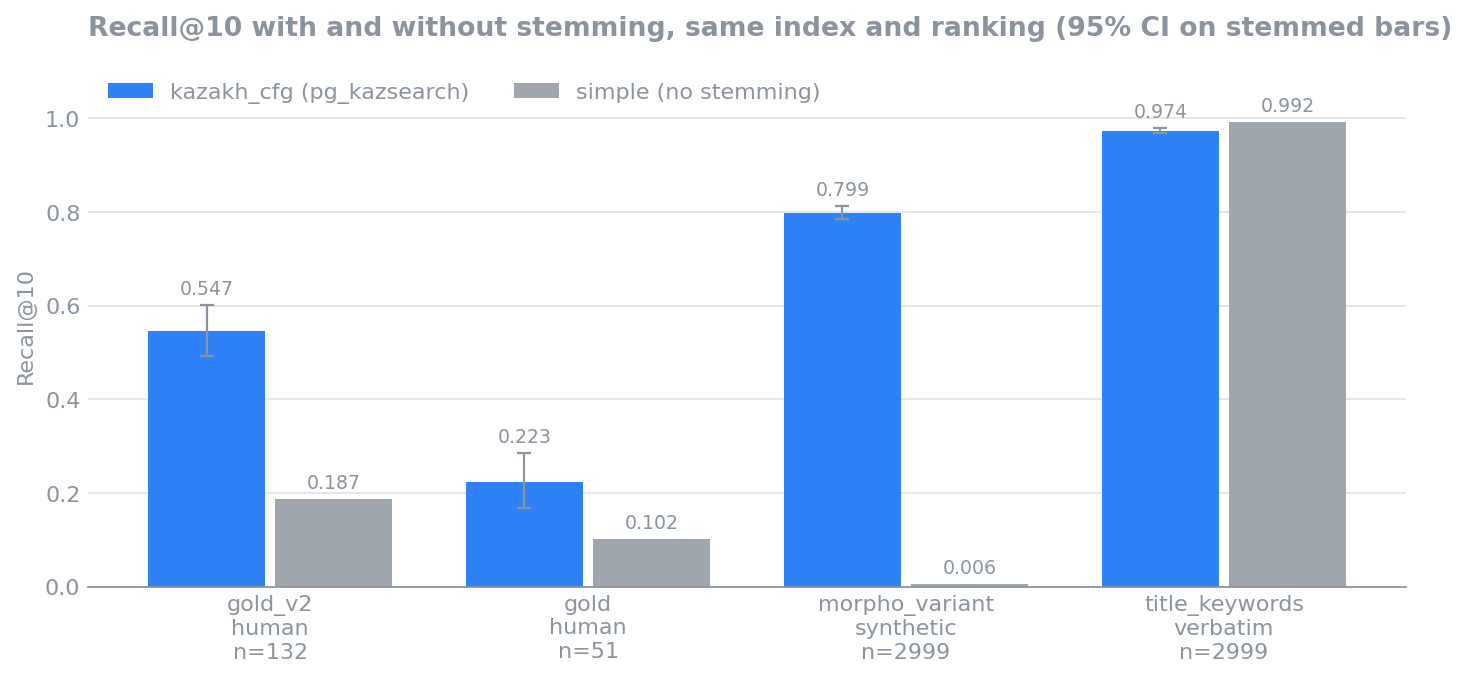
| Query set | kazakh_cfg R@10 |
simple R@10 |
MRR@10, stemmed vs not |
|---|---|---|---|
| gold_v2 (human, n=132) | 0.547 (95% CI 0.49 to 0.60) | 0.187 | 0.737 vs 0.420 |
| gold (human, n=51) | 0.223 | 0.102 | 0.525 vs 0.257 |
| morpho_variant (synthetic, n=2,999) | 0.799 | 0.006 | 0.725 vs 0.005 |
| title_keywords (verbatim, n=2,999) | 0.974 | 0.992 | 0.868 vs 0.920 |
report.json holds a marginal interval for each stemmed run and no paired interval between the stemmed and the unstemmed run, so the table reports the two values and no difference between them. One paired interval for stemming on gold_v2 is committed. With a pg_textsearch BM25 index on the same queries, Recall@10 with kazakh_cfg against simple is +0.140 (95% CI +0.084 to +0.200, eval/results/report_hybrid.json). Human queries contain inflected forms. Verbatim title words need no stemming, and on them Recall@10 reads 0.974 stemmed against 0.992 unstemmed. The morpho_variant generator picks its suffix by vowel harmony alone and ignores consonant assimilation, so many of its forms (мектеп + дар) are not Kazakh words. The guards from pull request #8 refuse such attachments (мектепдар passes through unstemmed on main), which is why this row reads 0.799 where the v2.3.0 README reported 0.865.
On KazQAD, an independent benchmark, stemming adds +0.069 nDCG@10 (95% CI +0.056 to +0.081)
KazQAD is a Kazakh question answering and passage retrieval dataset from ISSAI, released under CC BY-SA 4.0. Its retrieval task has 1,929 test questions taken from the Kazakh national university-entrance exam, judged against 825,309 Kazakh Wikipedia passages. Nobody on this project wrote the questions or the judgments, so this is the strongest evidence in this file. just eval-kazqad (eval/run_kazqad.py) indexes the passages with BM25 (k1=0.9, b=0.4, the Pyserini and Anserini defaults), an alphanumeric tokenizer, and the shipped stopword list, and changes only the stemmer between runs. It writes eval/results/kazqad.json, which records the dataset commit (ab8684a) and the SHA-256 of every file it read.
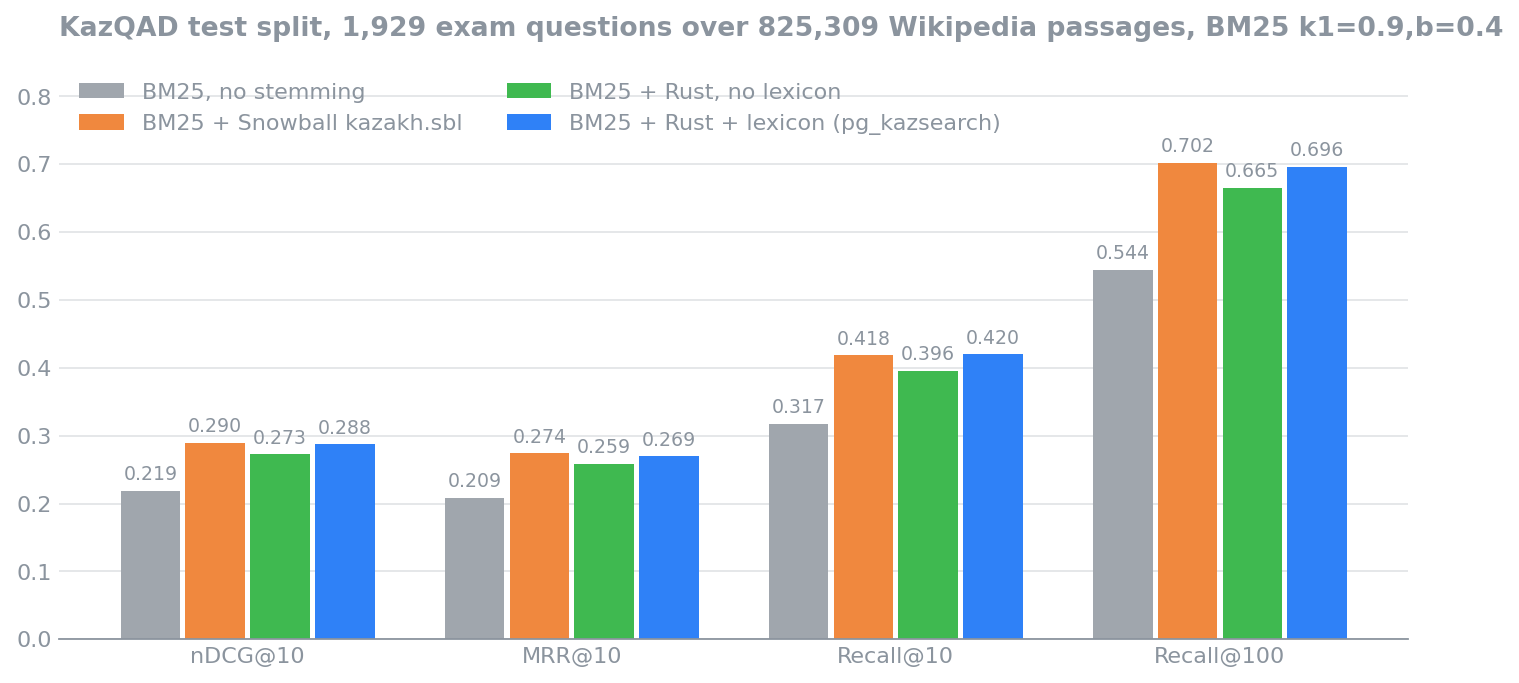
| BM25 on the test split (n=1,929) | nDCG@10 | MRR@10 | Recall@10 | Recall@100 |
|---|---|---|---|---|
| no stemming | 0.219 | 0.209 | 0.317 | 0.544 |
Snowball kazakh.sbl |
0.290 | 0.274 | 0.418 | 0.702 |
| Rust, no lexicon | 0.273 | 0.259 | 0.396 | 0.665 |
| Rust + lexicon (pg_kazsearch) | 0.288 | 0.269 | 0.420 | 0.696 |
Paired bootstrap over questions (10,000 resamples) on nDCG@10:
- Rust + lexicon against no stemming is +0.069 (95% CI +0.056 to +0.081). nDCG@10 is higher on 563 questions and lower on 300.
- Rust + lexicon against Rust without it is +0.015 (95% CI +0.007 to +0.024).
- Rust + lexicon against Snowball is −0.002 (95% CI −0.009 to +0.005). The interval includes zero and limits any difference to about 0.009 nDCG@10 either way, so this set does not establish a difference between the lexicon-backed engine and the dictionary-free algorithm in either direction. Snowball is +0.017 above the engine without the lexicon (95% CI +0.009 to +0.026).
Four things qualify the first table.
The harness reproduces the paper. With the parameters the KazQAD paper used (k1=1.2, b=0.75) and no stopword list, the no-stemming run scores 0.140 nDCG@10 against the 0.1446 the paper reports for its BM25 candidate generator, so the harness reads the data the way the authors did.
The table uses k1=0.9, b=0.4, the Pyserini and Anserini BM25 defaults. They were fixed before any run, and no score from either split chose them. The next table gives nDCG@10 for both parameter sets on both splits, with paired 95% intervals, so the choice can be checked against the validation questions as well as the test ones.
| Split | Parameters | No stemming | Snowball | Rust | Rust + lexicon | Rust + lexicon vs no stemming | Rust + lexicon vs Snowball |
|---|---|---|---|---|---|---|---|
| test (n=1,929) | k1=0.9, b=0.4 | 0.219 | 0.290 | 0.273 | 0.288 | +0.069 [+0.056, +0.081] | −0.002 [−0.009, +0.005] |
| test (n=1,929) | k1=1.2, b=0.75 | 0.143 | 0.210 | 0.190 | 0.209 | +0.066 [+0.055, +0.077] | −0.001 [−0.007, +0.005] |
| validation (n=548) | k1=0.9, b=0.4 | 0.230 | 0.297 | 0.279 | 0.298 | +0.069 [+0.046, +0.092] | +0.001 [−0.012, +0.014] |
| validation (n=548) | k1=1.2, b=0.75 | 0.148 | 0.214 | 0.200 | 0.209 | +0.061 [+0.042, +0.081] | −0.004 [−0.015, +0.006] |
In all four rows the interval for Rust + lexicon against no stemming excludes zero, and the interval for Rust + lexicon against Snowball contains it. The absolute scores depend on the parameters. The sign of the Snowball difference varies within its interval.
The judgments are sparse. Between 4.6% and 6.0% of the passages in any system's top 10 carry a judgment, and an unjudged passage counts as not relevant, so the absolute scores are lower bounds and the paired deltas are what the set measures.
The per-question disagreements have a visible mechanism. The JSON keeps the six questions each way where the two stemmers disagree most. Among the questions where Snowball scores higher, the lexicon engine kept a query word whole because the word is itself a dictionary entry (қуатты, where the passage has қуаты) or cut too deep (Көккесене to көк, деген to де). Among the questions where the engine scores higher, Snowball left a word unstemmed (ілімнің) or cut it to the wrong stem (қайғының to қайық).
Relaxing AND to OR when the strict list is short
websearch_to_tsquery joins terms with AND, so one term that matches nowhere empties the result. This table is measured on gold_v2 with one index and ts_rank_cd, changing only how the tsquery is built (python3 eval/measure_query_strategies.py, eval/results/query_strategies.json). The file holds a marginal 95% interval per strategy and no paired interval between strategies, so the table reports the values and no difference between them:
| Strategy | R@10 | MRR@10 | R@50 | Queries with no results |
|---|---|---|---|---|
AND (websearch_to_tsquery) |
0.547 | 0.737 | 0.675 | 4 / 132 |
| OR over the stemmed terms | 0.388 | 0.394 | 0.802 | 0 / 132 |
| AND, then OR fills the rest | 0.596 | 0.745 | 0.875 | 0 / 132 |
The marginal intervals on R@10 are 0.49 to 0.60 for AND, 0.33 to 0.45 for OR, and 0.54 to 0.65 for AND then OR. Plain OR fills the top of the list with single-term matches, and its MRR@10 reads 0.394 against 0.737 for AND. The third strategy runs the strict query first and tops up with OR-ranked rows only when the strict list is short. In psql, pass the query text as a variable (psql -v q='президенттің жарлығы') and read it as the string literal :'q':
WITH q AS (
    SELECT websearch_to_tsquery('kazakh_cfg', :'q') AS strict_q,
           (SELECT to_tsquery('simple', string_agg(quote_literal(lexeme), ' | '))
              FROM unnest(to_tsvector('kazakh_cfg', :'q'))) AS relaxed_q
),
strict AS (
    SELECT a.id, a.title, ts_rank_cd(a.fts, q.strict_q) AS rank
    FROM articles a, q
    WHERE a.fts @@ q.strict_q
    ORDER BY rank DESC
    LIMIT 10
),
relaxed AS (
    SELECT a.id, a.title, ts_rank_cd(a.fts, q.relaxed_q) AS rank
    FROM articles a, q
    WHERE a.fts @@ q.relaxed_q
      AND a.id NOT IN (SELECT id FROM strict)
    ORDER BY rank DESC
    LIMIT 10
)
SELECT * FROM strict
UNION ALL
SELECT * FROM relaxed
LIMIT 10;
The relaxed branch parses with the simple configuration because the lexemes that come out of unnest(to_tsvector('kazakh_cfg', …)) are already stemmed.
BM25 and hybrid search inside PostgreSQL
kazakh_cfg works as the text_config of a pg_textsearch BM25 index, and pgvector can sit next to it. Measured on gold_v2 with just hybrid-eval --models bge_m3 kaz_embedder (eval/results/report_hybrid.json), 95% paired-bootstrap intervals over queries:
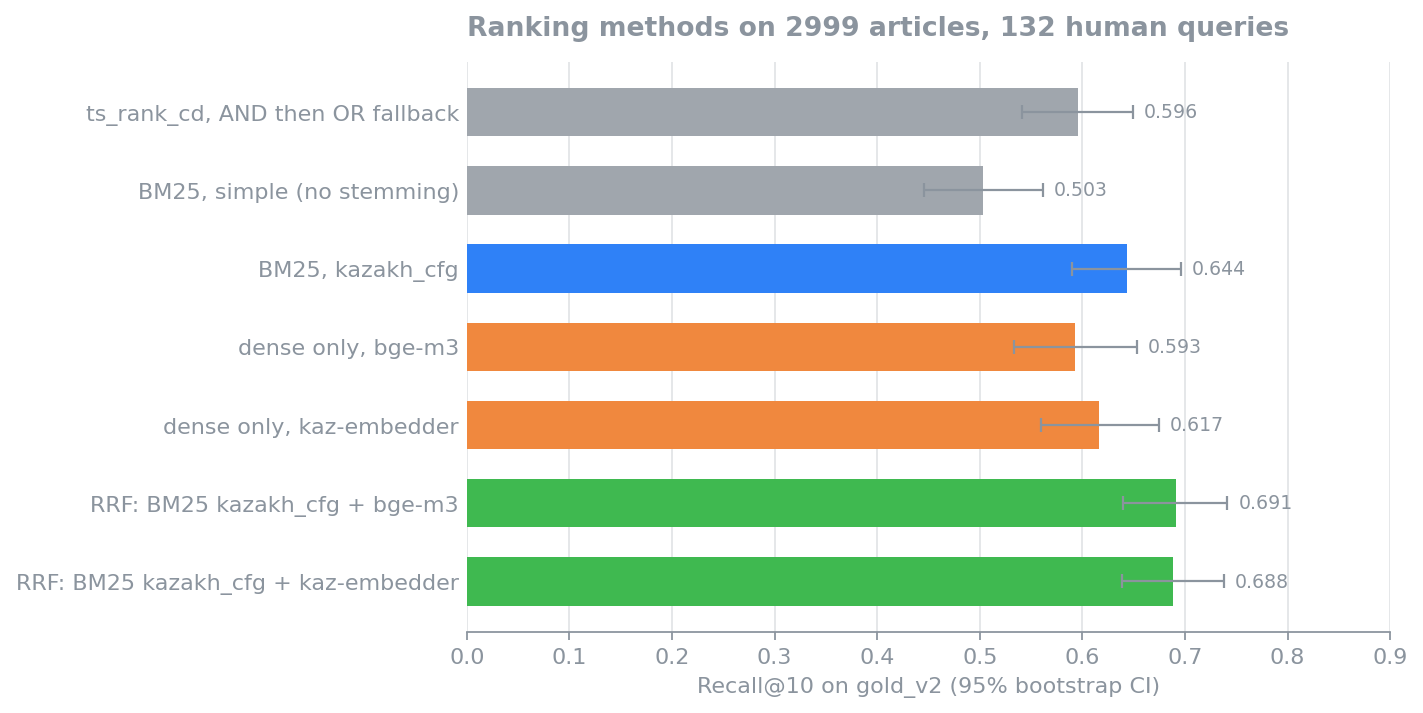
| Ranking | R@10 | MRR@10 | R@50 | Δ R@10 vs AND then OR | Median ms per query |
|---|---|---|---|---|---|
ts_rank_cd, AND then OR |
0.596 | 0.745 | 0.875 | baseline | 3.2 |
BM25, simple (no stemming) |
0.503 | 0.694 | 0.783 | −0.092 [−0.161, −0.023] | 0.7 |
BM25, kazakh_cfg |
0.644 | 0.790 | 0.925 | +0.048 [+0.004, +0.095] | 0.6 |
| Dense only, BAAI/bge-m3 | 0.593 | 0.731 | 0.875 | −0.003 [−0.067, +0.063] | 2.8 |
| Dense only, kaz-embedder | 0.617 | 0.713 | 0.878 | +0.021 [−0.039, +0.084] | 2.5 |
RRF of BM25 kazakh_cfg + bge-m3 |
0.691 | 0.814 | 0.935 | +0.095 [+0.046, +0.148] | 3.2 |
RRF of BM25 kazakh_cfg + kaz-embedder |
0.688 | 0.820 | 0.933 | +0.093 [+0.047, +0.142] | 3.5 |
Switching the ranking function from ts_rank_cd to BM25 on the stemmed index is the upgrade that needs no model (+0.048 R@10, 95% CI +0.004 to +0.095). The interval for each dense-only row against the baseline includes zero (−0.003 and +0.021 R@10). Fusing the BM25 list with a dense list by reciprocal rank fusion (k=60, top-100 from each) adds +0.048 R@10 over BM25 alone with bge-m3 (95% CI +0.017 to +0.080) and +0.045 with kaz-embedder (95% CI +0.012 to +0.079). The two fusion rows score 0.691 and 0.688 R@10. report_hybrid.json has no paired comparison between them, so the table does not show whether they differ.
flowchart LR
    subgraph IDX["index time"]
        direction TB
        D["title + body"] --> B1["bm25 index<br/>text_config = public.kazakh_cfg"]
        D --> E1["embedding vector(1024)<br/>computed by the application"] --> H1["hnsw index<br/>vector_cosine_ops"]
    end
    subgraph QRY["query time, one SQL statement"]
        direction TB
        Q["query text"] --> B2["top-100 by BM25<br/>doc <@> to_bm25query(q)"]
        Q --> E2["query embedding<br/>same model"] --> H2["top-100 by cosine<br/>embedding <=> qvec"]
        B2 --> F["RRF, sum of 1 / (60 + rank)"]
        H2 --> F --> T["top-10"]
    end
    IDX ~~~ QRY
pg_textsearch needs shared_preload_libraries = 'pg_textsearch' and a schema-qualified configuration name:
CREATE INDEX ON articles USING bm25 ((title || E'\n' || body))
    WITH (text_config = 'public.kazakh_cfg');
examples/hybrid-search.sql has the full schema and the one-statement RRF query. just hybrid-up starts PostgreSQL 18 with all three extensions on port 55439.
Kaz-RAG, a second independent benchmark
Kaz-RAG-search-benchmark is a Kazakh retrieval benchmark by another author, with 300 queries over 8,370 Kazakh Wikipedia passages in three categories. just eval-external runs pg_kazsearch through the benchmark's own tokenizer, BM25 (k1=1.5, b=0.75), metrics, and bootstrap at commit 08bc105, changing only the stemmer. The no-stemming run and the run with the benchmark's own stemmer reproduce its published nDCG@10 to the last digit (0.690 and 0.754), which is the check that the harness is theirs and not ours.
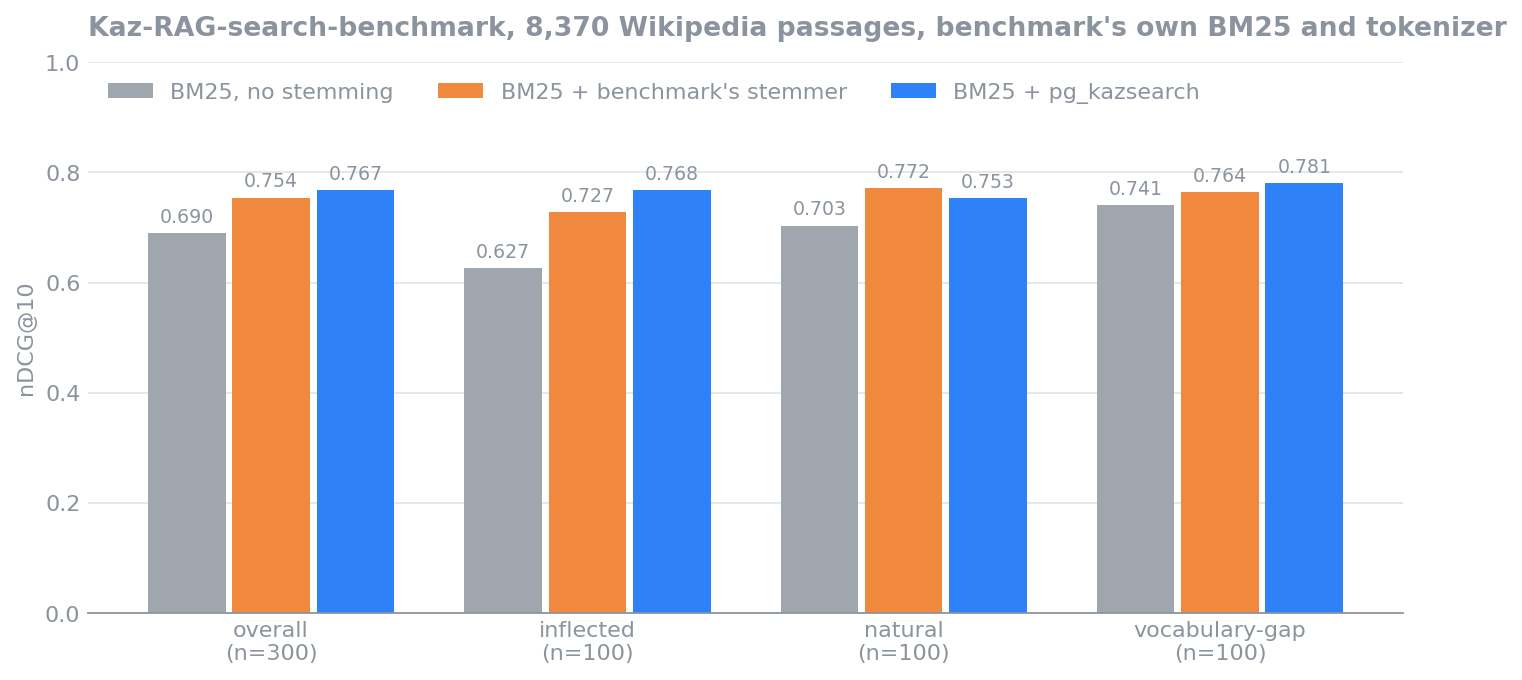
| nDCG@10 (n=300) | overall | inflected | natural | vocabulary-gap |
|---|---|---|---|---|
| BM25, no stemming | 0.690 | 0.627 | 0.703 | 0.741 |
| BM25 + the benchmark's stemmer | 0.754 | 0.727 | 0.772 | 0.764 |
| BM25 + pg_kazsearch | 0.767 | 0.768 | 0.753 | 0.781 |
pg_kazsearch against no stemming is +0.077 nDCG@10 overall (95% CI +0.041 to +0.113) and +0.142 on the inflected category (95% CI +0.072 to +0.213). On the natural and the vocabulary-gap categories the intervals for that pair include zero (−0.004 to +0.106 and −0.021 to +0.101). Against the benchmark's own stemmer the difference is +0.013 overall (95% CI −0.011 to +0.036), and the interval for that pair includes zero in every category, so this set does not establish a difference between the two stemmers in either direction. The benchmark's own results page reports dense BGE-M3 at 0.866 nDCG@10 on these queries. That is their measurement, not one of ours, and no paired comparison against it is committed. The hybrid section measures BM25 and an embedding model combined.
Keyboard restoration
Measured with python3 eval/measure_keyboard_fold.py (token level, eval/results/keyboard_fold.json) and eval/run_eval.py on gold_v2 typed both ways (eval/results/kb_*.json):
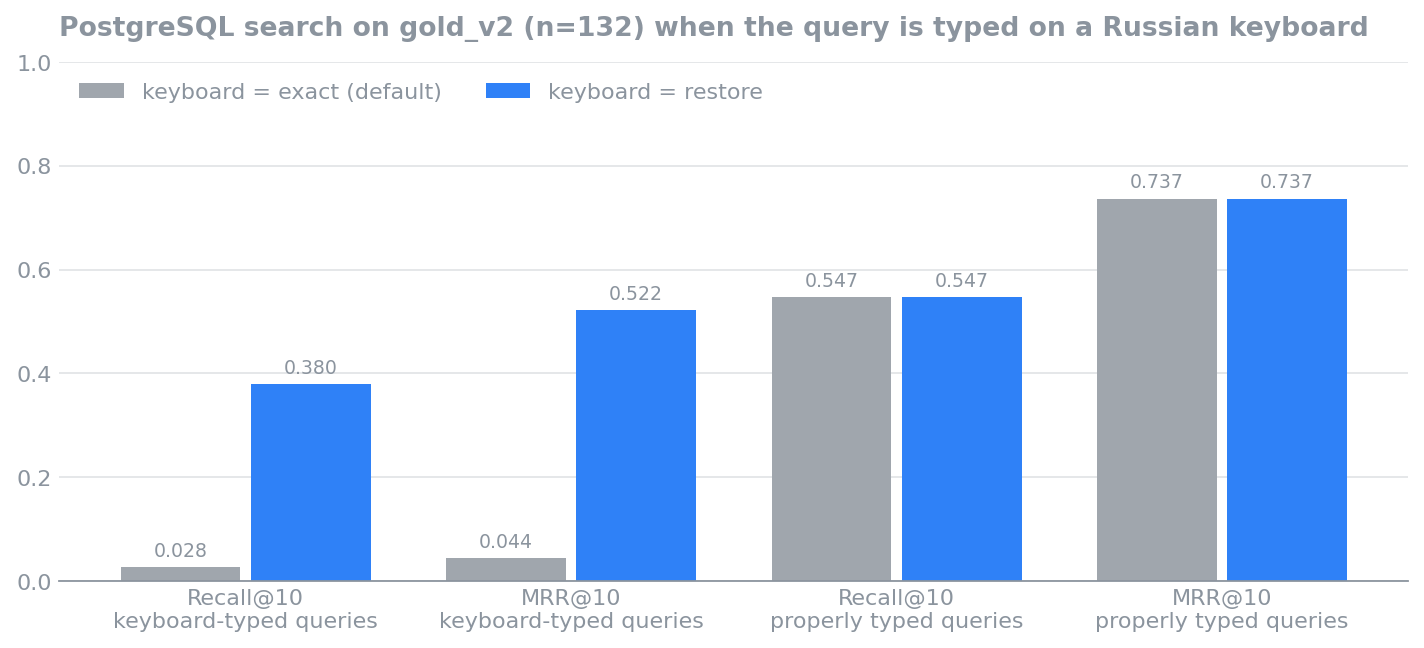
keyboard = exact |
keyboard = restore |
|
|---|---|---|
| Keyboard-typed corpus tokens that reach the proper stem | 1.6% | 74.9% |
| Correctly typed tokens without Kazakh letters whose stem changes | 0.12% (mostly names) | |
Keyboard-typed gold_v2 queries, R@10 / MRR@10 |
0.028 / 0.044 | 0.380 / 0.522 |
Correctly typed gold_v2 queries, R@10 / MRR@10 |
0.547 / 0.737 | 0.547 / 0.737 |
Of the keyboard-typed tokens that still miss, 59% have a one-syllable root that the policy refuses to restore (бұл, бір, үшін) and 23% have a proper stem that is not in the lexicon, mostly names.
pg_kazsearch against pg_trgm
A trigram index is the usual fallback when no stemmer exists. Both systems run on one seeded 500-query sample, with pg_trgm matching titles at similarity threshold 0.3, which eval/run_eval.py picks for pg_trgm by pg_trgm's own F1 at k=10. eval/results/report.json holds no paired interval for this pair, so the table reports the two values and no difference between them:
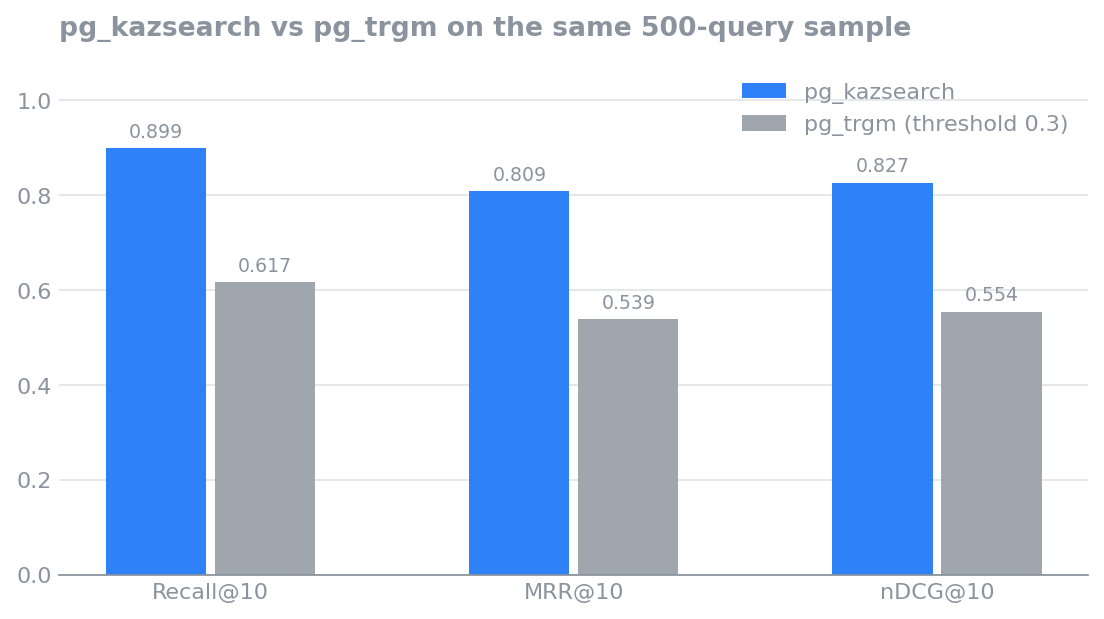
| Metric | pg_kazsearch | pg_trgm |
|---|---|---|
| Recall@10 | 0.899 | 0.617 |
| MRR@10 | 0.809 | 0.539 |
| nDCG@10 | 0.827 | 0.554 |
The sample is mostly auto queries, which are mined from the documents they must find.
Token coverage
Measured over the 45,708 tokens in core/tests/bench_tokens.txt with python3 eval/measure_stem_coverage.py (eval/results/stem_coverage.json):
| Rate | Value | Meaning |
|---|---|---|
| Analyzed | 75.9% | a suffix was stripped |
| Stem in lexicon | 74.9% | the final stem is a dictionary lemma |
| Recognized | 86.9% | stemmed, or already a dictionary lemma |
Elasticsearch
Measured with the v2.3.0 release of the plugin (python3 eval/run_eval_es.py, eval/results/report_es.json), standard tokenizer and lowercase filter on both sides, only the stem filter differs. report_es.json holds no intervals, so the table reports the two values and no difference between them:
| Query set | Metric | kazsearch_stem |
standard |
|---|---|---|---|
| gold (human, n=51) | Recall@10 | 0.396 | 0.309 |
| MRR@10 | 0.663 | 0.591 | |
| gold_v2 (human, n=132) | Recall@10 | 0.524 | 0.451 |
| MRR@10 | 0.669 | 0.569 |
The Elasticsearch run has not been repeated on main, because the plugin build needs a JDK that the measurement machine lacks. The stemmer inside the plugin is the same Rust crate, so the PostgreSQL results in this section use the current stemmer, but the Elasticsearch numbers themselves are from v2.3.0.
Snowball algorithm
snowball/kazakh.sbl is a rule-only Kazakh stemmer written for the Snowball compiler, for engines that cannot load a native library. just eval-snowball builds the pinned Snowball compiler into .cache/snowball, clones the Kaz-RAG checkout into .cache/kazrag, scores the algorithm with the same BM25 harness on both collections, and writes eval/results/snowball.json:
| Recall@10 | gold_v2 (news) | Kaz-RAG (Wikipedia) |
|---|---|---|
| no stemming | 0.524 | 0.830 |
Snowball kazakh.sbl |
0.626 | 0.920 |
| Rust, no lexicon | 0.637 | 0.910 |
| Rust + lexicon | 0.663 | 0.910 |
On the news queries the Rust engine with its lexicon is +0.037 Recall@10 above Snowball (95% CI +0.002 to +0.077, eval/results/snowball.json), and the engine without the lexicon against Snowball is +0.011 (95% CI −0.024 to +0.048). On Kaz-RAG the one paired interval in snowball.json between two stemmers is Snowball against the engine without the lexicon, +0.010 Recall@10 (95% CI −0.017 to +0.037). The file has no interval for Snowball against the engine with the lexicon, so for that pair it gives only the two values, 0.920 and 0.910. On the 1,929 KazQAD questions (eval/results/kazqad.json) the engine with its lexicon against Snowball is −0.002 nDCG@10 (95% CI −0.009 to +0.005), an interval that includes zero, and Snowball is +0.017 above the engine without the lexicon (95% CI +0.009 to +0.026).
An automated search did not improve the algorithm on unseen questions. A pi-autoresearch loop ran 60 grammatically motivated rule changes against KazQAD train (3,487 questions). eval/sbl_autoresearch.py kept a change only when its 99% paired-bootstrap lower bound on train was above zero, its validation gain was positive, and news recall did not drop. Four changes passed, for +0.008 nDCG@10 on train and +0.008 on validation. On the 1,929 test questions, which the loop never read, the gain is +0.003 (95% CI −0.001 to +0.007, eval/results/sbl_autoresearch_holdout.json). That interval includes zero, so the submitted algorithm stays as it is. eval/autoresearch/ holds the session prompt, gate scripts, the log of all 60 runs and the final candidate.
Against the site's own search
These counts were taken by hand in July 2026 against kaz.tengrinews.kz/search/?text=… and an Elasticsearch index that uses kazsearch_stem, and they are carried over from the v2.3.0 README. Raw counts are not comparable, because tengrinews searches its full archive and our index holds 2,999 articles, so the signal is whether inflections of one word find the same documents:
| Query form | tengrinews.kz (full archive) | ES + kazsearch_stem (2,999 docs) |
|---|---|---|
| мектеп | 906 | 156 |
| мектептердегі | 110 | 156 |
| мектептерімізде | 1 | 156 |
With kazsearch_stem, all three forms return the same 156 articles. On tengrinews.kz the possessive form returns 1 result from an archive that returns 906 for the bare word.
Stemmer examples
| Input | Output | What was stripped |
|---|---|---|
| мектептерімізде | мектеп | plural, possessive, locative |
| президенттерінің | президент | plural, possessive, genitive |
| өзгеруі | өзгер | possessive, then the verbal noun -у onto the verb root |
| тағайындалған | тағайындал | lexicalized participle onto the verb root |
| берді | бер | past tense |
| экономикалық | экономика | derivational adjective |
| almalar | алма | Latin script, plural |
онимдери (with keyboard = restore) |
өнім | keyboard folding, plural, possessive |
Install
PostgreSQL from a package (Debian, Ubuntu)
Download the .deb for your PostgreSQL major from GitHub Releases and install it:
curl -LO https://github.com/darkhanakh/pg-kazsearch/releases/latest/download/postgresql-18-pg-kazsearch_2.3.0_amd64.deb
sudo dpkg -i postgresql-18-pg-kazsearch_2.3.0_amd64.deb
Then, in psql, CREATE EXTENSION pg_kazsearch;.
PostgreSQL in Docker
ghcr.io/darkhanakh/pg-kazsearch:18 (also :17 and :16) is the official postgres image plus the extension:
services:
  db:
    image: ghcr.io/darkhanakh/pg-kazsearch:18
To add the extension to your own image, copy the three groups of files out of ours:
FROM ghcr.io/darkhanakh/pg-kazsearch:18 AS kazsearch
FROM postgres:18

COPY --from=kazsearch /usr/share/postgresql/18/extension/pg_kazsearch* /usr/share/postgresql/18/extension/
COPY --from=kazsearch /usr/lib/postgresql/18/lib/pg_kazsearch* /usr/lib/postgresql/18/lib/
COPY --from=kazsearch /usr/share/postgresql/18/tsearch_data/kaz_* /usr/share/postgresql/18/tsearch_data/
PostgreSQL from source
You need a Rust toolchain, cargo-pgrx 0.17.0, and the server headers for your PostgreSQL major:
cargo install --locked cargo-pgrx --version "=0.17.0"
cargo pgrx init --pg18 $(which pg_config)

git clone https://github.com/darkhanakh/pg-kazsearch.git
cd pg-kazsearch
cargo pgrx install --release -p pg_kazsearch

cp data/tsearch_data/kaz_stems.dict data/tsearch_data/kaz_stems.dict.verbs data/tsearch_data/kaz_stopwords.stop \
   $(pg_config --sharedir)/tsearch_data/
Elasticsearch
Elasticsearch loads a plugin only on the exact version it was built for, so each release ships one ZIP per supported version (8.17.0, 8.17.10, 8.18.8, 8.19.18). Each ZIP bundles the native library for linux/amd64 and linux/aarch64 and the lexicon:
bin/elasticsearch-plugin install https://github.com/darkhanakh/pg-kazsearch/releases/latest/download/analysis-kazsearch-2.3.0-es8.18.8.zip
The plugin registers the kazsearch_stem token filter:
{
  "settings": {
    "analysis": {
      "filter": {
        "kaz_stem": { "type": "kazsearch_stem" }
      },
      "analyzer": {
        "kazakh": {
          "type": "custom",
          "tokenizer": "standard",
          "filter": ["lowercase", "kaz_stem"]
        }
      }
    }
  }
}
Filter settings, all optional:
lexicon_path, an absolute path to a lexicon file that replaces the bundled one.script_mode,auto(default) orcyrillic_only.keyboard,exact(default) orrestore.
Confirm the filter is live:
curl -X POST 'localhost:9200/my_index/_analyze' \
  -H 'Content-Type: application/json' \
  -d '{"analyzer": "kazakh", "text": "алмаларымыздағы мектептеріміздегі"}'
# tokens: алма, мектеп
For an Elasticsearch version that has no ZIP, build one. You need a Rust toolchain, JDK 21, Gradle 8, and cargo-zigbuild:
just es-native                                          # Rust cdylib into the plugin resources
just es-build                                           # elastic/java/build/distributions/analysis-kazsearch-2.3.0.zip
cd elastic/java && gradle bundlePlugin -PesVersion=8.18.8   # stamp a specific ES version
Upgrading
A stemmer upgrade changes the output for some words. Rows indexed by the old version keep the old stems while new queries get the new ones, so the two sides stop matching for exactly the words the upgrade changed. Reindex after every upgrade.
PostgreSQL, after installing the new package:
ALTER EXTENSION pg_kazsearch UPDATE;
UPDATE articles SET title = title;   -- rewrites each row, which regenerates the STORED tsvector
VACUUM (ANALYZE) articles;
If triggers fill your tsvector column, rerun the population query instead. Sessions opened before the upgrade keep the old dictionary until they reconnect.
For Elasticsearch, remove the old plugin, install the ZIP that matches the new version on every node, restart, then POST _reindex into a fresh index or re-ingest from source.
Configuration
Russian-keyboard restoration
The shipped pg_kazsearch_dict stays on keyboard = exact. To restore keyboard-typed input, create a second dictionary and configuration, and use that configuration for both to_tsvector and the query functions:
CREATE TEXT SEARCH DICTIONARY kazakh_kb_dict (
    TEMPLATE = pg_kazsearch_template, lexicon = kaz_stems, keyboard = restore
);
CREATE TEXT SEARCH CONFIGURATION kazakh_kb_cfg (COPY = kazakh_cfg);
ALTER TEXT SEARCH CONFIGURATION kazakh_kb_cfg
    ALTER MAPPING REPLACE pg_kazsearch_dict WITH kazakh_kb_dict;

SELECT ts_lexize('kazakh_kb_dict', 'онимдери');         -- {өнім}
SELECT ts_lexize('kazakh_kb_dict', 'мектептеримизде');  -- {мектеп}
SELECT ts_lexize('kazakh_kb_dict', 'республикасынын');  -- {республика}
Restoration needs the lexicon and warns and stems exactly without it. Elasticsearch takes "keyboard": "restore" on the filter, and the CLI takes --keyboard restore.
Script mode
ALTER TEXT SEARCH DICTIONARY pg_kazsearch_dict (script_mode = cyrillic_only);
The CLI flag is --cyrillic-only and the Elasticsearch setting is script_mode.
Penalty weights
The scoring weights are dictionary options and change without a restart:
ALTER TEXT SEARCH DICTIONARY pg_kazsearch_dict (w_deriv = 3.5, w_short_char = 100.0);
just optimize runs the CMA-ES search that produced the defaults, and just apply-weights pushes its result to the running database. One weight rarely moves alone, so remeasure with just eval-search after a change.
Command line
cargo build -p kazsearch-cli --release

target/release/kazsearch stem -l data/tsearch_data/kaz_stems.dict алмаларымыздағы
# алмаларымыздағы	алма

target/release/kazsearch analyze -l data/tsearch_data/kaz_stems.dict мектептеріміздегі
# both tracks, their penalties, and the lexicon hit that decided

target/release/kazsearch stem -l data/tsearch_data/kaz_stems.dict --keyboard restore онимдери
# онимдери	өнім

target/release/kazsearch bench wordlist.txt
target/release/kazsearch lexicon validate data/tsearch_data/kaz_stems.dict
Without -l the CLI stems with rules alone, which is what the extension does when a dictionary is created without the lexicon option.
Development
Everything runs through just:
| Command | What it does |
|---|---|
just up / just down |
Start or stop the PostgreSQL 18 dev container (docker/Dockerfile, target dev) |
just build |
Rebuild the lexicon, compile the extension inside the container, and install it |
just reload |
just build, then DROP and CREATE EXTENSION |
just test-core |
Rust unit tests for kazsearch-core |
just test-ext |
Smoke-test the extension over SQL |
just cli |
Build the CLI |
just es-up / just es-down |
Build the plugin and start an Elasticsearch 8.17.0 container with it |
To reproduce the benchmarks, link or scrape the corpus into data/corpus/articles.jsonl (just scrape fetches it), then:
| Command | Produces |
|---|---|
just up && just load-corpus && just gen-queries && just eval-search |
eval/results/report.json |
python3 eval/measure_query_strategies.py |
eval/results/query_strategies.json |
just hybrid-deps && just hybrid-up && just hybrid-eval --models bge_m3 kaz_embedder |
eval/results/report_hybrid.json |
just eval-kazqad |
eval/results/kazqad.json |
just eval-external |
eval/results/external_kazrag.json |
python3 eval/measure_keyboard_fold.py |
eval/results/keyboard_fold.json and eval/gold_queries_v2.kbfold.jsonl |
python3 eval/measure_stem_coverage.py |
eval/results/stem_coverage.json |
just es-load-corpus && just es-eval |
eval/results/report_es.json |
just eval-snowball |
eval/results/snowball.json |
python3 scripts/gen_readme_charts.py |
the PNG files in docs/img/ |
just eval-kazqad, just eval-external, and just eval-snowball fetch what they need into .cache/ on the first run. The KazQAD files are pinned by SHA-256, the Kaz-RAG checkout at commit 08bc105, and the Snowball compiler at commit 6389c79. just eval-kazqad needs uv and about 4 GB of memory.
Contributing
Stemmer logic lives in core/src/, extension glue in pg_ext/src/lib.rs, and the plugin bridge in elastic/. Before opening a pull request, run cargo test -p kazsearch-core and just up && just reload && just test-ext. Three things to know before touching core/src/explore.rs:
- The penalty weights were fitted together with CMA-ES, so changing one moves cases that look unrelated. Remeasure.
- Each layer guard encodes a morphotactic constraint, and removing one brings back a class of wrong stems.
- Vowel harmony is a hard filter on every suffix, with the glides у, и, and ю transparent.
Commits follow Conventional Commits (feat:, fix:, docs:), one change per commit.
References
- Krippes, K.A. (1993). Kazakh (Qazaq) Grammatical Sketch with Affix List. ERIC.
- Washington, J., Salimzyanov, I., Tyers, F. (2014). Finite-state morphological transducers for three Kypchak languages. LREC.
- Makhambetov, O. et al. (2015). Data-driven morphological analysis and disambiguation for Kazakh. CICLing.
Licence
- Code: LGPL-3.0.
- Lexicon data: derived from Apertium-kaz (GPL-3.0).
snowball/: BSD-3-Clause, prepared for submission to Snowball. Its word lists come from Kazakh Wikipedia (CC BY-SA 3.0).eval/results/kazqad.jsonquotes questions and passage excerpts from KazQAD (CC BY-SA 4.0).
Explore related projects
Asabeneh/30-Days-Of-Python
The 30 Days of Python programming challenge is a step-by-step guide to learn the Python programming language in 30 days. This challenge may take more than 100 days. Follow your own pace. These videos may help too: https://www.youtube.com/channel/UC7PNRuno1rzYPb1xLa4yktw
78,486 starsgrafana/grafana
The open and composable observability and data visualization platform. Visualize metrics, logs, and traces from multiple sources like Prometheus, Loki, Elasticsearch, InfluxDB, Postgres and many more.
77,790 starsredis/redis
For developers, who are building real-time data-driven applications, Redis is the preferred, fastest, and most feature-rich cache, data structure server, and document and vector query engine.
77,332 starsapache/superset
Apache Superset is a Data Visualization and Data Exploration Platform
75,455 stars