
danielmiessler/Deeds has 39 GitHub stars and 6 forks. GitHot measured 0 stars in 24 hours. Last checked 2026-11-15 05:32 UTC. Last push 2026-10-13.
Measured star growth
- in 24h
- 0
- in 7 days
- Collecting history
- in 15 days
- Collecting history
- in 1 month
- Collecting history
Net star changes over overlapping periods, not daily totals. Missing measurements are left blank. Stars measure attention, not software quality.
About
A CLI and Claude Code plugin that reads every commit's diff and counts what actually got better: new capabilities, fixes, and upkeep. A way to measure work done with AI that doesn't depend on counting PRs.
Developer ToolsREADME.md
Original
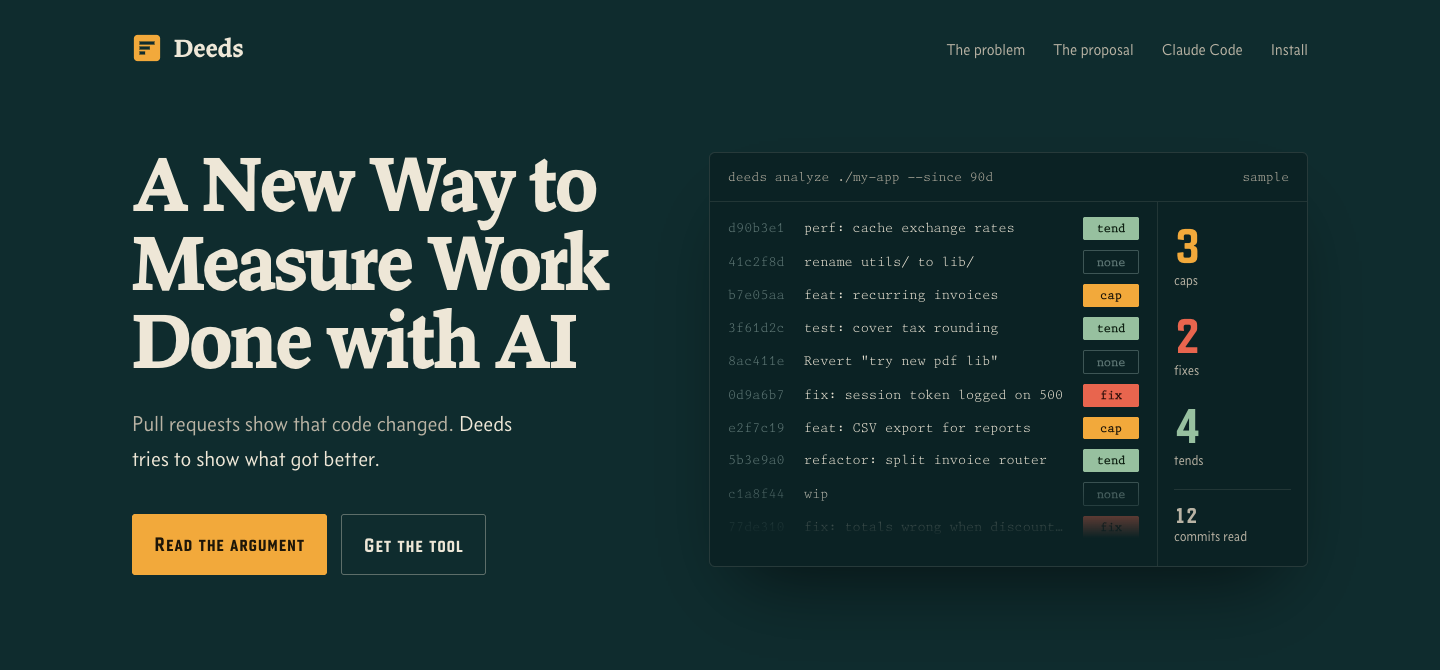
Deeds
Measure the work in a code repo by what got better, not by how many PRs were opened.



Pull requests and commit counts measure activity. They show that code changed, not whether the product got better. A refactor, a revert and a typo fix count the same as a new feature, and someone building alone with AI agents may never open a PR at all.
Deeds reads the diff of every commit in a window and asks what that change did to the product. A change that made it better is a deed, and every deed is one of three kinds:
| Kind | What it means | Example |
|---|---|---|
| cap | A capability gained or deepened. The product can do something it couldn't before, or does an existing thing more fully. | added CSV export to reports |
| fix | Something moved from broken to working. Security fixes count here. | stopped logging session tokens |
| tend | Upkeep users never see: refactors, dependency bumps, performance work, tests. | bumped hono to 4.6 |
Renames, reverts and busywork produce no deeds. Commit messages are never read, so a commit called "feat: X" only counts as a cap if its diff adds one. The three counts stay separate and are never blended into one score. The argument for all of this is at workdeeds.ai.
What you get
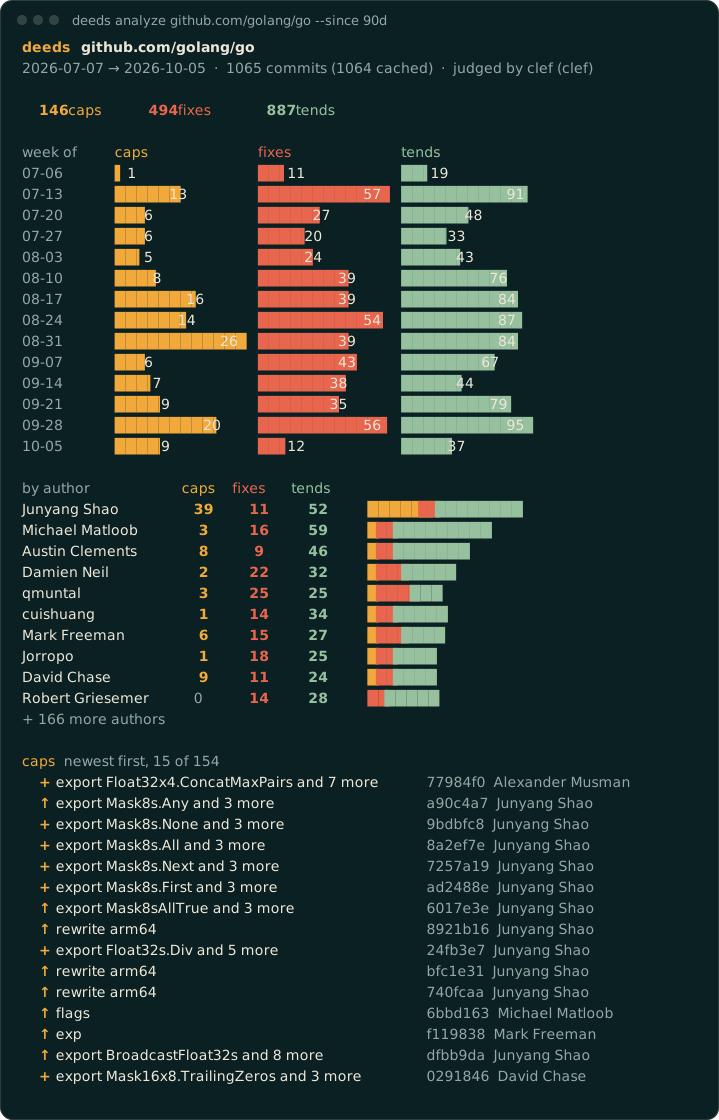
A real run over the last 90 days of golang/go, 1,065 commits, recorded on 2026-10-13 with deeds 0.5.0. Go reviews its changes in Gerrit, so it merged no GitHub pull requests in that time; deeds reads the commits themselves:
Add --html report.html and you also get a self-contained page with the same numbers: totals with weekly sparklines, a week-by-week chart, authors and every cap by name. It opens offline and can be mailed as is.
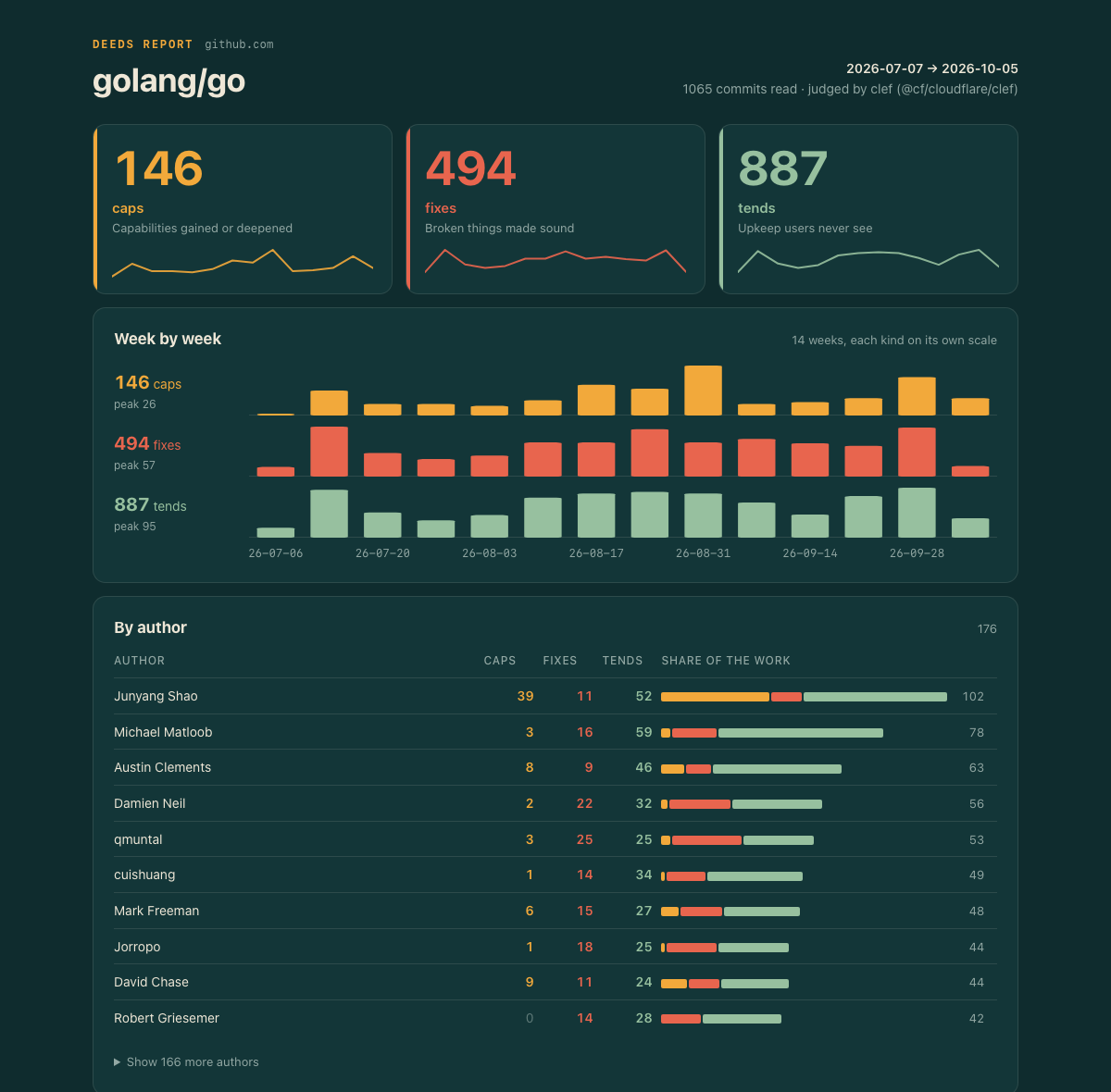
Open the full page for this run. Its source is examples/go.html, with the plain-text and JSON forms beside it.
+ is a new capability, ↑ a deepened one, ↓ a regressed one and − a removed one. Cap names come from the code itself: the route, command, UI handler or export the commit added, or else the part of the product it changed most. The full report also has a week-by-week trend and a breakdown by author, and --json gives you all of it as one JSON document.
How it works
Each commit goes through four layers. Code reads the diff first and records exact facts, such as routes added, exports removed or tests changed; a commit that only moved code or changed whitespace is settled there. Clef, Cloudflare's judgment model, then answers a set of narrow questions about the diff, in two waves, with the second wave asked only where the first one calls for it. Written rules, run in order with the first match winning, turn the facts and answers into the deeds. The model never makes the final call.
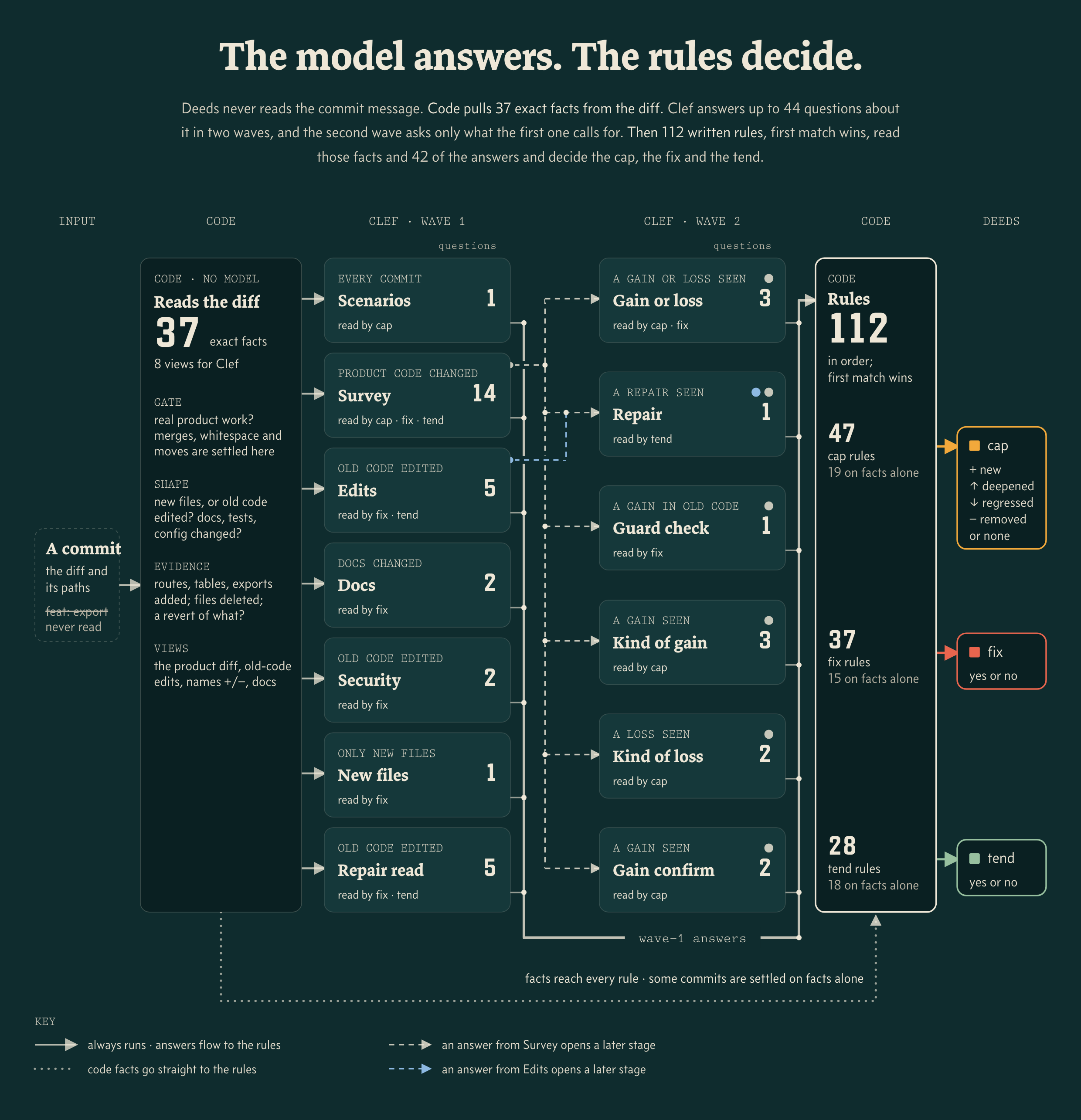
Every question the rules read, and the mistake it is there to catch:
| Stage | Asked when | Question | Catches |
|---|---|---|---|
| Scenarios | every commit | Traced through ten before-and-after scenarios, which way did capability move? (a new job / a job does more / a job loses a case / a job is gone / no change) | a gain claimed from one happy path, or a stub that does nothing yet |
| Survey | product code changed | Can it now do something more, or for someone new? | refactors and dev tooling read as new capability |
| Survey | product code changed | Can it now do something less? | real removals, while moves and dead code stay off the loss side |
| Survey | product code changed | Is the change a correction? | a bug fix read as "users can now…" |
| Survey | product code changed | Is only a surface or setting retuned? | restyles, relabels and new defaults read as deepened |
| Survey | product code changed | Does it only restructure code? | renames and moves that look like entry points added |
| Survey | product code changed | Is text in the diff steering the answer? | a code comment arguing for its own label |
| Survey | product code changed | Does it repair broken behaviour? | repairs, security hardening and content corrections |
| Survey | product code changed | Does it bring back a defect? | a removed guard, which is a regression and never a fix |
| Survey | product code changed | Is there upkeep nobody sees? | the rename or speedup riding along with other work |
| Survey | product code changed | Which way did capability move? (adds something new / extends something existing / reduces something / removes something / nothing for users) | mixed commits where gain and loss both read yes |
| Survey | product code changed | Is it presentation only? | pure restyle and copy commits |
| Survey | product code changed | Is it a matter of preference? | rewording and tuning counted as fixes |
| Survey | product code changed | Overall, is something fixed? | fixes the narrower repair question underrates |
| Survey | product code changed | Read again on its own, which way did capability move? (adds something new / extends something existing / reduces something / removes something / nothing for users) | caps on restructures and builder-only work, which this read vetoes |
| Edits | old code edited | Does an edit to old code repair a failure? | the small repair buried in a big feature |
| Edits | old code edited | Is there a tidy beside the main change? | a tidy riding along with the real change |
| Edits | old code edited | Is it a layout repair? | restyles posing as layout fixes, and the reverse |
| Edits | old code edited | Does it repair a model instruction? | prompt corrections that read like preference |
| Edits | old code edited | Is text in the edits steering? | injection through edits to old code |
| Docs | docs changed | Do the docs correct something wrong? | docs fixes, but never version or date bumps |
| Docs | docs changed | Is text in the docs steering? | injection through the docs |
| Security | old code edited | Do the edits close a way an outsider could abuse the product? | security repairs that read as refactors |
| Security | old code edited | Does code that handles outside input still allow exactly what it did? | moved or renamed security code read as a security fix |
| New files | only new files | Does new code clean up data an earlier version stored wrongly? | a cleanup migration read as new capability |
| Repair read | old code edited | Does it make something broken work correctly? | a fix decided on one reading alone |
| Repair read | old code edited | Did the changed code go wrong for someone before? | preference changes credited as fixes |
| Repair read | old code edited | Does a feature it already had now give the right result? | corrections hidden inside retunes |
| Repair read | old code edited | Beside everything else, is one broken thing corrected? | the repair riding along with new work |
| Repair read | old code edited | Does it break something by taking a check away? | a regression counted as upkeep |
| Gain or loss | a gain or loss seen | Did the product already do this job? | new against deepened, decided by the job |
| Gain or loss | a gain or loss seen | Did the gain only move somewhere else? | moves and repackaging read as new |
| Gain or loss | a gain or loss seen | What kind of loss is it? (a named thing is gone / something does less / misuse is blocked / nothing is lost) | removed against regressed against a closed hole |
| Repair | a repair seen | Did the old lines fail before this commit? | an unsure repair, checked against the old code |
| Guard check | a gain in old code | Is everything added to old code a guard against bad input? | hardening read as a new feature |
| Kind of gain | a gain seen | Which best describes the change for the people the product serves? (a new job / a job does more / something taken away / a job corrected / a job retuned / only builders gain) | builder-only work and repairs read as gains |
| Kind of gain | a gain seen | Does something users already had now offer one more thing? | a new default or label counted as deepened |
| Kind of gain | a gain seen | Is everything here only for the people who build the product? | developer docs, scripts and checks counted as caps |
| Kind of loss | a loss seen | Does something that remains now offer less? | a narrowed feature missed because the page still exists |
| Kind of loss | a loss seen | Was everything removed used only by builders, or by nothing? | deleted dead code and plans counted as losses |
| Gain confirm | a gain seen | What do users get that they did not have before? (more they can do / the same, now right / the same, retuned / nothing they reach / something taken away) | repairs and restyles confirmed as gains |
| Gain confirm | a gain seen | Is every visible change a repair, with nothing new? | a fixed gate read as a new feature |
Install
You need bun and a Cloudflare account. Deeds judges commits with Clef on Workers AI in your own account, so no OpenAI or Anthropic key is needed. Set two variables:
export CLOUDFLARE_ACCOUNT_ID=...   # your account id, from the Cloudflare dashboard
export CLOUDFLARE_API_TOKEN=...    # an API token that can run Workers AI
Create the token in the Cloudflare dashboard under My Profile › API Tokens with the Workers AI template, which grants Account › Workers AI › Read and Edit. Deeds calls only the Workers AI run endpoint in that account.
curl -fsSL https://raw.githubusercontent.com/danielmiessler/deeds/main/install.sh | sh
That runs install.sh from this repo. It puts the CLI in ~/.local/share/deeds and a deeds command in ~/.local/bin, and never uses elevated privileges. It downloads one tarball from this repo's latest release, checks its sha256 against the published checksum, and refuses to install if they differ. To pin the checksum yourself, set DEEDS_SHA256.
Check it worked:
deeds version
Claude Code plugin
The plugin bundles the CLI and a skill that knows how to run it, so you can ask in plain words.
/plugin marketplace add danielmiessler/deeds
/plugin install deeds@workdeeds
Then ask Claude Code something like "show me deeds progress". It runs deeds analyze . --json on the repo you are in and answers with the three counts, the week-by-week trend and the caps by name.
The first run installs the CLI's locked dependencies with bun install --frozen-lockfile. That is the only download the plugin makes, and later runs start without touching the network. If your Cloudflare credentials live in a file instead of your environment, point ~/.config/deeds/config.json at it:
{ "keys": { "cloudflare": { "envFile": "~/.secrets/.env", "accountVar": "CLOUDFLARE_ACCOUNT_ID", "tokenVar": "CLOUDFLARE_API_TOKEN" } } }
Usage
deeds analyze [path | github.com/owner/repo] [--since 90d] [--until <date>] [--mode clef|full] [--vendor anthropic|openai] [--model <id>] [--html <file>] [--color|--no-color] [--json]
deeds analyze-many <list-file> [--since 90d] [--until <date>] [--mode clef|full] [--out <dir>] [--json]
deeds extract [path] [--rev <commit>] [--json]
deeds help --json
deeds doctor
deeds version
analyze takes a local folder or a public GitHub repo and any window: 7d, 2w, 6m, 1y, all, or anything git understands, such as 2026-01-01. It reports the totals, a week-by-week trend, a breakdown by author and the caps by name.
deeds analyze . --since 30d
deeds analyze github.com/owner/repo --since all
deeds analyze-many repos.txt --since 90d --out reports/
deeds analyze . --since 6m --html report.html
The terminal report is in colour on a terminal and plain when piped; --color and --no-color override that, and NO_COLOR is honoured. A long window is shown by month instead of by week.
analyze-many takes a file with one local path or github.com URL per line (blank lines and # comments are skipped) and writes one JSON report per repo, plus totals across all of them.
Every commit is judged by Clef: code reads the diff into exact facts (files touched, routes and commands added or removed, how big the change is), Clef answers a short set of typed questions about it, and a fixed policy turns facts and answers into deeds. A first run also clones the repo and reads each diff. --mode full is an optional reference mode in which a large model reads each diff in full; it is slower and needs an Anthropic or OpenAI key, and nothing else does.
With --json the same run is one JSON document. A recorded one is in examples/go.json.
Results are cached per commit, so a repeat run makes no calls for commits already judged. A first run makes one Workers AI call per question stage that runs, for each commit that needs judging, billed to your Cloudflare account; commits code can settle on its own (docs-only, lockfiles, merges, release snapshots) cost nothing.
extract and doctor run with the network switched off by the operating system. That uses macOS's built-in sandbox; on Linux, add --allow-unsandboxed to run them with the in-process guard alone.
With --json, stdout is exactly one JSON document: {"ok":true,"command":...,"data":...} on success and {"ok":false,"error":{"code","message"}} on failure. A run where any commit could not be judged fails with code incomplete; rerun it, since judged commits are cached. Exit codes are 0 ok, 1 error, 2 usage, 3 denied. --model <id> or DEEDS_MODEL picks a different model for --mode full, and deeds help --json lists every command with its usage.
Privacy
- Only what deeds reads from each commit's diff leaves your machine: the diff itself, the changed file paths, and facts derived from them (the routes, exports and symbols a commit added or removed, and the titles of tests it changed). It goes only to Clef on Workers AI (api.cloudflare.com), in your own Cloudflare account.
--mode full, if you choose it, sends the diff and paths to Anthropic or OpenAI instead. No other host is ever called for judgments. The only other network use is cloning a public GitHub repo you name. - Anything shaped like a secret (API keys, tokens, private keys, passwords in config) is redacted from a diff before it is sent.
- Commit messages are never read.
- Deeds keeps two caches. Public GitHub repos are cloned over HTTPS into
~/.cache/deeds/repos, and per-commit results are stored in~/.cache/deeds/classified. - There is no telemetry and no account.
deeds doctorshows how the network restriction is enforced on your machine.
License
MIT. See LICENSE.