
damiansire/angular-signals-playground
damiansire/angular-signals-playground has 92 GitHub stars and 1 forks. GitHot measured 0 stars in 24 hours. Last checked 2026-11-17 02:54 UTC. Last push 2026-11-10.
Measured star growth
- in 24h
- 0
- in 7 days
- Collecting history
- in 15 days
- Collecting history
- in 1 month
- Collecting history
Net star changes over overlapping periods, not daily totals. Missing measurements are left blank. Stars measure attention, not software quality.
About
An interactive playground and introduction to learning Angular Signals (computed, effect, linkedSignal, resource) hands-on.
LearningREADME.md
OriginalAngular Signals — Interactive Introduction
An interactive playground for learning Angular Signals from the ground up.
Instead of reading about reactivity, you watch it happen: every concept is a
small, self-contained screen where you can click, type and toggle to see how
signals, computed, effect and change detection actually behave.
▶ Open the live playground — no install, runs in the browser.
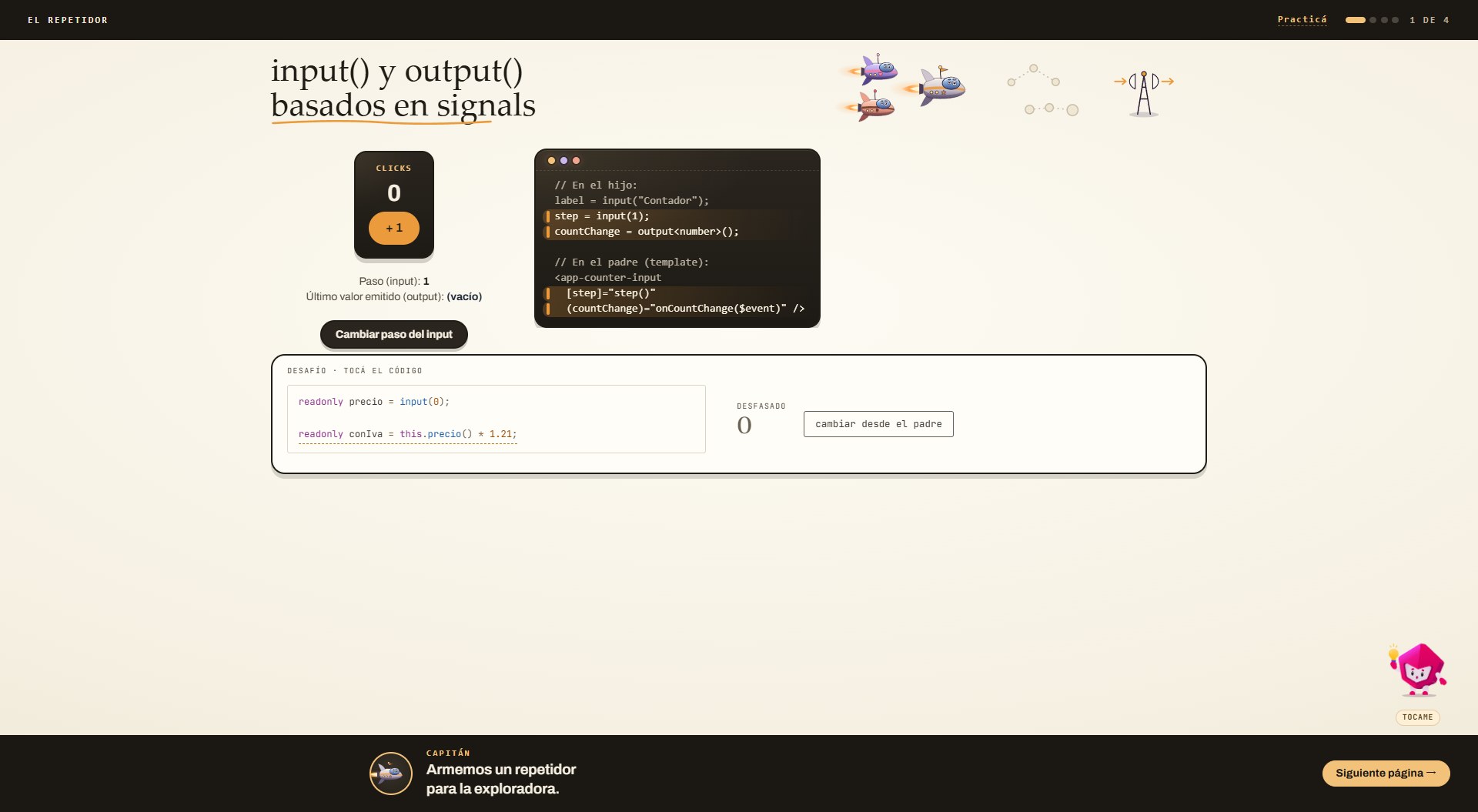
The default entry (/) is the integrated view: a "reactive molecule" tour
where each of the 11 chapters is an atom. Scroll to dive into an atom and its
sub-levels orbit the card, each one embedding the real demo component of that
lesson. Deep-links are shareable: ?nivel=1&sub-nivel=2 reopens exactly where
you were.
Played like a small RPG
The tour has a story. A crew of RxJS ships is dragged out of "Zone.js space" into a world of molecules where none of their operators work, and a guide (the Angular mascot) offers to teach them the rules. Each concept is a chapter of that trip:
- A cinematic per chapter. The first time you stop at a concept, a short cutscene sets up
the rule of that chapter as an incident of the crew (portrait and name of who speaks, one line
at a time).
Enteradvances,Escskips. The finale lights up only the chapters you actually established, so unfinished ones stay visible as debt. - Challenges you solve by touching the code. Every sub-level ends with a system whose code has a movable part and a reading that answers. The reading stays neutral until there is enough evidence, turns red if the system is broken and green once you fix it. No "well done" banner: the numbers are the answer.
- Saved progress. What you establish is stored in your browser (
localStorage,signals-cuaderno): reload and the molecule keeps its bonds. The prologue still plays after the hill every time, because it continues that scene; "Saltar intro →" skips it. - The logbook ("Bitácora", top bar): the chapters you established, the rule of the world you wrote in each one, and replays of the cinematics and the prologue.
- Sound that works on any machine. Everything is synthesized with one Web Audio context (characters "talk" with RPG-style blips); without audio support it simply stays silent. One switch mutes everything.
- Screening room.
/cine/6plays a chapter's cinematic directly, and/cine/6?cuadro=<beat>freezes one frame, useful to review scenes.
Scripted motion is CSS (springs solved by hand and fed to linear(), View Transitions for the iris,
lazy-loaded scenes). What answers the pointer (the mascot you can grab and stretch, the signal graphs
you can poke) runs on hand-rolled springs sharing one clock that sleeps when nothing moves: no
perpetual requestAnimationFrame, no expensive filters on moving things, and everything freezes when
the tab is hidden or honors prefers-reduced-motion.
Built with Angular 22 (standalone components, OnPush everywhere, signal-first
APIs) and styled with Tailwind CSS.
Why this exists
Signals are the biggest shift in Angular's reactivity model in years. This repo turns the official mental model into a guided, hands-on tour — useful both as a self-teaching resource and as a live demo for talks and workshops.
Learning path
The content is organized as progressive levels, each with focused sub-levels:
| Level | Topic | What you explore |
|---|---|---|
| 0 | Introduction | How Angular renders the DOM tree, classic change detection vs. signal-based change detection, HTML-to-tree visualization |
| 1 | Interacting with signals | Writable signals, set vs. update, read-only signals, the different kinds of signals |
| 2 | Computed signals | Derived state, dynamic dependencies, lazy evaluation & memoization |
| 3 | Effects | effect(), cleanup, manual destruction, what happens when a component is destroyed |
| 4 | Equality functions | Custom equality and when a signal doesn't notify its consumers |
| 5 | linkedSignal |
Writable state derived from a source: reset on change, or preserve if still valid |
| 6 | resource / rxResource / httpResource |
Async signals: value/status/error/isLoading with a Promise, an RxJS stream, or a real HTTP request |
| 7 | input · model · output · forms |
Signal-based component APIs: input()/output(), two-way model(), input.required() and transform, and Signal Forms (form(), validators, [formField]) |
| 8 | Queries & interop | viewChild()/viewChildren() and contentChild()/contentChildren() as signals, toSignal()/toObservable(), untracked() |
| 9 | afterRenderEffect & onCleanup |
Reading/measuring the DOM after render, and cleaning up effects without leaks |
| 10 | Debounced signals | A debounced value, three ways: RxJS (debounceTime), by hand (effect + onCleanup), and the native debounced() (experimental in v22) |
| 11 | Capstone: zoneless | Why signals + OnPush let Angular drop Zone.js (the default since v21; provideZoneChangeDetection() brings it back) |
Getting started
# 1. Install dependencies
npm install

# 2. Start the dev server (http://localhost:4200)
npm start
Requirements: Node.js 22 or newer (that is what
package.jsonenginesand.nvmrcpin, and what CI runs) and a Chromium-based browser for the unit tests.
Available scripts
| Script | Description |
|---|---|
npm start |
Dev server with HMR at http://localhost:4200 |
npm run build |
Production build into dist/angular-examples |
npm run watch |
Rebuild on change (development configuration) |
npm test |
Unit tests (Karma + Jasmine) |
npm run lint |
Lint with ESLint + angular-eslint |
npm run format |
Format src/ with Prettier |
npm run format:check |
Check formatting without writing |
npm run gate:prosa |
Prose budget per screen (ratchet: fails if a screen gets wordier) |
npm run test:scripts |
Unit tests for the gate scripts themselves (node --test) |
CI runs lint, format:check, test:scripts, gate:prosa, test and the
production build on every pull request, and GitHub Pages only deploys a commit
whose CI run went green.
Tech stack
- Angular 22 — standalone components, signals,
@if/@forcontrol flow @angular/build— esbuild/Vite-based toolchain- Tailwind CSS — utility-first styling
- ESLint + angular-eslint — linting and Angular best-practice rules
Project structure
src/app/
├── integrada-vista/  # The default entry (/): the "reactive molecule" tour of the 11 chapters
│   ├── cinematicas/  # Chapter cinematics: player, scripts and one lazy scene per chapter
│   └── bitacora/     # The logbook: established chapters, their rules, replays
├── signals/          # The learning levels (0–11) and their sub-levels
├── practice/         # Applied examples that use what you learned (/practica/*)
├── components/       # Feature components (histories, trees, forms…)
├── components-atom/  # Atomic UI building blocks (code block, concept card, title…)
├── components-draw/  # Drawing/visualization components (variable boxes, node tree)
├── layouts/          # Reusable page layouts (two-column, column + code)
├── libs/             # Framework-agnostic helpers (HTML parser, saved game, sound, springs)
├── interfaces/       # Shared TypeScript types
└── app.routes.ts     # Route tree that powers the leveled navigation
Conventions
- Change detection: every component uses
ChangeDetectionStrategy.OnPush. State that drives the view is held in signals; the few cases that aren't (e.g. router-event-driven menu state) explicitly callmarkForCheck(). - Standalone components with explicit
imports— noNgModules.
Non-goals
This is a teaching playground, not a library:
- It is not a reusable component or state library to
npm install. The demos are meant to be read and run, not consumed as a dependency. - It does not try to cover all of Angular, only the signals surface (reactivity,
computed,effect,resource, zoneless). - The integrated "molecule" view is a visual explainer, not a production UI pattern to copy verbatim.
Contributing
Bug fixes, new signals lessons and documentation improvements are welcome — see CONTRIBUTING.md. To report a security issue, see SECURITY.md.
License
Released under the MIT License.