
cuebook/cuelake
cuebook/cuelake has 290 GitHub stars and 30 forks. GitHot measured 0 in 7 days and 0 in 15 days. Last checked 2026-11-11 11:59 UTC. Last push 2022-05-25.
Use SQL to build ELT pipelines on a data lakehouse.
What you can do
- Upsert Incremental data. CueLake uses Iceberg’s merge into query to automatically merge incremental data.
- Create Views in data lakehouse. CueLake enables you to create views over Iceberg tables.
- Create DAGs. Group notebooks into workflows and create DAGs of these workflows.
- Elastically Scale Cloud Infrastructure. CueLake uses Zeppelin to auto create and delete Kubernetes resources required to run data pipelines.
Measured star growth
- in 24h
- Update delayed
- in 7 days
- 0
- in 15 days
- 0
- in 1 month
- Collecting history
Net star changes over overlapping periods, not daily totals. Missing measurements are left blank. Stars measure attention, not software quality.
README.md
Original





With CueLake, you can use SQL to build ELT (Extract, Load, Transform) pipelines on a data lakehouse.
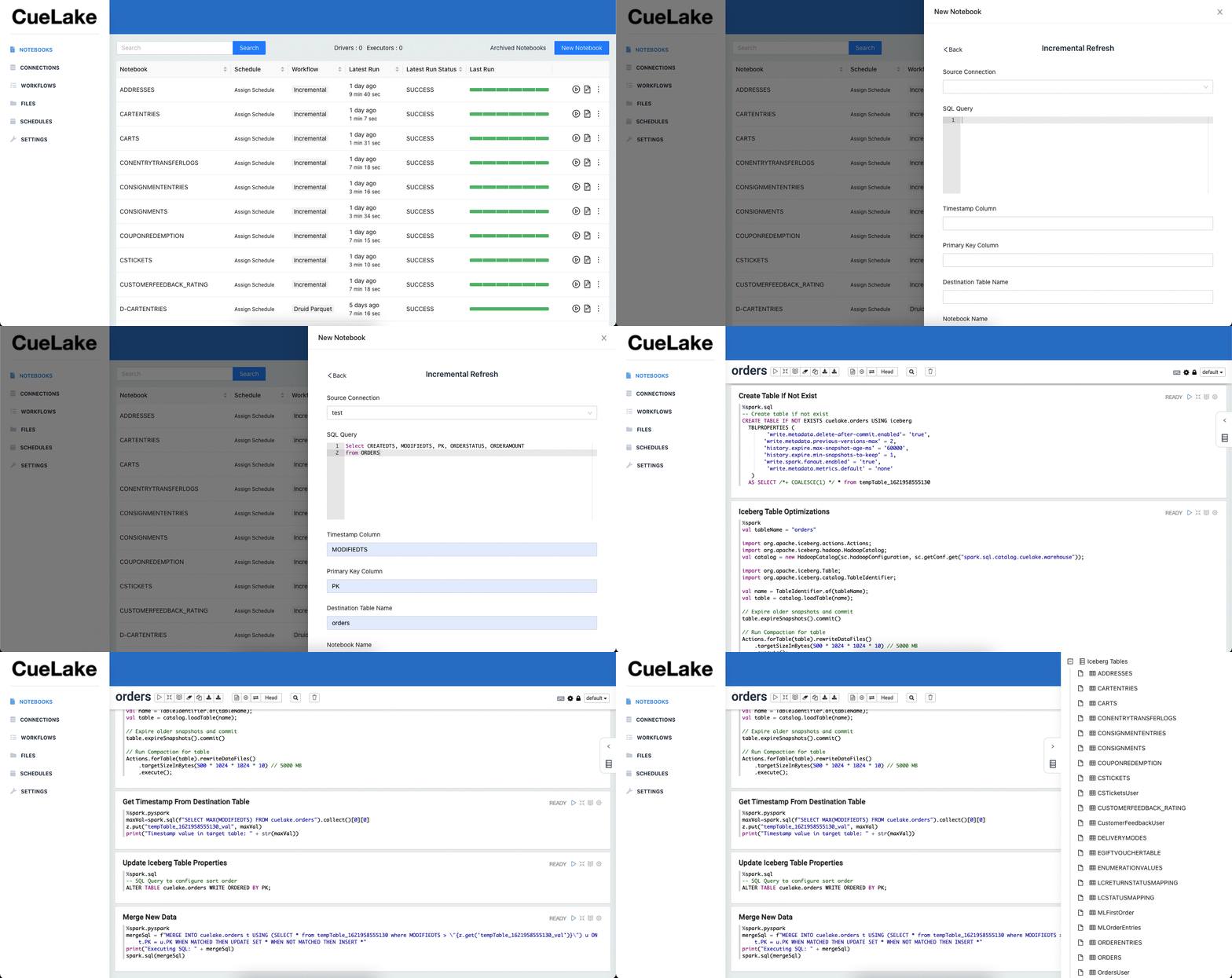
You write Spark SQL statements in Zeppelin notebooks. You then schedule these notebooks using workflows (DAGs).
To extract and load incremental data, you write simple select statements. CueLake executes these statements against your databases and then merges incremental data into your data lakehouse (powered by Apache Iceberg).
To transform data, you write SQL statements to create views and tables in your data lakehouse.
CueLake uses Celery as the executor and celery-beat as the scheduler. Celery jobs trigger Zeppelin notebooks. Zeppelin auto-starts and stops the Spark cluster for every scheduled run of notebooks.
To know why we are building CueLake, read our viewpoint.
Getting started
CueLake uses Kubernetes kubectl for installation. Create a namespace and then install using the cuelake.yaml file. Creating a namespace is optional. You can install in the default namespace or in any existing namespace.
In the commands below, we use cuelake as the namespace.
kubectl create namespace cuelake
kubectl apply -f https://raw.githubusercontent.com/cuebook/cuelake/main/cuelake.yaml -n cuelake
kubectl port-forward services/lakehouse 8080:80 -n cuelake
Now visit http://localhost:8080 in your browser.
If you don’t want to use Kubernetes and instead want to try it out on your local machine first, we’ll soon have a docker-compose version. Let us know if you’d want that sooner.
Features
- Upsert Incremental data. CueLake uses Iceberg’s
merge intoquery to automatically merge incremental data. - Create Views in data lakehouse. CueLake enables you to create views over Iceberg tables.
- Create DAGs. Group notebooks into workflows and create DAGs of these workflows.
- Elastically Scale Cloud Infrastructure. CueLake uses Zeppelin to auto create and delete Kubernetes resources required to run data pipelines.
- In-built Scheduler to schedule your pipelines.
- Automated maintenance of Iceberg tables. CueLake does automated maintenance of Iceberg tables - expires snapshots, removes old metadata and orphan files, compacts data files.
- Monitoring. Get Slack alerts when a pipeline fails. CueLake maintains detailed logs.
- Versioning in Github. Commit and maintain versions of your Zeppelin notebooks in Github.
- Data Security. Your data always stays within your cloud account.
Current Limitations
- Supports AWS S3 as a destination. Support for ADLS and GCS is in the roadmap.
- Uses Apache Iceberg as an open table format. Delta support is in the roadmap.
- Uses Celery for scheduling jobs. Support for Airflow is in the roadmap.
Support
For general help using CueLake, read the documentation, or go to Github Discussions.
To report a bug or request a feature, open an issue.
Contributing
We'd love contributions to CueLake. Before you contribute, please first discuss the change you wish to make via an issue or a discussion. Contributors are expected to adhere to our code of conduct.
Explore related projects
Asabeneh/30-Days-Of-Python
The 30 Days of Python programming challenge is a step-by-step guide to learn the Python programming language in 30 days. This challenge may take more than 100 days. Follow your own pace. These videos may help too: https://www.youtube.com/channel/UC7PNRuno1rzYPb1xLa4yktw
78,560 starsgrafana/grafana
The open and composable observability and data visualization platform. Visualize metrics, logs, and traces from multiple sources like Prometheus, Loki, Elasticsearch, InfluxDB, Postgres and many more.
77,830 starsredis/redis
For developers, who are building real-time data-driven applications, Redis is the preferred, fastest, and most feature-rich cache, data structure server, and document and vector query engine.
77,395 starsapache/superset
Apache Superset is a Data Visualization and Data Exploration Platform
75,473 stars