
crimeacs/auto-improve
crimeacs/auto-improve has 139 GitHub stars and 16 forks. GitHot measured 0 stars in 24 hours, +1 in 7 days, and +1 in 15 days. Last checked 2026-11-09 21:18 UTC. Last push 2026-08-03.
GAN-style self-improvement loop for any text artifact: mutate, grade with a SEPARATE model, keep only verified wins (pairwise-judged), revert the rest. The git history is the improvement log.
Measured star growth
- in 24h
- 0
- in 7 days
- +1
- in 15 days
- +1
- in 1 month
- Collecting history
Net star changes over overlapping periods, not daily totals. Missing measurements are left blank. Stars measure attention, not software quality.
README.md
Original
auto-improve
English | Русский



A GAN-style self-improvement loop for any text artifact. Point it at a file — bring a rubric, or let auto-improve write one from the artifact. It then mutates the file, grades each candidate with a strict, independent judge model, then filters them through a debiased pairwise gate (where candidate and champion are evaluated head-to-head in both orderings to cancel position bias). It keeps only the changes that genuinely win, and reverts the rest. By evaluating candidate mutations against this strict double-blind filter, auto-improve eliminates the "LLM slop" of unverified rewrites. The git history becomes the improvement log — every commit is a verified gain.
Works on anything text: emails, landing pages, prompts, READMEs, API designs, configs,
blog posts, cover letters. Don't have a rubric? Pass a one-line --goal (or nothing) and
it infers the right criteria first. Inspired by Karpathy's autoresearch — see Lineage.
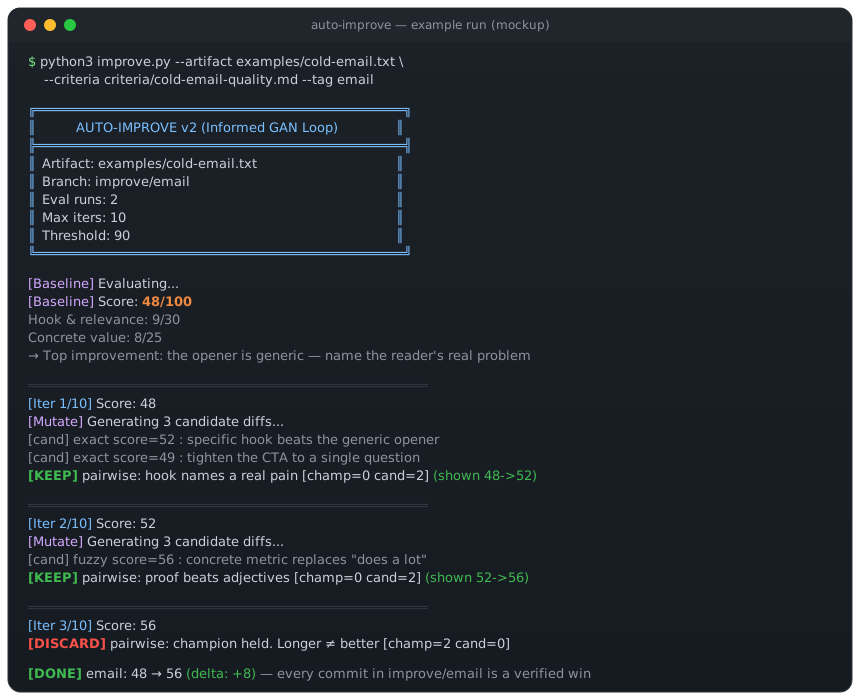
Mockup of a typical run: baseline score → verified KEEP steps → a weak candidate reverted → net gain.
Before → "I wanted to reach out because I think our product could really help your team. We've built an AI tool that does a lot of things…" After → "I saw your engineering team is scaling up deployment velocity this quarter, which usually strains QA. We cut regression cycles from 12 hours to under 15 minutes…"
Why it's different
The trap with "ask an LLM to improve this" is slop: the model rewrites confidently and you can't tell if it actually got better. auto-improve fixes that with two rules:
- A separate judge. The model that mutates never grades — grading is a fresh call against your rubric, so it can't grade its own homework.
- A pairwise keep/discard gate. Each candidate is evaluated head-to-head against the current champion. To cancel position bias (where LLMs favor the first option), the judge evaluates both orderings:
[Candidate, Champion]and[Champion, Candidate]. A mutation is kept only when the candidate receives more votes than the champion across those orderings; ties are discarded. Confident-but-worse rewrites get reverted, not shipped.
The result is a monotonic climb you can trust — and a git branch where every commit is a real improvement, fully diffable.
How it works
for each iteration:
  MUTATE   → ask the model for N candidate edits (best-of-N), applied as surgical diffs
  SCORE    → grade each candidate against the rubric (parallel, separate model)
  DECIDE   → pairwise-judge the best candidate vs. the champion; keep iff it wins
  COMMIT   → git-commit a keep (advance the branch) / discard the rest
- Surgical diffs, not rewrites — a crash-proof apply ladder (exact → unicode-canon → fuzzy) means a malformed edit is skipped, never corrupts the file. If an LLM-proposed patch fails to apply or corrupts syntax, the diff engine catches the exception, logs the failure, discards the malformed candidate, and falls back to evaluating the remaining intact candidates in the Best-of-N pool.
- Best-of-N — N candidates per round, so one bad draw doesn't stall the climb.
- The git history is the artifact —
git log improve/<tag>is your improvement trail.
Install
git clone https://github.com/crimeacs/auto-improve && cd auto-improve
pip install requests
export GEMINI_API_KEY=...        # free key: https://aistudio.google.com/apikey
Python 3.9+. One dependency (requests). Uses Google Gemini by default.
Quickstart
Run it on the bundled example (a weak cold email + a rubric):
python3 improve.py --artifact examples/cold-email.txt \
                   --criteria criteria/cold-email-quality.md --tag email
git log --oneline improve/email          # the improvement trail
git diff main improve/email -- examples/cold-email.txt
Or skip the rubric entirely — describe the goal and it writes the criteria first:
python3 improve.py --artifact path/to/your/file.md --tag v1 \
                   --goal "a landing hero that makes a developer try the product"
# → [Rubric] inferred from the artifact (saved to results/v1.rubric.md), then it climbs
The artifact must live inside a git repo — that's how keeps and discards are checkpointed. Run from your project root.
Usage
improve.py --artifact FILE --tag NAME [--criteria RUBRIC.md] [options]

  --artifact        file to improve (inside a git repo)
  --criteria        markdown rubric, dimensions totaling 100 (see criteria/).
                    OPTIONAL — omit it and a rubric is inferred from the artifact.
  --goal            one-line intent to steer the auto-generated rubric (optional)
  --tag             run id → git branch improve/<tag>, results/<tag>.tsv
  --max-iterations  default 10
  --candidates      candidate edits per round (best-of-N), default 3
  --eval-runs       eval passes averaged per candidate, default 2 (1 = faster)
  --threshold       stop when the score reaches this, default 90
  --status          show a finished run's results table
The rubric (optional)
The rubric is the spec auto-improve optimizes against. You don't have to write one —
omit --criteria and it infers a rubric from the artifact first (steer it with
--goal, and inspect the result it saves to results/<tag>.rubric.md). Bring your
own when you want control: a rubric is a markdown file with weighted dimensions that
sum to 100. See criteria/README.md for the full guide and
criteria/cold-email-quality.md for a worked example.
# <Artifact> — Quality Criteria
Anchors: 50 = average, 70 = good, 90+ = exceptional. Reward craft, not length.

## Dimensions (total: 100)
### <Dimension> (N points)
- <what earns the points> (0-X)
Going further
The loop is more general than "improve one file":
- Improve the artifact, or the generator that makes it. Point
--artifactat the output (a draft, a landing page) — or at the thing that produces it: a prompt template, a function, a config. Improving the generator compounds, because every artifact it produces next starts better. - When it plateaus, improve the rubric. A rubric is just text, so run auto-improve on it too — tighten vague dimensions, fix mis-weighted points, then re-run the artifact against the sharper rubric. The improver and the spec climb in turns.
- Source the rubric instead of writing it. Infer it from the artifact (
--goal), or extract one from a style guide, a spec, or a book — anything that encodes "what good looks like" can become the bar.
It won't take a weak idea "to the moon," but it reliably grinds down the obvious slop and the clearly-worse choices — automatically, and every step stays a verified gain.
Bundled examples
Runnable examples — point --artifact/--criteria at a pair and watch it climb:
| artifact | rubric | |
|---|---|---|
examples/cold-email.txt |
criteria/cold-email-quality.md |
|
examples/blog-post.md |
criteria/blog-post-quality.md |
|
examples/prompt.txt |
criteria/prompt-quality.md |
|
examples/api-design.py |
criteria/api-design-quality.md |
← the hard one: a footgun-ridden function interface → a clean, hard-to-misuse API |
Voice notes — improve spoken delivery
The same loop applied to how a note sounds, not just the words: it mutates the
text-to-speech voice + settings (and inline emotion tags), renders a clip, and an
audio model scores it — keeping the takes that genuinely sound better. See
voice/ (needs an ElevenLabs key). Run it alongside the text loop for a note
that reads well and lands when spoken.
Watch it climb (Rust plot)
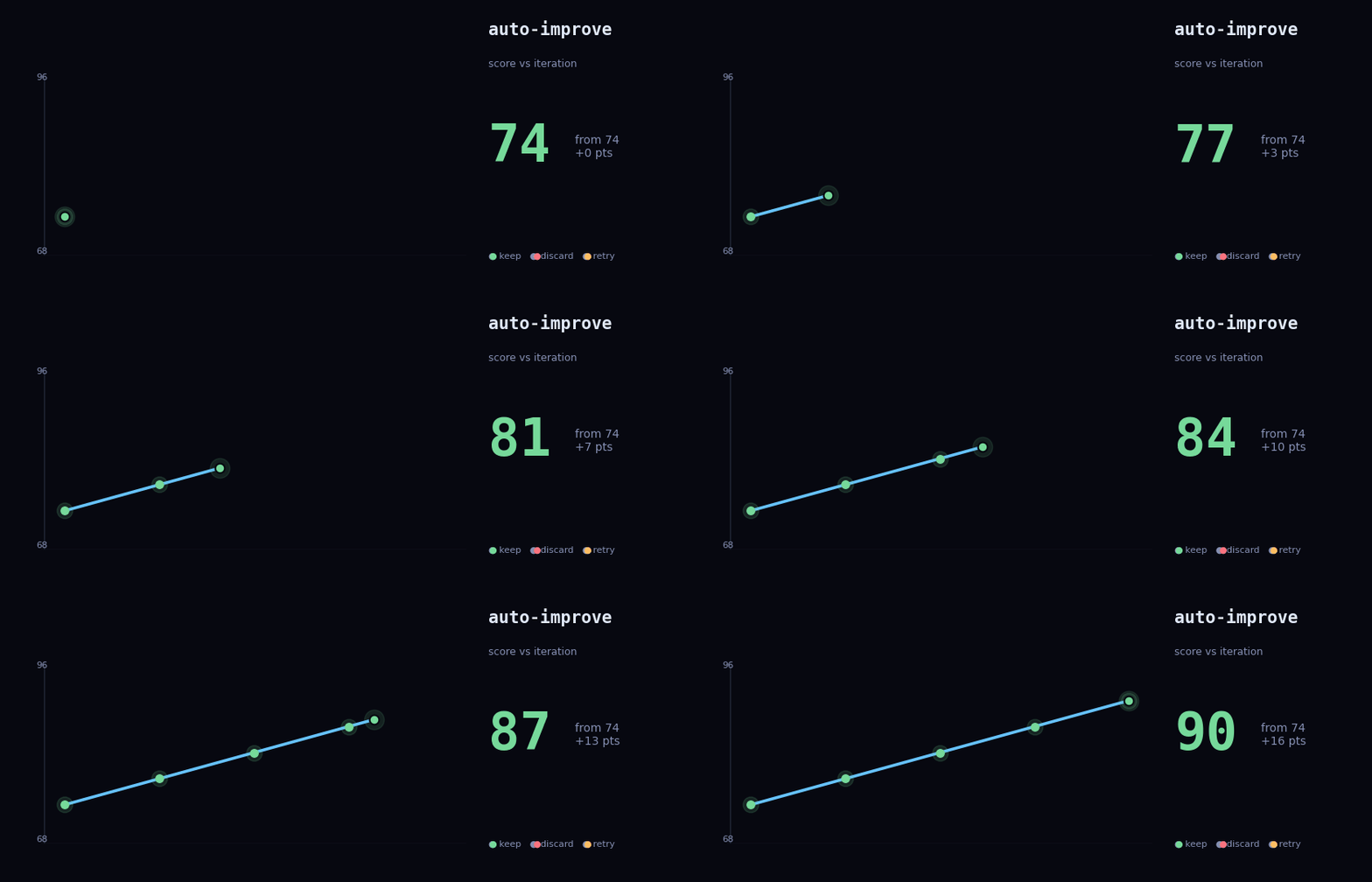
A tiny macroquad app in plot/ renders a run live —
score vs iteration, green keeps / red resets / gold retries — and re-reads the TSV as the
loop runs, so you watch the climb build in real time.
cd plot && cargo build --release
./target/release/plot ../results/<tag>.tsv     # or pass a dir to auto-pick the latest run
Run improve.py in one terminal and the plot in another to watch it climb. Headless check
(no window): ./target/release/plot --dump ../results/<tag>.tsv.
Configuration
| env var | default | purpose |
|---|---|---|
GEMINI_API_KEY / GOOGLE_API_KEY |
— | required |
IMPROVE_MUTATOR |
gemini-flash-latest |
model that proposes edits |
IMPROVE_EVALUATOR |
gemini-flash-latest |
model that grades + judges |
RESULTS_DIR |
./results |
where <tag>.tsv climb logs are written |
IMPROVE_EVENTS_LOG |
— | optional path to append run events as JSONL |
Lineage
auto-improve sits where three ideas meet:
- karpathy/autoresearch — the direct inspiration: an LLM proposing edits and judging its own work in a loop.
- GANs (Goodfellow et al., 2014) — a generator (the mutator) and a discriminator (the separate judge) held in tension: the mutator tries to produce changes the judge will accept, the judge keeps it honest. Here the trained artifact isn't a network — it's the git branch.
- RL from AI feedback (RLAIF, Lee et al., 2023) — read each iteration as one policy-improvement step whose reward is an AI judge's pairwise preference rather than a human's. The keep/discard gate is the reward model; "keep iff it wins" is the update.
License
MIT — see LICENSE.
Explore related projects
affaan-m/ECC
The agent harness performance optimization system. Skills, instincts, memory, security, and research-first development for Claude Code, Codex, Opencode, Cursor and beyond.
300,265 starsNousResearch/hermes-agent
The agent that grows with you
262,096 starsmultica-ai/andrej-karpathy-skills
A single CLAUDE.md file to improve Claude Code behavior, derived from Andrej Karpathy's observations on LLM coding pitfalls.
231,388 starsfirecrawl/firecrawl
Supercharge your AI agents with data from the web and beyond. Building the library for superintelligence. 🔥
200,178 stars