
cloakllm/CloakLLM
cloakllm/CloakLLM has 29 GitHub stars and 1 forks. GitHot measured 0 stars in 24 hours, 0 in 7 days, and 0 in 15 days. Last checked 2026-11-15 08:32 UTC. Last push 2026-10-09.
Measured star growth
- in 24h
- 0
- in 7 days
- 0
- in 15 days
- 0
- in 1 month
- Collecting history
Net star changes over overlapping periods, not daily totals. Missing measurements are left blank. Stars measure attention, not software quality.
About
Open-source PII cloaking + tamper-evident audit logs for LLM API calls
SecurityREADME.md
Original





CloakLLM
Cloak your prompts. Prove your compliance.
Open-source PII protection middleware for LLMs. Detect sensitive data, replace it with reversible tokens, and maintain tamper-evident audit logs — all before your prompts leave your infrastructure.
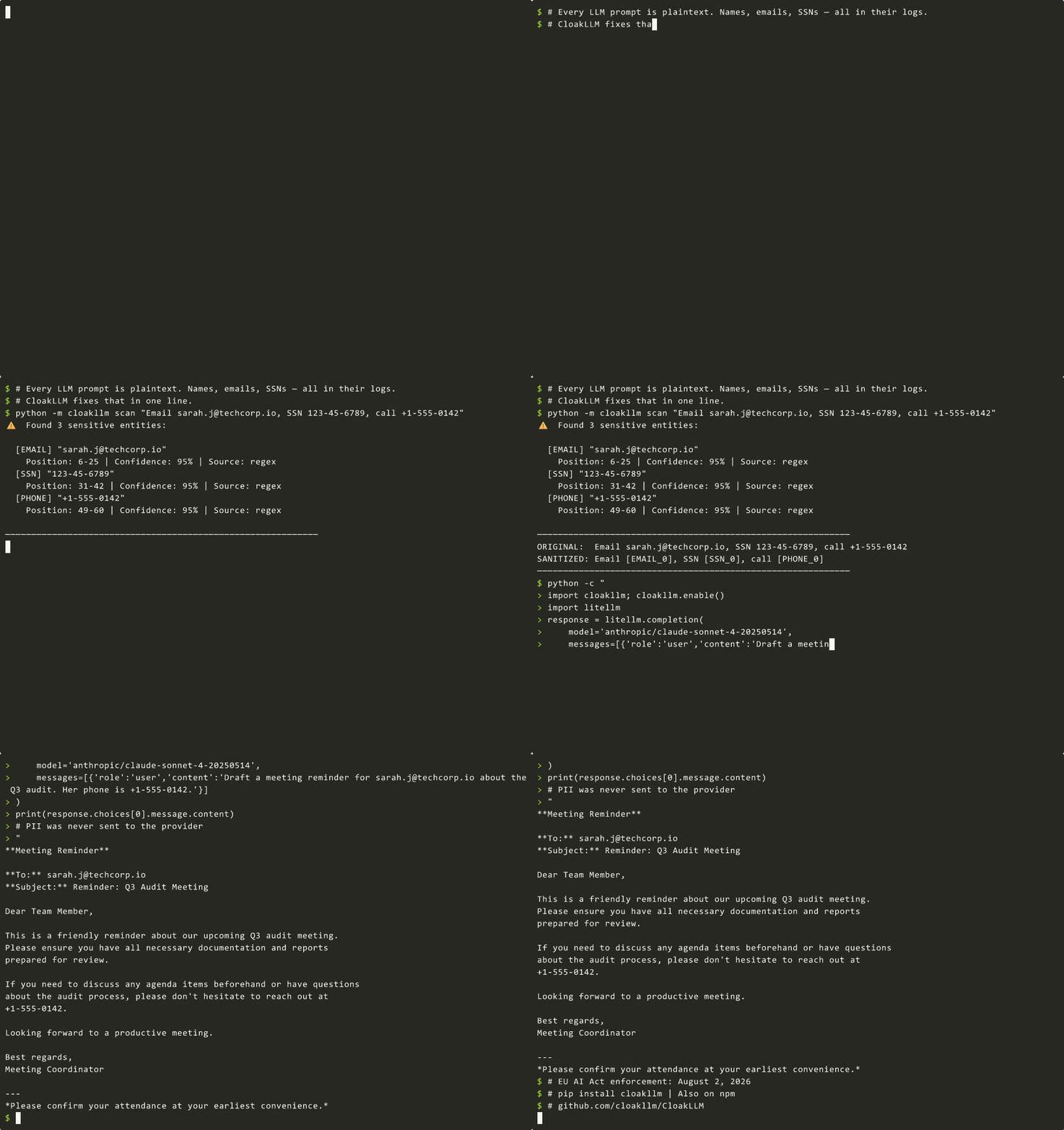
▶ Watch interactive demo on asciinema
SDKs
| SDK | Version | Install | Docs |
|---|---|---|---|
| CloakLLM-PY | 0.12.7 | pip install cloakllm |
Python README |
| CloakLLM-JS | 0.12.7 | npm install cloakllm |
JS/TS README |
| CloakLLM-MCP | 0.12.7 | python -m mcp run server.py |
MCP README |
| cloakllm-verifier | 0.12.0 | pip install cloakllm-verifier / npm install cloakllm-verifier |
Verifier README |
Not a developer? CloakLLM Guard is a Chrome extension that warns you before you send personal data to ChatGPT, Claude, Gemini or Copilot. It checks on your device and never sends or stores what you type. Chrome Web Store - source.
What it does
- PII Detection — emails, SSNs, credit cards, phone numbers, API keys, and more
- LLM-Powered Detection — opt-in local Ollama integration catches context-dependent PII that regex misses (addresses, medical terms)
- Reversible Tokenization — deterministic
[CATEGORY_N]tokens that preserve context for the LLM - Redaction Mode — irreversible
[CATEGORY_REDACTED]replacement for GDPR right-to-erasure - Tamper-Evident Audit Logs — hash-chained entries for EU AI Act Article 12 compliance
- Custom LLM Categories — user-defined semantic PII types (PATIENT_ID, EMPLOYEE_NUMBER) via configurable Ollama detection
- Per-Entity Hashing — deterministic HMAC-SHA256 hashes per detected entity for cross-request correlation without storing PII
- Performance Metrics — per-pass timing breakdowns (regex, NER, LLM) in audit logs and via
shield.metrics()API - Incremental Streaming —
StreamDesanitizerstate machine replaces tokens as chunks arrive, no full buffering - Cryptographic Attestation — Ed25519-signed sanitization certificates with Merkle tree batch proofs and replay-resistant nonces
- Multi-Language PII Detection — 13 locales (DE, FR, ES, NL, IT, PL, PT, HE, RU, ZH, JA, KO, HI) with locale-specific patterns. See the GUIDE for exactly what each one detects
- Context Risk Analysis —
ContextAnalyzerscores re-identification risk in sanitized text (token density, identifying descriptors, relationship edges) - Normalized Token Standard — formal spec (TOKEN_SPEC.md) with validation utilities (
validateToken,parseToken), canonical regex, and built-in category registry - Pluggable Detection Backends —
DetectorBackendbase class for custom detection pipelines; swap or extend the default regex→LLM→NER pipeline with your own backends - Article 12 Compliance Mode — formal EU AI Act compliance profile (
compliance_mode="eu_ai_act_article12") adds tamper-detectable compliance fields to every audit entry, pluscompliance_summary()and structuredverify_audit(output_format="compliance_report")for auditors. See COMPLIANCE.md. - Article 4a Bias Detection Workflow (v0.7.0+) —
BiasDetectionSessioncontext-managed API for processing GDPR Article 9 special-category PII (race, ethnicity, religion, political opinion, health/biometric, sexual orientation, trade union, genetic) strictly for AI bias detection and correction. Enforces all six Article 4a safeguards: recorded justification, pseudonymisation, in-memory-only token map,categories_allowedscope cap, hard-boundedmax_lifetime_secondswith auto-wipe on exit, and full audit-chain recording. Builds on Article 12. See COMPLIANCE.md § Article 4a. - Article 50 Content-Labeling Record-Keeping (v0.10.0+) —
Shield.record_content_generation()writes acontent_generationaudit event proving synthetic content was AI-generated and whether a machine-readable label / deep-fake disclosure was applied — for the EU AI Act Article 50 transparency obligation (applies 2 December 2026).generate_compliance_report()gains an Article 50 rollup (label-coverage %, modality breakdown, deep-fake count) so one report proves Article 12 + 4a + 19 + 50 together. The content itself never reaches CloakLLM — only a caller-computed hash. Record-keeping lane only; CloakLLM does not embed watermarks (C2PA / SynthID territory).cloakllm content-logCLI +record_content_generationMCP tool. See COMPLIANCE.md § Article 50. - Trusted Timestamping (RFC 3161) (v0.11.0+) —
Shield.checkpoint()stamps the audit chain's latest hash at an RFC 3161 Time-Stamp Authority, proving "every entry up to here existed no later than time T" under an external clock the deployer can't control — the defense against a backdated history. An eIDAS-qualified TSA gives the timestamp legal presumption of accuracy in EU audits. Checkpoint-level (one stamp covers everything before it by hash-chain induction), opt-in, fully offline-verifiable, and the TSA only ever sees a hash.cloakllm timestamp now/verifyCLI +record_chain_checkpointMCP tool. Optional[timestamping]extra (Python); zero-dep (JS). See COMPLIANCE.md § Trusted Timestamping. - Enterprise Key Management (experimental — disabled in v0.6.1) — KMS/HSM provider scaffolding (AWS KMS, GCP KMS, Azure Key Vault, HashiCorp Vault) is in place but currently raises
NotImplementedError. UseLocalKeyProvideruntil v0.7.0. - Security Hardened — Ollama SSRF prevention, thread-safe operations, ReDoS protection, CLI PII redaction by default
- Detection Benchmark — 108-sample labeled PII corpus with recall/precision/F1 harness, CI-enforced thresholds
- Middleware Integration — drop-in support for LiteLLM and OpenAI SDK (Python) and OpenAI/Vercel AI SDK (JS)
- MCP Server — use CloakLLM directly from Claude Desktop, Cursor, or any MCP-compatible client
Quick Start
Python
pip install cloakllm
# Option A: OpenAI SDK
from cloakllm import enable_openai
from openai import OpenAI

client = OpenAI()
enable_openai(client)  # Wraps OpenAI SDK — all calls are now protected

# Option B: LiteLLM
import cloakllm
cloakllm.enable()  # Wraps LiteLLM — all calls are now protected
JavaScript / TypeScript
npm install cloakllm
const cloakllm = require('cloakllm');

cloakllm.enable(openaiClient);  // Wraps OpenAI SDK
MCP (Claude Desktop)
Note: MCP tools are called by the LLM after it receives your prompt. The MCP server cannot prevent PII in your initial prompt from reaching the provider. For prompt-level protection, use the SDK middleware above.
Add to your claude_desktop_config.json:
{
  "mcpServers": {
    "cloakllm": {
      "command": "python",
      "args": ["-m", "mcp", "run", "server.py"],
      "cwd": "/path/to/cloakllm-mcp"
    }
  }
}
This exposes fourteen tools to Claude: sanitize, sanitize_batch, desanitize, desanitize_batch, analyze, analyze_batch, analyze_context_risk (added v0.5.0), bias_detection_session_start / bias_pseudonymise / bias_detection_session_end (added v0.7.0 for the EU AI Act Article 4a workflow), generate_compliance_report (added v0.8.0 -- end-to-end EU AI Act compliance reports in JSON / Markdown), get_key_manifest (added v0.8.1 -- externally-verifiable key provenance), and record_content_generation (added v0.10.0 -- Article 50 content-labeling record-keeping), and record_chain_checkpoint (added v0.11.0 -- RFC 3161 trusted timestamping).
Roadmap
Shipped in v0.8.1: externally-verifiable KeyManifest (KeyManifest + verify_key_provenance() + cloakllm key-manifest verify CLI + get_key_manifest MCP tool). Closes the trust loop on v0.8.0 reports: an EU AI Office auditor can now verify CloakLLM audit-chain signatures without trusting CloakLLM, your deployer, or anyone else's word about which keys are real. The audit chain stands on its own. Upcoming: KMS provider rebuild -- AWS / GCP / Azure / Vault. Full EU AI Act suite (sandbox-ready config, partner integrations, SME tier) in v1.0.
License
MIT