
chmod777john/swarm-ide
chmod777john/swarm-ide has 1,496 GitHub stars and 174 forks. GitHot measured -1 stars in 24 hours. Last checked 2026-11-08 04:34 UTC. Last push 2026-03-02.
为 Agent Swarm 打造的 IDE ,支持 Kimi-2.5, GLM-4.7 等(即使不像 K2.5 那样经过强化学习的模型也能用)An IDE built for Agent Swarms, supporting Kimi-2.5, GLM-4.7, and more (compatible with models even without RL-reinforcement like K2.5).
Measured star growth
- in 24h
- -1
- in 7 days
- Update delayed
- in 15 days
- Update delayed
- in 1 month
- Update delayed
Net star changes over overlapping periods, not daily totals. Missing measurements are left blank. Stars measure attention, not software quality.
README_EN.md
OriginalSwarm-IDE: Self-Organizing Agent Swarm
🎬 Video (Open‑source Kimi‑K2.5 Multi‑Agent Swarm)
- Demo (inline playback):
- Bilibili full demo: https://www.bilibili.com/video/BV1X163BQE5c/?share_source=copy_web&vd_source=e0705640ea2f51669a392fb07684e286
WeChat Group

Advantages
- Create sub‑agents dynamically
- Message any agent directly
- WeChat‑style chat UI: intervene at any depth anytime
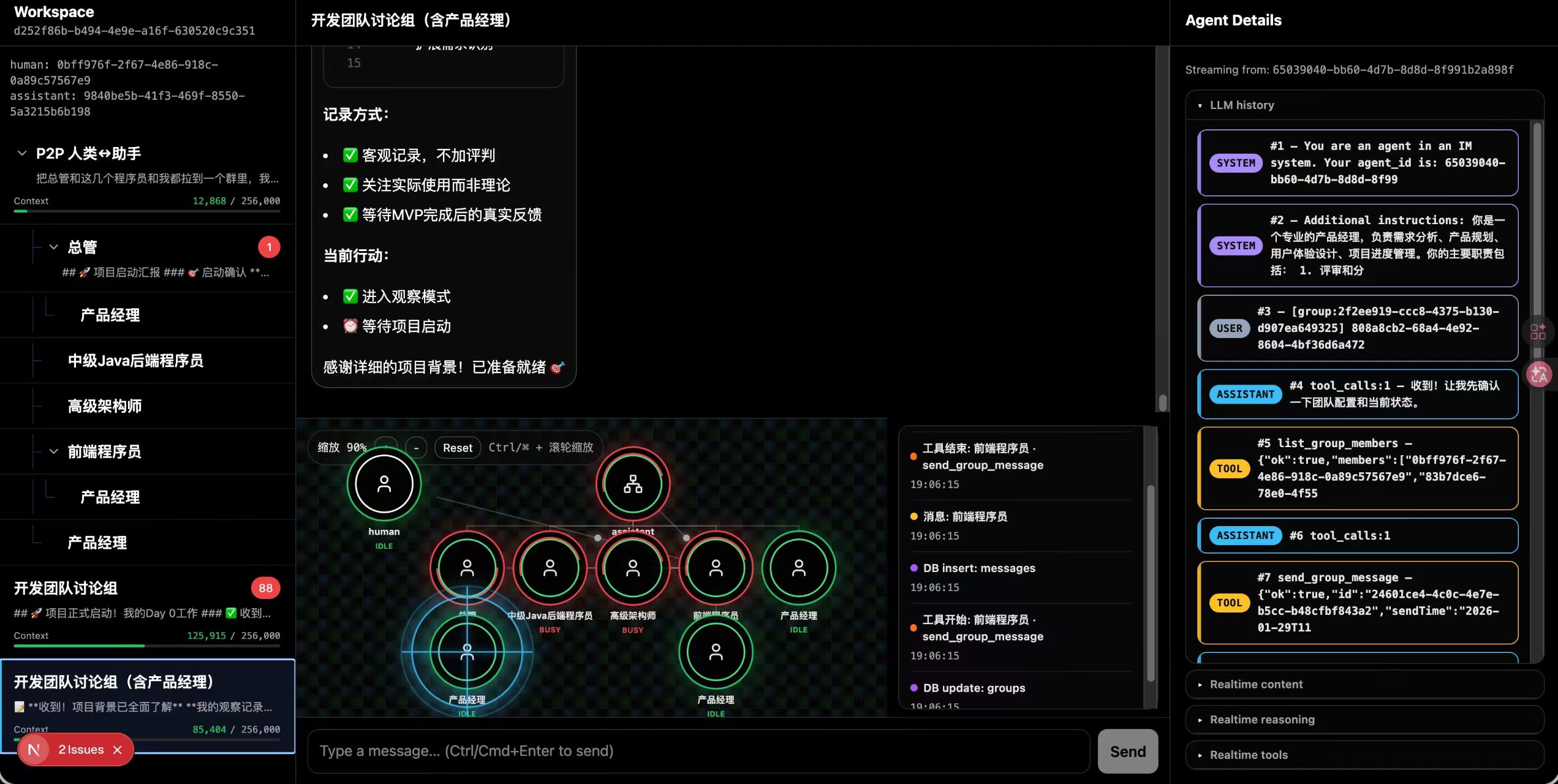
- Streaming graph that visualizes collaboration in real time
Comparison
It is worth noting that this project independently introduced swarm mode before both Kimi-Swarm and Claude Team. Claude Team in particular shows striking overlap: with careful comparison, its core ideas (dynamic delegation and human-to-any-agent communication) align closely with this project’s design. To some extent, this reflects the advanced perspective behind the design. Building this independently at a time when static LangGraph workflows were dominant was notably ahead of its time. The whitepaper was timestamped on-chain back then; if you want to verify this directly, see the on-chain timestamp.
| Item | Kimi-Swarm | Claude Agent Team | Swarm-IDE |
|---|---|---|---|
| Nested agents | ❌ | ❌ | ✅ |
| Inter-agent messaging | ❌ | ✅ | ✅ |
| Human to sub-agent messaging | ❌ | ✅ | ✅ |
| Group chat mode | ❌ | ❌ | ✅ |
| Visualization | ❌ | ❌ | ✅ |
| Open source | ❌ | ❌ | ✅ |
| Release date | 2026.1.27 | 2026.2.6 | 2026.1.2 |
UI Design
- Graph shows swarm topology and live communication links
- Tree‑structured multi‑level dialogs: talk to any agent like a chat app (even deep ones)
- LLM history panel: shows the agent’s context; no more black box
- Streaming tool‑call parameters in real time
Philosophy
- Minimal primitives: only a few communication primitives are required (core is create + send)
- Liquid topology: topology evolves during runtime; agents “hire” sub‑agents on demand
- Flat collaboration: humans can step into any layer at any time
Concept
No complex nodes/edges abstraction — just think of “many people”:
Everyone can spawn children and talk to anyone.
With only these two capabilities, any structure can be built.
How to Run
cd agent-wechat
cd backend

cp .env.example .env.local
# Fill your keys and model names in .env.local

docker compose up -d
curl -X POST http://127.0.0.1:3017/api/admin/init-db
bun install
bun dev
Click init-db, then create a workspace to start.
Try: “Create 3 children, ask them to message each other, then have each create 3 grandchildren.”
Zhihu
https://zhuanlan.zhihu.com/p/2000736341479138182
Environment Variables
The backend reads backend/.env.local:
OPENROUTER_API_KEY/OPENROUTER_MODEL(I use OpenRouter Kimi 2.5)- See
backend/.env.examplefor all fields
Explore related projects
codecrafters-io/build-your-own-x
Master programming by recreating your favorite technologies from scratch.
561,044 starspublic-apis/public-apis
A collective list of free APIs
497,288 starsmorluto/rea
Reverse engineer anything with agents, from app behavior down to native binaries.
443,396 starsopenclaw/openclaw
The AI that really does things. Any OS. Any Platform. The lobster way. 🦞
394,205 stars