
billpwchan/futu_algo
billpwchan/futu_algo has 629 GitHub stars and 192 forks. GitHot measured 0 stars in 24 hours and +3 in 7 days. Last checked 2026-11-23 05:26 UTC. Last push 2026-11-11.
Measured star growth
- in 24h
- 0
- in 7 days
- +3
- in 15 days
- Collecting history
- in 1 month
- Collecting history
Net star changes over overlapping periods, not daily totals. Missing measurements are left blank. Stars measure attention, not software quality.
About
Futu Algorithmic Trading Solution (Python) 基於富途OpenAPI所開發量化交易程序
Developer ToolsREADME.md
Original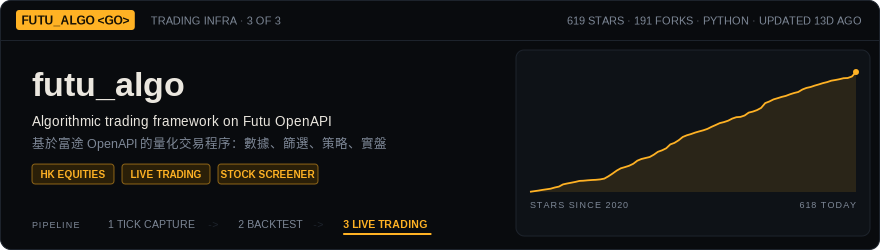
futu_algo
Algorithmic trading for Hong Kong equities on Futu OpenAPI: a local data cache, TDX-style strategies, a cost-accurate backtester, a stock screener and a paper-trading engine that trades exactly what the backtest traded, all driven from a web console or the command line.
基於富途 OpenAPI 的港股量化交易系統:本地 K 線快取、通達信風格策略、按港股真實費用計算的回測、 富途伺服器端選股,以及與回測逐筆一致的模擬盤實盤引擎,透過網頁控制台或命令列操作。



What it does
| Data | Downloads Futu K-lines into a Parquet cache, paging past 1,000-bar pages, within Futu's rate limits and history quota. Any minute multiple (10M, 2H, 4H) is built session by session, never across the lunch break. |
| Strategies | macd, kdj, rsi, ma_cross, ema_ribbon, boll, donchian, on TDX-exact indicators. Write your own in a few lines; every backtest checks it for future functions. |
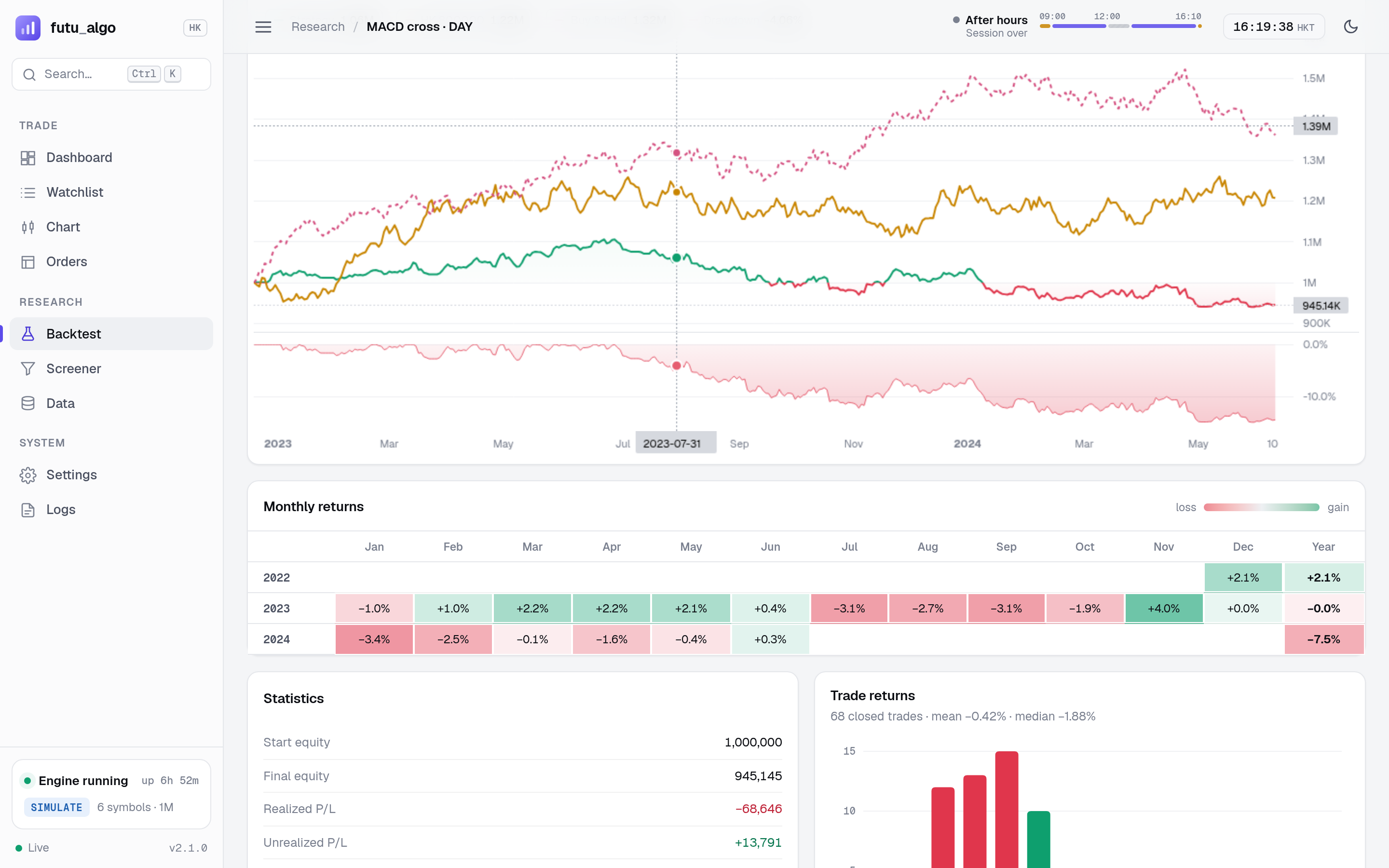
| Backtesting | Next-open fills in whole board lots, HK stamp duty and levies on the schedule in force each day, HKEX tick-table slippage, stops and targets, portfolio or per-symbol mode, benchmark against the Hang Seng Index. |
| Paper trading | Runs on live one-minute (or any) bars pushed by OpenD, sends tick-rounded limit orders to your Futu paper account, re-prices unfilled orders, reconciles fills, enforces risk limits and survives restarts. |
| Screener | Price, liquidity, valuation, financial and chart-pattern filters run on Futu's servers over the whole HK market without using history quota, optionally confirmed by a strategy. |
| Notifications | Email and Telegram for fills, rejections, errors, risk events, the daily summary and screener results. |
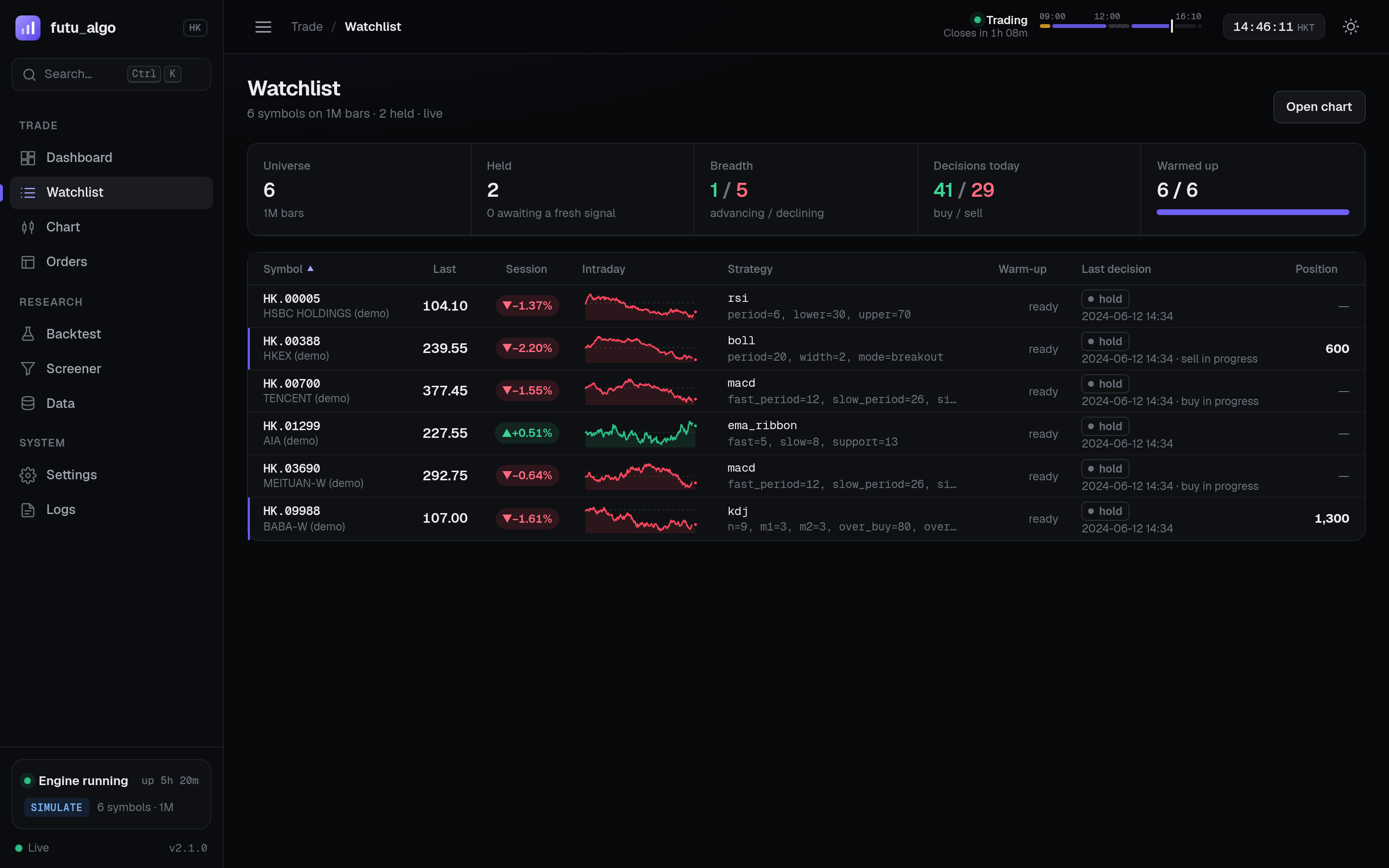
| Web console | A dark-first trading workstation: live dashboard, quote-board watchlist, charts with indicators and fills, backtest builder and tear-sheet reports, screener, order blotter, data cache, config editor and event log, with a command palette and keyboard shortcuts. |
 |
 |
 |
 |
The live engine and the backtester share the same strategy code and entry rules. The test suite replays real one-minute bars through both and requires every fill, fee and the final equity to match exactly.
Quick start
Requirements: Python 3.11+, and for real market data Futu OpenD running and logged in, with quote rights for HK stocks (LV1 or above).
git clone https://github.com/billpwchan/futu_algo.git
cd futu_algo
python -m venv .venv && source .venv/bin/activate      # Windows: .venv\Scripts\activate
pip install -e .

futu-algo web --demo --speed 30      # try everything on a simulated OpenD, no account needed
Open http://127.0.0.1:8765/. Demo mode runs a synthetic market with a virtual clock inside the HK session; the engine starts automatically and trades six made-up stocks on one-minute bars.
With OpenD:
futu-algo init config.yaml           # commented starter config + .env.example
futu-algo check -c config.yaml       # validates the config, OpenD, quota and the paper account
futu-algo backtest -c config.yaml    # downloads data once, prints a summary, saves a report
futu-algo web -c config.yaml         # console; start the engine from the dashboard
The console
The console is a single-page app served by the same process, with no build step and nothing loaded from the internet: fonts (Geist, OFL) and the chart library (Lightweight Charts, Apache 2.0) ship in the package, and a strict Content-Security-Policy allows only same-origin scripts.
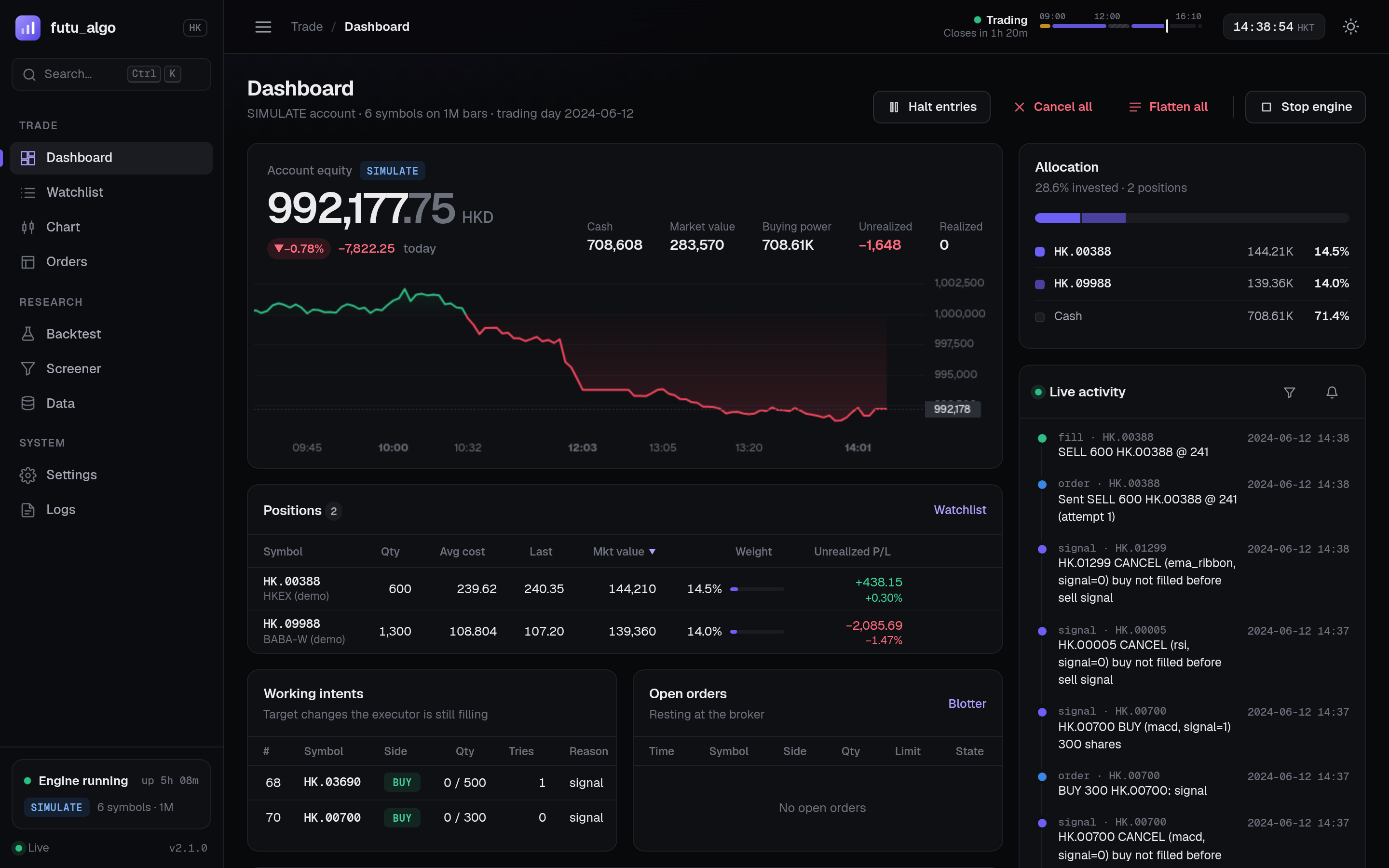
- Dashboard: account equity with today's P/L and the intraday equity curve, allocation, positions with weights, working intents, open orders, fills and a live event timeline. Engine controls (start, halt entries, cancel all, flatten, stop) sit in the page header.
- Watchlist: a quote board of the trading universe with session change, an intraday sparkline, each symbol's strategy, warm-up progress, last decision and position.
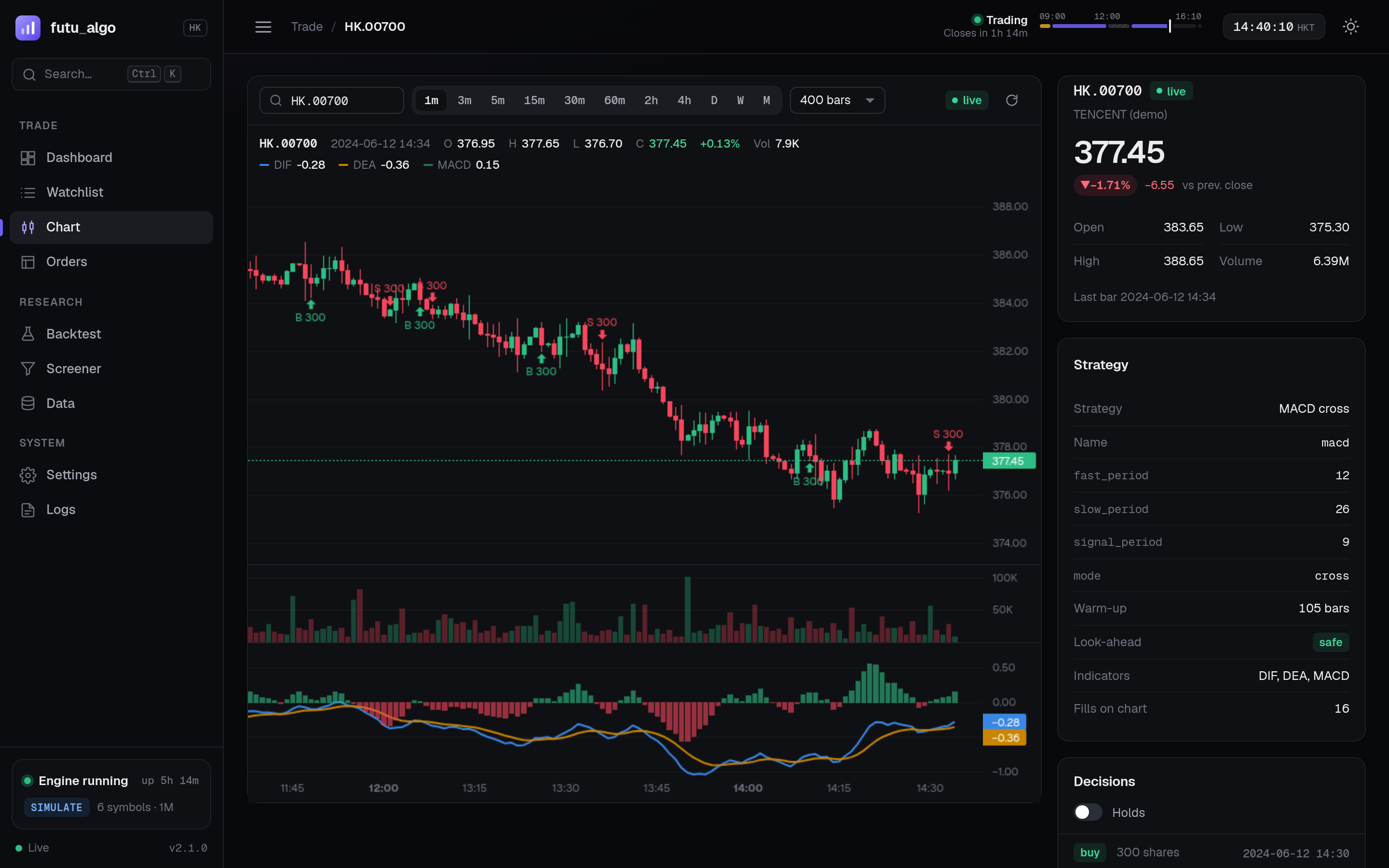
- Chart: candles, volume and the strategy's own indicator lines with buy/sell fills, updated on every bar, beside a quote panel and the engine's recorded decisions.
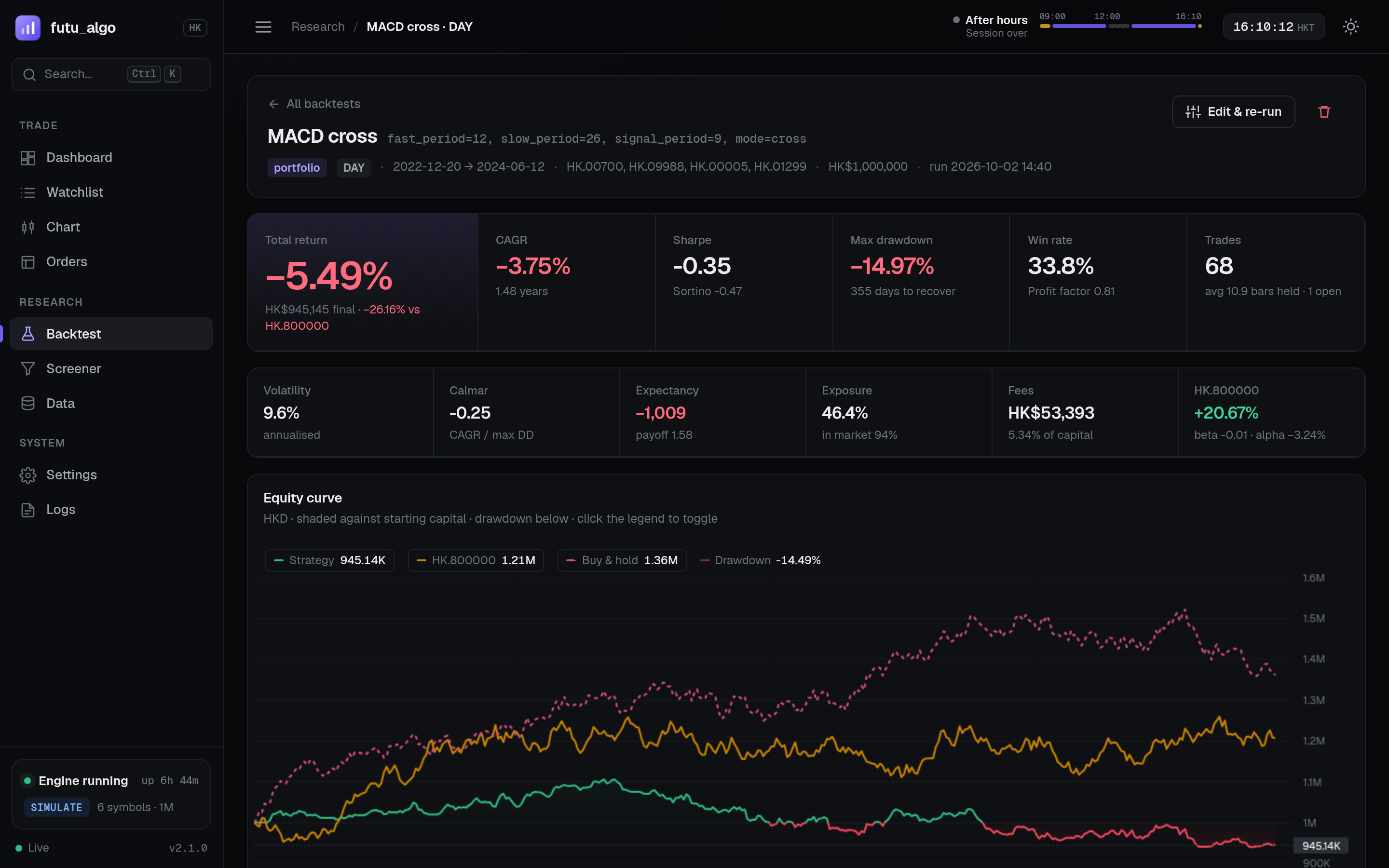
- Backtest: a stepped builder (strategy, universe, period, sizing, execution and exits, checks) and a tear-sheet report: headline metrics, equity versus benchmark and buy & hold with drawdown, monthly returns, the distribution of trade returns, drawdown periods and every trade.
- Screener, Orders, Data, Settings and Logs cover presets and results, the blotter, the bar cache and history quota, the YAML config editor with validation, and the event log.
The top bar shows the HK session as a timeline (auction, morning, lunch, afternoon, closing auction) with the time to the close. Press Ctrl/⌘+K (or /) for the command palette, which jumps to pages and symbols and runs engine actions; G then a letter switches page, T toggles the theme and ? lists the shortcuts. Dark is the default; light, follow-the-system and red-up/green-down colouring are in Settings. Every page works down to phone width.
Commands
| Command | What it does |
|---|---|
futu-algo web -c config.yaml [--engine] |
Web console; --engine also starts paper trading |
futu-algo web --demo [--speed 30] |
Console on a simulated OpenD and synthetic market |
futu-algo trade -c config.yaml [--dry-run] |
Headless paper trading; --dry-run fills locally and sends nothing to Futu |
futu-algo backtest -c config.yaml -s rsi -p period=9 --symbols HK.00700 HK.09988 |
Backtest; flags override the config |
futu-algo replay -c config.yaml --start 2026-09-01 |
Replay cached bars through the live engine to preview what it would have done |
futu-algo screen -c config.yaml -p liquid_uptrend [--notify] |
Run a screener preset |
futu-algo data fetch|list|quota -c config.yaml |
Manage the bar cache and check the history quota |
futu-algo strategies [--json] |
Strategies and their parameters |
futu-algo account|positions|orders -c config.yaml |
Inspect the Futu account |
futu-algo cancel-all|flatten -c config.yaml |
Emergency controls |
Any config value can be overridden on the command line with --set trading.timeframe=5M.
Configuration
Everything lives in one YAML file; futu-algo init writes a fully commented one
(example). Relative paths are resolved against the
config's directory. Secrets are never stored in it: fields ending in _env name environment
variables, and a .env file next to the config is loaded automatically.
trading:
  env: SIMULATE            # Futu paper account
  mode: paper              # or dry_run: local fills, nothing sent to Futu
  timeframe: 1M
  strategy: {name: macd}
  universe:
    - HK.00700
    - symbol: HK.09988
      strategy: {name: kdj, params: {over_sell: 25}}
  sizing: {method: fixed_value, value: 50000, max_positions: 5}
  risk: {max_daily_loss_pct: 0.03, max_position_value: 200000}
Paper trading (SIMULATE) is the supported environment. REAL is implemented but gated: it
needs trading.allow_real: true and FUTU_ALGO_ALLOW_REAL=1 in the environment.
Writing a strategy
A strategy returns indicator columns and a signal per bar: 1 = be long, 0 = be flat,
NaN = no change. TDX functions keep TDX semantics, so formulas port line by line.
import pandas as pd
from pydantic import Field
from futu_algo.indicators import CROSS, LLV, MA, REF
from futu_algo.strategy import Strategy, StrategyParams, events


class Params(StrategyParams):
    fast: int = Field(20, ge=2)
    slow: int = Field(60, ge=3)


class PullbackTrend(Strategy):
    name = "pullback_trend"
    title = "MA trend with pullback entry"
    Params = Params

    def warmup_bars(self) -> int:
        return self.params.slow

    def indicators(self, bars: pd.DataFrame) -> pd.DataFrame:
        c = bars["close"]
        return pd.DataFrame(
            {"fast": MA(c, self.params.fast), "slow": MA(c, self.params.slow), "low20": LLV(bars["low"], 20)},
            index=bars.index,
        )

    def signals(self, bars, ind):
        buy = CROSS(ind["fast"], ind["slow"]) & (bars["close"] > REF(ind["low20"], 1) * 1.05)
        return events(buy, CROSS(ind["slow"], ind["fast"]))
Put the file in a folder listed under strategy_paths and use name: pullback_trend in the
config. The same class runs in backtests, replays and live trading.
Deployment
Linux with systemd: deploy/systemd/futu-opend.service
runs the command-line OpenD and deploy/systemd/futu-algo.service
runs the console and engine. A Dockerfile is included for running futu_algo
next to an OpenD instance. If OpenD is on another machine, it requires an RSA key
(futu.rsa_private_key) for trading, and the console needs FUTU_ALGO_WEB_TOKEN before it will
listen on a non-local address.
Development
pip install -e ".[dev]"
pytest -m "not e2e"         # unit, integration and parity tests
ruff check . && mypy
pip install -e ".[e2e]" && pytest -m e2e    # browser tests of the console (Chromium)
docs/ARCHITECTURE.md explains the design, the timing model and the known limitations. CHANGELOG.md records why 1.x was replaced.
Part of a three-repo trading stack
futu_tick_downloader (tick capture) · strategy_powerbacktest (research backtesting) · futu_algo (screening, backtesting and paper trading, standalone)
Built by Bill Chan. Licensed under Apache 2.0. Charts use TradingView Lightweight Charts™ (Apache 2.0).
Disclaimer
For education and research. Trading stocks involves substantial risk of loss. Backtest and paper trading results do not predict live performance. Nothing in this repository is investment advice; the author takes no responsibility for trading results. Use at your own risk.
Explore related projects
Loading…