
berry-apps/berrydb-desktop
berry-apps/berrydb-desktop has 26 GitHub stars and 10 forks. GitHot measured 0 stars in 24 hours. Last checked 2026-11-11 21:43 UTC. Last push 2026-11-10.
Open-source (Apache 2.0) macOS database client in Swift & AppKit for PostgreSQL, MySQL, SQL Server, SQLite, Redis/Valkey, MongoDB, DynamoDB, Elasticsearch and Qdrant, with an optional AI assistant.
Measured star growth
- in 24h
- 0
- in 7 days
- Update delayed
- in 15 days
- Update delayed
- in 1 month
- Update delayed
Net star changes over overlapping periods, not daily totals. Missing measurements are left blank. Stars measure attention, not software quality.
README.md
Original
BerryDB 🫐
A Native Database Client Built for macOS







Swift 6 + AppKit • 9 database engines • AI SQL assistant • Apache 2.0
Download .DMG (macOS 15+) • Official Website • ⭐️ Star on GitHub • ☕ Donate on Ko-fi
📖 Overview
BerryDB is a native database client for macOS developers, data engineers, and DBAs. It is built with Swift 6, AppKit, and SwiftUI, with no Electron: the data grid is an AppKit NSTableView.
Whether you're querying production PostgreSQL databases, inspecting Redis caches, managing MongoDB collections, exploring Qdrant vector spaces, or querying SQLite files locally, BerryDB keeps the grid responsive and every credential in the macOS Keychain.
✨ Key Features
⚡ Native, No Electron
- Fast Launch: A window is on screen about 0.85s after a cold start — no Chromium runtime, no NodeJS backend overhead.
- Streaming Data Grid: A view-based AppKit
NSTableView. Rows arrive in batches while the query is still running, and only the rows on screen get cell views. - Bounded by Default: Results are capped at 1,000 rows; raise the limit or turn it off when you need more. Every row you load is kept in memory.
Launch time measured on an Apple M1 (16GB, macOS 26.6.2) with a release build. Run
scripts/measure-performance.shto reproduce it on your own machine — it reports process spawn and first window separately, because they are not the same number.
🗄️ Multi-Engine Database Support
Connect to SQL, NoSQL, Key-Value, and Vector databases all in a unified native workspace:
- Relational / SQL:
- PostgreSQL: Native wire protocol (
PostgresNIO), query cancellation viapg_cancel_backend, SSL/TLS. - MySQL & MariaDB: Native driver (
MySQLNIO),caching_sha2_password(with TLS on) andmysql_native_password, SSL/TLS,KILL QUERY. - SQLite: Direct embedded driver via
libsqlite3, opens WAL-mode databases. - Microsoft SQL Server: TDS protocol via dynamically linked FreeTDS (
libsybdb).
- PostgreSQL: Native wire protocol (
- In-Memory & Key-Value:
- Redis & Valkey: Valkey-Swift driver, key browser, TTL inspection, and viewers for Strings, Hashes, Lists, Sets, Sorted Sets, and Streams.
- Document & Cloud NoSQL:
- MongoDB: Collection browser, JSON document editor, custom filter syntax, and Replica Set support.
- AWS DynamoDB: Query via PartiQL syntax, item inspection, and AWS SigV4 authentication.
- Vector & Full-Text Search:
- Elasticsearch: Index browser, search query execution, and JSON document insert/edit/delete.
- Qdrant: Vector collections browser and distance metric inspector.
🔒 Keychain & Connection Security
- Keychain secrets: Passwords, API keys, SSH passwords, and SSH key passphrases are stored in the macOS Keychain. SSH private keys stay in their own files; BerryDB stores only the path.
- Built-in SSH Tunneling: Powered by Citadel (pure Swift SSH client) for secure bastion jump hosts without relying on external terminal sessions.
- TLS/SSL Encryption: Verify modes, a custom CA, and client certificates for PostgreSQL and MySQL; TLS on/off with system trust for MongoDB, Redis, Elasticsearch, Qdrant, and DynamoDB.
🤖 Intelligent AI SQL Copilot
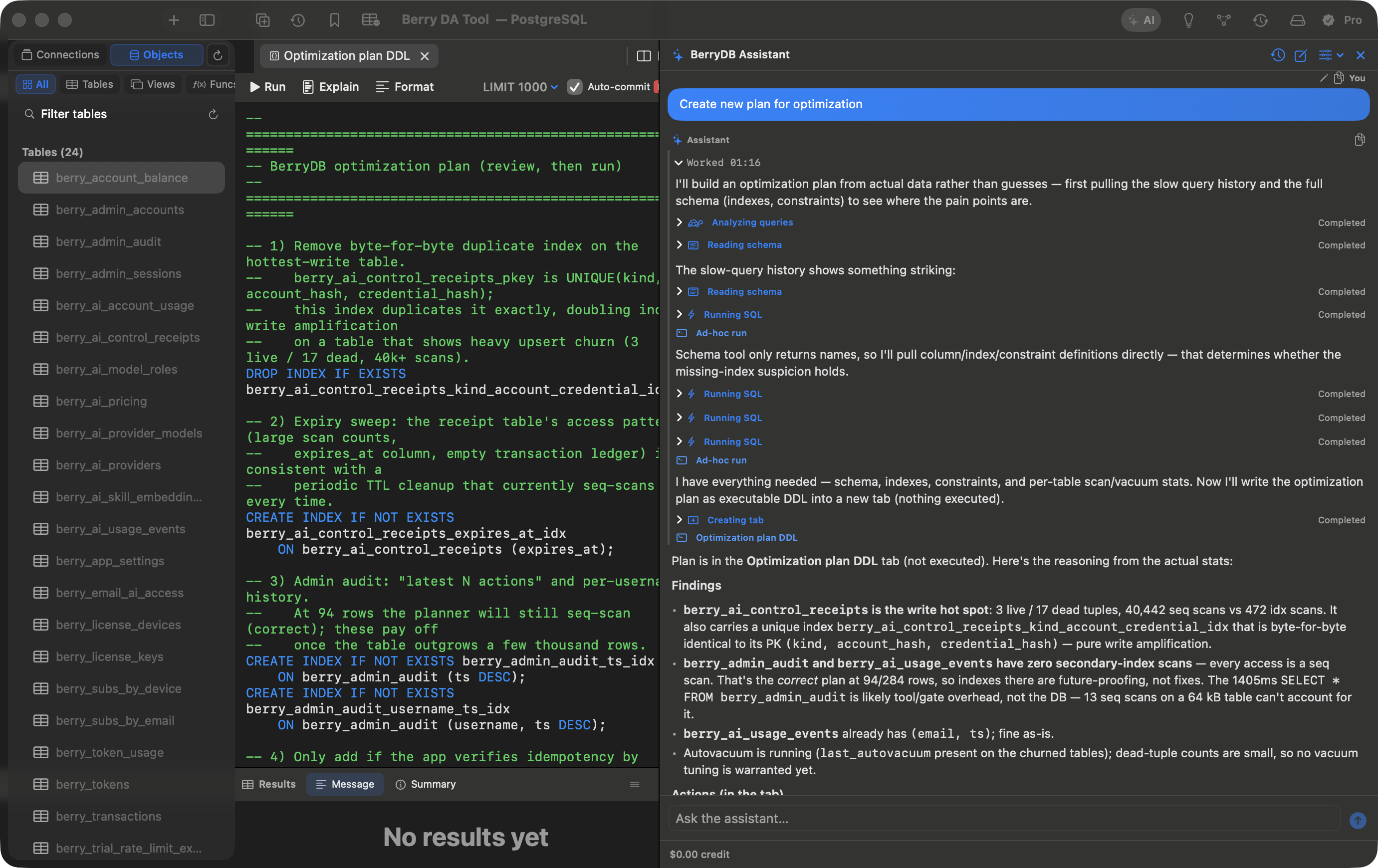
- Context-Aware SQL Generation: Turn natural language into SQL; the assistant reads your schema through tools.
- Query Explanation & Tuning:
EXPLAINanalysis, bottleneck detection, and index recommendations. - Chat with Your Database: Ask questions about your schema, tables, and relationships directly inside the integrated AI panel.
- Where the AI runs: In cloud mode (free trial, then a paid plan), your questions, the database type, your schema (table and column names), and the results of queries the assistant runs (up to 100 rows each) are sent to BerryDB's AI service; table sample rows are shared only if you turn that on. On macOS 26 with Apple Intelligence you can switch to Apple's on-device model for free; its turns send nothing to BerryDB's service, so the assistant's search of earlier conversation does not cover them. If you switch back to cloud mode in the same conversation, the earlier messages go with your next question as context.
- What runs without asking: Read-only queries the assistant writes run automatically unless you turn off Auto-run safe SELECTs; anything that changes data needs your approval. On PostgreSQL, MySQL/MariaDB, and SQLite, a query that runs without asking goes through a separate read-only connection, so the database itself refuses a write; on SQL Server and DynamoDB, BerryDB's own read-only check is the only one. When the read-only connection can't take a query, the approval card shows why. AI is off by default on connections marked as production.
🔌 Schema for Coding Agents (MCP)
- Local MCP helper: Claude Code, Codex, and Antigravity can start
berrydb-mcp, a helper inside BerryDB.app, to read the schema BerryDB has cached for the connections you choose: tables, columns, keys, indexes, relationships, and the schema graph. Here BerryDB is the MCP server and your coding agent is the client, the reverse of the MCP servers you can connect to BerryDB's own AI assistant. - Schema without a connection: The helper opens BerryDB's local store read-only; the schema tools never connect to your databases or read connection passwords.
- Live reads, off by default: For PostgreSQL, MySQL/MariaDB, and SQLite connections you can turn on Live reads per connection in Settings → AI Agents. The agent then gets
berrydb_execute_read_query, which runs one SQL statement in a read-only transaction (SQLite:query_only), so the database itself refuses a write; a read policy also turns away risky statements before they reach the server. Each read has a row, size, and time limit (production-labeled connections get stricter ones), and one agent session runs at most four reads at once. You can hide columns by name, which is best effort: only database column privileges keep a column from being returned. A read-only database user is recommended, and a read replica for production: if the user can write, BerryDB warns you before live reads turn on and asks you to acknowledge it; on a production-labeled connection it refuses instead. Live reads on a production-labeled connection also expire: you choose 1 hour, 8 hours, 24 hours (the default) or 7 days when you turn them on and renew them in the same place, andberrydb_list_connectionsreports the time aslive_read_until. On MySQL/MariaDB a user with theFILEprivilege can write files on the server even inside a read-only transaction; only the read policy and the server'ssecure_file_privstop that. On a DynamoDB connection, Live reads give the agentberrydb_dynamodb_queryinstead: oneQueryper call on a partition key, never aScan, with the same item, size, and time limits. BerryDB can't check the connection's IAM permissions, so use an access key limited todynamodb:ListTables(used to check the connection when it opens),dynamodb:DescribeTableanddynamodb:Queryon the tables the agent may read.ListTablescan't be limited to tables, so it needs"Resource": "*"; WhatListTablesreturns is never passed to the agent; the schema tools serve only the stored schema of the connections you assigned to the project. DynamoDB live reads don't work through an SSH tunnel. Tool calls made for the project are listed under Recent Activity in its settings (the newest 100), with no query text or rows. Query digests in that list's file are keyed, so a recipient of the file cannot recover or confirm a query or key value. - Where the data goes: Whatever the tools return, schema or rows, goes to the agent and from there to that agent's model provider.
📊 Database Intelligence & ER Diagrams
- Mermaid Diagrams: The AI assistant can draw Mermaid diagrams, such as an ER diagram of your schema, and open them in a tab.
- Table Analytics & Health: On-demand table sizing, index usage statistics, and row count estimations.
- Persistent Query History: Searchable query log with execution duration, row counts, and one click to open a statement in a new SQL tab.
✏️ Pro Query Editor & Inline Data Editing
- Atomic Inline Editing: Edit cells directly in the grid (the result needs a primary key); staged edits are written in one transaction when you apply them.
- Code Editor: SQL syntax highlighting, completion for keywords, tables, columns, and aliases, and multiple editor tabs.
- Query Cancellation: Cancel long-running queries (PostgreSQL, MySQL, SQLite).
📊 Database Compatibility Matrix
| Database Engine | Driver / Protocol | Direct Connection | SSH Tunnel | Inline Grid Edit | Schema Browser |
|---|---|---|---|---|---|
| PostgreSQL | Pure Swift (PostgresNIO) |
✅ | ✅ | ✅ | ✅ |
| MySQL / MariaDB | Pure Swift (MySQLNIO) |
✅ | ✅ | ✅ | ✅ |
| SQLite (3.x) | Embedded (libsqlite3) |
✅ | N/A | ✅ | ✅ |
| Microsoft SQL Server | FreeTDS (libsybdb) |
✅ | ✅ | ✅ | ✅ |
| Redis / Valkey | Pure Swift (valkey-swift) |
✅ | ✅ | ✅ (KV Editor) | ✅ (Keyspace) |
| MongoDB | Pure Swift (MongoWireClient) |
✅ | ✅ | ✅ (JSON Edit) | ✅ (Collections) |
| AWS DynamoDB | AWS REST + SigV4 | ✅ | Self-hosted endpoint only | ✅ | ✅ (Tables) |
| Elasticsearch | REST Client | ✅ | ✅ | ✅ (JSON Edit) | ✅ (Indices) |
| Qdrant | REST Client | ✅ | ✅ | ✅ (JSON Edit) | ✅ (Collections) |
Integration tests target PostgreSQL 16, MySQL 8.4, SQL Server 2022, MongoDB 7, Elasticsearch 9.5, Qdrant 1.10, and dynamodb-local 3.3 (see Tests/docker/compose.yml). Other versions may work but are not tested.
🚀 Installation & Quick Start
Option 1: Via Homebrew (Recommended)
Install BerryDB in a single command using the official Homebrew tap:
brew install --cask berry-apps/tap/berrydb
Or add the tap first and install:
brew tap berry-apps/tap
brew install --cask berrydb
Option 2: Download Pre-built DMG
- Download the latest release
.dmgfrom download-db.berryhub.app/BerryDB-latest.dmg (or from GitHub Releases). - Open the
.dmgfile and drag BerryDB.app into your Applications folder. - Launch BerryDB from Spotlight (⌘Space) or Launchpad.
System Requirements: macOS 15.0 (Sequoia) or later. Apple Silicon only (M1/M2/M3/M4).
Option 3: Build from Source
BerryDB uses the standard Swift Package Manager (SPM) and make.
Prerequisites
- macOS 15.0 or higher
- Xcode 16.0+ (with Swift 6 toolchain)
- FreeTDS library:
brew install freetds(required for FreeTDS / SQL Server C headers)
Build Steps
# 1. Clone repository
git clone https://github.com/berry-apps/berrydb-desktop.git
cd berrydb-desktop

# 2. Setup local development configuration
cp .env.example .env

# 3. Build debug bundle and launch application
make run
Available Make Commands
| Command | Description |
|---|---|
make run |
Build debug app bundle, package into dist/BerryDB.app, and launch. |
make watch |
Watch for file changes, auto-rebuild, and reload application. |
make test |
Run the complete Swift unit and integration test suite. |
make app |
Build optimized release application bundle in dist/BerryDB.app. |
🎯 User Guide
1. Adding a Database Connection
- Click New Connection (⇧⌘N) or select the
+button in the sidebar. - Choose your database type (PostgreSQL, MySQL, SQLite, Redis, MongoDB, SQL Server, etc.).
- Enter your connection credentials (Host, Port, User, Password, Database).
- Optional: Toggle SSH Tunnel to route traffic through a jump server.
- Optional: Toggle SSL/TLS for secure encrypted connections.
- Click Test Connection to verify connectivity, then click Save. Passwords are encrypted securely in your macOS Keychain.
2. Navigating Schema & ER Diagrams
- Use the sidebar schema tree to browse tables, views, functions, procedures, and triggers; Edit Table… and Show DDL show columns, keys, and indexes.
- Right-click a table for Open Data, Edit Table…, Show DDL, or Quick Info….
3. Writing Queries & Using the AI Copilot
- Press ⌘T to open a new query editor tab.
- Type SQL queries with keyword completion, then press ⌘Return to execute.
- Open the AI Assistant panel (or press ⌘J):
- Type a natural language prompt, e.g. "Show top 10 customers by revenue this month" or "Find slow queries and suggest index optimization".
- The assistant writes proposed SQL into the active editor tab. Before running a statement itself, it asks you to Run or Deny; read-only queries run automatically unless you turn off Auto-run safe SELECTs. On PostgreSQL, MySQL/MariaDB, and SQLite they run on a separate read-only connection; when that isn't possible, for example inside an open transaction, the card asks you instead and says why.
4. Editing Data Directly in the Grid
- Double-click a cell in the data grid to edit it inline (the result needs a primary key).
- Edited values show in orange and deleted rows are dimmed. Use the Apply (✓) or Discard button in the status bar to commit them in one transaction or revert.
5. Connecting Coding Agents (MCP)
Run BerryDB from your Applications folder, and open each connection you want agents to see once, so BerryDB caches its schema. Connections marked as production are not cached.
Open Settings (⌘,) → AI Agents → New Project…. Name the project, turn on Enabled, add the repositories it covers under Workspace Folders, turn on its connections, and click Save.
Copy your agent's command from the project's Agent Setup section and run it once in Terminal. For Claude Code it looks like this:
claude mcp add --scope user berrydb -- '/Applications/BerryDB.app/Contents/Helpers/berrydb-mcp'Start a new agent session in one of those folders and ask the agent to call
berrydb_status. If macOS asks whetherberrydb-mcpmay use a key in your login keychain, choose Always Allow.To let the agent run read queries, open the project, turn on Live reads for a connection, review its redacted columns (attributes, on DynamoDB), acknowledge any privilege warning (on a production-labeled connection a database user that can write is refused instead), for a production-labeled connection confirm the production notice and choose how long live reads stay on (24 hours by default; renew them here when they expire), and click Save. The agent's next session lists
berrydb_execute_read_query, orberrydb_dynamodb_queryfor a DynamoDB connection. Its first read on a connection reads that connection's secrets from your Keychain, so macOS may ask once for each of them whetherberrydb-mcpmay use it; choose Always Allow. The read waits for your answer and fails if you have not answered within 15 seconds.
Only add connections whose schema and data you are willing to share: what the tools return, including query rows, goes to the agent's model provider. Per-repository entries, status reasons, and current limits are in the Coding Agents (MCP) guide.
☕ Support the Project (Donate)
BerryDB is completely free and open-source for all local database management capabilities; only the cloud AI service is paid. If BerryDB saves you time, enhances your workflow, or replaces expensive subscription tools, consider buying the creators a coffee:

👉 https://ko-fi.com/dautay
Your support helps cover Apple Developer program fees, maintain server infrastructure, and fuel continuous feature development!
🤝 Contributing
Contributions, issues, and feature requests are welcome!
- Fork the repository.
- Create your feature branch (
git checkout -b feature/AmazingFeature). - Commit your changes (
git commit -m 'feat: add amazing feature'). - Push to the branch (
git push origin feature/AmazingFeature). - Open a Pull Request.
📄 License & Third-Party Notices
BerryDB is open-source software licensed under the Apache License 2.0 — free for personal and commercial use.
For detailed third-party attributions and compliance (including LGPL-2.1 dynamic linking compliance for FreeTDS), please refer to THIRD-PARTY-NOTICES.md.
⭐️ Support the Project
If you find BerryDB useful, please consider giving it a star on GitHub! It helps more developers discover the tool and supports continuous open-source development.
Explore related projects
codecrafters-io/build-your-own-x
Master programming by recreating your favorite technologies from scratch.
562,142 starspublic-apis/public-apis
A collective list of free APIs
498,534 starsmorluto/rea
Reverse engineer anything with agents, from app behavior down to native binaries.
455,254 starsopenclaw/openclaw
The AI that really does things. Any OS. Any Platform. The lobster way. 🦞
394,410 stars