
azerturk/kodyurd
azerturk/kodyurd has 8 GitHub stars and 0 forks. GitHot measured 0 stars in 24 hours. Last checked 2026-11-14 16:24 UTC. Last push 2026-11-12.
Measured star growth
- in 24h
- 0
- in 7 days
- Collecting history
- in 15 days
- Collecting history
- in 1 month
- Collecting history
Net star changes over overlapping periods, not daily totals. Missing measurements are left blank. Stars measure attention, not software quality.
About
Turn a local codebase into a walkable 3D city: modules as buildings, evidenced diagrams, playable flows and lessons. Runs locally with your own Claude or Codex agent.
Creative & MediaREADME.md
OriginalKodyurd
Kodyurd turns a local workspace into a walkable 3D city. Explore modules, inspect architecture and data relationships, replay evidenced behavior, read linked documents, and practice what you learned.
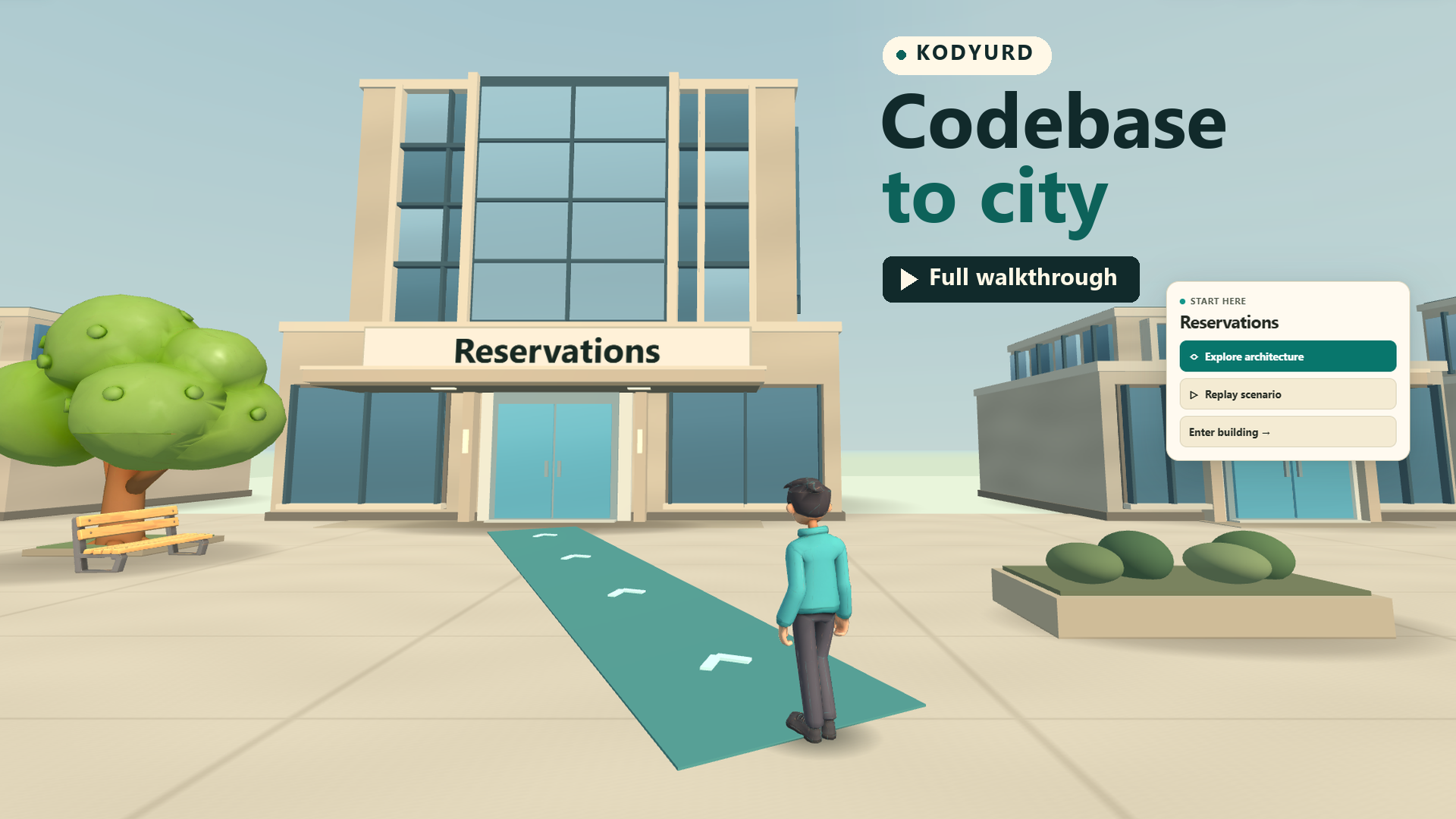
Download the 0.6.0 walkthrough (MP4, 4:17)
The video shows release 0.6.0. See the changelog for what was added since.
Walkthrough narration generated with ElevenLabs.
Run from source
Install Node.js 22.13 or newer. In a clone of this repository, run:
npm ci
npm run build
npm start
Open http://127.0.0.1:4717 if the browser does not open automatically. Generation uses your existing Claude Code or Codex CLI login, or your Anthropic API key. Choose a provider in Settings. Kodyurd stores workspace data under ~/.kodyurd and serves the app from your computer.
The 86 bundled GLBs are in packages/assets/models/. The app loads them locally and shows the opening view when its models are ready. Add your own Tripo API key in Settings if you want to generate a personal model. Model guide
Try Harbor Desk
Harbor Desk is the included example workspace. It models office reservations and asynchronous notifications. Select Add workspace, enter the full path to examples/harbor-desk, then generate a city with the example brief. The sample service can also run on its own. Harbor Desk source and instructions
Explore and share
- The brief decides which buildings you can enter. Each part it asks about gets a lesson: at least two buildings, up to ten in one run, and Build the remaining adds the rest.
- Explore architecture opens the focused module's diagram. Diagrams lists component, behavior and data views that are available for this city.
- Edit diagram corrects a diagram, and Draw or import a diagram adds your own from scratch, Mermaid text or a diagrams.net file. Any diagram can be copied as Mermaid or downloaded as
.drawio. - Replay scenario opens the playable examples supported by source evidence. Learn contains tours, practice and exams.
- Docs and diagram evidence open excerpts in the city or at a validated line in your editor.
- Saved cities keeps the latest city of each brief, so you can return to one without generating again.
- Export bundle saves a static ZIP with the models used by the city. A static HTTP server can serve the extracted city. Review the scene text and model rights before sharing.
Kodyurd scans your files locally. Generation and Guide Q&A send bounded workspace excerpts to your selected provider. Workspace guide · Privacy and network activity
Tech stack
- Language: TypeScript
- Frontend: React, Tailwind CSS, and Vite
- 3D rendering: PlayCanvas with bundled GLB models
- Local server and CLI: Node.js, with Fastify for the HTTP API
- Local storage: SQLite via
node:sqlite - Scene validation: Zod schemas for Scene JSON
- AI integrations: Claude Code, Codex CLI, or the Anthropic API for city generation and workspace Q&A
- Optional 3D generation: Tripo API for custom model overlays
- Project tooling: npm workspaces
Roadmap
Kodyurd is in early development. The first public release focused on getting the core workflow working end to end, from scanning a repository to exploring it as a 3D city.
- Create cities from GitHub repositories. Review the local scan and choose a provider before generating.
- Refine the architecture by clarifying how the UI, 3D engine, and server interact.
- Improve the codebase with a focus on code quality, consistency, and making it easier to maintain and extend.
- Expand what Kodyurd can do by adding new ways to explore and understand repositories and improving the experience of using the tool.
Ideas to explore
- Compare repository revisions by highlighting changes to modules and their relationships in the city.
- Build and share custom tours by choosing stops and adding notes for onboarding or architecture reviews.
- Jump from the editor to the city by opening the module or lesson related to the file you are editing.
Contribute
Fork or clone the repository to develop the application. Run npm run doctor for environment checks and npm run build followed by npm test to check changes. Architecture overview · Contributing · Security reporting
The source code is licensed under MIT. See the model pack notice for the bundled assets.