
aws-samples/sample-gen-ai-evaluations-workshop
aws-samples/sample-gen-ai-evaluations-workshop has 80 GitHub stars and 31 forks. GitHot measured 0 stars in 24 hours. Last checked 2026-11-15 05:20 UTC. Last push 2026-10-28.
Measured star growth
- in 24h
- 0
- in 7 days
- Collecting history
- in 15 days
- Collecting history
- in 1 month
- Collecting history
Net star changes over overlapping periods, not daily totals. Missing measurements are left blank. Stars measure attention, not software quality.
About
This workshop teaches systematic approaches to evaluating Generative AI workloads for production use. You'll learn to build evaluation frameworks that go beyond basic metrics to ensure reliable model performance while optimizing cost and performance.
AIREADME.md
OriginalGenerative AI Evaluations Workshop
This workshop teaches systematic approaches to evaluating Generative AI workloads for production use. You'll learn to build evaluation frameworks that go beyond basic metrics to ensure reliable model performance while optimizing cost and performance.
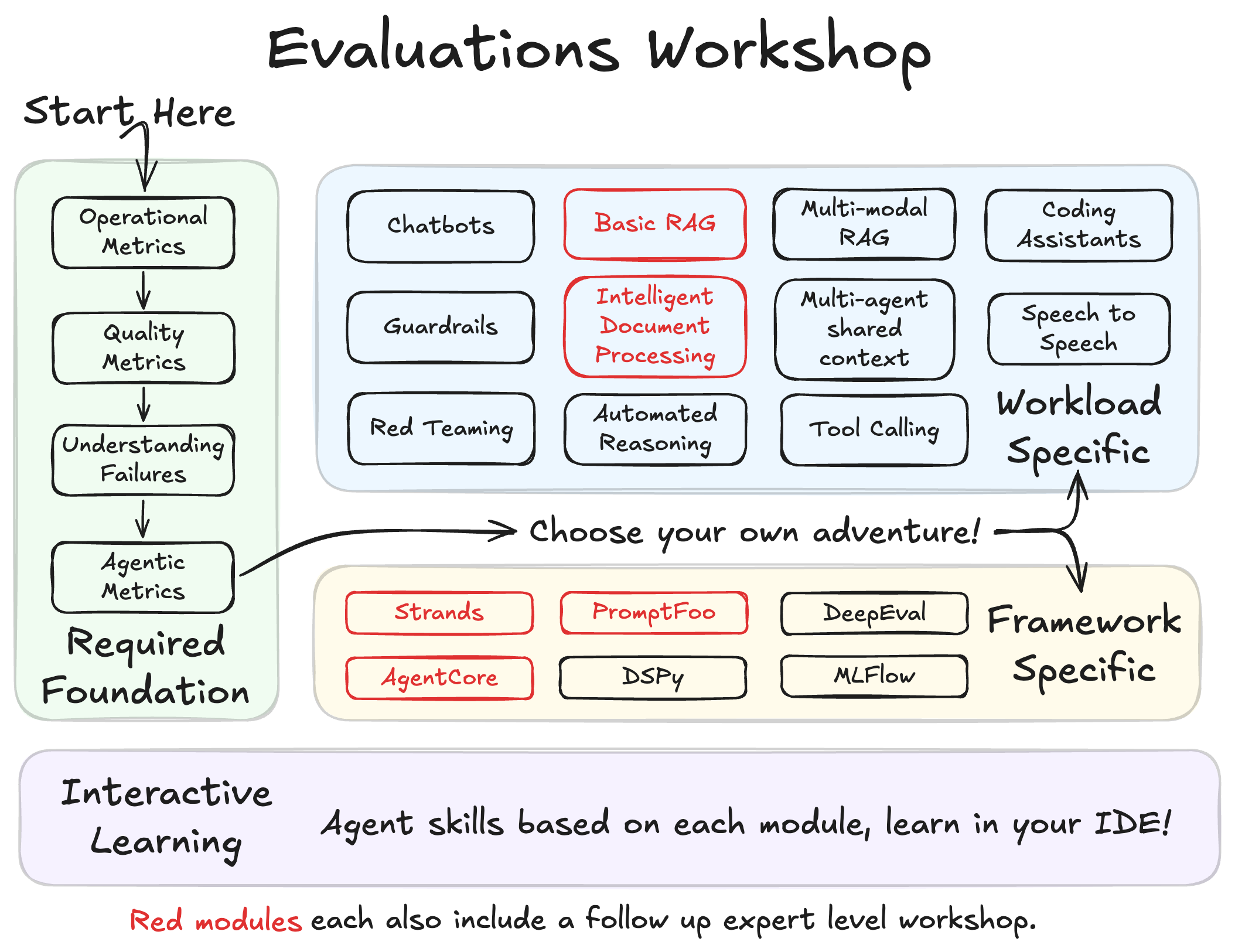
📥 Download the slide deck (.pptx) — covers the basics of evaluations and includes an overview of this workshop.
How to use this repository
We strongly recommend going in order through the Foundational Evaluations modules. These cover the core of generative AI evaluations which will be critical in all workloads. After that, please feel free to select any of the workload-specific, framework-specific, or industry-specific modules in any order, according to what is most relevant to you.
Interactive Learning
As an alternative to working through the Jupyter notebooks directly, you can use the Interactive Learning module as a skill file in your AI coding assistant (Kiro, Claude, or similar). The assistant reads the workshop's notebooks and skill docs, then guides you through hands-on challenges — asking you to write code, explain concepts, and debug configurations rather than passively reading. Tell the agent which module you want to work on and it will present exercises one at a time, check your understanding, provide hints when you're stuck, and adapt to your pace.
What You'll Learn
Foundational Evaluations - Do all of these in order!
- 01 Operational Metrics: evaluate how your workload is running in terms of cost and performance.
- 02 Quality Metrics: evaluate and tune the quality of your results.
- 03 Understanding Failures: discover failure patterns by reading agent traces.
- 04 Agentic Metrics: evaluate your agents and use agents for evaluation.
Optional Modules - Do any of these in any order!
Workload Specific Evaluations
- Intelligent Document Processing: evaluate structured data extraction accuracy with field-level precision/recall.
- Guardrails: configure and test content filters, grounding checks, alignment, and operational controls.
- Basic RAG: evaluate retrieval quality and end-to-end answer generation with precision@k, NDCG, and faithfulness scoring.
- MultiModal RAG: evaluate retrieval across text, vision, and audio modalities using ImageBind embeddings.
- Speech to Speech: end-to-end evaluation of Nova Sonic interactions using CloudWatch telemetry and LLM-as-Judge.
- Automated Reasoning Evaluations: verify LLM outputs against formal policy rules using SMT solver-based guardrails.
- Tool Calling: evaluate agent tool-calling behavior without real tool execution using five progressively sophisticated approaches.
- MCP Tool Calling: evaluate agents that call tools via the Model Context Protocol — schema-driven tool discovery, JSON Schema argument validation, structured error-envelope handling, and permission-scoped access. Synthetic fixtures, no live MCP server required.
- Chatbot: evaluate multi-turn conversational AI with simulated users, custom binary evaluators, and synthetic data generation.
- Red Teaming: systematically probe AI systems with adversarial inputs using Promptfoo across LLM apps, RAG, agents, and guardrails.
- Multiagent Shared Context Evaluation: measure memory coordination quality in multi-agent systems across hub-spoke and peer-to-peer patterns.
- Capacity Management: evaluate a workload across a model portfolio, optimize prompts per model with Advanced Prompt Optimization, and route around quota limits.
- Coding Assistant: coming soon.
Framework Specific Evaluations
- Prompt Foo: configure YAML-based evaluations, write assertion test cases, and compare models across providers.
- Strands: evaluate agents using the Strands Evals SDK with output quality, trajectory, and custom evaluators.
- AgentCore: run, observe, evaluate, and improve an AgentCore Runtime agent through built-in and custom evaluators, curated datasets, batch and online monitoring, simulation, and optimization.
- DSPy: optimize prompts automatically with BootstrapFewShot and measure improvement with custom metrics.
- MLflow: track and compare evaluation experiments using MLflow with Amazon Bedrock.
- DeepEval: evaluate LLM applications with pytest-style metrics for RAG, agents, multi-turn, and safety, plus custom G-Eval for any criteria.
Industry Specific Evaluations
These modules apply the same foundational evaluation techniques to domain-specific workloads. Generic patterns teach you how to evaluate. Industry-specific modules teach you what to look for — the failure modes, data shapes, and compliance requirements unique to a vertical.
Retail and CPG: evaluate product catalog enrichment accuracy (taxonomy classification, allergen extraction, description hallucination), demand sensing agent calibration and boundary adherence, and supply chain chatbot guardrail compliance.
Interactive Learning Mode
Interactive learning! Guided challenges, exercises, and real-time feedback with an interactive tutor.
Prerequisites
- AWS account with Amazon Bedrock enabled
- Basic Python and ML familiarity
- No prior AI evaluation experience required
Getting Started
- Clone the repository
- Configure AWS credentials
- Work through the Foundational Evaluations modules in order
- Pick from the Workload Specific, Framework Specific, and Industry Specific modules based on what's relevant to you
Security
See CONTRIBUTING for more information.
License
This library is licensed under the MIT-0 License. See the LICENSE file.