
automatika-robotics/embodied-agents
automatika-robotics/embodied-agents has 75 GitHub stars and 6 forks. GitHot measured 0 stars in 24 hours. Last checked 2026-11-16 18:39 UTC. Last push 2026-10-21.
What you can do
- Agents that adapt on the fly. Any component can react to what another one publishes. Let a person walking into view wake up your VLM, or let a decision model call time on a VLA the moment the job is done. If the cloud goes down mid-task, the agent switches to a local model and carries on.
- Classical and learned manipulation. MoveIt plans around what Vision lifts into 3D, and VLA runs learned policies. A decision model or a VLM watching the camera can end a policy's task the moment it is done.
- Run fully offline. Built-in local models for LLM, VLM, detection, speech-to-text and text-to-speech (llama.cpp, ONNX Runtime and sherpa-onnx), with no server. Suited to edge devices and NVIDIA Jetson.
- Any model server. Ollama, OpenAI-compatible APIs (vLLM, SGLang, llama.cpp, LMDeploy), RoboML and the LeRobot policy server, with Chroma for vector search.
Measured star growth
- in 24h
- 0
- in 7 days
- Update delayed
- in 15 days
- Update delayed
- in 1 month
- Update delayed
Net star changes over overlapping periods, not daily totals. Missing measurements are left blank. Stars measure attention, not software quality.
About
EmbodiedAgents is a fully-loaded ROS2 based framework for creating interactive physical agents that can understand, remember, and act upon contextual information from their environment.
AIREADME.md
Original
The production-grade framework for deploying Physical AI



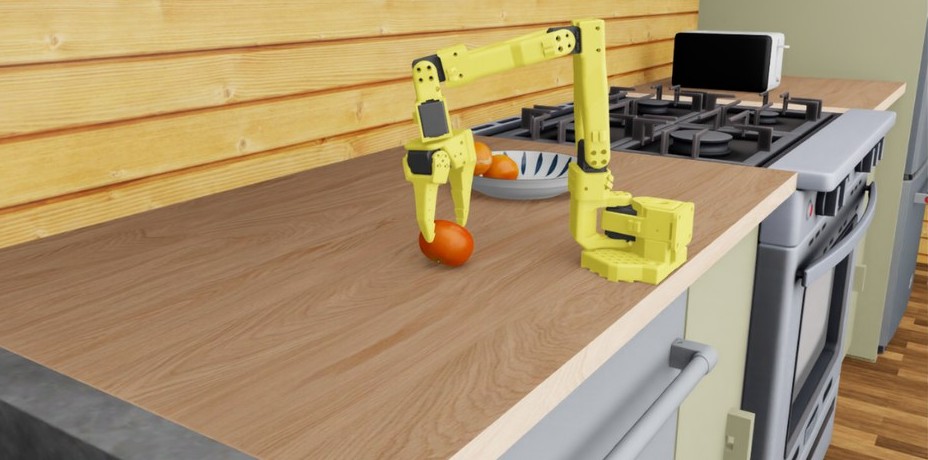
An SO-101 arm picks oranges in Isaac Sim with a GR00T N1.7 policy, run by the VLA component. An event stops the policy when a VLM watching the camera judges the task done (recipe).
EmbodiedAgents is the intelligence and manipulation layer of EMOS, the Embodied Operating System. An agent is a graph of components, written in one Python file called a recipe: models that see, listen, speak, remember, plan and act, connected by ROS 2 topics and events. Every component is a managed ROS 2 lifecycle node, and the graph can reconfigure itself while it runs.
Components
| Area | Components |
|---|---|
| Language and vision | LLM and VLM answer, call tools, describe and ground what the camera sees, and keep a turn-based chat history. SemanticRouter sends each query to the right component, by meaning, by an LLM or by a decision model. |
| Decisions | DecisionComponent asks a decision model typed questions (yes or no, a choice, a score) and publishes each answer with its probabilities, for events to act on. |
| Perception | Vision detects and tracks objects, and lifts its 2D boxes to metric 3D boxes on depth. MotionDetector finds motion in images or point clouds, ignoring the robot's own. |
| Speech | SpeechToText, with voice activity detection and a wake word, and TextToSpeech. |
| Manipulation | MoveIt plans collision-free motion, picks and places through MoveIt 2, around the objects the cameras see. VLA runs vision-language-action policies served by LeRobot, such as GR00T, π0.5, SmolVLA and ACT. |
| Memory | Memory keeps a spatio-temporal graph of what the robot saw, where and when (eMEM), with tools to search it. |
| Planning | Cortex plans a task in plain language, with every action in the recipe as a tool, and runs the plan as monitored routines. |
Key Features
- Agents that adapt on the fly. Any component can react to what another one publishes. Let a person walking into view wake up your VLM, or let a decision model call time on a VLA the moment the job is done. If the cloud goes down mid-task, the agent switches to a local model and carries on.
- Classical and learned manipulation. MoveIt plans around what Vision lifts into 3D, and VLA runs learned policies. A decision model or a VLM watching the camera can end a policy's task the moment it is done.
- Run fully offline. Built-in local models for LLM, VLM, detection, speech-to-text and text-to-speech (llama.cpp, ONNX Runtime and sherpa-onnx), with no server. Suited to edge devices and NVIDIA Jetson.
- Any model server. Ollama, OpenAI-compatible APIs (vLLM, SGLang, llama.cpp, LMDeploy), RoboML and the LeRobot policy server, with Chroma for vector search.
- Planning when you need it. Hand Cortex a task in plain language and it builds a plan from everything your recipe can already do, calling on any component along the way. Each plan runs as a routine you can pause or abort from the web UI.
A Recipe Is a Graph
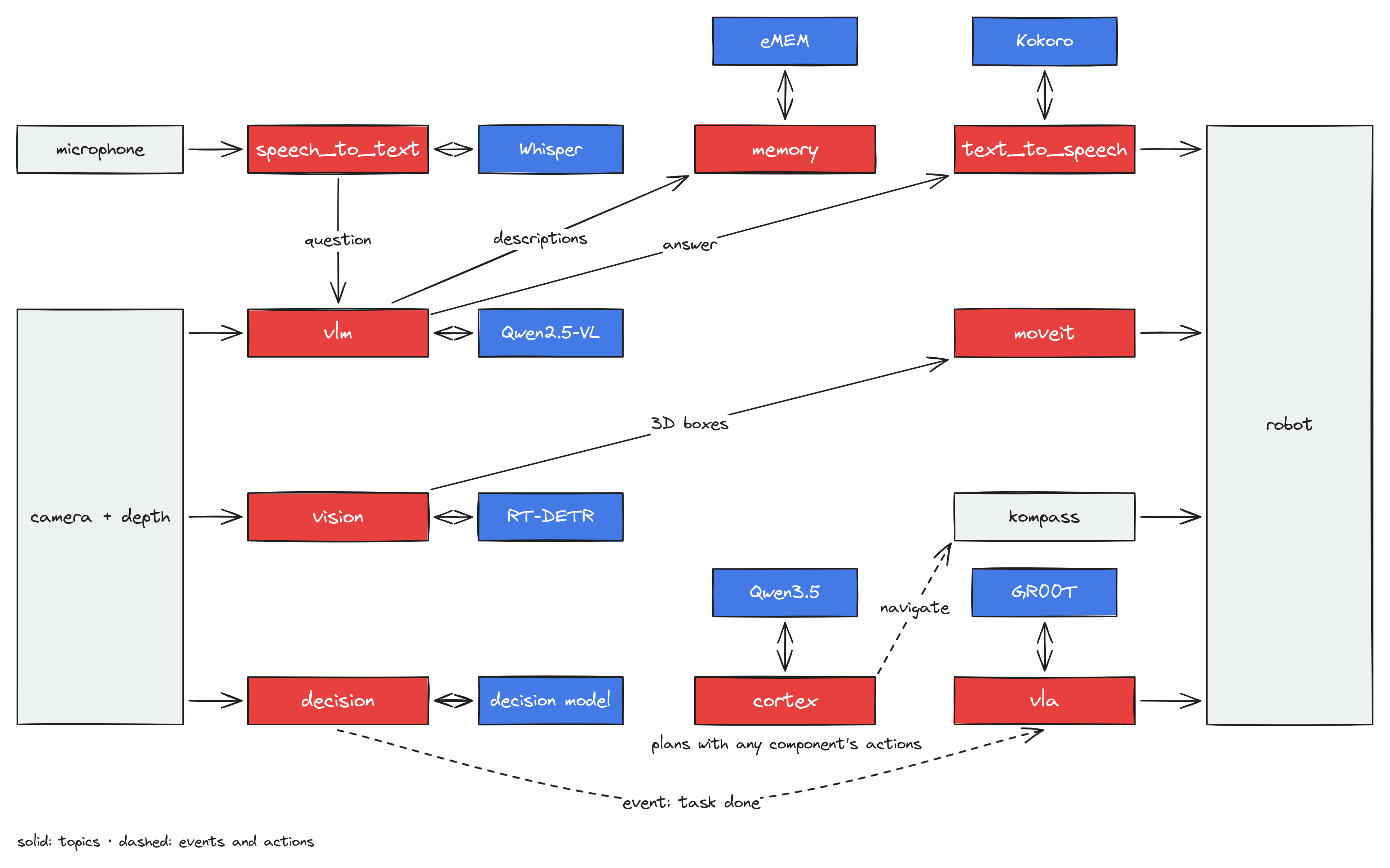
In this recipe, speech reaches a VLM that answers out loud and tells the memory what it sees. Vision's 3D boxes become MoveIt's planning scene, and a decision model watching the camera ends a VLA task through an event. Cortex can join a graph like this one and plan with every component's actions as its tools, including those of other packages such as Kompass for navigation.
Quick Start
A VLM agent that answers questions about what its camera sees:
from agents.clients.ollama import OllamaClient
from agents.components import VLM
from agents.models import OllamaModel
from agents.ros import Topic, Launcher

text0 = Topic(name="text0", msg_type="String")
image0 = Topic(name="image_raw", msg_type="Image")
text1 = Topic(name="text1", msg_type="String")

qwen_vl = OllamaModel(name="qwen_vl", checkpoint="qwen2.5vl:latest")
qwen_client = OllamaClient(qwen_vl)

vlm = VLM(
    inputs=[text0, image0],
    outputs=[text1],
    model_client=qwen_client,
    trigger=text0,
    component_name="vqa"
)

launcher = Launcher()
launcher.add_pkg(components=[vlm])
launcher.bringup()
Components are wired with topics and events. Here a detector runs on every frame with a small local model, and the VLM describes the scene only when a person appears:
from agents.components import Vision
from agents.config import VisionConfig
from agents.ros import Event, FixedInput

detections = Topic(name="detections", msg_type="Detections")

vision = Vision(
    inputs=[image0],
    outputs=[detections],
    trigger=image0,
    config=VisionConfig(threshold=0.6, enable_local_classifier=True),
    component_name="detector",
)

person_appears = Event(detections.msg.labels.contains_any(["person"]), on_change=True)

describer = VLM(
    inputs=[
        FixedInput(name="prompt", msg_type="String",
                   fixed="A person has appeared. Describe them briefly."),
        image0,
    ],
    outputs=[text1],
    model_client=qwen_client,
    trigger=person_appears,
    component_name="describer",
)

launcher = Launcher()
launcher.add_pkg(components=[vision, describer])
launcher.bringup()
Run Fully Offline
Every AI component can run on a built-in local model, with no server, no cloud and no heavy frameworks. Set enable_local_model=True:
from agents.components import LLM
from agents.config import LLMConfig
from agents.ros import Topic, Launcher

config = LLMConfig(
    enable_local_model=True,
    device_local_model="cpu",  # or "cuda"
    ncpu_local_model=4,
)

query = Topic(name="user_query", msg_type="String")

llm = LLM(
    inputs=[query],
    outputs=[Topic(name="response", msg_type="String")],
    config=config,
    trigger=query,
    component_name="local_brain",
)

launcher = Launcher()
launcher.add_pkg(components=[llm])
launcher.bringup()
Dynamic Web UI
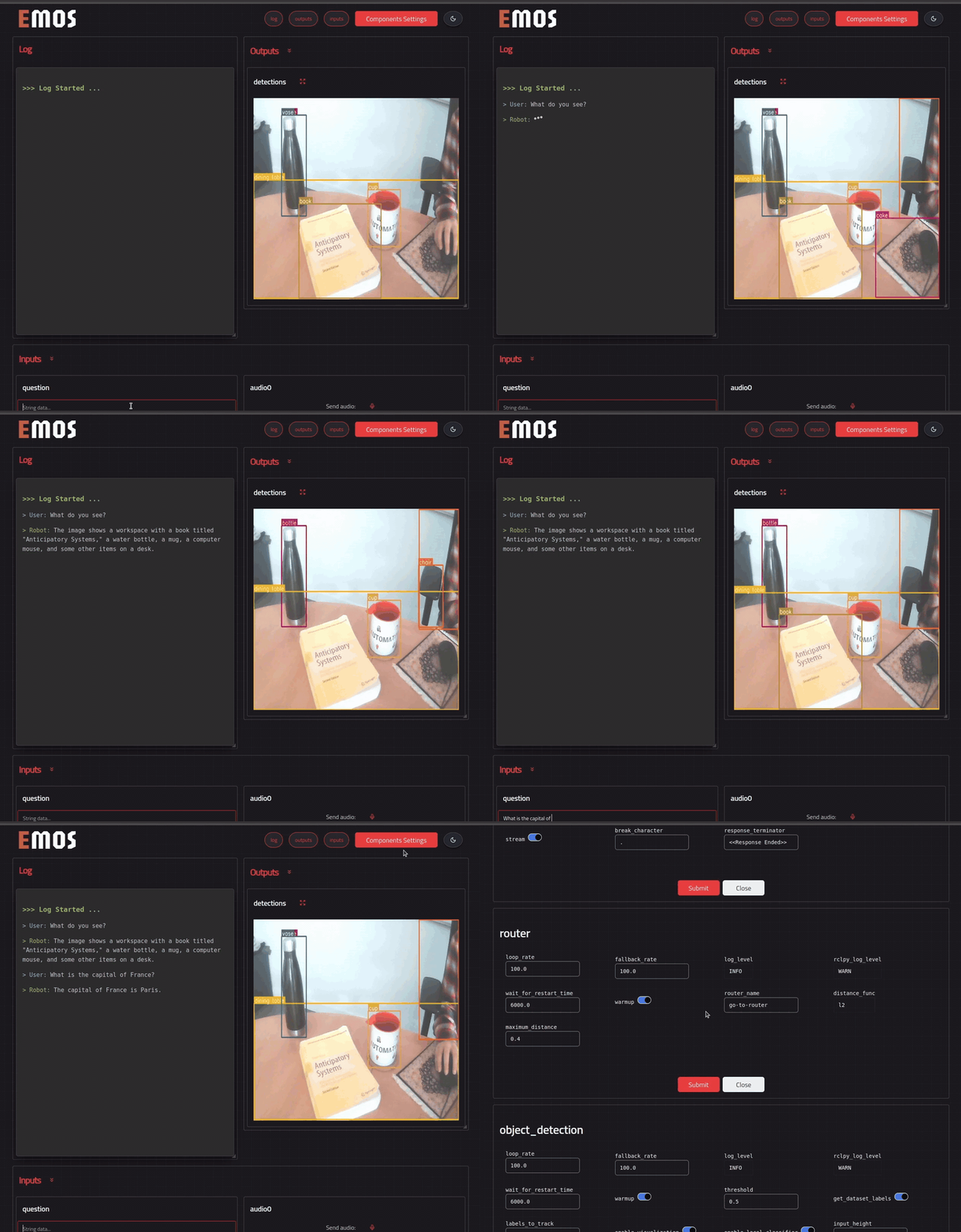
Every recipe gets a web UI generated from its components: their inputs, outputs, settings and tasks, with no frontend code.
Installation
The easiest way to get EmbodiedAgents with the rest of the stack is the EMOS CLI. See the installation docs for details.
With your package manager (Ubuntu, ROS 2 Humble or later):
sudo apt install ros-$ROS_DISTRO-automatika-embodied-agents
From source:
mkdir -p agents_ws/src && cd agents_ws/src
git clone https://github.com/automatika-robotics/sugarcoat
git clone https://github.com/automatika-robotics/embodied-agents
cd ..

pip install numpy opencv-python-headless 'attrs>=23.2.0' jinja2 httpx \
            msgpack msgpack-numpy setproctitle pyyaml toml \
            platformdirs tqdm websockets

colcon build
source install/setup.bash
Some features need an extra package: ollama for the Ollama client, emem for Memory, kompass-core for 3D boxes, redis[hiredis] for RoboML's RESP client, and llama-cpp-python, onnxruntime or sherpa-onnx for local models.
Part of the EMOS Ecosystem
EmbodiedAgents is one of three core open-source components in EMOS, the unified orchestration layer for Physical AI:
- EmbodiedAgents: intelligence and manipulation. Graphs of ML models with planning, memory, and classical and learned manipulation.
- Kompass: navigation. GPU-accelerated planning and control.
- Sugarcoat: system primitives. Lifecycle-managed components and event-driven system design for ROS 2.
Write a recipe once. Deploy it on any robot. No code changes.
Resources
- EMOS Documentation: tutorials, recipes and usage guides
- Developer Docs: architecture, custom components, API reference
llms.txt: context for AI coding agents, to write recipes with your preferred LLM- Discord: community and support
Copyright & Contributions
EmbodiedAgents is a collaboration between Automatika Robotics and Inria.
The code is available under the MIT License. See LICENSE for details. Copyright (c) 2024 Automatika Robotics unless explicitly indicated otherwise.