
atulapra/Emotion-detection
atulapra/Emotion-detection has 1,357 GitHub stars and 549 forks. GitHot measured -2 stars in 24 hours and -3 in 7 days. Last checked 2026-11-09 05:38 UTC. Last push 2024-08-30.
Real-time Facial Emotion Detection using deep learning
Measured star growth
- in 24h
- -2
- in 7 days
- -3
- in 15 days
- Collecting history
- in 1 month
- Collecting history
Net star changes over overlapping periods, not daily totals. Missing measurements are left blank. Stars measure attention, not software quality.
README.md
OriginalEmotion detection using deep learning
Introduction
This project aims to classify the emotion on a person's face into one of seven categories, using deep convolutional neural networks. The model is trained on the FER-2013 dataset which was published on International Conference on Machine Learning (ICML). This dataset consists of 35887 grayscale, 48x48 sized face images with seven emotions - angry, disgusted, fearful, happy, neutral, sad and surprised.
Dependencies
- Python 3, OpenCV, Tensorflow
- To install the required packages, run
pip install -r requirements.txt.
Basic Usage
The repository is currently compatible with tensorflow-2.0 and makes use of the Keras API using the tensorflow.keras library.
- First, clone the repository and enter the folder
git clone https://github.com/atulapra/Emotion-detection.git
cd Emotion-detection
Download the FER-2013 dataset inside the
srcfolder.If you want to train this model, use:
cd src
python emotions.py --mode train
- If you want to view the predictions without training again, you can download the pre-trained model from here and then run:
cd src
python emotions.py --mode display
The folder structure is of the form:
src:- data (folder)
emotions.py(file)haarcascade_frontalface_default.xml(file)model.h5(file)
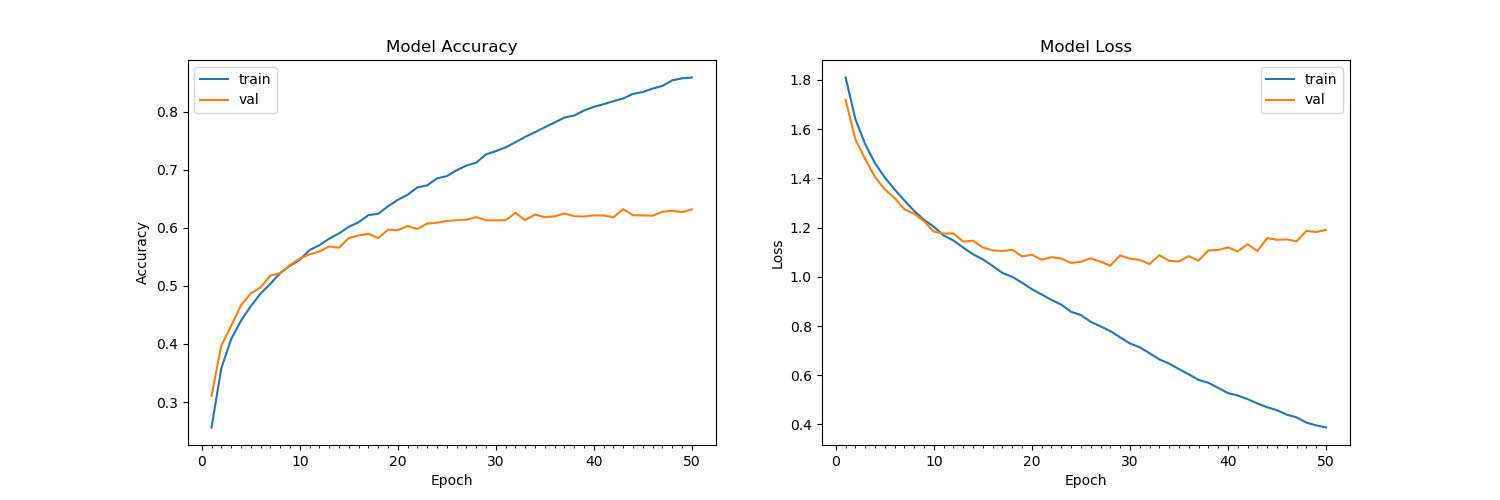
This implementation by default detects emotions on all faces in the webcam feed. With a simple 4-layer CNN, the test accuracy reached 63.2% in 50 epochs.
Data Preparation (optional)
The original FER2013 dataset in Kaggle is available as a single csv file. I had converted into a dataset of images in the PNG format for training/testing.
In case you are looking to experiment with new datasets, you may have to deal with data in the csv format. I have provided the code I wrote for data preprocessing in the
dataset_prepare.pyfile which can be used for reference.
Algorithm
First, the haar cascade method is used to detect faces in each frame of the webcam feed.
The region of image containing the face is resized to 48x48 and is passed as input to the CNN.
The network outputs a list of softmax scores for the seven classes of emotions.
The emotion with maximum score is displayed on the screen.
References
- "Challenges in Representation Learning: A report on three machine learning contests." I Goodfellow, D Erhan, PL Carrier, A Courville, M Mirza, B
Hamner, W Cukierski, Y Tang, DH Lee, Y Zhou, C Ramaiah, F Feng, R Li,
X Wang, D Athanasakis, J Shawe-Taylor, M Milakov, J Park, R Ionescu, M Popescu, C Grozea, J Bergstra, J Xie, L Romaszko, B Xu, Z Chuang, and Y. Bengio. arXiv 2013.
Explore related projects
tensorflow/tensorflow
An Open Source Machine Learning Framework for Everyone
201,400 starshuggingface/transformers
🤗 Transformers: the model-definition framework for state-of-the-art machine learning models in text, vision, audio, and multimodal models, for both inference and training.
168,668 starsAUTOMATIC1111/stable-diffusion-webui
Stable Diffusion web UI
165,261 starsComfy-Org/ComfyUI
The most powerful and modular diffusion model GUI, api and backend with a graph/nodes interface. The fastest local inference engine in the world.
145,835 stars