
assassin808/learn-from-lessons
assassin808/learn-from-lessons has 45 GitHub stars and 2 forks. GitHot measured +1 stars in 24 hours. Last checked 2026-11-15 03:14 UTC. Last push 2026-11-09.
Measured star growth
- in 24h
- +1
- in 7 days
- Collecting history
- in 15 days
- Collecting history
- in 1 month
- Collecting history
Net star changes over overlapping periods, not daily totals. Missing measurements are left blank. Stars measure attention, not software quality.
About
A skill/tool that lets your coding agents learn from your corrections — Claude Code, Codex, opencode, MCP
AIREADME.md
Original

Every time you correct your coding agent, it should learn. This makes it.
Install •
Usage •
How it works •
Guide •
Contributing

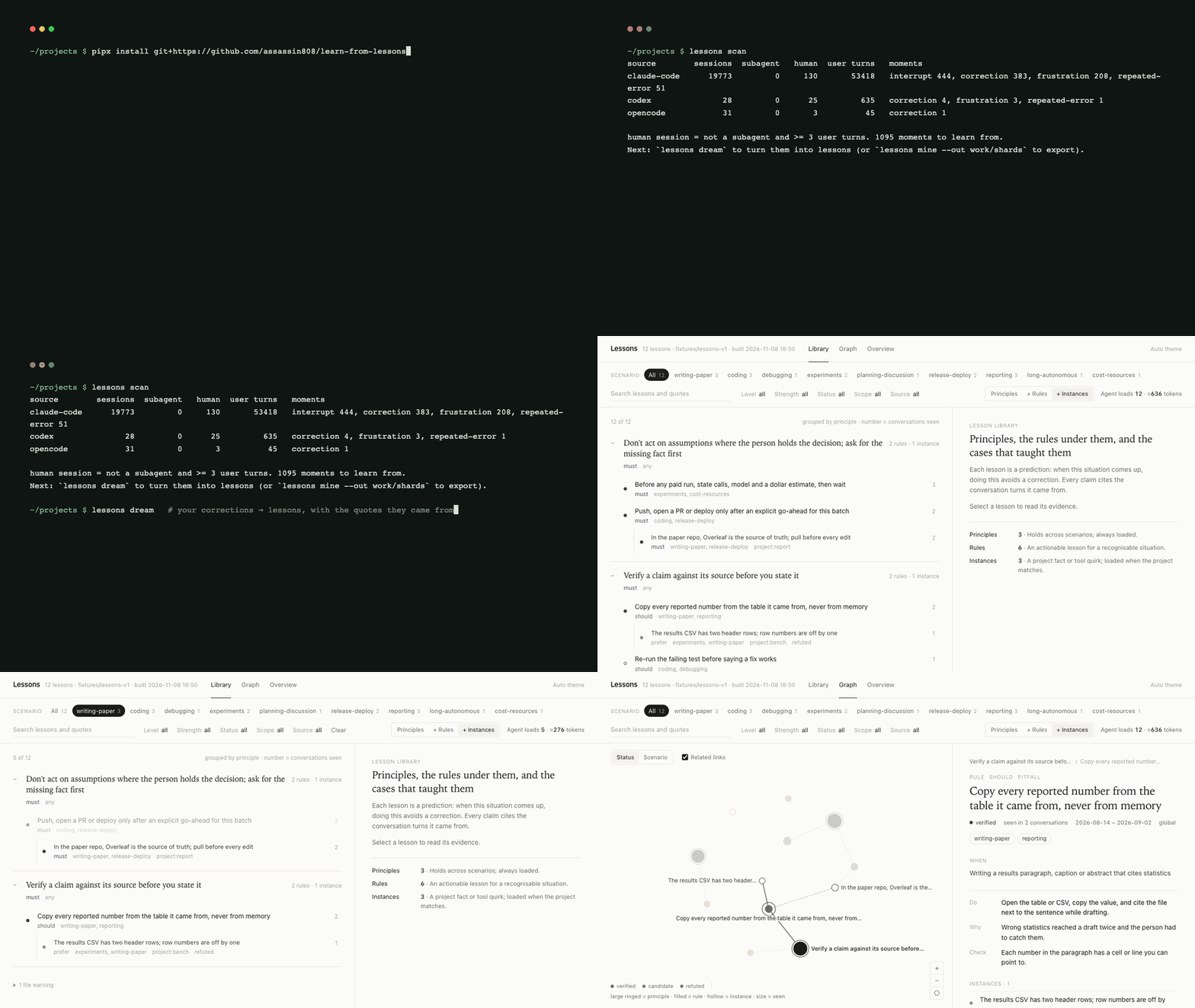
You tell Claude Code "don't push yet", "I asked why, not to change it", "that number isn't from the table" — and next session it does it again. Learn from Lessons reads the transcripts already on your machine (Claude Code, Codex, opencode), finds the moments you corrected the agent, and turns them into short lessons with the exact quote they came from. Your agents load them next time.
Install
pipx install git+https://github.com/assassin808/learn-from-lessons
Python 3.9+, no other dependencies. Everything runs locally.
Usage
lessons scan          # what's on this machine: sessions, corrections
lessons dream         # turn corrections into lessons (uses your own claude / codex CLI)
lessons view          # browse them: list, graph, evidence
lessons inject --target CLAUDE.md --apply   # let your agent load them
Writing a paper doesn't need your git-push lessons: filter by scenario.
lessons index --scenario writing-paper
lessons search "about to launch the eval runs" --context "$(git log -1)"
Also ships as a Claude Code skill, an AGENTS.md block for Codex and
opencode, and an MCP server (lessons mcp).
How it works
A lesson is a small prediction: when this situation comes up, doing X avoids a correction. Lessons sit at three levels — a principle ("ask where the person holds the decision"), the rules under it ("push only after an explicit go-ahead"), and narrow cases ("in this repo, Overleaf is the source of truth"). Each one cites the conversations it came from and is marked verified once it has been seen twice.
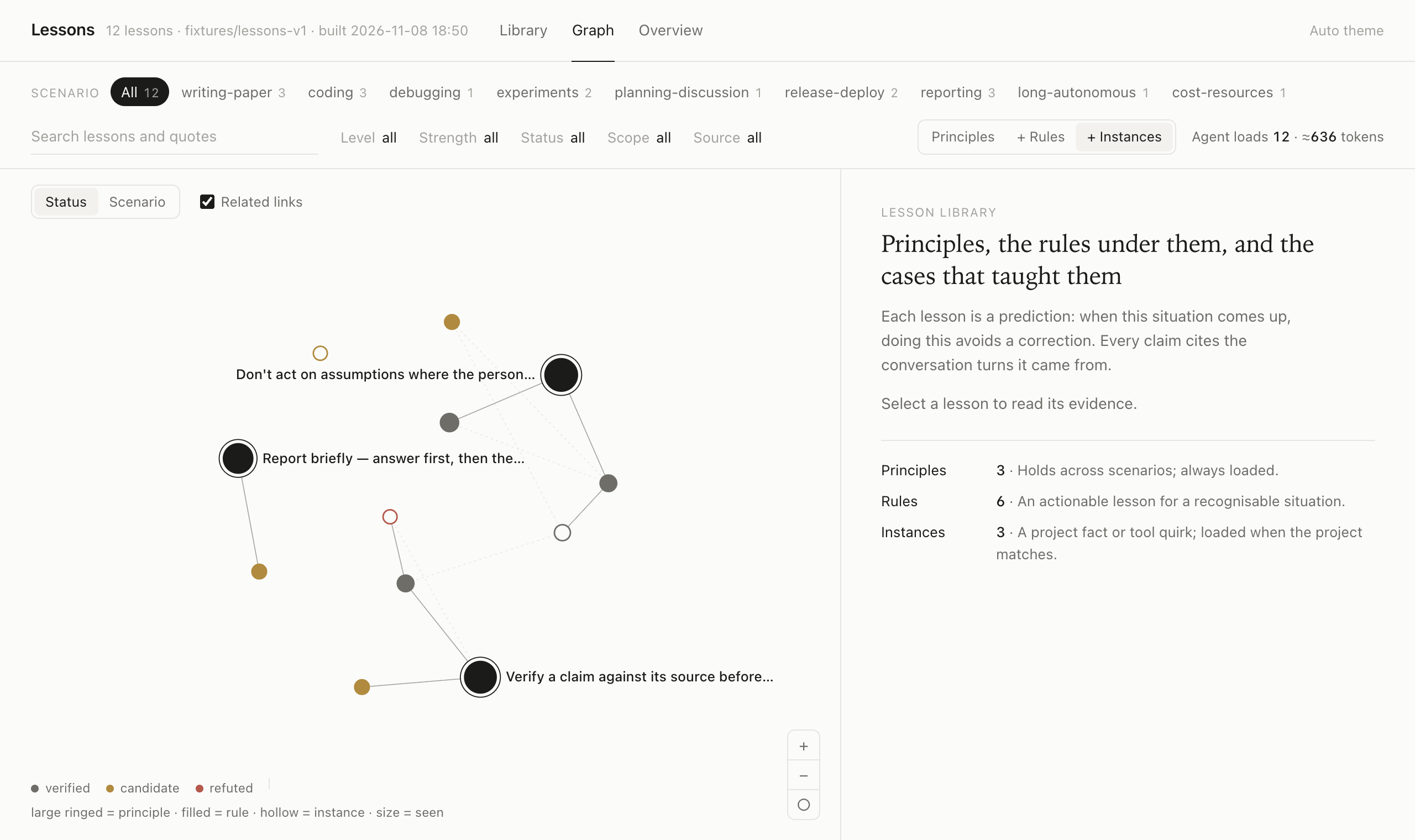
The design follows Anthropic's The Components of Agent Memory: transcripts are the ground truth, lessons are checked against them, and only a small index is loaded by default. Details: docs/GUIDE.md · docs/LESSON_FORMAT.md.
Does it work?
On 47 new situations — different projects from the ones the lessons came from — an agent followed the person's
rule 85% of the time without lessons and 98–100% with them, without becoming over-cautious elsewhere.
One person's data so far; the test is in eval/.
Contributing
Looking for collaborators: readers for more agents (Cursor, Aider, Gemini CLI, Cline), people willing to run the evaluation on their own history, and researchers interested in agent memory. Open an issue or a discussion. See CONTRIBUTING.md.
Citation
@software{learn_from_lessons_2026,
  author = {{learn-from-lessons contributors}},
  title  = {Learn from Lessons: Turning Coding-Agent Corrections into Evidence-Linked Lessons},
  year   = {2026},
  url    = {https://github.com/assassin808/learn-from-lessons}
}
Built on ideas from Anthropic, The Components of Agent Memory (2026). MIT License.