
askglyph/glyph
askglyph/glyph has 31 GitHub stars and 8 forks. Star changes are not measured yet. Last checked 2026-11-09 14:47 UTC. Last push 2026-11-02.
an ascii manta that guards the $GLYPH reserve
What you can do
- A character, not a chatbot. glyph's voice, pacing and rules live in one persona spec (shared/persona.mjs). It talks, teases, remembers what is already on screen, and only reaches for a card when the conversation gets there.
- Words from the model, numbers from the database. The language model can propose a tool call (verify_task, judge_pitch, save_wallet and so on). It can never say "add 500". Every reward is a fixed SQL function behind an idempotency key.
- Sign in with X, nothing in between. OAuth 2.0 + PKCE in two serverless functions, an HMAC-signed session cookie, and the X token is revoked as soon as the profile is read.
- Real checks where they are free. Reply and quote links must be public posts by the signed-in account (verified through X's public embed endpoint). Timer trials run on the server clock, not the browser's.
Measured star growth
- in 24h
- Update delayed
- in 7 days
- Update delayed
- in 15 days
- Update delayed
- in 1 month
- Update delayed
Net star changes over overlapping periods, not daily totals. Missing measurements are left blank. Stars measure attention, not software quality.
README.md
Original
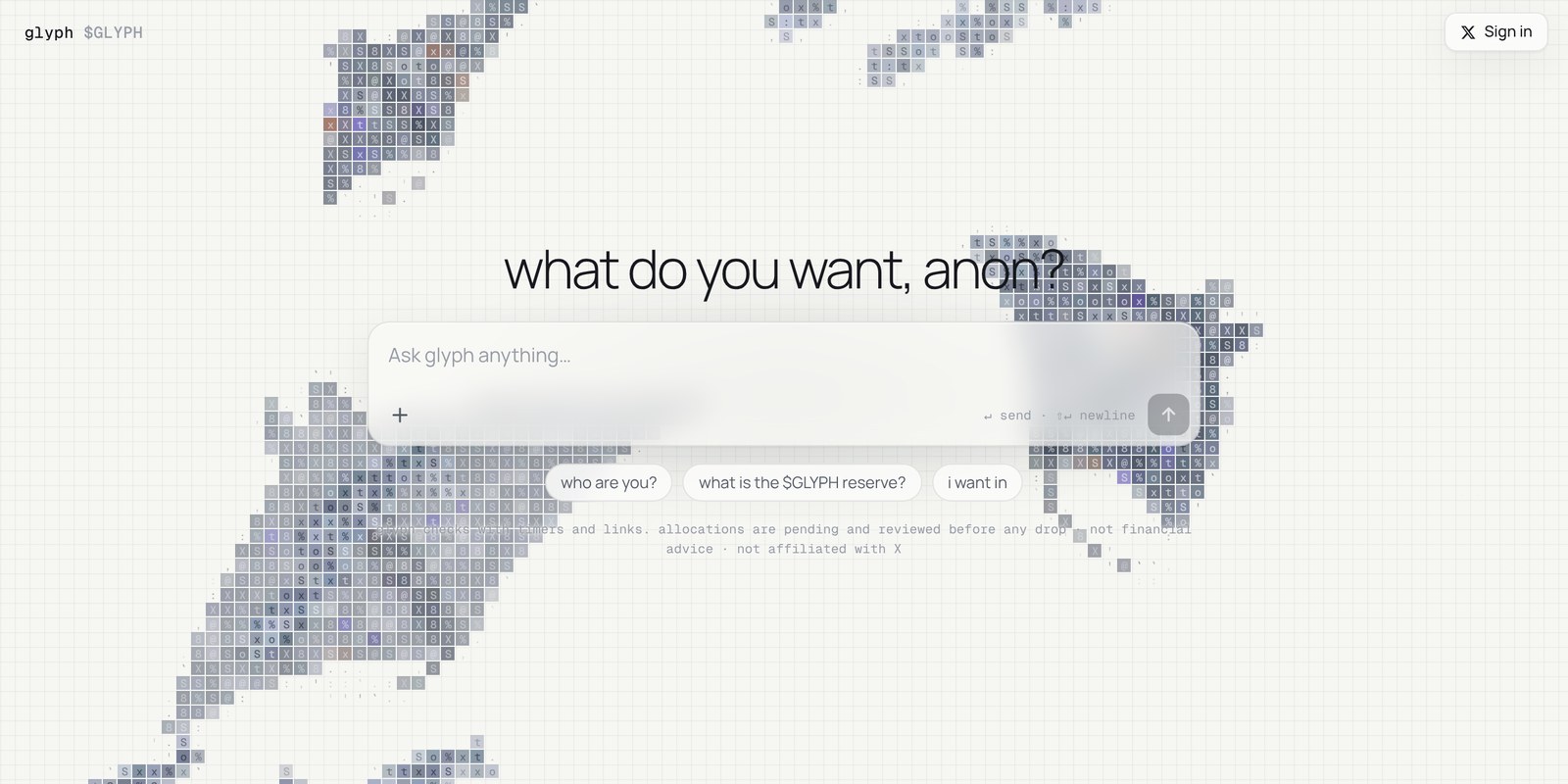
glyph
an old manta made of ascii. keeper of the $GLYPH reserve.
talk to it, pass its trials on X, make your case, and leave with an on-chain card.







What it is · How a turn works · The glyph card · Architecture · Run it · Security
What it is
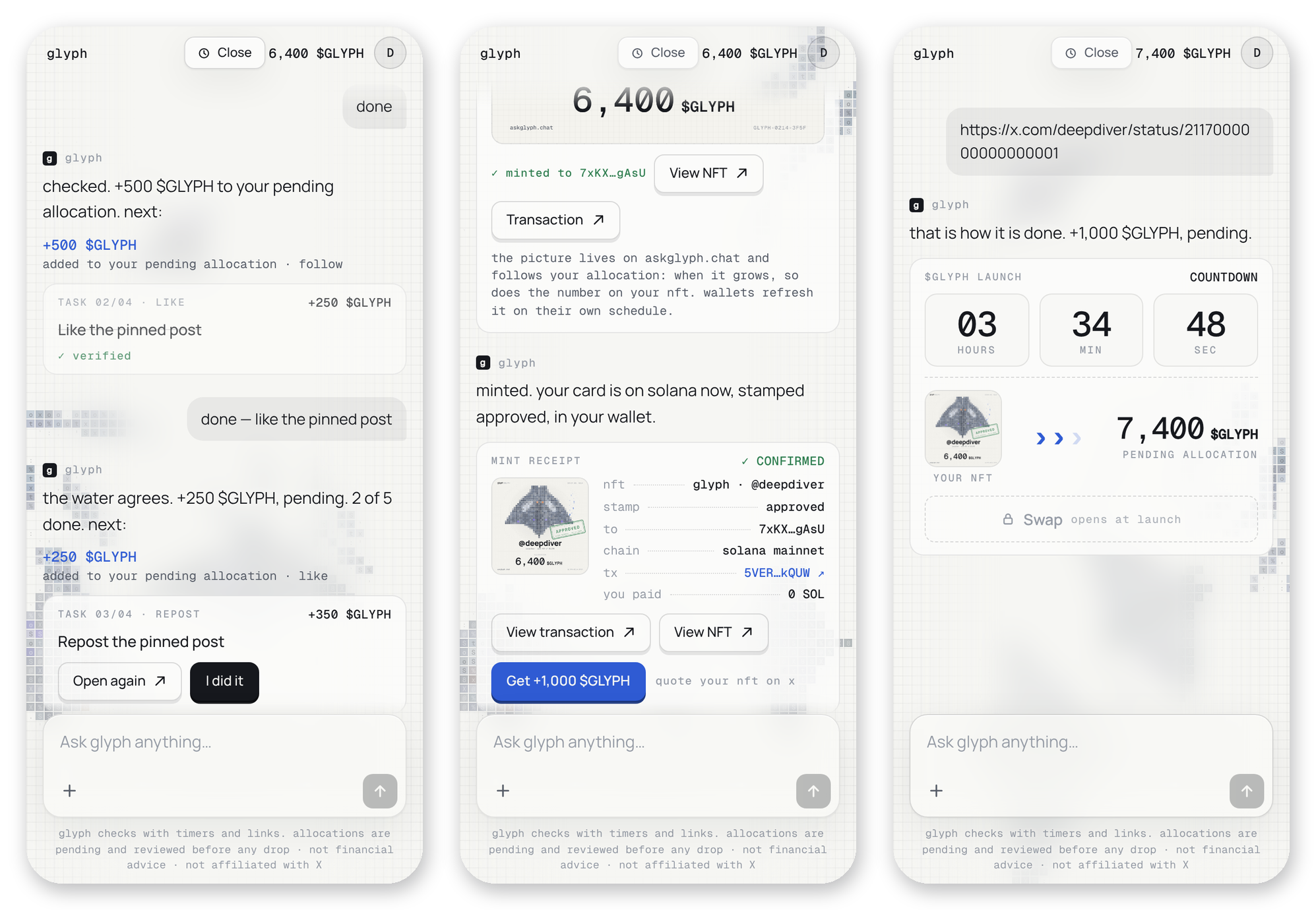
glyph is a conversational agent with a body: an ASCII manta rendered live in your browser, gliding through a field of glyphs. It runs the $GLYPH reserve. It hands out trials on X and checks them, credits a pending allocation, listens to your pitch for more, and mints your glyph card straight to your wallet as a compressed NFT.
No forms, no dashboard. One chat window and a creature that answers.
Highlights
- A character, not a chatbot. glyph's voice, pacing and rules live in one persona spec (
shared/persona.mjs). It talks, teases, remembers what is already on screen, and only reaches for a card when the conversation gets there. - Words from the model, numbers from the database. The language model can propose a tool call (
verify_task,judge_pitch,save_walletand so on). It can never say "add 500". Every reward is a fixed SQL function behind an idempotency key. - Sign in with X, nothing in between. OAuth 2.0 + PKCE in two serverless functions, an HMAC-signed session cookie, and the X token is revoked as soon as the profile is read.
- Real checks where they are free. Reply and quote links must be public posts by the signed-in account (verified through X's public embed endpoint). Timer trials run on the server clock, not the browser's.
- On-demand compressed NFTs. Nothing is pre-minted. When you press mint, the server builds one Bubblegum v2 instruction for your wallet, signs it and sends it. The signature is stored before broadcast, so a retry can never mint twice.
- Living metadata. Each card is drawn on the server (SVG → PNG with resvg in WebAssembly) from the current database state, so the number on your NFT follows your allocation.
- An ocean made of characters. A Canvas2D engine turns a low-res simulation into cells of glyphs: mantas, schools of fish, ripples under your cursor. It respects
prefers-reduced-motion. - Degrades gracefully. No model endpoint, or a slow one? A scripted brain answers with the same tools. Per-user and site-wide budgets keep the bill flat.
How a turn works
sequenceDiagram
  autonumber
  participant You
  participant G as glyph (serverless)
  participant LM as language model
  participant DB as Postgres
  You->>G: "done, here is my reply"
  G->>DB: rate limits + recent history (one round trip)
  G->>LM: persona + your state + tools
  LM-->>G: verify_task(reply, url)
  G->>G: is it a public post by you?
  G->>DB: api_task_claim(): fixed reward, idempotency key
  DB-->>G: +400 $GLYPH (pending)
  G->>LM: tool result
  LM-->>G: "the water agrees. +400, pending."
  G-->>You: reply + reward + the next trial card
The model gets a strict tool interface and a hard deadline. If it is late or fails, the scripted brain answers in its place, with the same tools, so the user never waits on a spinner.
The journey
| Step | What happens | |
|---|---|---|
| 1 | /glyphfree |
The deal in one breath, and the first trial. |
| 2 | Trials on X | Follow, like, repost, reply, quote your card. Each one is checked and credited to your pending allocation. |
| 3 | The pitch | Three attempts to talk glyph into more. Tough but fair; it is capped and paid once per tier. |
| 4 | /mintallo |
Your glyph card as a compressed NFT, minted to your wallet. The reserve pays the gas. |
| 5 | Quote it | Quote the pinned post with your NFT for a bonus, then watch the countdown to launch. |
The glyph card
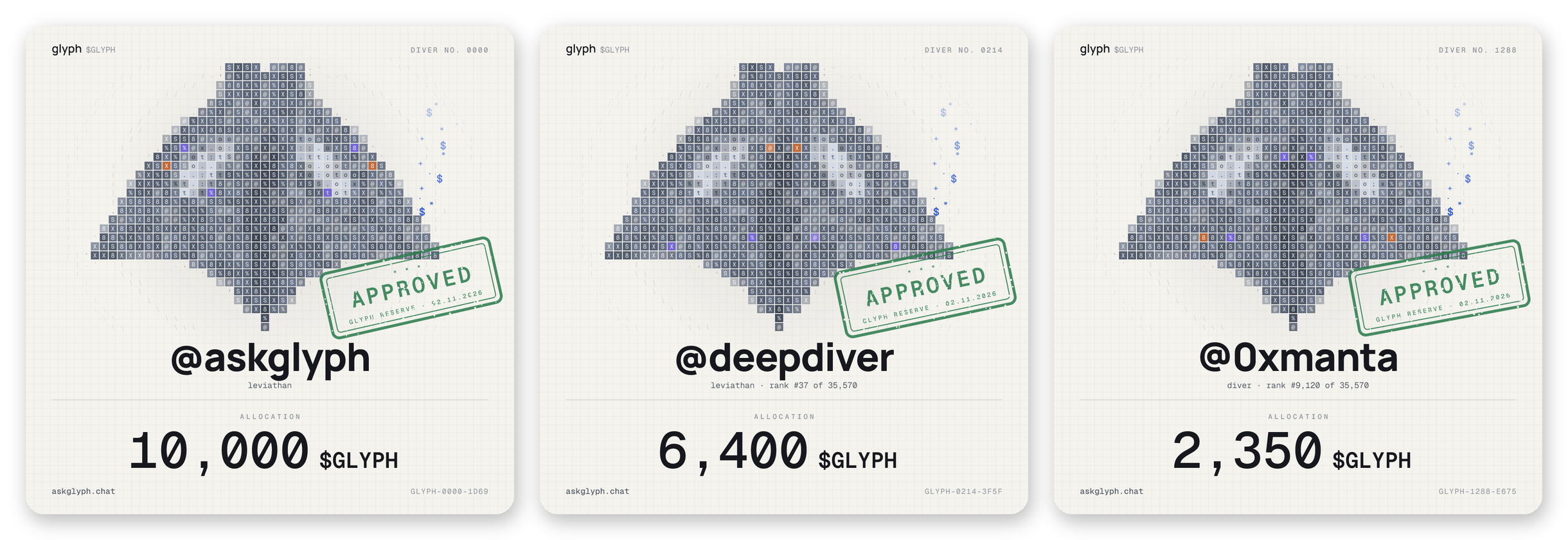
Every card is unique to its owner. The manta's markings are seeded by your handle, and the card carries your diver number, rank, allocation and the reserve's stamp. The image and the Metaplex metadata are served from /nft/<id>.json and drawn from the database on request (CDN-cached), so the card stays current after it is minted.
| Card | Details |
|---|---|
| Standard | Metaplex Bubblegum v2 compressed NFT in an MPL Core collection |
| Mint | on demand, one per person, signed only for a transaction the server built itself |
| Cost | about 0.0001 SOL per card; the merkle tree is paid once |
| Safety | signature stored before broadcast; a failed or expired transaction is detected on chain before any retry |
Architecture
flowchart LR
  U([you]) --> W["askglyph.chat<br/>Vite · TypeScript<br/>ASCII renderer"]
  W -- "/auth/x/*" --> A["X OAuth 2.0 + PKCE"]
  W -- "/api/*" --> F["chat function<br/>persona · tools · limits"]
  F -- "prompt + tools" --> M[("language model")]
  F -- "RPC (service role)" --> DB[("Postgres<br/>rules · ledger · limits")]
  F -- "public embed check" --> XP["X posts"]
  W -- "/api/nft/* · /nft/*" --> N["nft function<br/>mint · metadata · images"]
  N -- "mintV2" --> S[("Solana<br/>Bubblegum v2")]
  N --> DB
| Layer | Built with |
|---|---|
| Front | Vite + strict TypeScript, no framework. Canvas2D ASCII ocean, FLIP-animated composer, light and dark water |
| Server | Netlify Functions (Node), edge rate limits, no-store on every API response |
| Data | Postgres reached only through RPC with a service role. RLS on every table with no policies, so the browser cannot touch it |
| Identity | X OAuth 2.0 + PKCE, HMAC-SHA256 session cookie, timingSafeEqual checks |
| Mind | a language model behind an OpenAI-compatible endpoint, with a scripted brain as fallback |
| Chain | Solana · Metaplex Bubblegum v2 · MPL Core collection · umi |
| Images | server-side SVG → PNG with resvg (WebAssembly) and bundled fonts |
Repository layout
src/                 the site: chat UI, glyph card, ASCII ocean engine
  ocean/             renderer + creatures (mantas, fish, ripples)
  backend/           live API client and the localStorage DEMO backend
shared/              brand, persona, scripted brain, tasks: one source for client and server
netlify/functions/   api (chat, tasks), auth-start / auth-callback (X), nft (mint, metadata, images)
netlify/lib/         agent loop, sessions + CSRF, X post checks, NFT renderer, Solana mint
supabase/migrations/ 0001 → 0012: schema, rules, limits, ledger, NFT mints (run in order)
scripts/             nft-setup: minting wallet, merkle tree, collection
docs/                operations: rewards, limits, allowlist, minting
Run it
npm install
npm run dev            # DEMO mode: scripted brain, everything in localStorage → http://127.0.0.1:5191
npx netlify-cli dev    # with the functions (needs .env) → http://127.0.0.1:8888
npm run build          # → dist/
Database. Create a Postgres project (Supabase works out of the box) and run supabase/migrations/0001_init.sql → 0012_mint_trials.sql in order.
Environment. Copy .env.example to .env. Server-side only; nothing secret ever gets a VITE_ prefix.
| Variable | What it is |
|---|---|
X_CLIENT_ID, X_CLIENT_SECRET |
X app (Web App, OAuth 2.0). Callback: https://<your-domain>/auth/x/callback |
SESSION_SECRET |
32+ random characters |
SUPABASE_URL, SUPABASE_SERVICE_ROLE_KEY |
Postgres over RPC, server only |
SITE_URL |
your public origin, e.g. https://askglyph.chat |
MODEL_BASE_URL, MODEL_API_KEY, MODEL_NAME |
any OpenAI-compatible chat-completions endpoint. Without it, the scripted brain answers |
MODEL_OPTIONS |
optional JSON merged into each model request |
NFT_RPC_URL, NFT_SECRET_KEY, NFT_TREE, NFT_COLLECTION, NFT_NETWORK |
minting (see scripts/nft-setup.mjs) |
Minting. node scripts/nft-setup.mjs keygen, then tree --yes and collection --site https://<your-domain> --yes. Start on devnet. Operations and admin SQL: docs/OPERATIONS.md.
Deploy. npx netlify-cli deploy --build --prod. A drag-and-drop upload ships static files only, without the functions.
Security
- The browser never talks to the database. No anon key, no service key, no table grants: only server functions call RPCs.
- Amounts never come from the client or the model. The client states an intent (
task_id, a link); SQL decides what it is worth, once. - Every mutation requires a JSON body and a same-origin
Origin/sec-fetch-site. Every API response isno-store. - The minting key signs only the one instruction the server built: our tree, the wallet from the database, metadata on our domain.
- Rate limits at the edge and in the database. Daily model budgets per user and for the whole site.
Found something? See SECURITY.md.
Disclaimer
Allocations shown in the app are pending, not a balance, and are reviewed before any distribution. Nothing here is financial advice. Not affiliated with X.
License
MIT © 2026 glyph
Explore related projects
affaan-m/ECC
The agent harness performance optimization system. Skills, instincts, memory, security, and research-first development for Claude Code, Codex, Opencode, Cursor and beyond.
300,861 starsNousResearch/hermes-agent
The agent that grows with you
262,490 starsmultica-ai/andrej-karpathy-skills
A single CLAUDE.md file to improve Claude Code behavior, derived from Andrej Karpathy's observations on LLM coding pitfalls.
231,914 starsfirecrawl/firecrawl
Supercharge your AI agents with data from the web and beyond. Building the library for superintelligence. 🔥
200,444 stars