
antonellof/frink
antonellof/frink has 71 GitHub stars and 9 forks. GitHot measured +4 in 7 days. Last checked 2026-11-15 20:15 UTC. Last push 2026-11-07.
Measured star growth
- in 24h
- Update delayed
- in 7 days
- +4
- in 15 days
- Update delayed
- in 1 month
- Update delayed
Net star changes over overlapping periods, not daily totals. Missing measurements are left blank. Stars measure attention, not software quality.
About
Pure-Rust GGUF inference engine with quantized CPU, Metal & CUDA kernels, MoE support, OpenAI-compatible server. Benchmarked head-to-head against llama.cpp.
Developer ToolsREADME.md
Original
A pure-Rust GGUF inference engine. Dense and MoE, on CPU, Apple Metal, or CUDA.






Features · Models · CLI · API · Config · Benchmarks · Studio UI · Agents · Roadmap · Changelog · Contributing
Frink loads GGUF checkpoints and runs them on the hardware you already own. It does not bind to llama.cpp or wrap ggml: the loader, the quantized kernels, attention and expert routing are all written here, in Rust.
- Everything ships as one 23 MB binary (macOS arm64, with Metal and the
server): completions, the API server,
download,bench,batched-bench,quantize,imatrix,gguf-splitandverify. There are no Python wheels to install and no CUDA userspace to match against a driver. For comparison, PyTorch alone is 402 MB before a serving stack sits on top. - Weights stay quantized on mmap and are dequantized inside the matmul, so an 8B model fits on a laptop. Supported formats are the K-quants, the IQ tiers, MXFP4, F16 and BF16.
- It works as a drop-in for llama.cpp. The flags are the same, the
sampler chain runs in the same order, and the tools match:
quantizewrites Q8_0 and the K-quants byte-identically tollama-quantize, with or without an importance matrix, andgguf-split,imatrixandbatched-benchare ports. Tokenization is verified against libllama on twenty checkpoints under both special-token settings, and every engine number in the speed table was measured against llama.cpp on the same host with the same file. 101 architectures run with a logit comparison behind them. Any other architecture stops with an error that says what is missing. - The server is OpenAI-compatible. On Metal, concurrent clients share one batched decode worker (llama.cpp slots plus continuous batching, on by default). It also has paged KV shared across conversations, runtime model swap and sleep/wake, slot save and restore that names the checkpoint when it refuses a mismatch, resumable streams, Anthropic and Responses endpoints, and speculative decoding that stays lossless at any temperature. Your existing client can point at it unchanged. Measured, that comes to 1.28x aggregate throughput at eight concurrent requests, and 736 of 757 prompt tokens reused on a shared system prompt.
- The full sampling API is there:
nandbest_offrom one shared prefill, interleaved when streaming;logprobsandprompt_logprobs;logit_bias,allowed_token_idsandbad_words;echo,truncate_prompt_tokensandcache_salt. A field the server does not implement gets an error naming that field. Silently dropping it would look the same to the client as honouring it. - Speculative decoding with a draft model, as llama.cpp's
-md: a smaller GGUF from the same family and tokenizer proposes up to--draft-maxtokens and the target checks them in one batched pass. The verification is the speculative-sampling rejection rule, so the text is exactly what the target alone would write, at any temperature; the drafter can only save forward passes, and the run prints its acceptance length and per-position accept rate so you can see whether it did. The server speculates by itself with prompt lookup and reports what it bought inusage. - Structured output is enforced per token. Given a GBNF grammar, a
forced
tool_choicein ten of the eleven tool-call wire formats, or a tool's ownparametersschema, a stack machine masks every token that would break the constraint, so the model cannot produce an invalid answer and there is nothing to retry or repair. - For agents, reasoning streams into
reasoning_content, tool calls parse in the eleven formats real checkpoints emit, and prompts are framed by the GGUF's owntokenizer.chat_template, which is compiled and evaluated. - Mixture-of-experts models get GPU routing, indexed expert GEMMs and residency planning. Experts stream from the checkpoint when they do not fit in memory, and never when they do.
- Embeddings, reranking and scoring run on real encoder models. Point
-mat a BGE, E5 or GTE checkpoint and/v1/embeddingsserves it, pooled the way the file specifies, with no decoder hidden states standing in. A cross-encoder with a rank head answers/v1/rerankthrough that head;/v1/scoreaccepts either kind and reports which one answered.
Install
curl -fsSL https://raw.githubusercontent.com/antonellof/frink/main/scripts/install.sh | bash
Installs frink and frink-server into ~/.local/bin (override with
FRINK_INSTALL_DIR, pin with FRINK_VERSION=v0.55.0). The downloaded
frink is built with serve, so one binary runs completions and
serves the API. frink-server ships alongside it so an existing one on
your PATH keeps working. Prebuilts are macOS arm64 with Metal and Linux
x86_64 with CPU.
From crates.io or source instead:
# One binary, everything: completions, `frink serve`, `frink download`,
# bench, verify. Use --features cuda on Linux+NVIDIA.
cargo install frink-cli --features metal

# Or the server on its own, if you prefer two binaries.
cargo install frink-server --features metal

# From source.
cargo build --release -p frink-cli --features metal
The only feature flag to choose is the GPU backend: --features metal
on Apple silicon, --features cuda on Linux with an NVIDIA card, and
none on a CPU-only machine. frink serve, frink download,
frink bench, frink verify and completions are included by default.
Using frink as a Rust library rather than a command? Depend on
frink-inference, or on
frink-models / frink-core for just the engine. None of them pull
in the CLI or the server.
Quick start
# 0. Or skip step 1 entirely: -hf is llama.cpp's, and fetches on first use.
#    Most llama-server flags work as spelled: -c, --api-key, --alias, --jinja.
frink serve -hf bartowski/Llama-3.2-3B-Instruct-GGUF:Q4_K_M -c 8192 --alias local

# 1. Get a model. No Python, no huggingface_hub: same syntax as `hf download`.
#    The `:QUANT` tag works here too and picks the file for you.
frink download bartowski/Llama-3.2-3B-Instruct-GGUF \
  Llama-3.2-3B-Instruct-Q4_K_M.gguf --local-dir models

# 2. Run it. Frink evaluates the GGUF's own chat template and wraps your
#    prompt in it. Add --no-cnv for a raw completion.
frink -m models/Llama-3.2-3B-Instruct-Q4_K_M.gguf \
  -p "Explain quantization in two sentences" -n 128 -dev metal -ngl all

# 3. Or serve it on 127.0.0.1:8383 and point any OpenAI client at /v1.
#    On Metal, continuous batching is on by default, so several clients can
#    stream in parallel. `frink-server` is the same server standalone.
frink serve -m models/Llama-3.2-3B-Instruct-Q4_K_M.gguf -dev metal -ngl all &
curl -s -X POST http://127.0.0.1:8383/v1/chat/completions \
  -H 'content-type: application/json' \
  -d '{"model":"m","messages":[{"role":"user","content":"Hi"}],"max_tokens":64}'

# 4. Check it against llama.cpp on your own machine.
frink bench -m models/Llama-3.2-3B-Instruct-Q4_K_M.gguf -p 512 -n 128 -r 3 --compare

# 5. Speculative decoding: a 1B drafter from the same family proposes,
#    the 3B target verifies. The output is the target's own; the summary
#    line reports the acceptance length (tokens per verification step).
#    The drafter runs on the CPU, so the whole run does (-dev cpu).
frink download bartowski/Llama-3.2-1B-Instruct-GGUF \
  Llama-3.2-1B-Instruct-Q4_K_M.gguf --local-dir models
frink -m models/Llama-3.2-3B-Instruct-Q4_K_M.gguf \
  -md models/Llama-3.2-1B-Instruct-Q4_K_M.gguf --draft-max 5 \
  -p "Write the numbers from 1 to 30 separated by commas:" \
  -n 96 --temp 0 --no-cnv -dev cpu
The run ends with lines like these, from a CPU run of exactly that command (the token rate is elided: it is one laptop run, not a benchmark):
frink: predict 96 tokens, … t/s over 18 verification steps
frink: acceptance length 5.33 tokens/step, accepted 77 of 81 drafted
frink: accept rate per position [0.89, 1.00, 1.00, 0.94, 0.93]
Compare against the same command without -md to see whether the
drafter helps on your text. docs/CLI.md has
--draft-p-min and the cases it refuses (grammar-constrained runs,
recurrent models, a drafter placed on the GPU).
On Q8_0 and IQ4_NL, frink's logits match llama.cpp's. On K-quants
they drift, for a known reason
that is not a frink bug: llama.cpp quantizes activations to Q8_K
before the dot product, and frink keeps them in f32.
Despite the similar name, IQ4_XS drifts too. ggml declares
vec_dot_type = Q8_K for IQ4_XS and Q8_0 for IQ4_NL, so
frink parity on an IQ4_XS checkpoint reports DRIFT and explains
why in its output. Use whichever quant you would use with llama.cpp.
If you want to compare the two engines, use Q8_0, which takes
activation quantization out of the comparison.
docs/MODELS.md lists what runs today and which
checkpoints stop with an error instead.
Frink Studio
A web UI for the server: chat, the model inventory, live request
activity, and copy-pasteable connection snippets. It is a separate app
that talks to frink-server over the same public API as any other
client, so everything it does is something the API exposes.
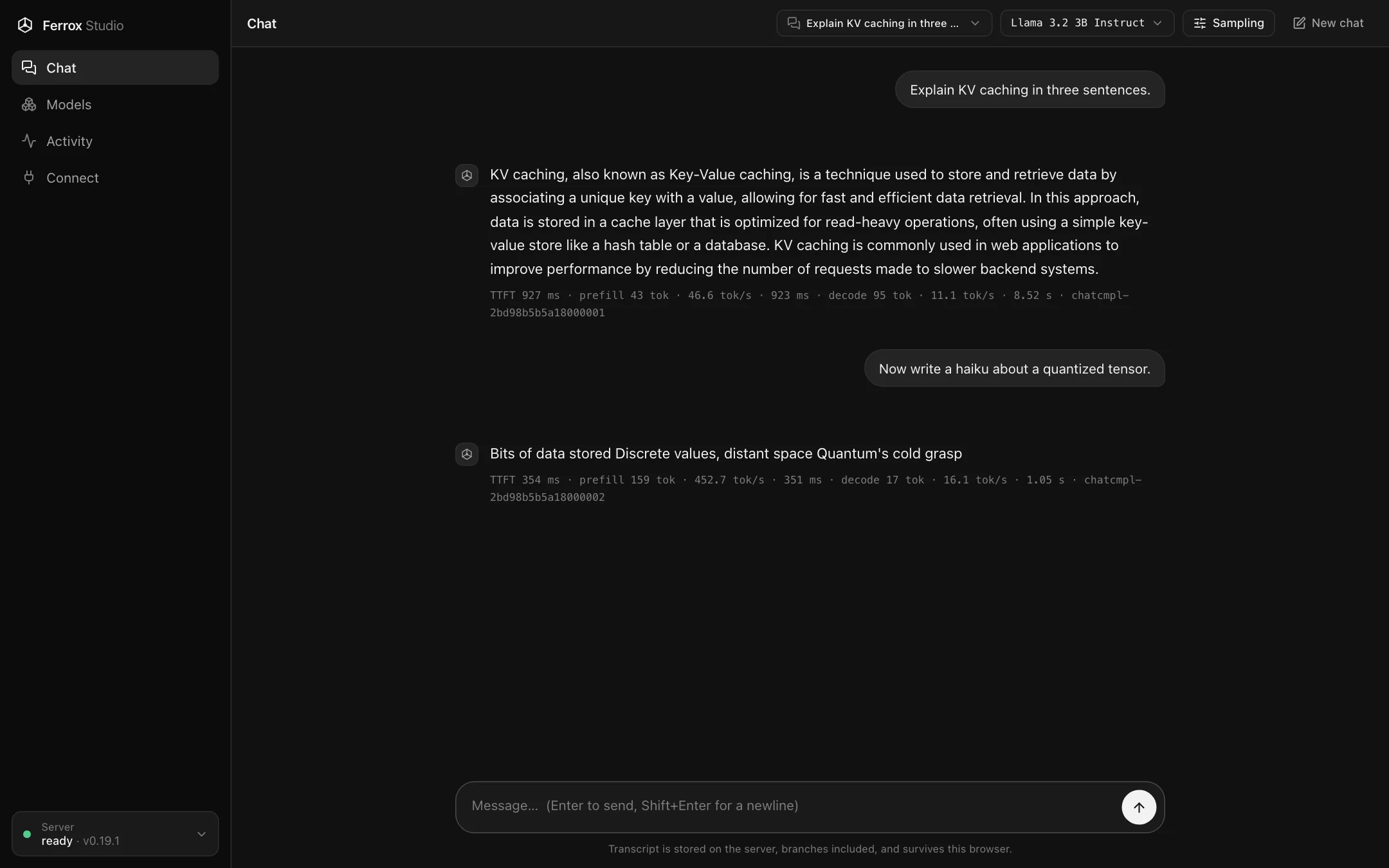
frink serve -m models/Llama-3.2-3B-Instruct-Q4_K_M.gguf -ngl all &
cd ui && npm install && npm run dev      # http://localhost:5173
More screenshots and how it is put together: ui/README.md.
Use it as a library
Published as frink-inference,
a facade re-exporting the workspace. The name frink on crates.io
belongs to an unrelated crate.
[dependencies]
frink-inference = "0.55"
use frink_inference::gguf::ShardedGguf;
use frink_inference::models::{Decoder, ModelConfig};

let path = "models/Llama-3.2-3B-Instruct-Q4_K_M.gguf";

// Read metadata without loading a single weight.
let file = ShardedGguf::open(path)?;
println!("{} tensors", file.tensor_count());

// Hyperparameters come from the file. Anything guessed is listed in
// `config.best_effort_fields`.
let config = ModelConfig::from_gguf(&file)?;
let decoder = Decoder::from_gguf(path, config)?;
Features, none on by default: metal, cuda, api. Every layer is
published separately if you want one rather than the stack:
gguf,
quant,
safetensors,
core,
moe,
models,
api,
metal,
cuda,
vulkan (an early Vulkan
backend, one kernel wide). All share one version.
AI full disclosure
This software is developed with heavy assistance from Cursor, Grok 4.5, GPT 5.6, and Claude Fable 5. Humans lead the ideas, the testing, and the debugging. We say so up front because it shaped how the project was built, and if you don't want AI-developed code, this software is not for you. It also would not exist without llama.cpp and GGML, which were largely written by hand.
Acknowledgements to llama.cpp and GGML
Frink does not link against GGML, but it exists because of llama.cpp: its kernels, its quantization formats, the GGUF ecosystem, and years of engineering knowledge worked out in the open. We are thankful to llama.cpp and its contributors. Their implementation, kernels, tests, and design choices were our main reference while building this pure-Rust GGUF / MoE inference path. Some source-level pieces are retained or adapted here under the MIT license, notably the IQ quantization codebook tables. Other pieces (GGUF layouts, quant/dot semantics, CLI and server conventions) were written independently against that public design. For that reason, and out of gratitude, we keep the GGML authors' copyright notice in docs/THIRD_PARTY_NOTICES.md.
License
Apache-2.0. See LICENSE and docs/THIRD_PARTY_NOTICES.md.