
alphastorm/omp-ninfer
alphastorm/omp-ninfer has 50 GitHub stars and 5 forks. GitHot measured 0 stars in 24 hours. Last checked 2026-11-15 00:56 UTC. Last push 2026-11-13.
Measured star growth
- in 24h
- 0
- in 7 days
- Collecting history
- in 15 days
- Collecting history
- in 1 month
- Collecting history
Net star changes over overlapping periods, not daily totals. Missing measurements are left blank. Stars measure attention, not software quality.
About
Durable local inference for Oh My Pi: NInfer + Qwen3.8 27B on one RTX 3090/4090/5090, with restart-resumable OpenAI Responses state.
AIREADME.md
Original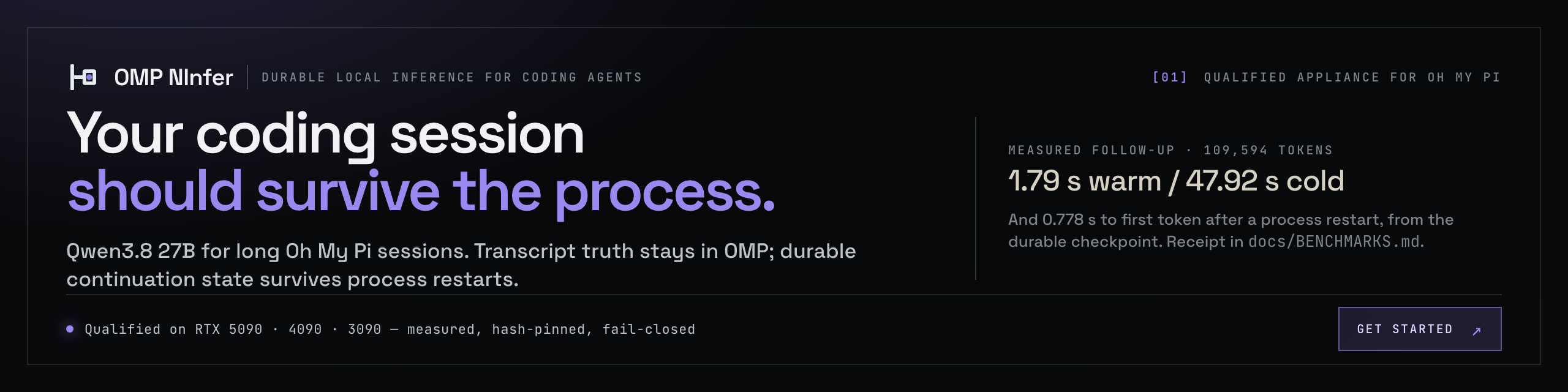
Oh My Pi is the coding agent. NInfer keeps your session's continuation state resident on your GPU. OMP NInfer is the qualified release that binds them with one hash-pinned Qwen3.8 27B model on an RTX 5090, 4090, or 3090 you own.
Every install route in the guide was run end to end on v0.19.0 with unmodified Oh My Pi 18.20.0 — 31 steps, three client platforms, both native lanes (receipt).
Get started →





Download v0.19.0 · Lanes · Facts · Compare · Benchmarks · Architecture · Security · Troubleshooting · Roadmap · Changelog
What it does
A long coding session is 100K tokens of transcript, thinking, tool calls, and images. Sent to a cloud provider, every token is metered and every file leaves your machine. Sent to a stateless local server, every turn re-sends the whole transcript. A live NInfer, llama.cpp, or vLLM process already avoids recomputing an unchanged prefix while it stays up; that is prior art, and this project does not claim it. What OMP NInfer adds is continuation you can rely on:
- Explicit and durable. Oh My Pi drives NInfer through stateful OpenAI Responses
(
previous_response_id); forks and rollback are qualified, and checkpoints restore after a server restart. Oh My Pi commits the transcript first, so losing retained state degrades to a replay, never a broken session. - Private and fail-closed. Both endpoints bind loopback only, every request is bearer-authenticated, and model fallback is off: an unreachable GPU fails the turn instead of answering from a cloud model. This is acceptance-tested, not configured.
- Exact and verifiable. Model SHA-256, container digest and SBOM, native package and client
checksums, and every qualification receipt are bound in one manifest;
python3 scripts/verify_release.py --require-readyproves your clone is the qualified release.

Recorded on v0.14.0 (RTX 5090): LRU bug fixed, tests green, ninfer-serve restarted mid-session, follow-up answered reusing 10,375 retained prompt tokens. 32 s, idle gaps and the 36 s reload compressed · MP4 · provenance
Is it for you
Use OMP NInfer when you run Oh My Pi, own an RTX 5090, 4090, or 3090 on Windows 11, want Qwen3.8 27B, and care about long private sessions that survive a server restart.
Use something else when you want a broad model catalog (Ollama), a desktop GUI (LM Studio), the widest hardware reach or Apple silicon (llama.cpp), or multi-user throughput (vLLM). Candid comparison: decision guide.
Qualified lanes
All three lanes share a 131,072-token context, DFlash2 speculative decoding with draft window 7,
JSON-schema output, and the same 20.4 GB Qwen3.8 27B artifact (81f924d4).
| Lane | Runs as | Serves | Decode | Exact retrieval, 130,048 tokens |
|---|---|---|---|---|
| RTX 5090 | Docker Desktop/WSL2 container on Windows 11; clients: Windows (local), macOS over a manual SSH tunnel (preview), Linux under WSL2 | Two requests in flight; vision, tools, and preserved thinking | 181.71 tok/s | 56.67 s |
| RTX 4090 | Native Windows 11 package; Windows client (local) | One request at a time; text and tools | 253.71 tok/s | 83.45 s |
| RTX 3090 | Native Windows 11 package; Windows client (local) | Two requests in flight over one shared 131,072-token pool, under a 350 W serving cap; text and tools | 227.19 tok/s | 188.45 s |
Each number links to its qualification receipt. RTX 5090 retrieval is from a cold start; native
decode is measured with one request at a time (C1).
Both native lanes install on one two-GPU host, each bound to its GPU UUID, and run one at a time on
port 18082. Checkpoints are best effort and restore only on the same runtime, model, profile, and
credentials. In v0.19.0, the RTX 5090 (v0.7.0-qwen38-5090-beta.8) and RTX 3090
(v0.8.0-qwen38-3090-beta.4) runtimes cap retryable refusals of memory-pressure checkpoint saves
at six retries or 10 seconds; the RTX 4090 package (v0.8.0-qwen38-4090-beta.3) is carried
unchanged from v0.18.0 without bounded pressure saves and will be re-cut (rebuilt) at the next
engine freeze. Exact component, source, and model identities: facts ·
glossary · manifest.
Get started
- Choose your lane and check its prerequisites.
- Clone tag
v0.19.0and runpython3 scripts/verify_release.py --require-ready. - Install the stock Oh My Pi 18.20.0 client with the fail-closed config and per-model fragment.
- Run the acceptance checks at the end of your lane's route: tool turn, continuation, restart survival, fail closed.
Upgrading from v0.18.0
v0.19.0 updates the client to Oh My Pi 18.20.0, updates the RTX 5090 container and RTX 3090
native Windows runtimes, and carries the v0.18.0 RTX 4090 native Windows package unchanged. The
Qwen3.8 27B model artifact and the reviewed model and config fragments are unchanged.
- Client. Install the stock Oh My Pi 18.20.0 client with this release's unchanged fail-closed config and per-model fragment (18.20.0 review).
- RTX 5090. Stop an existing
v0.18.0RTX 5090 container withexamples/manual-tunnel/stop-ninfer.shfrom yourv0.18.0checkout before startingv0.7.0-qwen38-5090-beta.8withexamples/manual-tunnel/start-ninfer.shfrom yourv0.19.0checkout. The new runtime writes checkpoints to its own host directory,checkpoints-v019; keep the priorcheckpoints-v018,checkpoints-v017, andcheckpoints-v013stores untouched for rollback. - RTX 4090 and RTX 3090. On RTX 3090, follow the
RTX 3090 route to stage and run
Install-Release.ps1forv0.8.0-qwen38-3090-beta.4, which stops a runningbeta.3lane through that lane'sControl-Release.ps1and keeps it forControl-Release.ps1 -Action Rollback; keep at least 40 GiB free on the checkpoint drive so durable saves are not refused for disk capacity. On RTX 4090, an existingv0.18.0install ofv0.8.0-qwen38-4090-beta.3already matches this release and needs no runtime reinstall (for a new install, follow the RTX 4090 route). - Sessions. After upgrading the RTX 5090 or RTX 3090 runtime, Oh My Pi replays its
authoritative transcripts for a fresh prefill; an unchanged RTX 4090
beta.3install keeps its existing checkpoint store.
What the updated runtimes change: on RTX 5090 and RTX 3090, a memory-pressure checkpoint save refused for disk capacity, an I/O outage, or a superseded session checkpoint tag stops retrying after six attempts or 10 seconds and releases the session's continuation instead of holding new requests behind the unsettled save (ninfer#122; store-quota refusals settle on the first refusal without retries, and the carried RTX 4090 package re-cuts — is rebuilt — with the next engine freeze). Everything else: release notes · changelog.
Native owners staying on v0.10.0 keep the
v0.10.0 guide.
How it works
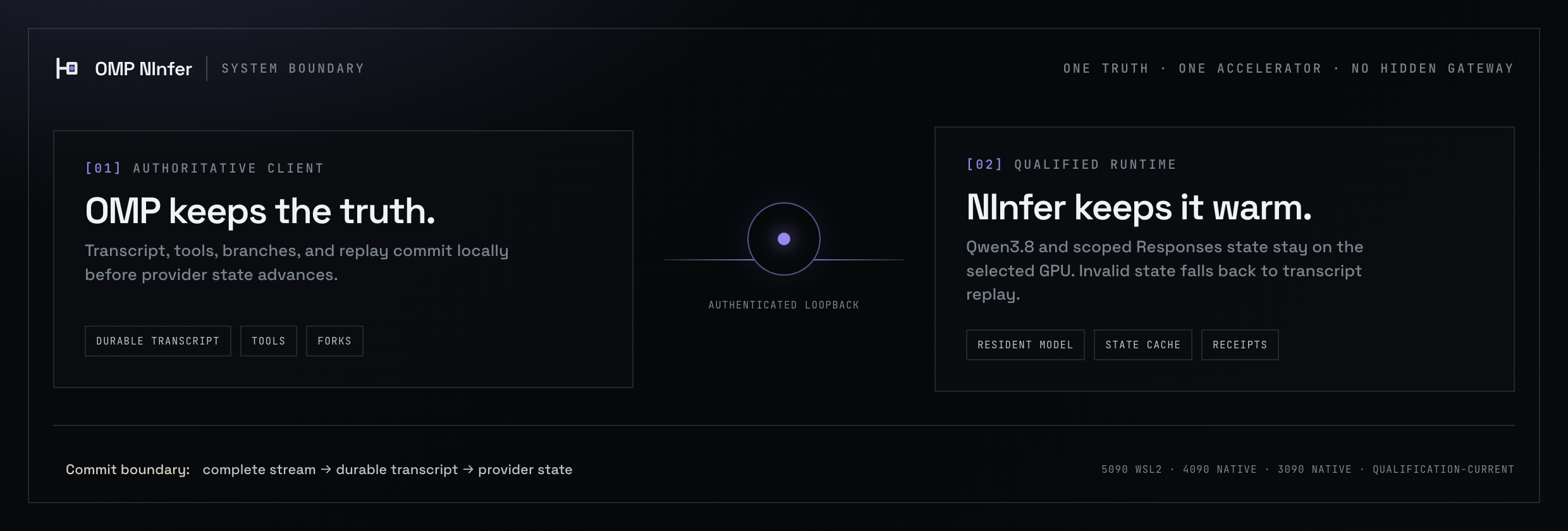
Oh My Pi (coding-agent client) → OMP NInfer (qualified appliance and release layer) → NInfer (inference engine) → Qwen3.8 27B (served model).
- Oh My Pi owns the truth. A turn advances provider state only after a complete stream and a durable transcript write.
- NInfer owns inference and retained state. The C++/CUDA engine from Neroued/ninfer and its GPU ports, plus this project's explicit Responses state and checkpoints. Retained state accelerates; it is never the source of truth.
- The manifest owns identity.
releases/v0.19.0/manifest.jsonbinds client, runtime, model, profile, and receipts;readyrequires composed external acceptance.
Architecture · Security model · Release lifecycle
Measured, not estimated
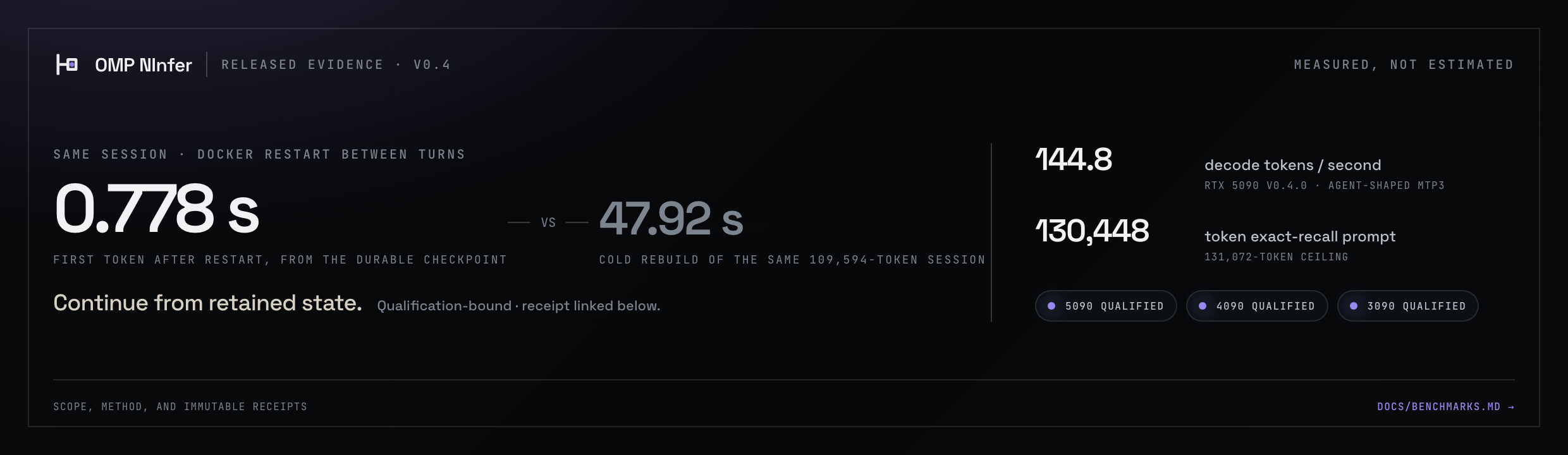
Each lane is measured on its own gate, machine, and profile; the figure is not a ranking. Method, per-lane charts, the warm-versus-cold boundary rules, model quality, and the community table: benchmarks.
Release integrity
python3 scripts/verify_release.py --require-ready
python3 -m unittest discover -s tests -v
Both pass on a tagged release. A ready manifest binds the upstream Oh My Pi binaries,
compatibility matrix, container digest and SBOM or native package checksums, lane-specific model
SHA-256, per-lane qualification receipts, and owner-operated acceptance of every documented route.
Lifecycle and cut rules: releases.
Documentation
| Document | What it answers |
|---|---|
| Quickstart | Which lane, prerequisites, exact install, acceptance checks |
| Facts | Current identities, limits, and non-claims in one place |
| Decision guide | This versus Ollama, LM Studio, llama.cpp, vLLM |
| Compatibility | Qualified client and runtime combinations (generated) |
| Architecture | State ownership, loopback topology, identity chain |
| Benchmarks | Receipts, method, charts, model quality, community results |
| Performance | Kernel and schedule experiment ledger |
| Security | Threat model and boundaries |
| Troubleshooting | Failure signatures and recovery |
| Related work | Prior art and the NInfer port family |
| Upstream | Upstream watch and fork points |
| Releases | Version history and how a release is cut |
| Roadmap | Remaining work and explicit non-promises |
| Changelog | What changed, per release |
| Media provenance | Checksums and capture notes for every recording |
Help make it better
- Ran a clean install? Report time-to-first-turn and every manual step; install friction is a bug.
- Measured your card? Submit the performance result form after the acceptance checks pass.
- Work on CUDA kernels? Pick a bottleneck from the performance program and send before/after receipts.
- Need another model or profile? File a model/profile request.
- Contributing without a GPU? No GPU is needed for contributor acceptance and doctor, which run in rehearsal/offline mode; rehearsal receipts never qualify a release.
Routing rules: CONTRIBUTING.md. Strip keys, hostnames, prompts, outputs, and raw
logs before filing. Support covers v0.19.0 and its exact profiles for a single local owner; no SLA.
Vulnerabilities: private reporting, never a public issue.
Credits
- Oh My Pi by can1357, built on Pi by Mario Zechner (MIT). The coding agent this appliance serves; since v0.8.0 the client is the unmodified upstream binary and this project publishes no client.
- NInfer by Neroued (Apache-2.0). The C++/CUDA engine,
.ninferformat, MTP and DFlash2 speculative decoding, and evaluation campaigns. Public runtime source for all three lanes: alphastorm/ninfer. - The Qwen team (Apache-2.0). Qwen3.8 27B, served from the registered conversions at neroued/Qwen3.8-27B-NInfer.
- UDPSendToFailed/ninfer-4090 and Don-Chad/ninfer-3090 (Apache-2.0). The RTX 4090 and RTX 3090 ports the native lanes build on.
- Gated DeltaNet (arXiv: 2412.06464), Tri Dao's ReplaySSM note,
Z-Lab's DFlash, Unsloth's NVFP4 weights, and vendored
utf8proc,nlohmann/json, andcpp-httplib; tracked in upstream.
Community project; not affiliated with or endorsed by Oh My Pi, Qwen, or NVIDIA.
License
MIT. NInfer and the Qwen artifacts retain their own licenses and notices.