
alchaincyf/huashu-motion
alchaincyf/huashu-motion has 2,566 GitHub stars and 257 forks. GitHot measured +468 in 7 days. Last checked 2026-11-09 21:13 UTC. Last push 2026-10-22.
Your coding agent creates commercial-grade product launch films in one click. It can compose music, and you can point to a frame to change it.
Measured star growth
- in 24h
- Update delayed
- in 7 days
- +468
- in 15 days
- Update delayed
- in 1 month
- Update delayed
Net star changes over overlapping periods, not daily totals. Missing measurements are left blank. Stars measure attention, not software quality.
README.en.md
Original简体中文 | English
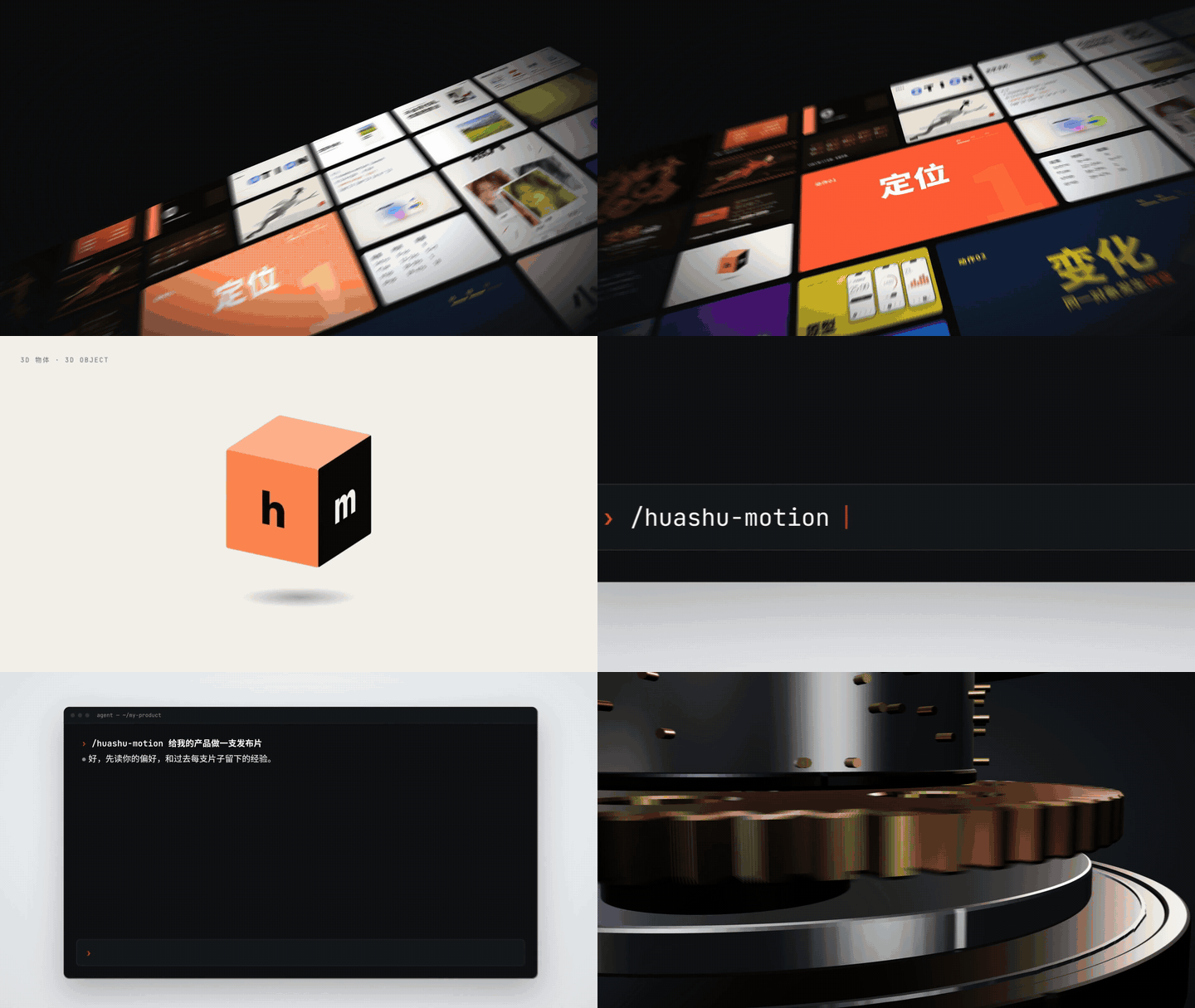
huashu-motion
"Commercial-grade product launch films, in one go."



Your coding agent makes the motion graphics, writes the score, and you point at the frame to change it.
Tell Claude Code or Codex "make a 30-second launch film for my product". It reads the product, shows you three directions,
writes the film, composes its music, and opens an editor in your browser.
Click the frame where something is off, type what you want, and it changes exactly that.
npx skills add alchaincyf/huashu-motion
See it
Every animation in this README was made with huashu-motion. The clip above opens the 53-second film it made about itself. 👉 Download the full film (MP4, with sound); the full Grok Bot, huashu-design, DeepSeek and Claude Duet films are on the same page (Grok Bot and Claude Duet are unofficial fan films).
Point at the frame
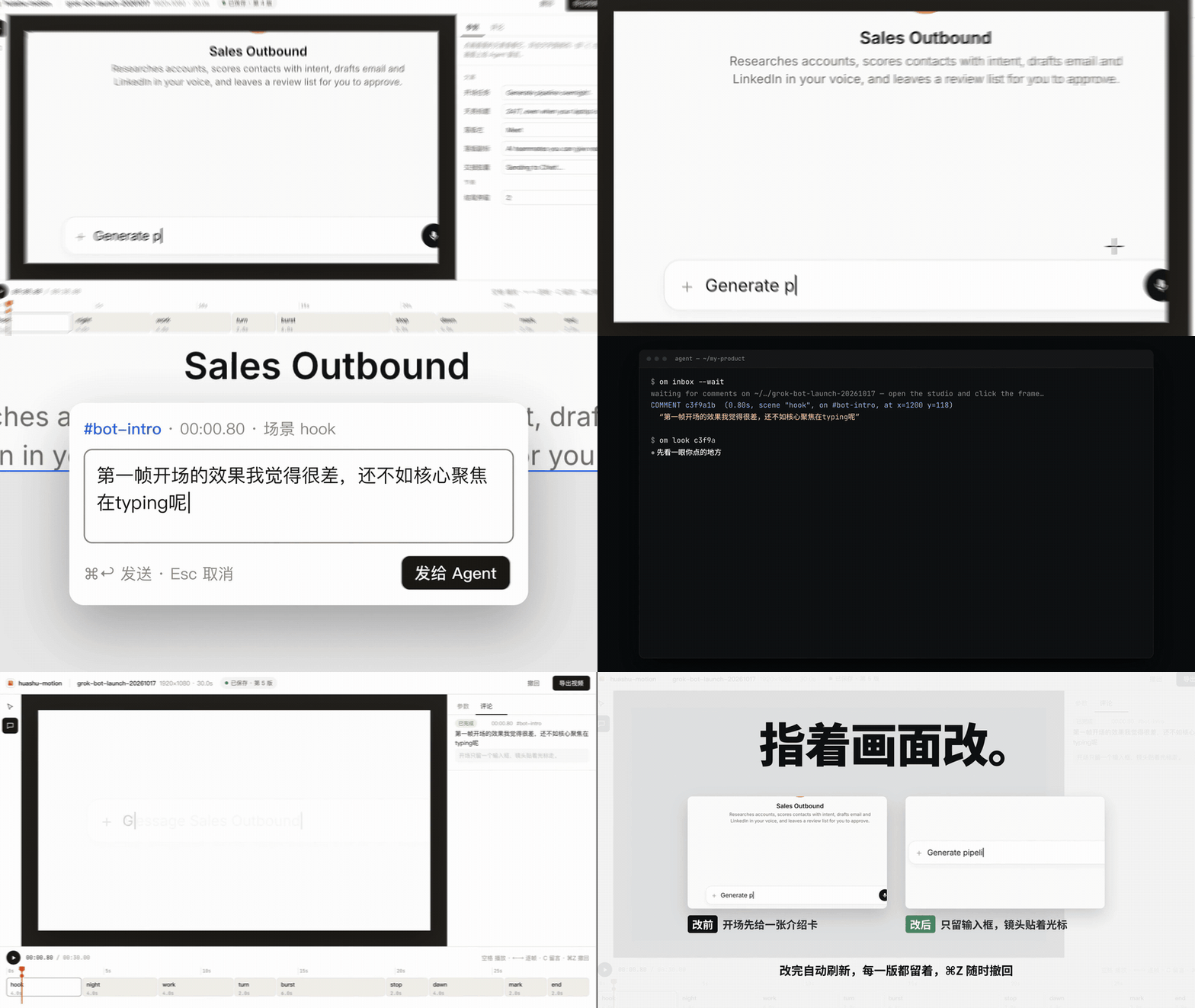
Press C, click the frame, type the change. The comment carries the time, the scene, the object under your cursor and its line in the source. The agent looks at that frame and a close-up of the spot first, changes only that, and replies in one line; the preview reloads where you were. Every version is kept and ⌘Z undoes. Titles, numbers, colours and hold times show up as fields you can edit yourself.
(The editor and terminal in this clip are rebuilt from the real interface; code details are illustrative. The comment is a real one.)
Score first, then the picture
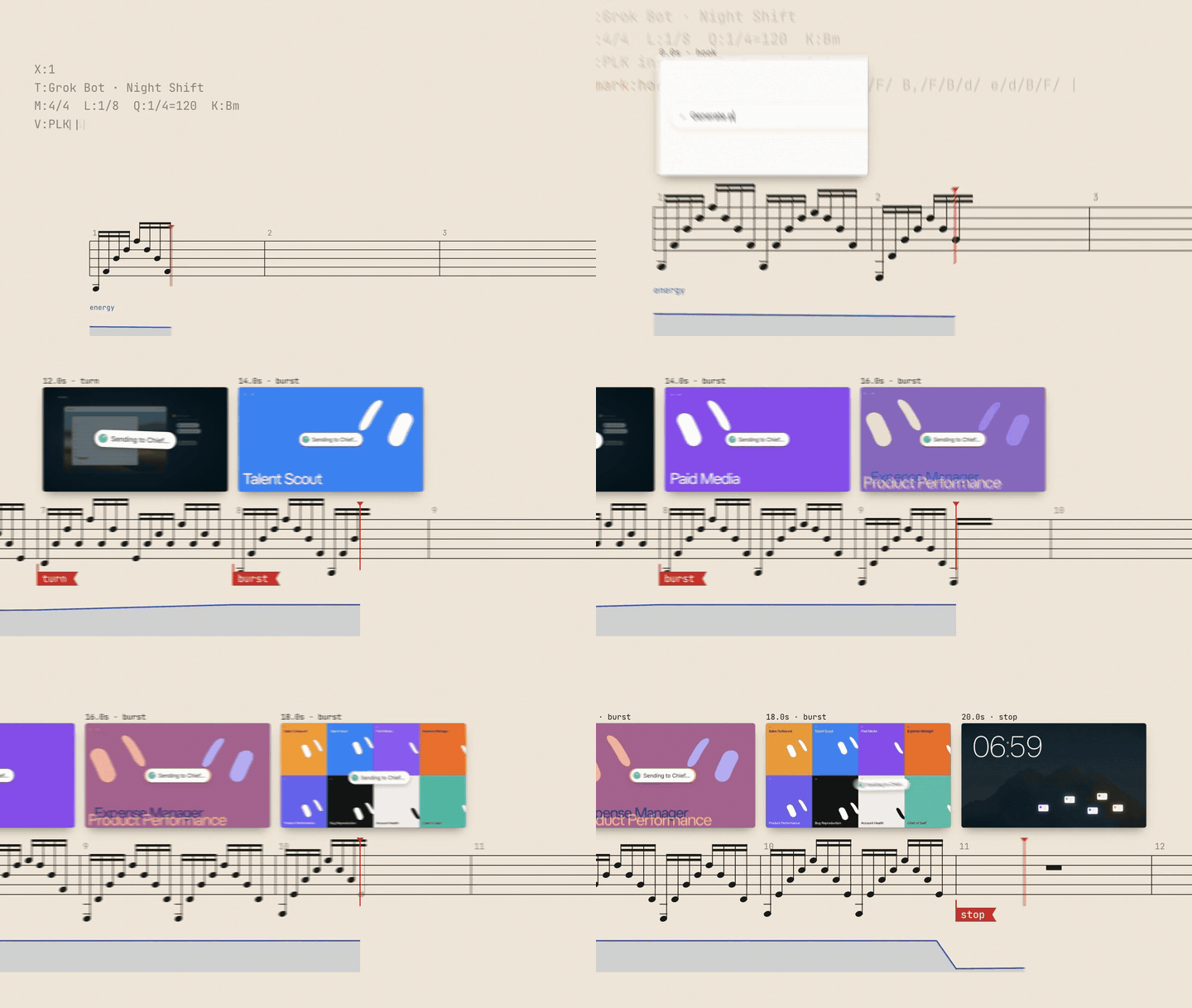
For launch films the agent writes a score in ABC notation, with marks that land on the scenes, and a sampled grand piano, string sections and drum kits play it (after a one-time om samples build; otherwise synths). Each landing gets a sound effect on its frame. All of it is generated locally; no paid API.
Twenty films in a day

Sixteen shots from seven films made the same day, cut on the beat.
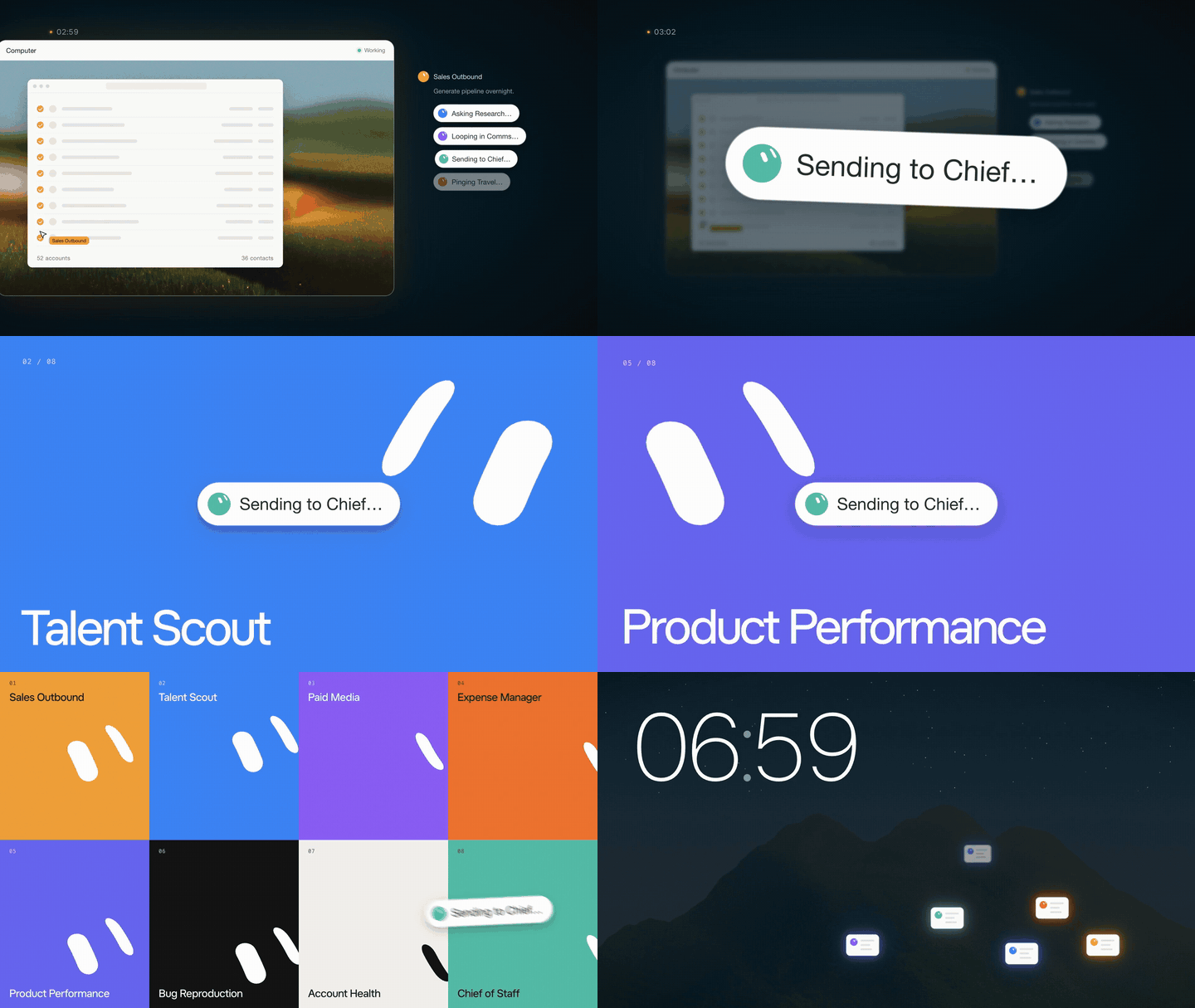
Grok Bot (fan-made, not official) · 30 s: hand over the work in the evening, agents work through the night, reports land on your phone at 7 am. This is the stretch where the reports go to the Chief of Staff.
 huashu-design 3.0 · one prompt stays put, the styles behind it change on the beat |
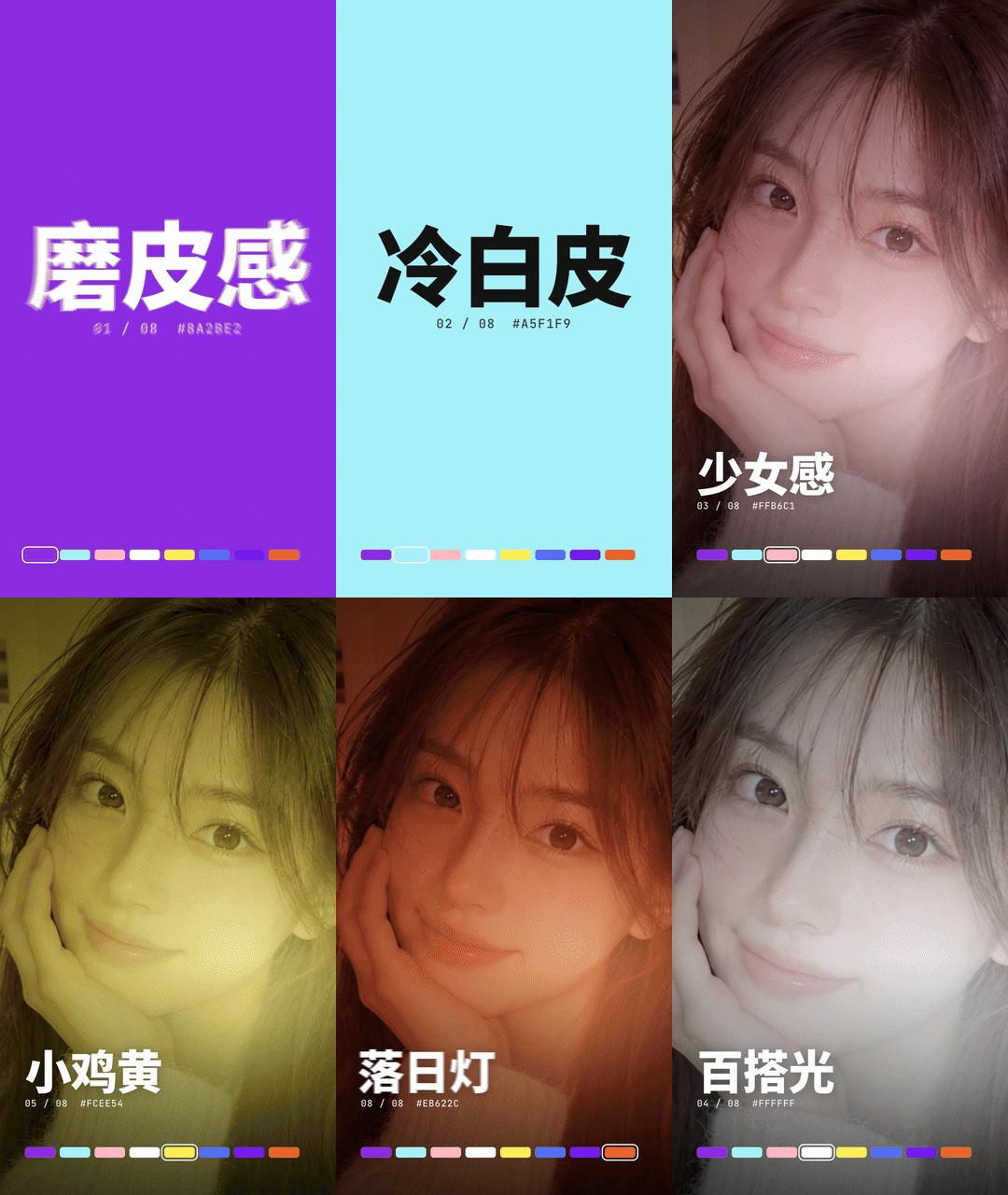 Catlight Pro · eight light colours, one per beat |
It doesn't need Opus: DeepSeek V4.1 Flash

This 22-second film was made with Claude Code running on DeepSeek V4.1 Flash (the 1017 release). I gave three rounds of notes (add DeepSeek's whale logo, drop a few shots); with music and effects it took under half an hour and cost ¥1.95 at the time (99.4% cache hits). The single palette, the dot carried through the film and the music locked to 124 BPM came from the skill; I never asked for them. With the method in the skill, a cheap model makes a good film too.
Claude Duet (fan-made, unofficial): one full brief, never asked me a thing
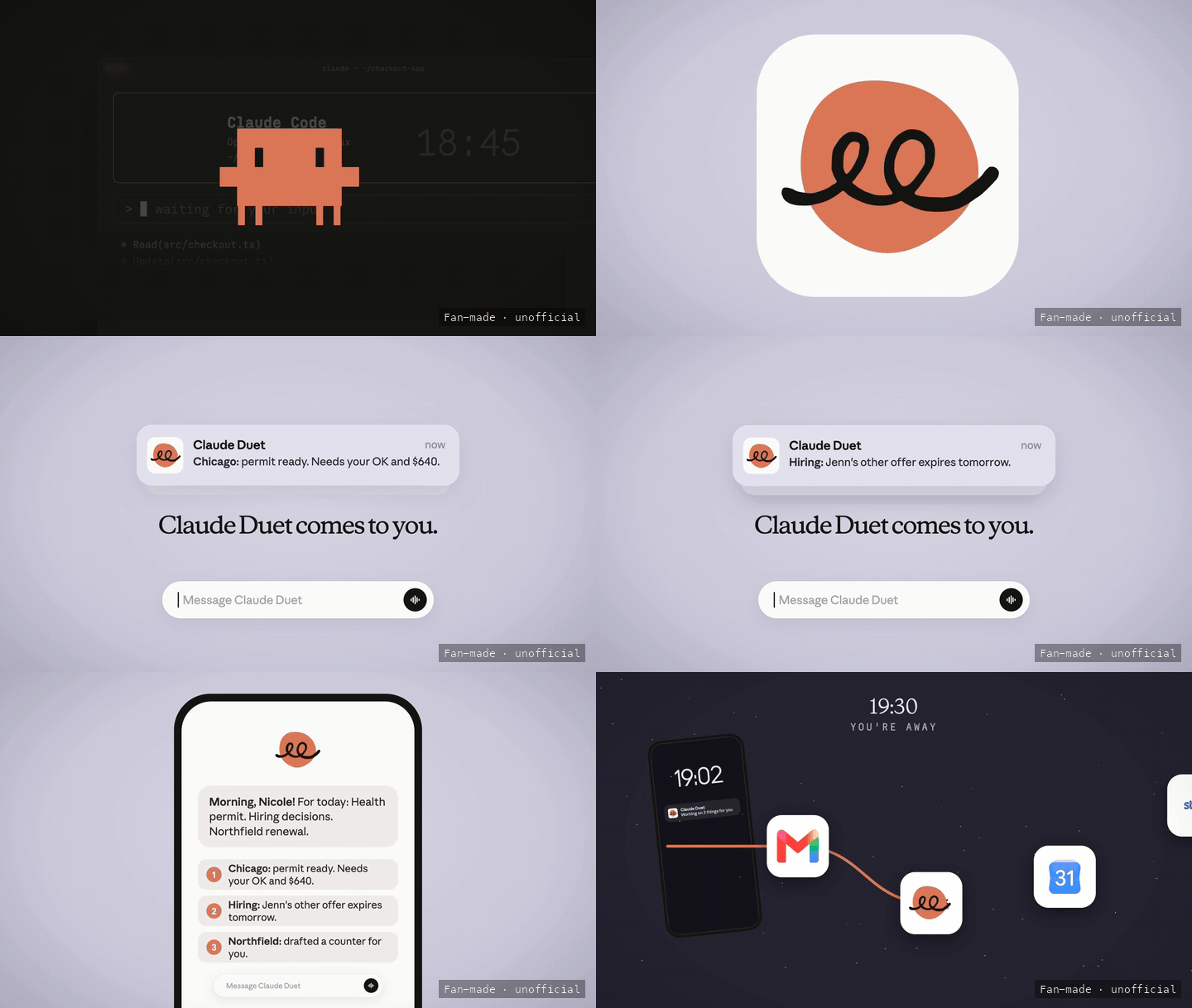
Made the day Anthropic launched Claude Duet, 29 seconds, in English. The pixel Claude Code waits in the terminal for your keystroke; turned into Duet, it comes to you first and keeps working while you sleep. Full film on the Release page.
How the sample films were made
People keep asking for the prompts behind these films. Here is what I actually said, translated from Chinese (the originals, word for word, are in the Chinese README). Local paths and screenshots are replaced by notes in square brackets, words unrelated to the film are cut and marked …, and parentheses are context I added.
The result does not come from the first sentence alone. For some films I said everything up front and let it run; for others I sat with it through several rounds. One line does make a film; to get to this level, either the first message carries the brief or someone keeps directing.
Claude Duet (unofficial) · one brief, two follow-ups, no notes in between
Anthropic just released Claude Duet. Research it properly, then make three versions of a video /huashu-motion
Version 1: 16:9, English, under 30 s
Version 2: 16:9, Chinese — apart from the brand, the main elements in Chinese, under 30 s
Version 3: Chinese voice-over, 2:3, the interface showing the official English and our Chinese version, to introduce Claude Duet on Douyin, under 1 minuteAll three need to get three things across, in whatever way suits each:
- how Claude Duet differs from a coding agent like Claude Code
- who can use it today: roughly Pro and Max members, after joining a waitlist
- ChatGPT dots, Muse and Grok Bot are all personal agents; you could say that facing those three, Claude answered with Duet. [a screenshot of the pixel Claude Code mascot] This is Claude Code's own character; I think you can tell this in a visual, well-animated, fun way.
All three only count as done when they are judged above 90 points. After the third, make the cover, title and description and post it to Douyin and WeChat Channels.Besides huashu-motion, you can also use /huashu-video-pipeline and /huashu-art-motion.
Then two more, 11 seconds and 5 minutes later:
No need to check anything with me; run it completely on your own.
Say it with more motion and visual metaphor rather than lots of captions and words.
In the Douyin version, an X screenshot or the like can back up the voice-over that Anthropic has just released this.
After that, only where to post it; no notes. The agent chose the direction itself; "above 90" was scored by a separate reviewer agent against a rubric, and the English version shipped at its ninth version with 91.
DeepSeek V4.1 Flash motion film · one line + three rounds, under half an hour
Use the /huashu-motion skill to show off your motion skills as much as you like. Don't worry about the message; as many fast cuts and kinds of motion as you can, under 30 s. At the end just show that this animation was made by DeepSeek v4.1 flash 1017.
While it worked:
Oh, and the opening could have a bit of the DeepSeek logo, the whale, then quickly into the animation.
On version 1:
[one frame] Drop this effect, I think it's poor, no need to show it. And the ending is a bit long. The big moment could start earlier!
On version 2:
[two more frames] These two effects can go too, poor.
Nothing after that; version 8 was the one delivered.
Grok Bot fan film · one line + a direction + one note
Let's make a launch film for Musk's new personal agent, Grok Bot.
The agent offered three directions (team launch, night shift, eight hands) and recommended the night-shift story as the spine, a burst of colour-block cuts in the middle and the real interface for the computer window. I said:
Fine, go with your recommended structure.
On version 4:
Good overall, but the first frame of the opening is poor; better to focus it on the typing.
On version 6:
Really, really great!! I think huashu-motion has got much, much better since last night. …
huashu-design 3.0 launch film · one line + a direction, accepted at the first cut, then pushed further
Open two more FanBox windows and make the launch animations for huashu-design and darwin.skill. Don't ask for much; just use our latest huashu-motion skill.
…
After the three direction key frames:
I'd like a and b combined.
On version 3:
Very good!
(the agent asked whether "60 styles" in the film should become 84)
Yes, change it!
The next day, watching it again:
This film is actually really good. But the examples — the fast cuts at the start, the three choices after, the app examples and so on — lack variety; it's monotonous. Look for whether we have better recent /huashu-design examples.
And if not, you can open new terminal windows yourself and have Opus 5.5 design some examples for what your film is trying to do and its shot language. /huashu-motion is the lead on this design.
I want to make this film 100% better again; this matters a lot to us!!!
huashu-motion's own launch film · the hardest one: an hour and a half, ten versions
… And I think we need to remake the /huashu-motion launch animation, right now!!! Have it make its abilities, workflow and features clear, and end on the huashu-motion repository address!
On version 2:
Not bad, but two problems:
- I'd like the opening to start with some fast cuts — different material, different camera moves, like a pile of material, a 3D view flowing, then quickly pushing in and cutting out of several launch films.
Then start showing the huashu-motion workflow!
And the workflow part is clear, but the 1, 2, 3, 4, 5 transitions feel very much like PowerPoint, not premium enough!
On version 3:
[two material folders] There's a pile of material in these two folders; pick the best. And if that's not enough, go further!! Make what you think it needs yourself.
Actually I think a detailed precision instrument or anatomical model, exploding, orbiting and so on, would look outstanding; consider it.
[a contact sheet] This feels like plenty, but pay attention to the variety of the material and how it looks when it's put together!
On version 7, several in a row:
[one frame] I think 01–06 still needs a big rework. If Steve Jobs wanted to launch this product, what would he demand of this part?
Also, the rhythm of the opening feels strange!!
The music and the picture rhythm are both off; the director needs to give more notes.
(the agent wanted to keep the 01–06 bar at the top) I don't think it should stay; keeping it makes it look like PowerPoint.
(the agent dropped a frame with a real face from the material wall) We're not against footage of real people.
On version 8:
The music and effects around 37–38 s are really strange and bad. Like it suddenly stutters and then cuts out. I've noticed the same in other films. Let's find the cause and fix it!!!
That last one became a fix in the music engine. Version 10 is the clip at the top of this README.
The notes that keep coming up here (a weak opening, a part that looks like slides, flat rhythm, monotonous material) are now in the skill: when you give it one line, the agent runs those checks on itself before it shows you the film.
Install
Ask your agent:
Install the huashu-motion skill (github.com/alchaincyf/huashu-motion) and run the demo
Or:
npx skills add alchaincyf/huashu-motion
Or clone the repo and link skills/huashu-motion into your agent's skills folder; the skill's bin/om then runs the CLI from the clone.
It runs in Claude Code, Codex, WorkBuddy, Grok Bot, Muse, Dots and more; it follows the Agent Skills standard, so any skill-capable agent can install it.
Requirements:
- Node 22+.
- Google Chrome, Chromium or Edge. Stills, checks and export run in the browser you already have; no renderer is downloaded.
- FFmpeg, for export and the soundtrack.
- Optional:
om samples builddownloads a ~55 MB pack of CC0 / CC-BY instrument samples once; without it the music uses synths. - Optional narration: macOS system voices need nothing; Kokoro voices print a one-line setup the first time (uv and Python 3.12, a ~325 MB model); word timing needs
whisper-cli(brew install whisper-cpp).
om doctor tells you what is missing. Tested on macOS only so far. Codex's sandbox blocks the local preview and the browser; approve them when asked.
What it does
| You say | It does |
|---|---|
| "Make a 30-second launch film for my product, site is xxx.com" | Reads the product, shows three directions as key frames, writes a rhythm sheet, builds the film, scores it, opens the editor |
| "Turn data/funnel.csv into a 30-second explainer on why signups doubled" | A data story: axes, then data, then one annotation; numbers become editable fields |
| "Add narration from my recording: voice.m4a" | Word-level alignment, motion lands on the word, subtitles, music ducks under the voice |
| "Package this talking-head video" | Name plate, number cards, keyword captions, chapter cards, exported as a transparent overlay for CapCut or Premiere |
| "Make it vertical" | A 1080×1920 copy, with the re-layout waiting in the inbox |
| "Export a GIF" / "transparent" / "a page to share" | MP4, MOV (alpha), WebM, GIF, or a share page with a player and the source |
Before a film it reads your past preferences and what earlier films taught; after it, it keeps what is worth keeping. Your preferences stay on your machine.
After the export, om share makes a share kit: a GIF under 10 MB (the opening plus the end frame — ready for a README header or a post) and a share.md with the post and the README snippet. Films of 4 s or more end with a small "Made with huashu-motion" for their last 1.2 s, in a free corner, in the film's own typeface and colour; ask your agent to switch it off if you'd rather not.
How it works
- A film is one
index.html. GSAP, Canvas, Three.js, SVG, anything a browser draws. No video model; every frame is a function of the code and the time. - Director rules, not templates. Measured from 21 real launch films (cuts, beats, loudness, energy curves) and 142 high-engagement launch and motion films, organised into 20 motion languages. Every film starts with a rhythm sheet: a hook within 3 s, a burst in the middle, a beat of silence before the biggest hit.
- Sound is half of it. Composer mode (the agent writes the score, sampled instruments play it), 12 product types × 3 fallback music directions, 23 sound effects placed on the line where the motion lands, narration from a system voice or your own recording.
- Its own render engine. Several Chrome instances at once (by CPU count, up to 8 by default), picture and audio encoded in parallel, unchanged music reused. A 30-second film renders in about 12–15 s on my 14-core Mac; with motion blur, about 1–1.5 min.
- Checked before delivery.
om check(scripts, files, motion rules, cut-off or covered text),om qa(single-frame pops, dead time, motion curve), and the skill asks the agent to watch the frames and, when it can, have another agent review cold.
| Command | What it does |
|---|---|
om grab |
The product's real material into the project: page screenshots, logo, images, its colours and type, or the screenshots, icons and recordings in its own project folder |
om new · om templates |
Start a project, from one of 12 templates |
om studio |
Live preview, scene strip, direct edits, frame comments |
om inbox --wait · om look · om done |
Agent side: take the next comment, see the spot, report back |
om sound · om voice · om samples |
Music and effects, narration, the instrument pack |
om check · om qa · om still |
Before and after rendering |
om render · om share · om export html · om fork |
Export, share kit (GIF + post), share page, new frame size |
om learn · om undo · om doctor |
Experience, undo, environment check |
What's inside
| Motion languages, each with what it says, what it suits and how to build it | 20, skills/huashu-motion/references/library/ |
| Starter templates (keynote, finance chart, kinetic type, whiteboard, Vox collage, 3Blue1Brown, Kurzgesagt, talking-head package, interface in 3D space, objects in a Three.js studio, …) | 12, templates/ |
| Sound effects | 23 |
| Fallback music directions | 12 product types × 3 |
| Annotated example scores | 3, skills/huashu-motion/references/scores/ |
| Fonts (CJK 500–900, serif, display) | 27, fonts/ |
Limits
- It can't hear. The agent checks music through the score, the energy curve and a spectrogram; the last listen is yours.
- It doesn't generate people or live footage. Everything is drawn in code; bring your own footage and it composes and packages it.
- Results depend on the model. I mostly use Opus 5.5 in Claude Code; DeepSeek V4.1 Flash does well too, but taste differs between models.
- It needs a machine that can run Node, Chrome and FFmpeg.
Why it exists
On 8 October 2026 Anthropic released Claude Motion: Claude animates reports, charts and product explainers in code, and you point at a part to edit it. At launch it was a beta for Team and Enterprise only. In April I had turned Claude Design's core ideas into a skill, huashu-design; after Motion came out I gave Claude Code one line: our skill should fully reproduce Claude Motion, and be much stronger.
The first day's result was dull: an editor, version history, a hundred-odd tests, and a 19-second 3D city whose camera moved so evenly it was mediocre. Claude's own review said it had built a project very good at proving it wasn't lying, and nothing anyone would want to share. We started over that day. Most of the time since went into making the films good: measuring real launch films, asking for film-score music, and turning every "not cool", "boring" or "ugly font" into a rule in the skill. Then it made its own launch film, the one at the top of this page.
Credits and license
Code and docs are MIT. Bundled third-party pieces keep their licenses: GSAP (GSAP Standard License) and the fonts (SIL OFL 1.1). Instrument samples, the Kokoro voice model and whisper.cpp models are downloaded from their sources on first use and not redistributed. The films that were measured are kept as numbers only, no frames. The om demo film uses the painting engine from huashu-art-motion. See THIRD_PARTY.md.
Exception: the "bean Huashu" character (drawn in runtime/clip/lib/toon.js, and as it appears in the storytime template and demo films) is Huashu's cartoon likeness, for demonstrating this project only, and is not licensed under MIT for other uses.
About the author
Huashu (花叔) — AI-native coder and indie developer. Known for Catlight (小猫补光灯, #1 on the App Store paid chart).
| 🌐 Site | bookai.top · huasheng.ai |
| 𝕏 Twitter | @AlchainHust |
| ▶️ YouTube | @Alchain |
| 📺 Bilibili | 花叔v |

nuwa-skill makes skills. huashu-design designs. huashu-art-motion makes paintings move. huashu-motion lets your agent make the launch film.
MIT License © 花叔 Huashu

Explore related projects
ytdl-org/youtube-dl
Command-line program to download videos from YouTube.com and other video sites
141,527 starsexcalidraw/excalidraw
Virtual whiteboard for sketching hand-drawn like diagrams
135,396 starsgodotengine/godot
Godot Engine – Multi-platform 2D and 3D game engine
119,942 starsmrdoob/three.js
JavaScript 3D Library.
117,983 stars