
agjs/voicebox
agjs/voicebox has 37 GitHub stars and 4 forks. GitHot measured 0 stars in 24 hours, 0 in 7 days, and +2 in 15 days. Last checked 2026-11-09 22:04 UTC. Last push 2026-08-15.
Self-hosted, OpenAI-compatible speech server: faster-whisper STT and Piper/Kokoro TTS. A local voice backend for Open WebUI, CLIs, and custom agents.
Measured star growth
- in 24h
- 0
- in 7 days
- 0
- in 15 days
- +2
- in 1 month
- Collecting history
Net star changes over overlapping periods, not daily totals. Missing measurements are left blank. Stars measure attention, not software quality.
README.md
Original
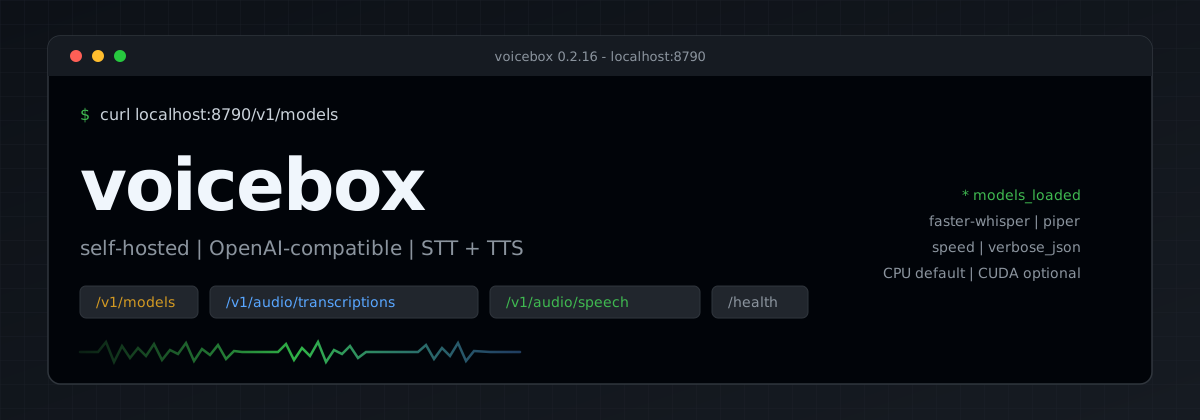
voicebox
Self-hosted, OpenAI-compatible speech server. Speech-to-text (faster-whisper)
and text-to-speech (Piper or Kokoro) behind the same HTTP API as OpenAI's
audio endpoints, so Open WebUI, agents, CLIs, and coding assistants get a local
voice with no glue code.




Why this
- Fully local. No cloud calls and no required API keys; audio stays on your machine.
- OpenAI drop-in.
GET /v1/models,POST /v1/audio/transcriptions(includingverbose_jsonsegment timestamps), andPOST /v1/audio/speechwithvoiceandspeed(0.25-4.0). - CPU-fast by default. Piper TTS runs roughly 14x faster than real-time on a plain quad-core; STT uses distil-whisper int8. Thread caps stay aligned with your container CPU quota.
- One Docker command. Models bake into the image;
docker compose upis enough. - Works with your stack. Open WebUI, included voice-chat / Claude Code clients, or any OpenAI-audio SDK.
Quick start
You only need Docker. Prefer the published image (models already baked in). Compose publishes to localhost by default; set a private host bind address when clients are on another machine.
# Fastest: pull a release (or :main) from GHCR
docker pull ghcr.io/agjs/voicebox:0.2.16
docker run --rm -p 127.0.0.1:8790:8790 ghcr.io/agjs/voicebox:0.2.16

# Or build locally (first build downloads models; a few minutes)
git clone https://github.com/agjs/voicebox.git && cd voicebox
cp .env.example .env
docker compose up -d --build

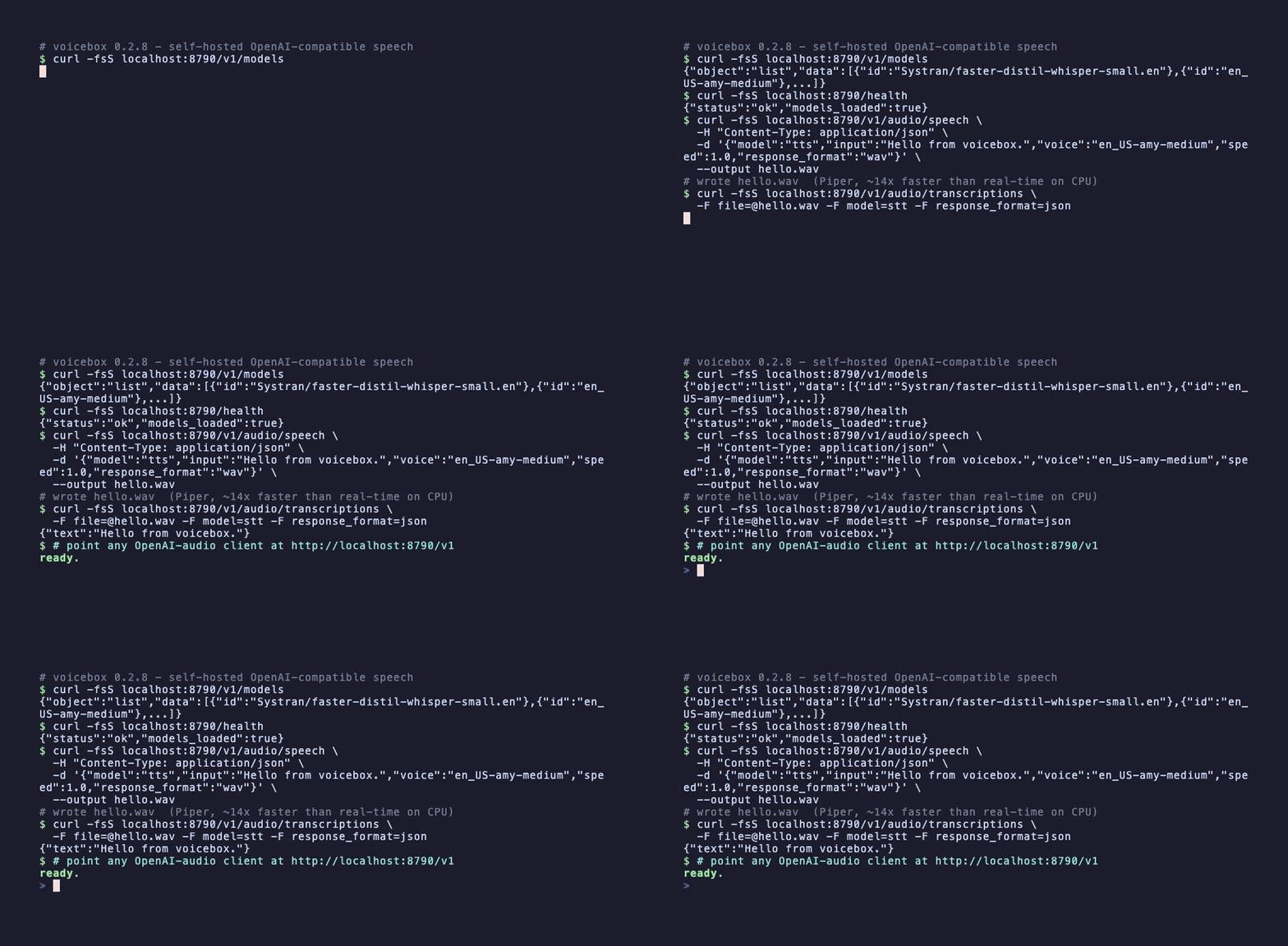
curl -fsS localhost:8790/health   # {"status":"ok","models_loaded":true}
Text to speech:
curl -fsS localhost:8790/v1/audio/speech \
  -H "Content-Type: application/json" \
  -d '{"model":"tts","input":"Hello from voicebox.","response_format":"wav"}' \
  --output hello.wav
Speech to text:
curl -fsS localhost:8790/v1/audio/transcriptions \
  -F "[email protected]" -F "model=stt"
# {"text":"Hello from voicebox."}
Point any OpenAI-audio-compatible client at http://<host>:8790/v1 and you are done.
For LAN access, set VOICEBOX_BIND_ADDRESS to a private IP on the host (or
0.0.0.0 when a firewall controls access). Set VOICEBOX_API_KEY as well, and set
VOICEBOX_ALLOW_INSECURE_BIND=false so the process refuses unauthenticated
non-loopback listens. Clients send the key as an OpenAI-style bearer token. The
health endpoint intentionally remains unauthenticated for container probes.
Bare metal (no Docker)
Requires Python 3.11 (the upper bound is <3.12 until native deps are validated
on newer CPythons), plus host packages ffmpeg and espeak-ng.
python3.11 -m venv .venv && source .venv/bin/activate
pip install -e ".[dev]"
# Optional: pre-seed models (otherwise first start downloads them)
python scripts/fetch_models.py
export HF_HOME="${HF_HOME:-$PWD/models/huggingface}"
export OMP_NUM_THREADS=4 MKL_NUM_THREADS=4   # match VOICEBOX_CPU_THREADS
python -m voicebox   # listens on 127.0.0.1:8790 by default
Listening defaults to loopback. Non-loopback binds require VOICEBOX_API_KEY unless
you explicitly set VOICEBOX_ALLOW_INSECURE_BIND=true.
Use it with your apps
Open WebUI
In Admin, open Settings then Audio:
| Setting | Value |
|---|---|
| Speech-to-Text Engine | OpenAI |
| STT API Base URL | http://<host>:8790/v1 |
| STT API Key | sk-none, or your VOICEBOX_API_KEY when authentication is enabled |
| Text-to-Speech Engine | OpenAI |
| TTS API Base URL | http://<host>:8790/v1 |
| TTS Voice | Piper: a baked id such as en_US-amy-medium (default engine). Kokoro: e.g. af_heart. |
Included clients (clients/)
Voice chat CLI
Turn-taking mic conversation against voicebox STT/TTS and any OpenAI-compatible
LLM. Optional --barge-in interrupts playback when you speak (headphones
required; no AEC). Optional --wake keeps a long-running process that listens
for “hey jarvis”, then enters conversation until goodbye or idle. Start the
session when you want voice (Ctrl-C to exit) — it does not attach inside
Cursor/Claude/etc.
# Install once (client-only deps; does not install the speech server)
uv tool install "git+https://github.com/agjs/voicebox.git#subdirectory=clients/voice-chat"
# or: pip install "git+https://github.com/agjs/voicebox.git#subdirectory=clients/voice-chat"

export VOICEBOX_URL=http://localhost:8790
export VOICEBOX_LLM_URL=http://localhost:8000/v1/chat/completions
export VOICEBOX_LLM_MODEL=local-model
voicebox-chat --wake --barge-in
More detail: clients/voice-chat/README.md.
Claude Code helpers
clients/claude-code/ has a Stop hook that synthesizes the first sentence before
the remainder, plus a push-to-talk dictation helper. Both read VOICEBOX_URL.
Voices
TTS defaults to Piper, which is fast, natural, and CPU-friendly. Three voices
ship baked into the image. Switch with VOICEBOX_PIPER_VOICE or the request
voice field (must be one of the baked ids; unknown voices return 400):
VOICEBOX_PIPER_VOICE / request voice |
character |
|---|---|
en_US-amy-medium (default) |
warm, female |
en_US-bryce-medium |
male |
en_US-lessac-medium |
clear, neutral |
Audition every Piper voice at https://rhasspy.github.io/piper-samples/ . Found
one you like? Set VOICEBOX_PIPER_VOICE=en_US-<voice>-<quality>, add it to
scripts/fetch_models.py, and rebuild. Runtime Hugging Face access is deliberately
offline, so voices must be baked into the image.
Speaking rate: request speed on /v1/audio/speech (OpenAI-style 0.25-4.0,
default 1.0), or set VOICEBOX_PIPER_LENGTH_SCALE as the base rate (lower is
faster: 1.0 natural, 0.8 brisk, 1.2 slow narration). Effective Piper
length scale is VOICEBOX_PIPER_LENGTH_SCALE / speed.
Two engines
piper (default) is the fastest, with great quality, roughly 7 times faster
than Kokoro on CPU. kokoro gives higher-fidelity neural voices (about 50 of
them, such as af_bella and bf_emma) but is slower on CPU. Switch to it with
VOICEBOX_TTS_ENGINE=kokoro and pick a voice with the voice request field or
VOICEBOX_DEFAULT_VOICE.
API
| Endpoint | Description |
|---|---|
GET /v1/models |
Lists the STT model id and available TTS voice ids for the active engine. |
POST /v1/audio/transcriptions |
Multipart file (any common audio format), language, and response_format=json|text|verbose_json. verbose_json includes segment timestamps. |
POST /v1/audio/speech |
JSON {input, voice?, speed?, response_format?}. speed is 0.25-4.0 (default 1.0). Piper voice must be one of the baked voices (en_US-amy-medium, en_US-bryce-medium, en_US-lessac-medium). wav is complete; pcm is streamed 16-bit mono and declares its format in X-Audio-* headers. |
GET /health |
Returns {"status":"ok","models_loaded":true}. |
The shapes match OpenAI's audio API, so existing SDKs and clients work unmodified.
Configuration
Everything is set with environment variables (see .env.example):
| Variable | Default | Description |
|---|---|---|
VOICEBOX_TTS_ENGINE |
piper |
piper or kokoro |
VOICEBOX_PIPER_VOICE |
en_US-amy-medium |
Piper voice id |
VOICEBOX_PIPER_LENGTH_SCALE |
1.0 |
Speaking rate (lower is faster) |
VOICEBOX_PIPER_NOISE_SCALE |
0.667 |
Prosody variability |
VOICEBOX_PIPER_NOISE_W |
0.8 |
Phoneme-duration variability |
VOICEBOX_STT_MODEL |
Systran/faster-distil-whisper-small.en |
faster-whisper model |
VOICEBOX_STT_MODEL_REVISION |
pinned commit | Reproducible Hugging Face model revision |
VOICEBOX_STT_BEAM_SIZE |
1 |
Greedy decoding for interactive latency; use 5 for more accuracy |
VOICEBOX_STT_VAD_FILTER |
true |
Remove non-speech with faster-whisper's Silero VAD |
VOICEBOX_STT_MIN_SILENCE_MS |
500 |
Silence removed by server-side VAD |
VOICEBOX_STT_HOTWORDS |
empty | Comma-separated project names and vocabulary hints |
VOICEBOX_TTS_MODEL |
speaches-ai/Kokoro-82M-v1.0-ONNX |
Kokoro model (when engine is kokoro) |
VOICEBOX_DEFAULT_VOICE |
af_heart |
Kokoro default voice |
VOICEBOX_DEVICE |
cpu |
cpu or cuda (CUDA needs the optional GPU image; see below) |
VOICEBOX_CPU_THREADS |
4 |
CTranslate2 CPU threads for STT. Match physical cores / VOICEBOX_CPUS. Compose also sets OMP_NUM_THREADS and MKL_NUM_THREADS from this value to avoid OpenMP oversubscription (more threads than CPUs often hurts latency). Bare-metal runs should export the same OpenMP/MKL vars before starting the process. |
VOICEBOX_API_KEY |
empty | Optional bearer token protecting audio endpoints |
VOICEBOX_BIND_ADDRESS |
127.0.0.1 |
Listen address for bare metal; Compose host publish address (container always listens on 0.0.0.0) |
VOICEBOX_ALLOW_INSECURE_BIND |
false |
Allow non-loopback listen without an API key (Compose/image default true) |
VOICEBOX_PORT |
8790 |
Listen port |
VOICEBOX_MAX_AUDIO_SECONDS |
120 |
Reject longer STT input |
VOICEBOX_MAX_UPLOAD_MB |
25 |
Reject larger uploads |
VOICEBOX_MAX_INPUT_CHARS |
4000 |
Reject longer TTS text |
Performance
CPU-only, on one reference box (a 2015-era quad-core, no GPU):
| Stage | Model | Real-time factor |
|---|---|---|
| STT | distil-whisper-small.en (int8) |
about 0.3x (roughly 3x faster than real-time) |
| TTS | Piper amy-medium |
about 0.07x (roughly 14x faster than real-time) |
| TTS | Kokoro-82M | about 0.5x |
For that class of CPU, keep Piper, int8 STT, four inference threads, and a
four-CPU container quota. Cap OpenMP/MKL to that same thread count (Compose wires
OMP_NUM_THREADS / MKL_NUM_THREADS from VOICEBOX_CPU_THREADS); oversubscribing
threads past the cgroup CPU limit usually adds latency rather than removing it.
If latency varies under load, give voicebox priority over heavier background
services and watch for sustained frequency drops.
Optional CUDA image (GPU STT and TTS)
Default path stays CPU: Dockerfile, docker compose up, and GHCR tags without a
suffix are unchanged. The -cuda image differs in three ways:
| CPU image | -cuda image |
|
|---|---|---|
| STT compute | int8 | float16 |
| STT model | faster-distil-whisper-small.en |
faster-whisper-large-v3 |
| TTS (Kokoro) | CPU | CUDA via onnxruntime-gpu |
large-v3 is baked in at build time because a GPU removes the reason to ship a
small distilled model. It is substantially better on proper nouns, technical
vocabulary and accented speech — and it is multilingual, where
distil-small.en is English-only and turns other languages into English-shaped
nonsense.
Because the runtime sets HF_HUB_OFFLINE=1, only the baked model is available:
overriding VOICEBOX_STT_MODEL at docker run fails at startup with the model
missing from the cache. Build with --build-arg VOICEBOX_STT_MODEL=… and its
matching VOICEBOX_STT_MODEL_REVISION to bake a different one.
TTS execution providers are chosen explicitly in tts.py, with
CPUExecutionProvider kept last — a CUDA image on a host without a usable GPU
degrades to CPU synthesis rather than failing to start. The providers ONNX
Runtime actually accepted are logged at startup (TTS: providers active=…),
which is the first thing to check if a GPU build feels slow: it silently drops
a provider it cannot initialise.
To use it:
docker compose --profile cuda up -d --build   # needs NVIDIA Container Toolkit
# or pull a release tag: ghcr.io/agjs/voicebox:0.2.16-cuda
-cuda tags publish on version tags (v*) and manual workflow_dispatch only,
not on every main push. CI validates compose config; it does not run GPU
inference. Treat the first real NVIDIA host as the validation gate —
ctranslate2/cuDNN mismatches are a known risk until then.
Development
pip install -e ".[dev]"   # requires Python 3.11
pytest -m "not model and not latency"  # fast unit suite, including clients
pytest                    # full local model + latency suite
docker compose up -d --build && ./scripts/smoke.sh   # end-to-end
# Published images are also smoked in CI after push (and weekly via image-smoke.yml)
Merges to main automatically patch-bump the version, tag vX.Y.Z, create a
GitHub Release, and dispatch the GHCR publish for that tag (see
.github/workflows/release.yml). For a minor/major bump,
run the Release workflow manually and pick the part. Skip a release with a commit
message starting with chore: release (the bot uses that) or by not merging to main.
Under src/voicebox/: stt.py (faster-whisper), tts.py (Kokoro),
tts_piper.py (Piper), app.py (FastAPI routes), config.py (env), wav.py.
Licenses
voicebox itself is MIT (see LICENSE). It builds on:
| Component | License |
|---|---|
| faster-whisper, ONNX Runtime, kokoro-onnx | MIT |
| Kokoro-82M model | Apache-2.0 |
| Piper voices (amy, bryce, lessac) | public domain / MIT |
piper-tts |
GPL-3.0 |
Note on piper-tts: it is GPL-3.0. voicebox's own source is MIT and only imports
it (nothing is vendored), but the prebuilt Docker image bundles it, so a
distributed image carries GPL obligations for that component. If you need a
purely permissive image, set VOICEBOX_TTS_ENGINE=kokoro and drop piper-tts
from pyproject.toml and the Dockerfile.
Explore related projects
awesome-selfhosted/awesome-selfhosted
A list of Free Software network services and web applications which can be hosted on your own servers
335,474 starsimmich-app/immich
High performance self-hosted photo and video management solution.
118,568 starsStirling-Tools/Stirling-PDF
#1 PDF Application on GitHub that lets you edit PDFs on any device anywhere
96,048 starslouislam/uptime-kuma
A fancy self-hosted monitoring tool
93,389 stars