
aftertonesignal/brume has 29 GitHub stars and 0 forks. GitHot measured 0 stars in 24 hours. Last checked 2026-11-15 01:58 UTC. Last push 2026-11-12.
Measured star growth
- in 24h
- 0
- in 7 days
- Collecting history
- in 15 days
- Collecting history
- in 1 month
- Collecting history
Net star changes over overlapping periods, not daily totals. Missing measurements are left blank. Stars measure attention, not software quality.
About
A 24-voice, multi-part synthesizer for the Raspberry Pi CM5. Touchscreen UI, audio and MIDI over USB, four sound engines, no samples.
Creative & MediaREADME.md
OriginalBrume



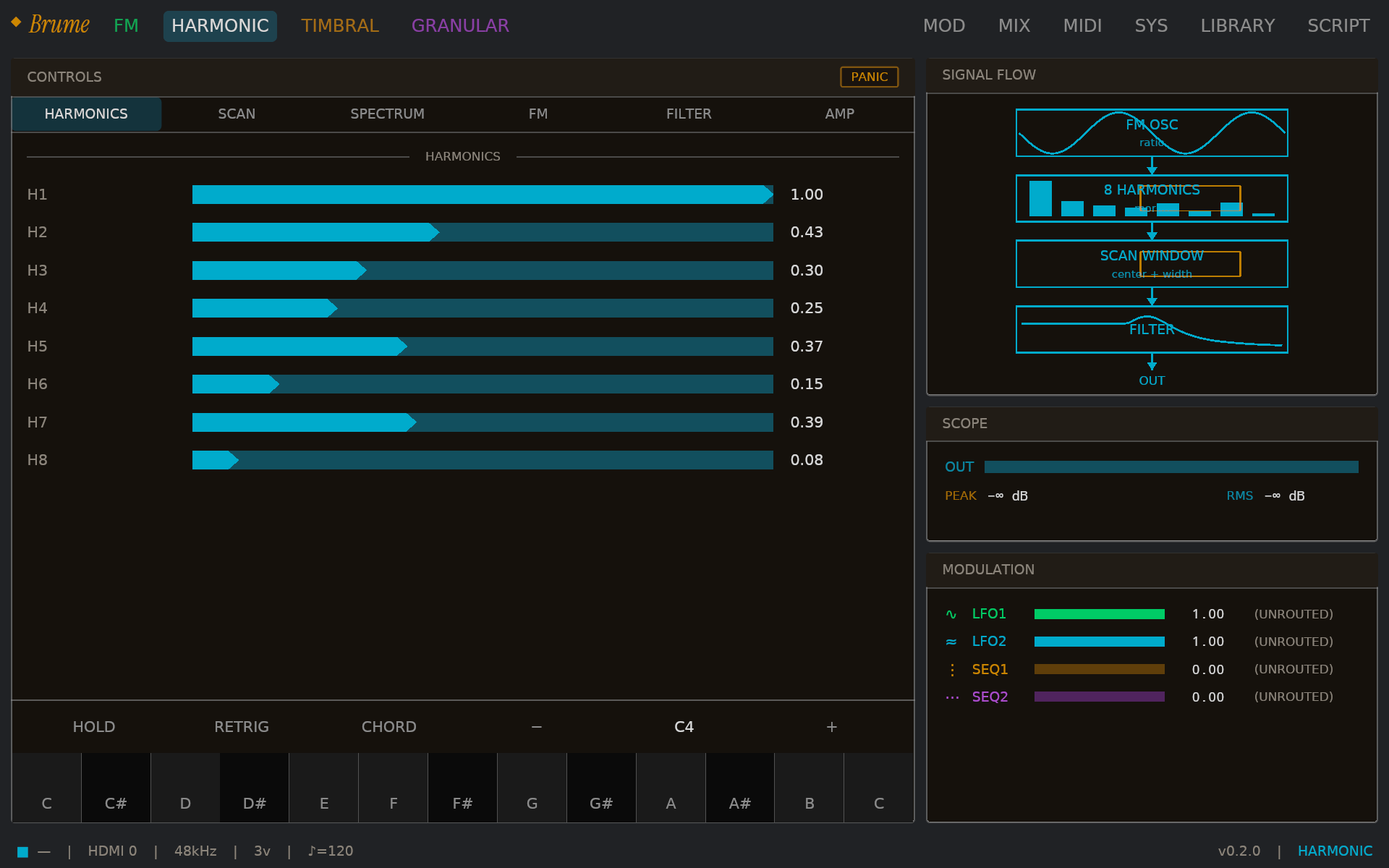
A four-part multi-timbral synthesizer that runs on a Raspberry Pi Compute Module 5. Brume has four sound engines and six voices per part, a shared filter section feeding an effects chain, a sandboxed Lua scripting layer, and a 10.1-inch touchscreen UI. A single USB cable presents the device to a host computer as a class-compliant audio and MIDI interface.
What's in the box
- Engines: FM, Harmonic, Timbral, Granular
- Voices: 6 per part, 24 total
- Filter: One state-variable filter per voice
- Effects: Saturator, chorus, delay, dattorro plate reverb
- Modulation: 2 LFOs and 2 step sequencers per part, 24 named transition shapes
- Scripting: Sandboxed Lua 5.5; control scripts and FX scripts
- MIDI: 16 channels, over USB or a hardware MIDI input
- Audio: Stereo over USB; per-part stems also available
- Display: iced + wgpu touchscreen, 10.1 inch, 1920×1200
Hardware
Brume's reference platform is the Raspberry Pi Compute Module 5 on
a carrier IO board, because Brume's audio and MIDI bridge to a host
computer requires USB device-mode and the CM5 IO board exposes that
mode through a USB OTG jumper. Whether the device-mode port on the
carrier is Type-C or Type-A is incidental; what matters is that one
of the carrier's USB ports is wired to the CM5's peripheral
controller. The same combination pairs the
CM5 with a 10.1-inch HDMI touchscreen; the reference unit's specific
parts are documented in HARDWARE.md. The software is
written against the stock Pi kernel and ALSA; notes from anyone who has
gotten Brume running on different IO boards or displays are welcome in
the same file.
Status
Brume is pre-1.0, hobby-grade, single-maintainer; the tracked
surface is in CHANGELOG.md.
Documentation
INSTALL.md: first-time CM5 bring-up.DEPLOY.md: iteration loop on a CM5.HARDWARE.md: IO board, screen, and audio notes.BOM.md: the exact parts we developed on, with links.CONTRIBUTING.md: house style, PR flow, and scope.AGENTS.md: entry point for AI coding agents.CHANGELOG.md: every user-observable change.
License
Copyright (C) 2026 Brandon Huey [email protected]
Brume is licensed under the GNU General Public License version 3.0
only (GPL-3.0-only). The full license text is in
LICENSE. Contributions land under the same license
without a CLA or copyright reassignment; see
CONTRIBUTING.md for details.
The Brume wordmark and splash use Instrument Serif by Rodrigo
Fuenzalida and the Instrument Serif Project Authors, distributed
under the SIL Open Font License 1.1; the font and its license live
under crates/ui-native/assets/.