
affifuddin-hazam/ghost-infer
affifuddin-hazam/ghost-infer has 237 GitHub stars and 15 forks. GitHot measured +7 stars in 24 hours. Last checked 2026-11-15 23:42 UTC. Last push 2026-11-14.
Measured star growth
- in 24h
- +7
- in 7 days
- Update delayed
- in 15 days
- Update delayed
- in 1 month
- Update delayed
Net star changes over overlapping periods, not daily totals. Missing measurements are left blank. Stars measure attention, not software quality.
About
Fast local LLM inference for the GPU you already have: one Rust binary, GGUF models, an OpenAI-compatible server and a chat page with a ghost.
AIREADME.md
Original

ghost-infer
Fast local LLM inference for the GPU you already have.
One small Rust program that runs GGUF models on an NVIDIA card, serves an OpenAI-compatible API,
and comes with a desktop app where the model works on your files.
Install · Speed · The engine · Desktop app · What's new · Server API · How it works


Most inference engines are built for data centres: many users, big GPUs, batching. ghost-infer is built for the other case: one person, one consumer GPU, one model at a time, and it is tuned for exactly that.
Speed
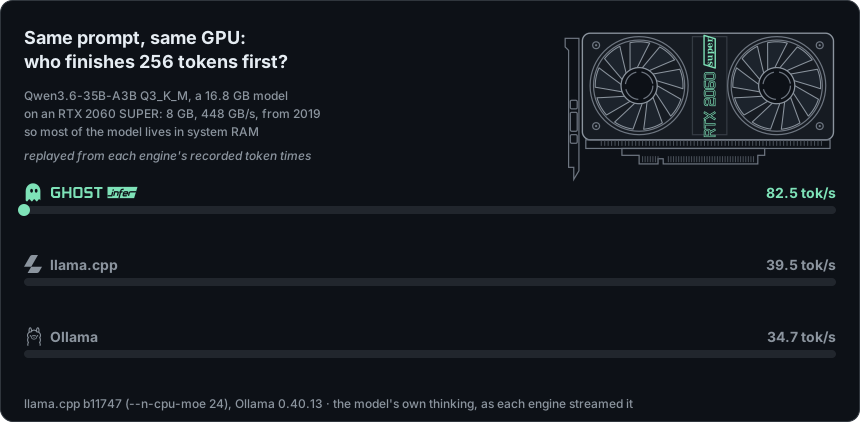
On an 8 GB RTX 2060 SUPER with 24 GB of RAM, on the same GGUF files:
| Generation speed | ghost-infer | llama.cpp | Ollama |
|---|---|---|---|
| Qwen3 8B, 5 GB: fits in the GPU | 75.3 tokens/s | 64.7 | 65.8 |
| Qwen3.6-35B-A3B, 16.8 GB: bigger than the GPU | 80.5 tokens/s | 39.5 | 34.7 |
| Qwen3-30B-A3B, 13.7 GB: bigger than the GPU | 68.7 tokens/s | 29.5 | 26.9 |
| Qwen3.5-35B-A3B Claude-4.6-Opus distill, 16.8 GB | 76.4 tokens/s | not measured | not measured |
| Qwen3-Coder-30B-A3B, 14.7 GB * | 32.7 / 47.3 | not measured | not measured |
| Qwen3-Coder-Next 80B, 22 GB: bigger than the RAM * | 11.8 / 14.5 | 9.3 / 12.4 | not measured |
ghost-infer 0.4.0, llama.cpp b11747 and Ollama 0.40.13, all measured 2026-11-14 in one run
(scripts/bench-all.ps1). Qwen3 8B: GuideLLM, a ~264-token chat prompt and 128 tokens. The A3B rows: seven varied
prompts (code, an explanation, a code review, a summary, a chat, a word problem, SQL) through each engine's API,
the median of two rounds, llama.cpp at its best --n-cpu-moe setting (24); i1-Q3_K_M files. Rows marked *:
measured 2026-11-10 with 16 GB of RAM and ghost-infer 0.3.0, tokens/s writing code / writing a long answer, the
second (warm) of two runs, llama.cpp with its automatic GPU split. Method and more results in
Benchmarks.
Models bigger than your GPU
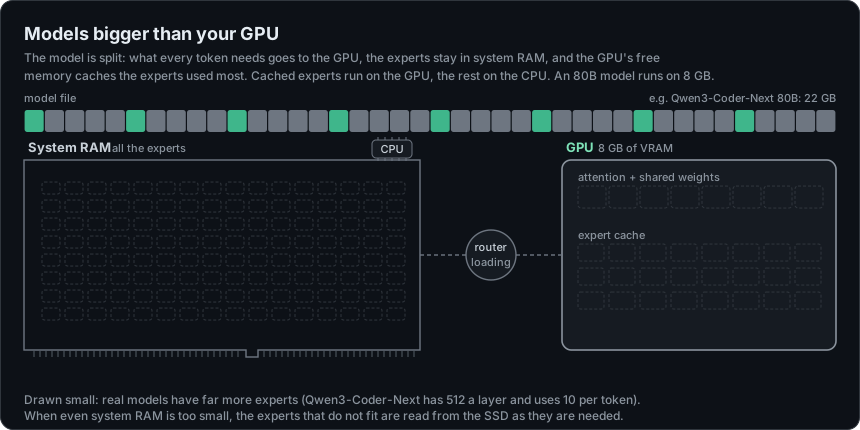
A mixture-of-experts model uses only a few of its experts for each token. ghost-infer keeps attention on the GPU and the experts in RAM, caches on the GPU the ones a reply keeps reaching for, and runs the others on the CPU meanwhile. Each layer runs as one CUDA graph and the GPU picks its own experts, so the cached ones never wait for the CPU. So Qwen3.6-35B-A3B (16.8 GB) runs on an 8 GB card at 80 tokens/s, twice llama.cpp's speed, and an 80B model runs at all.
Long chats stay fast
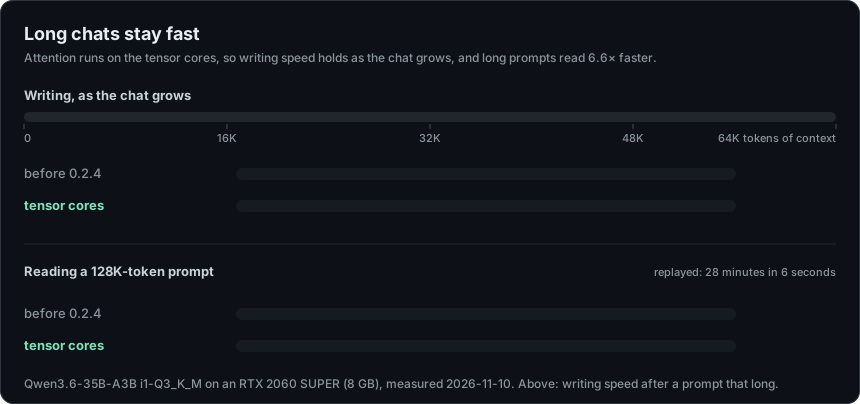
Attention runs on the tensor cores, both while the model writes and while it reads a prompt, so a long chat or a
long file pasted in does not slow it down: 49 tokens/s after 64K tokens of context, and a 128K-token prompt read
in about 4 minutes instead of 28. GHOST_INFER_NO_TC_DECODE=1 and GHOST_INFER_NO_TC_ATT=1 turn the
tensor-core kernels off.
Exact speculative decoding
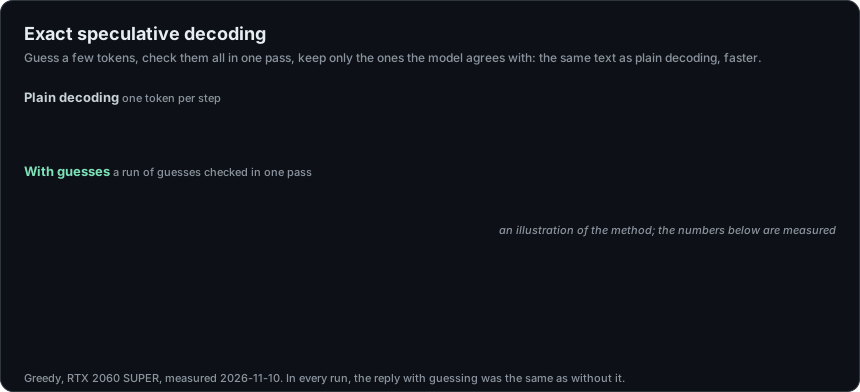
ghost-infer guesses a few tokens ahead and checks them all in one pass, keeping only the ones the model would have
written itself, so the reply is the same text as plain greedy decoding, only sooner. The guesses come from text
already in the chat (lookup, on by default for models that fit in the GPU: 3.2× on agent work that copies text,
such as editing a file) or from a small draft model (--draft). Results are also checked against exact maths and llama.cpp. More
A drop-in server
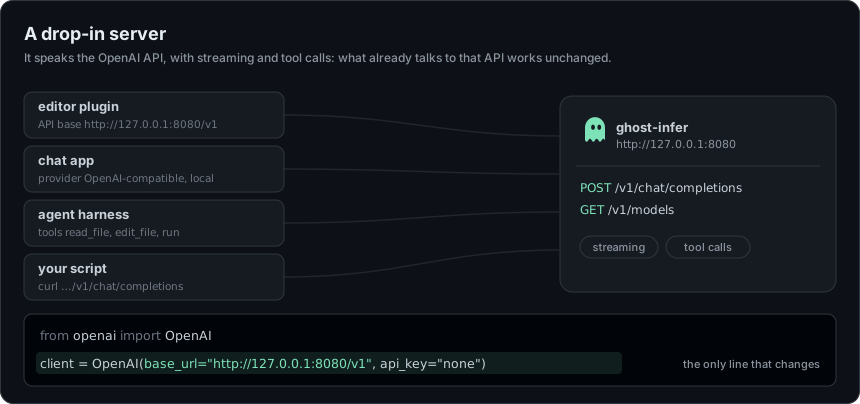
An OpenAI-compatible /v1/chat/completions with streaming and tool calls, so editor plugins, chat apps and agent
harnesses work unchanged: point them at http://127.0.0.1:8080/v1. More
One small program
One 3.8 MB file with two Rust dependencies: no Python, no Docker. It compiles its GPU code for your card on first start.
Install
Download GhostSetup for Windows and run it. It needs no administrator rights and nothing else installed. The app starts the server and, the first time, offers models to download, or uses the GGUF files you already have.
Build from source
git clone https://github.com/affifuddin-hazam/ghost-infer
cd ghost-infer
cargo build --release
target\release\ghost-infer serve models\Qwen3-8B-Q4_K_M.gguf --gpu
Open http://127.0.0.1:8080 to chat, or point any OpenAI client at http://127.0.0.1:8080/v1. Built from
source, it needs the CUDA toolkit's NVRTC: see Building.
The desktop app
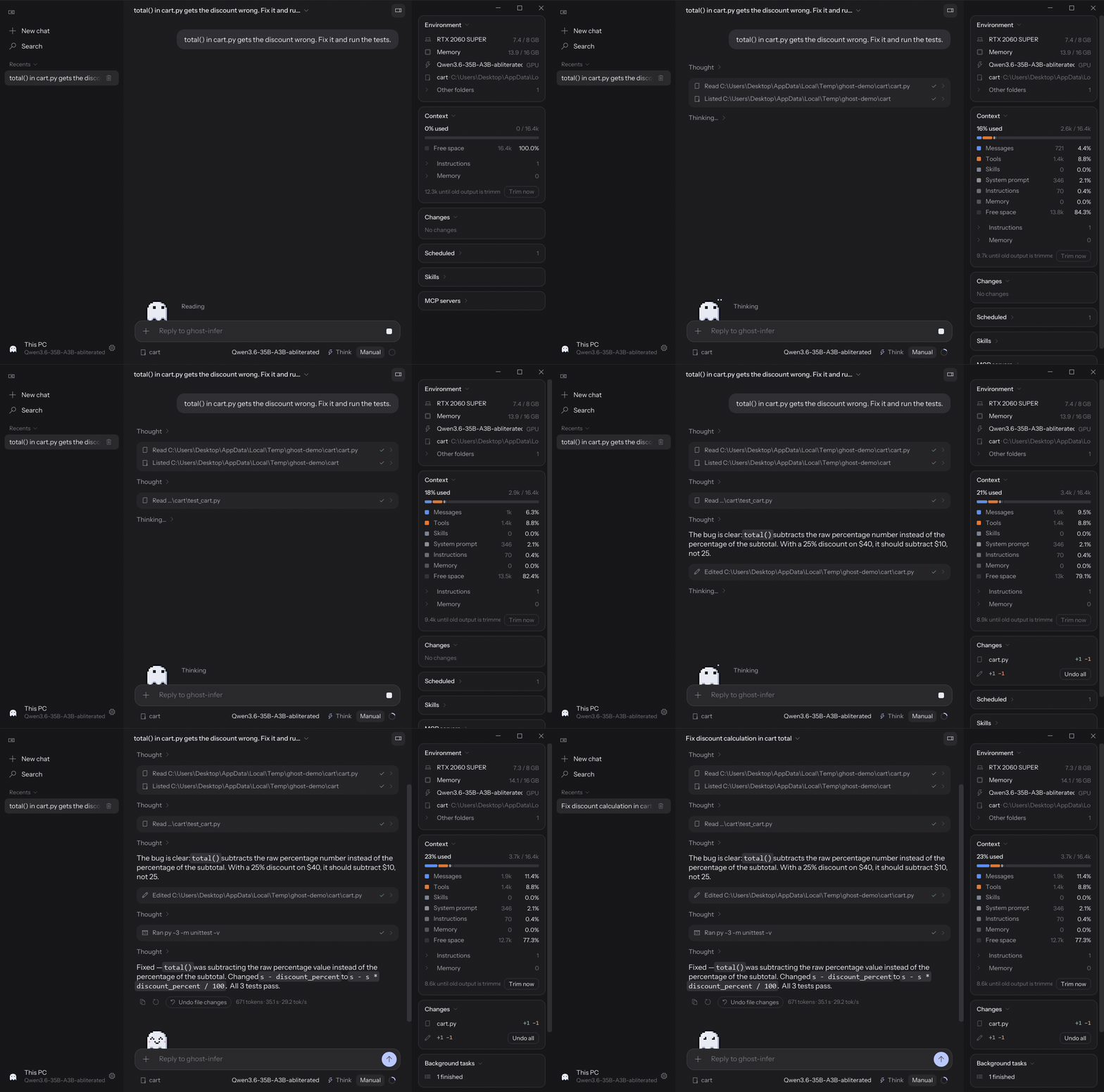
Real time, not sped up: the desktop app fixing a failing test, Qwen3.6-35B-A3B (Huihui abliterated, i1-Q3_K_M) on an RTX 2060 SUPER (8 GB) with 16 GB of RAM.
- An agent on your files. The model reads and edits your files and runs commands, asking first, with permission modes, a task list and background jobs. More
- Voice calls. Talk with Maya, a companion who answers aloud and remembers your calls, with her own model beside the coding one when the GPU has room. Speech and listening run on the same card. The voice files (about 3 GB) are on Hugging Face. More
- English or Chinese. The desktop app's own words come in either language: Settings, General, Language, or follow Windows.
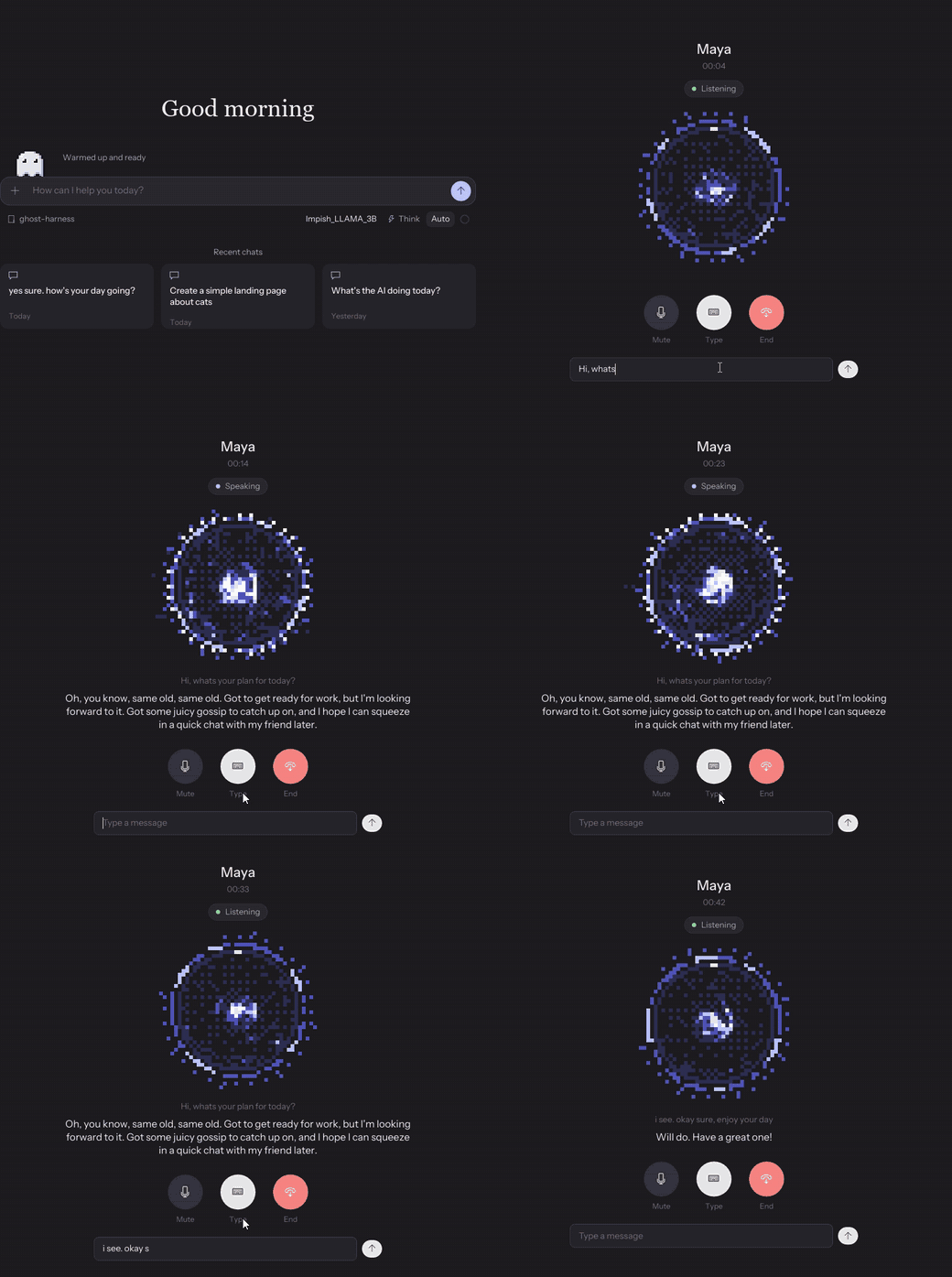
A voice call, real time: Impish_LLAMA_3B, the voice (maya1 with a voice fine-tune of our own,
on Hugging Face) and Whisper turbo together on an 8 GB RTX 2060 SUPER. With sound.
It learns while you sleep
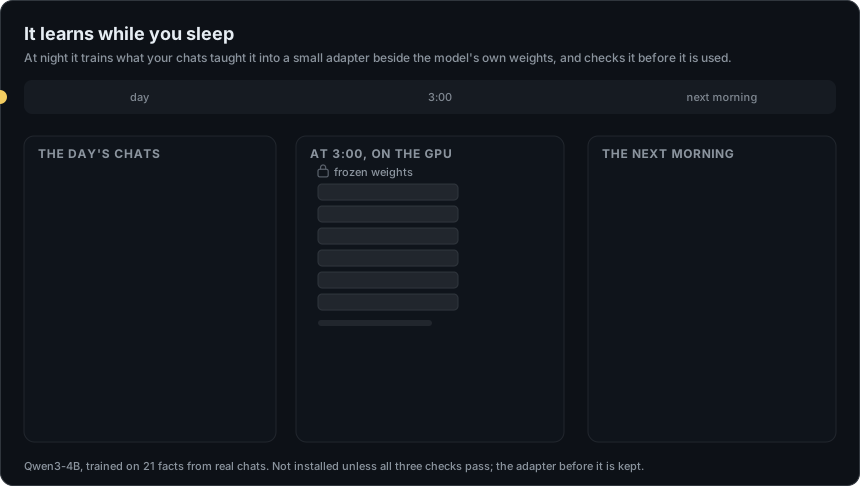
Each night it can read the day's chats for things worth remembering and train them into the model's own weights: a small LoRA adapter for Qwen3-4B, beside its frozen weights. The adapter is checked before it is used: the facts must be learned, general answers unchanged, and the model must still call its tools. If any check fails, the one before stays. Settings, Sleep training shows each night and everything it has learned, with the chat each fact came from, and forgetting a fact takes it out of the next night's training.
Experimental, and for now from source only: it trains with Python and PyTorch on the model's original weights
(scripts/nightly, about 25 minutes a night on an 8 GB card), and the installer does not include it yet.
What's new
New in 0.4.0:
- About twice as fast on models bigger than the GPU. Each layer runs as one CUDA graph, the GPU picks its own experts, small kernels are fused, and the CPU's expert threads each keep a core of their own: Qwen3.6-35B-A3B on an RTX 2060 SUPER went from about 45 to 80 tokens/s, twice llama.cpp's speed, with the same tokens as before.
- Faster sampling. Picking a token with temperature, top-k or a repetition penalty no longer scans the whole vocabulary: up to 3 ms less per token.
- Ternary Bonsai 27B on the GPU (Q2_0 and PTQ1_0), about 40 tokens/s on an 8 GB card.
- 4-bit KV cache (
--kv q4, the app's default): about half the memory per token, so longer chats fit. - Plugins in the app: a side-bar row with its own page, and a status badge over every page.
- Select and copy anywhere in a chat, tool output included; pages the model opens go to the side pane.
ghost-infer monitordraws a live tokens/s graph in a terminal, andclaude-local.batruns Claude Code on your own model (from source).
New in 0.3.0:
- Faster on models bigger than the GPU. The GPU's expert cache now keeps the experts a reply keeps using instead of swapping one in on every miss, which made a 16 GB computer read them back from the disk: Qwen3.6-35B-A3B on an RTX 2060 SUPER went from 34.7 to 42.1 tokens/s on average. The CPU's workers run below normal priority, so the rest of the computer stays responsive while it writes.
- RAM for experts. Settings, Models: leave 2 GB (the default) or 4 GB free for your other programs, or use all of it. Qwen3.6-35B-A3B on 16 GB used 10.5 GB of RAM before and 3.9 GB now, at the same speed.
- Experts on the GPU only. Settings, Models: the CPU runs none of the experts, at some cost in speed.
- Edit, regenerate, copy. Edit a message you sent and send it again; regenerate any reply, not only the last; copy a message, or select part of it to copy.
- Plugins it writes itself. The model can write small tools for its own use (plain Python functions) and turn them on; it asks before saving one. Skills, plugins and MCP tools are found when a message needs them instead of filling every prompt.
- LoRA adapters.
--lora <file>[:scale]loads an adapter in llama.cpp's GGUF format, on the GPU or CPU. - Sleep training (from source, experimental). Each night it can train what your chats taught into an
adapter for Qwen3-4B, checked before it is used: the facts learned, general answers unchanged, tools still
called. Settings, Sleep training shows what it learned and lets you forget any of it. It needs Python and
PyTorch and runs from a copy of the source (
scripts/nightly); the installer does not include it yet.
New in 0.2.5:
- The desktop app in Chinese. Settings, General, Language: English, 中文, or System to follow Windows. It switches at once, no restart. The model still answers in whatever language you write in. Thanks to huai_xin for the translation.
New in 0.2.4:
- Long chats stay fast on Qwen3.6-35B-A3B. Its attention (256-wide heads) now runs on the tensor cores,
both when it writes and when it reads a prompt. On an RTX 2060 SUPER, generation at a 16K context went from
25.2 to 39.7 tokens/s and at 64K from 12.0 to 40.8; reading a 128K-token prompt takes about 4 minutes
instead of 27 (81 to 581 tokens/s).
GHOST_INFER_NO_TC_DECODE=1andGHOST_INFER_NO_TC_ATT=1turn the new kernels off. - Attach files in the desktop app. Text and code files go with a message: from the + menu, dropped on the window, or pasted with Ctrl+V after copying them in Explorer.
- See a file being written. While the model writes a file, the reply shows a live line with its name, how much is written and for how long, instead of going quiet until the file is done.
- Smaller fixes in the app. Each thinking block opens and closes on its own, and the token count and speed show only while the model is writing (not while it waits for your OK).
Models
The app offers these on its first start:
| Model | Download | Good for |
|---|---|---|
| Qwen3.6-35B-A3B | 16.8 GB | Thinks before it answers: coding and agent work (16 GB of RAM) |
| Qwen3-Coder-30B-A3B | 14.7 GB | Answers at once: fast for code |
| Qwen3-4B-Instruct-2507 | 2.5 GB | Computers with less memory |
Other GGUF files of Llama 3, Mistral Nemo, Qwen3, Qwen3-Next, Qwen3.5 / 3.6 and DeepSeek-style models such as GLM-4.7-Flash run too, in Q3_K to Q8_0 or the 2-bit IQ2 formats: the full list. 3-bit files stay 3-bit on the GPU, so a 12B Q3_K_M runs on an 8 GB card.
Requirements
Windows 10 or 11, an NVIDIA GPU from the GTX 10 series on with a current driver, and a CPU with AVX2.
Documentation
- Benchmarks: the method, long contexts, mixture of experts, speculative decoding
- The desktop app and the chat page
- Command line and server API
- How it works, and its accuracy
- Building, requirements and models: from source, GPU requirements, the installer
Roadmap
- Linux support
- More architectures (Gemma) and formats (Q4_0, the other IQ quants)
- Constrained decoding for tool calls
License
Licensed under either of
- Apache License, Version 2.0 (LICENSE-APACHE or https://www.apache.org/licenses/LICENSE-2.0)
- MIT license (LICENSE-MIT or https://opensource.org/licenses/MIT)
at your option.
Unless you explicitly state otherwise, any contribution intentionally submitted for inclusion in the work by you, as defined in the Apache-2.0 license, shall be dual licensed as above, without any additional terms or conditions.
The chat page includes three.js (MIT, src/vendor/three.LICENSE)
and the Instrument Sans typeface (SIL Open Font License 1.1,
src/vendor/instrument-sans.LICENSE). The installer includes NVIDIA's
NVRTC under the CUDA Toolkit EULA (installer/THIRD-PARTY.txt).
The speed race names the engines it measures with their marks: llama.cpp's from ggml-org/llama-brand, and Ollama's. They belong to their projects, which do not endorse ghost-infer.