
advait/c4a0
advait/c4a0 has 27 GitHub stars and 1 forks. GitHot measured 0 stars in 24 hours. Last checked 2026-11-14 10:29 UTC. Last push 2026-11-07.
Measured star growth
- in 24h
- 0
- in 7 days
- Collecting history
- in 15 days
- Collecting history
- in 1 month
- Collecting history
Net star changes over overlapping periods, not daily totals. Missing measurements are left blank. Stars measure attention, not software quality.
About
Alpha-Zero Connect Four NN trained via self play
Machine LearningREADME.md
Originalc4a0: Connect Four AlphaZero

An AlphaZero-style Connect Four engine that learns entirely from self-play, measured move by move against a perfect solver.
Rust runs the game, Monte Carlo Tree Search (MCTS) and multi-threaded self-play. A PyTorch network, called from Rust through PyO3, estimates move priors and position values for the search.

Training progress
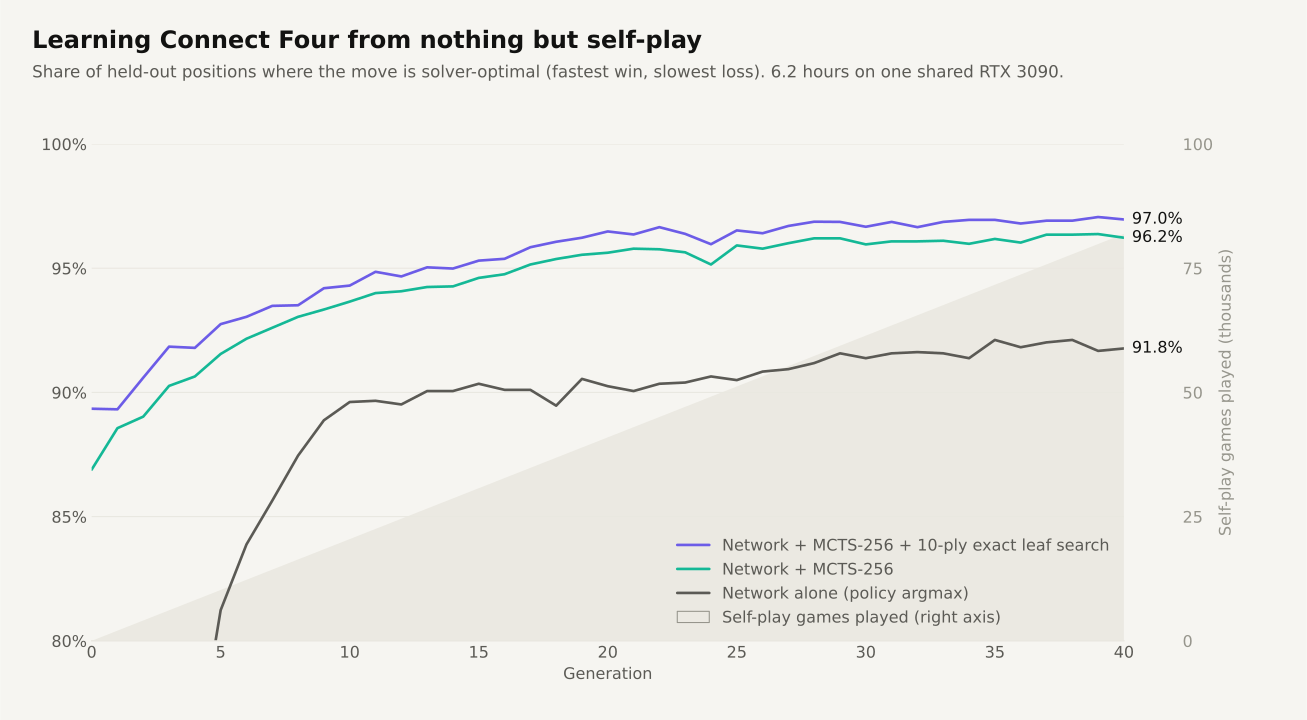
Every generation's saved model is scored on a fixed, solver-labeled suite of positions it never trains on. The headline metric asks whether the move MCTS chooses keeps the game result: a won position stays won and a drawn one stays drawn. The target is 98%.
| Configuration | Generations | MCTS-256 move keeps the result | MCTS-64 picks the solver's best move |
|---|---|---|---|
| Original search, 1x32 network | 20 | not measured | 57% (and falling) |
| PUCT search | 20 | not measured | 81% |
| + root noise, replay 4, 2,048 games | 20 | not measured | 88% |
| + replay 8, 60 generations | 60 | 96.5% | 89% |
| + 4x64 network, search-value targets, random starts | 41 | 98.0% | 93% |
| + MCTS-Solver (the current defaults) | 20 | 97.4% (96.5% without it at generation 20) | 94% |
Each row is the mean of two independent runs. The best generation (run 2, generation 41) keeps the result on 98.1% of the 1,484 counted dev positions and on 98.7% of the 1,513 held-out test positions, which no experiment decision ever looked at. The full record of what was tried, what helped, what hurt and what is still open is in what we learned trying to make self-play converge.
Install
You need two things on the machine:
- mise, which installs Rust, uv and Python 3.11 for the project.
- A C toolchain (
cc), which the Rust build links with. On Debian or Ubuntu, runsudo apt install build-essential.
Then, from the repository root:
mise trust
mise install
Every task below builds the Rust extension and the Python environment the first time it runs, so there is no separate build step. On Linux the locked PyTorch build includes CUDA, and training uses an NVIDIA GPU when one is present.
Play
To play in the terminal against plain MCTS, with no trained network:
mise run play -- --model uniform
To play against your latest trained generation:
mise run play
Train
To train with the best configuration found so far:
mise run train
Generations are written to training/, one directory per generation, each with model.pkl, games.pkl and metadata.json. Rerunning the command resumes from the latest generation. A GPU is strongly recommended: one generation takes several minutes on an RTX 3090 and much longer on a CPU.
Any train option can be passed after --. For example, to stop after 10 generations:
mise run train -- --max-gens 10
To check that everything works end to end on a CPU, run the tiny smoke configuration. It takes a few seconds once the project is built:
mise run train:smoke
Run uv run python src/c4a0/main.py train --help for every option and its default.
Measure progress
To print the score curve of a training run:
mise run report -- training
The report shows, per generation, the share of MCTS-256 moves that keep the game result, the strict best-move share, and the opening plies where most errors remain. Point it at a directory of several runs (for example runs/, with one base directory per run) to compare arms side by side.
To rescore saved generations, for example after adding an MCTS budget:
mise run eval -- --base-dir training --mcts-iterations 1024
To redraw the progress graph above from docs/data/training-progress.json:
mise run plot
How it works
Game and search
rust/src/c4r.rs holds the bitboard position and every Connect Four rule. rust/src/mcts.rs runs PUCT search: each child is scored by its mean value plus c * prior * sqrt(N_parent) / (1 + n), with root Dirichlet noise mixed in during self-play only. It also proves outcomes from the rules alone (MCTS-Solver): a node with a move that reaches a proven loss for the opponent is a proven win, a node whose moves are all proven takes their exact best value, and search never spends iterations below a proven node. No external solver is involved. The search also proves outcomes from the rules, in the style of MCTS-Solver. A finished position is proven, a position with a move into a proven loss for the opponent is a proven win, and a position whose moves are all proven takes the best of them. Search never descends below a proven node. A proven root stops searching, puts all its policy mass on the proven-best moves, and reports its exact value. rust/src/self_play.rs plays thousands of games in parallel. It batches positions from every game into one network call, caches evaluations within a generation, and samples moves from the visit counts.
Network and training loop
src/c4a0/nn.py defines a residual CNN with a policy head and two value heads. src/c4a0/training.py runs the generation loop:
- Play self-play games with the current network.
- Train a copy of the network on the last 8 generations' games. The policy target is the MCTS visit distribution and the value target is the search's own root value.
- Save the child and score it on the dev suite before publishing its metadata.
Half of the self-play games start from a random opening of up to 12 moves, so the network sees more than the lines it already likes. Every setting is a field of GenConfig and a train option.
Evaluation
src/c4a0/suite/v1/ holds a committed dev and test suite of about 2,400 positions each. Positions are sampled by random walks across plies 2 to 41, and every move is labeled by Pascal Pons's solver. A position and its mirror image always land in the same split. src/c4a0/evaluation.py scores the raw network and MCTS at fixed budgets, by ply bucket, and stores the result in each generation's metadata, so evaluation needs no solver at run time.
Rebuild the suite or label positions
Training and evaluation do not need the solver. You only need it to rebuild the committed suite or to label positions for the supervised ceiling (main.py label and main.py ceiling). Build it in solver/:
git clone https://github.com/PascalPons/connect4.git solver
make -C solver
curl -L -o solver/7x6.book https://github.com/PascalPons/connect4/releases/download/book/7x6.book
mise run suite:build
A clean-room Rust solver lives in rust/src/native_solver/. It agrees with Pons on every one of 228,041 compared positions, checked by brute force on late positions, and is not wired into labeling yet. mise run solver:diff reruns the comparison against Pons, and docs/native-solver.md has the full report.
Develop
mise run check
check runs Ruff (lint and format), ty, the Rust tests and the Python tests. CI runs mise run ci, which adds the smoke training run. See docs/development.md for the tooling details.
Explore related projects
tensorflow/tensorflow
An Open Source Machine Learning Framework for Everyone
201,592 starshuggingface/transformers
🤗 Transformers: the model-definition framework for state-of-the-art machine learning models in text, vision, audio, and multimodal models, for both inference and training.
168,962 starsAUTOMATIC1111/stable-diffusion-webui
Stable Diffusion web UI
165,311 starsComfy-Org/ComfyUI
The most powerful and modular diffusion model GUI, api and backend with a graph/nodes interface. The fastest local inference engine in the world.
146,752 stars