
aashish254/ai-image-detection
aashish254/ai-image-detection has 40 GitHub stars and 0 forks. GitHot measured +2 stars in 24 hours. Last checked 2026-11-09 17:59 UTC. Last push 2026-11-06.
🔍 Multi-Modal Forensic Analysis Platform — Detect AI-generated images using frequency-domain math, vision AI & 7 novel detection algorithms
Measured star growth
- in 24h
- +2
- in 7 days
- Update delayed
- in 15 days
- Update delayed
- in 1 month
- Update delayed
Net star changes over overlapping periods, not daily totals. Missing measurements are left blank. Stars measure attention, not software quality.
README.md
OriginalOriginLayer

Multi-modal forensic analysis for AI-generated images.
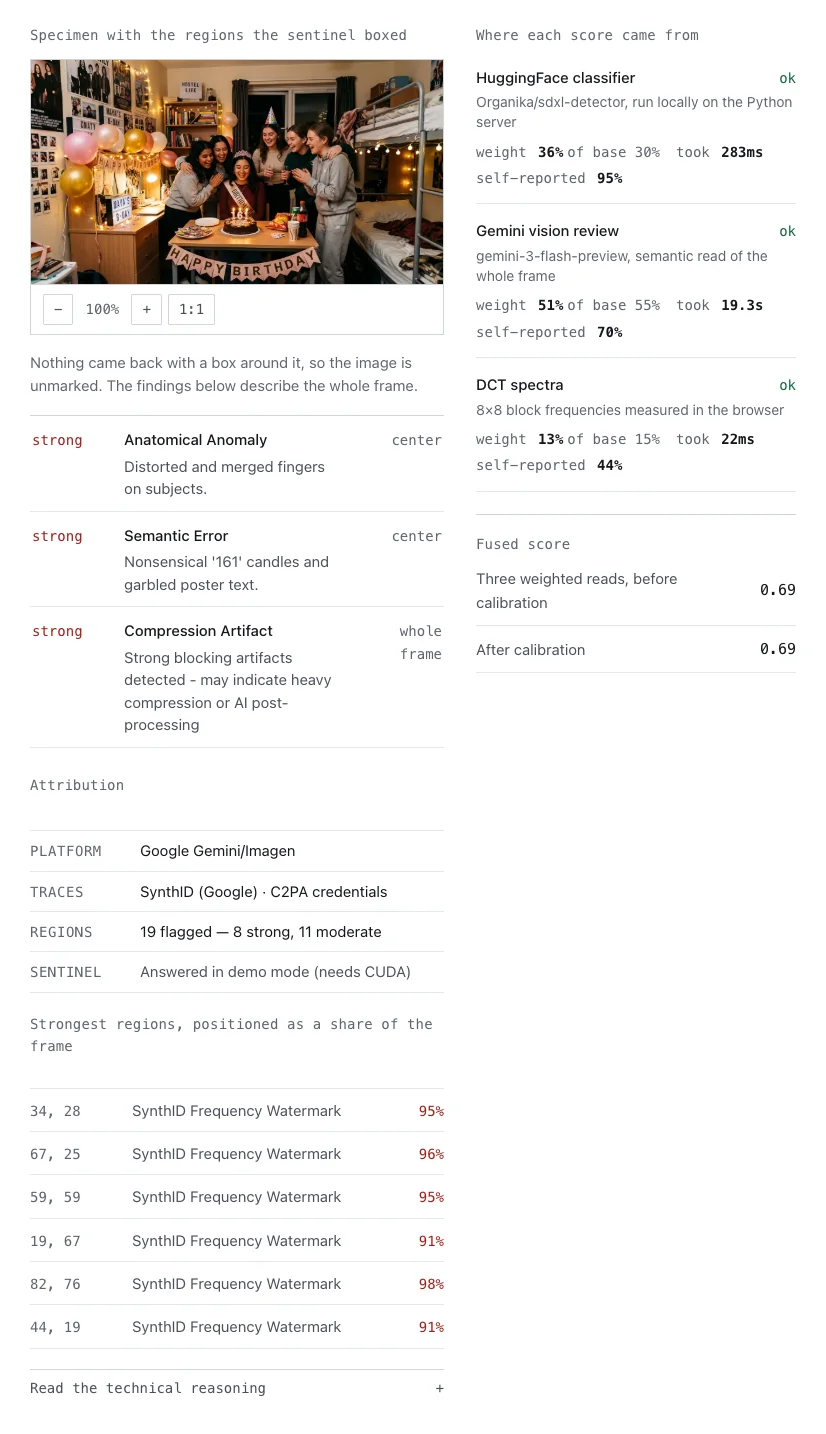
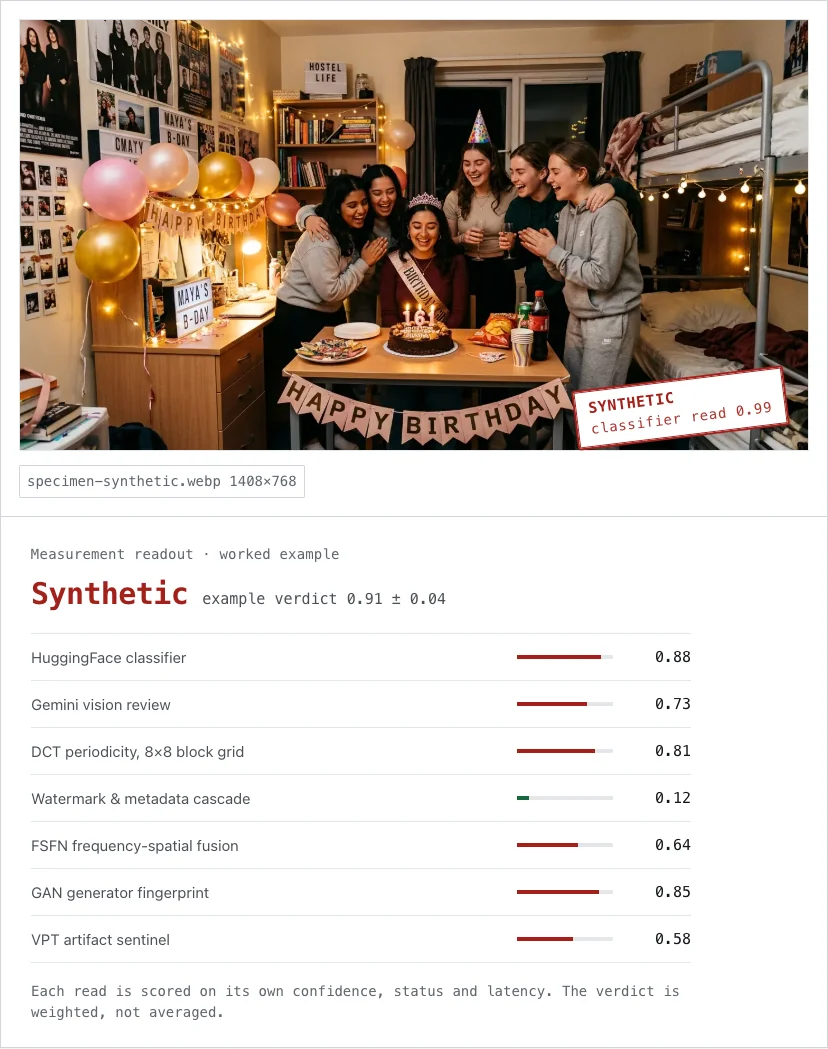
OriginLayer runs seven independent measurements over one image and issues one report. Three of those measurements are weighted into a verdict — a local classifier, a vision-language read and an in-browser frequency analysis — and the report shows each read's own confidence, status and latency next to the others. When the reads disagree, the verdict says so instead of hiding it.
Version 2.0.0 · MIT · Next.js 14 App Router + a Python FastAPI model server.
What you get
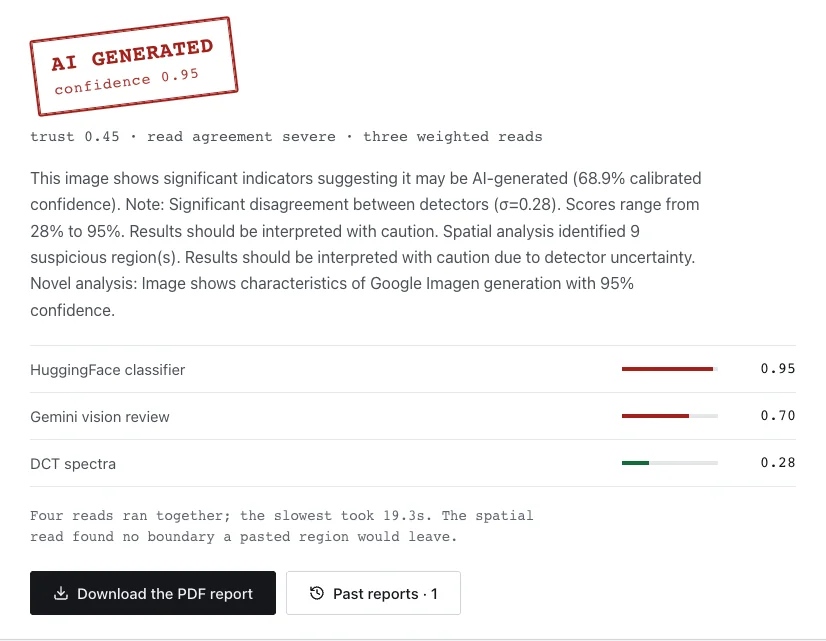
- A verdict with a band, not a boolean. Five states —
AI_GENERATED,LIKELY_AI,UNCERTAIN,LIKELY_REAL,REAL— derived from a calibrated score, plus a trust line that names the spread between the reads. - Seven measurements per image. Each one is scored and timed on its own row.
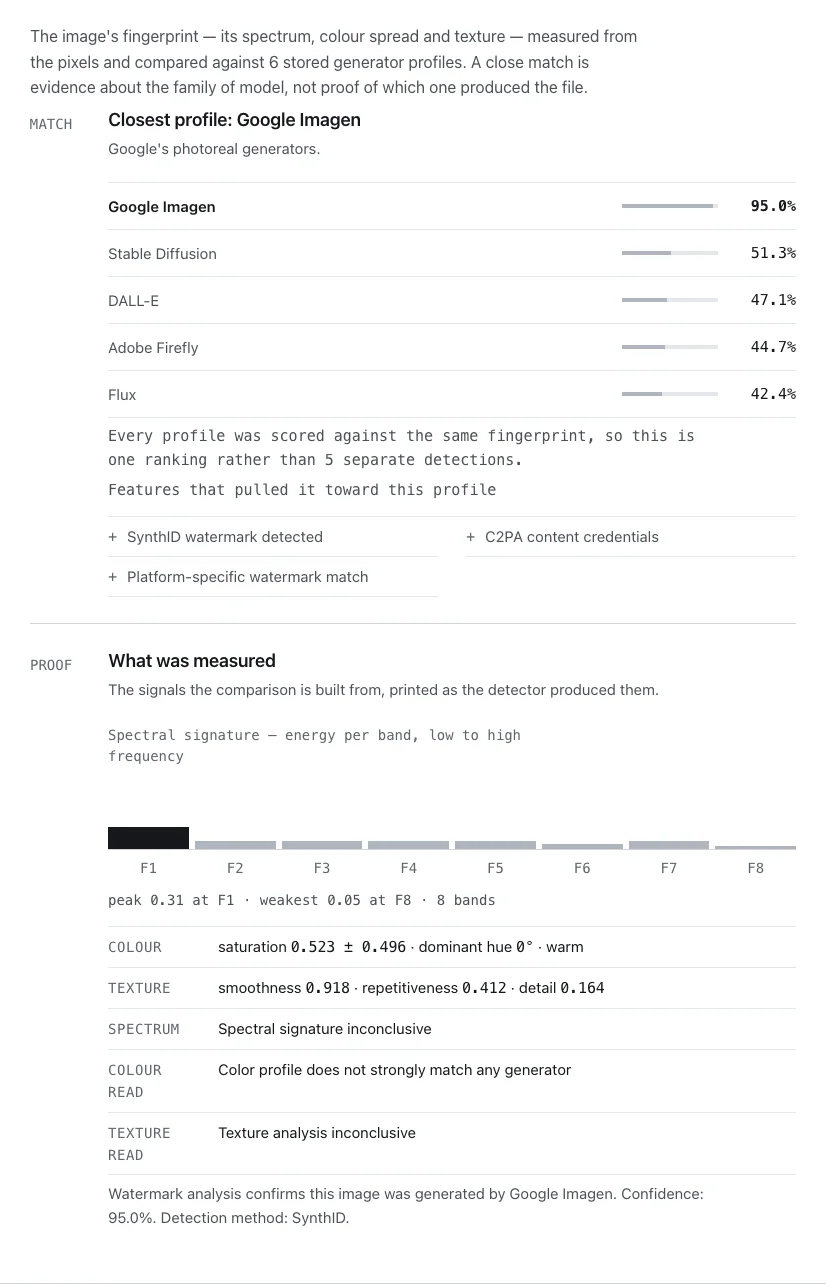
- Attribution, when there is evidence for it. Six generator profiles (DALL-E, Midjourney, Stable Diffusion, Adobe Firefly, Google Imagen, Flux) and a watermark cascade for SynthID, C2PA and Stable Diffusion marks.
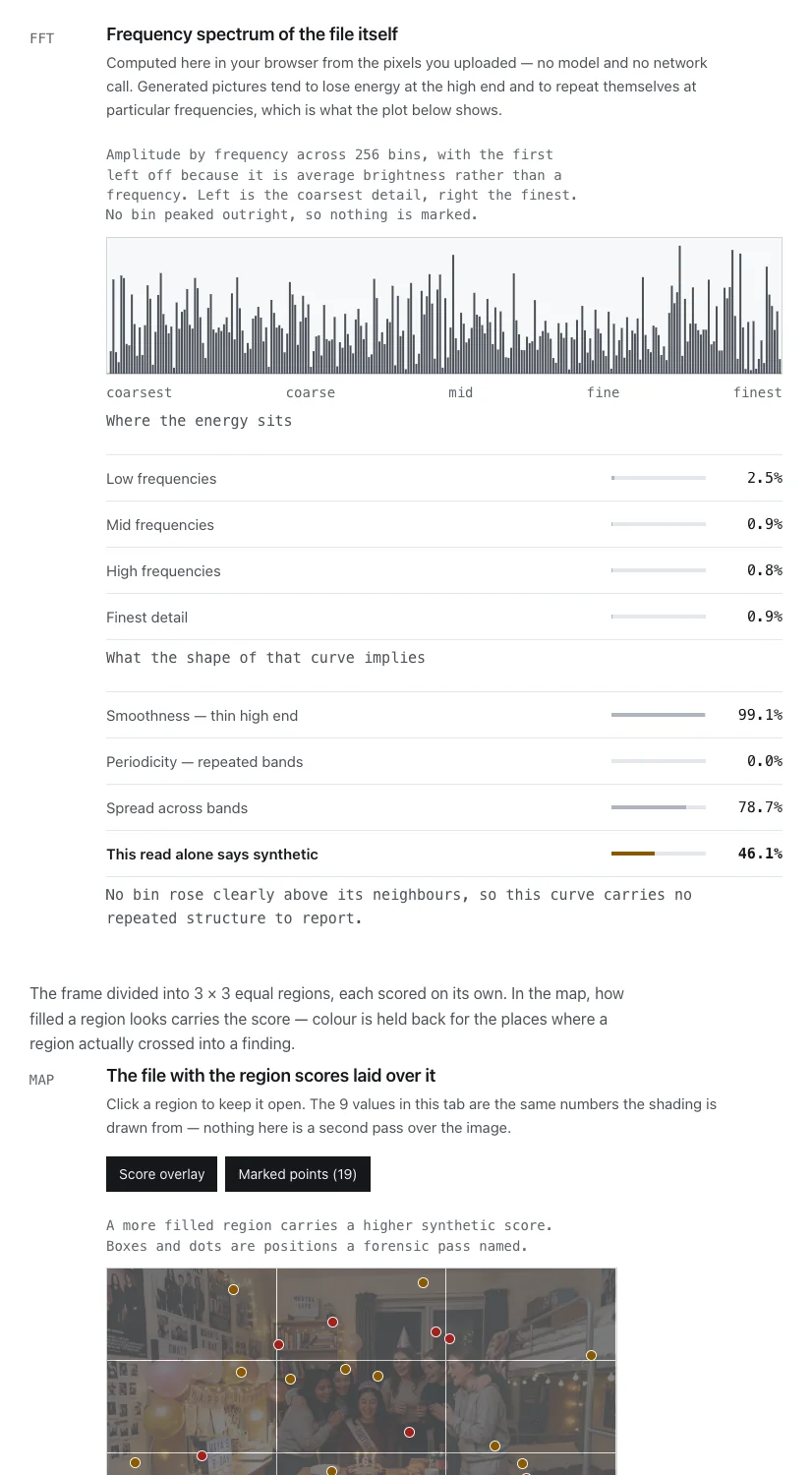
- A spatial map. Artifact regions are flagged with coordinates and severity rather than a single whole-frame number.
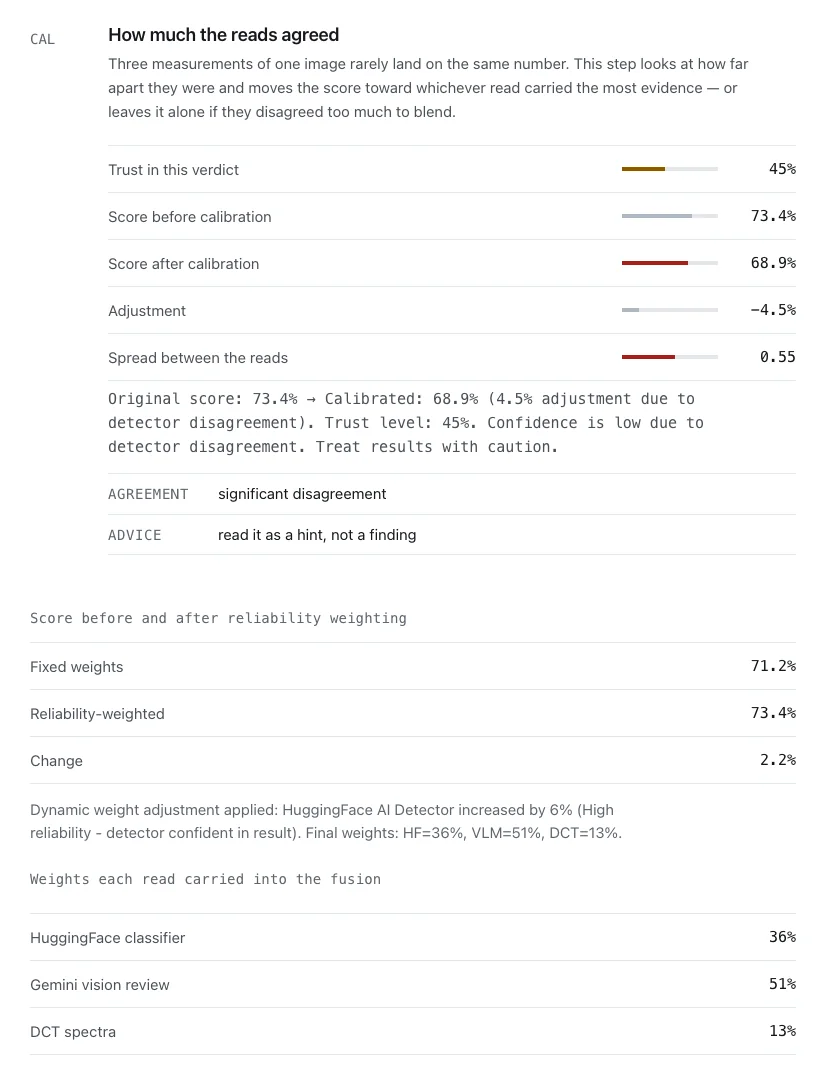
- Reliability accounting. Disagreement-aware calibration, epistemic uncertainty and a plain recommendation: safe to report, report with the spread shown, or a person should look at it.
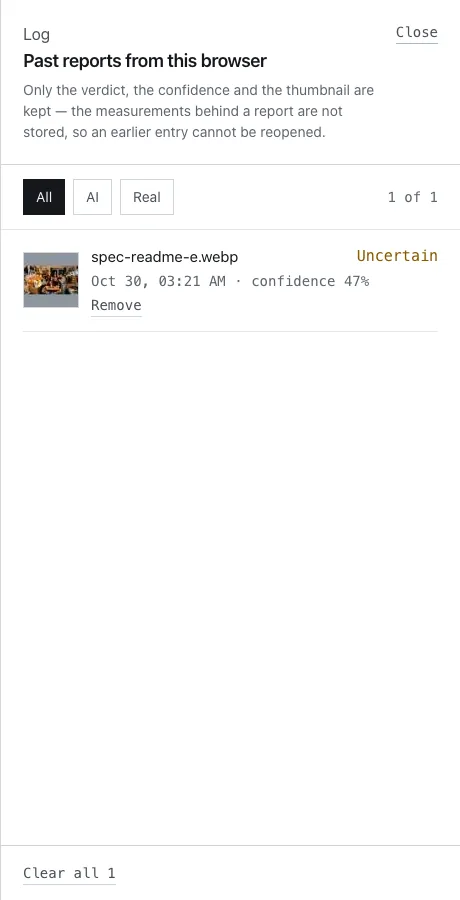
- A PDF of the report and a local history of past examinations in your browser.
- Light and dark. Same document layout in both; the theme is stored locally.

The seven measurements
Three are weighted into the verdict. Four run alongside them and appear in the report's own
sections. Base weights are in
src/lib/dynamic-weights.ts and are re-scaled per run by each read's
confidence, status and latency.
| Measurement | What it does | Where it runs | Base weight |
|---|---|---|---|
| Local classifier | Organika/sdxl-detector, a ViT image classifier |
Python server, POST /classify-json |
30% |
| Gemini vision review | Semantic read of the whole frame — anatomy, lighting, texture, text | Google Gemini, gemini-3-flash-preview |
55% |
| DCT spectra | 8×8 block frequency statistics | Browser, src/lib/detectors/dct-analysis.ts |
15% |
| Watermark & metadata cascade | SynthID, C2PA and Stable Diffusion mark scanning | Server, before fusion | supporting |
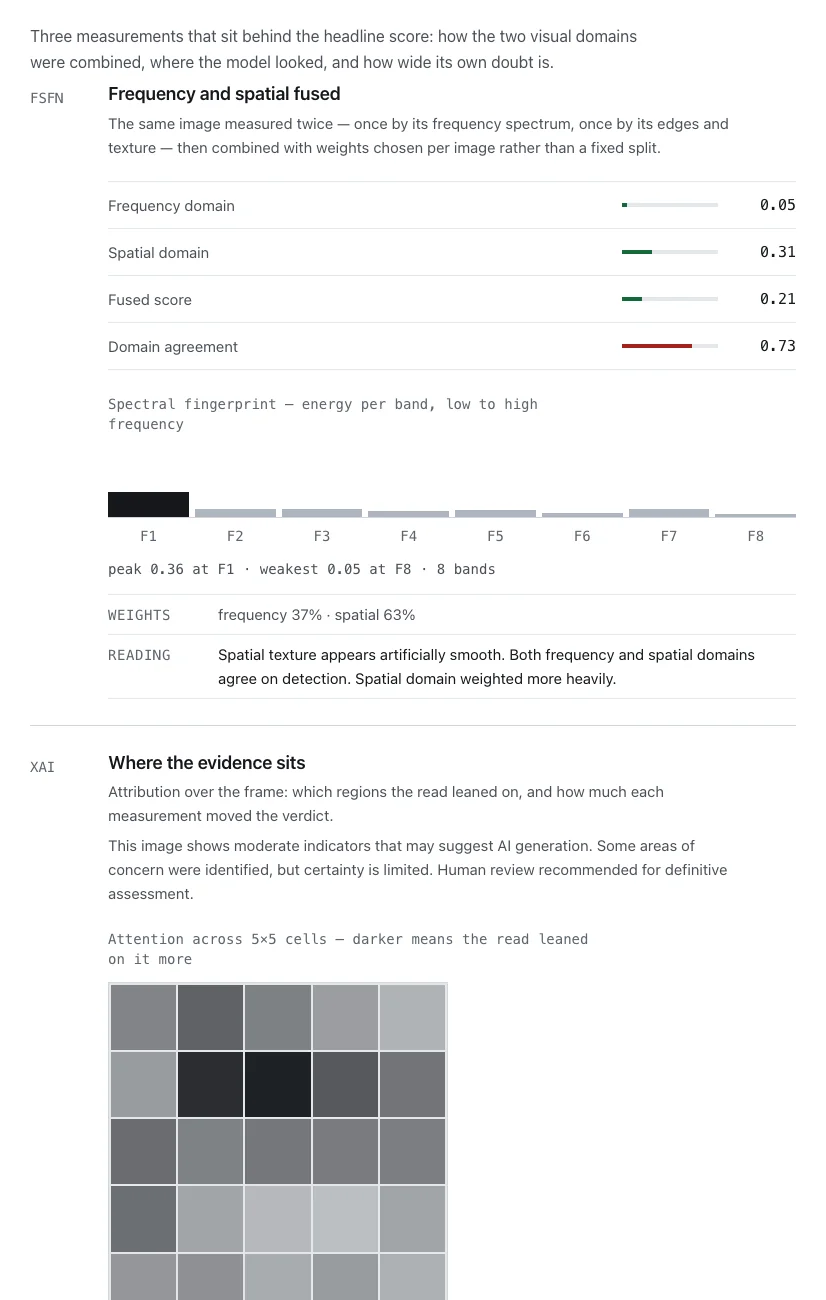
| FSFN | Fuses the frequency and spatial signals, reports domain agreement | src/lib/frequency-spatial-fusion.ts |
supporting |
| GAN generator fingerprint | Correlates the signal against six generator profiles | src/lib/gan-fingerprint.ts |
supporting |
| VPT artifact sentinel | Bounding boxes around suspected artifact regions | Python server (needs a CUDA GPU) | supporting |
Verdict thresholds
The calibrated score maps to a verdict at
src/app/api/analyze/route.ts:375:
| Calibrated score | Verdict |
|---|---|
| ≥ 0.80 | AI_GENERATED |
| ≥ 0.60 | LIKELY_AI |
| ≥ 0.40 | UNCERTAIN |
| ≥ 0.25 | LIKELY_REAL |
| < 0.25 | REAL |
Screenshots
Examination request
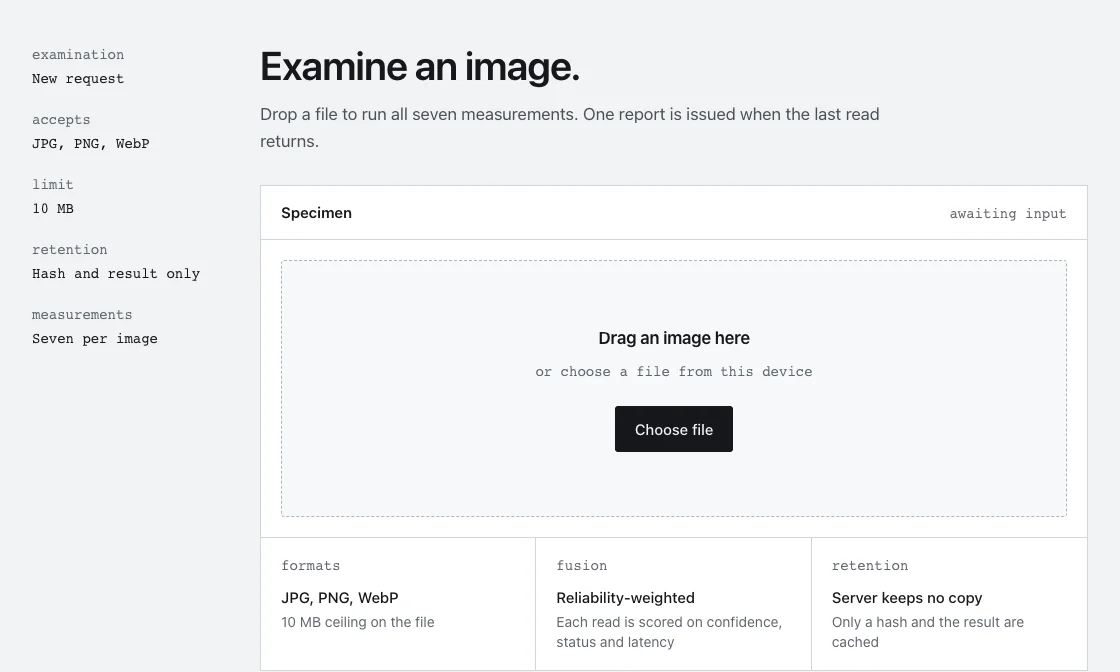
Overview — where each score came from
Novel methods
Generator attribution
Spatial map
Reliability
Past reports
Landing page specimen
Architecture
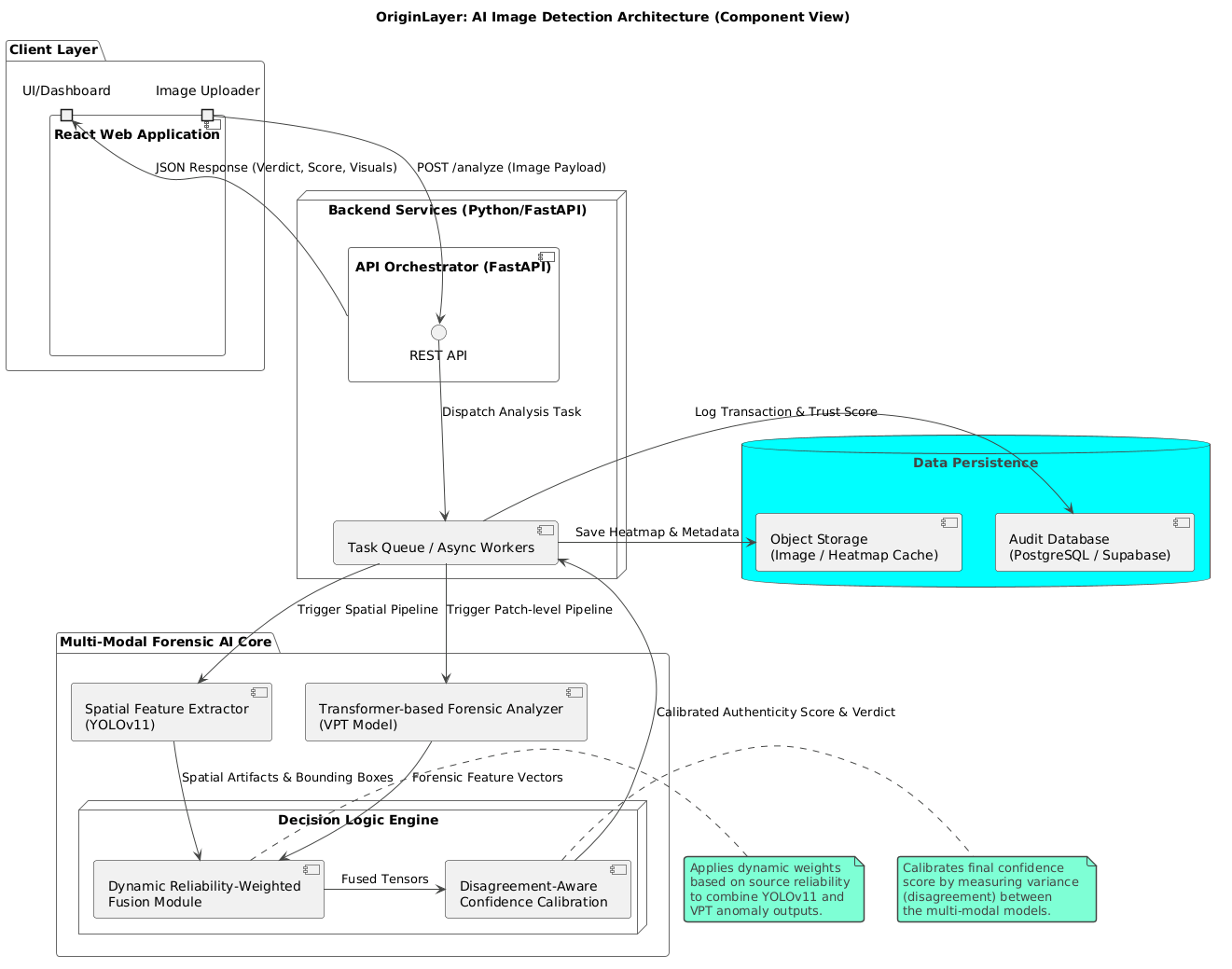
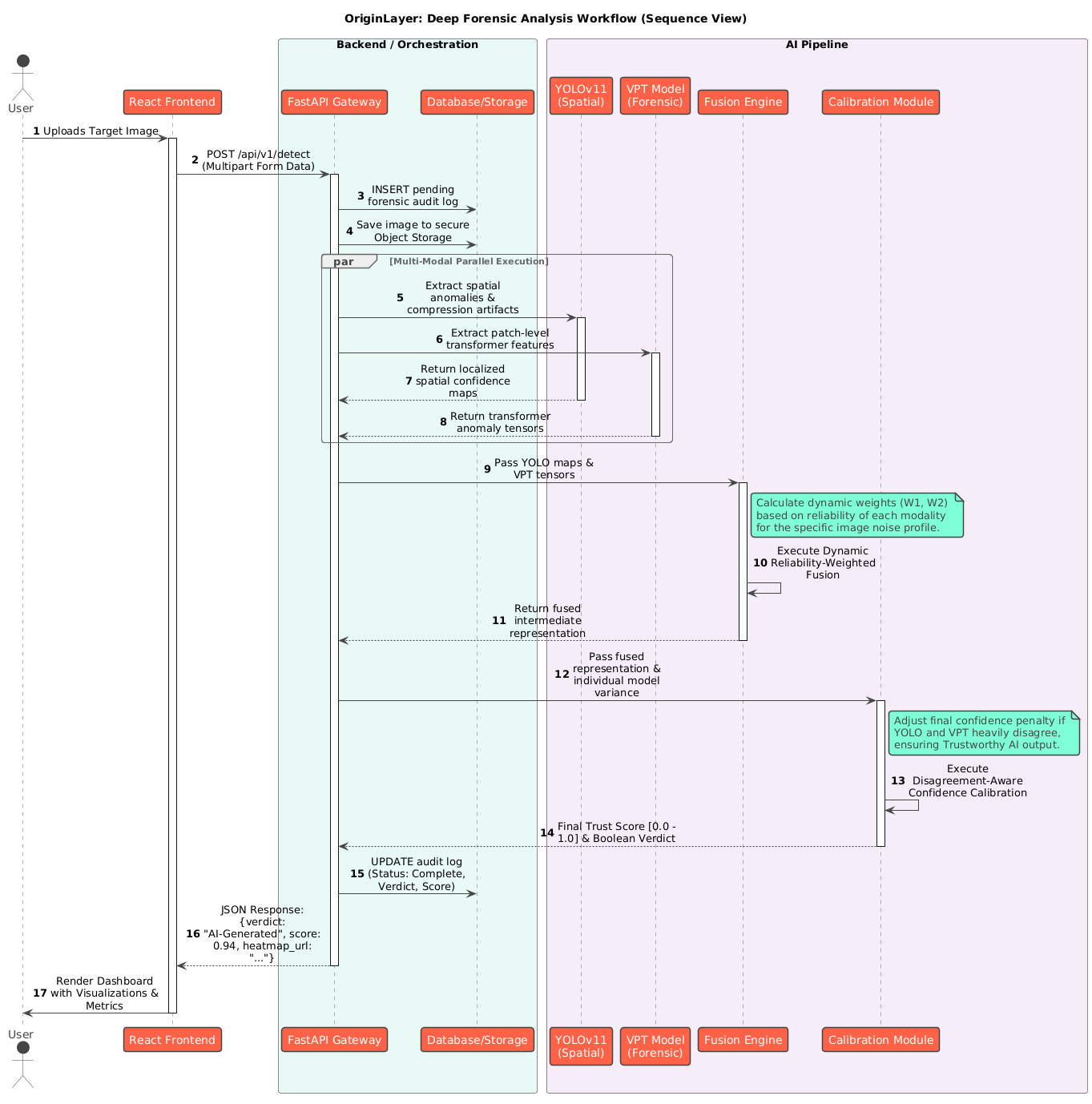
The two figures are the design view. What runs in this repo today is the pipeline below: POST /api/analyze,
the FastAPI classifier and sentinel on :8100, the Gemini vision read, the in-browser DCT read and an
in-process cache.
Browser: file → data URL → POST /api/analyze
                              │
                    image hash · cache lookup (24 h, in-process)
                              │
              ┌───────────────┼───────────────┐
              ▼               ▼               ▼
      Local classifier   Gemini vision    DCT spectra
      (FastAPI :8100)    (55% weight)     (in browser)
              └───────────────┼───────────────┘
                              ▼
        Watermark cascade · FSFN · GAN fingerprint · VPT sentinel
                              ▼
              DRWF fusion → disagreement-aware calibration
                              ▼
              Verdict · confidence · per-read provenance
The client sends the image once. The server keeps no copy of the pixels — only the hash and the
result are cached, for 24 hours, in an in-process map of up to 100 entries
(src/lib/cache.ts); an optional Redis layer sits behind the same interface.
Analysis history lives in localStorage under ai_forensic_history.
Novel contributions
Named as they appear in src/app/novelty/page.tsx:
| Contribution | What it adds | |
|---|---|---|
| DRWF | Dynamic reliability-weighted fusion | Re-weights the three reads per run instead of fixing their contributions |
| FSFN | Frequency-spatial fusion network | Combines spectral and spatial signals and reports whether the two domains agree |
| SAM | Spatial artifact mapping | Turns whole-frame scores into positioned, severity-ranked regions |
| GFI | GAN fingerprint identification | Attributes synthetic output to one of six generator profiles |
| DACC | Dynamic adaptive confidence calibration | Pulls the score toward the spread between reads when they disagree |
| EUQ | Epistemic uncertainty quantification | Separates what the system does not know from measurement noise |
| XAI | Explainable forensic reports | Emits the findings, coordinates and reasoning behind the verdict |
Tech stack
| Layer | Technology |
|---|---|
| Frontend | Next.js 14.2.3 (App Router), React 18, TypeScript |
| Styling | CSS custom properties + styled-jsx, no utility framework |
| Motion & icons | Framer Motion, lucide-react |
| Upload & notices | react-dropzone, react-hot-toast |
| PDF export | jsPDF — the report is laid out as text, not screenshotted |
| Model server | Python FastAPI + Uvicorn, PyTorch, Transformers, PEFT |
| Local models | Organika/sdxl-detector (ViT classifier), VPT Artifact Sentinel (Qwen2.5-VL-7B + LoRA) |
| Vision API | Google Gemini gemini-3-flash-preview, with fallbacks |
Quick start
Prerequisites
- Node.js 18.17 or newer — this was developed on 24.x
- Python 3.9 or newer — for the local classifier and the sentinel server
1. Install and configure
git clone https://github.com/aashish254/ai-image-detection.git
cd ai-image-detection
npm install
cp .env.example .env.local
Edit .env.local:
| Variable | Required | Notes |
|---|---|---|
GOOGLE_GEMINI_API_KEY |
yes | aistudio.google.com/apikey. Without it the 55%-weighted read fails and the verdict is fused from the other two. |
VPT_SERVER_URL |
no | Defaults to http://localhost:8100 |
REDIS_URL |
no | Shares the 24-hour result cache across processes; without it the cache is in-memory only |
2. Python environment and model weights
python3 -m venv .venv
source .venv/bin/activate

# Classifier only (any machine, including macOS):
pip install torch torchvision transformers pillow fastapi "uvicorn[standard]" python-multipart peft accelerate

# Full VPT sentinel (Linux with CUDA):
pip install -r vpt_server/requirements.txt
pip install "unsloth[colab-new]" bitsandbytes

pip install huggingface_hub
python scripts/download_model.py
scripts/download_model.py pulls Organika/sdxl-detector
(331 MB, the classifier) and
aashish254/vpt-artifact-sentinel-v1
(208 MB, the sentinel) into local_models/. Only the classifier is needed to run the app.
3. Run
Terminal 1 — model server:
source .venv/bin/activate && cd vpt_server && python3 server.py
Terminal 2 — app:
npm run dev
Open http://localhost:3000. Check the server first if a run looks thin:
curl localhost:8100/health reports which models are loaded and on what device.
Platform compatibility
| Platform | Local classifier | VPT sentinel |
|---|---|---|
| Linux or Windows with an NVIDIA GPU | CUDA | Full — returns artifact boxes |
| macOS, Apple Silicon | CPU | Demo mode — the model needs CUDA |
| Any CPU-only machine | CPU | Demo mode |
Demo mode is not an error: the report prints "Answered in demo mode (needs CUDA)" on the sentinel line and no boxes are drawn, so the spatial map falls back to whole-frame findings.
Project layout
src/
├── app/
│   ├── page.tsx                 Landing page
│   ├── analyze/page.tsx         Examination request and report
│   ├── features/page.tsx        Feature index
│   ├── novelty/page.tsx         The seven contributions
│   ├── working-model/page.tsx   Method write-up
│   ├── api/analyze/route.ts     Orchestration, fusion, calibration
│   └── globals.css              Token layer and report primitives
├── components/                  23 files; AnalysisResults, DetectorBreakdown,
│                                ExplanationPanel, SpatialHeatmap, ArtifactViewer,
│                                GANIdentificationPanel, NovelContributionsPanel,
│                                TrustIndicator, MeasureRow, SpectralStrip, …
└── lib/
    ├── detectors/               huggingface · vision-llm · dct-analysis · watermark
    ├── fusion.ts                DRWF fusion
    ├── dynamic-weights.ts       Base weights and per-run reliability
    ├── calibration.ts           Disagreement-aware calibration (DACC)
    ├── frequency-spatial-fusion.ts  FSFN
    ├── gan-fingerprint.ts       Six generator profiles (GFI)
    ├── uncertainty.ts           EUQ
    ├── explainable-ai.ts        XAI findings and attention map
    ├── gradcam-analysis.ts      Forensic report assembly
    ├── spatial-analysis.ts      Region mapping (SAM)
    ├── vpt-integration.ts       Model-server client
    ├── cache.ts                 Hash → result cache
    ├── report.ts                Shared verdict/tone semantics for the UI
    └── types.ts                 Detector and report contracts

vpt_server/server.py             FastAPI: /health /classify-json /analyze-json
scripts/download_model.py        Model weight downloader
docs/                            README images and the two architecture diagrams
public/specimen-synthetic.webp   The AI-generated specimen shown on the landing page
What this project does not claim
- No published accuracy figure. There is no held-out labelled benchmark behind these numbers, so the report shows the reads and their disagreement rather than a headline percentage. If you want an accuracy claim, measure one against a set you trust.
- Not a watermark reader with guaranteed coverage. The cascade reports what it finds; "no trace" means no trace, not that none was ever present.
- The sentinel is GPU-only. Without CUDA, artifact boxes are unavailable and the spatial map falls back to frequency findings.
- The cache is per-process. Restarting
npm run devclears it; it is not shared between instances.
Authors
Rahul Yadav · Aashish Kumar Mahato · Bibek Gami
License
MIT — see LICENSE.
Built with Next.js, Python and frequency-domain mathematics.
Explore related projects
tensorflow/tensorflow
An Open Source Machine Learning Framework for Everyone
201,427 starshuggingface/transformers
🤗 Transformers: the model-definition framework for state-of-the-art machine learning models in text, vision, audio, and multimodal models, for both inference and training.
168,711 starsAUTOMATIC1111/stable-diffusion-webui
Stable Diffusion web UI
165,274 starsComfy-Org/ComfyUI
The most powerful and modular diffusion model GUI, api and backend with a graph/nodes interface. The fastest local inference engine in the world.
146,024 stars