
Zihao-Wu06/distillops
Zihao-Wu06/distillops has 101 GitHub stars and 3 forks. GitHot measured 0 stars in 24 hours. Last checked 2026-11-16 19:56 UTC. Last push 2026-11-04.
What you can do
- Classification, routing, intent detection - the predicted label equals the gold label
- Structured extraction (JSON, forms, entities) - the output parses and its fields match
- Tool / function calling - the function name and arguments match the expected call
- Code generation - the code passes the task's unit tests
Measured star growth
- in 24h
- 0
- in 7 days
- Collecting history
- in 15 days
- Collecting history
- in 1 month
- Collecting history
Net star changes over overlapping periods, not daily totals. Missing measurements are left blank. Stars measure attention, not software quality.
About
Black-box LLM distillation for any verifiable task, with text or image inputs: teacher API -> rejection sampling -> SFT -> eval -> GRPO
AIREADME.md
Originaldistillops
Distil any LLM, hosted or local, into a small model you own
Black-box distillation for any task whose result can be Verified.
Want a LLM’s results on your own task? Distil it into a small local model, from its answers, never its weights.





Try it · How it works · Add your own task · Results · Install · Reference
git clone https://github.com/Zihao-Wu06/distillops && cd distillops && pip install -e ".[train,dev]"
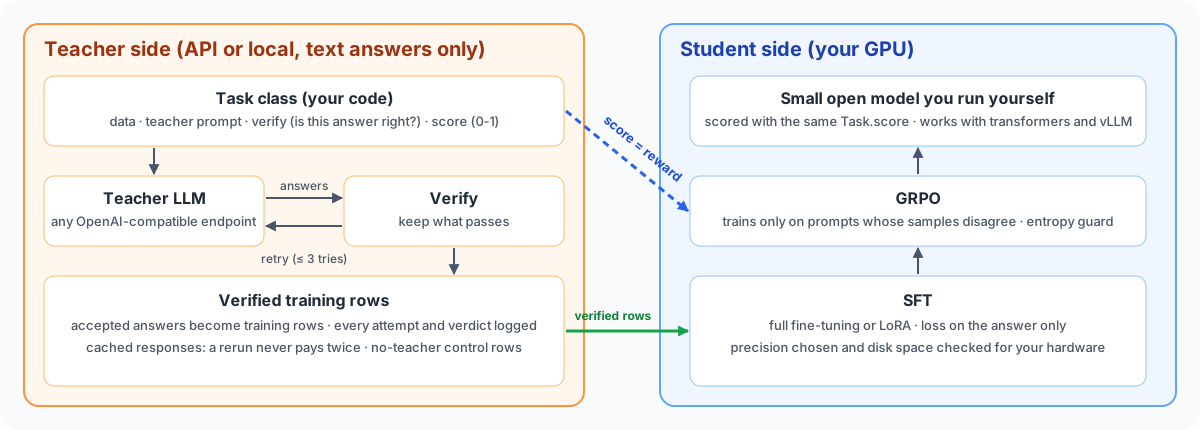
Have a task a large LLM does well, such as extracting fields, finding personal information, solving math or reading documents? distillops turns it into a small open model that does the same job on your own machine. The large model, the teacher, answers your inputs. Your code checks every answer, and only the answers that pass become training data. A small student learns from them with SFT, then improves with reinforcement learning (GRPO) on the same metric you report. Only the teacher's text answers are needed, never its weights or logits, so any model behind an OpenAI-compatible endpoint can teach: a hosted API, or an open model you serve yourself with vLLM or SGLang.
The student can match its teacher, and sometimes beat it. A 0.6B personal-information detector trained without a single human label beats the API model that taught it (0.955 vs 0.934 F1; details). A 1.7B base model reaches the math accuracy of Qwen's own post-trained Qwen3-1.7B (details). A 2B vision model ties its 32B teacher at reading receipt photos (vision extension). A 0.5M-parameter recommender matches LLM recommenders about 1,500 times its size (details).
Every gain is measured against a control, not assumed. Each example also trains the same student on the dataset's own labels with no teacher, so you can see what the teacher itself added. The math, PII and receipt comparisons are paired over the same test set, with 95% confidence intervals.
You describe a task once, in a Task class: its data, prompts, a verifier and a score. The same
commands then collect verified teacher answers, fine-tune, evaluate and run GRPO, for any causal LM
on the Hugging Face hub as the student.
Released models: GSM8K, Qwen3-1.7B-Base (teacher data: 7,274 verified answers) · PII, Qwen3-0.6B · recommendation, SASRec
Try it
Distil DeepSeek's math reasoning into Qwen3-0.6B-Base on one 24 GB GPU (e.g. an RTX 4090), for under
$1 of API calls. The teacher can be any OpenAI-compatible endpoint, a hosted API or a model you serve
locally (vLLM, SGLang): copy the template, set base_url, model and api_key_env, and export the key.
git clone https://github.com/Zihao-Wu06/distillops && cd distillops
pip install -e ".[train,dev]"
cp configs/teacher_template.yaml configs/my_teacher.yaml       # then edit it for your provider
export TEACHER_API_KEY=...                                      # the variable named by api_key_env
T=tasks.math.gsm8k:GSM8KTask

python -m distillops eval    --task $T --model Qwen/Qwen3-0.6B-Base --chat-template plain   # 56.8%
python -m distillops teacher --task $T --teacher configs/my_teacher.yaml --n 100            # smoke test
python -m distillops teacher --task $T --teacher configs/my_teacher.yaml                   # all 7,473 problems
python -m distillops sft     configs/sft_qwen3_0.6b_base.yaml
python -m distillops eval    --task $T --model checkpoints/gsm8k_0.6b_base_teacher          # 65.9%
+9.1 points on all 1,319 test problems (95% CI +6.3 to +11.9). With DeepSeek as the teacher the
calls cost 3.79 CNY (~$0.53); python -m distillops usage --teacher configs/my_teacher.yaml reports the
tokens. Measured on an RTX PRO 6000 with GPU memory capped at 24 GB: SFT took 7 minutes and peaked at
14 GB allocated (23 GB reserved); slower cards take longer. The same commands work for your own task
once it has a Task class (Add your own task); Results has the
1.7B route, with GRPO on top.
What it can be used for
The one requirement: given an input and an output, your code can say whether the output is right
(verify, for teacher data) and how right it is on a 0-1 scale (score, for evaluation and RL).
| Task type | What verify / score checks |
|---|---|
| Classification, routing, intent detection | the predicted label equals the gold label |
| Structured extraction (JSON, forms, entities) | the output parses and its fields match |
| Tool / function calling | the function name and arguments match the expected call |
| Code generation | the code passes the task's unit tests |
| Math and quantitative reasoning | the final number equals the answer |
| Short-answer QA | the normalised answer matches |
| Ranking, retrieval, recommendation | the right item appears in the output (e.g. in the top-k) |
Three of these ship as worked examples: math (GSM8K), personal-information (PII)
detection (structured extraction) and recommendation (Amazon). They show what the framework does and how well; nothing in the framework
is specific to them. Any other task needs only its own Task class
(Add your own task has a complete one in ~45 lines).
How it works
         ┌───────────────────────────────────────────────────────────────┐
 task ──►│ Task class: data, teacher prompt, verify, training row,       │  the only task-specific code
         │ student prompt, score (+ optional: label-only rows, decoding) │
         └───────────────────────────────────────────────────────────────┘
                                    │
 0 check     python -m distillops doctor     GPU, chosen precision, free memory and disk, versions
                                    │
 1 baseline  python -m distillops eval       the untrained student: the starting point
                                    │
 2 teacher   python -m distillops teacher    any OpenAI-compatible endpoint answers -> verify -> retry the failed
                                             ones (up to --max-attempts, default 3): rejection sampling
   control   python -m distillops labels     rows from the dataset's own labels (answers or human
                                             solutions), no teacher
                                    │
 3 SFT       python -m distillops sft        one run on teacher rows, one on control rows (LoRA by default)
                                    │
 4 eval      python -m distillops eval       teacher SFT vs control SFT vs baseline
                                    │
 5 GRPO      python -m distillops grpo       reward = Task.score; optional --filter-samples keeps prompts that
                                             are sometimes right; validation picks the best checkpoint;
                                             stops on entropy collapse
                                    │
 6 eval      python -m distillops eval       before vs after GRPO
verify decides which teacher outputs become training data; score is both the evaluation metric
and the GRPO reward, so reinforcement learning optimises exactly what you report.
Features
- Any verifiable task, one class. Teacher calls, rejection sampling, SFT, evaluation and GRPO are shared; a task only supplies data, prompts, a verifier and a score.
- Any student model. Any causal LM from the Hugging Face hub or a local path can be the student (Qwen, Llama, Mistral, Gemma, Phi, GPT-2, ...), including base models, with or without a chat template of their own.
- Verified data, measured value. Teacher outputs are kept only if they pass your verifier (failed
examples are retried), and a no-teacher control (
labels) shows what the teacher actually adds. - RL that tells you when it will not work. Before GRPO, the share of prompts that carry a learning signal is measured and explained; during and after it, validation on prompts the model never trained on picks the best checkpoint, an entropy guard stops collapse, and a weight-change check catches updates that never landed.
- Runs on the GPU you have. Precision is chosen from the hardware, batch sizes from free memory and
the model's size, and disk space is checked before training;
doctorreports all of it.
Add your own task
A complete task: support tickets classified into a fixed label set, with the teacher explaining its
choice. Save it as e.g. my_tasks/triage.py.
import json
import re

from distillops.task import Task, Verdict

class TicketTriage(Task):
    name = "triage"
    LABELS = ["billing", "bug", "feature", "other"]

    def load_examples(self, split):  # any source; here JSONL rows {"id", "text", "label"}
        with open(f"data/triage_{split}.jsonl", encoding="utf-8") as f:
            return [json.loads(line) for line in f]

    def example_id(self, ex):
        return ex["id"]

    def teacher_messages(self, ex, attempt):
        return [{"role": "user", "content": f"{ex['text']}\n\nExplain in one or two sentences which "
                 f"team should handle this, then end with: LABEL: <one of {', '.join(self.LABELS)}>"}]

    def parse_teacher(self, ex, text):
        found = re.findall(r"LABEL:\s*(\w+)", text)
        return found[-1].lower() if found else None

    def verify(self, ex, parsed, text, attempt):
        if parsed not in self.LABELS:
            return Verdict(False, "parse_error")
        return Verdict(parsed == ex["label"], "ok" if parsed == ex["label"] else "wrong_label")

    def sft_example(self, ex, parsed, text):
        return {"prompt": self.student_messages(ex), "completion": [{"role": "assistant", "content": text}]}

    def student_messages(self, ex):
        return [{"role": "user", "content": f"{ex['text']}\n\nEnd with: LABEL: <one of {', '.join(self.LABELS)}>"}]

    def score(self, ex, completion):
        return float(self.parse_teacher(ex, completion) == ex["label"])

    def gold_sft_example(self, ex):  # optional: the no-teacher control for `labels`
        return {"prompt": self.student_messages(ex),
                "completion": [{"role": "assistant", "content": f"LABEL: {ex['label']}"}]}
python scripts/check_task.py --task my_tasks.triage:TicketTriage --model Qwen/Qwen3-0.6B  # data, prompts, masked row
python -m distillops teacher --task my_tasks.triage:TicketTriage --teacher configs/my_teacher.yaml --n 50
# then labels / sft / eval / grpo as in Try it
The methods, with the included GSM8K example for comparison:
| Method | Purpose | GSM8K |
|---|---|---|
load_examples(split) |
your dataset (a valid split, if any, is used for GRPO validation) |
datasets.load_dataset("openai/gsm8k") |
example_id(ex) |
stable id (logging, resume, --exclude, --keep-ids) |
"gsm8k:train:17" |
teacher_messages(ex, attempt) |
prompt for the teacher | question + "end with ANSWER: <number>" |
parse_teacher(ex, text) |
raw text -> structured answer | steps + final number |
verify(ex, parsed, text, attempt) |
the distillation filter | number equals gold, length limit |
sft_example(ex, parsed, text) |
accepted output -> training row | <think>steps</think>ANSWER: n |
student_messages(ex) |
the student's prompt | question + answer-format instruction |
score(ex, completion) |
metric and GRPO reward, in [0, 1] | 1 if the final number is right |
gold_sft_example(ex) (optional) |
label-only control row | ANSWER: n, or the human solution |
extra_metrics(examples, completions, scores) (optional) |
metrics over the whole set, next to the mean score (e.g. macro-F1, BLEU) |
- |
evaluate(...) (optional) |
custom decoding | - (recommendation overrides it with constrained beam search) |
Constructor arguments can be passed on the command line, e.g. --task-arg max_words=200.
Writing a good verifier is most of the work. Teachers break instructions in ways that would
teach the student the wrong thing (e.g. referring to information only the teacher saw); verify is
where those outputs are dropped. Read accepted samples before scaling up. If GRPO's pass-rate filter
reports a sparse reward, a score that gives partial credit is the first thing to try.
Results
The three included examples, chosen to be very different, show what the framework does and
how well; their code lives in tasks/ and is not needed for your own task.
Math: GSM8K (Qwen3-1.7B-Base student, all 1,319 test problems)
| Model | Accuracy |
|---|---|
| Qwen3-1.7B-Base, untrained (zero-shot, plain prompt) | 73.8% |
| + SFT on GSM8K's human solutions (same problems and settings, no teacher) | 68.5% |
| + SFT on DeepSeek reasoning (rejection-sampled, full fine-tuning) | 80.1% |
+ GRPO (1 epoch, reward = Task.score) |
81.6% |
| Qwen3-1.7B: Qwen's own post-trained model, for reference | 80.2% |
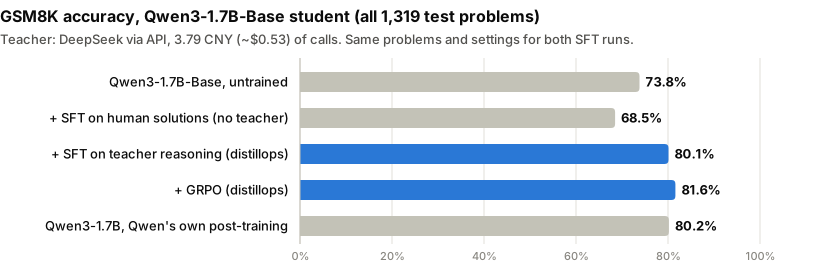
Teacher: DeepSeek Flash, 7,274 of 7,473 problems accepted (97.3%), 3.79 CNY. The student is a base
model, which has seen no post-training on math, so the gain is the distillation's own. Paired over
the 1,319 problems: SFT adds +6.3 points (95% CI +3.9 to +8.6, p < 1e-6) and GRPO with the same
verifier as reward +1.6 more (+0.2 to +3.1, p = 0.046); the result is on par with Qwen's post-trained
Qwen3-1.7B (+1.4, CI -0.8 to +3.6, p = 0.24). Before GRPO, 40.7% of training prompts carried a learning
signal (57.3% were always solved); GRPO ran 96 steps and token entropy went 0.19 -> 0.15 (no collapse).
The no-teacher control (labels --task-arg label_reasoning=human, same 7,274 problems, same SFT
settings) scores 68.5%, below the untrained model; the teacher's reasoning beats it by +11.6 points
(+9.1 to +14.3, p < 1e-17), so the gain comes from the teacher, not from training on GSM8K problems.
Training is not bit-for-bit repeatable on GPUs: an earlier run of the same route gave 78.5% / 80.4%
(no significant difference from these numbers). The smaller Try it route, Qwen3-0.6B-Base
with the same teacher answers and no GRPO, goes from 56.8% to 65.9%.
Reproduce it
The full route behind the chart, with the teacher set up as in Try it. The teacher
answers are the same as there: after Try it, the two teacher commands send no requests.
T=tasks.math.gsm8k:GSM8KTask
TEACHER=configs/my_teacher.yaml
B=Qwen/Qwen3-1.7B-Base

python -m distillops eval    --task $T --model $B --chat-template plain             # baseline: 73.8%
python -m distillops teacher --task $T --teacher $TEACHER --n 100                   # smoke test on 100 problems
python -m distillops teacher --task $T --teacher $TEACHER                           # full train split
python -m distillops sft     configs/sft_qwen3_full.yaml                             # writes checkpoints/gsm8k_1.7b_base_teacher
python -m distillops eval    --task $T --model checkpoints/gsm8k_1.7b_base_teacher   # 80.1%

# GRPO (Linux + vLLM): measure the learning signal first, then train on the useful prompts
python -m distillops grpo configs/grpo_gsm8k_qwen3_1.7b_base.yaml --task $T --filter-samples 8 --filter-only
python -m distillops grpo configs/grpo_gsm8k_qwen3_1.7b_base.yaml --task $T \
         --keep-ids checkpoints/gsm8k_1.7b_base_grpo/pass_rate_kept.txt --epochs 1
python -m distillops eval    --task $T --model checkpoints/gsm8k_1.7b_base_grpo      # 81.6%
python -m distillops usage   --teacher $TEACHER                                     # teacher calls and tokens
- Full fine-tuning, not LoRA: the base model's chat-template tokens (
<|im_start|>,<|im_end|>,<think>) were never trained, and LoRA cannot learn embeddings; with LoRA,sftstops and says so. Full fine-tuning of 1.7B parameters needs ~33 GB plus activations (and vLLM's share during GRPO); the results were produced on a 96 GB GPU. - Baseline: a base model is scored with the
plaintemplate (it has not learned the chat format); 4-shot prompting scored lower (68.1%), so 73.8% is the baseline. - GRPO validation: SFT saw nearly every training problem, and the few it did not are ones the
teacher failed, so there is no representative validation set: the config sets
eval_every: 0and GRPO keeps its final model. To select checkpoints instead, set problems apart with--task-arg valid_size=500on bothteacherandgrpo, and turneval_everyback on. - Teacher: the included results used DeepSeek (
configs/teacher_deepseek.yaml); the GSM8K teacher calls cost 3.79 CNY (3.74 for the full run, 0.05 for the 100-problem smoke test).
Personal-information detection: a student that beats its teacher
Find names, contact details, addresses, ID and card numbers, dates and demographics in English text (OpenPII-1M) so they can be masked locally. The teacher (DeepSeek, 3 worked examples) labels 10,000 texts; its answers are accepted by rules alone (values copied verbatim, plausible formats, no long number left unmasked), with no gold labels. A Qwen3-0.6B student then learns from them, and GRPO uses per-text F1 as the reward.
| Model (2,000 test texts, 7 categories) | Labelled texts used | Mean F1 | Personal info left visible |
|---|---|---|---|
| Qwen3-0.6B, untrained | - | 0.158 | 73.1% |
| Teacher (DeepSeek, 3-shot) | 103 (100 to write its instructions, 3 as examples) | 0.934 | 3.0% |
| 0.6B, SFT on rule-checked teacher labels | 103 (the teacher's; it trains on none) | 0.945 | 2.0% |
| + GRPO on a small labelled pool | 2,100 | 0.955 | 1.9% |
| 0.6B, SFT on gold labels of all 10,000 texts (control) | 10,000 | 0.982 | 1.1% |
The student beats its teacher (+1.15 points, 95% CI +0.65 to +1.67, p = 4e-5), and GRPO adds +0.95 (p = 1e-9); teacher labels reach 96-97% of what full human annotation gives. Teacher calls: 17.7 CNY. Per-category scores, the pilot batch that shaped the teacher's instructions, leakage checks and the commands: tasks/pii/README.md. Model (the GRPO student, bf16): Liquor-06/Qwen3-0.6B-PII-distillops.
Recommendation: an LLM teacher for a deployable recommender
A task far from math: next-item recommendation on Amazon Industrial & Scientific. A fine-tuned Qwen3-1.7B recommends well but is too large to serve, so it is used offline as a teacher (item embeddings + top-3 soft labels) for SASRec. Two ~0.5M-parameter SASRecs then reach HR@10 .164 / NDCG@10 .119, on par with recent LLM recommenders (1.5B-7B parameters, HR@10 .159-.163) at ~1/1,500 of their serving size. Tables, cold-start results and the commands to reproduce: tasks/rec/README.md. Model (both SASRecs, ~0.8M parameters, plain PyTorch): Liquor-06/SASRec-TwoStage-Industrial-distillops.
Images: reading receipts (vision extension)
A Qwen3-VL-2B student reads receipt photos (CORD-v2) into JSON: items, totals, cash and change. Mean F1 on 200 test receipts:
| Model | Human labels used | Mean F1 | Receipts read perfectly |
|---|---|---|---|
| Qwen3-VL-2B, untrained | 0 | 0.756 | 10.5% |
| Qwen3-VL-32B teacher | 0 | 0.896 | 41.0% |
| 2B, SFT on the teacher's arithmetic-checked labels | 0 | 0.897 | 42.0% |
| + GRPO on 200 labelled receipts | 300 | 0.905 | 49.5% |
| 2B, SFT on all 800 gold labels (control) | 800 | 0.928 | 58.0% |
The teacher's labels give 82% of the gain that gold labels for every training receipt give (87% after GRPO). GRPO's mean gain is not significant (p = 0.16), but it reads 15 more receipts perfectly (McNemar p = 0.004). The extension adds images to every stage (teacher requests, SFT, evaluation, GRPO with vLLM) without changing distillops. Tables, process notes and commands: extensions/vision/vision_tasks/cord/README.md.
Takeaways
- A few CNY of verified teacher reasoning replace a model's math post-training: on GSM8K, SFT takes a base model +6.3 points and GRPO with the same verifier as reward +1.6 more, matching Qwen's own post-trained model of the same size.
- Always compare against a same-data, no-teacher control (
python -m distillops labels), not just the untrained model, to see what the teacher itself contributes: on GSM8K, SFT on the human solutions of the same problems lowered the score (73.8% -> 68.5%) while the teacher's reasoning raised it (80.1%). - Labelling every training text is not needed: rules that check the teacher's answers, plus 100 labelled texts to write its instructions, train a 0.6B PII detector that beats its teacher, and 2,000 labelled texts for GRPO bring it to 97% of what labelling all 10,000 training texts gives.
- For latency-bound products, use the LLM as an offline teacher: item embeddings plus soft labels lifted SASRec by 22-24% HR@10, and a two-stage recall + re-rank matched recent LLM recommenders, at unchanged serving cost.
Install
git clone https://github.com/Zihao-Wu06/distillops && cd distillops
pip install -e ".[train,dev]"          # framework, training stack and tests
pip install "vllm==0.11.0"             # only for GRPO and the pass-rate filter (Linux)
python -m distillops doctor            # GPU, chosen precision, free memory and disk, library versions
python -m pytest -q                    # unit tests; no GPU or network needed
Python 3.11-3.12. Tested on these setups:
| Machine | Used for | torch | transformers | TRL | PEFT | vLLM |
|---|---|---|---|---|---|---|
| Windows 11, RTX 4090 24GB | teacher calls, SFT, evaluation, SASRec | 2.11 (cu128) | 5.21 | 1.16 | 0.21 | - |
| Ubuntu 22.04, RTX PRO 6000 96GB (and RTX 6000D 84GB) | GRPO, pass-rate filter, SFT, evaluation | 2.8 (cu128) | 4.57.1 | 0.24 | 0.21 | 0.11.0 |
| macOS (Apple Silicon), CPU only | SFT, evaluation and GRPO without vLLM on non-Qwen students (gpt2, SmolLM2-135M-Instruct) | 2.15 | 4.57.1 | 0.24 | 0.21 | - |
vLLM 0.11 needs transformers 4.x; pin transformers==4.57.1 trl==0.24.0 next to it. The framework
handles the version differences it knows about (warmup arguments, chat-template options).
Teacher terms of use: check that your teacher's terms allow training other models on its outputs; some providers' terms forbid training competing models.
Hardware
Nothing is tuned to a particular GPU: memory settings are fractions of the card or are sized from the memory that is free when the run starts.
| Step | Needs |
|---|---|
teacher, labels, usage |
no GPU (teacher requests and files); a teacher you serve locally needs its own GPU |
sft, eval |
a CUDA GPU; without one they run on the CPU, which is practical only for small models |
grpo with vLLM (default), pass-rate filter |
Linux and a CUDA GPU; use_vllm: false runs anywhere, more slowly |
Rough GPU memory per billion student parameters, before activations:
- LoRA SFT: ~2 GB (base weights in bf16/fp16; the adapter and its optimizer state are small).
- Full fine-tuning (
lora: false; GRPO's default): ~16 GB (fp32 weights, gradients and AdamW state). GRPO with vLLM also reservesvllm_gpu_memory_utilizationof the card for rollouts. - Evaluation: ~2 GB for the weights; the rest goes to the KV cache.
What adapts and what does not:
- Evaluation and GRPO size their batches from free memory and the model's config, and shrink them
if a batch would not fit. SFT uses
batch_sizeas given: if it runs out of memory, lowerbatch_sizeand raisegrad_accum(same effective batch). doctorreports the GPU, precision and free memory; training refuses to start if the disk cannot hold the run, and GRPO stops at once if vLLM's share of the GPU is not free, naming the setting to lower.- One GPU per run; multi-GPU launches (
accelerate,torchrun) are not tested.
Reference
Commands
python -m distillops <command> --help lists every flag. Commands that read a dataset share
--task module:Class (or a YAML file with task: and args:), --task-arg KEY=VALUE (constructor
arguments, repeatable), --split, --n (random subset, 0 = all) and --seed.
| Command | What it does | Main flags |
|---|---|---|
doctor |
environment report and platform warnings | - |
teacher |
teacher outputs -> verify -> accepted SFT rows, with retries; a rerun resumes, and refuses a folder made with another teacher, task settings, teacher prompt or task code |
--teacher (config, required), --max-attempts (3), --out |
labels |
label-only SFT rows from gold_sft_example (the no-teacher control) |
--out |
sft |
supervised fine-tuning from a YAML config | --train_file, --output_dir, --model, --epochs, --chat-template (override the config) |
eval |
generate with a student and score with Task.score |
--model, --max-new-tokens (512), --batch (0 = auto), --template-arg KEY=VALUE, --no-think (= enable_thinking=false), --chat-template, --tag, --out |
grpo |
GRPO with Task.score as the reward |
--model, --filter-samples N, --filter-only, --filter-gpu-memory (0.4), --keep-ids, --exclude, --epochs, --max-steps, --eval-every, --eval-examples, --chat-template, --template-arg, --output_dir |
merge |
merge a LoRA adapter into its base model | --base, --adapter, --out |
usage |
teacher calls and tokens (prompt, provider prompt-cache hits, completion) from the local response cache | --teacher (required) |
grpo details: --filter-samples 8 --filter-only samples 8 completions per prompt with vLLM (same
temperature, length limits and prompt truncation as GRPO), keeps the prompts whose samples differ in
score (the only ones GRPO learns from, with binary or partial-credit scores), prints why the others
were dropped, and writes pass_rate_kept.txt; --keep-ids then trains on
those prompts in a fresh process. --exclude <jsonl> skips prompts whose meta.id appears in a file
(e.g. the SFT data). --epochs E sets the number of steps so each prompt is seen E times.
Configuration (teacher, student model, SFT, GRPO)
Every option has a default and can be changed in the YAML file. Whenever the framework chooses something itself (micro-batch, precision, validation source), it prints what it chose and why.
Teacher (configs/teacher_template.yaml; configs/teacher_deepseek.yaml is a filled-in example)
| Field | Default | Meaning |
|---|---|---|
base_url, model |
required | any OpenAI-compatible endpoint (hosted API, vLLM, SGLang, ...) and model name |
api_key_env |
TEACHER_API_KEY |
environment variable holding the key (keys never go in config files); a local server started without a key accepts any value |
temperature |
1.0 | > 0 so retries in rejection sampling give different answers; null = not sent (models that only accept their default) |
max_tokens |
1024 | per call; null = not sent |
max_tokens_param |
max_tokens |
request field for max_tokens; OpenAI's reasoning models need max_completion_tokens |
max_concurrency |
32 | parallel requests; raise it if your provider allows |
timeout_s, max_retries |
300, 6 | per request; retries (exponential backoff) only for network errors, timeouts, replies without a completion, 408/409/429 and 5xx |
extra_body |
{} |
provider-specific request options, passed through unchanged |
cache_path |
cache/teacher.sqlite |
response cache: an identical request to the same endpoint is never sent twice; teachers can share the file (usage counts each separately) |
Student model
Any causal language model can be the student: set model in the SFT or GRPO config, or pass
--model, to a hub id or a local path. The included configs name Qwen3 only because the example
results used it.
- Chat template. Prompts and training rows go through the student's chat template, the same one
in SFT, evaluation and GRPO. Instruct models bring their own. A model without one (a base model
such as
gpt2) gets a plainUser:/Assistant:template whose replies end with the EOS token, so the model learns to stop; a notice says so. To choose another, setchat_templatein the config or pass--chat-template:plain, a Jinja file, or a Jinja string. The template is saved with the trained model, so later commands use it without the option. - Base models with a chat template. A base model may ship a chat template whose special tokens it
never trained (Qwen3-Base:
<|im_start|>,<|im_end|>,<think>). LoRA cannot learn those embeddings, sosftstops with the options instead of training a model that never ends its reply; uselora: false(configs/sft_qwen3_full.yaml). Generation stops at the template's end-of-turn token as well as EOS, and both are written to the saved model'sgeneration_config.json, so transformers and vLLM stop there too. - Template options (
--template-arg KEY=VALUE,chat_template_kwargsin the GRPO config;--no-thinkisenable_thinking=false) are passed to the template; templates that do not use them ignore them. - Architectures. Memory and disk estimates read layer, head and vocabulary sizes under each family's own config names (Llama/Qwen, GPT-2, Falcon, ChatGLM, multimodal configs, ...). For a model with no attention heads (e.g. a state-space model), generation starts at batch 8 and adapts.
- No CUDA GPU. SFT, evaluation and GRPO with
use_vllm: falserun on the CPU (slow, but fine for small models); GRPO with vLLM and the pass-rate filter need a Linux GPU.
SFT (configs/sft_qwen3.yaml with LoRA; configs/sft_qwen3_full.yaml and configs/sft_qwen3_0.6b_base.yaml with full fine-tuning)
| Field | Default | Meaning |
|---|---|---|
model, train_file, output_dir |
required | base model, JSONL of prompt/completion rows, where to write |
eval_file |
none | optional JSONL evaluated each epoch |
max_length |
1024 | longer rows are dropped, never truncated (the length distribution is printed) |
epochs, lr |
2, 1e-4 | 1e-4 suits LoRA; use ~1e-5 for full fine-tuning |
batch_size, grad_accum |
8, 4 | per-device batch and accumulation (effective batch 32) |
warmup_ratio |
0.03 | cosine schedule |
lora, lora_r, lora_alpha, lora_dropout |
true, 32, 64, 0.05 | LoRA on all linear layers; lora: false = full fine-tuning (fp32 master weights) |
seed, logging_steps, save_strategy |
42, 10, epoch |
|
chat_template |
none | none = the model's own (plain if it has none); plain, a Jinja file or string (Student model) |
extra |
{} |
any TRL SFTConfig argument, including ones the framework sets (report_to, lr_scheduler_type, gradient_checkpointing, ...; overrides are printed); arguments with a field above are set through that field |
With LoRA, a merged copy is saved to output_dir/merged for evaluation and serving. Each saved model
gets trained_ids.txt, the ids of the rows it was trained on (rows from teacher and labels carry
them), so GRPO never validates on them. Checkpoints hold
weights only and one is kept (extra: {save_only_model: false, save_total_limit: null} keeps
optimizer state and every checkpoint); disk space for what will be written is checked before training.
GRPO (configs/grpo_gsm8k_qwen3_1.7b_base.yaml)
| Field | Default | Meaning |
|---|---|---|
model, output_dir |
required | start checkpoint (the SFT model; --model overrides) and where to write |
num_generations |
8 | completions per prompt; the group is the baseline for the advantage |
max_prompt_length, max_completion_length |
768, 256 | token limits; TRL < 0.28 keeps the last max_prompt_length tokens of a longer prompt, later TRL (which removed the argument) leaves such prompts out, with a count |
temperature |
1.0 | sampling temperature for rollouts |
lr |
1e-6 | learning rate (full fine-tuning keeps fp32 master weights) |
beta |
0.0 | KL coefficient to the start model (0 = no reference model) |
epsilon, loss_type |
0.2, dapo |
clipping and loss; extra: {epsilon_high: 0.28} for DAPO clip-higher |
batch_size, grad_accum |
8, 4 | completions per device step and accumulation; the micro-batch shrinks automatically if long completions would not fit, keeping the product |
max_steps |
500 | or set by --epochs |
use_vllm, vllm_mode, vllm_gpu_memory_utilization |
true, colocate, 0.3 |
rollouts with vLLM on the training GPU |
lora, lora_r, lora_alpha, lora_dropout |
false, 32, 64, 0.0 | true = LoRA on all linear layers (low-precision base); LoRA usually needs a higher lr (~1e-5 to 1e-4) |
chat_template |
none | as for SFT; a model trained with distillops already carries its template |
chat_template_kwargs |
{} |
e.g. {enable_thinking: false}; prompts are rendered by the framework, so this works with any TRL version |
eval_every |
25 | validation check every N steps (0 = off) |
eval_examples |
200 | validation prompts: the task's valid split if it has one, else held out of training (at most 20%); never prompts the start model was trained on (its trained_ids.txt): with none left, selection is off and output_dir holds the final model; scores are printed with their standard error |
eval_patience |
0 | stop after N checks without improvement (0 = never stop early) |
entropy_floor_ratio, entropy_patience |
0.1, 2 | stop when entropy stays below 10% of its starting value for 2 logs (0 = off) |
seed, logging_steps, save_steps |
42, 5, 100 | |
extra |
{} |
any TRL GRPOConfig argument, as for SFT (e.g. epsilon_high, report_to); checkpoints default to weights only, one kept (save_only_model, save_total_limit) |
Outputs
| Command | Writes |
|---|---|
teacher |
results/<task>/teacher_<split>_n<n>[_<task args>]/: run.json (teacher, task settings, and hashes of the teacher prompt and task code), accepted.jsonl (SFT rows), log.jsonl (every attempt and verdict; reruns resume from it), stats.json (yield, rejection reasons, token usage) |
labels |
data/sft/<task>/labels_<split>_n<n>[_<task args>].jsonl |
sft |
output_dir/ (LoRA adapter, or the model with full fine-tuning), output_dir/merged/ (LoRA merged into the model), trained_ids.txt in each, sft_summary.json |
eval |
results/<task>/eval/<tag>/metrics.json and predictions.jsonl (every completion and its score); <tag> defaults to the model folder's name (<run>-merged for an SFT model) |
grpo --filter-only |
output_dir/pass_rate_filter.json (statistics and advice), output_dir/pass_rate_kept.txt |
grpo |
output_dir/ = best model on validation (a copy of the start model if nothing beat it; the final model when there is no validation), output_dir/last/ = final model, trained_ids.txt, output_dir/validation.json (scores per check, best step, weight change, entropy stop) |
What the framework handles
- Teacher client (
distillops/teacher.py): any OpenAI-compatible endpoint (hosted API, vLLM, SGLang, ...); configurable concurrency, retries with backoff for network errors, rate limits and server errors only, an on-disk response cache (a re-run sends no repeated request) and a token counter. - Adaptive rejection sampling (
distillops/rejection.py): retry only failed examples, up to--max-attempts; append-only logs so a killed run resumes where it stopped. - SFT (
distillops/sft.py): TRL, completion-only loss, over-long rows dropped (never truncated), LoRA, and a printout of exactly which tokens carry loss. - Evaluation (
distillops/evaluate.py): batched generation +Task.score; tasks can override decoding. - GRPO (
distillops/grpo.py):Task.scorebecomes the reward, so RL optimises the reported metric; pass-rate filter, validation-based checkpoint selection, entropy guard. - Hardware-agnostic (
distillops/precision.py,memory.py,preflight.py): precision chosen from the GPU, batch sizes from free memory and the model's KV-cache size, disk checked before training. - Model-agnostic (
distillops/chat.py,memory.py): any causal LM; a chat template for models without one, and config sizes read under each architecture's field names.
Related work
- Distillation toolkits. EasyDistill (Alibaba, EMNLP 2025 demos) covers black-box data synthesis across text, vision-language, text-to-image and text-to-video, with outputs for LLaMA-Factory / ms-swift; DistillKit focuses on logit-level distillation. distillops is narrower (text tasks, plus image prompts through its vision extension) and goes deeper on the training loop: verification-based rejection sampling, no-teacher controls, built-in GRPO and its diagnostics. Training itself runs on TRL.
- LLM recommenders into sequential recommenders: see tasks/rec/README.md.
Layout
distillops/       the framework: teacher, task interface, rejection sampling, sft, evaluate, grpo,
                  chat (templates), precision / memory / preflight, cli
tasks/            the three included example tasks (not needed for your own):
  math/           GSM8K, also the reference implementation of a Task
  pii/            personal-information detection (its own README.md): labels, entity parsing and
                  rule checks, F1 and leak rate
  rec/            recommendation (its own README.md): data, SASRec baseline and distillation, prompts, title trie,
                  constrained beams, item embeddings; resources/ holds the SFT user list
scripts/          check_task.py (any task); pii_*.py: the PII example (prepare, rule check, teacher eval);
                  rec_*.py: the recommendation example (prepare, SASRec sweep, build SFT data,
                  LLM / SASRec eval, paired comparison, SASRec distillation, two-stage)
configs/          teacher, SFT and GRPO configs (example settings)
assets/           README figures
tests/            unit tests; no network or GPU needed
extensions/vision/  image prompts (its own README.md, package, configs and tests), with the receipts
                  example in vision_tasks/cord/
data/, results/, checkpoints/ and cache/ are created at run time and not tracked.
Data: GSM8K (MIT); OpenPII-1M by Ai4Privacy (CC-BY-4.0); CORD-v2 by NAVER Clova (CC-BY-4.0); MiniOneRec's preprocessed Amazon splits (Apache-2.0) of the Amazon Reviews dataset (McAuley Lab). Code: MIT.