
ZhouYanzhao/ORN has 217 GitHub stars and 49 forks. Star changes are not measured yet. Last checked 2026-11-15 17:59 UTC. Last push 2022-07-17.
Measured star growth
- in 24h
- Collecting history
- in 7 days
- Collecting history
- in 15 days
- Collecting history
- in 1 month
- Collecting history
Net star changes over overlapping periods, not daily totals. Missing measurements are left blank. Stars measure attention, not software quality.
About
Oriented Response Networks, in CVPR 2017
Machine LearningREADME.md
OriginalOriented Response Networks


[Home] [Project] [Paper] [Supp] [Poster]
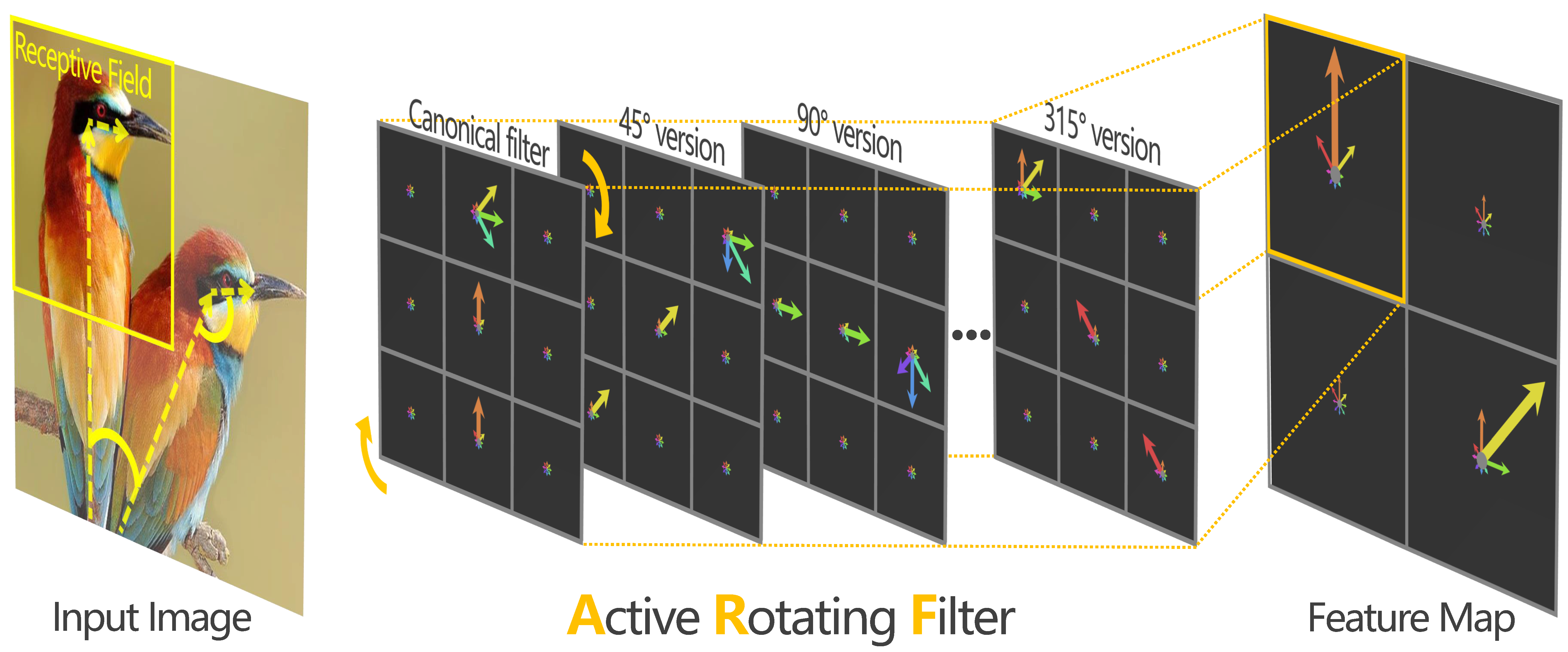
🎉Update: Reimplemented ORN that supports modern PyTorch.
- Tested with PyTorch 1.12.0 (Ubuntu / GTX 2080 Ti)
- A New helper function
upgrade_to_ornfor easy model conversion. - Predefined ORN-upgraded models (OR-VGG, OR-ResNet, OR-Inception, OR-WRN, etc.).
Please check the pytorch-v2 branch for more details.
Torch Implementation
The torch branch contains:
- the official torch implementation of ORN.
- the MNIST-Variants demo.
Please follow the instruction below to install it and run the experiment demo.
Prerequisites
- Linux (tested on ubuntu 14.04LTS)
- NVIDIA GPU + CUDA CuDNN (CPU mode and CUDA without CuDNN mode are also available but significantly slower)
- Torch7
Getting started
You can setup everything via a single command wget -O - https://git.io/vHCMI | bash or do it manually in case something goes wrong:
install the dependencies (required by the demo code):
clone the torch branch:
# git version must be greater than 1.9.10
git clone https://github.com/ZhouYanzhao/ORN.git -b torch --single-branch ORN.torch
cd ORN.torch
export DIR=$(pwd)
install ORN:
cd $DIR/install
# install the CPU/GPU/CuDNN version ORN.
bash install.sh
unzip the MNIST dataset:
cd $DIR/demo/datasets
unzip MNIST
run the MNIST-Variants demo:
cd $DIR/demo
# you can modify the script to test different hyper-parameters
bash ./scripts/Train_MNIST.sh
Trouble shooting
If you run into 'cudnn.find' not found, update Torch7 to the latest version via cd <TORCH_DIR> && bash ./update.sh then re-install everything.
More experiments
CIFAR 10/100
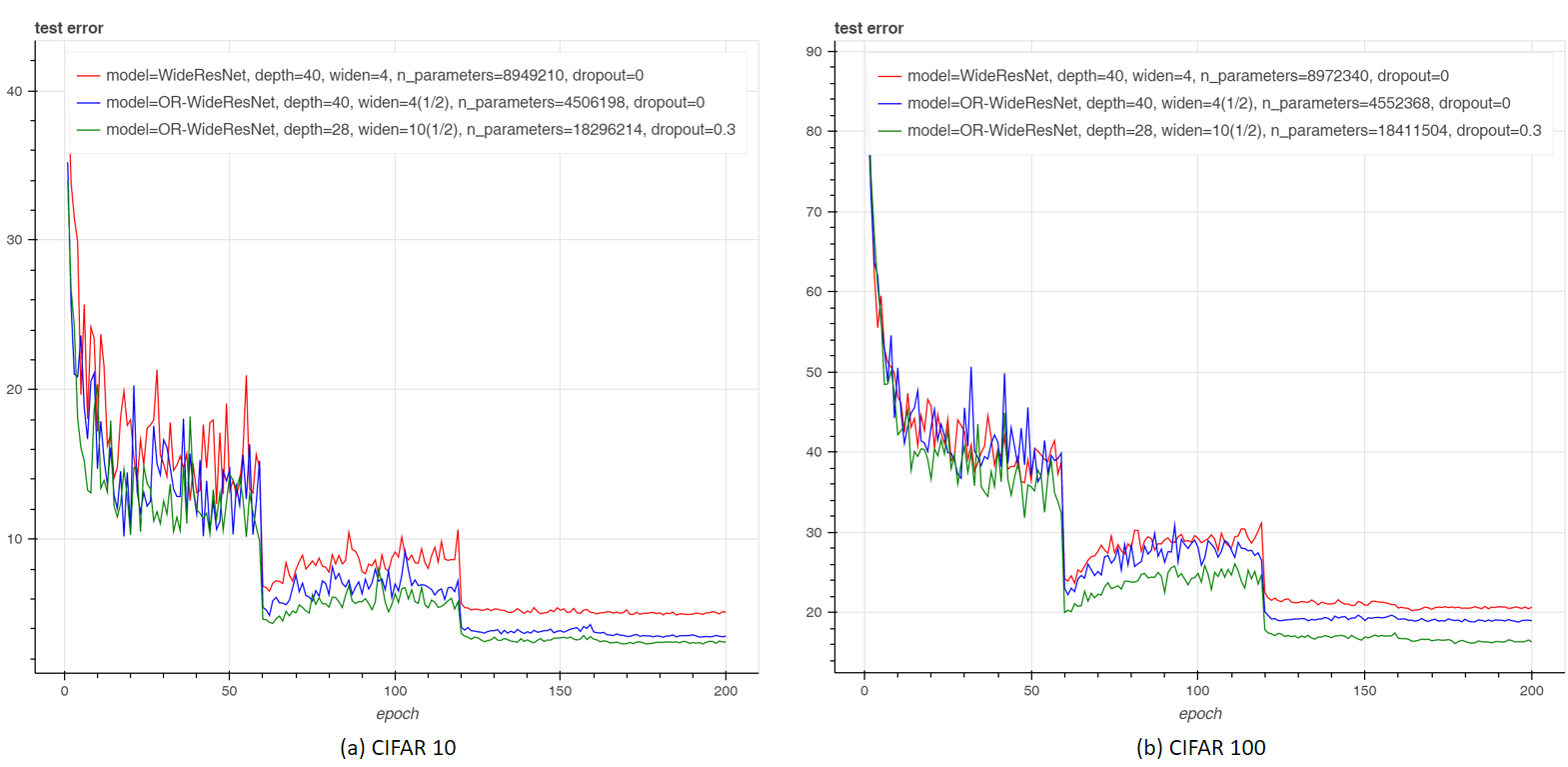
You can train the OR-WideResNet model (converted from WideResNet by simply replacing Conv layers with ORConv layers) on CIFAR dataset with WRN.
dataset=cifar10_original.t7 model=or-wrn widen_factor=4 depth=40 ./scripts/train_cifar.sh
With exactly the same settings, ORN-augmented WideResNet achieves state-of-the-art result while using significantly fewer parameters.
| Network | Params | CIFAR-10 (ZCA) | CIFAR-10 (mean/std) | CIFAR-100 (ZCA) | CIFAR-100 (mean/std) |
|---|---|---|---|---|---|
| DenseNet-100-12-dropout | 7.0M | - | 4.10 | - | 20.20 |
| DenseNet-190-40-dropout | 25.6M | - | 3.46 | - | 17.18 |
| WRN-40-4 | 8.9M | 4.97 | 4.53 | 22.89 | 21.18 |
| WRN-28-10-dropout | 36.5M | 4.17 | 3.89 | 20.50 | 18.85 |
| WRN-40-10-dropout | 55.8M | - | 3.80 | - | 18.3 |
| ORN-40-4(1/2) | 4.5M | 4.13 | 3.43 | 21.24 | 18.82 |
| ORN-28-10(1/2)-dropout | 18.2M | 3.52 | 2.98 | 19.22 | 16.15 |
Table.1 Test error (%) on CIFAR10/100 dataset with flip/translation augmentation)
ImageNet
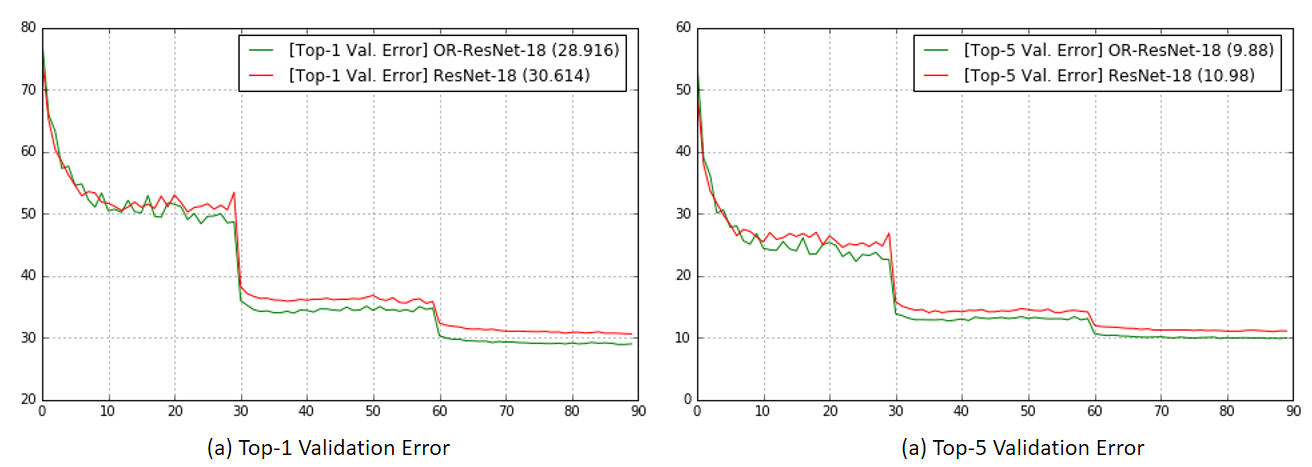
The effectiveness of ORN is further verified on large scale data. The OR-ResNet-18 model upgraded from ResNet-18 yields significant better performance when using similar parameters.
| Network | Params | Top1-Error | Top5-Error |
|---|---|---|---|
| ResNet-18 | 11.7M | 30.614 | 10.98 |
| OR-ResNet-18 | 11.4M | 28.916 | 9.88 |
Table.2 Validation error (%) on ILSVRC-2012 dataset.
You can use facebook.resnet.torch to train the OR-ResNet-18 model from scratch or finetune it on your data by using the pre-trained weights.
-- To fill the model with the pre-trained weights:
model = require('or-resnet.lua')({tensorType='torch.CudaTensor', pretrained='or-resnet18_weights.t7'})
A more specific demo notebook of using the pre-trained OR-ResNet to classify images can be found here.
PyTorch Implementation (Deprecated)
Please check the pytorch-v2 branch for more details.
The pytorch branch contains:
- the official pytorch implementation of ORN (alpha version supports 1x1/3x3 ARFs with 4/8 orientation channels only).
- the MNIST-Variants demo.
Please follow the instruction below to install it and run the experiment demo.
Prerequisites
- Linux (tested on ubuntu 14.04LTS)
- NVIDIA GPU + CUDA CuDNN (CPU mode and CUDA without CuDNN mode are also available but significantly slower)
- PyTorch
Getting started
install the dependencies (required by the demo code):
clone the pytorch branch:
# git version must be greater than 1.9.10
git clone https://github.com/ZhouYanzhao/ORN.git -b pytorch --single-branch ORN.pytorch
cd ORN.pytorch
export DIR=$(pwd)
install ORN:
cd $DIR/install
bash install.sh
run the MNIST-Variants demo:
cd $DIR/demo
# train ORN on MNIST-rot
python main.py --use-arf
# train baseline CNN
python main.py
Caffe Implementation
The caffe branch contains:
- the official caffe implementation of ORN (alpha version supports 1x1/3x3 ARFs with 4/8 orientation channels only).
- the MNIST-Variants demo.
Please follow the instruction below to install it and run the experiment demo.
Prerequisites
- Linux (tested on ubuntu 14.04LTS)
- NVIDIA GPU + CUDA CuDNN (CPU mode and CUDA without CuDNN mode are also available but significantly slower)
- Caffe
Getting started
install the dependency (required by the demo code):
- idx2numpy:
pip install idx2numpy
- idx2numpy:
clone the caffe branch:
# git version must be greater than 1.9.10
git clone https://github.com/ZhouYanzhao/ORN.git -b caffe --single-branch ORN.caffe
cd ORN.caffe
export DIR=$(pwd)
install ORN:
# modify Makefile.config first
# compile ORN.caffe
make clean && make -j"$(nproc)" all
run the MNIST-Variants demo:
cd $DIR/examples/mnist
bash get_mnist.sh
# train ORN & CNN on MNIST-rot
bash train.sh
Note
Due to implementation differences,
- upgrading Conv layers to ORConv layers can be done by adding an
orn_param - num_output of ORConv layers should be multipied by nOrientation of ARFs
Example:
layer {
  type: "Convolution"
  name: "ORConv" bottom: "Data" top: "ORConv"
  # add this line to replace regular filters with ARFs
  orn_param {orientations: 8}
  param { lr_mult: 1 decay_mult: 2}
  convolution_param {
    # this means 10 ARF feature maps
    num_output: 80
    kernel_size: 3
    stride: 1
    pad: 0
    weight_filler { type: "msra"}
    bias_filler { type: "constant" value: 0}
  }
}
Check the MNIST demo prototxt (and its visualization) for more details.
Citation
If you use the code in your research, please cite:
@INPROCEEDINGS{Zhou2017ORN,
    author = {Zhou, Yanzhao and Ye, Qixiang and Qiu, Qiang and Jiao, Jianbin},
    title = {Oriented Response Networks},
    booktitle = {CVPR},
    year = {2017}
}