
ZZzyy714227/Labsus
ZZzyy714227/Labsus has 120 GitHub stars and 3 forks. GitHot measured 0 stars in 24 hours. Last checked 2026-11-16 19:25 UTC. Last push 2026-10-17.
Measured star growth
- in 24h
- 0
- in 7 days
- Update delayed
- in 15 days
- Update delayed
- in 1 month
- Update delayed
Net star changes over overlapping periods, not daily totals. Missing measurements are left blank. Stars measure attention, not software quality.
About
Open-source FSAE suspension K&C workbench: kinematics & compliance, 4-Post dynamics, quasi-static handling and transient track sim - runs in a single browser page
Creative & MediaREADME.en.md
Original🏎️ LABSUS · Suspension Laboratory
High-Performance Full-Chassis Suspension Analysis Workbench — Kinematics & Compliance / 15-DOF Dynamics / Quasi-Static Handling / Transient Track Simulation





A modern full-chassis suspension engineering workbench tailored for Formula Student (FSAE), FIA GT3 racing, and Baja off-road vehicles. From double-wishbone/pushrod spatial hardpoint editing and K&C multi-body sweeps, to 4-Post dynamics, quasi-static load transfer, and 15-DOF autonomous circuit simulation, all within a responsive, instrumented browser environment. Lightweight proprietary engine deeply benchmarked against OptimumKinematics and ADAMS/Car.
📁 All engineering code lives in the
LABSUS/subdirectory; all relative paths in this document are rooted there.
📸 Screenshots
1. V4 Workbench — Formula SAE (Light Theme, 4-Viewport Sync)
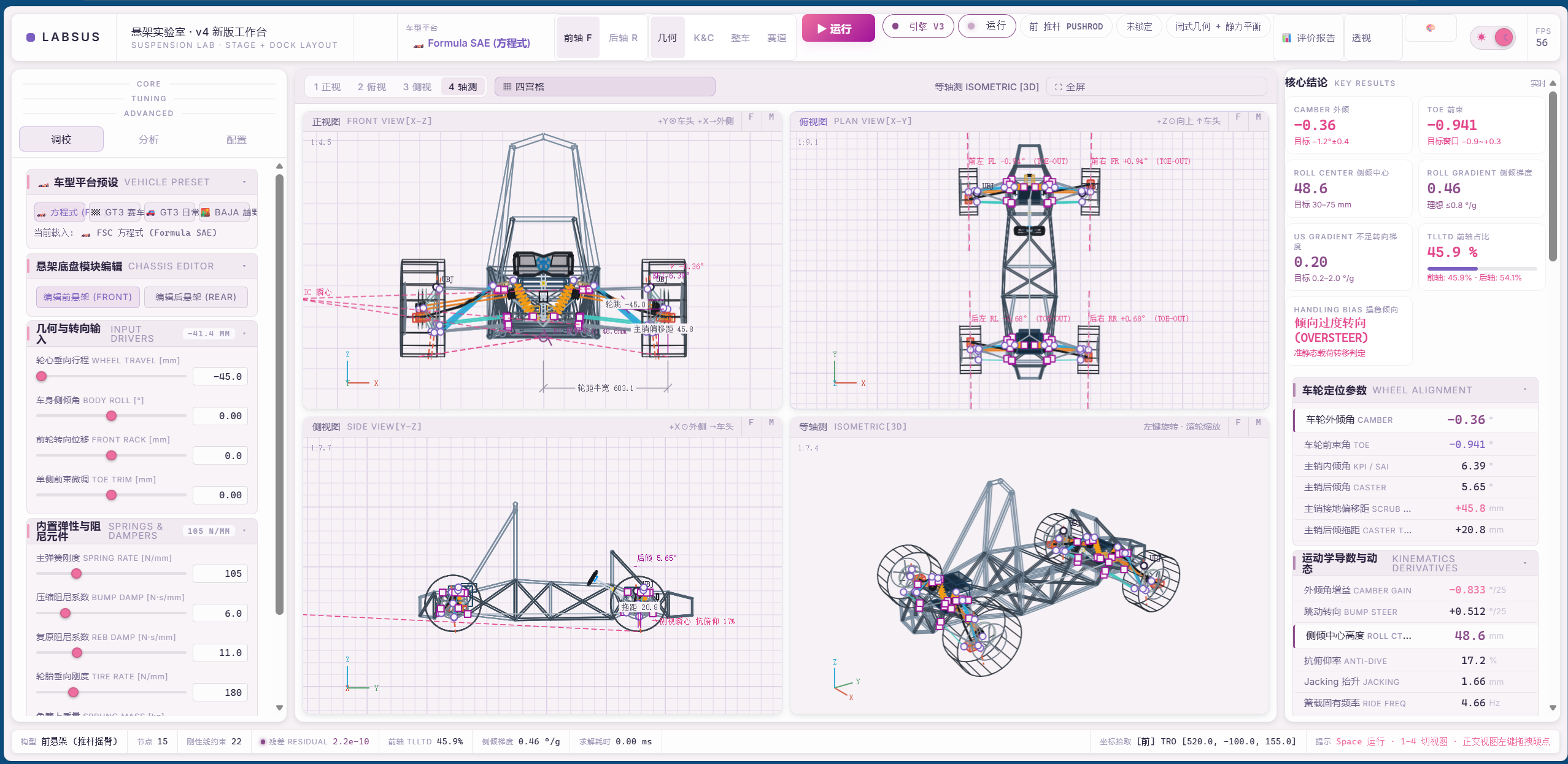 Synchronized Front/Plan/Side/Isometric viewports with the Key Results card streaming Camber/Toe/Roll Center/Roll Gradient/US Gradient/TLLTD in real time; direct 3D hardpoint dragging converges in milliseconds (residuals ~$10^{-10}$).
2. SAE Baja Off-Road — Direct Coilover Long-Travel Architecture (Warm Theme)
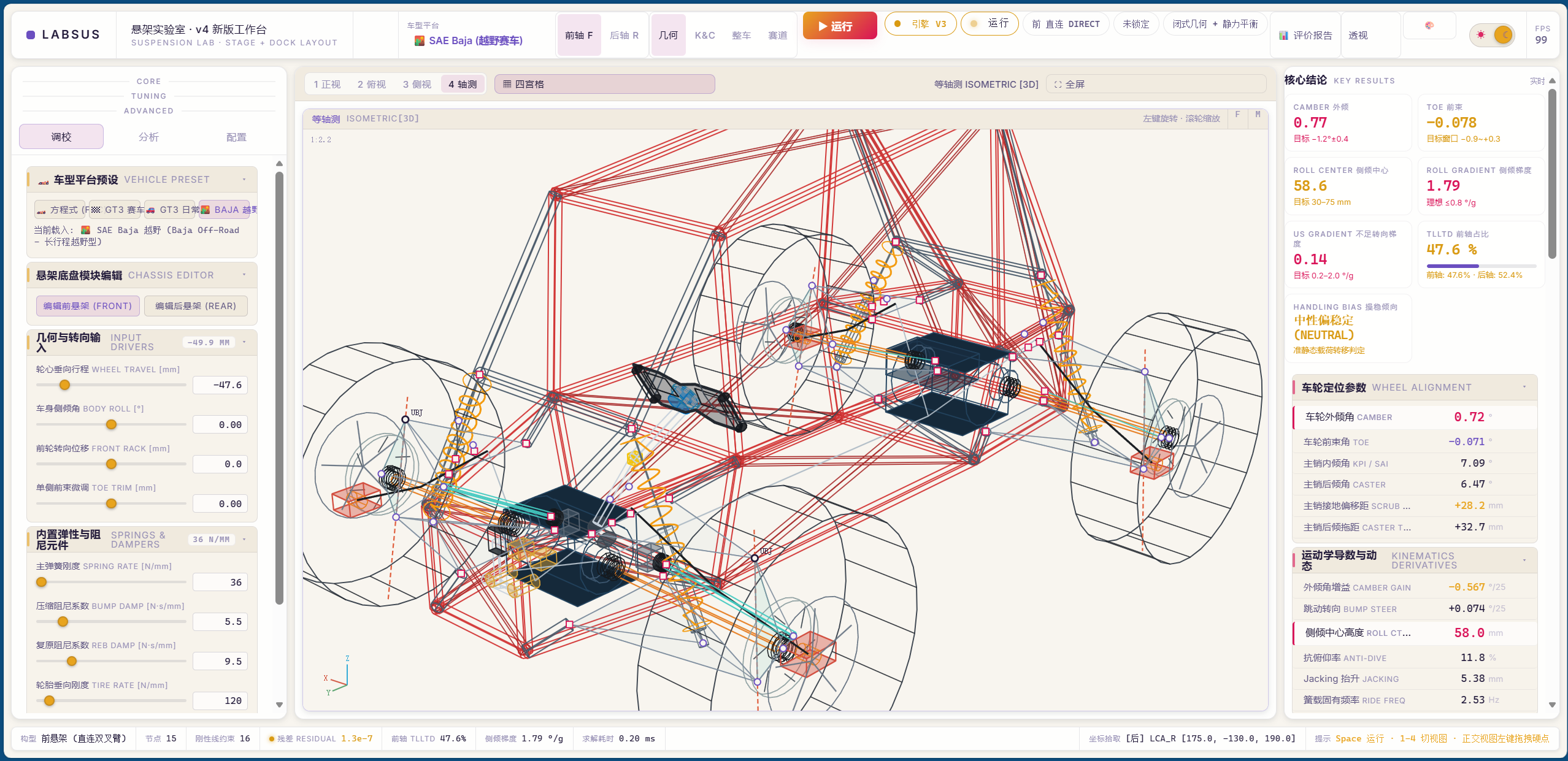 Externally-mounted upright direct coilovers (DIRECT), $R=396,\text{mm}$ all-terrain tires and $[-90, 100],\text{mm}$ wheel travel; pushrod/direct suspension topology switchable in one click.
3. FIA GT3 Race Mode — Dark Cockpit Theme
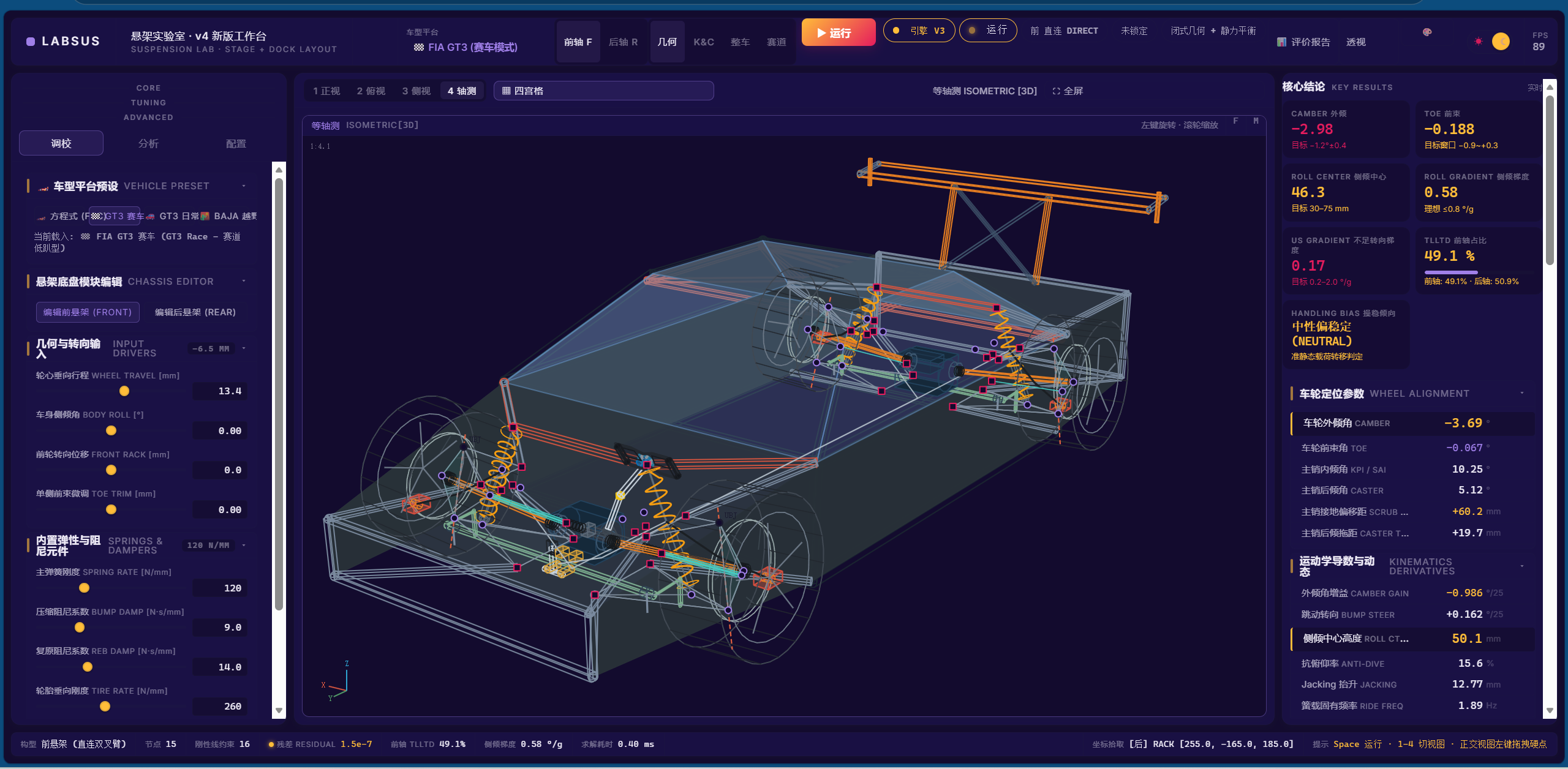 GT3 spaceframe bodyshell with subframe-mounted ARBs, race/street suspension modes switchable; multi-tab engineering workflow across Geometry / K&C / Full Vehicle / Circuit.
4. Shanghai International Circuit (SIC) 15-DOF Transient Simulation Stage
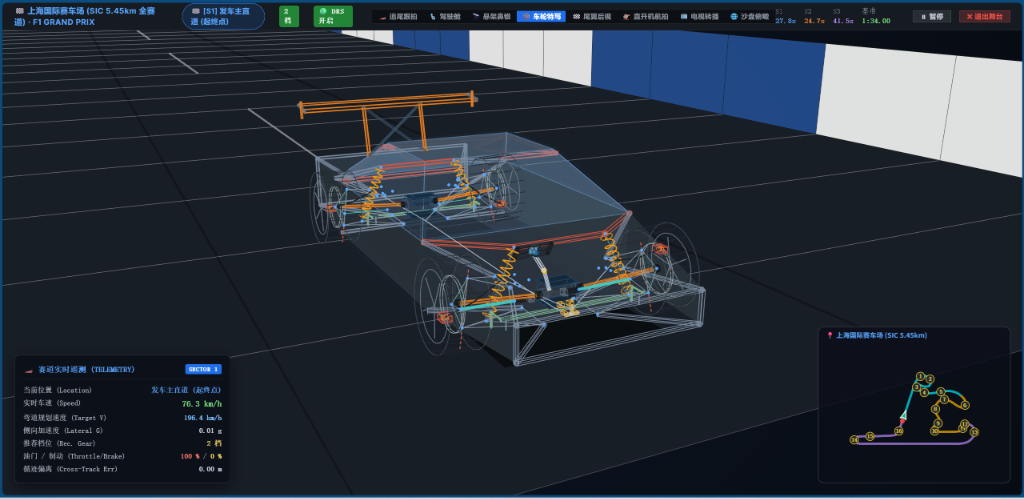 High-precision 15-DOF multi-body dynamics, Pacejka combined-slip friction circle, outer-in-out racing line with per-lap adaptive braking-point learning, runoff penalties and lap counting, multi-angle follow cameras, and real-time engineering telemetry HUD.
🌟 Core Feature Highlights
1. 3D Chassis Modeling & Interactive Visualization
- Double Wishbone & Pushrod/Pullrod 3D Geometry: Front/rear unequal A-arms (upper & lower wishbones), uprights, pushrod/pullrod rockers, coilover spring-dampers, half-shafts with CV boots, ventilated brake discs/calipers, EDU electric drive unit, central rack-and-pinion steering, spaceframe tubular chassis (crumple zone + adaptive suspension bay).
- Synchronized 4-Viewport Interaction: Front (X-Z), Plan (X-Y), Side (Y-Z), and Isometric (3D) live projections with real-time hardpoint drag-and-drop tuning.
- Pure Suspension X-Ray & Layer Filtering: One-click toggle for "Pure Suspension Mode", allowing independent isolation or hiding of chassis frame, powertrain, steering column, and brake master cylinder to focus solely on suspension linkage kinematics.
- Four Out-of-the-Box Vehicle Presets (Multi-Topology):
- 🏎️ Formula SAE (Student Formula): Pushrod architecture, ARB-free ultra-stiff chassis ($f_n \approx 3.4,\text{Hz}$);
- 🏎️ FIA GT3 Race / 🚗 GT3 Street: Direct-coilover double wishbones with subframe-mounted anti-roll bars (ARB);
- 🚜 Baja SAE (All-Terrain Off-Road): Direct long-travel off-road coilovers, $R=396,\text{mm}$ all-terrain tires, $[-90, 100],\text{mm}$ wheel travel.
2. Multibody Kinematics & K&C Compliance Solvers
- High-Precision Multibody Closed-Form Projection Kernel: Joint geometric vector closed-form projection and nonlinear least-squares convergence (residuals $< 10^{-13},\text{mm}$).
- Full Spectrum Suspension Alignment Parameters:
- Camber & Camber Gain ($d\gamma/dz$);
- Toe & Bump Steer ($d\delta/dz$);
- Kingpin Inclination (KPI / SAI), Caster Angle, Scrub Radius, Caster Trail;
- Instantaneous Centers (IC) and dynamic Roll Center Height ($RCH$) migration curves;
- Damper Motion Ratio ($MR$), Spring/Wheel Rates ($K_s / K_w$), Sprung Mass Natural Frequencies ($f_n$).
- K&C Bushing Compliance Solvers (Dual-Layer Architecture): 6-DOF rubber bushing force balance coupled with secondary mechanism re-solving; calibrated bushing stiffness matrices can be injected directly back into the simulation loop.
3. Quasi-Static Handling & Load Transfer
- TLLTD 3-Path Load Transfer Decomposition:
- Elastic roll moment component (main spring + anti-roll bar ARB stiffness distribution);
- Geometric roll center moment arm component (roll center height and direct axle load transfer);
- Unsprung mass lateral inertial force component.
- Quasi-Static Closed-Loop Coupling: Precise computation of roll angle ($\phi$), full-vehicle roll gradient ($d\phi/dg_y$), dynamic 4-wheel normal loads ($F_z$), and handling balance classification (Understeer / Oversteer / Neutral).
- Comprehensive Chassis KPIs:
- US Gradient (target window $0.2\sim2.0,^\circ/g$; all four factory presets measure $0.21\sim0.27,^\circ/g$ @1g) with front/rear axle slip angle ($\alpha_f/\alpha_r$) decomposition;
Balance is carried by two real levers: per-axle cornering stiffness scaled by tire width ($k_\text{axle}=W_\text{axle}/\overline{W}$ — stiffness factor only, peak μ untouched) plus the per-axle sprung-mass split. The ARB is nearly inert for US in this model (front ARB $0\to40$ swings TLLTD $45%\to83%$ but US by only $+0.01,^\circ/g$).
- Jacking effect, front axle TLLTD percentage, and roll gradient displayed live on the "Key Results" card with design target corridors;
- Understeer characteristic $\delta$-$a_y$ sweep curves: 2-path decomposition of tire slip and roll steer across $0\to2g$.
4. 15-DOF Full-Track Transient Dynamics & AutoPilot Stage
- Full-Vehicle Multibody Dynamics (
VehicleDynamics15DOF, legacy naming):- Chassis 6-DOF: position $X,Y,Z$ + attitude $\phi,\theta,\psi$ + body velocities $u,v,w$ + body rates $p,q,r$;
- 4-wheel independent rotational spin (4-DOF, $\omega_{FL,FR,RL,RR}$);
- Wheel vertical motion is kinematically slaved ($tr = -(z_\text{corner}-z_\text{road})$, clamped by droop/bump-stop); wheel load $F_z$ is computed algebraically from spring + damper + ARB + bump-stop and applied to the chassis — i.e. no unsprung-mass vertical inertia and no tire vertical compliance DOF;
- 1000 Hz high-frequency sub-stepping integrator (
MAX_SUB_DT = 1ms), capturing squat/dive, roll, and dynamic wheel load transfer.
⚠️ Caliber note: the implementation is "6 chassis DOF + 4 wheel spin + 4 kinematically slaved wheels", not the textbook "6 chassis + 4 unsprung vertical + 4 wheel spin" 15-DOF form. Consequences and the upgrade path are registered in
INTENTIONAL_DIFFERENCES.md("15-DOF caliber") and in the caliber comment above the class declaration inweb/js/11-stages.js. The engine-side/api/v3/chassis/simulate_trackis a planar 3-DOF model with algebraic quasi-static roll/pitch — a different model from this stage kernel (the cross-language parity test targets the built-in TPHYS closure, not this kernel). - Pacejka Magic Formula Combined-Slip Tire Model:
- Accurate calculation of pure side-slip lateral force ($F_y$), pure longitudinal slip traction/braking force ($F_x$), and combined-slip friction circle adhesion limits.
- Shanghai International Circuit (SIC 5.45km) Simulation:
- 7-point smoothing window for corner curvature extraction, 60-iteration convergent forward-backward tracking speed profile planning;
- Realistic Driver Behavior Model: Out-in-out racing line clipping apex kerbs, adaptive lap-by-lap braking-point exploration, +5s runoff penalty with physical gravel trap handling (never teleports or abruptly resets), lap/penalty/off-track logging;
- AutoPilot autonomous cruise control (curvature Ackermann feedforward + velocity-adaptive Stanley steering + G-G friction circle longitudinal arbitration) preventing high-power RWD snap-oversteer;
- 6 dedicated camera views (Chase Cam, Cockpit First-Person, Nose Cone, Wheel Close-Up, Rear Wing Reverse, Heli Top-Down);
- Real-time telemetry HUD (current corner/straight, speed, lateral G, suggested gear, throttle/brake percentage, yaw rate).
5. Engineering Assessment Reports & Utilities
- One-Click Comprehensive Engineering Report: 12 core performance metrics graded with S/A/B/C/D badges, radar charts, and specific tuning recommendations.
- Engineering Data Persistence: LocalStorage persistence, one-click JSON import/export, and factory reset.
- Baseline Snapshot Diff: Save the current chassis as a baseline snapshot and visualize real-time dashed comparison curves while modifying geometry or parameters.
6. Measured-Data Calibration Loop (Correlation)
- Tire Parameter Identification (Tire Fit): Import JSON/CSV measured tire curves, multi-stage nonlinear least-squares identification of Pacejka coefficients ($B_y/C_y/E_y/F_{y0}/LS$), normalized residual & RMS reports, one-click injection into simulation;
- K&C Rig Correlation: Import bench-tested CSV data, overlay on simulated wheel travel curves (Camber/Toe), and compute travel-window RMS deviations;
- Steer Camber Gain Decomposition: Composite curve = Caster term + KPI term + geometric residual quantitative decomposition;
- Bushing Stiffness Calibration: Per-hardpoint translational/rotational stiffness overrides driving K&C compliance load case verification.
🚀 Quick Start
Method A: Zero-Dependency Browser Run
- The LABSUS web frontend is built using pure native web technologies with zero npm build or bundling steps required.
- Open the primary entry
LABSUS/web/dwb-pro-v4.html(V4 Modern Workbench) directly in Chrome/Edge, or use the modularLABSUS/web/dwb-pro-fullchassis.html/ single-fileLABSUS/web/dwb-pro-allinone.html. Alternatively, serve locally:python -m http.server 8000 --directory LABSUS/web - Navigate to
http://127.0.0.1:8000/dwb-pro-v4.htmlin your browser.
Method B: One-Click Windows Launcher
Double-click LABSUS/start.bat:
- Launches the Python FastAPI calculation engine on port 8001 (automatically reuses if already active);
- Launches a local no-cache HTTP frontend server and opens your default browser.
Method C: Python FastAPI Backend Engine (Optional Enhancement)
For full-featured high-performance numerical solving via REST API:
# 1. Install dependencies
pip install -r LABSUS/requirements.txt

# 2. Launch FastAPI engine server
python LABSUS/engine/server.py
# Server starts at http://127.0.0.1:8001 (Interactive Docs: http://127.0.0.1:8001/docs)
🧪 Testing & Quality Assurance
LABSUS includes a rigorous automated test suite (run from the LABSUS/ directory).
All frontend suites are npm-free, browser-free node vm sandboxes with built-in
DOM/Canvas stubs; only the TPHYS parity check is cross-language:
cd LABSUS

# ── Python engine: physics assertions / gates / API-contract guard / TPHYS parity / stress ──
pytest engine/tests -q                 # 189 passed / 1 skipped (skip = OptimumK rows not entered, explicit)
                                       #   · test_api_contract            frontend/backend key-set contract
                                       #   · test_static_split_invariant  static load-split invariant
                                       #   · test_tire_width_balance      tire width -> cornering stiffness
                                       #   · test_legacy_isolation        V1 frozen-line isolation guard
ruff check engine                      # All checks passed (config in pyproject.toml, rules E/F/W/I)
python scripts/sync_root_docs.py --check   # root <-> LABSUS README/LICENSE byte-identical

# ── Frontend defense lines (per suite) ──────────────────────────────────
node web/test/test_dom.js              # 274 assertions: shell structure / dual-entry parity / bug regressions
node web/test/stage_boot_check.js      # 45 assertions: module order / TDZ / 3 stages x 20 frames
node web/test/test_lap_15dof.js        # 23 assertions: 2 laps of 5.45 km + 6 powertrain parity checks
node web/test/test_15dof_steady.js     # 14 assertions: analytic steady-state anchors for the 15-DOF kernel
node web/test/test_powertrain.js       # 587 assertions (7 powertrain architectures)
node web/test/test_tire_lab.js         # 65 · test_tire_wiring.js 36 · proving_ground_test.js 36
node web/test/test_racingline.js       # 30 · test_engine_sound.js 26 · test_kc_wiring.js 25
node web/test/undulating_road_test.js  # 21 · test_mpc.js 19 · test_p2b_damper.js 18
node web/test/test_p2a_aero.js         # 14 · test_circuit_ui.js 100% (64 ids + 22 classes)

# ── Cross-language physics parity (JS TPHYS <-> Python transient, 5% threshold) ──
node web/test/tphys_parity.cjs         # measured worst 0.51%

# ── Diagnostic tools (not part of the regression) ───────────────────────
node web/test/preset_balance_sweep.cjs # preset balance sweep (US / TLLTD vs sprung split / ARB / tire width)
node web/test/mpc_diag_g30.cjs         # MPC tuning diagnostics · mpc_calib_g30.cjs calibration grid
Numbers reflect the current workspace (baseline 2026-09-20). After frontend edits run at least
test_dom+stage_boot_check; after engine edits runpytest engine/tests+ruff check engine; after touching TPHYS/inlined physics runtphys_parity.cjs.Automated gates:
.github/workflows/ci.yml(lint / pytest / node jobs, runs on every PR); pre-commit hooks in.pre-commit-config.yaml(fast checks + 2 MB large-file guard + README consistency check; pytest deliberately excluded).
📂 Project Structure
LABSUS/                           # Engineering Root Directory
├── assets/                       # Screenshots, vehicle models, and UI assets
├── web/                          # Modern Web Frontend
│   ├── index.html                # Root landing page auto-redirect
│   ├── dwb-pro-v4.html           # V4 Main Workbench Entry (Primary)
│   ├── dwb-pro-fullchassis.html  # Modular Workbench (Thin shell + css/ + js/)
│   ├── dwb-pro-allinone.html     # Zero-dependency single-file bundle
│   ├── css/
│   │   └── fullchassis.css       # Modular dark/light instrument CSS design system
│   ├── js/                       # Core frontend domain modules (loaded in order)
│   │   ├── 01-core.js            # Math utilities / state management / matrix ops
│   │   ├── 02-presets.js         # Vehicle presets (Formula / GT3 / Baja)
│   │   ├── 03-mechanism.js       # Multibody closed-form projection & K&C sweeps
│   │   ├── 04-dynamics.js        # Quasi-static load transfer & 4-post solver
│   │   ├── 05-scene3d.js         # 4-viewport 3D Canvas wireframe rendering engine
│   │   ├── 06-ui-panels.js       # Control panels & measured data calibration UI
│   │   ├── 07-plots.js           # Interactive kinematic characteristic plots
│   │   ├── 08-interact.js        # State persistence & viewport interaction
│   │   ├── 09-track.js           # TPHYS physics engine & track playback
│   │   ├── 10-eval.js            # Comprehensive engineering report & racing line planner
│   │   ├── 11-stages.js          # 15-DOF hill-climb / skidpad / SIC track stages
│   │   ├── 12-v4-arrange.js      # V4 UI layout orchestration & key results card
│   │   ├── 13-engine-sound.js    # WebAudio dynamic RPM exhaust acoustic synthesizer
│   │   ├── 14-tire-lab.js        # Tire Laboratory (MF5.2 Brush / Magic Formula fit)
│   │   ├── 15-mpc.js             # Model Predictive Control (MPC) trajectory solver
│   │   └── 16-powertrain.js      # Powertrain & torque vectoring calculations
│   └── test/                     # 16 automated frontend test suites
├── engine/                       # High-Performance Python Numerical Engine
│   ├── server.py                 # FastAPI server entry (:8001)
│   ├── src/                      # Solvers (K&C / Bushing / Pacejka / Tire Fit / Transient)
│   └── tests/                    # pytest unit test suite (164 tests, 100% pass)
├── scripts/                      # Utility and automation scripts
├── requirements.txt              # Python dependencies
├── start.bat                     # Windows one-click startup script
├── INTENTIONAL_DIFFERENCES.md    # Source-of-truth dual-kernel architectural conventions
├── AUDIT_AND_REFACTOR_LOG.md     # Full codebase audit & remediation log
├── LICENSE                       # MIT Open Source License
└── README.md                     # Chinese documentation
Note:
LICENSEand English documentationREADME.en.mdare located at the repository root;AUDIT_AND_REFACTOR_LOG.mdprovides in-depth records of all audit fixes and interface parity alignments.
📄 License
This project is licensed under the MIT License. Contributions, issues, and pull requests are welcome!