
Yimeng-Zhang/feature-engineering-and-feature-selection
Yimeng-Zhang/feature-engineering-and-feature-selection has 1,663 GitHub stars and 425 forks. GitHot measured 0 stars in 24 hours and 0 in 7 days. Last checked 2026-11-11 16:59 UTC. Last push 2022-09-24.
A Guide for Feature Engineering and Feature Selection, with implementations and examples in Python.
Measured star growth
- in 24h
- 0
- in 7 days
- 0
- in 15 days
- Collecting history
- in 1 month
- Collecting history
Net star changes over overlapping periods, not daily totals. Missing measurements are left blank. Stars measure attention, not software quality.
README.md
OriginalFeature Engineering & Feature Selection
A comprehensive guide [pdf] [markdown] for Feature Engineering and Feature Selection, with implementations and examples in Python.
Motivation
Feature Engineering & Selection is the most essential part of building a useable machine learning project, even though hundreds of cutting-edge machine learning algorithms coming in these days like deep learning and transfer learning. Indeed, like what Prof Domingos, the author of 'The Master Algorithm' says:
“At the end of the day, some machine learning projects succeed and some fail. What makes the difference? Easily the most important factor is the features used.”
— Prof. Pedro Domingos
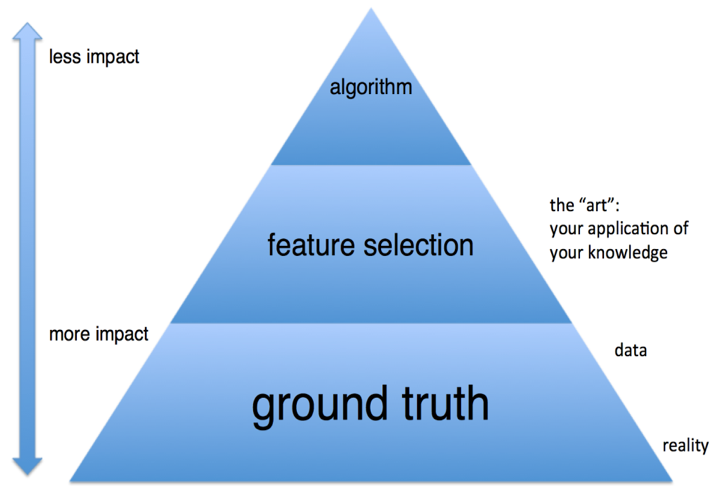
Data and feature has the most impact on a ML project and sets the limit of how well we can do, while models and algorithms are just approaching that limit. However, few materials could be found that systematically introduce the art of feature engineering, and even fewer could explain the rationale behind. This repo is my personal notes from learning ML and serves as a reference for Feature Engineering & Selection.
Download
Download the PDF here:
Same, but in markdown:
PDF has a much readable format, while Markdown has auto-generated anchor link to navigate from outer source. GitHub sucks at displaying markdown with complex grammar, so I would suggest read the PDF or download the repo and read markdown with Typora.
What You'll Learn
Not only a collection of hands-on functions, but also explanation on Why, How and When to adopt Which techniques of feature engineering in data mining.
- the nature and risk of data problem we often encounter
- explanation of the various feature engineering & selection techniques
- rationale to use it
- pros & cons of each method
- code & example
Getting Started
This repo is mainly used as a reference for anyone who are doing feature engineering, and most of the modules are implemented through scikit-learn or its communities.
To run the demos or use the customized function, please download the ZIP file from the repo or just copy-paste any part of the code you find helpful. They should all be very easy to understand.
Required Dependencies:
- Python 3.5, 3.6 or 3.7
- numpy>=1.15
- pandas>=0.23
- scipy>=1.1.0
- scikit_learn>=0.20.1
- seaborn>=0.9.0
Table of Contents and Code Examples
Below is a list of methods currently implemented in the repo.
1. Data Exploration
- 1.1 Variables
- 1.2 Variable Identification
- 1.3 Univariate Analysis
- 1.4 Bi-variate Analysis
2. Feature Cleaning
- 2.1 Missing Values
- 2.2 Outliers
- Detect by Arbitrary Boundary [guide] [demo]
- Detect by Mean & Standard Deviation [guide] [demo]
- Detect by IQR [guide] [demo]
- Detect by MAD [guide] [demo]
- Mean/Median/Mode Imputation [guide] [demo]
- Discretization [guide] [demo]
- Imputation with Arbitrary Value [guide] [demo]
- Windsorization [guide] [demo]
- Discard Outliers [guide] [demo]
- 2.3 Rare Values
- 2.4 High Cardinality
3. Feature Engineering
- 3.1 Feature Scaling
- 3.2 Discretize
- 3.3 Feature Encoding
- 3.4 Feature Transformation
- 3.5 Feature Generation
4. Feature Selection
- 4.1 Filter Method
- 4.2 Wrapper Method
- 4.3 Embedded Method
- 4.4 Feature Shuffling
- 4.5 Hybrid Method
Key Links and Resources
- Udemy's Feature Engineering online course
https://www.udemy.com/feature-engineering-for-machine-learning/
- Udemy's Feature Selection online course
https://www.udemy.com/feature-selection-for-machine-learning
- JMLR Special Issue on Variable and Feature Selection
http://jmlr.org/papers/special/feature03.html
- Data Analysis Using Regression and Multilevel/Hierarchical Models, Chapter 25: Missing data
http://www.stat.columbia.edu/~gelman/arm/missing.pdf
- Data mining and the impact of missing data
http://core.ecu.edu/omgt/krosj/IMDSDataMining2003.pdf
- PyOD: A Python Toolkit for Scalable Outlier Detection
https://github.com/yzhao062/pyod
- Weight of Evidence (WoE) Introductory Overview
- About Feature Scaling and Normalization
http://sebastianraschka.com/Articles/2014_about_feature_scaling.html
- Feature Generation with RF, GBDT and Xgboost
https://blog.csdn.net/anshuai_aw1/article/details/82983997
- A review of feature selection methods with applications
https://ieeexplore.ieee.org/iel7/7153596/7160221/07160458.pdf
Explore related projects
tensorflow/tensorflow
An Open Source Machine Learning Framework for Everyone
201,505 starshuggingface/transformers
🤗 Transformers: the model-definition framework for state-of-the-art machine learning models in text, vision, audio, and multimodal models, for both inference and training.
168,815 starsAUTOMATIC1111/stable-diffusion-webui
Stable Diffusion web UI
165,289 starsComfy-Org/ComfyUI
The most powerful and modular diffusion model GUI, api and backend with a graph/nodes interface. The fastest local inference engine in the world.
146,271 stars