
Wimacs/trellis2.c
Wimacs/trellis2.c has 71 GitHub stars and 8 forks. GitHot measured 0 stars in 24 hours. Last checked 2026-11-16 18:39 UTC. Last push 2026-10-23.
Measured star growth
- in 24h
- 0
- in 7 days
- Collecting history
- in 15 days
- Collecting history
- in 1 month
- Collecting history
Net star changes over overlapping periods, not daily totals. Missing measurements are left blank. Stars measure attention, not software quality.
About
Generate textured, segmented and rigged GLB assets entirely on your own GPU.
AIREADME.md
Original
_______ ____ _____ _ _ ___ ____ ____ ____
|__ __| _ \| ____| | | | |_ _/ ___||___ \ / ___|
| | | |_) | _| | | | | | |\___ \ __) || |
| | | _ <| |___| |___| |___ | | ___) |/ __/ | |___
|_| |_| \_\_____|_____|_____|___|____/|_____(_)____|
trellis2.c 3D Local Gen All-in-One
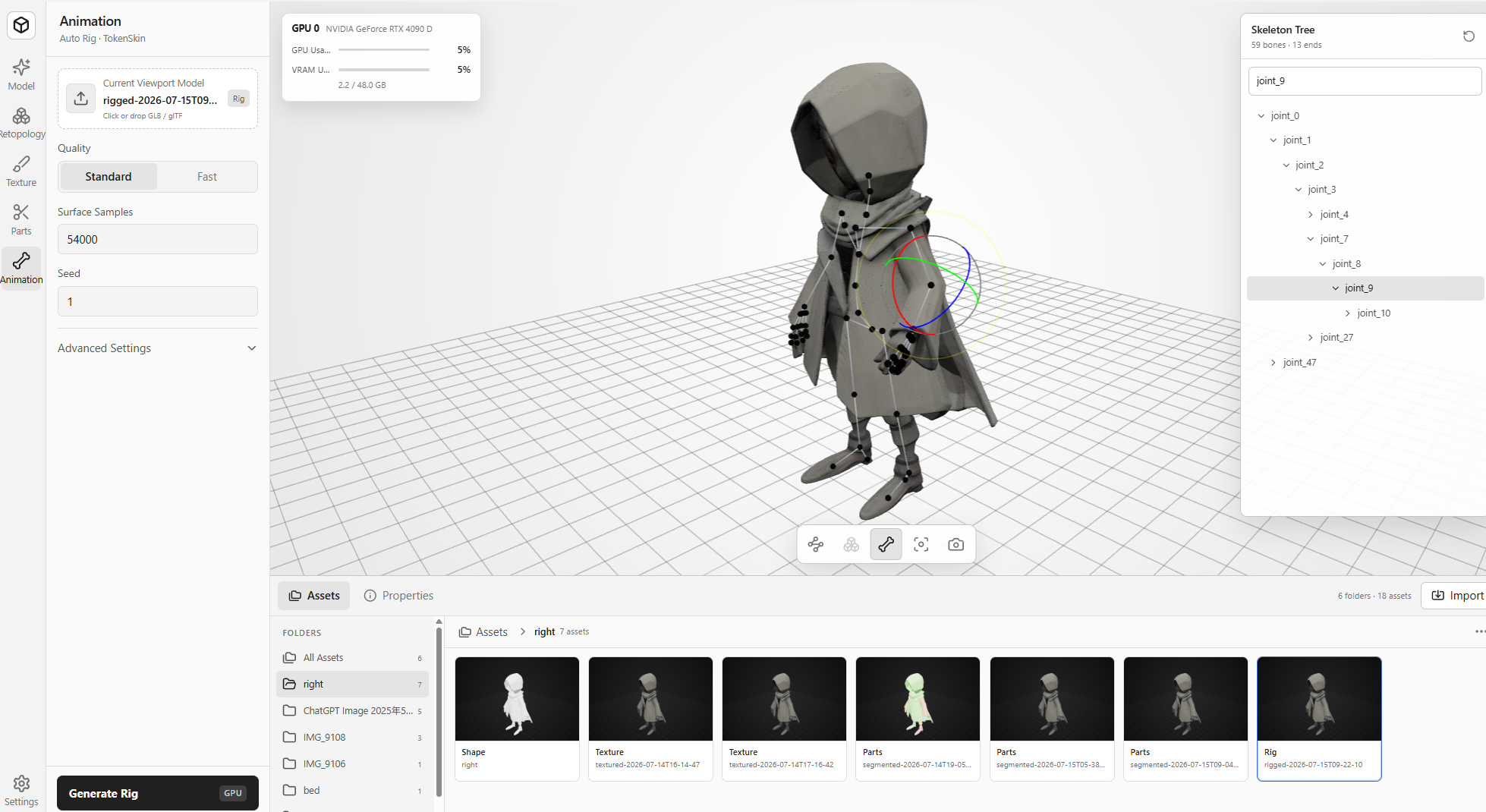
trellis2.c is an all-in-one local 3D generation toolkit powered by TRELLIS.2,
Pixal3D, SegViGen, and TokenSkin. It includes image-to-3D generation, mesh
texturing, automatic part decomposition, and automatic rigging. Inference runs
entirely on native CUDA or Vulkan, with no Python or PyTorch runtime.


Build
Requirements:
- Git and CMake 3.22 or newer.
- A C/C++ toolchain: GCC/Clang on Linux or Visual Studio 2022 on Windows.
- The Vulkan SDK, including the loader, headers, and
glslc. - The CUDA Toolkit when building the CUDA backend.
- OpenGL and X11 development packages on Linux when building the bundled raylib viewer.
The Vulkan SDK is required for both inference backends because the pipeline tools also build the Vulkan mesh postprocessor and texture baker.
Clone the repository with all submodules:
git clone --recursive https://github.com/Wimacs/trellis2.c.git
cd trellis2.c
If the repository was cloned without submodules:
git submodule update --init --recursive
Linux
CUDA:
cmake -S . -B build-cuda \
  -DCMAKE_BUILD_TYPE=Release \
  -DTRELLIS2_C_BACKEND=cuda
cmake --build build-cuda -j
Vulkan:
cmake -S . -B build-vulkan \
  -DCMAKE_BUILD_TYPE=Release \
  -DTRELLIS2_C_BACKEND=vulkan
cmake --build build-vulkan -j
Windows
Run from a Visual Studio developer shell.
CUDA:
cmake -S . -B build-win -G "Visual Studio 17 2022" -A x64 `
  -DTRELLIS2_C_BACKEND=cuda
cmake --build build-win --config Release --parallel
Vulkan:
cmake -S . -B build-win-vulkan -G "Visual Studio 17 2022" -A x64 `
  -DTRELLIS2_C_BACKEND=vulkan
cmake --build build-win-vulkan --config Release --parallel
CUDA defaults to compute capability 8.9. Set
-DCMAKE_CUDA_ARCHITECTURES=<SM> for another GPU generation. For CLI-only
builds, add -DTRELLIS2_C_BUILD_RAYLIB_VIEWER=OFF; add
-DTRELLIS2_C_BUILD_TESTS=OFF when the test binaries are not needed.
The examples below use ./build-cuda/. Use ./build-vulkan/ for a Vulkan
build, ./build-win/Release/ for Windows CUDA, or
./build-win-vulkan/Release/ for Windows Vulkan. The backend is compiled into
the executable and does not require a different command-line flag.
Pipelines
The examples assume that the corresponding model packages have already been
downloaded or converted. TRELLIS.2, DINOv3, and BiRefNet can use the layout
created by tools/download_weights.py; conversion helpers for NAF, SegviGen,
and TokenSkin are also provided under tools/.
trellis2-image-to-gltf
Generates a textured 3D asset from one image with TRELLIS.2. The complete path
prepares the foreground, encodes the image with DINOv3, generates and decodes
the shape, cleans the topology, generates PBR textures, and exports GLB/glTF.
The default profile is 512; --pipeline 1024 selects the 1024 profile.
--shape-only skips texture generation.
./build-cuda/trellis2-image-to-gltf \
  --model ../TRELLIS.2/TRELLIS.2-4B \
  --dino ../TRELLIS.2/dinov3-vitl16-pretrain-lvd1689m \
  --image example_image/T.png \
  --pipeline 1024 \
  --output output.glb
For opaque input, an auto-discovered BiRefNet checkpoint is used when available; transparent RGBA input is used directly.
pixal3d-image-to-gltf
Generates a textured 3D asset with Pixal3D's NAF and projected-image
conditioning. It defaults to 1024_cascade; use
--pipeline 1536_cascade for the larger cascade. NAF is discovered at
MODEL/ckpts/naf_release.safetensors or can be supplied with --naf.
./build-cuda/pixal3d-image-to-gltf \
  --model ../Pixal3D/Pixal3D \
  --dino ../TRELLIS.2/dinov3-vitl16-pretrain-lvd1689m \
  --image example_image/T.png \
  --output pixal3d.glb
Opaque input also requires an auto-discovered BiRefNet checkpoint or an
explicit --birefnet FILE; transparent RGBA input does not.
trellis2-texture-mesh
Generates new PBR materials for an existing triangle mesh from a reference image. It encodes the mesh as a TRELLIS.2 shape latent, runs the texture flow and decoder, and writes a new static GLB. Because the asset is rebuilt, source node hierarchy, materials, UVs, skins, animations, and VRM extensions are not preserved.
./build-cuda/trellis2-texture-mesh \
  --model ../TRELLIS.2/TRELLIS.2-4B \
  --dino ../TRELLIS.2/dinov3-vitl16-pretrain-lvd1689m \
  --input input.glb \
  --image reference.png \
  --output textured.glb
Opaque reference images require BiRefNet. A prepared foreground image can be
passed with --image-prepared.
trellis2-segment-mesh
Automatically decomposes a static GLB/glTF mesh with SegViGen Full. When no condition image is supplied, the pipeline renders one from a fixed camera, predicts part labels, separates connected components, and writes one assembly GLB with one selectable node and mesh per physical part. The default output preserves every source face exactly once together with mappable standard vertex attributes, materials, and textures.
./build-cuda/trellis2-segment-mesh \
  --model ../TRELLIS.2/TRELLIS.2-4B \
  --segmentation-model ../SegviGen \
  --dino ../TRELLIS.2/dinov3-vitl16-pretrain-lvd1689m \
  --input input.glb \
  --output parts.glb
--small-part-mode keep|merge|discard controls disconnected micro-shells;
discard intentionally removes their faces. The pipeline does not generate
cut surfaces or caps, so separated parts are not guaranteed to be watertight.
Inputs whose skins, animations, morphs, instancing, or extensions cannot be
preserved correctly are rejected.
tokenskin-rig
Automatically rigs an existing GLB/glTF mesh with TokenSkin. The output GLB contains the generated skeleton, joints, inverse bind matrices, and skin weights. Flattened world-space geometry and standard PBR appearance are preserved; source node hierarchy, morph targets, and existing animations are not.
./build-cuda/tokenskin-rig \
  --model models/tokenskin \
  --input input.glb \
  --output rigged.glb
License
The original source code and documentation authored for this project are licensed under the MIT License.
Third-party code under 3rd/, files carrying their own notices, model
weights, datasets, input files, sample assets, and generated outputs are not
relicensed by the project MIT License. See
THIRD_PARTY_NOTICES.md and preserve the license files
provided by each dependency and model source.
In particular, DINOv3 weights use Meta's DINOv3 License, not MIT. A mirror or converted checkpoint does not remove its redistribution, use, and trade-control conditions. The release packages contain no model weights; the weight downloader keeps upstream model cards and license files where available.