
Veloresearch/impulse
Veloresearch/impulse has 34 GitHub stars and 4 forks. GitHot measured 0 stars in 24 hours. Last checked 2026-11-09 17:44 UTC. Last push 2026-11-03.
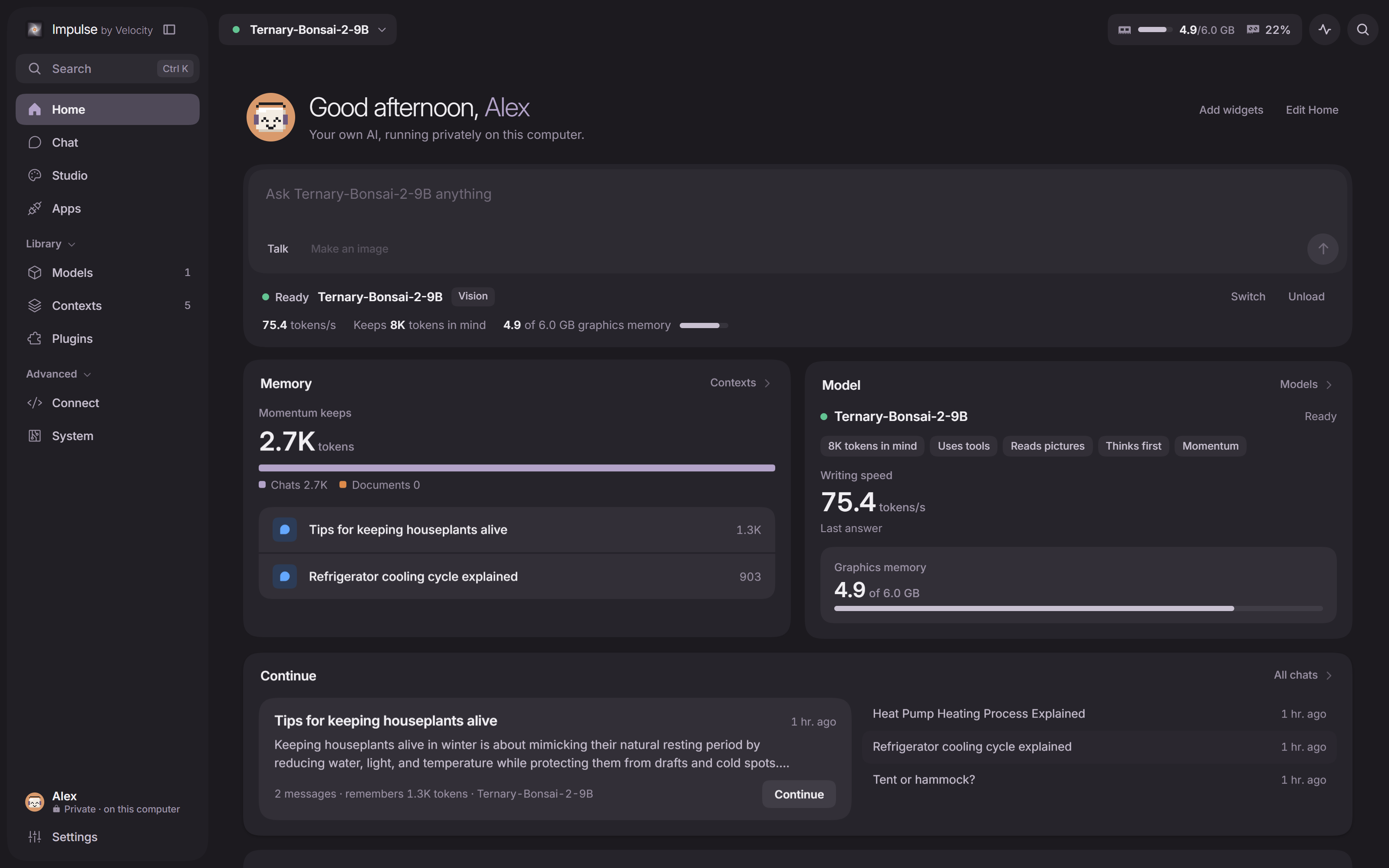
Impulse by Velocity: run AI models on your own computer, on Windows and Linux. Load any GGUF model and chat with web search, files, charts and voice, let it use your computer, and serve it to any app through an OpenAI-compatible API and MCP. Momentum memory up to 32M tokens. No cloud.
Measured star growth
- in 24h
- 0
- in 7 days
- Collecting history
- in 15 days
- Collecting history
- in 1 month
- Collecting history
Net star changes over overlapping periods, not daily totals. Missing measurements are left blank. Stars measure attention, not software quality.
README.md
Original
Intelligence with longer memory.
Run any AI model on your own computer, give it a memory of up to 32 million tokens, and use it from chat, voice and every app you have.
Made by Velocity, an independent AI company.


Offline? Get the full Windows installer.







Technical report · Release notes · veloresearch.com · X · Hugging Face
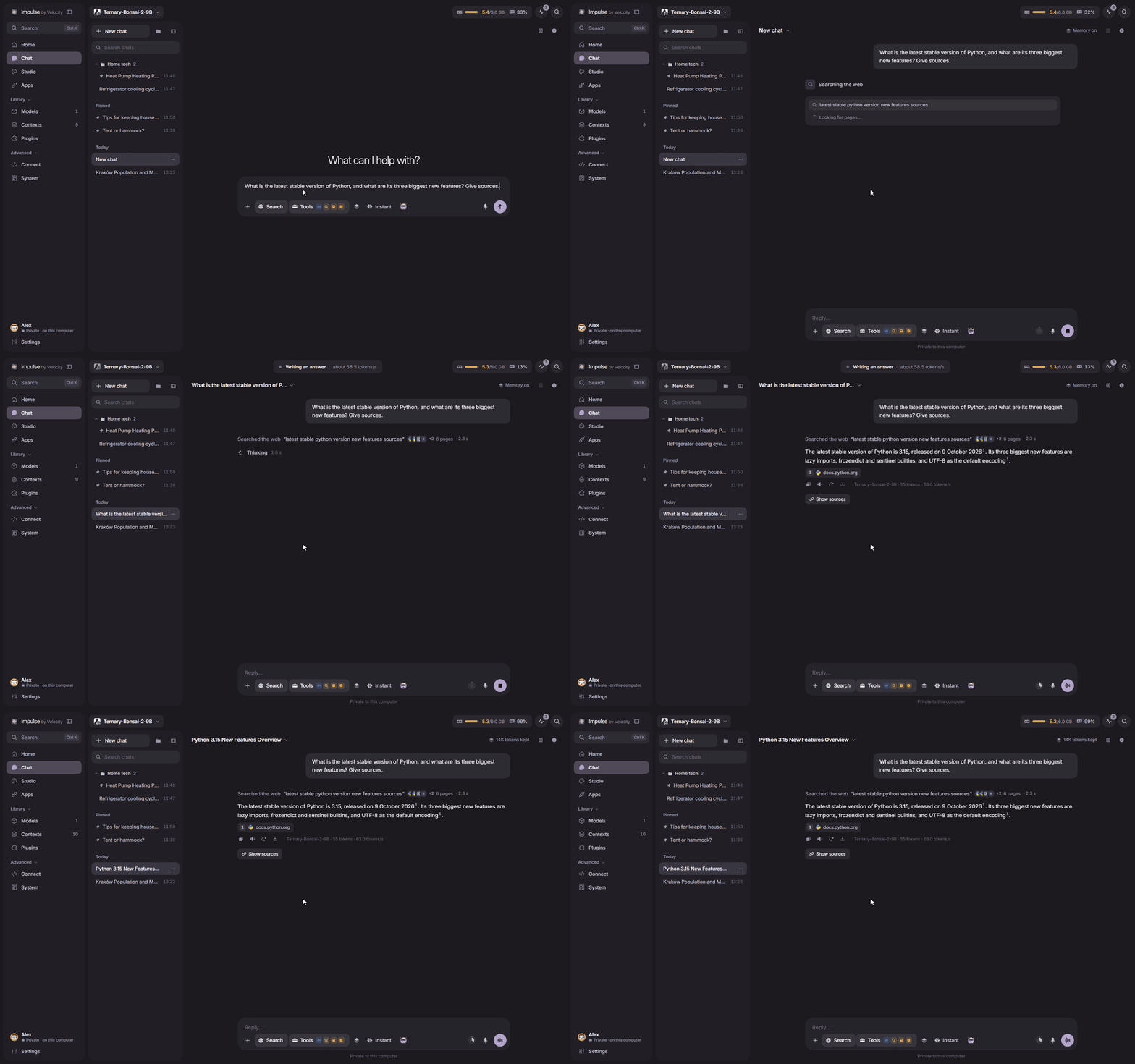
A real recording on a 6 GB laptop card: the question is looked up, the pages are read, and the answer cites them.
In 30 seconds
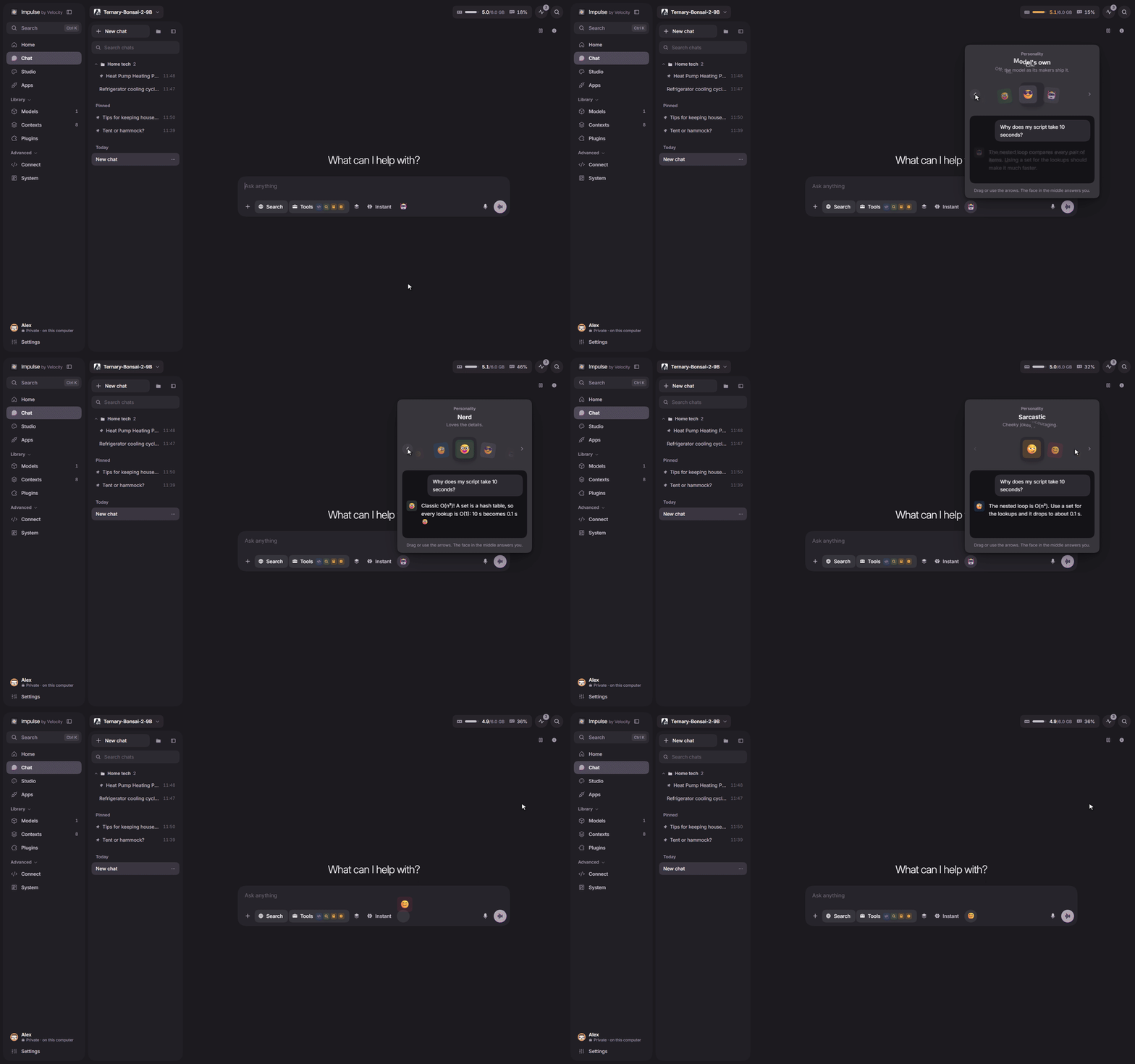 Personalities: one spin |
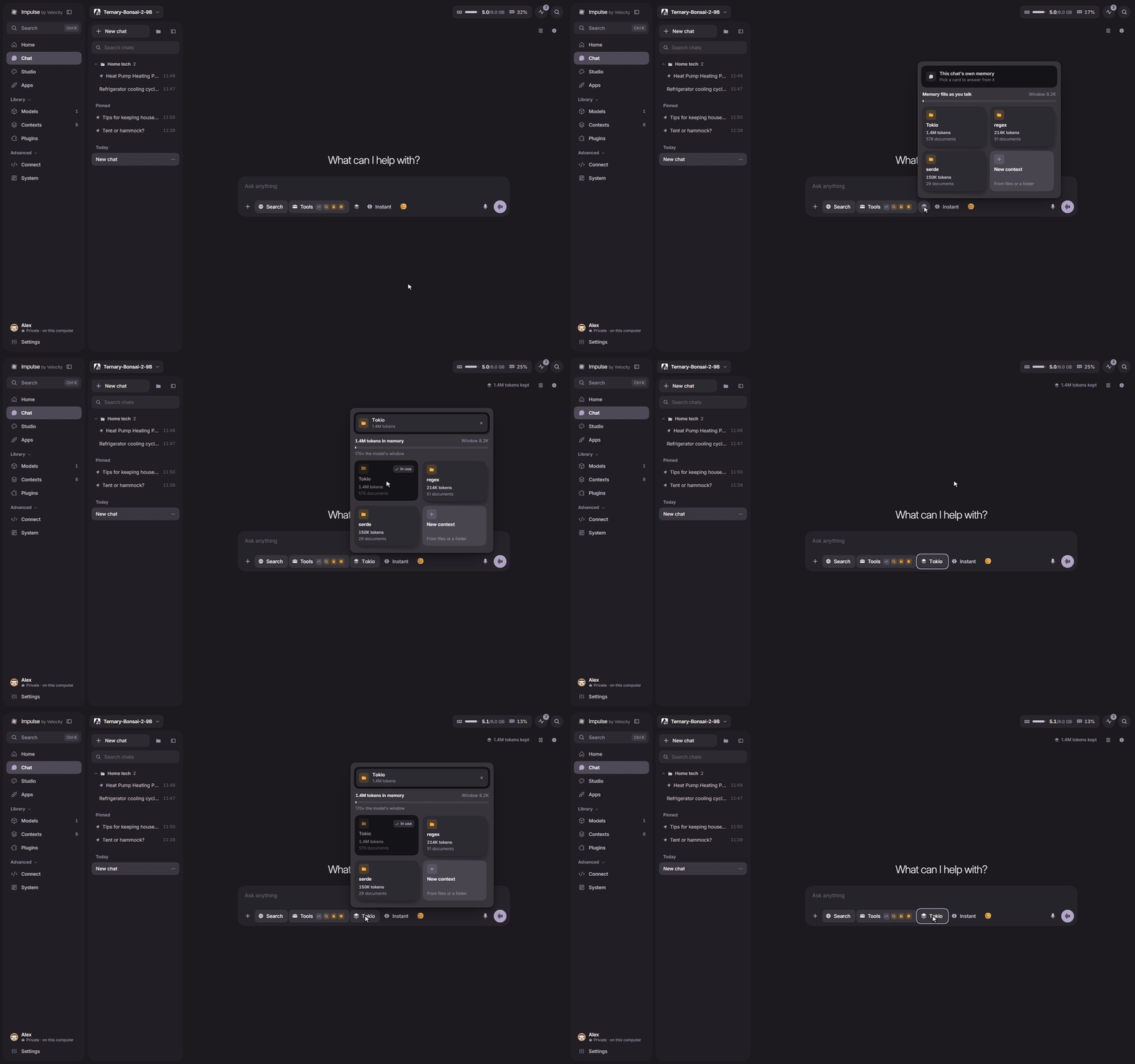 Momentum: 1.4M tokens, one click |
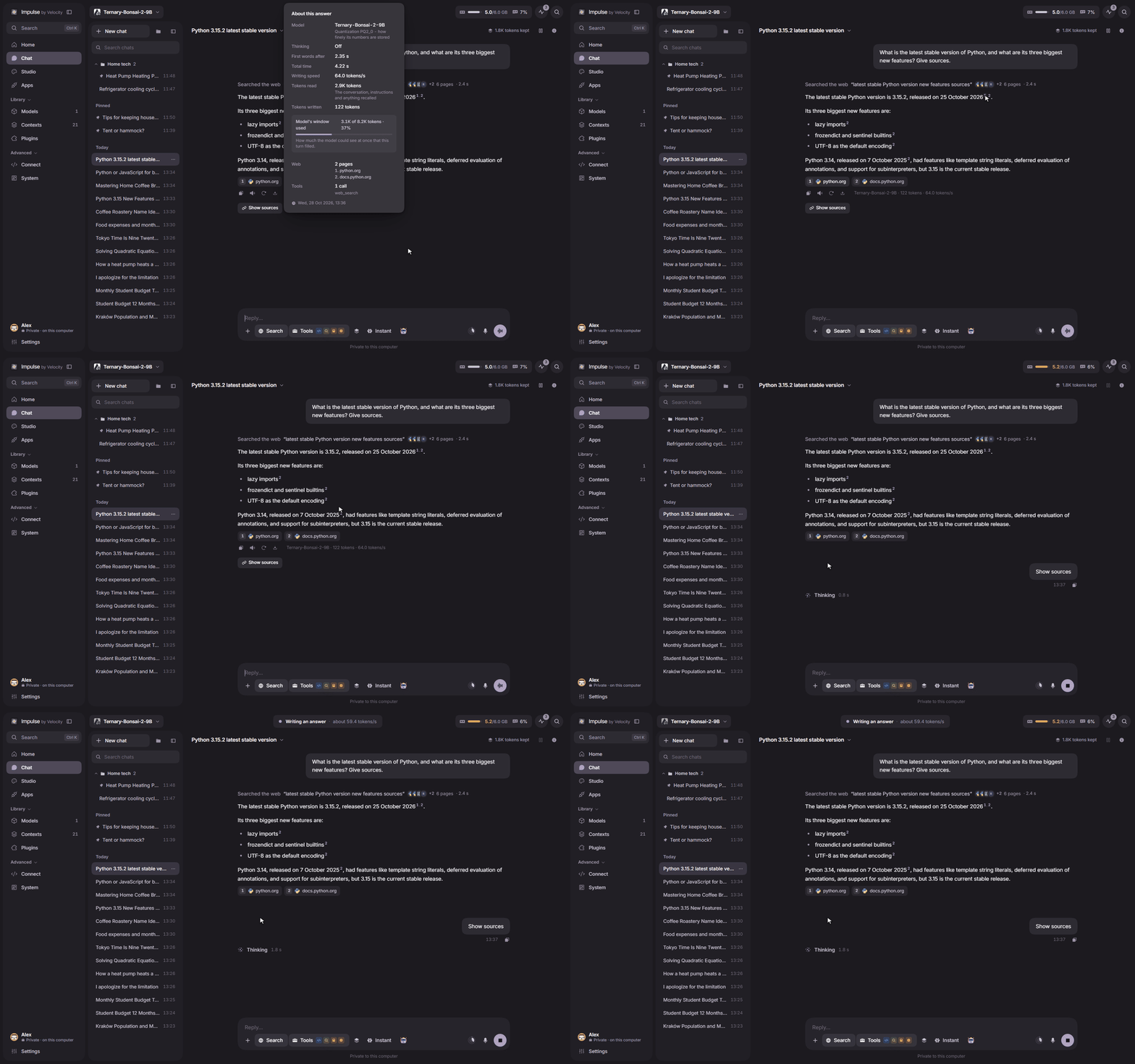
Sources: every claim checked
| See it | Why Impulse · Momentum · Chat · Explore the app · The details |
| Go deeper | Measured, not claimed · Computer use · Look inside the model · Studio, Plugins and Apps |
| Set up | Install · Make it yours · Use it from the agent you already have · One address for everything · FAQ |
Why Impulse
- One app for running models locally. Download or add a GGUF model, and Impulse chooses how it runs on your graphics card. Chat, voice, pictures and an OpenAI-compatible API on one address, in one install, with a panel that explains itself.
- More than the model's window. With Momentum a model works across far more material than its window holds: add a folder, a repository or a year of notes once, and every question can reach all of it, up to 32M tokens.
- Private by construction. No account, no telemetry, no Docker. The only outbound requests are the ones you ask for.
Most local runners load a model and give you its window. Impulse does that too, and adds what sits around the model: a memory far larger than the window, tools the model can use, a computer it can operate with your permission, and a way to see how it wrote each answer.
Momentum

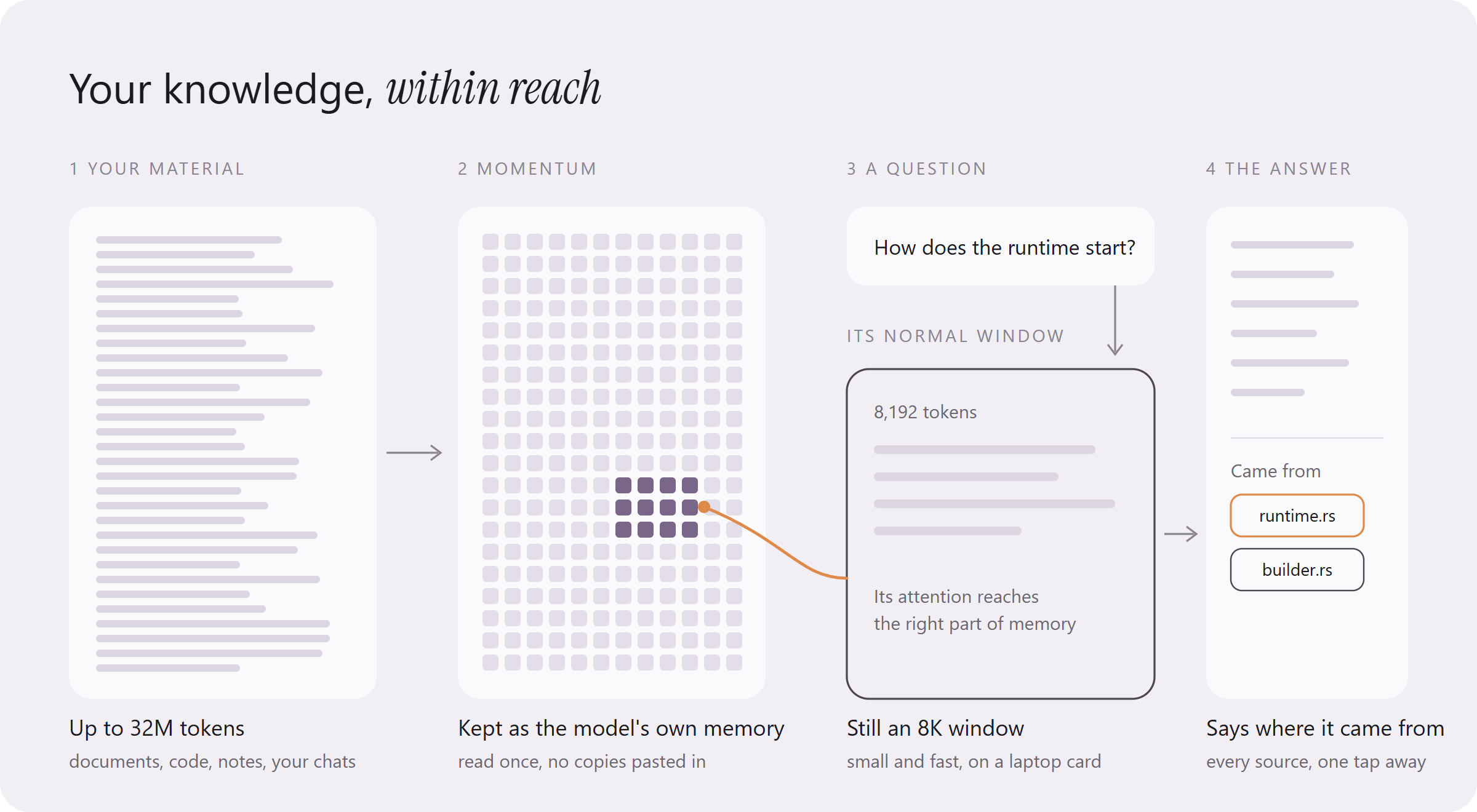
Momentum is memory for local models: your knowledge, within reach. A model with an 8K-token window works across up to 32 million tokens of your documents, chats and code, on a laptop graphics card. No embeddings, no vector database, nothing leaves the machine.
You add material once (a folder, a repository, your notes, or simply the conversation as it happens) and every question after that can reach all of it.
| Local processing | Material is processed on the machine where Momentum is installed. |
| Works with the model's own tokenizer | Sizes are counted in the loaded model's tokens, so what you see is what the model sees. |
| No embedding model or vector database | Not RAG: no chunk size and no second service to run. |
| Portable .mfyc files | A context is a file you own, built in seconds and independent of the model you load. |
| Shows its sources | Every answer shows which parts of your material it used. |
If you point Impulse at a cloud model, the parts of your material used for a question are sent to that provider.
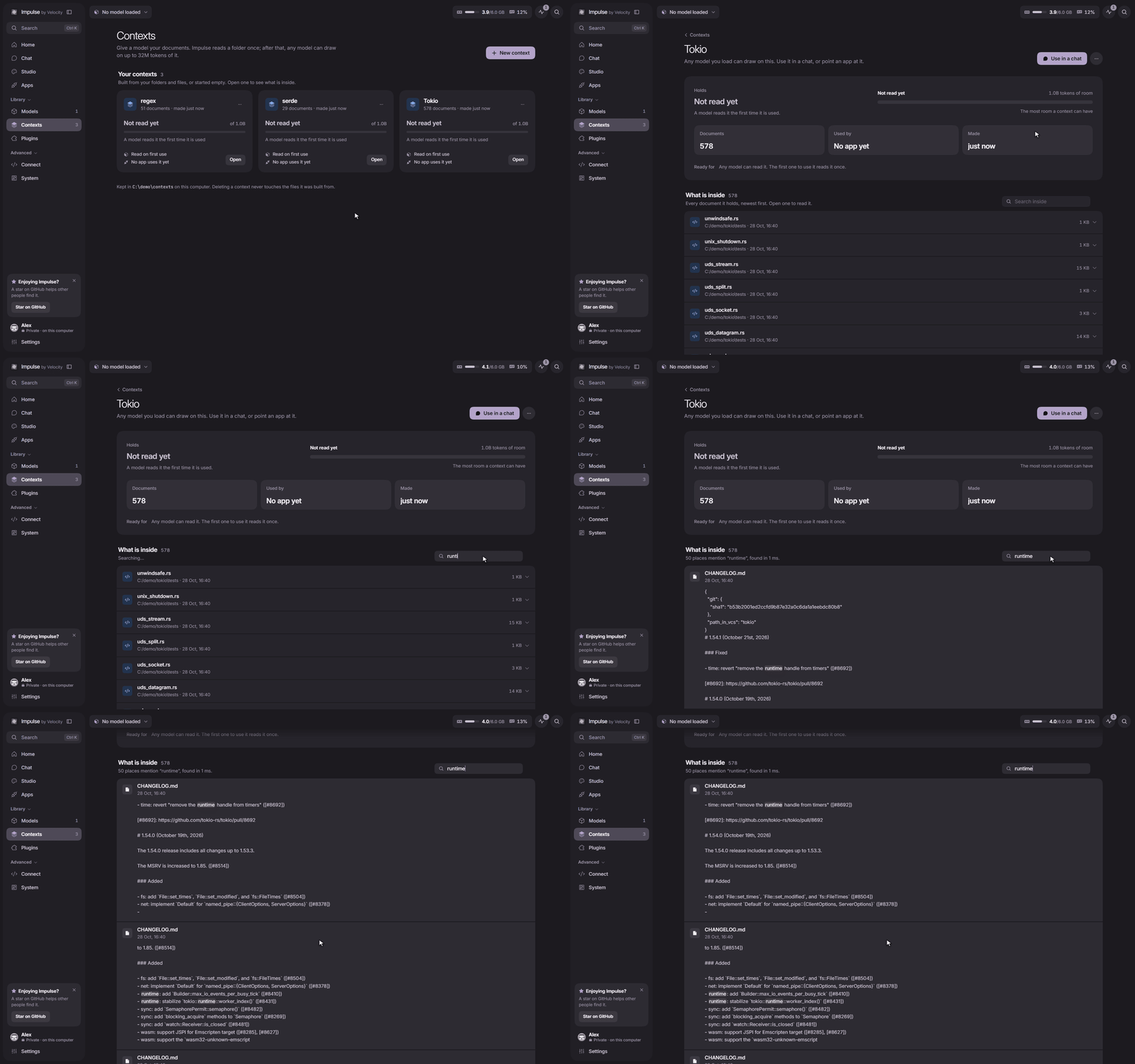
Contexts: a context of 578 source files, opened and searched
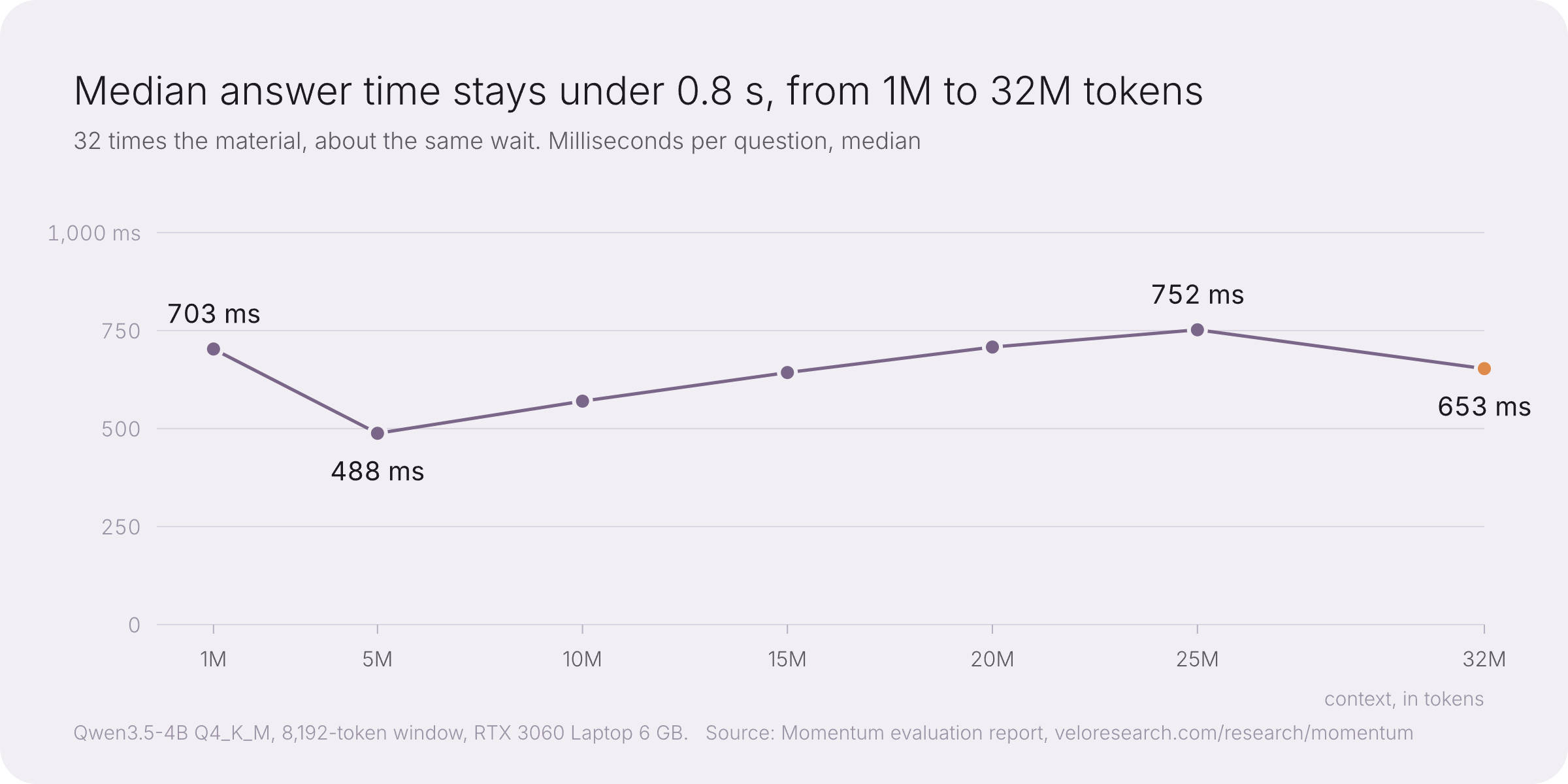
Answer time stays under 0.8 s, from 1M to 32M tokens (median; the build is a one-time text pass):
| context | one-time build | answer, median | answer, p90 |
|---|---|---|---|
| 1M tokens | 0.5 s | 703 ms | 890 ms |
| 5M tokens | 2.6 s | 488 ms | 982 ms |
| 10M tokens | 5.3 s | 570 ms | 1 081 ms |
| 15M tokens | 8.0 s | 643 ms | 1 132 ms |
| 20M tokens | 10.6 s | 708 ms | 1 117 ms |
| 25M tokens | 13.4 s | 752 ms | 1 128 ms |
| 32M tokens | 17.2 s | 653 ms | 1 111 ms |
Measured, not claimed
One laptop: RTX 3060 Laptop, 6 GB, Qwen3.5-4B-Q4_K_M, an 8,192-token window throughout. The full method, the per-task tables and the limits are in the evaluation report (PDF).
| benchmark | result |
|---|---|
| NVIDIA RULER at 128K, 13 tasks, 20 samples each, NVIDIA's harness unmodified | 90.0 average |
| BABILong QA1, 100 published samples per length | 92.0% at 128K, 86.0% at 1M; 0.0% with the text removed |
| Answer time at 32M tokens | 653 ms median |
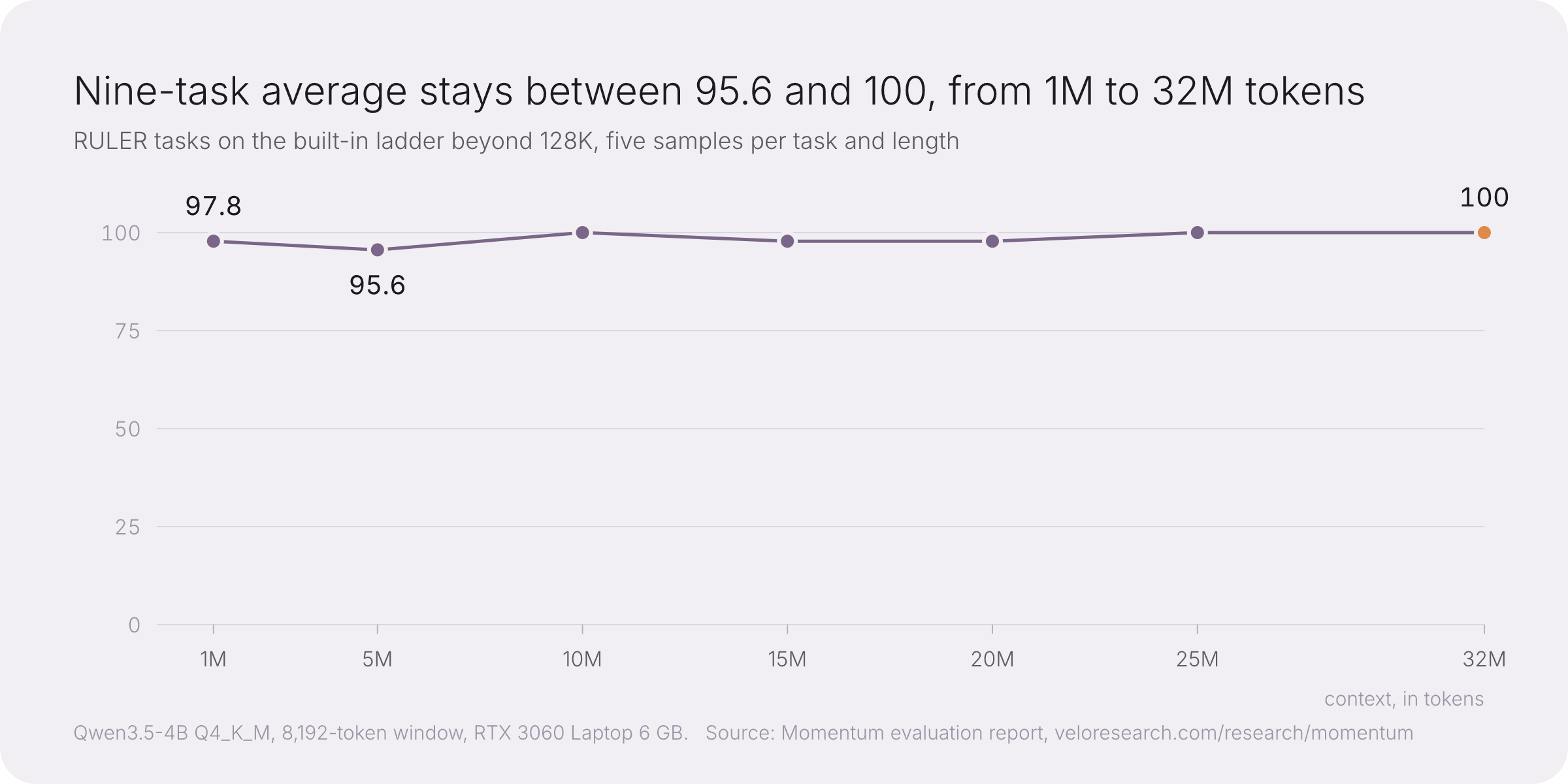
Beyond 128K, on the app's built-in ladder with nine of RULER's tasks and five samples per cell. This is a separate benchmark lane, reported on its own and never averaged with the result above:
| 1M | 5M | 10M | 15M | 20M | 25M | 32M | |
|---|---|---|---|---|---|---|---|
| nine-task average | 97.8 | 95.6 | 100 | 97.8 | 97.8 | 100 | 100 |
Every benchmark can be run on your own machine from the panel.
Chat
Text, photos and files, voice with live transcription, and a model that looks things up before it answers.
Search first, with sources: every claim points back to the page it came from
Search first, with sources. A question about a part number, a price, a datasheet or anything recent is searched before the model writes a word. You watch the pages being read, and every claim in the answer points back to its source.
Exact maths. A built-in calculator works with units, constants and radio and circuit formulas, and shows every step. The model does not do arithmetic in its head.
Drawings for electronics. Schematics are checked before you see them: every pin connected, every value in range. Pin-outs, wiring diagrams and antenna aiming are drawn the same way, and a schematic exports to KiCad.
A Python sandbox. The model writes and runs Python in the page, with numpy, pandas and matplotlib and no internet needed, and the files it makes appear as cards you can open or save.
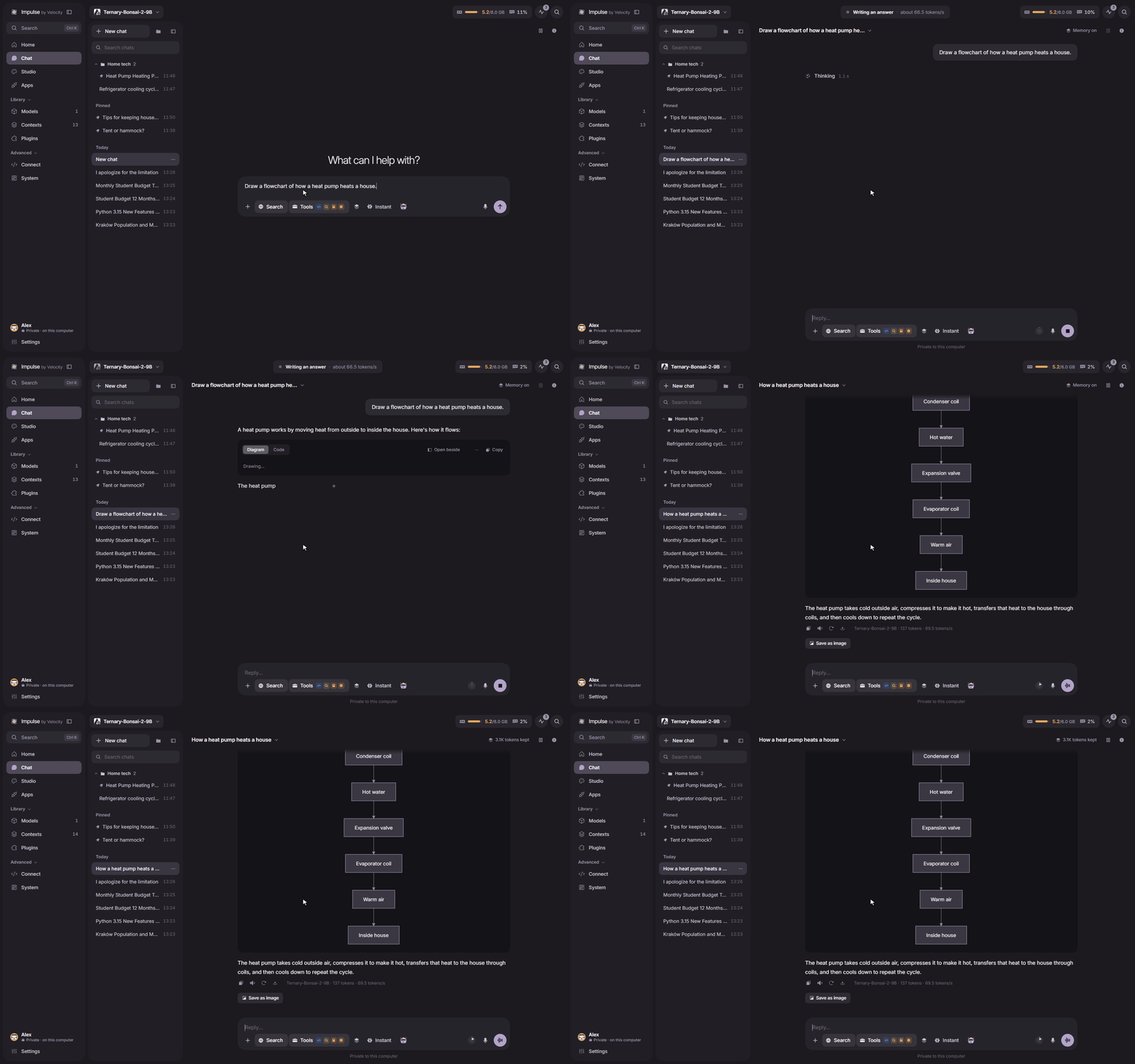 Diagrams: a flowchart drawn inside the answer |
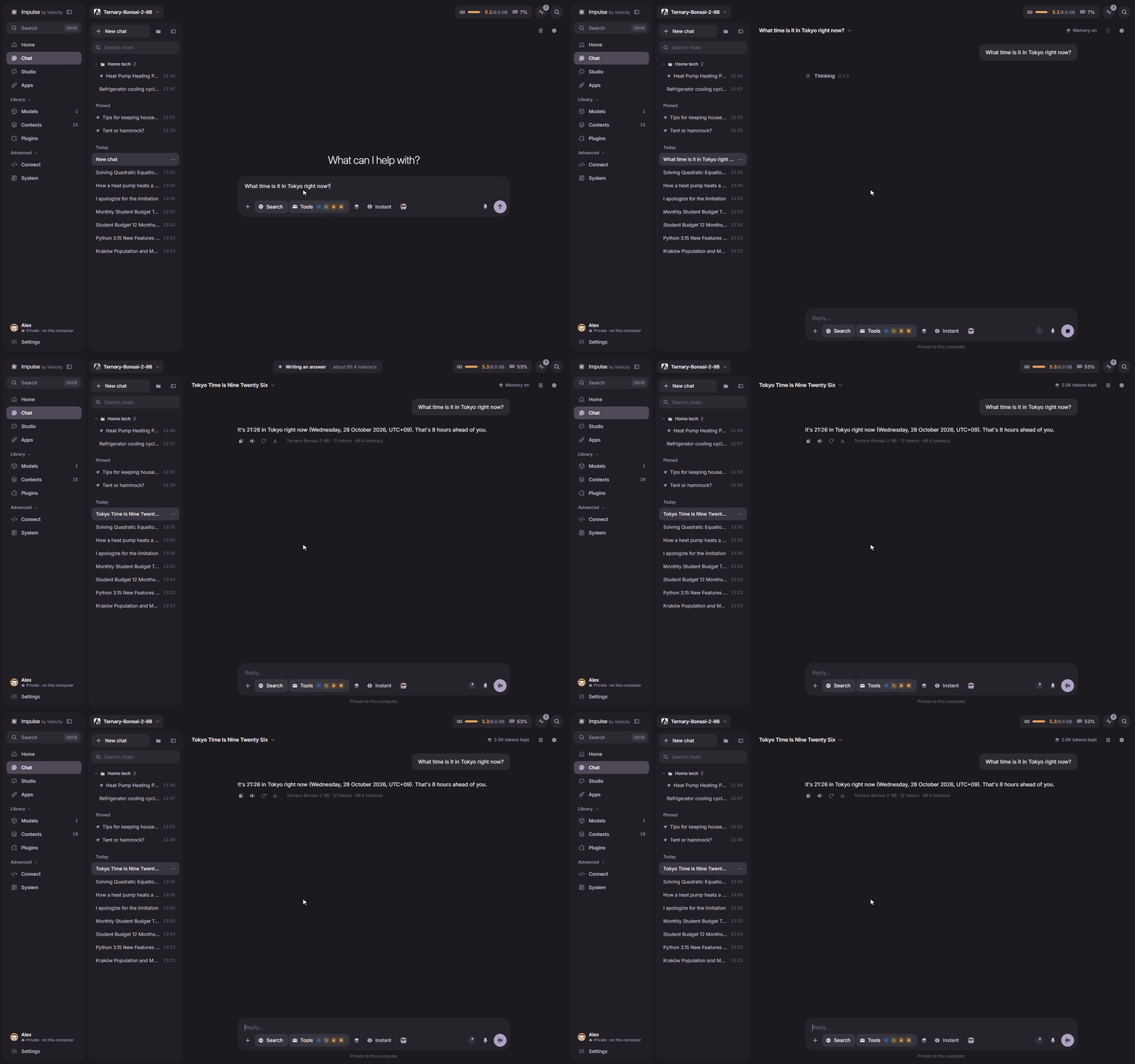 Instant facts: the time anywhere, answered at once |
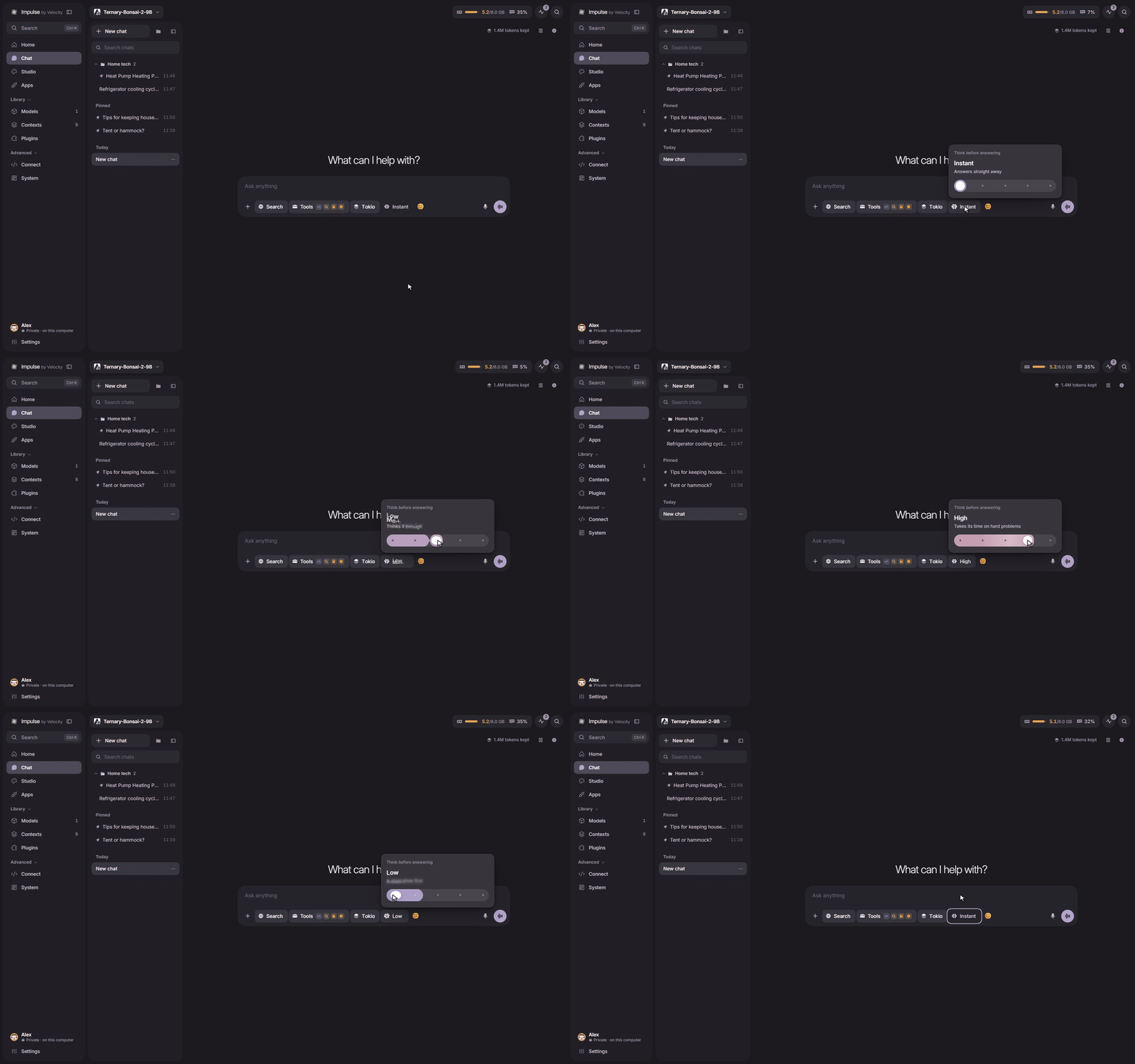 Thinking level: Instant to Max on one slider |
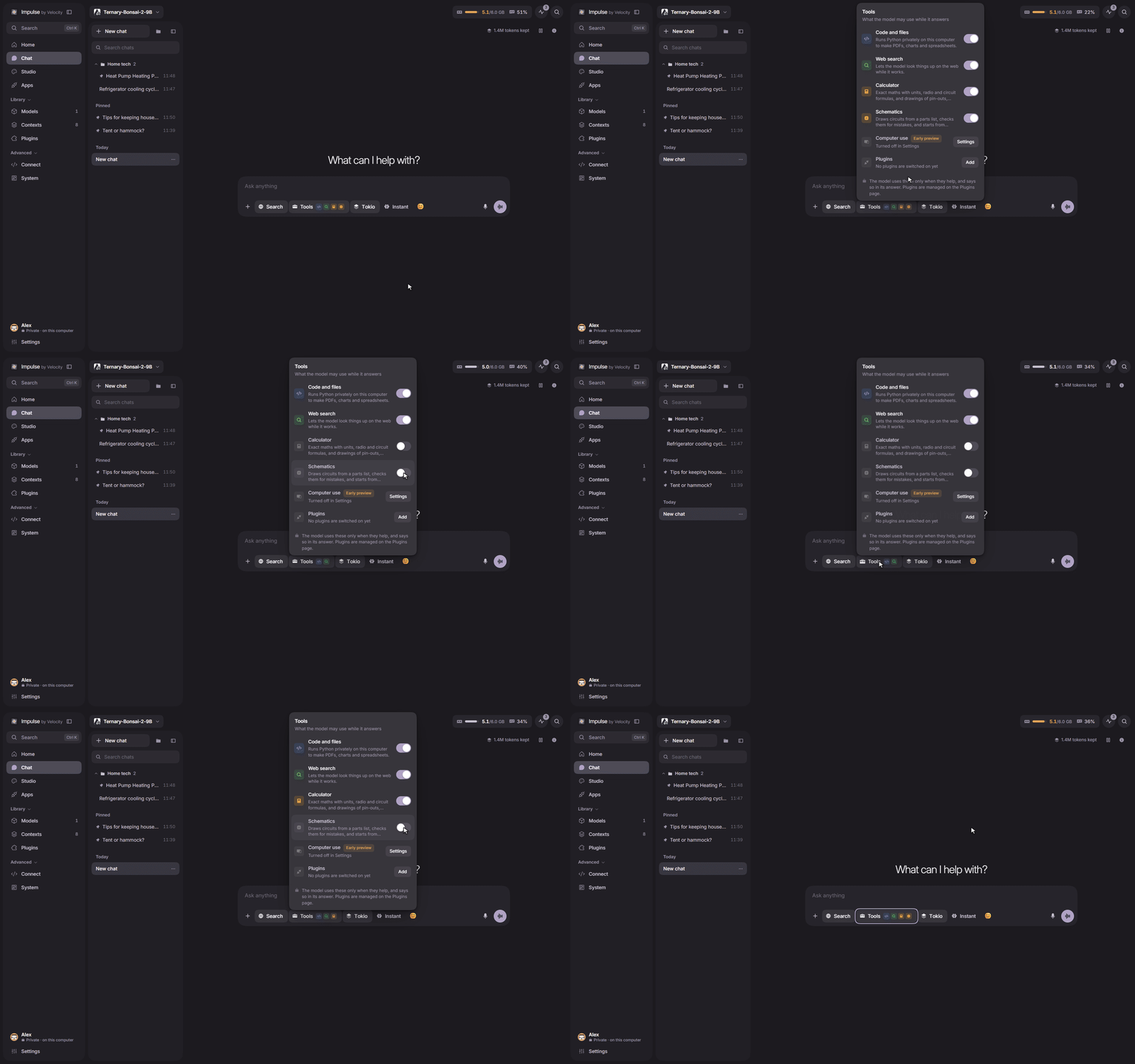 Tools: switch tools on and off; the pill follows |
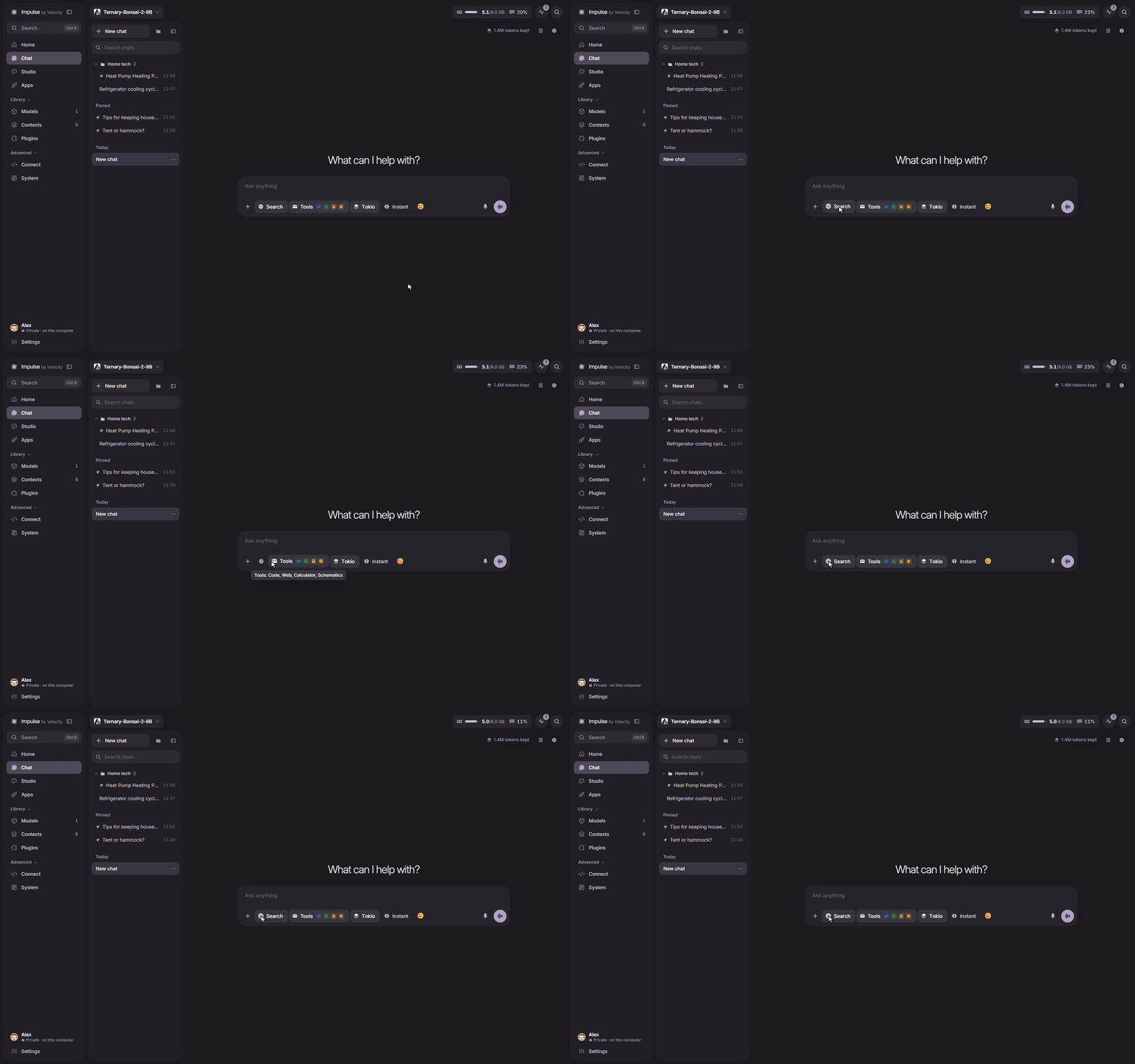 Web search: one tap on or off |
 Answer versions: page between answers with ‹ 1/2 › |
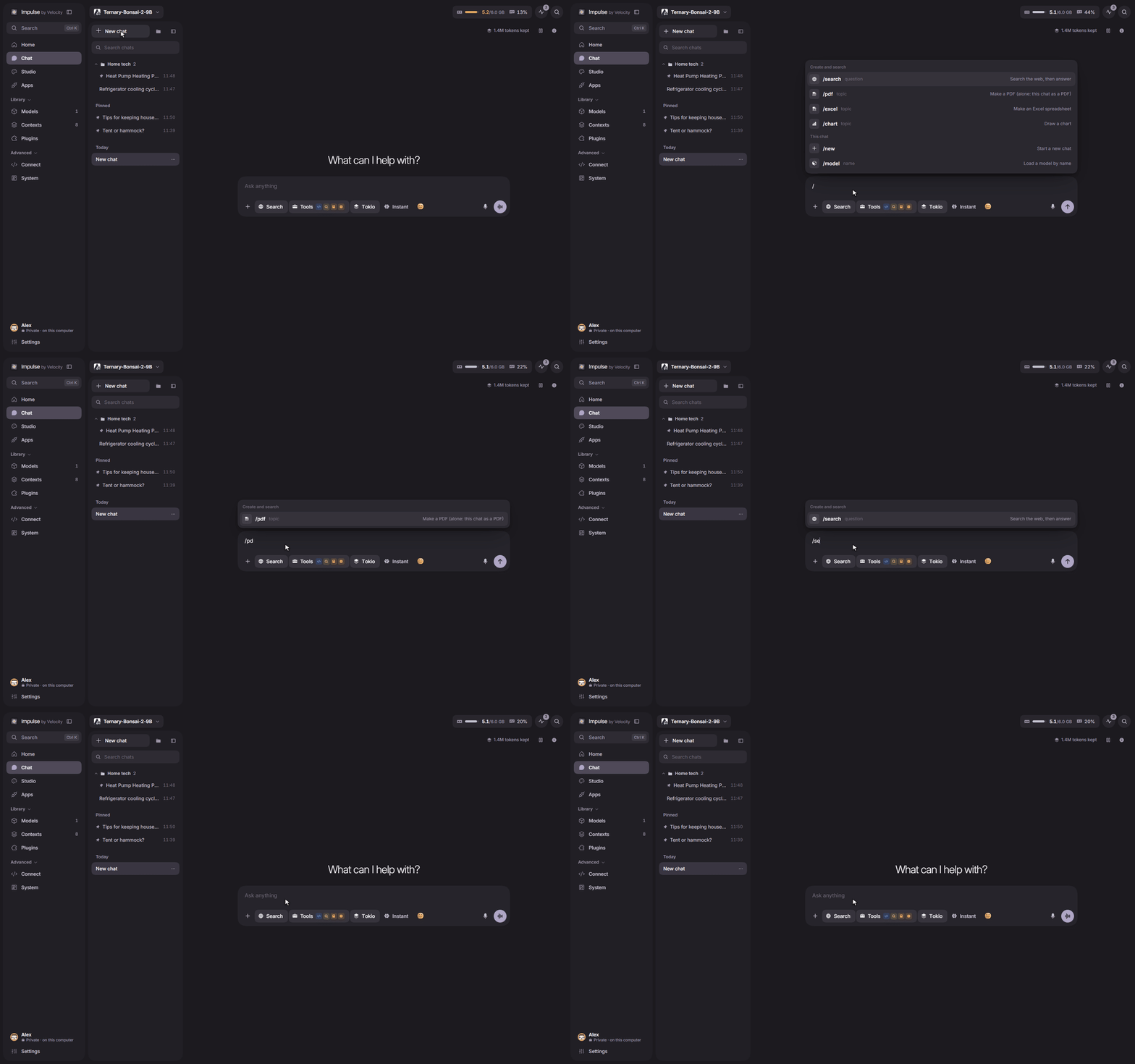 / commands: type / and a letter narrows it |
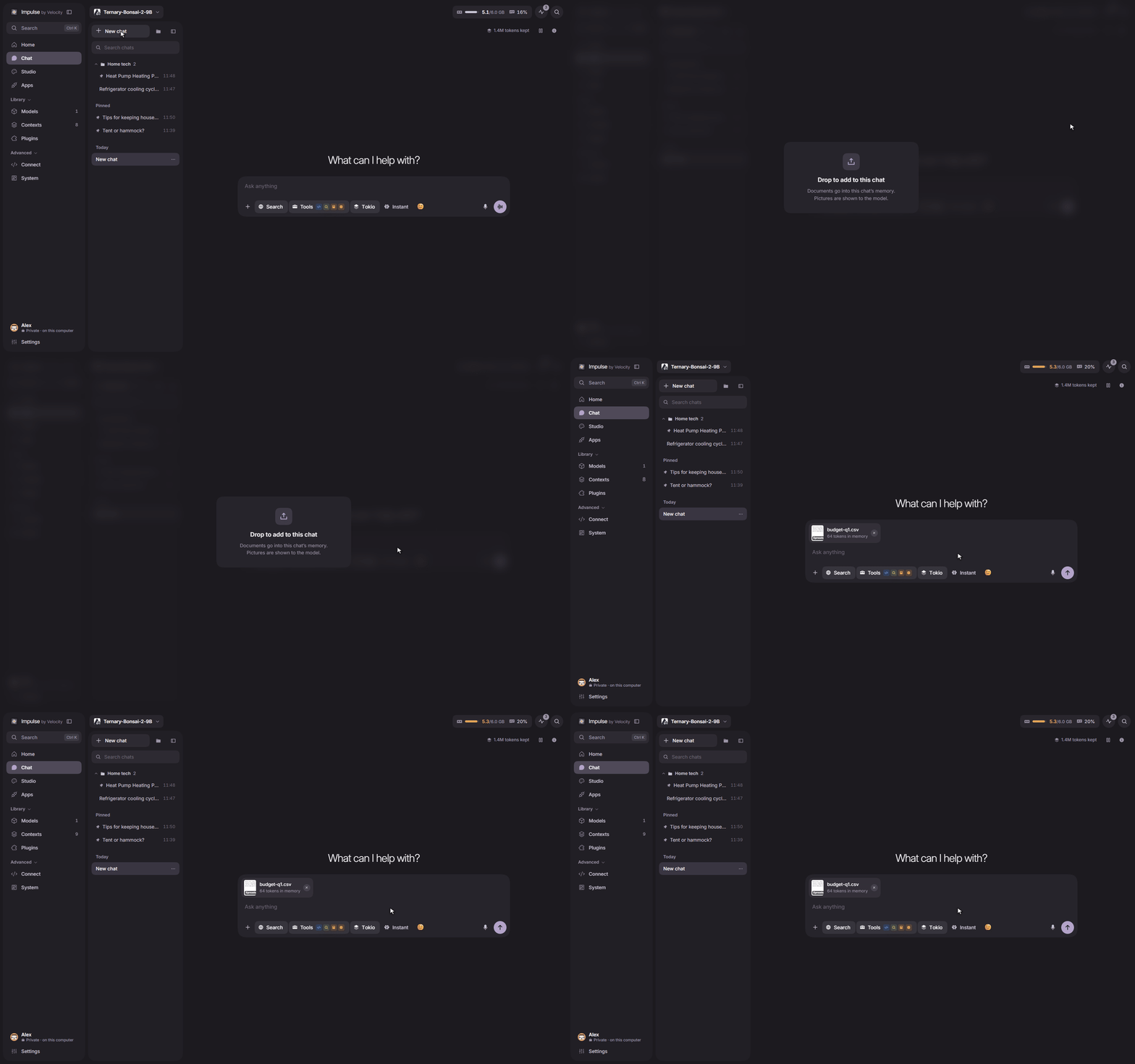 Drop a file: it joins the chat |
Everything an answer needs around it. Save any answer as PDF, Markdown or an image. See what it cost: time to first words, writing speed, tokens read and written, and how much of the window it used. Find anything in a long conversation with Ctrl+F.
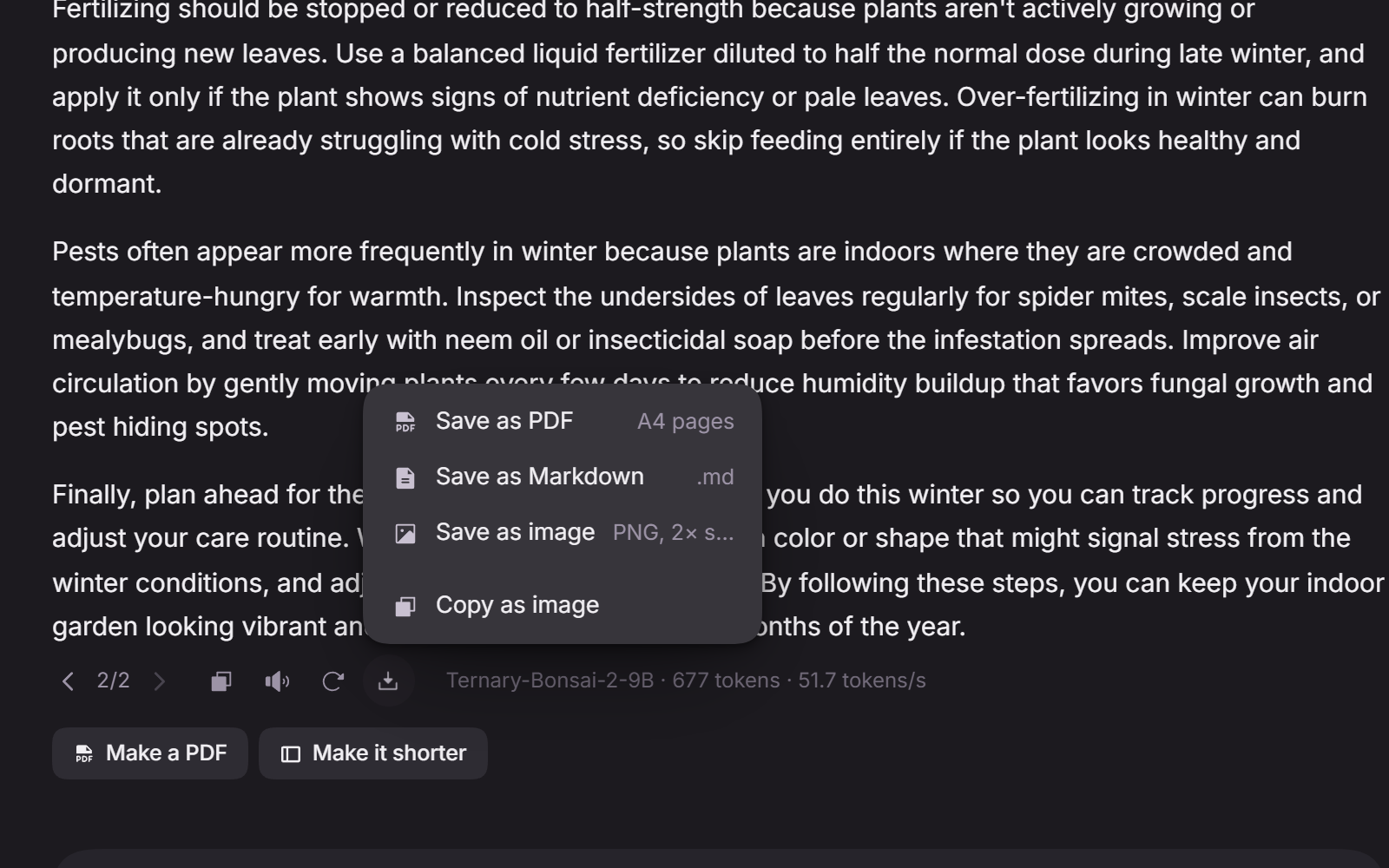 Save as: PDF, Markdown or an image |
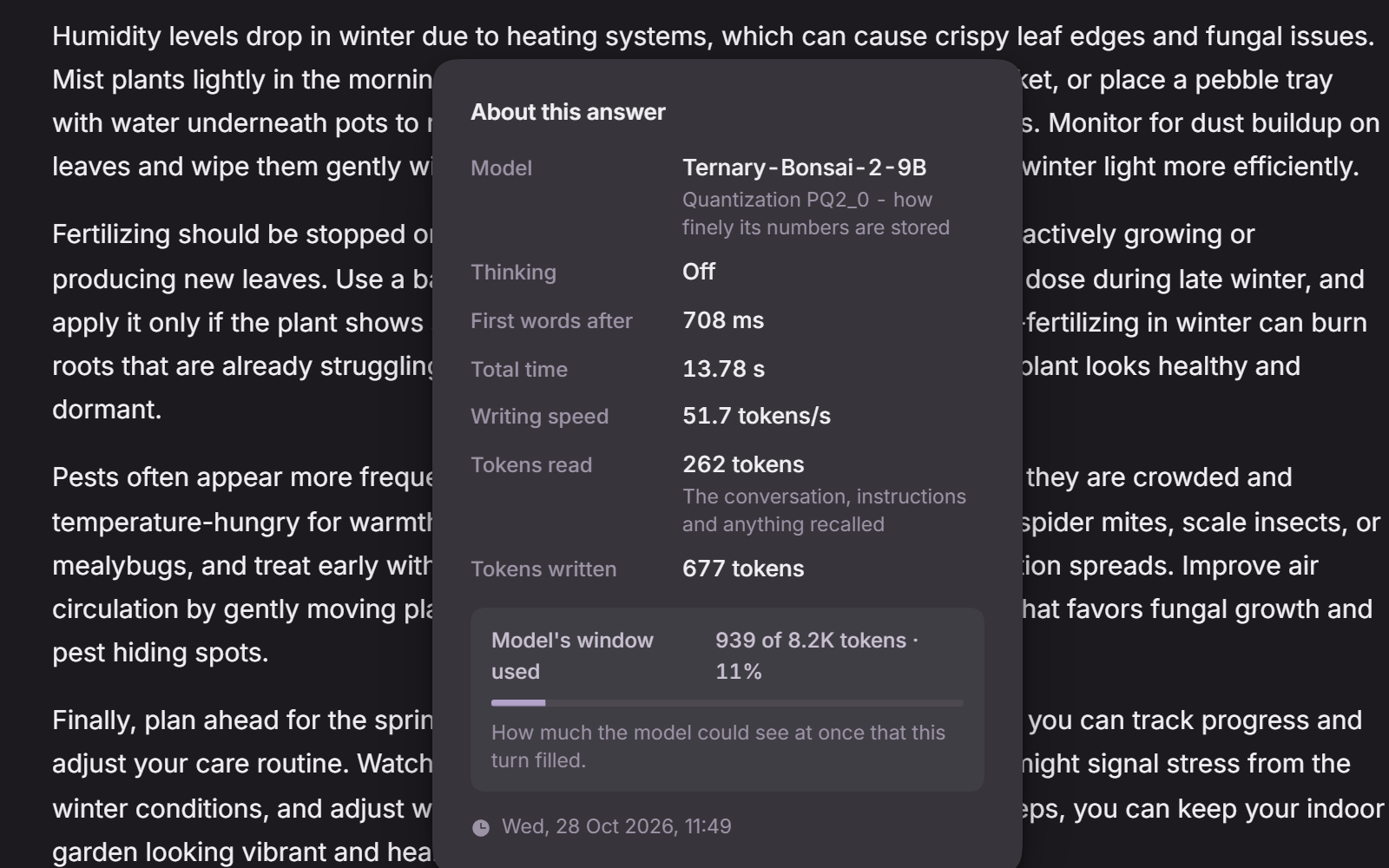 Answer details: what one answer took |
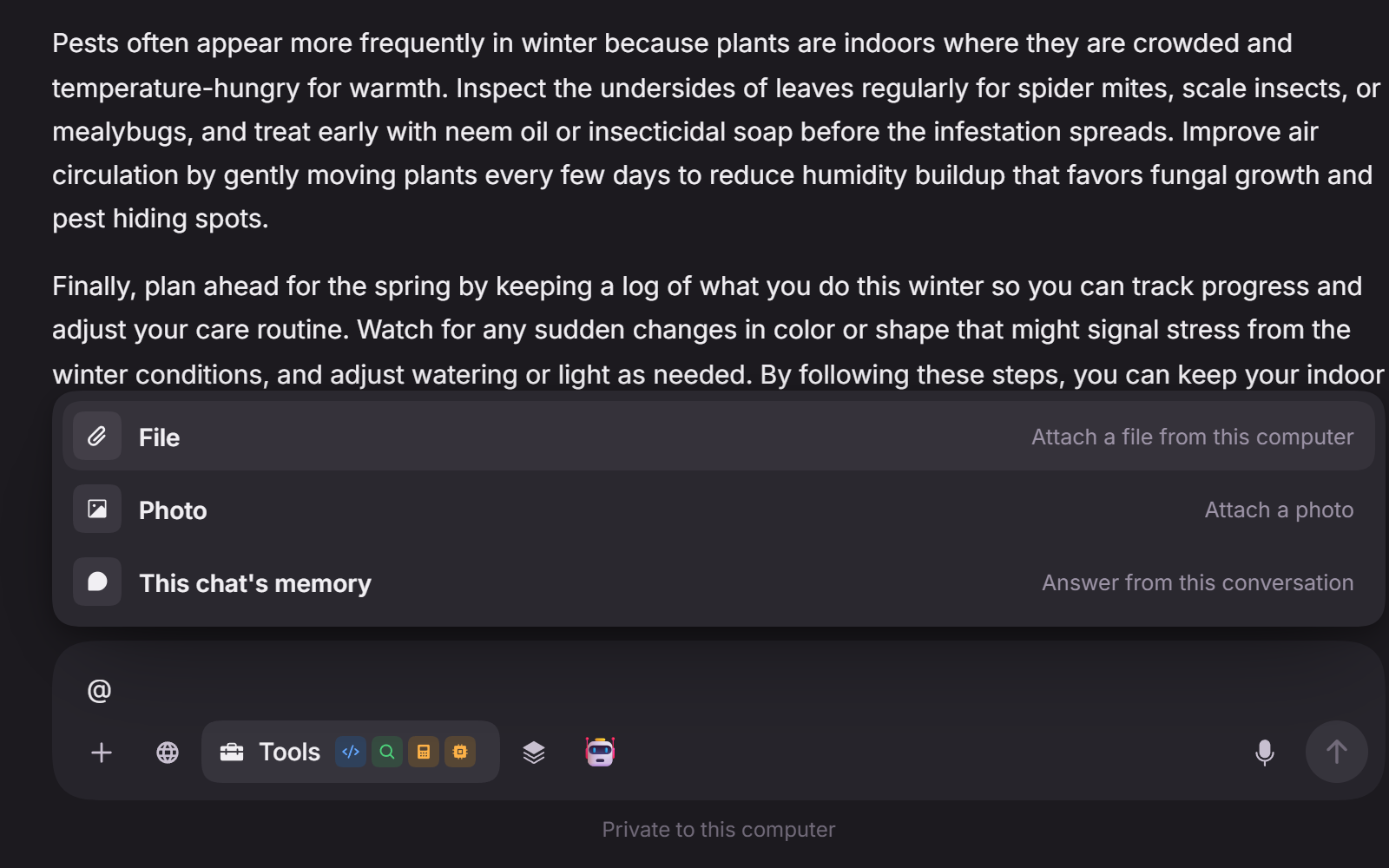 @ mentions: attach a file or answer from a memory |
Enter sends, Shift+Enter starts a new line, Esc stops, ↑ edits your last message. Long pasted text becomes a chip with its size in tokens.
Explore the app
Real recordings of a first look around, with no model loaded.
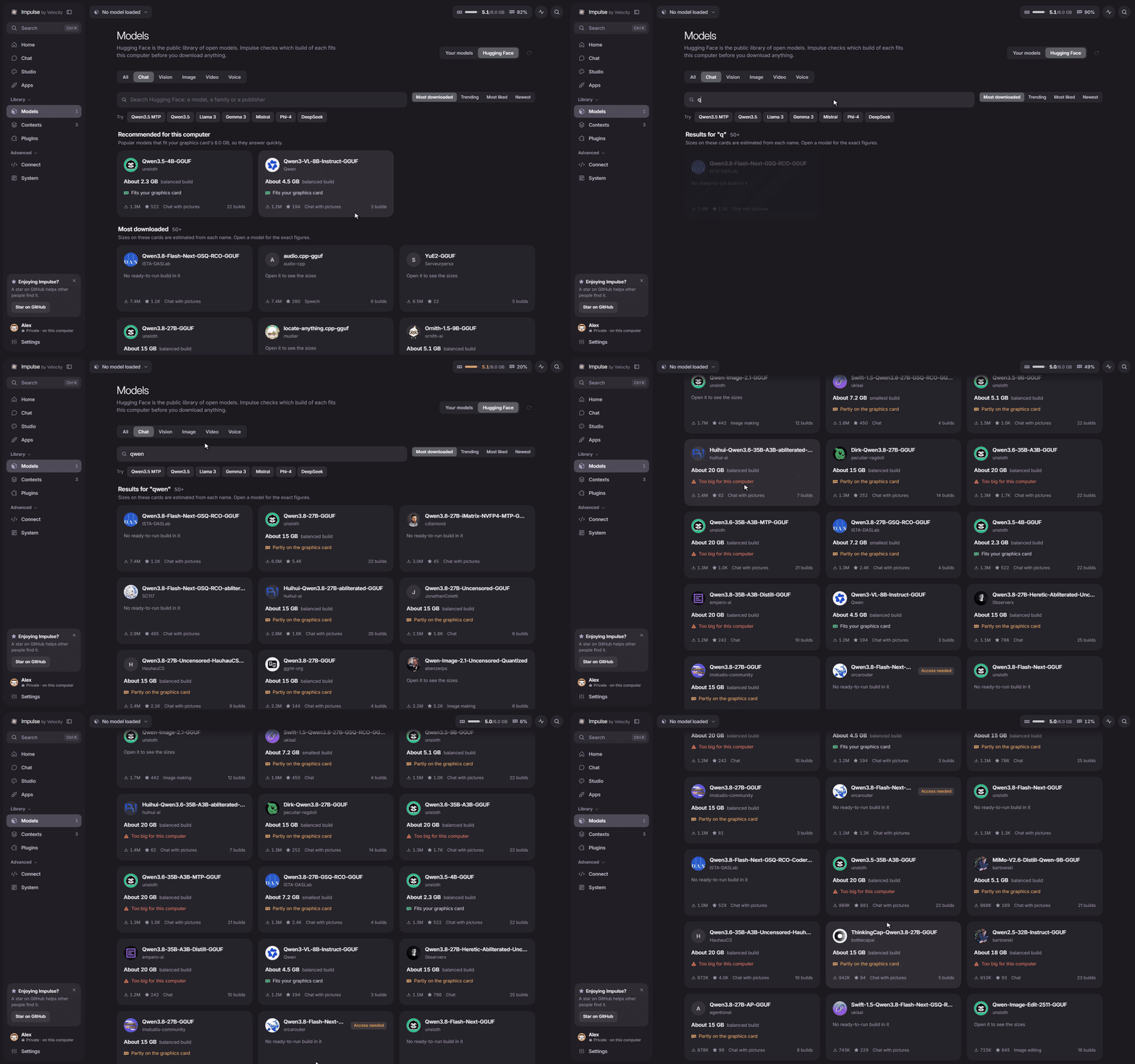
Models and Hugging Face: search, filter, and every build checked against your card
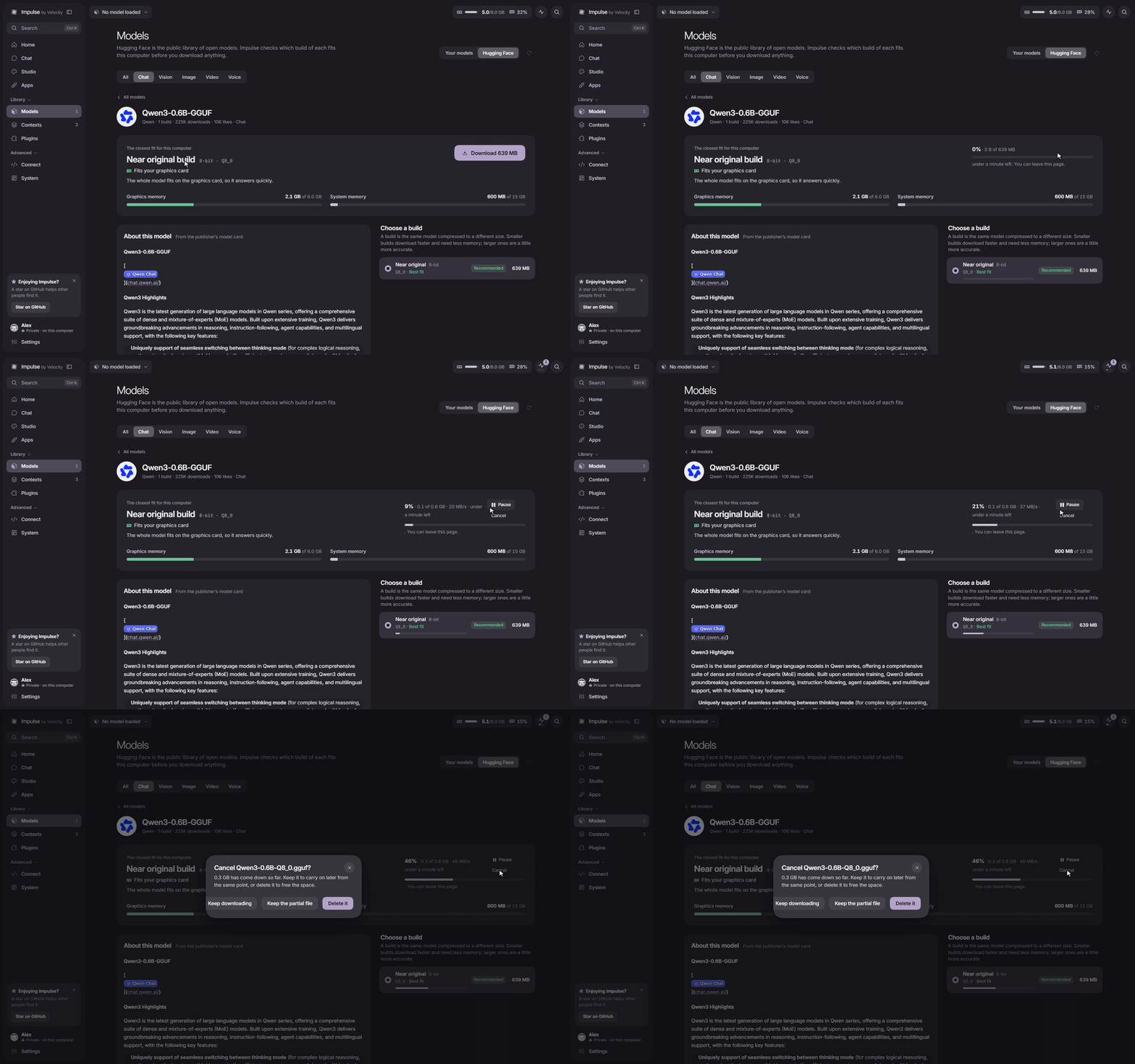 A download: a 610 MB build, picked to fit this card |
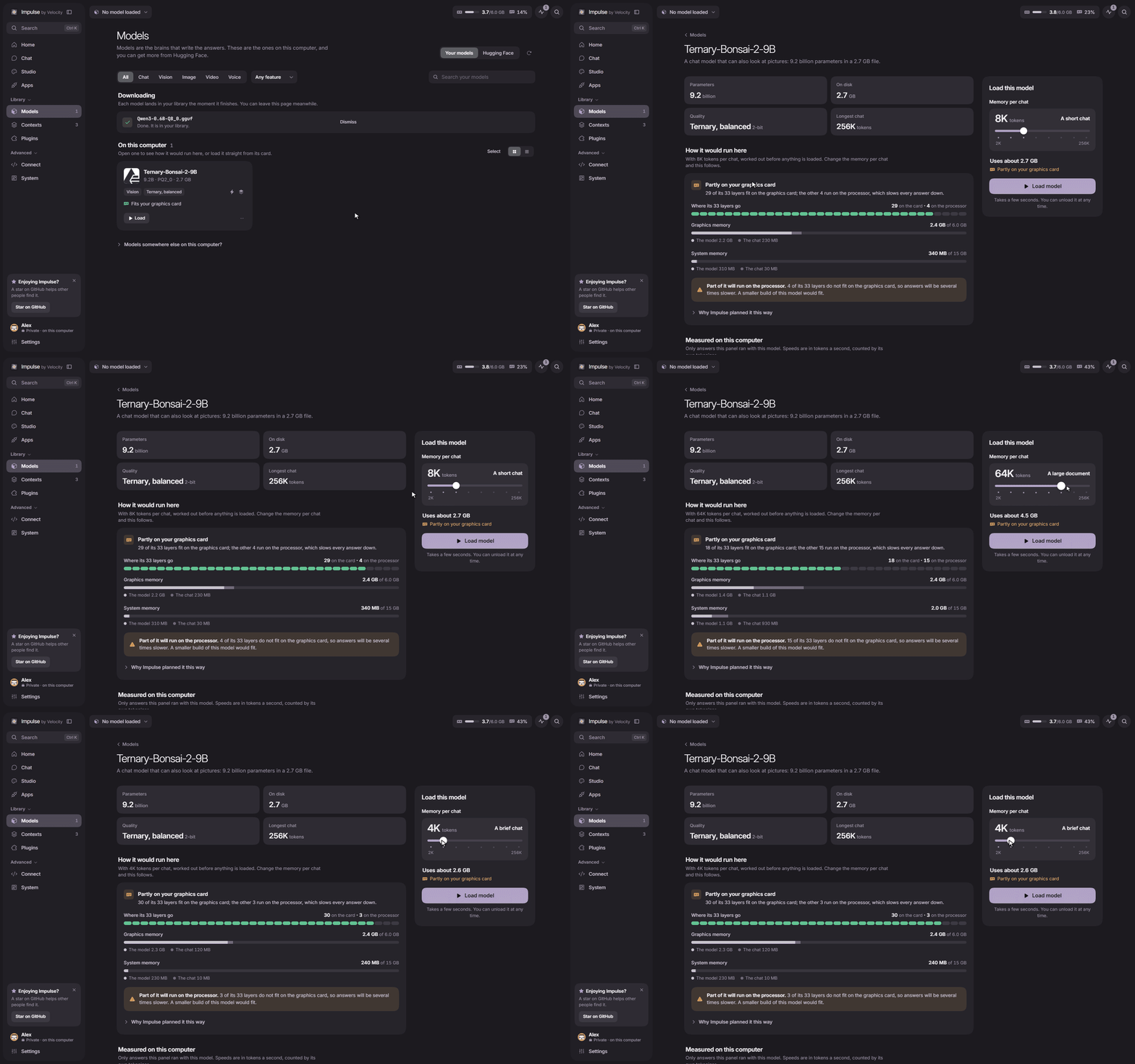 Your models: memory per chat, and where the layers go |
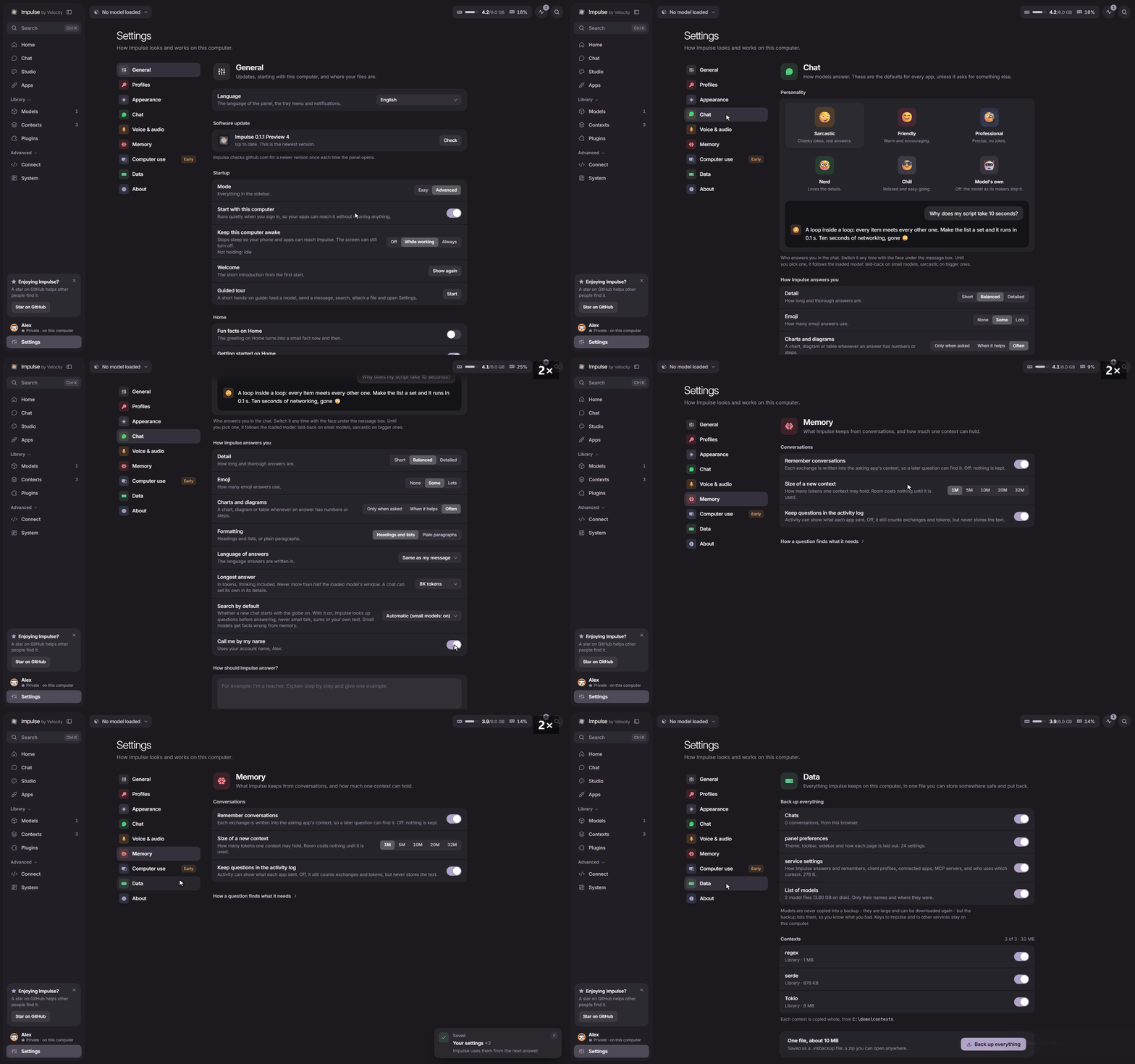 Settings: chat style, memory size and backups |
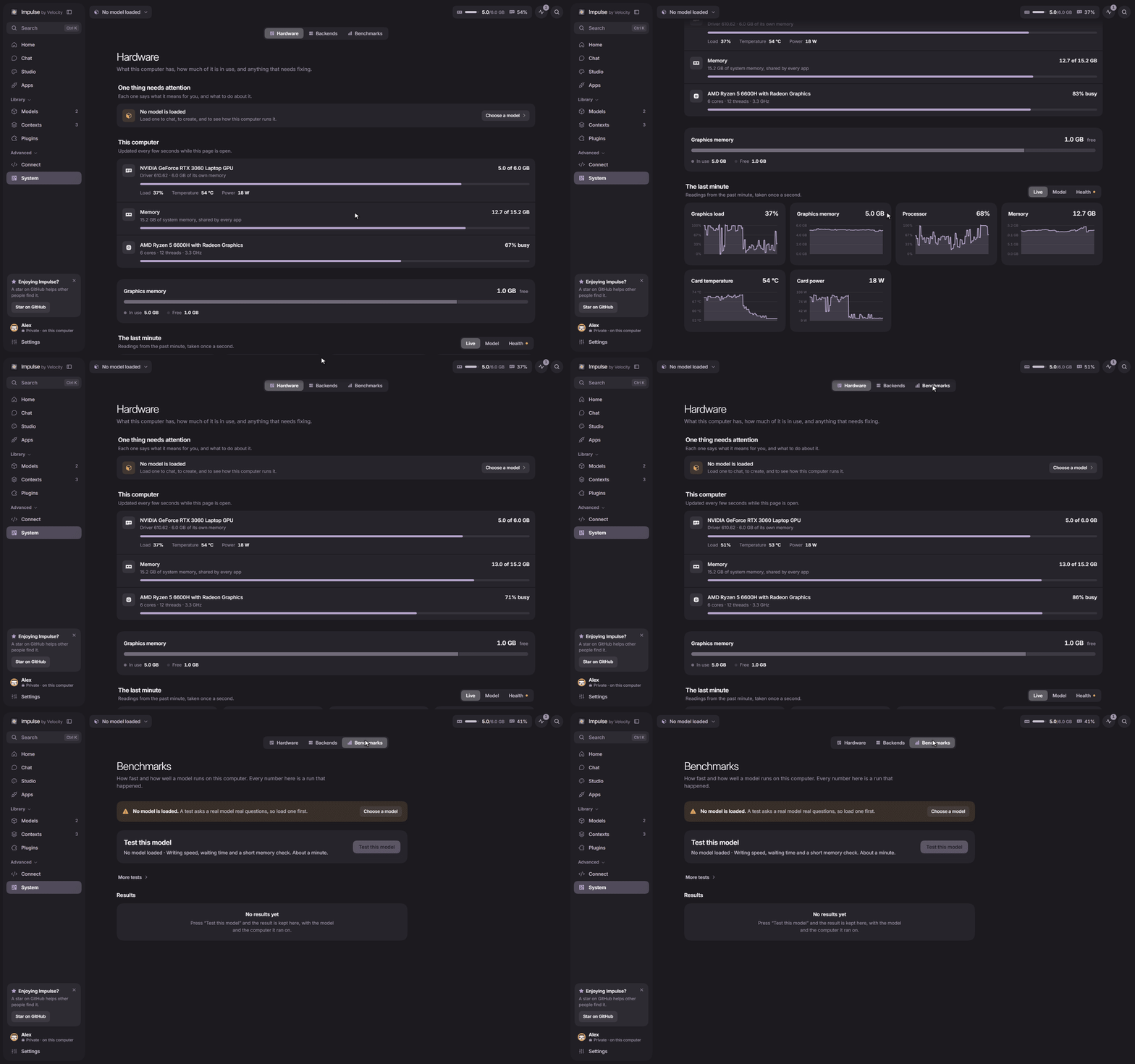 Hardware: the card, memory and engines, live |
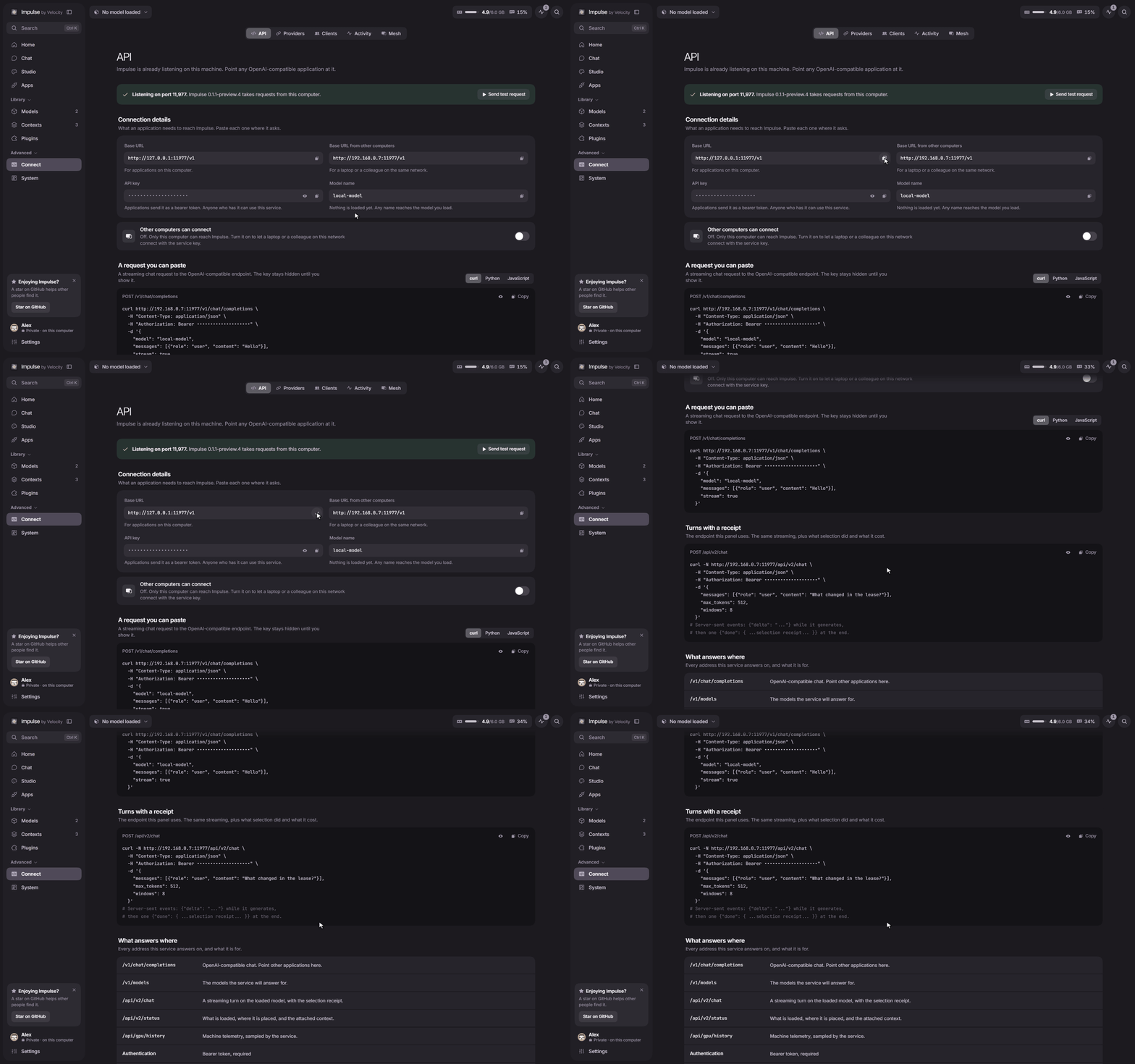 Connect: one address and key for every app |
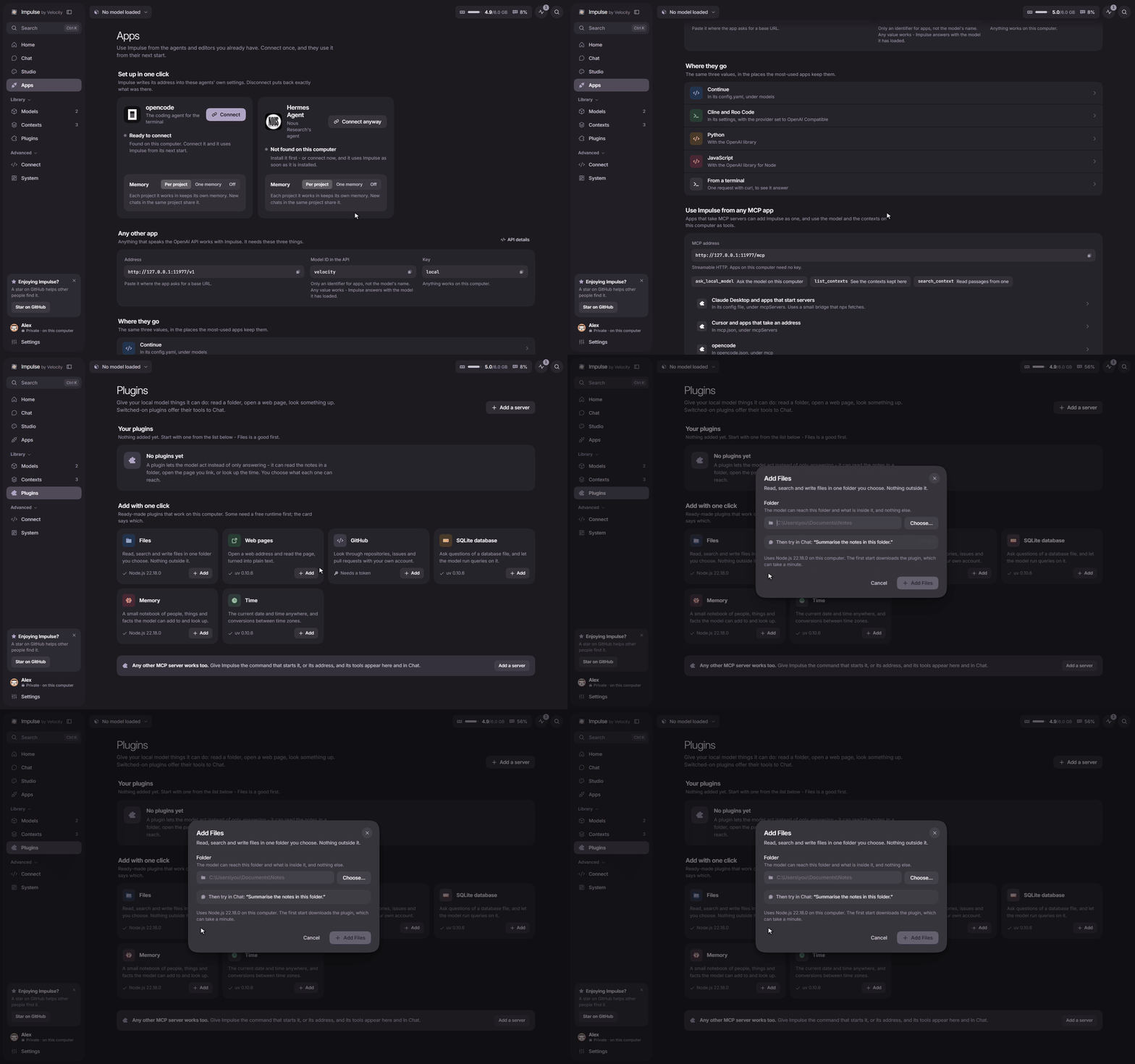 Apps and Plugins: agents in one click, MCP servers as presets |
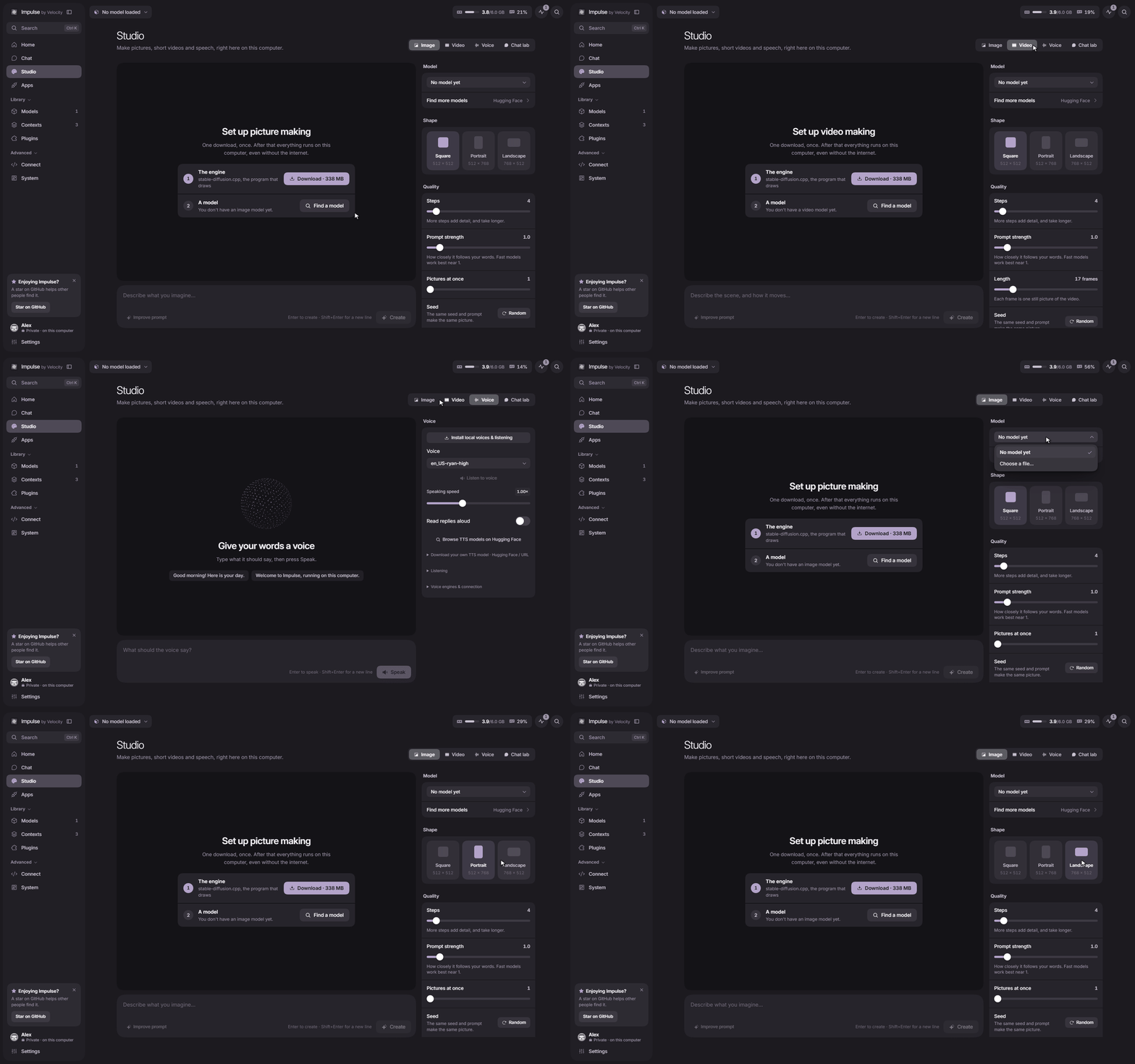 Studio: images, video and voice, set up in place |
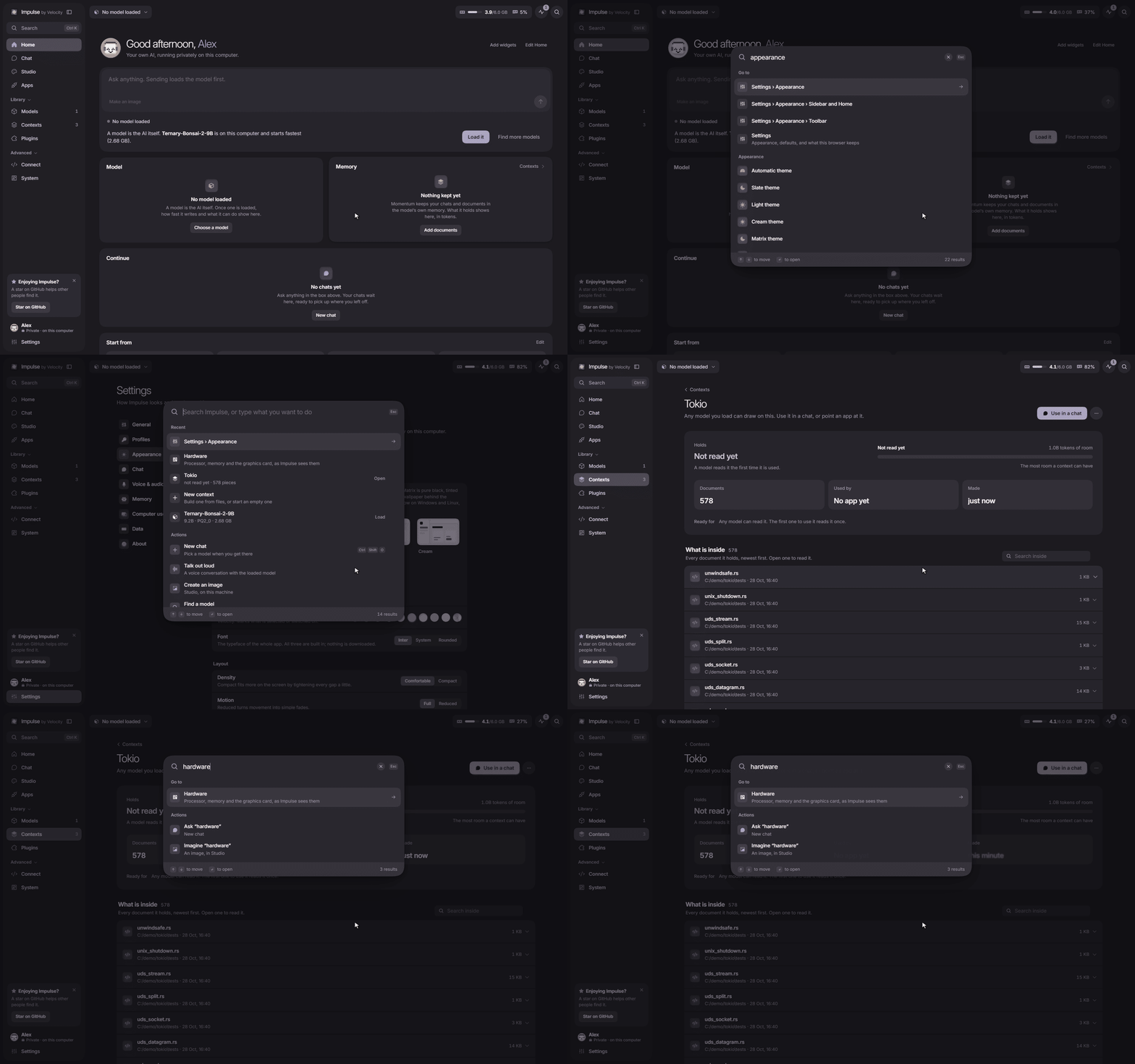 Ctrl+K: jump to a setting, a context or a page |
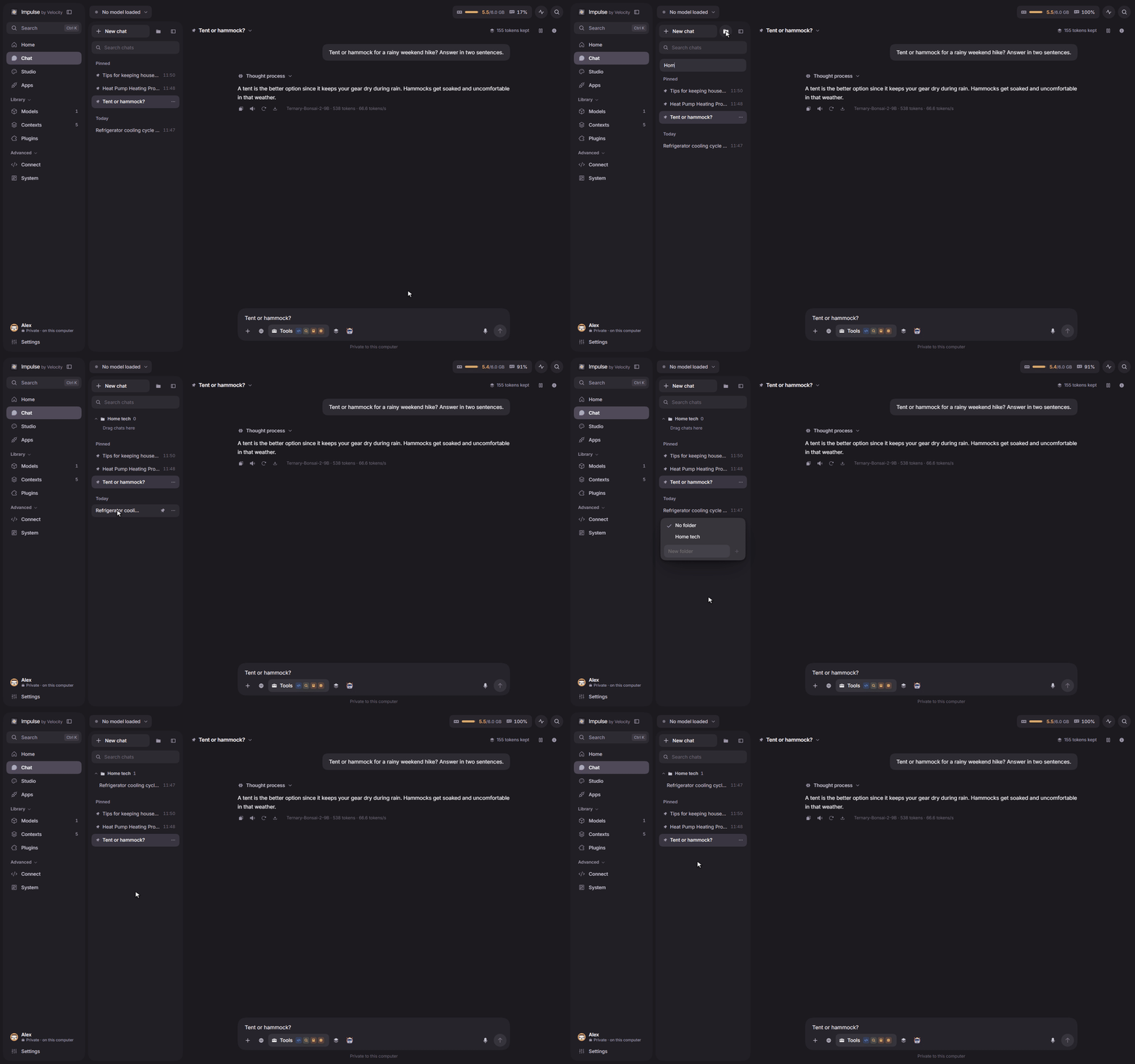 Folders: group chats in folders |
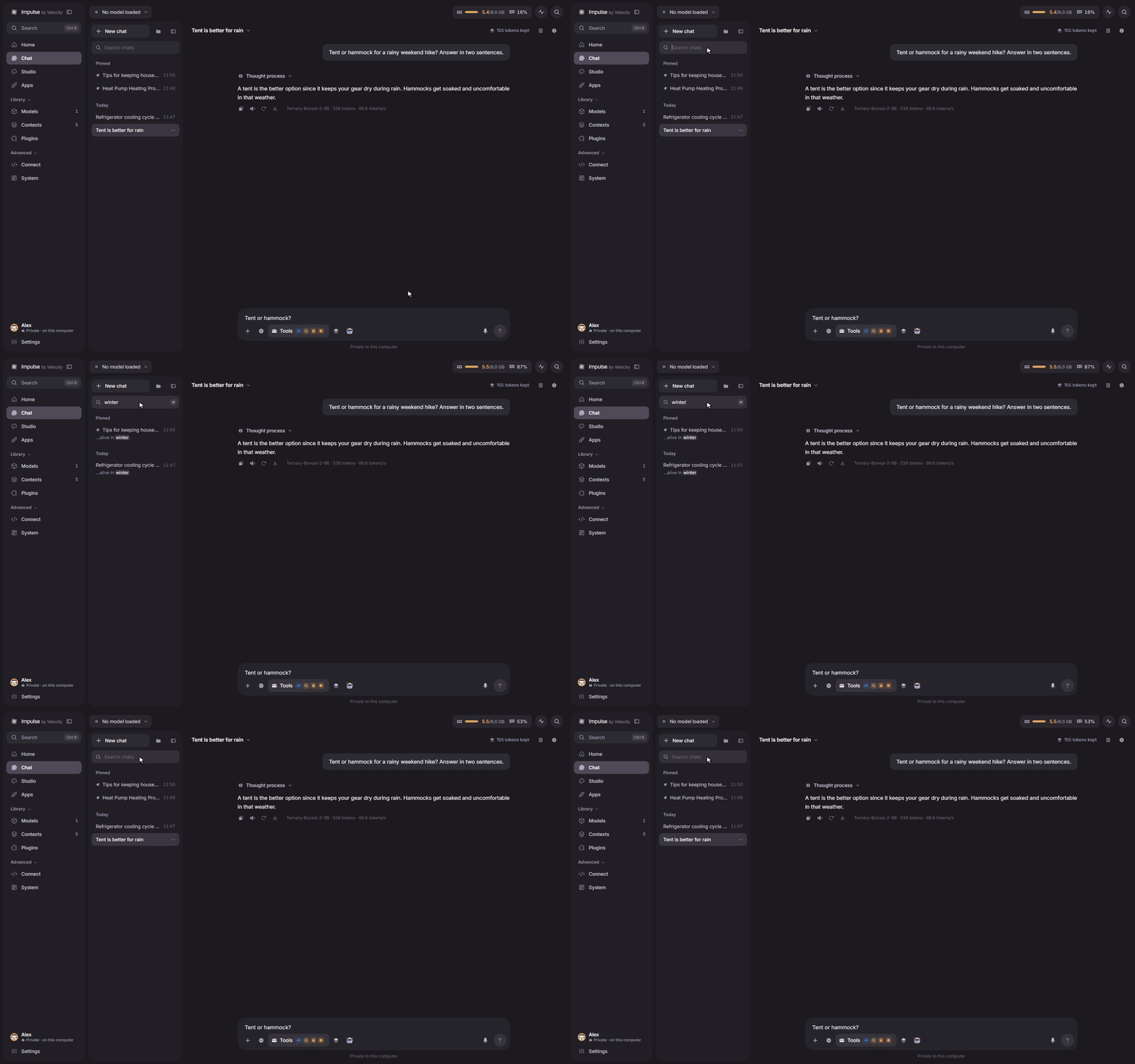 Find a chat: every chat searched, matches marked |
Computer use
Your local model can open apps, click, type and fill in forms. It reads each window's buttons and fields directly instead of guessing from pixels, and falls back to a screenshot for apps that do not describe themselves.
Its own cursor. A second pointer shows where it is going and what it is doing. Your mouse stays yours.
You decide how much it may do. Watch only, Ask every time, Ask before risky actions (the default), or Act without asking. It is off until you turn it on.
You can always stop it. Esc, Stop, or moving the mouse into the top-left corner halts it at once. Pause, Take over and Continue hand control back and forth.
- It never types into password fields, always asks before closing unsaved work, and never acts on a window you did not name.
- Choose which screen it works on. Every action is recorded in an activity log.
- It works with the sandbox: take something from the screen, process it in Python, put the result back.
Measured. Tested with Qwen3.5-4B on Notepad and Calculator tasks: 4 of 4 passed. Reading a window takes 40-120 ms, and an action takes about half a second.
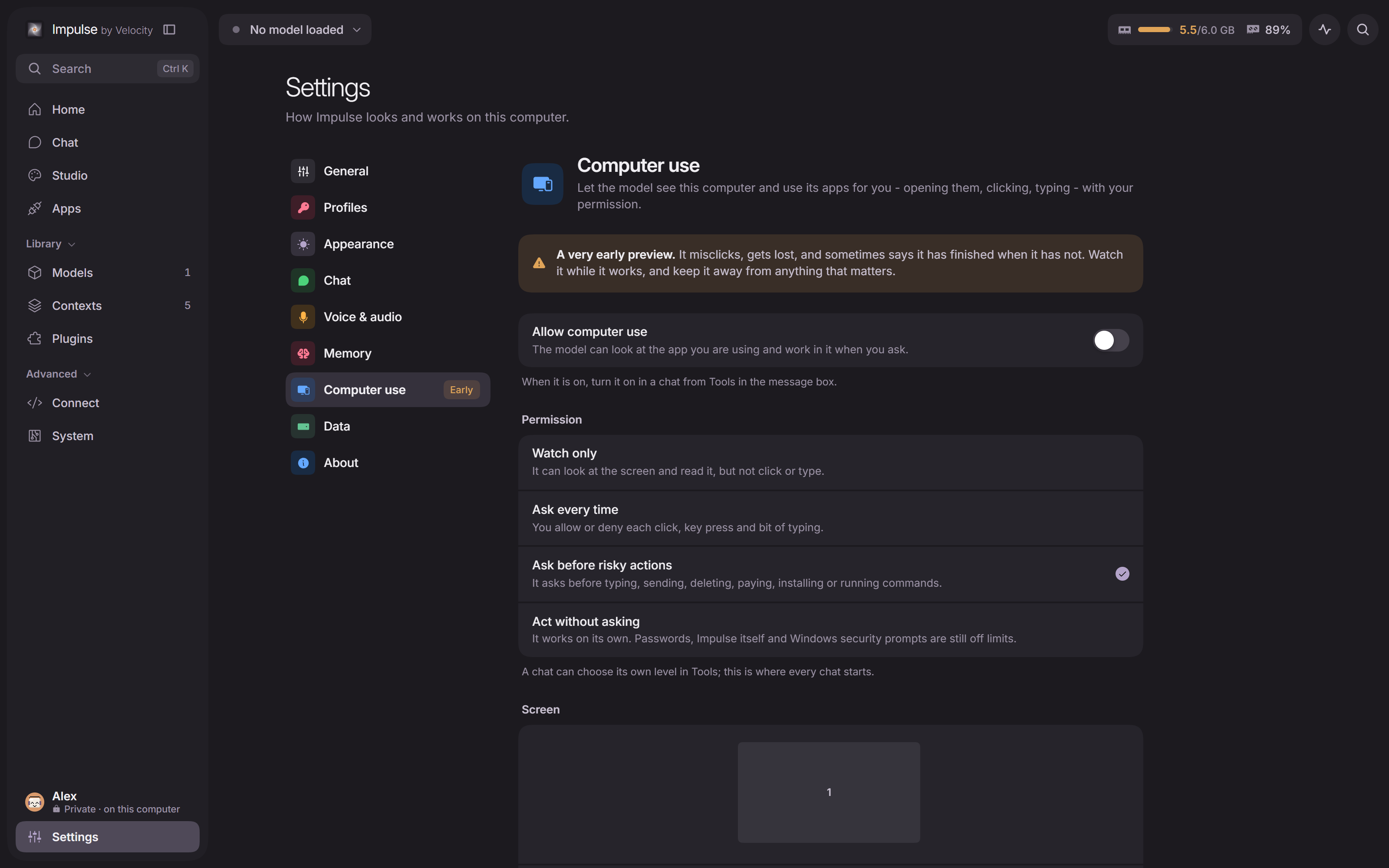
Computer use: one switch, four permission levels, and the screen it works on
Computer use is new and Windows only. Start with Ask before risky actions, and check what matters.
Look inside the model
How the last answer was written, one token at a time: what the model chose, how sure it was, and what it nearly said. Then the model itself: every layer, read straight from its file.
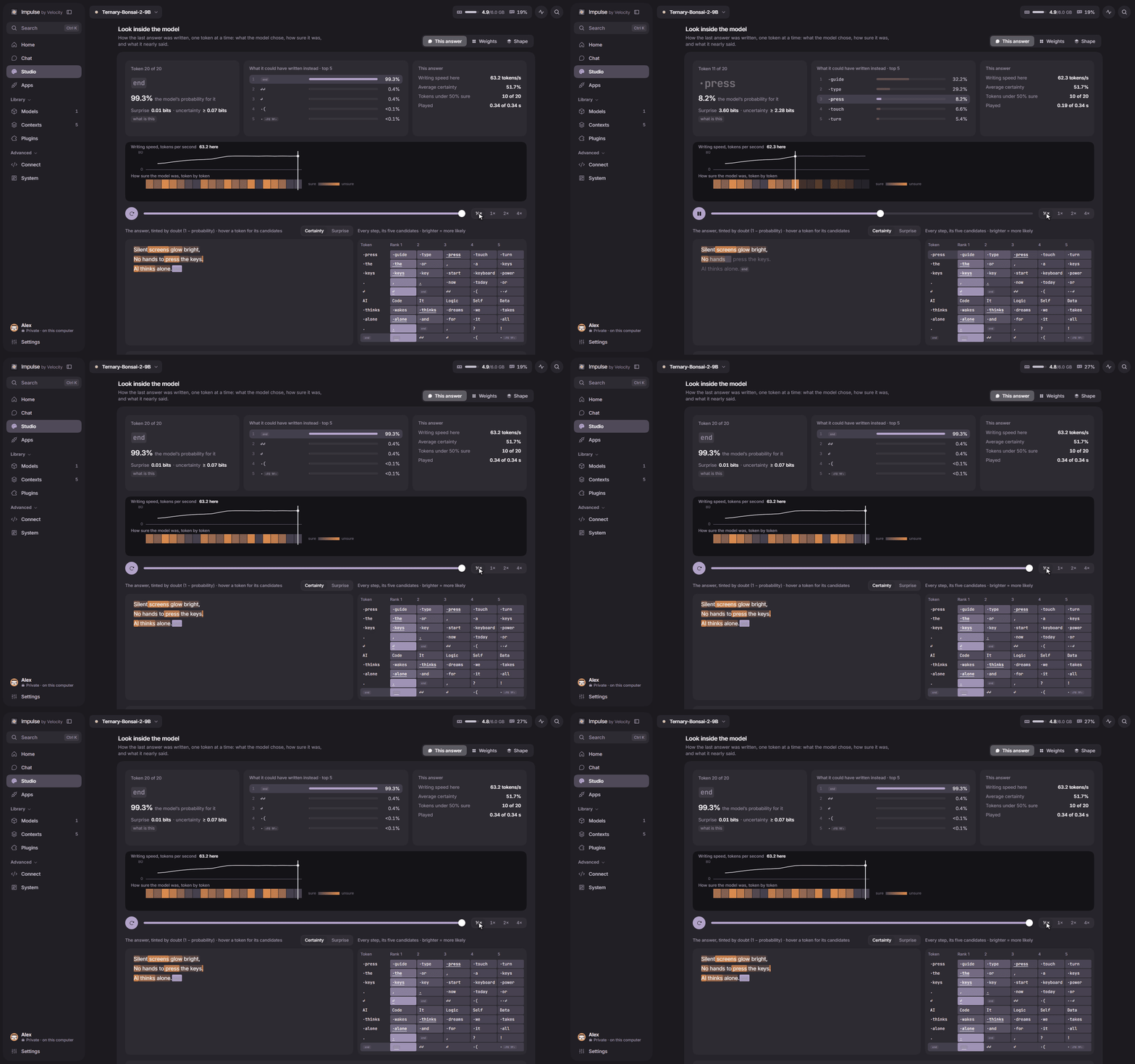
Replay: an answer, token by token, with what it nearly said
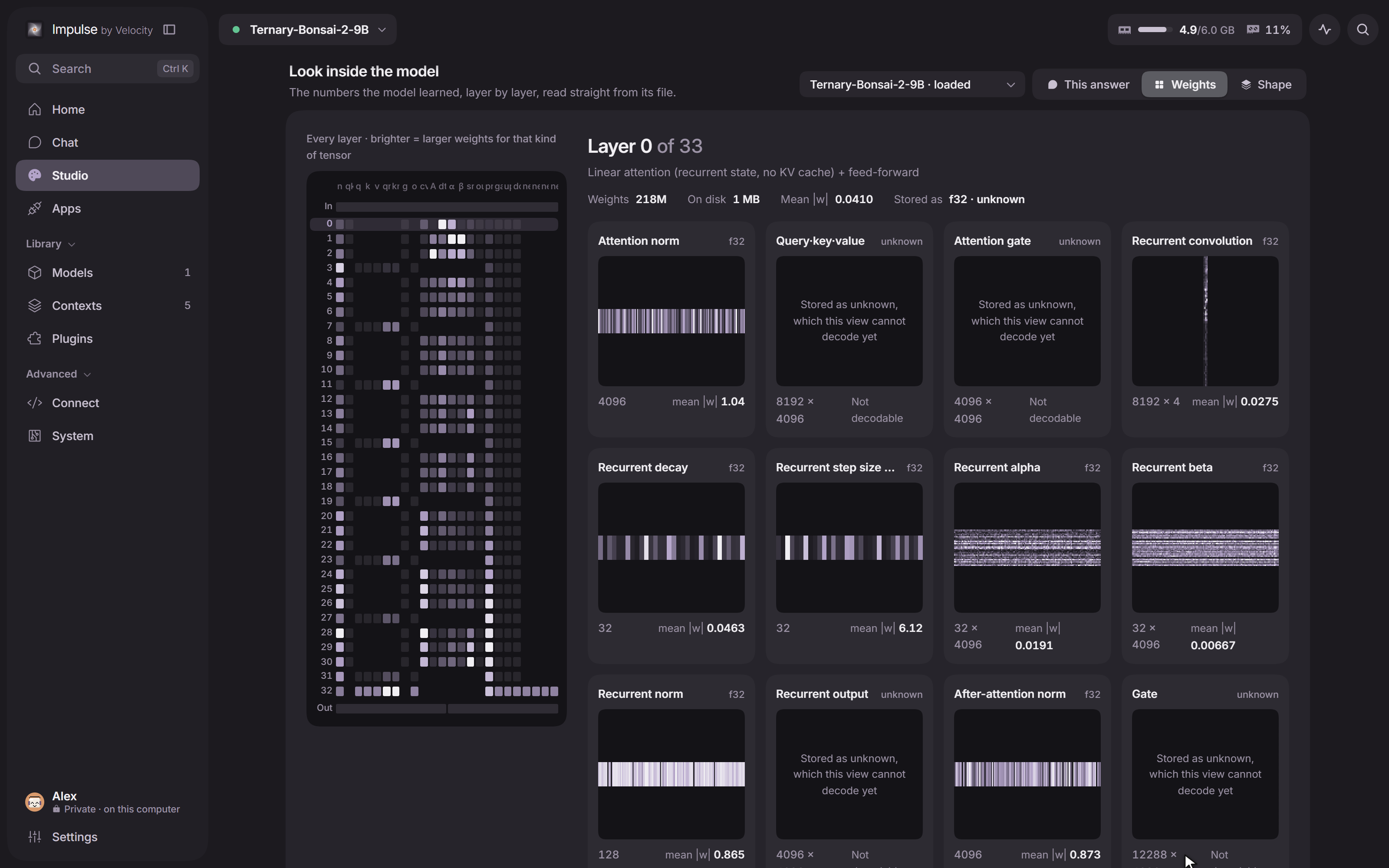 Weights: every layer, brighter where the weights are larger |
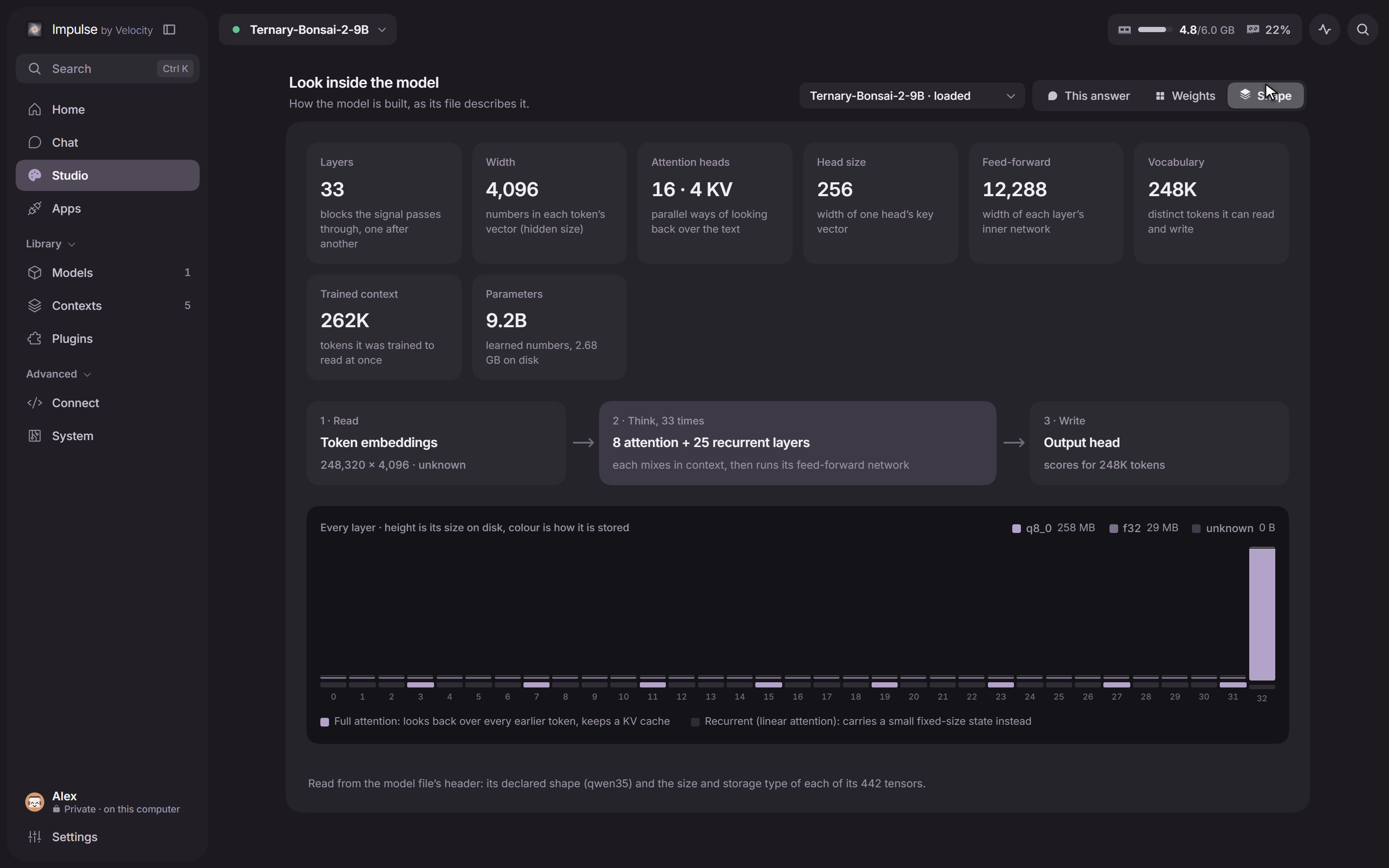 Shape: how the model is built, as its file describes it |
Studio, Plugins and Apps
| Studio | Images and video from local diffusion models, speech in over a hundred Piper voices, all on this machine. |
| Models | Search Hugging Face from the panel; each build is checked against your card before it downloads. |
| Plugins | Any MCP server (a folder, GitHub, a database) with one-click presets. Enabled plugins offer their tools in Chat. |
| Apps | One-click connection for opencode and Hermes Agent; one address for everything else. |
| Mesh | Every machine in your home as one: a model too big for one card is split across them. |
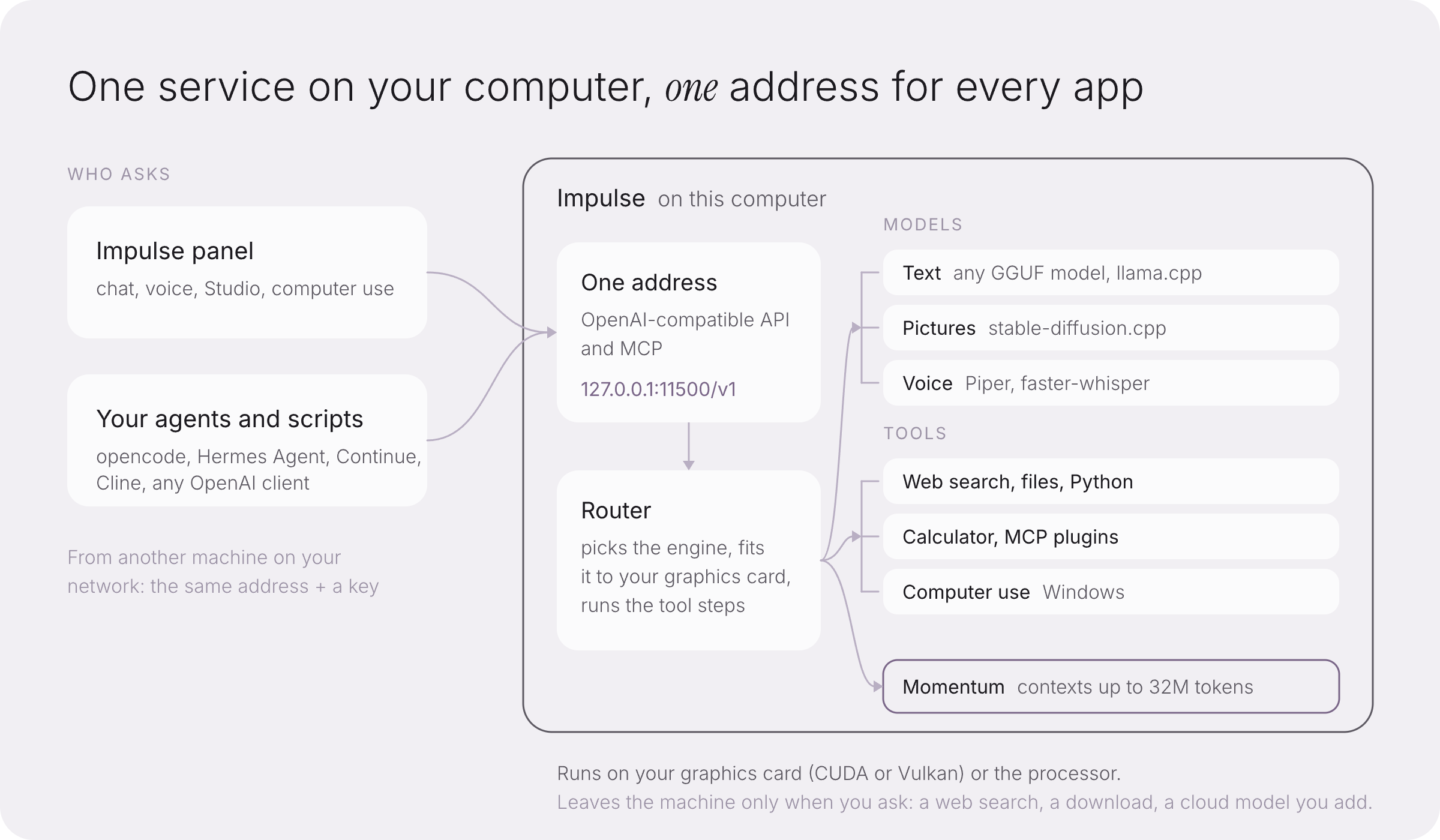
The details
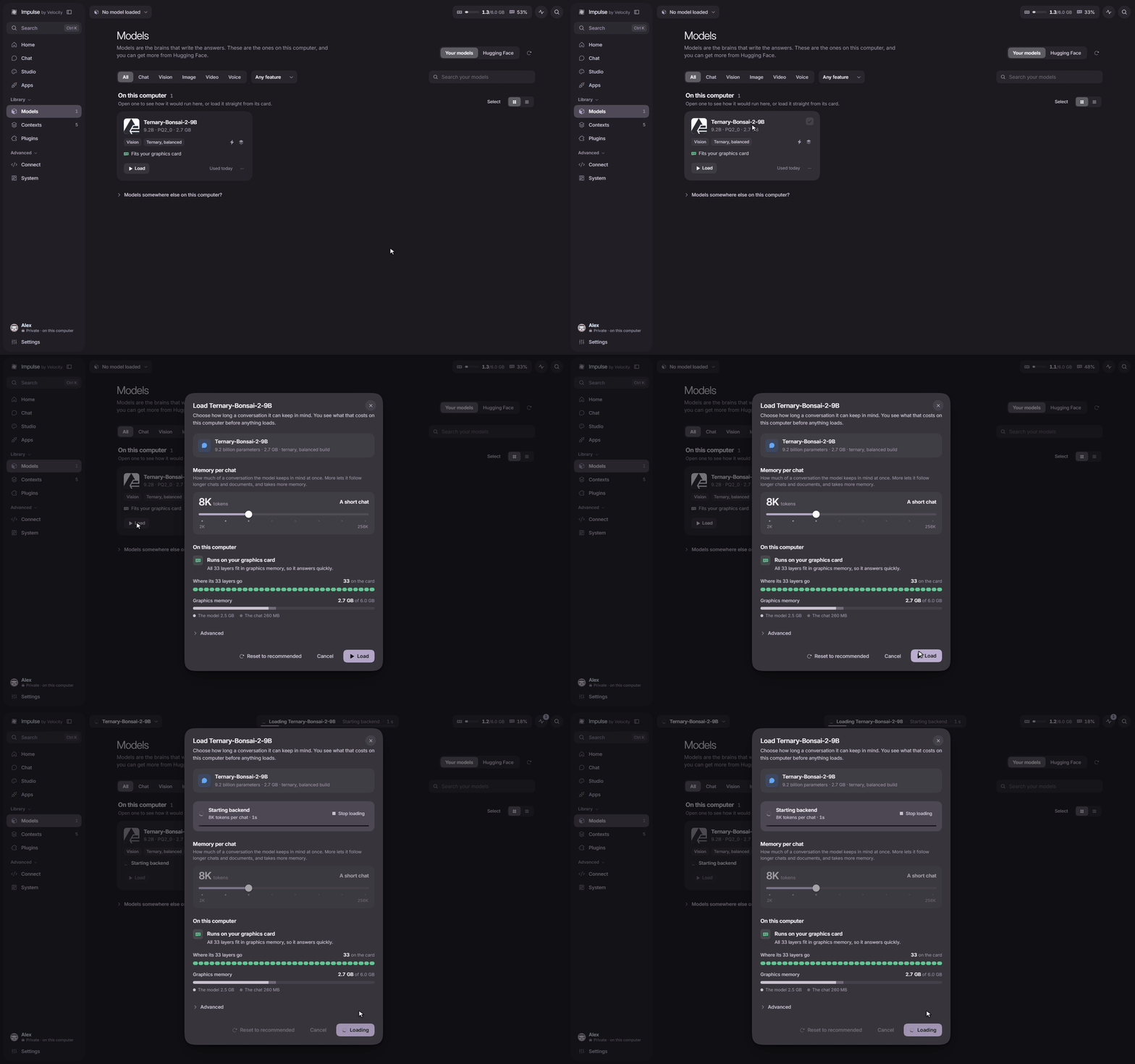
Load a model: the sheet says what fits your card before it starts
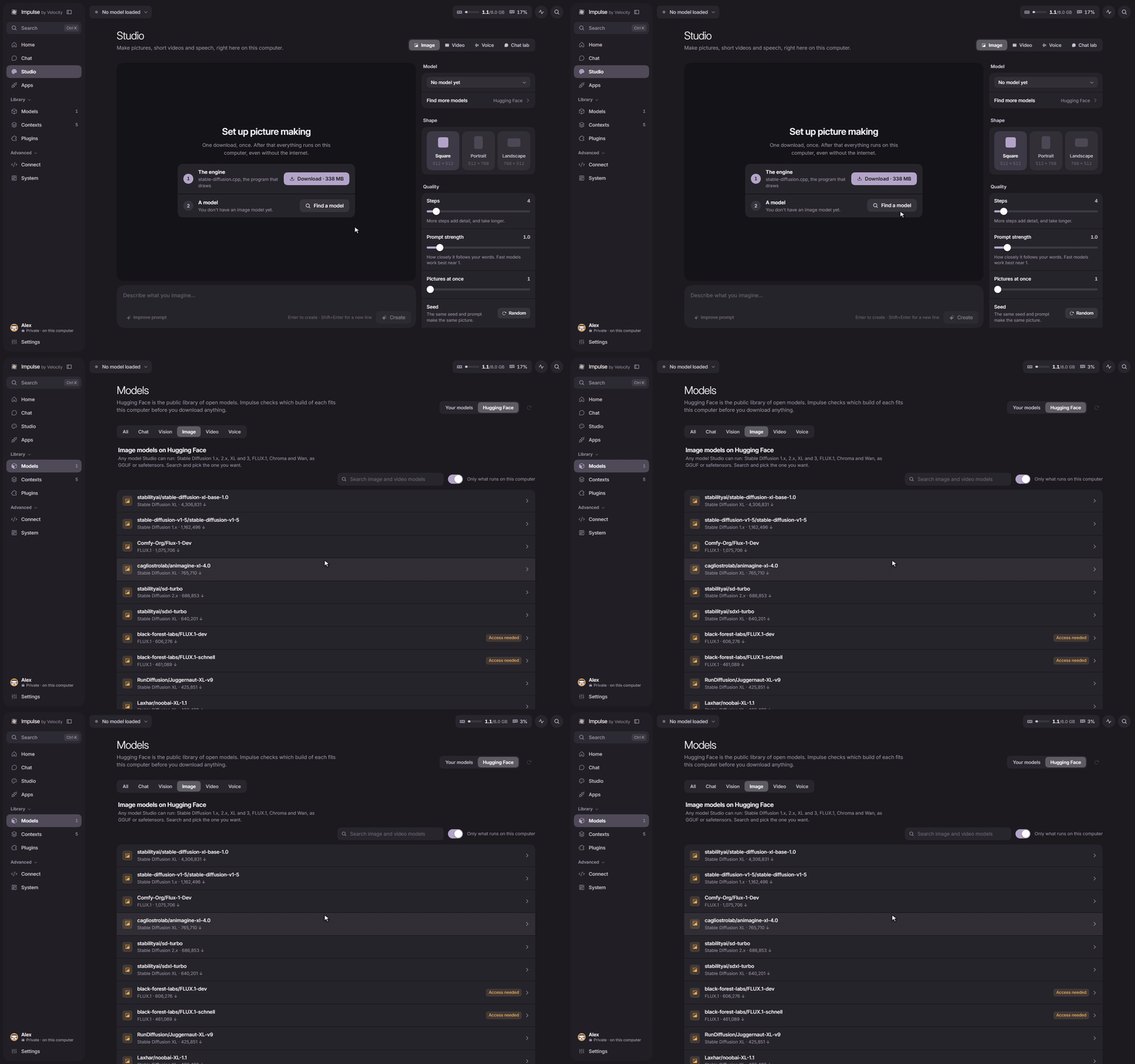 Find a model: from an empty Studio to the models that run here |
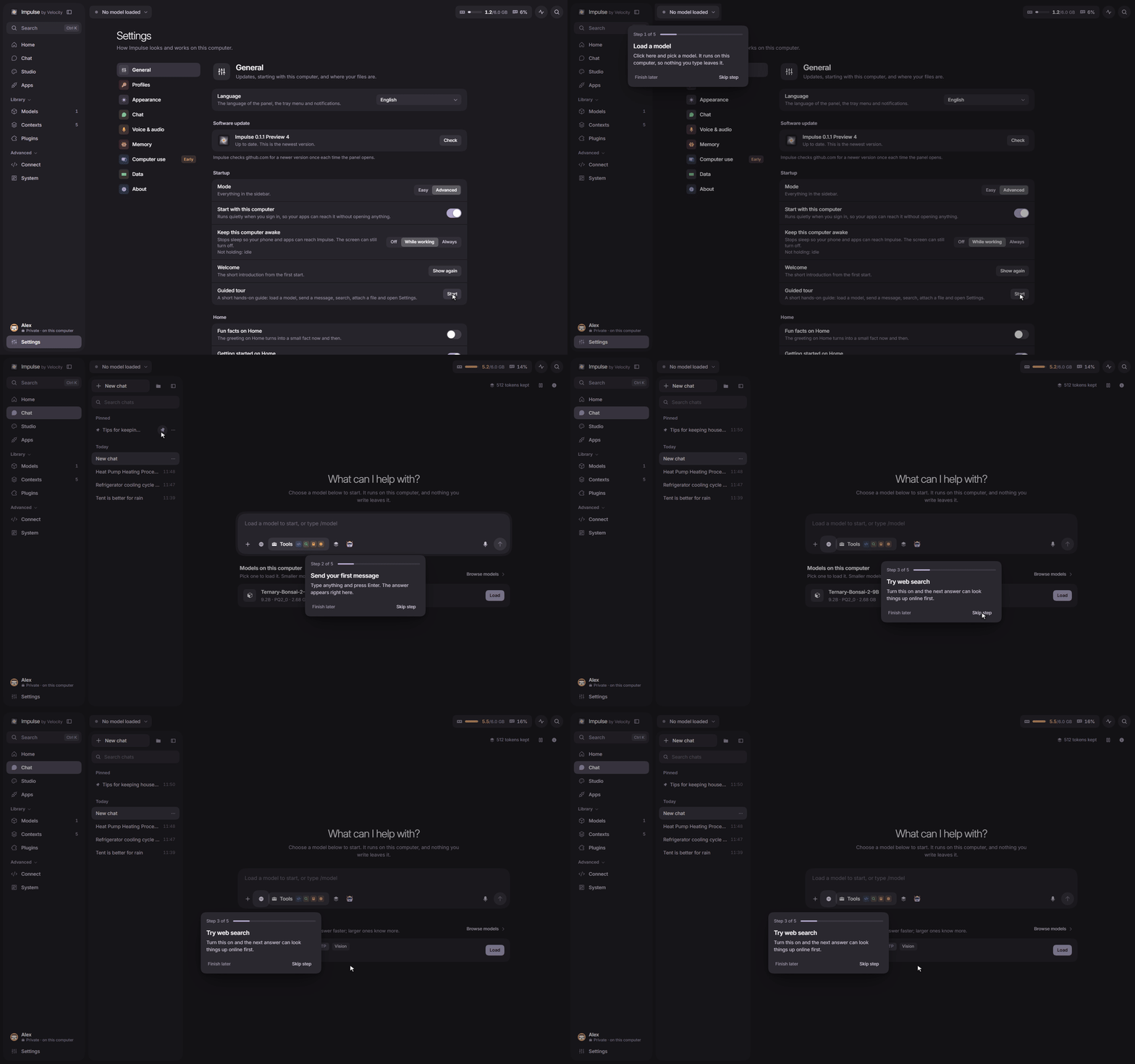 Guided tour: it points at each place the first time |
Make it yours
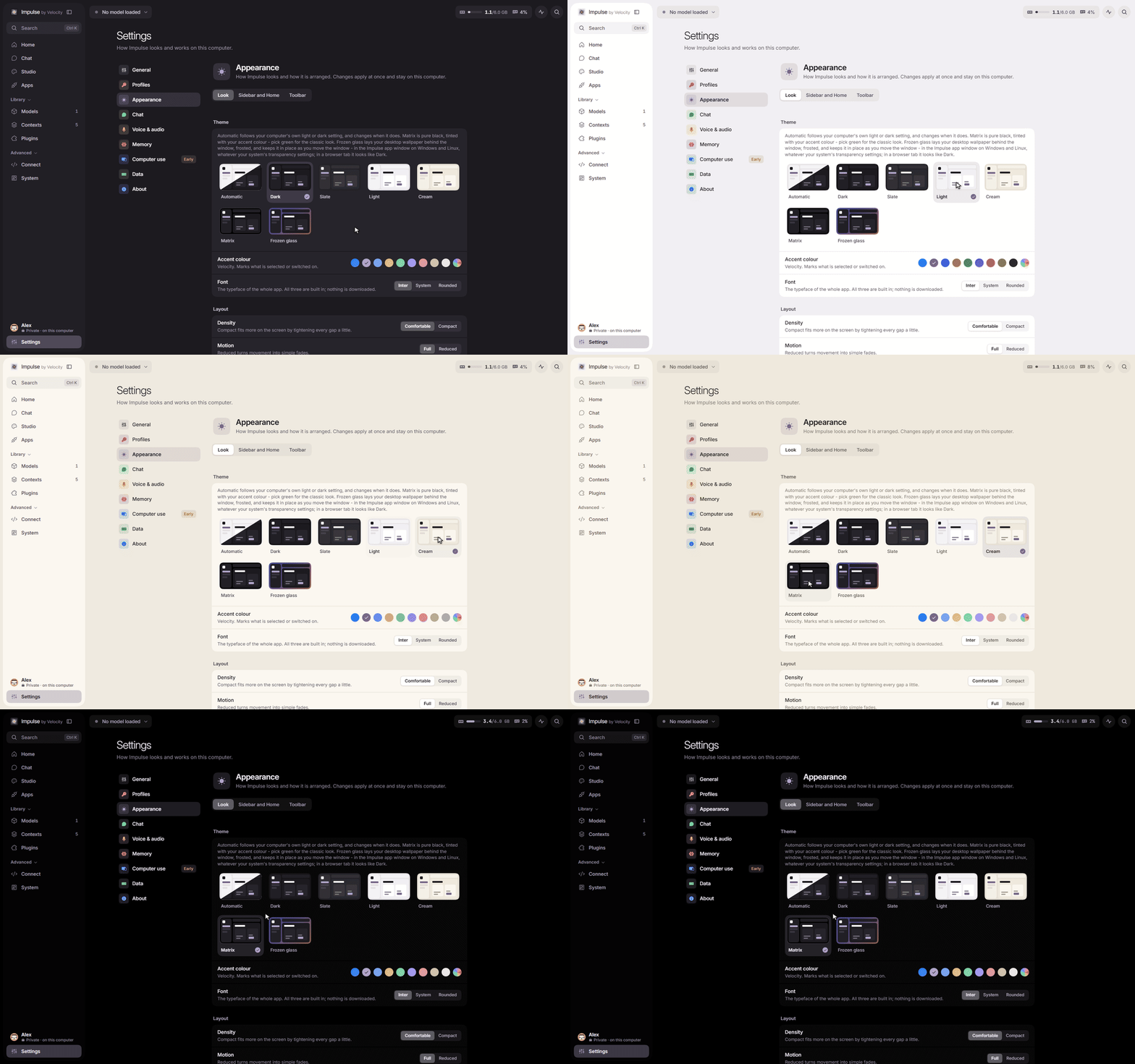
Themes: Dark, Light, Cream and Matrix, applied at once
Home and the sidebar, arranged your way. Drag widgets by their handles, resize them, add or remove what you do not use. The sidebar shows what you choose, in your order, under your headings.
Themes. Dark, Slate, Light and Cream, or follow the system, with nine accents.
Your account. A name for the greeting, and an optional password required before the panel opens. Apps keep working with the API key; the password only protects the panel.
Backups and restore. Everything Impulse keeps (chats, preferences, service settings, contexts) in one file you can store anywhere, on a schedule if you like, and restore on a new machine.
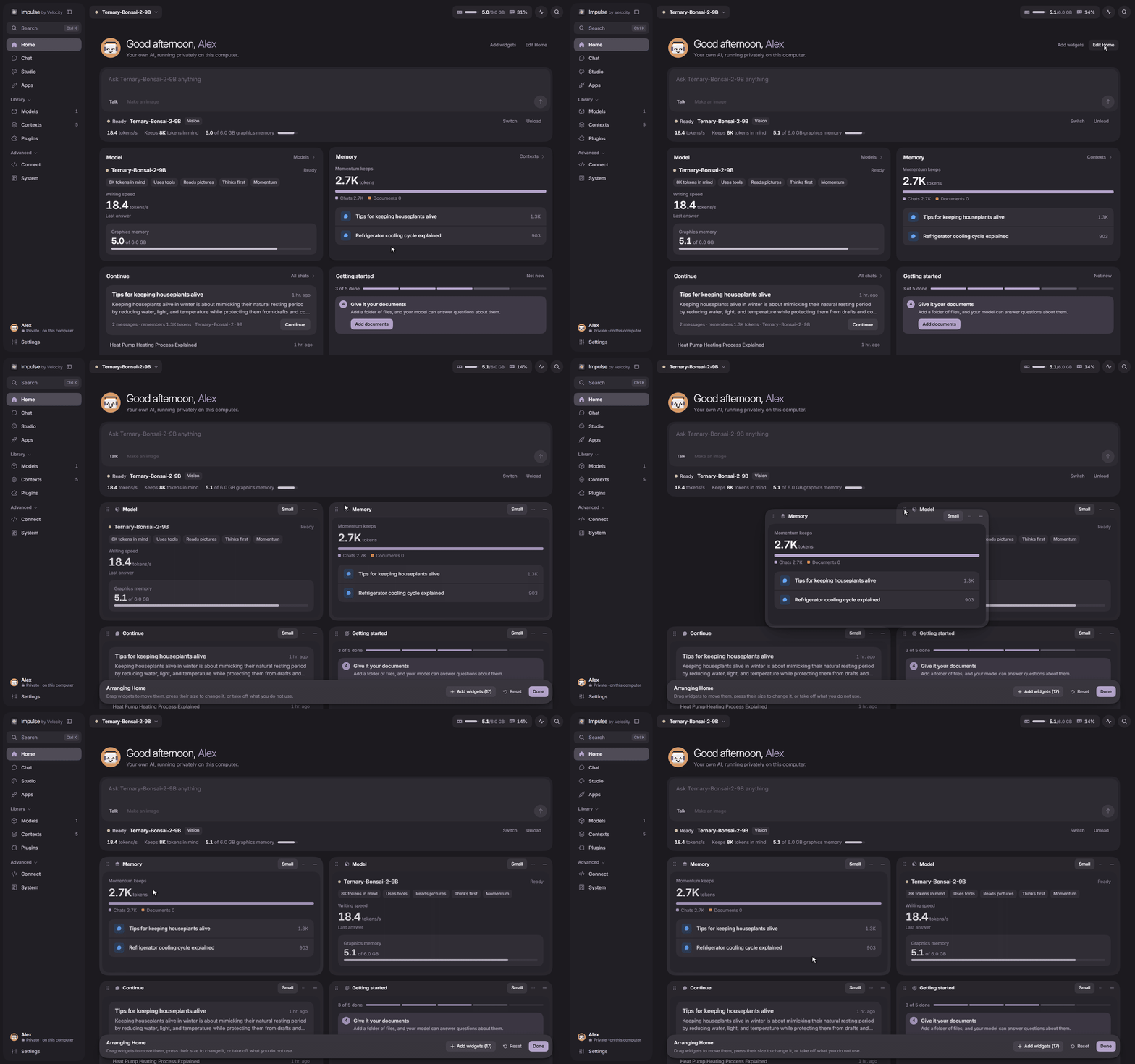 Arranging Home: drag, resize, add |
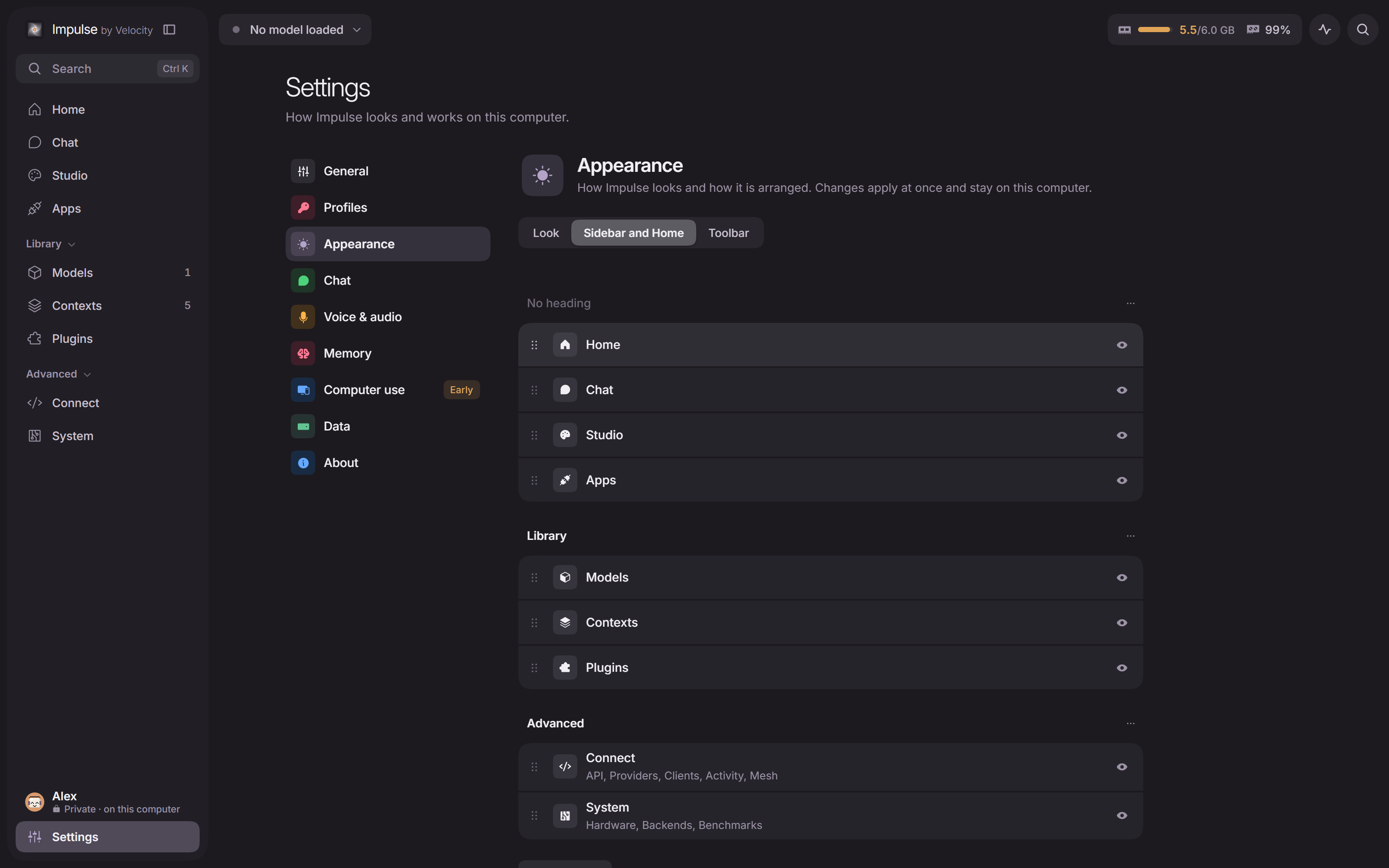 Sidebar: your pages, your order |
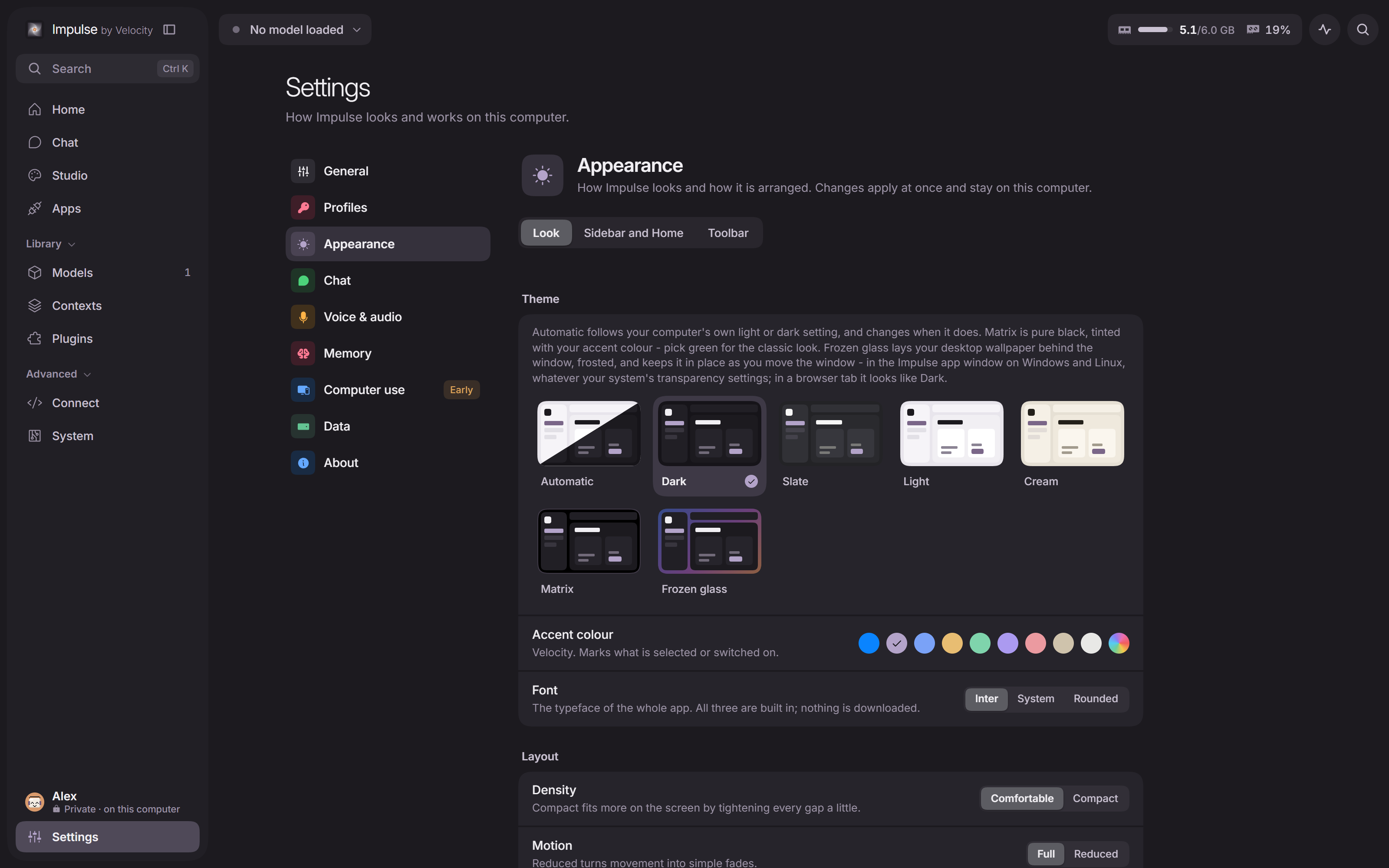 Appearance: themes, accents and fonts |
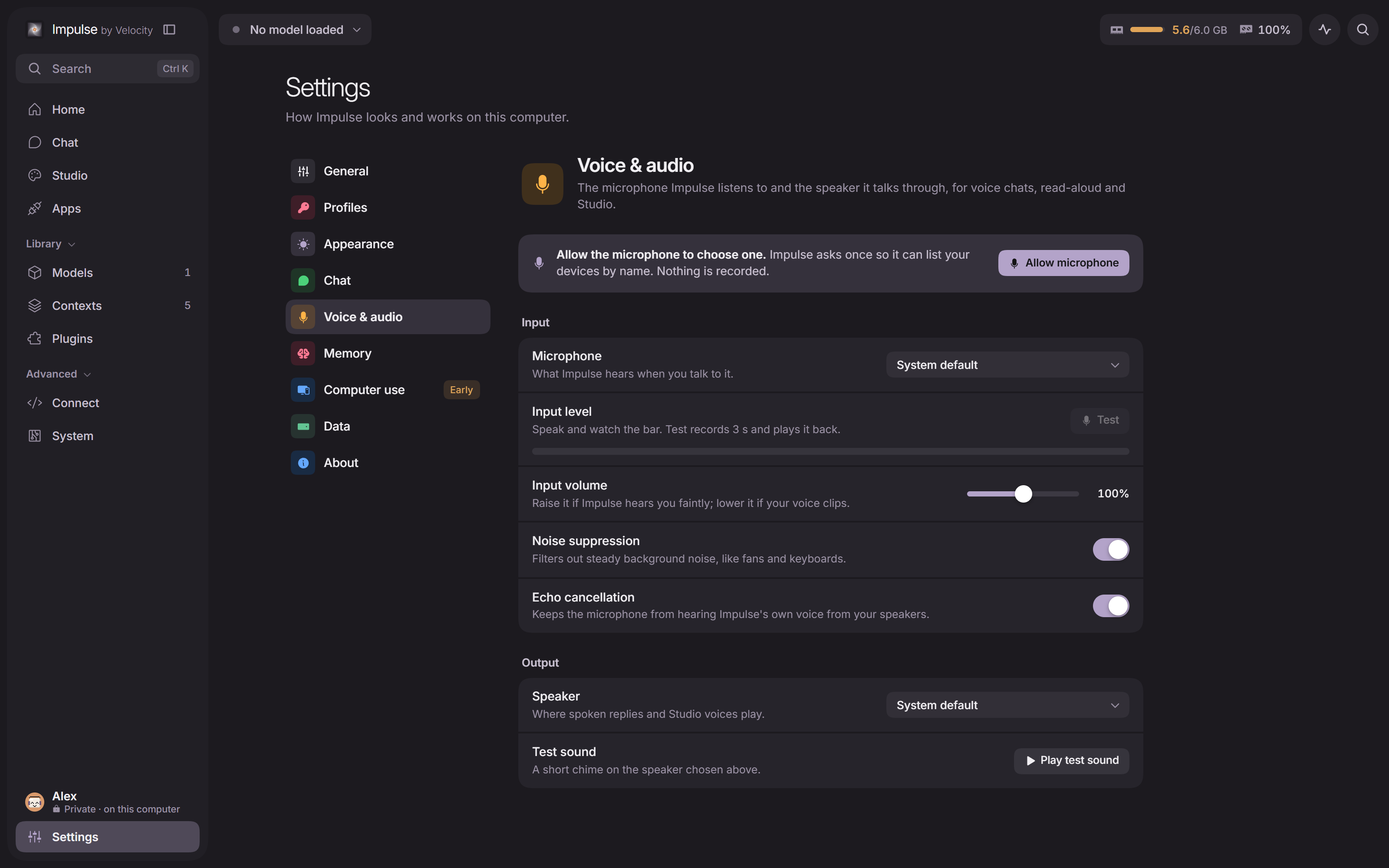 Voice & audio: microphone and speaker, tested in place |
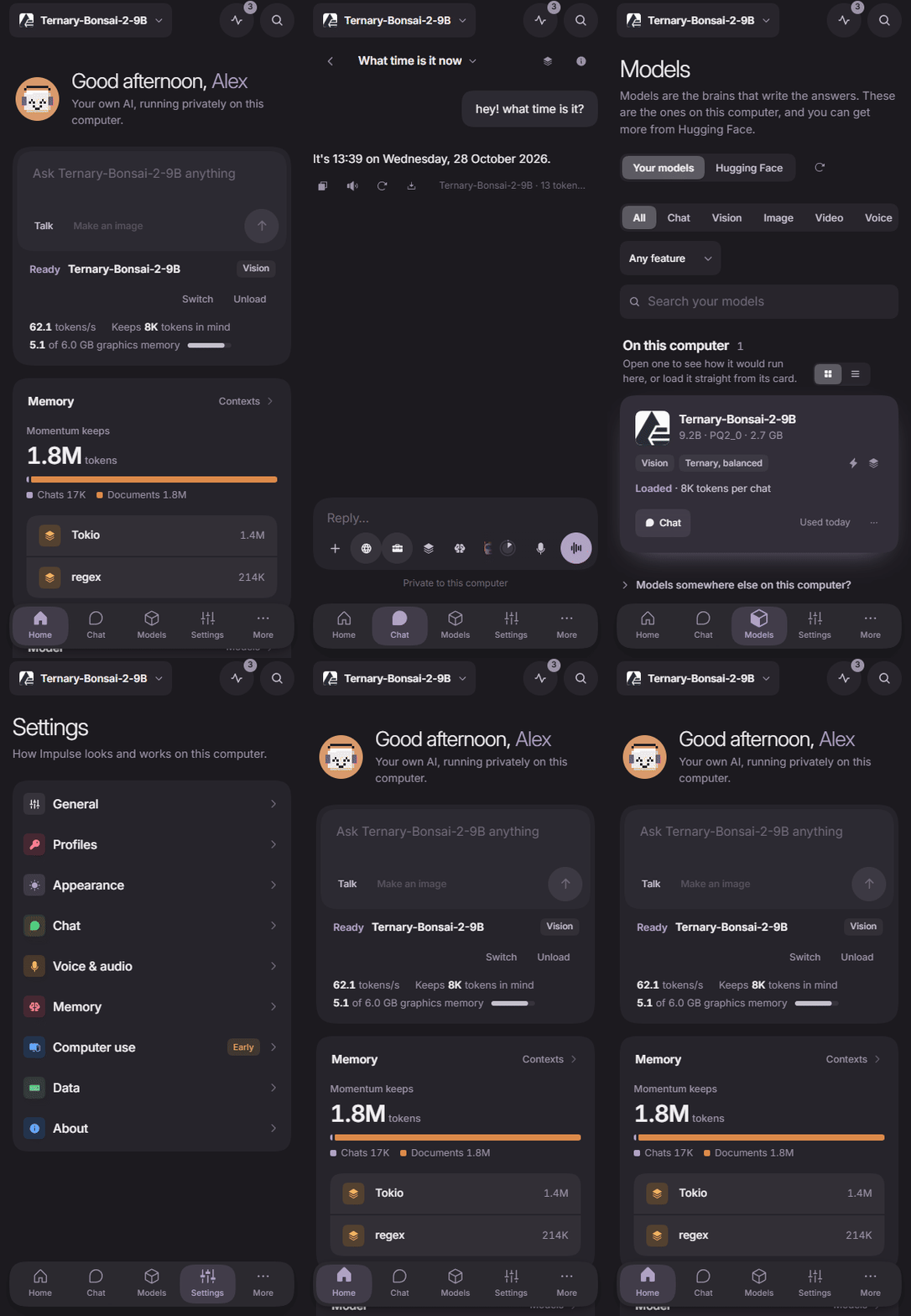 On a phone: the same panel, with a floating bar |
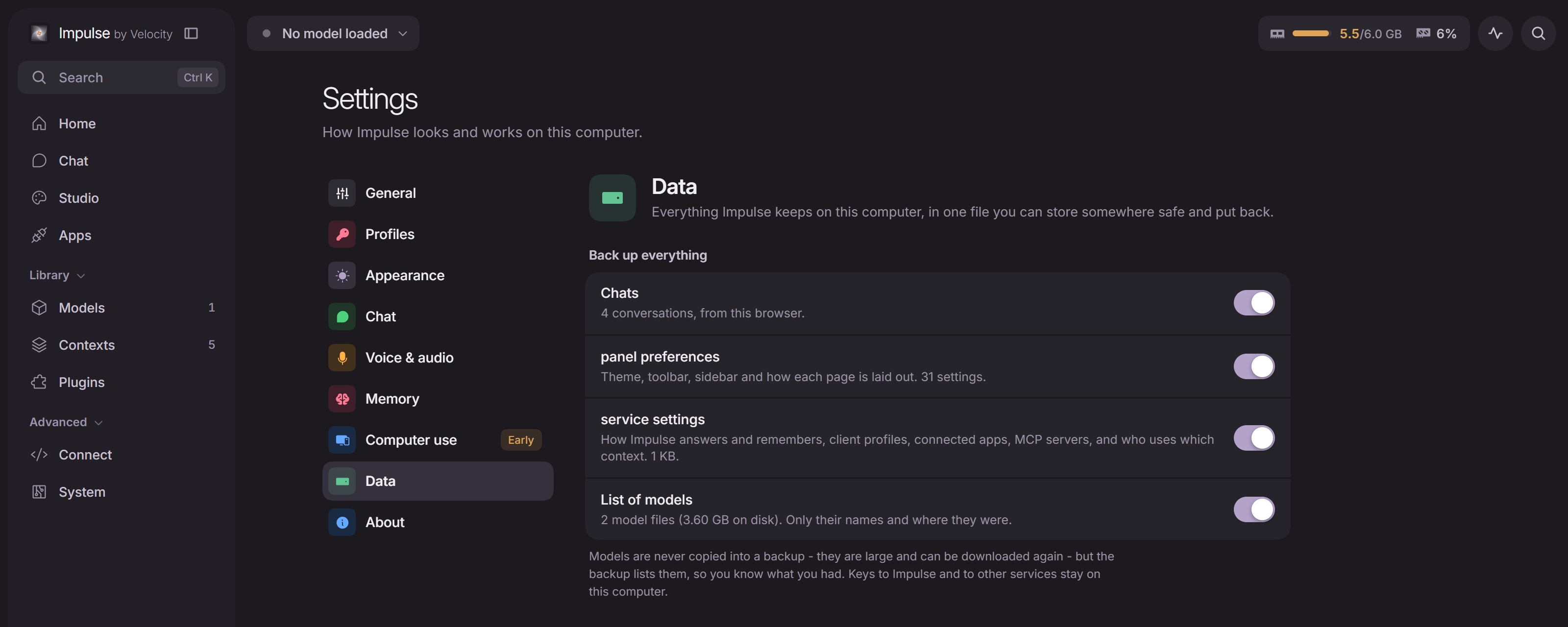 Data: back up and restore |
A window or a browser. Impulse opens in its own window. The same panel works in any browser on this computer at http://127.0.0.1:11500.
Install
One command. No account, no sign-in, no telemetry, no Docker.
Windows
Download the installer (small, always the newest; the full offline installer is there too), or in PowerShell:
irm https://github.com/Veloresearch/impulse/releases/latest/download/install.ps1 | iex
The preview is not code-signed yet. If SmartScreen stops it, choose More info → Run anyway.
Linux
AppImage · .deb · x64 build · Vulkan build, or:
curl -fsSL https://github.com/Veloresearch/impulse/releases/latest/download/install.sh | sh
Builds are packaged and tested less than Windows. Computer use is Windows only for now.
The installer checks the machine before it downloads anything and picks the build that suits it: CUDA where there is an NVIDIA card, Vulkan on Linux where there is any card at all, and the processor build otherwise. It opens the panel when it is done. Updates install from Settings. Removing Impulse means deleting one folder; your models and memories are stored separately.
| Graphics card | Optional. A 6 GB card runs a 4B model with every layer on the card; the processor build works everywhere. |
| Every build | On the releases page, with the notes for the latest. |

Starting Impulse: the mark, then the panel
The first start shows you around. Pick a language and a name, choose how much of the app you want to see, and Impulse tells you what this computer can run before you download anything.
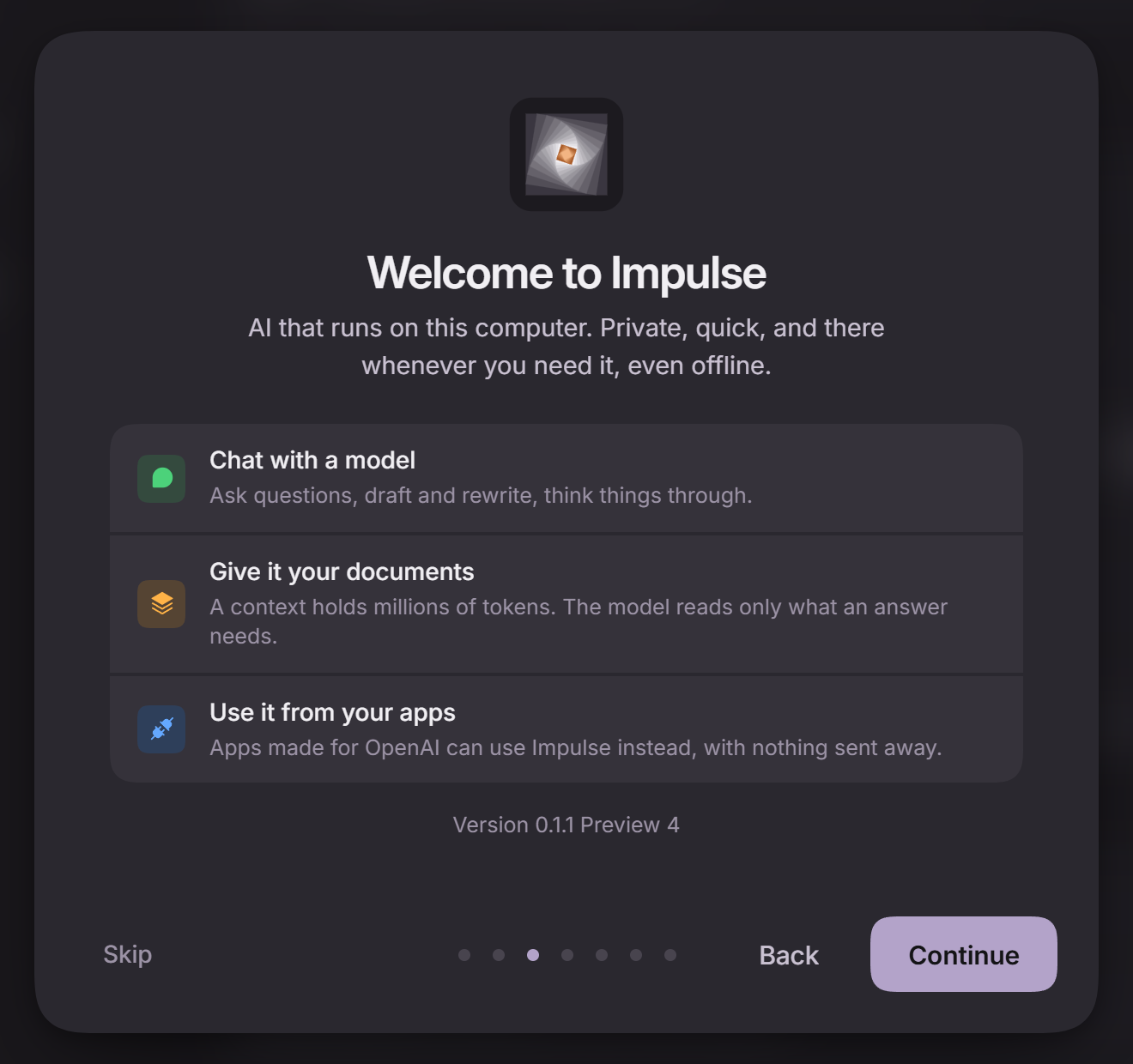 Welcome: what it does |
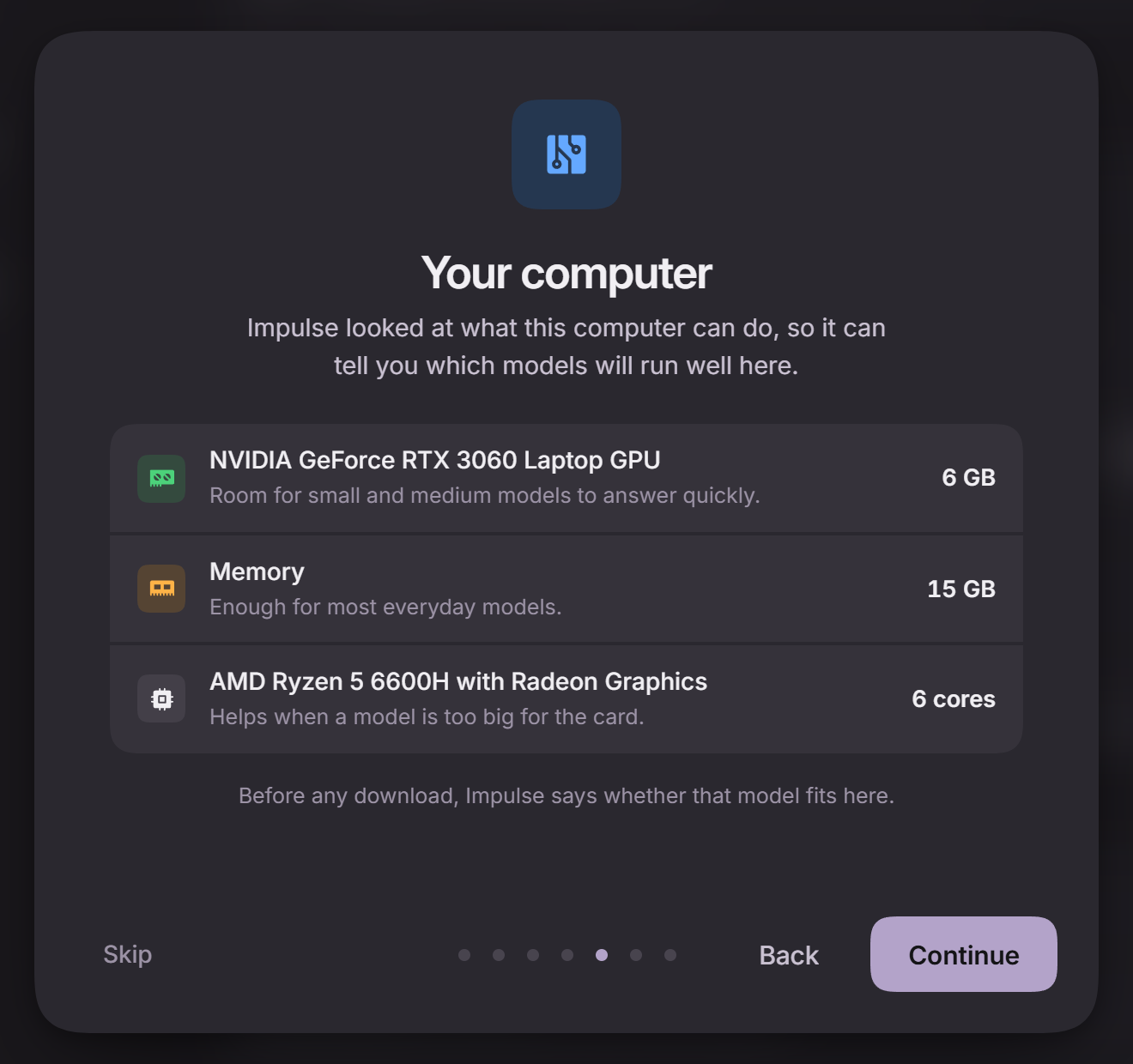 Your computer: read before any download |
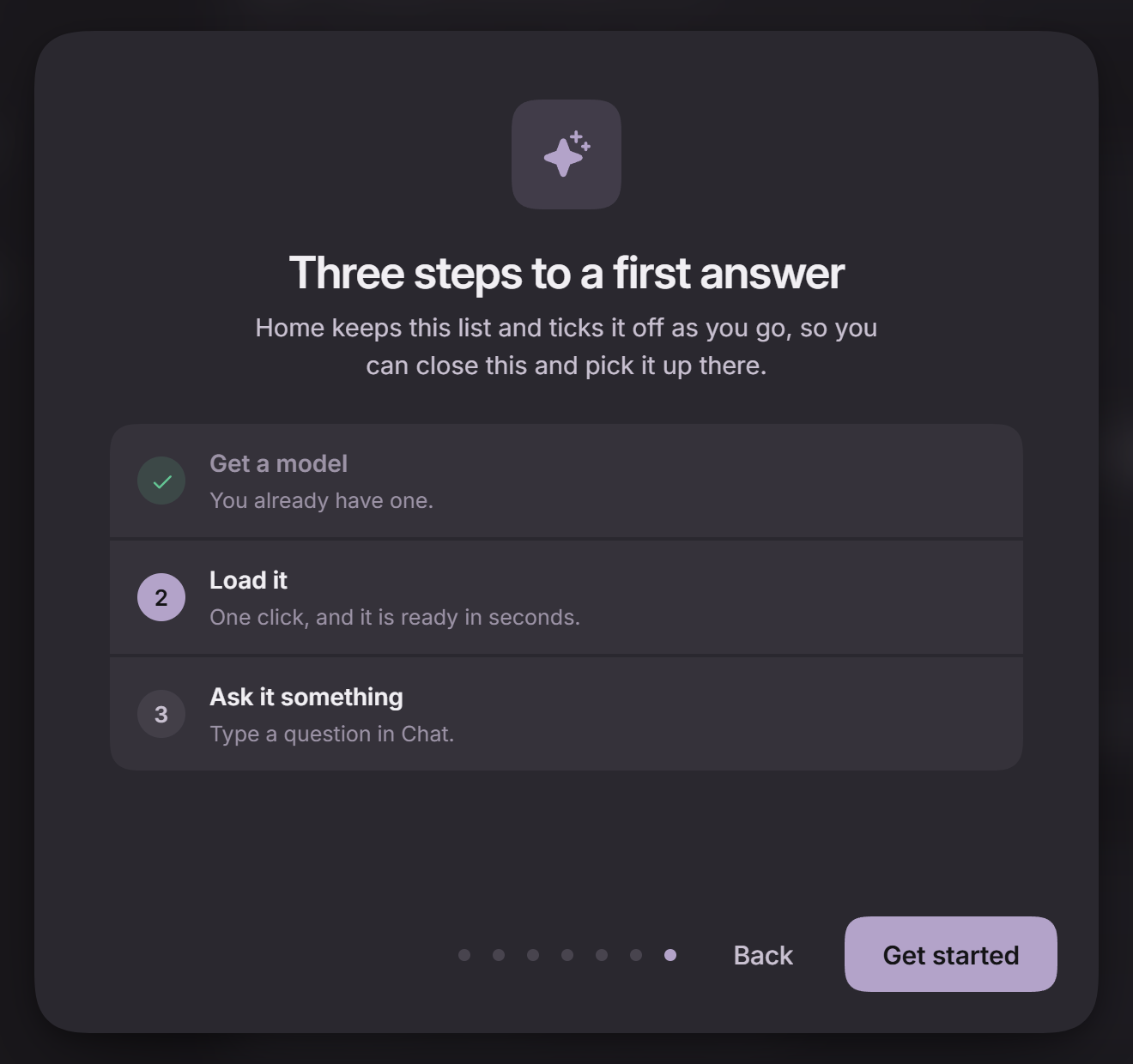 Three steps: to a first answer |
Use it from the agent you already have
Open Apps in the panel and press Connect beside the agent you use:
| what Connect does | ||
|---|---|---|
 |
opencode | adds Impulse as a regular provider in ~/.config/opencode/opencode.json and makes it the model opencode starts with |
 |
Hermes Agent | points ~/.hermes/config.yaml at Impulse as its custom endpoint, keeping your previous model to restore |
Not an MCP plug-in and not a bridge: Impulse is the model provider itself, the same way a cloud API would be.
The next time the agent starts, it is talking to the model on your machine. Disconnect removes exactly what Connect added; nothing else in those files is touched, and a backup is kept the first time.
For anything else that speaks the OpenAI API (Continue, Cline, LangChain, your own scripts):
Base URL   http://127.0.0.1:11500/v1
API key    anything (none is needed from this computer)
Model      velocity  (or any name: it reaches the loaded model)
What the agent remembers. Every application gets its own memory without any setup, and a coding agent gets one per project: it says which folder it is working in, and Impulse keeps that project's memory apart from the others. A new chat in the same project picks up where the last one left off; a different repository starts clean. Each app can be switched to one shared memory, or to no memory, on its card.
One address for everything
# chat
curl http://127.0.0.1:11500/v1/chat/completions -H "content-type: application/json" \
  -d '{"model":"velocity","messages":[{"role":"user","content":"hello"}]}'

# speech: any installed voice, or the default for OpenAI voice names
curl http://127.0.0.1:11500/v1/audio/speech -H "content-type: application/json" \
  -d '{"input":"Hello from this computer.","voice":"en_US-ryan-high"}' -o hello.wav

# transcription
curl http://127.0.0.1:11500/v1/audio/transcriptions -F [email protected]

# images
curl http://127.0.0.1:11500/v1/images/generations -H "content-type: application/json" \
  -d '{"prompt":"a watercolor lighthouse at dawn","size":"512x512"}'
from openai import OpenAI
client = OpenAI(base_url="http://127.0.0.1:11500/v1", api_key="local")
print(client.chat.completions.create(model="velocity",
      messages=[{"role": "user", "content": "hello"}]).choices[0].message.content)
From another machine on your network, the same address works with the key from the panel's API page.
Built on
Impulse is a router with Momentum behind it. The memory, the routing, the hardware fit, the mesh and the panel are built by Velocity. llama.cpp (MIT) runs the GGUF models, stable-diffusion.cpp the pictures, and Piper and faster-whisper the voice. Their licences ship inside every package.
Every picture and GIF on this page is a recording of the real app with real model output; the contexts are public open-source code.
FAQ
Does anything leave my machine?
No. The only outbound requests are the ones you ask for: searching Hugging Face, searching the web from Chat, downloading what you chose, and checking for a newer release. No telemetry, no account.
Do I need a GPU?
No. A graphics card makes it faster; the processor build works everywhere.
Which models work?
Any GGUF that llama.cpp runs, Piper voices, and diffusion models for Studio.
How can a 4B model with an 8K window answer across 32M tokens?
The model keeps its small, fast window. Momentum keeps your material as the model's own memory, and for each question the model's attention reaches the part it needs. It is not a bigger window. What we measured, and how, is in the evaluation report.
Which model should I use for computer use?
It was tested with Qwen3.5-4B on a 6 GB card, on Notepad and Calculator tasks. Whatever the model, it is held to the permission level you chose.
Can I turn web search off?
Yes, in Chat's Tools menu. With it off, only questions that are plainly about today are looked up, and the Search button always searches.
Does computer use work on Linux?
Not yet. Computer use is Windows only for now; the rest of Impulse runs on both.
Is it open source?
No. Impulse is free for personal use; companies need a licence. Write to [email protected]. See LICENSE.
Is it finished?
It is a preview. When you find a rough edge, open an issue; it is the fastest way to get it fixed.
If Impulse is useful to you, a star helps others find it


Impulse and Momentum are made by Velocity, an independent AI company.
veloresearch.com · Impulse · Momentum · Evaluation report · Releases · Issues · @velo_research · [email protected]
Explore related projects
affaan-m/ECC
The agent harness performance optimization system. Skills, instincts, memory, security, and research-first development for Claude Code, Codex, Opencode, Cursor and beyond.
300,179 starsNousResearch/hermes-agent
The agent that grows with you
262,046 starsmultica-ai/andrej-karpathy-skills
A single CLAUDE.md file to improve Claude Code behavior, derived from Andrej Karpathy's observations on LLM coding pitfalls.
231,314 starsfirecrawl/firecrawl
Supercharge your AI agents with data from the web and beyond. Building the library for superintelligence. 🔥
199,847 stars